

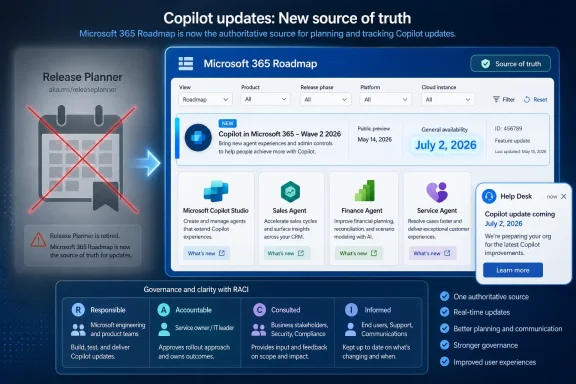
Starting July 2, 2026, Microsoft began publishing feature updates for Microsoft Copilot Studio, Sales Agent, Finance Agent, and Service Agent on the Microsoft 365 Roadmap, while Release Planner stopped being the source of feature information for those products. The immediate admin move is simple: stop treating saved Release Planner views as authoritative, update bookmarks, and make the Microsoft 365 Roadmap the new intake point for change tracking. The bigger operational question is not whether Microsoft has another AI roadmap page; it is whether your organization knows who owns that page, who translates it into rollout plans, and who tells the business before users discover agent changes in production.
Microsoft’s own guidance says no immediate action is required, which is true in the narrow break-glass sense. Nothing in the transition says tenants will suddenly change on July 2 because a bookmark went stale. But for IT teams that use release plans as the front door for readiness, governance, support scripts, training decks, and stakeholder updates, this is a process migration disguised as a documentation migration.
The concrete change is straightforward. Microsoft has moved feature update publication for Microsoft Copilot Studio, Sales Agent, Finance Agent, and Service Agent to the Microsoft 365 Roadmap as of July 2, 2026. Release Planner is no longer the source for feature information for those products after that transition.
The exact practical procedure is equally straightforward: open the Microsoft 365 Roadmap, search or filter for Microsoft Copilot Studio and the relevant agent products, save the new Roadmap view in whatever browser, Teams channel, internal wiki, or service-management system your team uses, and retire Release Planner bookmarks that were previously used for those products. If your team maintains a monthly change review, update the standing agenda so Copilot Studio and agent updates are pulled from the Microsoft 365 Roadmap rather than Release Planner. If you maintain internal documentation, replace “check Release Planner” language with “check Microsoft 365 Roadmap” wherever those four products are named.
That may sound like clerical work, but clerical work is exactly where enterprise rollout failures often begin. The wrong saved link turns into the wrong planning assumption, the wrong planning assumption turns into an unbriefed help desk, and the unbriefed help desk becomes the first team to learn that a feature has appeared, shifted, or disappeared from the expected release narrative.
Microsoft’s position, as stated in its transition notice and reflected by the Roadmap destination itself, is that the Microsoft 365 Roadmap is now the primary source. The company also says users should update saved Release Planner bookmarks. The important word there is primary: admins should not treat the old Release Planner habit as a harmless backup for Copilot Studio or the three named agents.
The real action is procedural. Every organization that has normalized Microsoft 365 change management probably has a private set of artifacts built around Microsoft’s public planning surfaces: bookmarks, release-review decks, SharePoint pages, Planner tasks, Azure DevOps work items, ServiceNow knowledge articles, CAB templates, internal newsletters, and Teams posts. Those artifacts are rarely owned by one person, and that is precisely why this change matters.
Copilot Studio and Microsoft’s business agents are not peripheral toys in many environments. They sit close to automation, business data, CRM-like workflows, finance processes, service operations, and the broader governance question of who may create, publish, use, and manage AI agents. A roadmap-source move for those products changes the upstream signal for teams that are trying to keep business owners, compliance staff, security reviewers, and support desks aligned.
Admins should therefore treat July 2 as a documentation cutover date. The feature stream did not stop; the place where Microsoft says to watch it changed. If your release-management muscle memory still points at Release Planner next month, your process is already stale.
When the source changes, the owner of that chain needs to be named again. In some organizations, Microsoft 365 Roadmap monitoring belongs to the messaging or productivity team. In others, Power Platform owners watched Copilot Studio because it sat closer to automation and maker governance. Sales Agent, Finance Agent, and Service Agent may pull in business-application owners who do not routinely attend Microsoft 365 release meetings.
That is the core operational wrinkle: Microsoft has centralized publication into the Microsoft 365 Roadmap, but your organization may not have centralized ownership of the products now represented there. The Roadmap may be a single public page; the responsibility map inside the business is not.
For WindowsForum readers who live in the real world of hybrid responsibilities, this is familiar territory. The person who knows how to interpret a Microsoft 365 Roadmap entry is often not the person who understands how a sales team uses an agent, how finance validates automation, or how service-desk knowledge gets rewritten. A source-of-truth move only helps if someone is assigned to translate it.
That does not require panic. It does require disciplined housekeeping. The owner of your release calendar should identify every current internal entry for Microsoft Copilot Studio, Sales Agent, Finance Agent, and Service Agent, then mark whether the entry has a corresponding Roadmap item, whether its status still appears current, and whether any local assumptions came from Release Planner language that should no longer be treated as live.
This matters because custom release plans often become more trusted than the vendor source over time. A project manager copies a date into a spreadsheet. A business analyst copies a description into a readiness deck. A governance lead copies the feature name into a policy-review queue. Three months later, nobody remembers where the wording came from, but everyone treats it as the plan.
The July 2 transition is a good excuse to purge that ambiguity. If your internal plan says “from Release Planner,” it should now either point to the Microsoft 365 Roadmap as the current source or be labeled as historical. That distinction sounds fussy until an executive asks why IT missed an agent-related change that Microsoft had already moved into the Roadmap feed everyone else assumed someone was watching.
A centralized roadmap is useful to Microsoft because it creates a cleaner publication model. It is useful to customers only if it reduces ambiguity rather than simply moving ambiguity somewhere else. For admins, the risk is that “Microsoft 365 Roadmap” becomes a dumping ground everyone recognizes but nobody operationally owns.
That is especially important for Copilot Studio. Unlike a cosmetic Outlook change or a Teams UI tweak, Copilot Studio work can overlap with low-code governance, data access, environment strategy, connector controls, maker permissions, and security review. Sales, Finance, and Service Agent updates may land in workflows where the business impact is not obvious to a generic Microsoft 365 admin scanning a long list of entries.
The practical answer is to make Roadmap review part of governance, not browsing. If your organization has an AI governance board, a Power Platform center of excellence, a Microsoft 365 change advisory process, or even a lightweight monthly admin huddle, these products now need an explicit line item. The Roadmap should trigger triage: Is this relevant? Who owns the business process? Does it need communication? Does it affect support? Does it raise policy questions?
A better internal reading is: no emergency action, but prompt administrative cleanup is warranted. The transition already happened on July 2, 2026. That means any saved process still pointing to Release Planner for these products is already behind Microsoft’s stated source model.
For smaller organizations, this may be a five-minute fix. One admin updates bookmarks and moves on. For larger tenants, it may require touching a surprising number of places: internal release calendars, SharePoint pages, help-desk runbooks, stakeholder newsletters, change-management templates, onboarding docs for Copilot administrators, and any Power Platform governance material that references Copilot Studio release tracking.
The timeline is thin because Microsoft’s verified facts are thin. We know the start date and the destination. We know Release Planner is no longer the source for these products. We know Microsoft says to update saved bookmarks and use the Microsoft 365 Roadmap as the primary source. Anything beyond that should be treated cautiously unless Microsoft publishes more detail.
The Microsoft 365 admin team may be responsible for monitoring the Roadmap. The Power Platform team may be accountable for Copilot Studio governance. Sales operations, finance operations, or service leadership may need to be consulted when agent updates touch business workflows. The help desk, trainers, and security reviewers may need to be informed when a change is likely to create tickets or policy questions.
Without that split, centralization can backfire. The Roadmap may show the update, but the wrong team may assume it is someone else’s problem. Copilot agents are cross-functional by design, and cross-functional products punish vague ownership.
This is where IT pros should be more skeptical than the marketing language. “AI-ready” and “centralized” sound clean. Real administration is messier. The destination page is less important than whether the signal reaches the right people in time to make a decision.
A lightweight support note is enough. It should say that feature information for Microsoft Copilot Studio, Sales Agent, Finance Agent, and Service Agent is now tracked through the Microsoft 365 Roadmap as of July 2, 2026, and that Release Planner should not be used as the current source for those products. It should identify the internal owner or channel for questions.
The same note should go to business stakeholders who rely on IT for change visibility. Sales leadership does not need a lecture about Microsoft’s publishing architecture. Finance does not need to know the history of Release Planner. They need to know that the official watch point has changed, and that IT will use that source when communicating upcoming agent-related changes.
That kind of communication prevents a subtle trust problem. If business teams hear about a feature from Microsoft, a consultant, or a user before they hear about it from internal IT, they may assume IT was not watching. In this case, the fix is simple: tell them where you are watching now.
That centralization also helps Microsoft tell a cleaner story. Copilot is not a bolt-on. It is becoming a horizontal layer across Microsoft 365, business workflows, and low-code automation. Putting Copilot Studio and named agents into the Microsoft 365 Roadmap reinforces that story.
But the same move raises the stakes for customers because the Microsoft 365 Roadmap is crowded. A product-specific Release Planner habit may have been narrower, but narrower can be useful. When admins move to a broader feed, they need filters, ownership rules, and a routine that prevents relevant agent updates from being lost among the rest of Microsoft 365’s release churn.
For Windows enthusiasts, this is another sign that “Microsoft 365 administration” and “Windows administration” are no longer cleanly separable. Copilot experiences increasingly touch Windows endpoints, Office clients, browser surfaces, identity, data protection, and business-process automation. The roadmap may be cloud-hosted, but the impact lands on desktops, help desks, and user workflows.
The dependency discovery step is finding everywhere Release Planner is named for Copilot Studio and the three agents. The cutover is replacing those references with the Microsoft 365 Roadmap. Validation is confirming that the people who consume release information know the source changed. Decommissioning is telling teams not to use Release Planner for current feature information for these products.
This is also where organizations should be honest about internal documentation quality. If nobody knows where the Release Planner links live, that is itself a finding. Copilot agent governance depends on being able to trace decisions back to sources; if roadmap references are scattered and unmanaged, the source change exposes a weakness that already existed.
The fix does not need to be bureaucratic. A simple internal page that lists the current official sources for Microsoft 365, Copilot Studio, Power Platform, security advisories, and service health can save hours of confusion. The point is not to create another document nobody reads. The point is to make source ownership visible.
The thinness of the facts actually clarifies the admin response. This is not a product deep dive. It is a source-of-truth change. The correct response is therefore not technical remediation but process correction.
That distinction should shape internal messaging. Do not tell stakeholders that Copilot Studio itself is being reworked because of this notice unless Microsoft separately says so. Do not imply Sales Agent, Finance Agent, or Service Agent features are changing on July 2 merely because their roadmap publication moved. Tell people exactly what changed: where feature information is published and which old source is no longer authoritative.
In enterprise IT, precision is a form of risk control. Overstating a documentation change creates noise; understating it creates drift. The useful middle is to treat the Roadmap transition as a governance signal that needs cleanup, not drama.
That means internal records created after July 2 should not cite Release Planner as the current source for Microsoft Copilot Studio, Sales Agent, Finance Agent, or Service Agent feature information. If they do, they should be corrected. If internal change plans straddle the date, they should be reviewed for stale source assumptions.
This is not about pedantry. When Microsoft changes where it publishes release information, organizations that operate under audit, compliance, or formal change control need to know which source was authoritative at the time a decision was made. A July 2 boundary gives them that.
It also gives IT leaders a simple message for teams: anything new goes through the Microsoft 365 Roadmap. Anything old that still points to Release Planner needs review. That is a better instruction than “keep an eye on Microsoft’s roadmap pages,” which is how responsibility dissolves.
Microsoft’s July 2 Roadmap shift will not be remembered as a dramatic Copilot milestone, and that is fine. Its significance is quieter: Copilot Studio and Microsoft’s named business agents are now being folded into the same change-tracking machinery that admins already use for the rest of Microsoft 365. The organizations that benefit will be the ones that stop asking only what Microsoft is shipping and start asking who, internally, is responsible for noticing when the answer changes.
Microsoft’s own guidance says no immediate action is required, which is true in the narrow break-glass sense. Nothing in the transition says tenants will suddenly change on July 2 because a bookmark went stale. But for IT teams that use release plans as the front door for readiness, governance, support scripts, training decks, and stakeholder updates, this is a process migration disguised as a documentation migration.
 Microsoft Moves the Copilot Agent Calendar to the Place Admins Already Watch
The concrete change is straightforward. Microsoft has moved feature update publication for Microsoft Copilot Studio, Sales Agent, Finance Agent, and Service Agent to the Microsoft 365 Roadmap as of July 2, 2026. Release Planner is no longer the source for feature information for those products after that transition.The exact practical procedure is equally straightforward: open the Microsoft 365 Roadmap, search or filter for Microsoft Copilot Studio and the relevant agent products, save the new Roadmap view in whatever browser, Teams channel, internal wiki, or service-management system your team uses, and retire Release Planner bookmarks that were previously used for those products. If your team maintains a monthly change review, update the standing agenda so Copilot Studio and agent updates are pulled from the Microsoft 365 Roadmap rather than Release Planner. If you maintain internal documentation, replace “check Release Planner” language with “check Microsoft 365 Roadmap” wherever those four products are named.
That may sound like clerical work, but clerical work is exactly where enterprise rollout failures often begin. The wrong saved link turns into the wrong planning assumption, the wrong planning assumption turns into an unbriefed help desk, and the unbriefed help desk becomes the first team to learn that a feature has appeared, shifted, or disappeared from the expected release narrative.
Microsoft’s position, as stated in its transition notice and reflected by the Roadmap destination itself, is that the Microsoft 365 Roadmap is now the primary source. The company also says users should update saved Release Planner bookmarks. The important word there is primary: admins should not treat the old Release Planner habit as a harmless backup for Copilot Studio or the three named agents.
The Bookmark Is the Smallest Part of the Migration
Microsoft says no immediate action is required, and that is the line most brief writeups will understandably lead with. But “no immediate action” does not mean “no administrative consequence.” It means the change is not asking you to run a script, flip a tenant setting, buy a license, or remediate a vulnerability today.The real action is procedural. Every organization that has normalized Microsoft 365 change management probably has a private set of artifacts built around Microsoft’s public planning surfaces: bookmarks, release-review decks, SharePoint pages, Planner tasks, Azure DevOps work items, ServiceNow knowledge articles, CAB templates, internal newsletters, and Teams posts. Those artifacts are rarely owned by one person, and that is precisely why this change matters.
Copilot Studio and Microsoft’s business agents are not peripheral toys in many environments. They sit close to automation, business data, CRM-like workflows, finance processes, service operations, and the broader governance question of who may create, publish, use, and manage AI agents. A roadmap-source move for those products changes the upstream signal for teams that are trying to keep business owners, compliance staff, security reviewers, and support desks aligned.
Admins should therefore treat July 2 as a documentation cutover date. The feature stream did not stop; the place where Microsoft says to watch it changed. If your release-management muscle memory still points at Release Planner next month, your process is already stale.
Release Planner’s Exit Changes the Chain of Custody
The underestimated issue is chain of custody. In traditional Microsoft 365 operations, a roadmap item is not merely something an admin reads. It is an input that becomes a readiness assessment, a tenant decision, a support note, a training blurb, a policy review, or a “not applicable to us” entry in a change log.When the source changes, the owner of that chain needs to be named again. In some organizations, Microsoft 365 Roadmap monitoring belongs to the messaging or productivity team. In others, Power Platform owners watched Copilot Studio because it sat closer to automation and maker governance. Sales Agent, Finance Agent, and Service Agent may pull in business-application owners who do not routinely attend Microsoft 365 release meetings.
That is the core operational wrinkle: Microsoft has centralized publication into the Microsoft 365 Roadmap, but your organization may not have centralized ownership of the products now represented there. The Roadmap may be a single public page; the responsibility map inside the business is not.
For WindowsForum readers who live in the real world of hybrid responsibilities, this is familiar territory. The person who knows how to interpret a Microsoft 365 Roadmap entry is often not the person who understands how a sales team uses an agent, how finance validates automation, or how service-desk knowledge gets rewritten. A source-of-truth move only helps if someone is assigned to translate it.
Custom Release Plans Need a Reconciliation Pass
The competitive gap in much of the coverage is custom release planning. “Update bookmarks” is true, but it is not enough for teams that previously built custom views or internal release plans around Copilot Studio and agent updates. If those plans were manually curated from Release Planner, they now need a reconciliation pass against the Microsoft 365 Roadmap.That does not require panic. It does require disciplined housekeeping. The owner of your release calendar should identify every current internal entry for Microsoft Copilot Studio, Sales Agent, Finance Agent, and Service Agent, then mark whether the entry has a corresponding Roadmap item, whether its status still appears current, and whether any local assumptions came from Release Planner language that should no longer be treated as live.
This matters because custom release plans often become more trusted than the vendor source over time. A project manager copies a date into a spreadsheet. A business analyst copies a description into a readiness deck. A governance lead copies the feature name into a policy-review queue. Three months later, nobody remembers where the wording came from, but everyone treats it as the plan.
The July 2 transition is a good excuse to purge that ambiguity. If your internal plan says “from Release Planner,” it should now either point to the Microsoft 365 Roadmap as the current source or be labeled as historical. That distinction sounds fussy until an executive asks why IT missed an agent-related change that Microsoft had already moved into the Roadmap feed everyone else assumed someone was watching.
The Roadmap Becomes a Governance Object, Not Just a Web Page
Microsoft’s AI story has increasingly pushed Copilot from a chat interface into a substrate for work: agents, workflows, business processes, and embedded experiences. WindowsForum has covered that arc in related discussions of Microsoft 365 roadmap planning, Copilot updates, and the broader shift from Copilot Studio prototypes toward enterprise agent platforms. This Roadmap move belongs in that same pattern.A centralized roadmap is useful to Microsoft because it creates a cleaner publication model. It is useful to customers only if it reduces ambiguity rather than simply moving ambiguity somewhere else. For admins, the risk is that “Microsoft 365 Roadmap” becomes a dumping ground everyone recognizes but nobody operationally owns.
That is especially important for Copilot Studio. Unlike a cosmetic Outlook change or a Teams UI tweak, Copilot Studio work can overlap with low-code governance, data access, environment strategy, connector controls, maker permissions, and security review. Sales, Finance, and Service Agent updates may land in workflows where the business impact is not obvious to a generic Microsoft 365 admin scanning a long list of entries.
The practical answer is to make Roadmap review part of governance, not browsing. If your organization has an AI governance board, a Power Platform center of excellence, a Microsoft 365 change advisory process, or even a lightweight monthly admin huddle, these products now need an explicit line item. The Roadmap should trigger triage: Is this relevant? Who owns the business process? Does it need communication? Does it affect support? Does it raise policy questions?
“No Immediate Action” Is Not the Same as “No Deadline”
Microsoft’s “no immediate action required” language is designed to reassure, and in the narrow sense it should. There is no verified indication here of a tenant break, product retirement, or forced configuration deadline tied to July 2. The danger is that admins hear reassurance and skip the quiet work that prevents later confusion.A better internal reading is: no emergency action, but prompt administrative cleanup is warranted. The transition already happened on July 2, 2026. That means any saved process still pointing to Release Planner for these products is already behind Microsoft’s stated source model.
For smaller organizations, this may be a five-minute fix. One admin updates bookmarks and moves on. For larger tenants, it may require touching a surprising number of places: internal release calendars, SharePoint pages, help-desk runbooks, stakeholder newsletters, change-management templates, onboarding docs for Copilot administrators, and any Power Platform governance material that references Copilot Studio release tracking.
The timeline is thin because Microsoft’s verified facts are thin. We know the start date and the destination. We know Release Planner is no longer the source for these products. We know Microsoft says to update saved bookmarks and use the Microsoft 365 Roadmap as the primary source. Anything beyond that should be treated cautiously unless Microsoft publishes more detail.
Admins Need a New RACI Before They Need a New Bookmark
The acronym is ugly, but the idea is useful: responsible, accountable, consulted, informed. For this Roadmap move, the most useful admin exercise is not technical discovery. It is deciding who does what when the Roadmap changes.The Microsoft 365 admin team may be responsible for monitoring the Roadmap. The Power Platform team may be accountable for Copilot Studio governance. Sales operations, finance operations, or service leadership may need to be consulted when agent updates touch business workflows. The help desk, trainers, and security reviewers may need to be informed when a change is likely to create tickets or policy questions.
Without that split, centralization can backfire. The Roadmap may show the update, but the wrong team may assume it is someone else’s problem. Copilot agents are cross-functional by design, and cross-functional products punish vague ownership.
This is where IT pros should be more skeptical than the marketing language. “AI-ready” and “centralized” sound clean. Real administration is messier. The destination page is less important than whether the signal reaches the right people in time to make a decision.
The Help Desk Should Hear About the Source Change Before Users Hear About the Features
One of the first downstream teams to update is support. Not because the support desk needs to study every Copilot Studio roadmap item, but because it needs to know where escalation teams are now getting their product-change information. When a user asks, “Is this Sales Agent behavior expected?” the answer should not depend on someone remembering that Microsoft moved the roadmap source weeks earlier.A lightweight support note is enough. It should say that feature information for Microsoft Copilot Studio, Sales Agent, Finance Agent, and Service Agent is now tracked through the Microsoft 365 Roadmap as of July 2, 2026, and that Release Planner should not be used as the current source for those products. It should identify the internal owner or channel for questions.
The same note should go to business stakeholders who rely on IT for change visibility. Sales leadership does not need a lecture about Microsoft’s publishing architecture. Finance does not need to know the history of Release Planner. They need to know that the official watch point has changed, and that IT will use that source when communicating upcoming agent-related changes.
That kind of communication prevents a subtle trust problem. If business teams hear about a feature from Microsoft, a consultant, or a user before they hear about it from internal IT, they may assume IT was not watching. In this case, the fix is simple: tell them where you are watching now.
Microsoft’s Centralization Push Makes Sense, but It Raises the Stakes
There is a coherent Microsoft argument behind the move. Copilot Studio and business agents increasingly belong in the same planning universe as Microsoft 365 Copilot, Office apps, Outlook, Teams-adjacent work, browser experiences, and admin controls. A single Roadmap surface can make it easier for customers to scan the broader Copilot and agent pipeline.That centralization also helps Microsoft tell a cleaner story. Copilot is not a bolt-on. It is becoming a horizontal layer across Microsoft 365, business workflows, and low-code automation. Putting Copilot Studio and named agents into the Microsoft 365 Roadmap reinforces that story.
But the same move raises the stakes for customers because the Microsoft 365 Roadmap is crowded. A product-specific Release Planner habit may have been narrower, but narrower can be useful. When admins move to a broader feed, they need filters, ownership rules, and a routine that prevents relevant agent updates from being lost among the rest of Microsoft 365’s release churn.
For Windows enthusiasts, this is another sign that “Microsoft 365 administration” and “Windows administration” are no longer cleanly separable. Copilot experiences increasingly touch Windows endpoints, Office clients, browser surfaces, identity, data protection, and business-process automation. The roadmap may be cloud-hosted, but the impact lands on desktops, help desks, and user workflows.
The Documentation Cleanup Should Be Treated Like a Mini-Migration
The phrase “mini-migration” may sound exaggerated for a roadmap-page change, but it is the right mental model. Migrations are not defined only by data movement. They are defined by dependency discovery, cutover, validation, and decommissioning the old path.The dependency discovery step is finding everywhere Release Planner is named for Copilot Studio and the three agents. The cutover is replacing those references with the Microsoft 365 Roadmap. Validation is confirming that the people who consume release information know the source changed. Decommissioning is telling teams not to use Release Planner for current feature information for these products.
This is also where organizations should be honest about internal documentation quality. If nobody knows where the Release Planner links live, that is itself a finding. Copilot agent governance depends on being able to trace decisions back to sources; if roadmap references are scattered and unmanaged, the source change exposes a weakness that already existed.
The fix does not need to be bureaucratic. A simple internal page that lists the current official sources for Microsoft 365, Copilot Studio, Power Platform, security advisories, and service health can save hours of confusion. The point is not to create another document nobody reads. The point is to make source ownership visible.
The Thin Facts Are a Feature, Not a Bug, for Admin Planning
Because Microsoft has provided only a small number of verified facts, it is tempting to overfill the gap with speculation. That would be a mistake. There is no verified basis here to invent new feature dates, hidden deprecations, version numbers, tenant impacts, or product behavior changes.The thinness of the facts actually clarifies the admin response. This is not a product deep dive. It is a source-of-truth change. The correct response is therefore not technical remediation but process correction.
That distinction should shape internal messaging. Do not tell stakeholders that Copilot Studio itself is being reworked because of this notice unless Microsoft separately says so. Do not imply Sales Agent, Finance Agent, or Service Agent features are changing on July 2 merely because their roadmap publication moved. Tell people exactly what changed: where feature information is published and which old source is no longer authoritative.
In enterprise IT, precision is a form of risk control. Overstating a documentation change creates noise; understating it creates drift. The useful middle is to treat the Roadmap transition as a governance signal that needs cleanup, not drama.
The July 2 Cutover Gives IT a Clean Line in the Sand
The date matters because it gives administrators a clean audit boundary. Before July 2, Release Planner may have been part of how teams tracked these products. Starting July 2, Microsoft says the Microsoft 365 Roadmap is where feature updates for these products are published.That means internal records created after July 2 should not cite Release Planner as the current source for Microsoft Copilot Studio, Sales Agent, Finance Agent, or Service Agent feature information. If they do, they should be corrected. If internal change plans straddle the date, they should be reviewed for stale source assumptions.
This is not about pedantry. When Microsoft changes where it publishes release information, organizations that operate under audit, compliance, or formal change control need to know which source was authoritative at the time a decision was made. A July 2 boundary gives them that.
It also gives IT leaders a simple message for teams: anything new goes through the Microsoft 365 Roadmap. Anything old that still points to Release Planner needs review. That is a better instruction than “keep an eye on Microsoft’s roadmap pages,” which is how responsibility dissolves.
The Admin Playbook Now Has Five Jobs
This transition is small enough to fix quickly and important enough to assign deliberately. The winning move is to turn Microsoft’s destination change into an internal ownership change before the first missed update proves the need.- Update all saved Release Planner bookmarks for Microsoft Copilot Studio, Sales Agent, Finance Agent, and Service Agent so they point teams toward the Microsoft 365 Roadmap instead.
- Review custom release plans and internal calendars for those four products, then mark old Release Planner-derived entries as historical or reconcile them against the Roadmap.
- Assign a named team or role to monitor Microsoft 365 Roadmap entries for Copilot Studio and the three agents on a recurring schedule.
- Tell help-desk, governance, security, and business stakeholders that Release Planner is no longer the current source for these products after July 2, 2026.
- Add the Roadmap source change to internal Microsoft 365 or AI governance documentation so future admins do not rediscover the transition by accident.
Microsoft’s July 2 Roadmap shift will not be remembered as a dramatic Copilot milestone, and that is fine. Its significance is quieter: Copilot Studio and Microsoft’s named business agents are now being folded into the same change-tracking machinery that admins already use for the rest of Microsoft 365. The organizations that benefit will be the ones that stop asking only what Microsoft is shipping and start asking who, internally, is responsible for noticing when the answer changes.
References
- Primary source: learn.microsoft.com
Microsoft 365 Roadmap | Microsoft 365
The Microsoft 365 Roadmap lists updates that are currently planned for applicable subscribers. Check here for more information on the status of new features and updates.learn.microsoft.com
- Independent coverage: techcommunity.microsoft.com
Loading…
techcommunity.microsoft.com - Independent coverage: microsoft.com
Microsoft 365 Roadmap | Microsoft 365
The Microsoft 365 Roadmap lists updates that are currently planned for applicable subscribers. Check here for more information on the status of new features and updates.www.microsoft.com
- Independent coverage: mwpro.co.uk
Loading…
mwpro.co.uk - Independent coverage: techradar.com
Microsoft makes Copilot Cowork open to everyone, and wants to help you tackle even the trickiest work tasks | TechRadar
Copilot Cowork gets an upgrade as it opens to all userswww.techradar.com - Independent coverage: releaseplans.net
Loading…
releaseplans.net
- Independent coverage: windowscentral.com
Microsoft Copilot Wave 3 adds AI agents and E7 Frontier Suite | Windows Central
Microsoft Copilot is rolling out more agentic AI control and model support in a new subscription tier for Microsoft 365.www.windowscentral.com - Primary source: WindowsForum
Microsoft 365 Roadmap 2025–26: Copilot Agents, Edge AI, Excel GA & Governance
Microsoft’s public roadmap entries and recent admin notices show a coordinated next wave of Microsoft 365 updates that touch the browser, mobile Outlook, Excel’s new agent-driven capabilities, and the underlying Copilot platform — with rollout windows concentrated in December 2025 through early... windowsforum.com