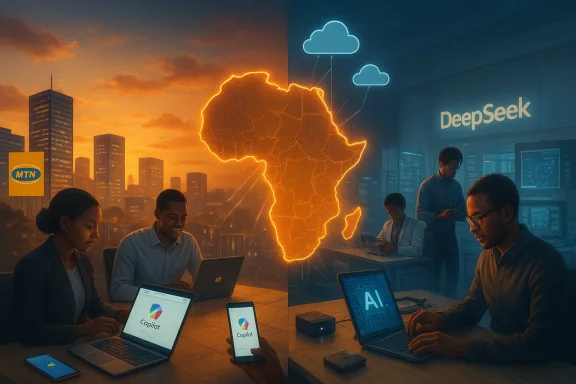
Microsoft’s announcement that it will train millions of Africans and pair its productivity suite with telco distribution marks a decisive escalation in the race to shape the continent’s AI future — one that blends skills development, cloud infrastructure, and commercial bundling to counter inexpensive, fast‑growing Chinese alternatives such as DeepSeek.
Africa sits at the intersection of two powerful trends: the continent’s population is the youngest and fastest‑growing in the world, and demand for digital services is rising even as infrastructure, skills and regulatory frameworks lag. For tech giants, that combination creates a strategic market opportunity: shape how AI is used, who trains and benefits from it, and where the data and digital value chains end up.
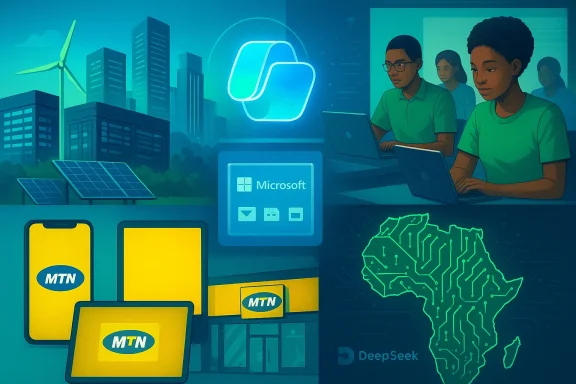
Microsoft’s 2026 push — which combines a large skilling commitment, fresh cloud investments in South Africa, a renewable‑powered data‑centre initiative in Kenya, and a commercial distribution tie‑up with MTN to bundle Microsoft 365 with Copilot — is explicit about those stakes. The company is positioning AI skilling and trusted cloud services as a pathway to commercial adoption and, crucially, to influence. At the same time, low‑cost, open models from Chinese firms like DeepSeek have already gained measurable traction across several African markets, forcing Microsoft to respond on multiple fronts.
Key dynamics:
At the same time, African countries are not passive actors. Several governments have signalled that AI must be a national priority and are drafting policies, funding research and seeking partnerships. The countries that combine clear regulation, investment incentives and skill pipelines will have leverage over how multinational vendors operate on their territory.
The most likely outcome is a layered ecosystem:
Governments must insist on value beyond promises: local jobs, data sovereignty, transparent model governance and measurable benefits. Corporates and small businesses must adopt strategically, piloting solutions that balance cost with compliance. And tech vendors — whether Western hyperscalers or Chinese model providers — should recognise that winning in Africa requires more than distribution; it requires partnerships that build local capability, protect citizens’ data, and deliver tangible economic outcomes.
The competition between Microsoft and DeepSeek is not merely about which company secures the largest enterprise deal; it is about who helps Africa shape its own digital future. The best outcome for the continent will be a competitive market that leaves room for local innovators, enforces strong governance, and ensures that the productivity gains of AI translate into jobs, services and sustainable growth for African economies.
Source: News24 Microsoft pushes for Africa AI adoption in challenge to DeepSeek | News24
 Background / Overview
Africa sits at the intersection of two powerful trends: the continent’s population is the youngest and fastest‑growing in the world, and demand for digital services is rising even as infrastructure, skills and regulatory frameworks lag. For tech giants, that combination creates a strategic market opportunity: shape how AI is used, who trains and benefits from it, and where the data and digital value chains end up.Microsoft’s 2026 push — which combines a large skilling commitment, fresh cloud investments in South Africa, a renewable‑powered data‑centre initiative in Kenya, and a commercial distribution tie‑up with MTN to bundle Microsoft 365 with Copilot — is explicit about those stakes. The company is positioning AI skilling and trusted cloud services as a pathway to commercial adoption and, crucially, to influence. At the same time, low‑cost, open models from Chinese firms like DeepSeek have already gained measurable traction across several African markets, forcing Microsoft to respond on multiple fronts.
What Microsoft is doing — the components of its strategy
Microsoft’s Africa AI strategy is multi‑pronged: training, infrastructure, channel partnerships and enterprise adoption. Each element reinforces the others.Skilling at scale: the Elevate push
Microsoft has publicised a target to train millions of Africans on AI tools and cloud skills in 2026. The program aims to reduce cost barriers and reach learners through schools, universities and institutions, prioritising markets such as South Africa, Kenya, Nigeria and Morocco. This is being framed not only as corporate social responsibility but as a pipeline‑building exercise — more trained developers, IT professionals and business users increases the likelihood that organisations will adopt Microsoft Azure, Microsoft 365 and Copilot.- Focus areas: AI literacy, cloud certification, developer toolchains and enterprise productivity workflows.
- Delivery channels: partnerships with universities, vocational programs, and private partners including large banks and employers that can scale on‑the‑job use.
- Promise: reduce cost barriers to building practical AI skills at continental scale.
Infrastructure: cloud and green data centres
Microsoft has committed a multi‑hundred‑million‑dollar investment to expand cloud and AI capacity in South Africa and has publicly supported a geothermal‑powered data‑centre campus in Kenya. Those investments serve three purposes:- Increase local cloud capacity and reduce latency for African enterprises using Azure and Microsoft services.
- Offer an on‑continent option that addresses data‑residency and sovereignty concerns.
- Position Microsoft as a partner to governments and large enterprises seeking sustainable, resilient infrastructure.
Commercial distribution: the MTN channel
The partnership with MTN — Africa’s largest telecom operator by subscribers — is a pragmatic go‑to‑market play. MTN’s customer base gives Microsoft direct retail reach to hundreds of millions of mobile subscribers; bundling Microsoft 365 with Copilot into MTN packages lowers friction for small businesses and consumers to try AI‑enabled productivity.- Why it matters: Telcos own billing, customer relationships and last‑mile distribution. Bundling AI into telco bundles accelerates adoption where direct enterprise sales are slow or expensive.
- Target users: SMBs, remote knowledge workers, students and public sector staff using cheap smartphones and prepaid plans.
Enterprise play: Copilot, Azure and startups
Microsoft is also leaning on enterprise customers to prove value. Copilot—the AI assistant integrated with Microsoft 365—is being pitched as a productivity multiplier for organisations. Microsoft’s Startup Founders Hub and GitHub leverage create a developer funnel, while Azure credits and integration support aim to keep startups inside the Microsoft ecosystem.- Corporate case studies: Retailers and financial groups across the continent are being showcased as early adopters to persuade risk‑averse buyers.
- Developer incentives: Programs and credits that make Azure and GitHub attractive for building AI solutions.
The DeepSeek challenge: why Microsoft sees China’s offerings as a threat
DeepSeek — a low‑cost, open model and chatbot ecosystem originating from China — has grown rapidly in regions where access and affordability matter most. Its appeal is simple: free access for end users, permissive licensing for developers, and low infrastructure cost. That model has enabled DeepSeek to capture nontrivial market share in a variety of developing markets.Key dynamics:
- Affordability: DeepSeek’s free chatbot and lower developer costs make it a natural fit where budgets are tight and cloud spend is a barrier.
- Distribution: Bundling with affordable phones and being embedded as default on some devices helps reach mass users in markets where Western platforms have historically struggled.
- Speed of adoption: Open, cheap tools can scale quickly in regions with high mobile penetration but low enterprise budgets.
Why the contest matters for Africa
The competition between Microsoft and DeepSeek (and other cloud vendors) isn’t just commercial — it shapes choices about:- Data governance and sovereignty: Which vendors host and control African data will influence regulation, privacy, and national policy decisions.
- Local capacity and skills: Which toolchains Africans learn determines who gets startups, jobs, and long‑term technical leadership.
- Economic returns: The vendor that captures developer mindshare and enterprise billings shapes where AI value is captured — local economies benefit more if local firms can build on open, affordable platforms.
- Strategic influence: Technology choices carry geopolitical overtones. Vendors become vectors of soft power and standards.
Strengths of Microsoft’s approach
Microsoft has several structural advantages that it is leveraging in Africa.- Deep enterprise relationships: Microsoft already has long‑standing partnerships with governments, large corporates and academic institutions across the continent, creating trust and procurement channels.
- Comprehensive stack: Azure, GitHub, Microsoft 365 and Copilot provide an integrated ecosystem from cloud to developer tooling to productivity, which simplifies enterprise deployments and governance.
- Capital and scale: Microsoft has the cash flow to make multi‑year infrastructure investments and to fund large skilling programs.
- Energy and sustainability framing: Investments in renewable and geothermal data centres help mitigate concerns about the carbon and power footprint of scaling data infrastructure.
- Channel leverage through MTN: Telco partnerships provide rapid consumer reach that purely enterprise sales efforts often cannot match.
Risks, weaknesses and open questions
Microsoft’s plan is not without meaningful risks. The company must navigate structural constraints in Africa and a host of political, technical and commercial challenges.1. Cost and accessibility vs. cheaper competitors
DeepSeek and other low‑cost models are compelling where budgets are tight. Microsoft’s Azure and Copilot offerings are often more expensive, both in compute costs and licensing. If Microsoft cannot make its stack materially cheaper or subsidised at scale, adoption among cash‑constrained businesses and developers will be limited.2. Infrastructure and energy constraints
Even with investments, large parts of the continent still face unreliable electricity, limited fiber connectivity, and constrained data centre capacity. Building and operating cloud infrastructure requires reliable power and network ecosystems that are not evenly distributed.3. Trust, governance and vendor lock‑in
Microsoft’s enterprise features are attractive for governments worried about security, but reliance on a single cloud vendor can create vendor lock‑in risks and raise sovereignty concerns. Conversely, cheaper options from external vendors may raise national security and supply‑chain questions. Governments must balance both.4. Skills and absorptive capacity
Training millions is necessary but not sufficient. The quality of training, pathways to employment, and the presence of ecosystems (mentorship, accelerators, access to capital) determine whether skilling leads to meaningful economic value. There is a risk of high‑volume skilling programs that do not translate into real, long‑term job creation.5. Data protection and privacy
Deploying Copilot and enterprise AI raises legitimate questions about where data is stored, how it’s used to train models, and what protections are in place against leakage or misuse. African regulators and organisations will expect clarity about data residency and model training use cases.6. Geopolitical backlash and tradeoffs
Microsoft’s counter to Chinese vendors is partly geopolitical. That raises two issues: (a) governments may not want to be forced to take sides, and (b) friction could increase if local policy makers perceive US and Chinese pushes as proxies for broader power competition.What African governments and organisations should ask for
If governments and corporate buyers want to extract maximum value from this competition, they should take a proactive posture. Here are recommended priorities.Build for sovereignty and local value
- Tie investment to local supply chains: Insist that infrastructure investments include local hiring, capacity building and opportunities for local infrastructure providers.
- Mandate data residency and access controls: Where national regulation requires it, ensure contracts include data‑localisation, audit rights and clear rules about model retraining on local data.
- Insist on open standards and portability: Avoid lock‑in by requiring interoperable APIs and migration pathways.
Focus skilling on applied outcomes
- Connect training to real projects: Pair classroom learning with apprenticeships, public sector pilots and startup support to create actual product development opportunities.
- Measure outcomes: Track not just certifications issued, but startup formation, employment placements, and revenue growth tied to trained cohorts.
Secure public‑interest guardrails
- Force transparency on model use: Contracts should require vendors to be explicit about how enterprise data may be used to improve or train models.
- Demand robust privacy and security safeguards: Including encryption, access logs and incident response commitments.
What Microsoft (and other vendors) must deliver to win sustainably
For Microsoft’s approach to win on more than marketing, it should address the following:- Price parity or subsidised entry tiers: Offer meaningful, sustained cost reductions or bundled subsidised offers for startups and SMBs, particularly in markets where DeepSeek’s low cost is a decisive advantage.
- Local partnerships and revenue sharing: Make room for local cloud and systems integrator partners to avoid perceptions of colonising markets.
- Transparent data governance: Be explicit about how enterprise and consumer data will be stored and used; offer contractual guarantees and technical controls that satisfy local regulators.
- Outcome‑focused training: Ensure Elevate programs include job placements and measurable KPIs that translate to local economic benefit.
- Edge and offline solutions: Invest in offline, on‑device and hybrid models that work in low‑connectivity contexts, not only expensive hyperscale cloud solutions.
- Support for local languages and contexts: Prioritise model localisation for African languages and datasets that make AI genuinely usable for local populations.
The startup and developer angle: where local innovation can win
Africa’s future in AI will be decided as much by local entrepreneurs as by global cloud vendors. Here’s how the ecosystem can tip in favour of domestic innovation:- Local accelerators and grants that fund pilots using both low‑cost open models and cloud services.
- Public datasets and open benchmarks that encourage local model development and evaluation in African languages and contexts.
- Neutral compute platforms (for example, publicly funded research clusters) that allow experimentation without immediate commercial vendor lock‑in.
- Regulatory sandboxes to test AI in sectors like finance, health and agriculture while maintaining oversight.
The geopolitics of AI: soft power, data and influence
The Microsoft vs. DeepSeek story is part of a larger geopolitical narrative about who builds the digital future. When a vendor dominates developer tooling and data flows, it shapes norms around privacy, content moderation and acceptable use. Governments will need to make careful, strategic decisions about aligning with platforms that match their policy and economic goals.At the same time, African countries are not passive actors. Several governments have signalled that AI must be a national priority and are drafting policies, funding research and seeking partnerships. The countries that combine clear regulation, investment incentives and skill pipelines will have leverage over how multinational vendors operate on their territory.
Practical steps for enterprises and IT leaders today
If you are an IT leader or decision maker in an African company, here is a short playbook to navigate the coming months:- Map your data footprint: Know where your data currently resides and what regulations apply.
- Pilot multiple providers: Run short pilots with both low‑cost open models and enterprise cloud services to evaluate tradeoffs in cost, latency and compliance.
- Negotiate data and IP terms: Include explicit clauses on model training, data usage and export controls in any vendor contract.
- Prioritise training with measurable KPIs: When investing in staff skilling, tie training to clear business outcomes and deployment projects.
- Invest in resilience: Plan for hybrid architectures that tolerate intermittent connectivity and local power constraints.
The long view: a pragmatic forecast
Microsoft’s campaign to train millions, build data centres and partner with telcos will accelerate AI adoption in Africa — particularly among enterprises and institutions that value security, compliance and integrated productivity stacks. Yet the market will not flip entirely to one vendor. DeepSeek and other inexpensive, open models will remain attractive for developers, entrepreneurs and consumers who prioritise cost and accessibility.The most likely outcome is a layered ecosystem:
- Large enterprises, government and regulated sectors will lean toward proven vendors offering compliance guarantees and local infrastructure.
- Startups and small businesses will blend open models with targeted cloud services, choosing tools based on cost and time‑to‑market.
- Telco partnerships and device‑level integrations will expand reach to mass users, especially for productivity and education use cases.
Conclusion
Microsoft’s Africa AI push is a high‑stakes gambit: it links skills, sustainable infrastructure and channel reach to counter low‑cost alternatives and capture the continent’s long‑term AI market. For African stakeholders, that creates a window of opportunity — and a set of responsibilities.Governments must insist on value beyond promises: local jobs, data sovereignty, transparent model governance and measurable benefits. Corporates and small businesses must adopt strategically, piloting solutions that balance cost with compliance. And tech vendors — whether Western hyperscalers or Chinese model providers — should recognise that winning in Africa requires more than distribution; it requires partnerships that build local capability, protect citizens’ data, and deliver tangible economic outcomes.
The competition between Microsoft and DeepSeek is not merely about which company secures the largest enterprise deal; it is about who helps Africa shape its own digital future. The best outcome for the continent will be a competitive market that leaves room for local innovators, enforces strong governance, and ensures that the productivity gains of AI translate into jobs, services and sustainable growth for African economies.
Source: News24 Microsoft pushes for Africa AI adoption in challenge to DeepSeek | News24