

Microsoft Commercial CEO Judson Althoff told CRN that Microsoft partners should build managed services around AI agents after Microsoft’s own Agent 365 testing reportedly found 500,000 internal agents producing 65,000 responses per day across a 28-day period. The message is not subtle: Microsoft believes the agent boom will be too sprawling for most customers to govern alone. That makes the channel less of a resale mechanism and more of the operating layer for enterprise AI. If Copilot was the pitch, managed agent governance is becoming the annuity.
For the last two years, enterprise AI has been sold as a productivity story. Give workers a chatbot, connect it to documents, let it summarize meetings, and wait for the savings to appear. Althoff’s remarks point to a more mature and less glamorous phase: the hard work of making sure all those bots, agents, prompts, connectors, and automations do not become an unmanageable shadow IT estate.
That is why Microsoft’s own internal number matters. A company with Microsoft’s engineering depth still found itself staring at half a million agents inside its environment. The implication for everyone else is obvious: if Microsoft can be surprised by agent sprawl, a regional manufacturer, hospital network, law firm, or school district is not going to manage this with a quarterly admin review and a hopeful governance policy.
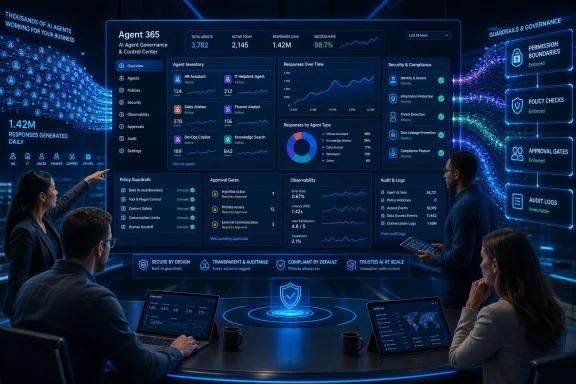
Agent 365 is Microsoft’s answer to that problem. It is being positioned as an observability and control plane for agents, including Microsoft-built and third-party agents. In plain English, Microsoft wants a dashboard and governance layer for the next wave of workplace automation before customers conclude that AI agents are too risky to deploy broadly.
The strategic pivot is familiar. Microsoft has often turned complexity into a partner opportunity. Windows licensing, Exchange migrations, Active Directory modernization, cloud consumption, endpoint security, compliance, and now AI agents have all followed the same pattern: Microsoft creates or captures the platform, then relies on partners to operationalize it in the messy world of real customers.
That distinction matters because it changes the economics of the Microsoft channel. The traditional partner motion often began with licensing advice, moved into implementation, and then settled into support. In the agentic AI model, the support layer may become the product. Customers will need someone to decide which agents deserve access to sensitive data, which ones are producing value, which ones are duplicative, and which ones are quietly expanding the attack surface.
This is also where Microsoft’s interests and partner interests align neatly. Microsoft wants AI workloads running through Copilot, Azure AI Foundry, Microsoft 365, Entra, Purview, Defender, and the rest of its trust stack. Partners want recurring revenue that is harder to commoditize than license resale. Agent management gives both sides a reason to keep customers inside the Microsoft orbit.
But there is a catch. Managed AI is not just managed endpoint protection with a more fashionable label. A partner that understands patching, backups, and Microsoft 365 administration is not automatically qualified to redesign finance workflows, legal review processes, sales operations, or HR onboarding around AI agents. Althoff’s call for partners to develop “adjacent skills” is doing a lot of work.
That makes observability more than a compliance checkbox. Organizations need to know which agents exist, what they can access, who created them, what they are doing, and whether their outputs are reliable enough for the business process they inhabit. Without that, AI automation becomes a fog of good intentions.
Microsoft is trying to frame Agent 365 as the tool that turns this fog into something administrators can see. The appeal is strongest for enterprises that already live in Microsoft 365 and are trying to bring order to Copilot Studio, Azure AI Foundry, Power Platform, and third-party agent ecosystems. If Microsoft can make Agent 365 the default place where AI work is inventoried and controlled, it gains a powerful new administrative beachhead.
For WindowsForum readers, the parallel with endpoint management is hard to miss. The endpoint used to be the center of user computing. Then identity became the control plane. Now Microsoft is arguing that agents themselves need their own control layer, one that sits across productivity apps, data stores, security tools, and business systems.
That is a pragmatic move. Enterprises are not going to standardize all AI development on one model provider, one cloud, or one agent framework. Different teams will choose different tools because of cost, latency, data residency, existing contracts, developer preference, or industry-specific requirements.
Microsoft’s play is to make that diversity less threatening by absorbing it into a Microsoft-managed experience. The company can say it supports openness while still making Copilot, Agent 365, and Azure AI Foundry the places where enterprise AI becomes visible, governable, and billable. That is classic platform strategy: let customers bring their variety, then make the management layer indispensable.
For partners, that expands the consulting surface. They can help customers choose models, connect agents, design workflows, apply policies, and measure results. But it also raises expectations. A partner selling AI managed services will need enough fluency to talk about Microsoft’s stack while understanding the reality of multi-cloud AI development.
That matters because Microsoft has a long history of using premium licensing to turn emerging needs into standardized enterprise commitments. E3 and E5 became shorthand for different levels of security, compliance, voice, analytics, and productivity capability. E7 is being positioned for the AI-first organization that needs Copilot, agent control, identity, protection, and governance as a single procurement motion.
The pricing and packaging debate will be fierce, as it always is with Microsoft licensing. Customers will ask whether the bundle is cheaper than buying capabilities separately, whether they need every component, and whether AI usage justifies another premium tier. Partners will be asked to answer those questions with ROI models that are credible rather than vendor-shaped.
This is where Althoff’s managed services thesis becomes commercially useful. If partners can show that agent governance reduces risk, improves productivity, and prevents waste, E7 becomes easier to justify. If they cannot, E7 risks looking like another expensive Microsoft bundle chasing a still-uncertain AI payoff.
EY’s “client zero” framing is important. The firm is using its own Copilot deployment, internal AI assistant adoption, document processing, payment matching, and agent experimentation as proof points for customer engagements. In consulting terms, it is selling from lived transformation rather than slideware.
That is valuable because enterprise AI buyers are increasingly allergic to abstract promises. They have seen demos. They have funded pilots. What they need now is evidence that AI can be embedded into workflows without breaking controls, annoying employees, or creating a new governance nightmare. A firm that can say “we did this to ourselves first” has a stronger hand.
But EY also shows the scale advantage in this market. Global systems integrators can combine industry knowledge, change management, security architecture, data engineering, and executive advisory. Smaller MSPs cannot copy that model directly. They need a narrower, more repeatable version of the same idea.
For years, MSPs have been told to move from break-fix work to recurring services, from reactive support to strategic advisory, and from infrastructure maintenance to business outcomes. AI accelerates that pressure. If agents automate routine IT tasks, ticket triage, reporting, documentation, and user support, MSPs cannot simply bill for the old workload under a new name.
The opportunity is to become the customer’s AI operations partner. That means helping small and midsize businesses identify practical use cases, clean up permissions, train employees, build agents, measure time savings, and avoid reckless automation. For many SMBs, the MSP may be the only realistic source of that guidance.
There is risk here, too. Some partners will overpromise. Some will sell Copilot licenses without doing the permissions and data hygiene work that makes Copilot safe. Some will call themselves AI advisors after building a few internal automations. Customers will need to separate partners with real operational capability from those simply rebranding their Microsoft practice.
That is why dashboards and reporting matter. If partners are going to sell managed AI services, they need to show what changed. How many hours were saved? Which workflows improved? Which agents are used? Which licenses are idle? Which automations reduced errors? Which risks were mitigated?
The danger for Microsoft and its partners is that AI value becomes too diffuse to prove. A worker may feel more productive with Copilot, but finance leaders will eventually ask whether the monthly cost, implementation work, governance tooling, and training burden are justified. Anecdotes will help open doors; measurements will renew contracts.
This is another reason Microsoft wants Agent 365 in the center. Observability is not only for security. It is also for monetization. The more Microsoft and its partners can quantify agent usage and behavior, the easier it becomes to defend licensing, managed services, and expansion.
The risks are not hypothetical. Agents inherit the data access, identity posture, connectors, and workflow permissions around them. If those foundations are weak, AI makes the weakness more visible and potentially more consequential. Oversharing in SharePoint, stale permissions, poorly classified data, and unmanaged third-party integrations all become bigger problems when an agent can retrieve, synthesize, and act on that information.
This is where Microsoft’s broader security stack becomes inseparable from the AI story. Entra, Purview, Defender, Intune, and Microsoft 365 governance tools are no longer adjacent products. They are the plumbing Microsoft needs customers to trust before letting agents deeper into business processes.
For administrators, that means AI readiness is not just prompt training. It is identity hygiene, least privilege, data classification, endpoint posture, retention policy, audit logging, and incident response. The partner that can explain this without killing enthusiasm will be the one customers keep calling.
That reach is especially important because AI transformation is not a single product installation. It is a long negotiation with business process, employee behavior, compliance requirements, data quality, and executive impatience. Microsoft can build the stack, but partners have to land it in the field.
Still, partners should hear the promise and the pressure. Microsoft is offering a large opportunity, but it is also setting the terms. The more customers standardize on Copilot, Agent 365, Azure AI Foundry, and E7, the more partner services will orbit Microsoft’s commercial model. That is lucrative, but it can also narrow differentiation.
The best partners will not merely repeat Microsoft’s messaging. They will translate it, challenge it, and sometimes tell customers not to automate a process yet. Trust will come from judgment, not enthusiasm.
 Microsoft’s AI Sales Pitch Has Shifted From Adoption to Control
For the last two years, enterprise AI has been sold as a productivity story. Give workers a chatbot, connect it to documents, let it summarize meetings, and wait for the savings to appear. Althoff’s remarks point to a more mature and less glamorous phase: the hard work of making sure all those bots, agents, prompts, connectors, and automations do not become an unmanageable shadow IT estate.That is why Microsoft’s own internal number matters. A company with Microsoft’s engineering depth still found itself staring at half a million agents inside its environment. The implication for everyone else is obvious: if Microsoft can be surprised by agent sprawl, a regional manufacturer, hospital network, law firm, or school district is not going to manage this with a quarterly admin review and a hopeful governance policy.
Agent 365 is Microsoft’s answer to that problem. It is being positioned as an observability and control plane for agents, including Microsoft-built and third-party agents. In plain English, Microsoft wants a dashboard and governance layer for the next wave of workplace automation before customers conclude that AI agents are too risky to deploy broadly.
The strategic pivot is familiar. Microsoft has often turned complexity into a partner opportunity. Windows licensing, Exchange migrations, Active Directory modernization, cloud consumption, endpoint security, compliance, and now AI agents have all followed the same pattern: Microsoft creates or captures the platform, then relies on partners to operationalize it in the messy world of real customers.
The Channel Is Being Asked to Become the AI Operations Department
Althoff’s central argument is that managed services are the partner “superpower” in the AI era. That is a flattering way of saying Microsoft expects customers to need ongoing help after the licenses are sold. The opportunity is not simply deploying Copilot or building a handful of agents; it is tuning, securing, governing, measuring, and retiring agents over time.That distinction matters because it changes the economics of the Microsoft channel. The traditional partner motion often began with licensing advice, moved into implementation, and then settled into support. In the agentic AI model, the support layer may become the product. Customers will need someone to decide which agents deserve access to sensitive data, which ones are producing value, which ones are duplicative, and which ones are quietly expanding the attack surface.
This is also where Microsoft’s interests and partner interests align neatly. Microsoft wants AI workloads running through Copilot, Azure AI Foundry, Microsoft 365, Entra, Purview, Defender, and the rest of its trust stack. Partners want recurring revenue that is harder to commoditize than license resale. Agent management gives both sides a reason to keep customers inside the Microsoft orbit.
But there is a catch. Managed AI is not just managed endpoint protection with a more fashionable label. A partner that understands patching, backups, and Microsoft 365 administration is not automatically qualified to redesign finance workflows, legal review processes, sales operations, or HR onboarding around AI agents. Althoff’s call for partners to develop “adjacent skills” is doing a lot of work.
Agent Sprawl Is the New Shadow IT
The phrase shadow IT used to mean employees putting corporate data into unsanctioned SaaS apps. Agentic AI raises the stakes because the unsanctioned system may not merely store information; it may act on it. An AI agent can summarize, classify, route, draft, trigger workflows, call APIs, and influence decisions at machine speed.That makes observability more than a compliance checkbox. Organizations need to know which agents exist, what they can access, who created them, what they are doing, and whether their outputs are reliable enough for the business process they inhabit. Without that, AI automation becomes a fog of good intentions.
Microsoft is trying to frame Agent 365 as the tool that turns this fog into something administrators can see. The appeal is strongest for enterprises that already live in Microsoft 365 and are trying to bring order to Copilot Studio, Azure AI Foundry, Power Platform, and third-party agent ecosystems. If Microsoft can make Agent 365 the default place where AI work is inventoried and controlled, it gains a powerful new administrative beachhead.
For WindowsForum readers, the parallel with endpoint management is hard to miss. The endpoint used to be the center of user computing. Then identity became the control plane. Now Microsoft is arguing that agents themselves need their own control layer, one that sits across productivity apps, data stores, security tools, and business systems.
Model Choice Is Becoming a Microsoft On-Ramp, Not an Escape Hatch
One of the more interesting parts of Althoff’s interview is his emphasis on model choice. Microsoft is no longer pitching a world in which every enterprise AI experience must be built on a single Microsoft-preferred model. Instead, it is arguing that agents built with different models — including those connected to Google Cloud or Amazon Web Services — can still flow back into Copilot and be managed through Microsoft’s governance layer.That is a pragmatic move. Enterprises are not going to standardize all AI development on one model provider, one cloud, or one agent framework. Different teams will choose different tools because of cost, latency, data residency, existing contracts, developer preference, or industry-specific requirements.
Microsoft’s play is to make that diversity less threatening by absorbing it into a Microsoft-managed experience. The company can say it supports openness while still making Copilot, Agent 365, and Azure AI Foundry the places where enterprise AI becomes visible, governable, and billable. That is classic platform strategy: let customers bring their variety, then make the management layer indispensable.
For partners, that expands the consulting surface. They can help customers choose models, connect agents, design workflows, apply policies, and measure results. But it also raises expectations. A partner selling AI managed services will need enough fluency to talk about Microsoft’s stack while understanding the reality of multi-cloud AI development.
E7 Turns AI Governance Into a Licensing Moment
Microsoft 365 E7 is part of the same story. The new premium enterprise bundle, generally available May 1, packages AI, security, and governance capabilities for organizations that are further along in Microsoft’s vision of the AI workplace. It is not just a SKU; it is Microsoft’s attempt to define what the upper tier of enterprise productivity looks like when agents become normal.That matters because Microsoft has a long history of using premium licensing to turn emerging needs into standardized enterprise commitments. E3 and E5 became shorthand for different levels of security, compliance, voice, analytics, and productivity capability. E7 is being positioned for the AI-first organization that needs Copilot, agent control, identity, protection, and governance as a single procurement motion.
The pricing and packaging debate will be fierce, as it always is with Microsoft licensing. Customers will ask whether the bundle is cheaper than buying capabilities separately, whether they need every component, and whether AI usage justifies another premium tier. Partners will be asked to answer those questions with ROI models that are credible rather than vendor-shaped.
This is where Althoff’s managed services thesis becomes commercially useful. If partners can show that agent governance reduces risk, improves productivity, and prevents waste, E7 becomes easier to justify. If they cannot, E7 risks looking like another expensive Microsoft bundle chasing a still-uncertain AI payoff.
EY Shows the Enterprise Version of the Bet
The EY example in the CRN report illustrates the high end of Microsoft’s partner strategy. EY and Microsoft announced a joint investment of more than $1 billion over five years to accelerate enterprise AI transformation, with EY practitioners and Microsoft forward-deployed engineers working together on AI products and services. That is not a reseller motion; it is industrialized consulting.EY’s “client zero” framing is important. The firm is using its own Copilot deployment, internal AI assistant adoption, document processing, payment matching, and agent experimentation as proof points for customer engagements. In consulting terms, it is selling from lived transformation rather than slideware.
That is valuable because enterprise AI buyers are increasingly allergic to abstract promises. They have seen demos. They have funded pilots. What they need now is evidence that AI can be embedded into workflows without breaking controls, annoying employees, or creating a new governance nightmare. A firm that can say “we did this to ourselves first” has a stronger hand.
But EY also shows the scale advantage in this market. Global systems integrators can combine industry knowledge, change management, security architecture, data engineering, and executive advisory. Smaller MSPs cannot copy that model directly. They need a narrower, more repeatable version of the same idea.
Smaller MSPs Are Being Pushed Up the Value Chain
The CRN piece wisely does not treat the AI partner opportunity as something reserved for global consultancies. Smaller Microsoft partners such as 5K Technical Services and Alvarez Technology Group are presented as examples of MSPs trying to turn AI into a business model evolution. That is where the story becomes most relevant to the broader channel.For years, MSPs have been told to move from break-fix work to recurring services, from reactive support to strategic advisory, and from infrastructure maintenance to business outcomes. AI accelerates that pressure. If agents automate routine IT tasks, ticket triage, reporting, documentation, and user support, MSPs cannot simply bill for the old workload under a new name.
The opportunity is to become the customer’s AI operations partner. That means helping small and midsize businesses identify practical use cases, clean up permissions, train employees, build agents, measure time savings, and avoid reckless automation. For many SMBs, the MSP may be the only realistic source of that guidance.
There is risk here, too. Some partners will overpromise. Some will sell Copilot licenses without doing the permissions and data hygiene work that makes Copilot safe. Some will call themselves AI advisors after building a few internal automations. Customers will need to separate partners with real operational capability from those simply rebranding their Microsoft practice.
ROI Will Decide Whether Agent Services Stick
The most useful AI business cases are often boring. A lawyer saving 45 minutes of billable time, an employee recovering hours from meeting summaries, a finance team automating payment matching, or a supplier questionnaire collapsing from 20 minutes to seconds may not sound revolutionary. But these are the examples that survive procurement scrutiny.That is why dashboards and reporting matter. If partners are going to sell managed AI services, they need to show what changed. How many hours were saved? Which workflows improved? Which agents are used? Which licenses are idle? Which automations reduced errors? Which risks were mitigated?
The danger for Microsoft and its partners is that AI value becomes too diffuse to prove. A worker may feel more productive with Copilot, but finance leaders will eventually ask whether the monthly cost, implementation work, governance tooling, and training burden are justified. Anecdotes will help open doors; measurements will renew contracts.
This is another reason Microsoft wants Agent 365 in the center. Observability is not only for security. It is also for monetization. The more Microsoft and its partners can quantify agent usage and behavior, the easier it becomes to defend licensing, managed services, and expansion.
Security Is the Argument That Keeps the Budget Alive
Productivity sells the first AI pilot. Security and governance often sell the enterprise rollout. Althoff’s emphasis on securing, governing, and managing agents reflects a reality that IT pros already understand: no serious organization can let hundreds or thousands of semi-autonomous tools operate against corporate data without controls.The risks are not hypothetical. Agents inherit the data access, identity posture, connectors, and workflow permissions around them. If those foundations are weak, AI makes the weakness more visible and potentially more consequential. Oversharing in SharePoint, stale permissions, poorly classified data, and unmanaged third-party integrations all become bigger problems when an agent can retrieve, synthesize, and act on that information.
This is where Microsoft’s broader security stack becomes inseparable from the AI story. Entra, Purview, Defender, Intune, and Microsoft 365 governance tools are no longer adjacent products. They are the plumbing Microsoft needs customers to trust before letting agents deeper into business processes.
For administrators, that means AI readiness is not just prompt training. It is identity hygiene, least privilege, data classification, endpoint posture, retention policy, audit logging, and incident response. The partner that can explain this without killing enthusiasm will be the one customers keep calling.
Microsoft’s Partner Promise Comes With Platform Gravity
Althoff’s comments are also a reminder that Microsoft’s partner ecosystem remains one of its strongest competitive advantages. Around 500,000 partners give Microsoft reach that no AI startup can match. The channel can translate platform announcements into local projects, industry-specific workflows, and recurring support contracts.That reach is especially important because AI transformation is not a single product installation. It is a long negotiation with business process, employee behavior, compliance requirements, data quality, and executive impatience. Microsoft can build the stack, but partners have to land it in the field.
Still, partners should hear the promise and the pressure. Microsoft is offering a large opportunity, but it is also setting the terms. The more customers standardize on Copilot, Agent 365, Azure AI Foundry, and E7, the more partner services will orbit Microsoft’s commercial model. That is lucrative, but it can also narrow differentiation.
The best partners will not merely repeat Microsoft’s messaging. They will translate it, challenge it, and sometimes tell customers not to automate a process yet. Trust will come from judgment, not enthusiasm.
The Agent Boom Needs Adults in the Room
The most concrete lesson from Althoff’s comments is that the AI agent era is arriving before most organizations have a mature operating model for it. The winners will not be the companies with the most demos; they will be the ones that can govern useful automation at scale.- Microsoft is positioning Agent 365 as the control plane for discovering, observing, securing, and managing AI agents across Microsoft and third-party environments.
- Partners are being pushed toward recurring managed services because customers will need continuous help with agent tuning, governance, security, and ROI measurement.
- Microsoft 365 E7 turns AI, security, and governance into a premium licensing motion aimed at organizations ready to standardize around Microsoft’s frontier stack.
- Large consultancies such as EY can sell AI transformation through internal proof points, while smaller MSPs will need repeatable, practical offerings for SMB customers.
- The biggest near-term risk is not that customers lack AI tools, but that they deploy too many of them without visibility, ownership, or measurable business value.
- For IT administrators, AI readiness now means identity, permissions, data governance, endpoint security, and auditability as much as it means Copilot training.
References
- Primary source: crn.com
Published: Wed, 27 May 2026 14:00:00 GMT
Microsoft’s Althoff To Partners: Managed Services Are Your AI Superpower
Microsoft Commercial CEO Judson Althoff says AI agents and Copilot create massive managed services opportunities for partners–and executives with EY, SoftwareOne, 5K Technical Resources and Alvarez Technology Group agree.www.crn.com - Related coverage: ey.com
EY–Microsoft Alliance | EY - Global
Discover how EY and Microsoft design and deliver transformative cloud solutions powered by business ingenuity that helps create long-term value. www.ey.com
- Official source: blogs.microsoft.com
From AI pilots to enterprise impact: Why execution is the new differentiator - The Official Microsoft Blog
As the pace of change accelerates, organizations are moving quickly from AI experimentation to enterprise-scale transformation. Leaders are prioritizing measurable outcomes, faster time to value and repeatability across the business. But many are encountering the same reality: the challenge is...blogs.microsoft.com - Related coverage: prnewswire.com

EY and Microsoft announce global initiative to help clients scale AI enterprise-wide value creation and move beyond experimentation
/PRNewswire/ -- The EY organization and Microsoft today announce a significant evolution of their Alliance, investing US$1b+ over five years and launching a...
www.prnewswire.com
- Related coverage: straced.com
Microsoft and EY commit $1B+ to enterprise AI initiative · Straced
Enterprise AI transformation services, industry-specific AI solutions, client deployment at scale across Tax, Assurance, Consulting, and EY-Parthenonwww.straced.com - Official source: microsoft.com
AI as a platform shift, not another experiment - Microsoft in Business Blogs
Mark Luquire, Managing Director and Global Co Innovation Leader at EY, shared that the firm is scaling AI across its global operations.www.microsoft.com
- Related coverage: stockjabber.com
Why are Microsoft and EY launching a $1 billion AI initiative? | Stock Jabber
Microsoft and EY announced a more than $1 billion investment over five years to help organizations accelerate artificial intelligence adoption. The partnership www.stockjabber.com
- Official source: learn.microsoft.com
Frontier previews for Microsoft Agent 365 | Microsoft Learn
Learn how to preview features for Microsoft Agent 365 through the Microsoft Frontier Program.learn.microsoft.com - Related coverage: blog.cloudfactorygroup.com

Microsoft 365 E7 Officially Announced: The AI-First Enterprise Bundle Arrives May 1 — Cloud Factory
Microsoft officially announces Microsoft 365 E7 at $99/user/month, bundling E5, Copilot, Agent 365, and Entra Suite. Available May 1, 2026.
blog.cloudfactorygroup.com
- Related coverage: thegputrade.com
Microsoft, EY Pledge $1B to Scale Agentic AI
Joint $1B, five-year program pairs engineers and consultants to push agentic AI into enterprise operationsthegputrade.com
- Related coverage: redresscompliance.com
Microsoft 365 E7 Licensing: 2026 Buyer Guide | Redress
There is no Microsoft 365 E7 SKU. See what buyers really mean by E7, how E5 plus targeted add ons covers it, and how to price the stack without overbuying.www.redresscompliance.com - Related coverage: scottarmbruster.com
Microsoft Spent $1B to Fix AI's Pilot Problem | Scott Armbruster
Microsoft and EY committed $1B over five years to drag Fortune 500 AI from pilot to production. Learn what to fix without the billion-dollar price tag. scottarmbruster.com
- Related coverage: windowscentral.com
Microsoft 365 premium E7 tier is "the First Frontier Suite" | Windows Central
Microsoft’s latest subscription tier promises AI power at $99/month, but analysts are skeptical about its benefits compared to existing plans.www.windowscentral.com - Official source: adoption.microsoft.com
