

Microsoft’s latest set of results delivered a paradox: blockbuster headline numbers paired with a market unease that knocked the stock lower after hours. The company reported revenue of $81.3 billion and GAAP net income that ballooned to $38.5 billion, but investors focused less on the quarterly beat than on what’s buried inside Microsoft’s contract backlog, its sky-high capital spending, and the growing concentration of future cloud revenue tied to a handful of frontier AI customers.
Microsoft’s fiscal second quarter results (quarter ended December 31, 2025) reflect a business in rapid transformation. The company’s cloud and AI franchises continue to power top-line growth, while Microsoft also disclosed sweeping, structural changes in its relationships with leading AI model developers that now dominate demand for hyperscale compute.
Two items define the conversation today:
It’s important to be precise about what that number represents: RPO/backlog is recognized over time as revenue when Microsoft delivers the contracted cloud services. It is not a current cash receipt, but it is a strong signal of revenue visibility and future capacity needs. The RPO mix and duration determine how quickly that backlog converts into revenue and cash flow.
On paper, Anthropic and other startup model developers increase Microsoft’s customer breadth. But there are three critical caveats:
What Maia 200 represents strategically:
The company’s strategic choices — big bets on in‑house silicon, a willingness to accept concentrated contracted demand, and a portfolio approach to partnering with model vendors — are rational responses to the scale of the frontier AI opportunity. They also create new failure modes: customer concentration, hardware obsolescence, and counterparty credit risk.
For investors, the next several quarters should reveal whether Microsoft can convert a gargantuan RPO into operational reality while managing capex intensity and maintaining margin expansion. For enterprise customers and partners, Microsoft’s massive scale and integration capabilities remain compelling, but the evolving commercial arrangements underscore the importance of contractual clarity and multicloud risk management.
Microsoft has bought a front‑seat in the AI economy — and the next act is about turning that seat into a durable, profitable theatre.
Source: theregister.com Microsoft investors sweat cloud giant's OpenAI exposure
 Background
Microsoft’s fiscal second quarter results (quarter ended December 31, 2025) reflect a business in rapid transformation. The company’s cloud and AI franchises continue to power top-line growth, while Microsoft also disclosed sweeping, structural changes in its relationships with leading AI model developers that now dominate demand for hyperscale compute.Two items define the conversation today:
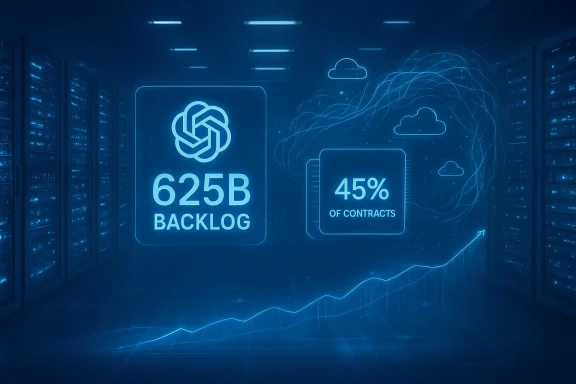
- A commercial remaining performance obligation (RPO) — the firm backlog of contracted future revenue — of roughly $625 billion, with Microsoft saying roughly 45 percent of that balance is attributable to OpenAI.
- Very large, AI-driven capital expenditures: Microsoft spent about $37.5 billion in the quarter on infrastructure, much of it on short‑lived compute assets such as GPUs and CPUs that are central to AI workloads.
By the numbers: what Microsoft reported
- Revenue: $81.3 billion, up 17% year over year.
- GAAP net income: $38.5 billion, a large year‑over‑year increase (partly reflecting accounting treatment around equity stakes and investments).
- Commercial RPO / backlog: $625 billion (commercial bookings and contracted revenue yet to be recognized).
- OpenAI share of commercial RPO: ~45% (company disclosure).
- Capital expenditures (capex) in the quarter: $37.5 billion, a step‑change increase as Microsoft scales datacenter and AI infrastructure.
- Average RPO duration: ~2.5 years, with around 25% expected to be recognized in the next 12 months.
- Anthropic commitment: a separate, previously disclosed arrangement to purchase $30 billion of Azure compute plus up to 1 gigawatt of capacity; Nvidia and Microsoft are also committing capital to support Anthropic’s scaling.
What “45% of the backlog is OpenAI” actually means
The arithmetic and the mechanics
When Microsoft says 45 percent of its commercial RPO is tied to OpenAI, that is not a throwaway statistic; it is a measure of contractual future demand. In raw terms that percentage against a $625 billion RPO implies roughly $280–$285 billion in contracted future Azure services attributable to OpenAI. Microsoft’s earlier announcements have also said OpenAI has committed to an incremental $250 billion of Azure services as part of its restructuring arrangements.It’s important to be precise about what that number represents: RPO/backlog is recognized over time as revenue when Microsoft delivers the contracted cloud services. It is not a current cash receipt, but it is a strong signal of revenue visibility and future capacity needs. The RPO mix and duration determine how quickly that backlog converts into revenue and cash flow.
Why concentration matters
Concentration at this scale matters for several reasons:- Credit and counterparty risk: If a large customer’s business or priorities change, expected future revenue may be delayed, renegotiated, or impaired. Microsoft’s reassurance that many GPU contracts are sold for the “entire useful life” of the hardware reduces some rollover risk, but it does not eliminate the systemic risk of a major customer reducing demand or defaulting on payments.
- Operational strain: Delivering on hundreds of billions of dollars of cloud commitments requires an enormous pipeline of hardware, power, real estate, networking and skilled operations teams — all of which must scale reliably over multiple years.
- Market signaling: Publicly acknowledging such concentration changes the story investors use to value the company. Growth that looks dependent on one customer can trade at a discount relative to broad‑based recurring revenue growth.
The OpenAI restructure: rights, revenue and risk
Late in 2025, OpenAI completed a major corporate restructuring into a public benefit corporation. That deal changed the commercial relationship with Microsoft in meaningful ways:- OpenAI committed to buying a very large amount of Azure services (company disclosures and market reports referenced an incremental $250 billion pledge).
- Microsoft accepted a significant equity stake and secured extended rights to commercialize OpenAI technology inside Microsoft products for a defined period.
- As part of the restructuring, Microsoft relinquished a standing right of first refusal for being OpenAI’s exclusive compute provider — effectively allowing OpenAI to shop portions of its compute business to others, even as it signaled continued large spending on Azure.
Anthropic and “portfolio” customers: real diversification or concentrated risk dressed as choice?
Microsoft and Nvidia entered an arrangement with Anthropic that has Anthropic committing to purchase $30 billion of Azure compute, with additional potential capacity commitments up to one gigawatt. Those deals were structured with co-investments by Nvidia and Microsoft into Anthropic’s model development.On paper, Anthropic and other startup model developers increase Microsoft’s customer breadth. But there are three critical caveats:
- Many of these model developers are still investing heavily and not yet consistently profitable. That makes them more vulnerable to demand shifts or capital strain, which can translate into revenue risk for their infrastructure providers.
- The Anthropic deal and similar arrangements typically contain complex economics — they can include hardware leases, equity stakes, or preferred pricing that compresses Microsoft’s margins in exchange for volume. Scale helps, but the near-term margin profile is often weaker than run‑rate enterprise IaaS revenue.
- Some of these deals are dependent on specific hardware architectures (for example, Anthropic’s commitment tied to Nvidia Grace Blackwell and Vera Rubin systems), meaning Microsoft’s fleet needs to be heterogeneous. That forces Microsoft into large purchases of third‑party accelerators alongside its own silicon efforts.
Capex: an industrial-scale buildout with unique accounting and risk dynamics
Microsoft’s capex in the quarter surged to roughly $37.5 billion, a number that will stick in investors’ minds. Several distinctive features of this spending pattern matter:- A significant fraction of the new capex is in fast‑depreciating compute assets (GPUs and related systems) that are capitalized and then depreciated over their estimated useful life (Microsoft cited typical server useful lives around six years).
- Microsoft stated that a large proportion of the capacity purchased this year has already been contracted (sold) for the majority or the entirety of its useful life, which reduces revenue‑recognition and utilization risk in theory.
- Nevertheless, the accounting reality is that Microsoft capitalizes expensive hardware now and recovers value over multiple years as the contracted services are delivered. If customers scale back or markets change, the timing and quantum of recoveries can be affected.
- Can Microsoft deploy and monetize this hardware quickly enough to generate attractive returns on investment?
- What happens to gross margins and free cash flow if model consumption fall short of contracted expectations?
- Are there residual value risks for specialized AI hardware if demand falls and the market for resale or repurposing is limited?
Maia 200 and in‑house silicon: mitigation or new complexity?
Microsoft announced its next-generation inference accelerator, Maia 200, positioned as an in-house chip optimized for inference economics. The company described it as a materially more efficient inference engine and said it is already in datacenter deployment.What Maia 200 represents strategically:
- Vertical integration: Building in-house accelerators reduces dependence on outside vendors over time and can improve the total cost of ownership for inference workloads that run constantly at hyperscale.
- Systems approach: Microsoft emphasized a “silicon-to-service” approach — designing hardware in concert with software and system architecture to maximize throughput and efficiency for token generation workloads.
- Competitive signalling: The move signals that hyperscalers are not willing to be 100 percent dependent on a single chip vendor. Microsoft clearly wants differentiated cost advantages on inference.
- Technical claims about transistor counts, theoretical FP4/FP8 FLOPS and “30 percent better performance‑per‑dollar” are vendor assertions and require independent verification and time in market to validate across a range of models and workloads.
- Even with successful in-house silicon, Microsoft will still run heterogeneous fleets. Anthropic’s stated requirement for Nvidia Grace Blackwell and Vera Rubin systems, and many model developers’ reliance on Nvidia ecosystems, mean Microsoft will remain a mixed‑vendor operator.
- Designing, manufacturing (via foundries), testing and operating custom silicon at scale introduces new complexity, supply chain exposure and program costs that must be managed over multiple hardware generations.
The investor calculus: scenarios and what could go wrong
For capital markets, three plausible scenarios frame valuation risk.- Base case — contracts convert, capex normalizes
- OpenAI, Anthropic and other customers consume capacity as contracted.
- Microsoft’s capex margins recover as hardware is monetized; RPO converts to revenue and cash over the next 2–3 years.
- Outcome: sustained revenue growth, improved gross margins over time, and a profitable compounding of Microsoft’s platform and product integrations.
- Stress case — partial conversion and slower monetization
- Some customer commitments are delayed, restructured or partially executed.
- Microsoft must operate more idle or under-utilized capacity or reprice to attract new customers.
- Outcome: weaker-than-expected gross margins, pressure on free cash flow and a re-rating of the shares until visibility returns.
- Adverse case — concentrated default or market contraction
- A major model provider reduces demand substantially or faces financial stress that triggers contract renegotiation or impairment.
- Microsoft is left with large, specialized hardware and contractual disputes that compress near‑term profitability.
- Outcome: significant earnings and cash flow volatility; investors reprice Microsoft to reflect higher execution risk.
What management said — and what to watch for
Microsoft management made several explicit points on the earnings call intended to calm markets:- Many of the GPU purchases are already contracted for most or all of the hardware’s useful life, which should reduce rollover risk.
- The non‑OpenAI portion of the RPO is broad and growing — the company highlighted that 55 percent of the RPO (about $350 billion) is diversified across customers, geographies and products and grew 28 percent in the quarter.
- Capex intensity will fluctuate; Microsoft expects lower capex in the following quarter due to “normal variability” in cloud infrastructure build outs and finance lease timing.
- Quarterly RPO composition: How that 45 percent OpenAI figure changes over time — decline would be diversification, growth would mean rising concentration.
- Capex cadence and disclosure: Management’s quarterly capex guidance and the split between long‑lived facility builds and short‑lived compute purchases.
- Contractual terms and counterparty credit: Any disclosure about the nature of the contracts (e.g., prepayment, finance leases, revenue recognition milestones) that affect realization risk.
- Utilization rates: Evidence Microsoft can keep utilization high and repurpose hardware economically if model demands change.
- Third‑party deployment: The proportion of workloads actually served on Azure versus other clouds — structural leakage would degrade the perceived royalty of Microsoft’s position.
Strengths and mitigants
There are clear strengths in Microsoft’s position:- Scale advantage: Microsoft operates one of the world’s largest cloud platforms with deep enterprise relationships across software, productivity and platform layers.
- Commercial integration: Through the Copilot stack and enterprise agreements, Microsoft can embed differentiated AI services that are sticky and high value.
- Balance sheet and capital flows: Microsoft has the balance sheet and operational scale to make very large infrastructure investments that would be prohibitive for most competitors.
- Silicon development: Maia 200 and other in‑house engineering initiatives give Microsoft optionality to control some of the cost curve on inference.
Risks that deserve the spotlight
- Customer concentration: A large fraction of near‑term contracted demand comes from a small set of customers; concentrated revenue is inherently higher risk.
- Counterparty financial health: Startups with big compute commitments might face funding or profitability shocks that change consumption patterns, even if contracts are nominally in place.
- Hardware obsolescence and residual value: Specialized AI accelerators have uncertain secondary markets; if demand slows, realized exit values for used hardware could be depressed.
- Ecosystem friction: Microsoft no longer has exclusive compute rights with OpenAI. Even if OpenAI commits a large sum to Azure, competition among cloud providers for modeling customers will persist.
- Execution complexity of custom silicon: Building, validating and managing in‑house chips at hyperscale is harder than it looks; setbacks or supply chain issues could raise costs.
Pragmatic guidance for investors and enterprise customers
For investors:- Track RPO composition quarterly and ask for more granularity on contract types and credit terms.
- Watch capex guidance with an eye to the split between long‑lived infrastructure and short‑lived compute purchases.
- Model alternative revenue conversion scenarios from backlog to revenue, and stress-test for partial conversion and renegotiation.
- Be explicit about multi‑cloud strategies if you need redundancy for model serving or data sovereignty; don’t assume a single vendor will always deliver.
- Negotiate termination, SLAs and pricing protections for long‑running model workloads, especially when working with startups whose business profiles can change.
- Validate technical requirements against hardware choices — some models and vendors will insist on a specific accelerator architecture.
Claims that require caution and independent verification
- Technical performance specifications for new chips (claims about transistor counts, petaFLOPS at FP4/FP8, or precise performance‑per‑dollar improvements) are vendor statements that need independent benchmarks and real-world deployments to validate.
- The practical resale or residual value of specialized accelerators in a down market is difficult to quantify and remains an open question.
- Large multi‑year customer commitments can contain detailed clauses that materially affect economics (equity versus service purchase agreements, force majeure, renegotiation clauses, and payment security). Public headline numbers do not reveal those contract mechanics; investors should seek more granular disclosure.
Conclusion
Microsoft’s second quarter shows the paradox of the AI era: the company is harvesting enormous demand and locking in multi‑year contracts that dramatically expand future revenue visibility, even as it faces a capital and execution challenge that makes the financial path forward more contingent than in a typical enterprise software cycle.The company’s strategic choices — big bets on in‑house silicon, a willingness to accept concentrated contracted demand, and a portfolio approach to partnering with model vendors — are rational responses to the scale of the frontier AI opportunity. They also create new failure modes: customer concentration, hardware obsolescence, and counterparty credit risk.
For investors, the next several quarters should reveal whether Microsoft can convert a gargantuan RPO into operational reality while managing capex intensity and maintaining margin expansion. For enterprise customers and partners, Microsoft’s massive scale and integration capabilities remain compelling, but the evolving commercial arrangements underscore the importance of contractual clarity and multicloud risk management.
Microsoft has bought a front‑seat in the AI economy — and the next act is about turning that seat into a durable, profitable theatre.
Source: theregister.com Microsoft investors sweat cloud giant's OpenAI exposure
