

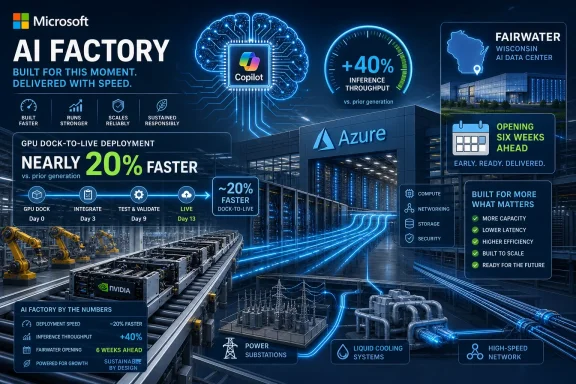
As Microsoft described on its fiscal 2026 third-quarter earnings call, and as market commentary from Equiti and reporting from CRN and Yahoo Finance subsequently highlighted, the company has reduced the time needed to bring new GPUs live in its largest regions by nearly 20 percent since the start of the year. It also brought its Fairwater data center in Wisconsin online six weeks ahead of schedule and reported a 40 percent inference-throughput improvement across heavily used Copilot models. Those numbers do not settle the AI return-on-investment argument. They do, however, change the shape of it.
Microsoft’s AI Bet Is No Longer Just a Spending Story
For much of the past two years, the cleanest way to describe Microsoft’s AI strategy was brutally simple: spend first, monetize later. The company had the distribution, the enterprise relationships, the developer ecosystem, the cloud platform, and the OpenAI relationship. What it did not have, at least in unlimited supply, was enough compute.
That shortage turned capital expenditure into the main character of the Microsoft story. Data centers, GPUs, power, cooling, networking, and long-term leases became the physical underlay of every Copilot demo and every Azure AI growth number. Investors who once viewed Microsoft as the gold standard of asset-light software suddenly had to evaluate it as one of the world’s largest infrastructure builders.
The uncomfortable part is that both views are true. Microsoft is still a software giant with extraordinary operating leverage, but AI has pulled it deeper into the economics of steel, silicon, substations, and construction schedules. The strategic question is not whether Microsoft can afford the spending. It plainly can. The harder question is whether the next dollar of AI capital produces enough incremental revenue, retention, pricing power, and platform control to justify the drag on free cash flow.
That is why the operational signals matter. A 20 percent improvement in GPU deployment time is not the sort of number that produces a glossy keynote moment. But for a capacity-constrained cloud business, it may be more important than another chatbot feature. If demand is waiting and supply is the bottleneck, shaving weeks from deployment turns idle capital into billable infrastructure faster.
The GPU Is the New Unit of Cloud Leverage
Cloud computing used to be discussed mostly in terms of regions, virtual machines, storage, and consumption. AI has narrowed the investor vocabulary toward one scarce unit: accelerated compute. The GPU, or a comparable AI accelerator, is now the practical atom of the modern cloud growth story.
That has consequences. In traditional cloud workloads, a hyperscaler could expand capacity with a relatively predictable mix of servers, networking, and data-center expansion. AI workloads are different. They are more power-dense, more supply-chain sensitive, more dependent on advanced networking, and more exposed to the availability and pricing of a small number of cutting-edge components.
Microsoft’s comment about reducing “dock-to-live” times for GPUs in its largest regions is therefore more than an internal operations metric. It says the company is working on the messy middle between buying chips and monetizing them. A GPU sitting in a logistics chain, a rack, or a partially commissioned facility is capital without revenue. A GPU made available to Azure customers or Copilot workloads is capital with a chance to earn.
The nearly 20 percent improvement also hints at a broader discipline. Microsoft is not only trying to acquire more capacity; it is trying to industrialize the process of making capacity useful. For a company expected to spend more than $40 billion in fiscal fourth-quarter capital expenditure, according to CFO Amy Hood’s guidance on the earnings call, that distinction is central.
Scale alone does not guarantee advantage if everyone is spending. Amazon, Google, Meta, Oracle, and a growing list of AI infrastructure specialists are all participating in the buildout. Microsoft’s advantage depends on how quickly it can convert purchased capacity into sold capacity, and how tightly it can match those deployments to real customer demand.
Fairwater Shows the Calendar Is Part of the Margin Stack
The Fairwater data center in Wisconsin has become a small but revealing example of the bigger AI infrastructure race. Satya Nadella said the facility came online six weeks ahead of schedule, allowing Microsoft to recognize revenue earlier. That last phrase is the one investors should underline.
Data-center construction is often described as if the only relevant issue is eventual capacity. In practice, timing matters enormously. If a facility is delayed, customer demand may be deferred, redirected, or left unmet. If it arrives early, the capital-to-revenue gap narrows. That is not glamorous, but it is exactly where hyperscale execution becomes financial performance.
For WindowsForum readers who have spent years watching enterprise infrastructure projects, this should feel familiar. The purchase order is not the deployment. The deployment is not the workload. The workload is not the utilization curve. Every step introduces friction, and AI magnifies the cost of that friction because the components are so expensive.
Microsoft’s early delivery of Fairwater does not prove that every future data center will beat schedule. It does show that the company understands the market is watching execution velocity, not only headline investment totals. In a world where AI demand is described as capacity constrained, a six-week acceleration is a revenue event.
There is also a competitive angle. Azure does not merely compete on model quality or developer tooling. It competes on whether a customer can actually get the capacity it needs in the region it wants, under the commercial terms it can accept. Capacity availability is becoming a feature.
Copilot Economics Depend on Inference, Not Demos
The 40 percent improvement in inference throughput across heavily used Copilot models may be the most important number in the set. Training models is spectacular, expensive, and strategically important. But inference is where AI products either become profitable at scale or become a permanent margin tax.
Copilot is not a lab experiment. Microsoft has embedded AI into Office, Windows, GitHub, Dynamics, Security, and the broader Microsoft 365 stack. That means inference costs are not occasional; they are recurring. Every prompt, summary, code suggestion, meeting recap, security analysis, and document rewrite has an infrastructure cost behind it.
A 40 percent throughput improvement suggests Microsoft can serve more AI work from the same or similar hardware base. That matters because the early phase of generative AI adoption has often been judged by user enthusiasm and product attach rates. The next phase will be judged by unit economics.
If Microsoft can make Copilot cheaper to run while keeping quality acceptable or improving it, the company gets more strategic flexibility. It can preserve margins, bundle more aggressively, support heavier usage, or push AI features into lower-priced tiers without destroying economics. That is the difference between AI as a premium add-on and AI as a platform layer.
This is also where Microsoft’s full-stack position matters. The company controls applications, cloud infrastructure, developer tools, model partnerships, and a growing amount of optimization work between software and hardware. When Nadella talks about throughput gains driven by software and hardware optimization, he is pointing to the boring but decisive engineering work that separates a profitable platform from a costly feature.
The CapEx Number Still Casts a Long Shadow
None of this makes the capital-spending debate disappear. Microsoft’s expected fiscal fourth-quarter capital expenditure of more than $40 billion is a staggering figure even for a company of its size. The market is right to ask whether AI infrastructure spending is outrunning the visibility of returns.
The risk is not that Microsoft suddenly runs out of cash. The company remains one of the strongest cash generators in corporate history. The risk is that investors begin to apply a different multiple to those cash flows if they believe AI has structurally lowered free-cash-flow conversion.
That is the tension inside the current bull case. Microsoft can be executing well and still face investor skepticism if spending keeps rising faster than proof of monetization. Efficiency gains help, but they do not eliminate the need for revenue evidence. They simply make the spending easier to defend.
The market has seen infrastructure booms before. Telecom overbuilt fiber. Cloud providers periodically overbuilt general-purpose capacity. Crypto miners overbuilt around volatile demand. AI may be more durable than those cycles, but durability is not the same as guaranteed return. Even strong demand can produce poor capital returns if too many players build too much capacity too quickly.
Microsoft’s best defense is not rhetoric about AI transformation. It is utilization. If GPUs come online faster, if data centers arrive earlier, if inference becomes cheaper, and if Azure growth continues to absorb new capacity, the spending starts to look like platform reinforcement rather than speculative expansion.
Azure Is Where the AI Story Has to Become Accounting
Azure remains the proof point because it is where AI enthusiasm becomes reported revenue. Microsoft has said Azure surpassed a $75 billion annual revenue run rate, up 34 percent, giving the company a massive base from which AI demand can compound. That number matters because it reminds investors that AI is not being bolted onto a small business; it is being layered onto one of the largest cloud platforms in the world.
The bullish interpretation is straightforward. If AI continues to add meaningful growth to Azure, Microsoft’s infrastructure buildout extends the life of its cloud growth curve. Even if non-AI cloud demand normalizes, AI workloads can keep Azure expanding at a premium rate.
But the burden of proof rises with scale. A small cloud business can post eye-catching growth from a narrow base. Azure cannot. At $75 billion and beyond, maintaining high growth requires enormous incremental dollars. AI helps, but it also requires enormous incremental capital.
This is why investors listen so closely to Microsoft’s commentary on capacity constraints. If Azure growth is limited by available AI infrastructure, then capex is not merely discretionary spending; it is a prerequisite for near-term revenue capture. If, however, capacity begins to arrive faster than durable demand, the same spending becomes a margin problem.
The distinction will not be visible in one quarter. It will appear over several reporting cycles through Azure growth, Microsoft Cloud margins, remaining performance obligations, customer commitments, Copilot adoption, and management’s language around utilization. The numbers Microsoft just shared are encouraging, but they are leading indicators. Azure revenue is the scoreboard.
The OpenAI Relationship Is an Asset and a Complication
Microsoft’s AI infrastructure strategy cannot be separated from OpenAI. The partnership gave Microsoft a lead in enterprise generative AI, a privileged model pipeline, and a powerful narrative for Azure. It also made Microsoft’s capacity planning more complicated.
OpenAI is both a strategic partner and a major consumer of compute. That is useful when Microsoft wants anchor demand for AI infrastructure. It is more complicated when investors ask how much Azure growth is coming from external enterprise customers versus a deeply intertwined partner ecosystem. The answer matters because not all demand signals deserve the same multiple.
Microsoft has tried to frame the relationship as mutually reinforcing. OpenAI gets access to massive infrastructure, while Microsoft gets model access, product integration, and Azure consumption. That remains a strong position. But the market will continue to scrutinize whether the economics are as attractive as the strategic story.
There is also a governance and concentration issue. The more Microsoft’s AI growth depends on a small number of frontier-model relationships and workloads, the more investors will ask about durability, pricing, and bargaining power. Microsoft’s advantage is strongest when Azure becomes the broad default platform for many AI developers and enterprises, not merely the infrastructure behind one famous partner.
This is where Copilot and Azure AI services matter. They diversify Microsoft’s monetization paths. If AI revenue comes from Office users, GitHub developers, security operations teams, Dynamics customers, and independent Azure workloads, the story becomes broader and sturdier. If it concentrates too heavily in a few mega-consumers of GPU capacity, the capex debate remains sharper.
Efficiency Is Microsoft’s Answer to the Margin Question
The most persuasive part of Microsoft’s latest AI message is that it has moved from promise to process. The company is no longer saying only that demand is strong. It is saying it can deploy GPUs faster, bring data centers online sooner, and run major AI workloads more efficiently.
That is the right answer to investor anxiety because margins are not protected by optimism. They are protected by engineering, procurement discipline, pricing power, and utilization. Microsoft is signaling progress on at least some of those fronts.
Inference throughput is especially important for Microsoft 365 Copilot and related products. Enterprise software margins are supposed to be exceptional. If AI features permanently lower those margins without creating enough price expansion or retention benefit, the market will notice. If optimization reduces serving costs over time, Microsoft can preserve more of the economics that made its software business so valuable in the first place.
The same logic applies to Azure. Cloud gross margin has always depended on scale, utilization, hardware efficiency, and lifecycle management. AI raises the stakes because accelerators are expensive and depreciate against a fast-moving performance curve. The sooner Microsoft can fill that capacity with paying workloads, and the more efficiently it can run them, the better the margin story becomes.
There is no magic here. This is industrial execution. The AI era may be marketed through agents and copilots, but its financial performance will be built through deployment speed, power availability, networking efficiency, model optimization, and disciplined capacity planning.
Wall Street Wants Proof, Not Just Capacity
The stock-market reaction to AI capex across Big Tech has become more discriminating. Investors are no longer automatically rewarding every infrastructure announcement. They want to know who is spending into demand, who is spending into hope, and who is confusing strategic necessity with capital indiscipline.
Microsoft benefits from starting in a stronger position than most. Azure has scale. Microsoft 365 has distribution. GitHub has developer mindshare. Windows remains a critical endpoint platform, even if the center of gravity has moved toward cloud and AI services. The company can push AI across existing channels in a way few competitors can match.
Still, the market’s skepticism is rational. AI spending has grown so large that even Microsoft must show operating leverage eventually. A trillion-dollar infrastructure thesis cannot rest forever on the idea that demand is “massive.” It must show up in reported revenue, expanding customer commitments, defensible margins, and durable competitive advantage.
That is why the latest efficiency signals are useful but not decisive. They are evidence that Microsoft is improving the machine. They are not yet proof that the machine will produce the returns investors expect.
The next few quarters will test whether the operational improvements become visible in financial results. If Azure continues to outperform expectations and management can credibly point to better utilization and capacity availability, the capex debate will soften. If spending keeps rising while growth decelerates or margins compress, the same efficiency claims will look like footnotes.
The Windows Angle Is the Endpoint Microsoft Cannot Ignore
For Windows enthusiasts and IT administrators, Microsoft’s AI capex story may sound distant from the daily work of managing PCs, endpoints, policies, and users. It is not. The infrastructure buildout determines how aggressively Microsoft can push cloud-backed AI into Windows, Microsoft 365, Defender, Intune, Edge, and developer workflows.
Copilot on the desktop is only as useful as the services behind it. Local NPUs in Copilot+ PCs may handle some workloads, but the most capable models, enterprise graph integrations, and cross-application workflows still depend heavily on cloud infrastructure. That makes Azure capacity a practical constraint on the Windows AI experience.
This also affects IT planning. Enterprises evaluating Copilot are not merely buying a feature. They are buying into a service model that depends on Microsoft’s ability to deliver reliable, compliant, performant AI at scale. Latency, data residency, cost controls, admin visibility, and service availability all connect back to the infrastructure layer.
If Microsoft’s throughput improvements lower serving costs, enterprise customers may eventually see broader packaging or more generous usage. If capacity remains tight, customers may see prioritization, regional limitations, or slower rollout of advanced capabilities. The data center has become part of the endpoint roadmap.
Windows itself is increasingly a distribution surface for Microsoft’s cloud AI strategy. That does not mean every user wants AI in the Start menu or every admin welcomes another policy surface. It does mean Microsoft’s infrastructure economics will shape how aggressively those features arrive, how much they cost, and how deeply they integrate into the operating system.
The AI Buildout Is Becoming an Execution War
The first phase of the generative AI boom rewarded access: access to frontier models, GPUs, cloud regions, enterprise customers, and developer attention. The next phase rewards execution. Microsoft appears to understand that the story now depends on throughput, deployment speed, and revenue conversion.
That shift favors companies with operational depth. Building AI data centers is not like launching a SaaS feature. It requires power contracts, permitting, supply-chain coordination, specialized hardware, cooling systems, high-speed networking, and software layers that can keep accelerators busy. The winners will not simply be the companies with the biggest budgets. They will be the companies that turn those budgets into useful capacity fastest.
Microsoft’s latest numbers suggest progress on that front. A nearly 20 percent improvement in GPU go-live time means less dead time between purchase and monetization. A data center delivered six weeks early means schedule discipline can move revenue forward. A 40 percent inference-throughput gain means software optimization can partially offset hardware scarcity.
But execution wars do not end quickly. Every improvement becomes the new baseline. If Microsoft can deploy GPUs 20 percent faster, investors will soon ask whether it can do it again. If Copilot inference gets 40 percent more efficient, customers and finance teams will expect that efficiency to show up in margins, pricing, or product expansion.
This is the paradox of operational excellence. It strengthens the bull case while raising expectations. Microsoft is telling the market it can run the AI factory better. The market will now expect it to prove that repeatedly.
Redmond’s AI Factory Now Has a Scorecard
The practical readout for Microsoft is narrower than the hype cycle suggests. The company does not need every AI feature to become beloved overnight. It does need its infrastructure investment to keep translating into Azure growth, Copilot adoption, and defensible economics.
- Microsoft’s nearly 20 percent improvement in GPU deployment time matters because capacity only creates value once it is live and available to paying workloads.
- The Fairwater data center arriving six weeks ahead of schedule matters because timing can pull revenue forward in a capacity-constrained cloud business.
- The 40 percent inference-throughput gain across major Copilot models matters because recurring AI usage will be judged by unit economics, not demo quality.
- The expected fiscal fourth-quarter capex figure above $40 billion keeps pressure on Microsoft to show that spending is productive rather than merely defensive.
- Azure remains the decisive proof point because AI infrastructure value must ultimately appear in cloud revenue, utilization, and margin resilience.
- For Windows and enterprise IT customers, Microsoft’s AI buildout will shape the pace, reliability, cost, and policy complexity of Copilot-era features.
The Microsoft AI story is therefore becoming less mystical and more measurable. That is healthy. The industry has spent too long talking about artificial intelligence as if it were detached from power grids, depreciation schedules, and gross margins. Microsoft’s latest signals suggest the company is improving the machinery underneath the narrative. Now it has to show that the machinery can keep turning capital into durable cloud growth faster than the market’s patience runs out.
References
- Microsoft AI CapEx: GPU Efficiency & Azure Growth Trajectory equiti.com · 2026-07-08T11:30:13.686997
- microsoft.com microsoft.com