

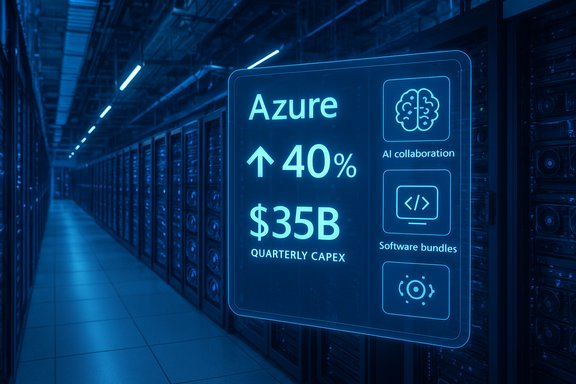
Microsoft’s latest quarter consolidated a simple, uncomfortable truth for investors: the AI era is not only reshaping product roadmaps and enterprise IT, it’s remaking capital allocation at hyperscale — and that remaking is expensive. In the July–September reporting period Microsoft disclosed nearly $35 billion in capital spending, a roughly 74% year‑over‑year increase, even as Azure and broader cloud revenue surged; the numbers impressed on the top line but intensified debate about whether the AI buildout will deliver commensurate returns.
Microsoft’s business narrative over the past three years has migrated from software-and-OS vendor to cloud-and-AI platform company. The company now couples a global hyperscale cloud (Azure) with enterprise software and productivity suites (Microsoft 365, Dynamics) and strategic AI partnerships, most prominently with OpenAI. That strategic posture has been rewarded in revenue growth: for the quarter Microsoft reported $77.7 billion in revenue, with Azure growth in the 40% range — evidence that enterprise demand for model training and inference is real and accelerating. At the same time, Microsoft’s management told investors it is building ahead of demand to avoid capacity bottlenecks, driving a spike in short‑term, high‑price purchases such as GPUs. This is not a one‑off: the company signaled that capital intensity will remain elevated into the next fiscal year and that capex growth for fiscal 2026 will exceed the 2025 pace. CFO Amy Hood specifically warned that Microsoft expects to be capacity‑constrained for AI through at least the end of the fiscal year, a point investors took seriously.
Key competitive dynamics to monitor:
Key takeaways for practitioners and power users:
Source: Communications Today Microsoft's massive AI spending draws investor concerns | Communications Today
 Background
Microsoft’s business narrative over the past three years has migrated from software-and-OS vendor to cloud-and-AI platform company. The company now couples a global hyperscale cloud (Azure) with enterprise software and productivity suites (Microsoft 365, Dynamics) and strategic AI partnerships, most prominently with OpenAI. That strategic posture has been rewarded in revenue growth: for the quarter Microsoft reported $77.7 billion in revenue, with Azure growth in the 40% range — evidence that enterprise demand for model training and inference is real and accelerating. At the same time, Microsoft’s management told investors it is building ahead of demand to avoid capacity bottlenecks, driving a spike in short‑term, high‑price purchases such as GPUs. This is not a one‑off: the company signaled that capital intensity will remain elevated into the next fiscal year and that capex growth for fiscal 2026 will exceed the 2025 pace. CFO Amy Hood specifically warned that Microsoft expects to be capacity‑constrained for AI through at least the end of the fiscal year, a point investors took seriously. Financial snapshot: the numbers that matter
Short, verifiable facts from the quarter:- Total revenue: $77.7 billion, an 18% year‑over‑year increase.
- Azure growth: roughly 40% year‑over‑year in the July–September period, outpacing many consensus estimates.
- Capital expenditures (capex): nearly $35 billion for the quarter, a 74% year‑over‑year jump, with about half of that spend on short‑lived assets (notably high‑end GPUs).
- Profitability: Microsoft reported GAAP diluted earnings per share of $3.72, while non‑GAAP EPS (which excludes certain OpenAI‑related items) was $4.13. Management presented both measures to help separate core operating performance from investment effects.
Where the money went: chips, shells, and software
Microsoft’s capex jump was both tactical and structural. The breakdown of the large outlay can be summarized as:- High‑end GPUs and accelerator inventory (short‑lived, price‑sensitive assets).
- Hyperscale datacenter building — land, shells, power and cooling upgrades (long‑lived facilities).
- Networking, storage, and specialized boards for interconnect and throughput.
- Investments in internal silicon efforts and software optimizations to reduce cost‑per‑inference over time.
Investor reaction and market mechanics
The immediate market reaction was telling: Microsoft shares fell roughly 3–4% in after‑hours trading following the disclosure. That drop reflected several investor concerns:- Return on capital: Spending tens of billions in a single quarter increases the payback horizon and makes investors sensitive to utilization and revenue per GPU‑hour.
- Demand sustainability: Will enterprise demand remain exponential, or normalize after initial surges? A moderation would leave hyperscalers with idle, expensive equipment.
- Supplier concentration: Heavy dependence on a small number of GPU suppliers (notably NVIDIA) creates procurement risk and price volatility.
Strategic rationale: why Microsoft is doubling down
Despite investor jitters, Microsoft’s strategy is coherent and defensible on several fronts:- Platform scale and bundling: Microsoft pairs Azure compute with Microsoft 365, Dynamics, and enterprise sales channels. Embedding AI (Copilot, 365 Copilot, GitHub Copilot) increases value per customer and creates stickier revenue.
- First‑mover capacity advantage: Owning abundant proximate compute reduces latency and enables differentiated performance for large models — a material product differentiator for enterprise buyers.
- Partnerships and optionality: The revised OpenAI arrangement preserves deep commercial ties while Microsoft also seeks to build in‑house models and partner with other providers, reducing single‑vendor risk over time.
The OpenAI deal: clarity and complexity
This quarter’s results arrived alongside a restructured Microsoft–OpenAI relationship that dramatically altered the landscape. Under the rework, Microsoft holds a roughly 27% stake valued at about $135 billion, gaining continued commercial rights to OpenAI products while OpenAI expands its ability to work with other infrastructure partners. These terms clarified a key uncertainty that had been clouding investor views of Azure’s AI growth prospects. Important caveats: parts of the deal are still subject to interpretation and further regulatory scrutiny — the governance and valuation mechanics, especially the long‑term rights around AGI milestones and IP, are complex and will require careful monitoring. Some headline figures about multiyear compute commitments that circulated in media reporting also appear to come from people‑familiar‑with‑the‑matter and thus should be treated cautiously until confirmed in contractual disclosures.Risks: what could go wrong
The upside case for Microsoft is large, but the risks are real and measurable:- Overcapacity / underutilization: If adoption flattens or model training cycles lengthen, capital‑heavy assets could sit idle for quarters or years, compressing returns.
- Price competition and commoditization: Lower priced models or alternative compute providers could push down revenue per inference faster than Microsoft’s cost curve improves.
- Supply‑chain shocks: Geopolitical issues, export restrictions, or chip shortages could constrain provisioning and inflate costs.
- Regulatory risk and scrutiny: The close commercial ties between a major cloud provider and a leading model developer invite competition, data governance, and national‑security reviews. These could impose new constraints or compliance costs.
- Financing and macro risk: Sustained high capex is sensitive to interest rates and balance sheet strategies; funding through debt or higher leverage would increase risk in an economic downturn.
What to watch: the 90‑day investor checklist
Management provided guidance and signals that will matter most to the market going forward. The priority metrics to track in coming quarters are:- Azure unit economics: revenue and margin per GPU‑hour or per inference — improvements here validate the capex strategy.
- Capex composition disclosures: explicit breakdowns between short‑lived compute inventory and long‑lived facility spend. This clarifies timing of cash conversion.
- Utilization and efficiency metrics: any disclosure showing rising utilization rates or falling cost‑per‑inference will be a positive operational sign.
- Bookings and multi‑year agreements: growth in committed consumption and enterprise contracts provides durable revenue that justifies front‑loaded buildouts.
- OpenAI contractual clarifications: payment schedules, revenue‑share mechanics, and exclusivity windows materially affect Azure demand assumptions.
Competitive context: where Azure stands
Azure’s AI differentiation rests on three pillars: capacity, enterprise integration, and product bundling. Competitors — AWS and Google Cloud chief among them — are pursuing similar strategies: massive capex, custom silicon, and software optimizations. Specialist cloud vendors and on‑prem providers target regulated or latency‑sensitive workloads.Key competitive dynamics to monitor:
- Pricing pressure from rivals and open‑source models that could erode premium pricing for managed model hosting.
- Custom silicon rollouts by major cloud providers that change supplier dynamics and total cost of ownership.
- Enterprise procurement choices — multi‑cloud vs. single‑vendor — which affect long‑term stickiness and revenue per customer.
Practical implications for enterprises and CIOs
For corporate IT leaders evaluating AI adoption, Microsoft’s quarter surfaces practical guidance:- Adopt multi‑cloud resilience for critical workloads to mitigate provider outages and capacity limits.
- Negotiate clear SLAs and consumption commitments that protect against pricing and availability risk.
- Treat AI capacity as a strategic procurement category — measure cost per inference, lifecycle of accelerators, and refresh cadence.
- Pilot Copilot and other AI features with defined ROI metrics before large-scale rollout.
Productivity proof points: hype vs. evidence
One of the hardest questions in the AI investment debate is whether enterprises are realizing transformational productivity gains at scale. Early deployments of Copilot‑style assistants show promise in automating tasks and enhancing workflows, but independent, broadly generalizable productivity metrics remain limited and mixed.- There are case studies showing meaningful efficiency gains in specific workflows.
- There is limited comprehensive evidence that these gains translate to broad macro productivity jumps across companies and sectors.
Governance, regulatory and public‑policy angles
Microsoft’s role in the AI ecosystem invites regulatory attention. Key governance issues include:- Antitrust and competition scrutiny tied to deep commercial ties between a dominant cloud provider and a leading model developer.
- Data governance and cross‑border compliance as model training and inference involve sensitive datasets and jurisdictional complexity.
- AGI governance mechanics, where contractual rights and independent verification processes in large deals will attract public interest.
Verdict: an informed, measured take
Microsoft’s record quarterly capex and robust Azure growth present a classic trade‑off of the hyperscaler era: invest massively to secure disproportionate platform advantages, while accepting near‑term pressure on free cash flow and a higher bar for demonstrating returns.- Strengths: scale, enterprise distribution, product bundling, and diversified monetization paths.
- Weaknesses / Risks: capital intensity, supplier concentration, uncertain ROI evidence, and regulatory exposure.
Final thoughts for WindowsForum readers
For the Windows and enterprise communities, Microsoft’s AI spending translates into both opportunity and risk. On one hand, sustained investment promises richer AI experiences across Windows, Office, Teams, and developer tooling. On the other hand, the company’s financial decisions could influence pricing, service rollout cadence, and long‑term product priorities.Key takeaways for practitioners and power users:
- Expect deeper AI integration in Windows and Microsoft 365 as Azure capacity scales.
- Watch for potential shifts in enterprise pricing or feature packaging as Microsoft seeks to monetize high‑value AI workloads.
- Stay alert to multi‑cloud strategies and vendor SLAs when building AI‑dependent workflows to avoid single‑provider risk.
Source: Communications Today Microsoft's massive AI spending draws investor concerns | Communications Today
