

Microsoft’s AI chief publicly lost patience this week, telling critics that he’s “mindblown” people aren’t amazed by a technology his division has been pouring billions into — a terse X post that crystallizes a widening gap between Silicon Valley confidence and everyday user fatigue with Microsoft’s AI-first push inside Windows and its Copilot family of products.
Microsoft reorganized its consumer AI efforts in 2024 to form a centralized division now known internally as Microsoft AI, placing Mustafa Suleyman — a co‑founder of DeepMind and a high‑profile figure in the AI industry — at the head. That unit was built to unite Copilot, Bing, Edge, and other generative and agentic initiatives under a single leadership structure and accelerate deployment of large language models, image and voice generators, and agent features across the Windows ecosystem.
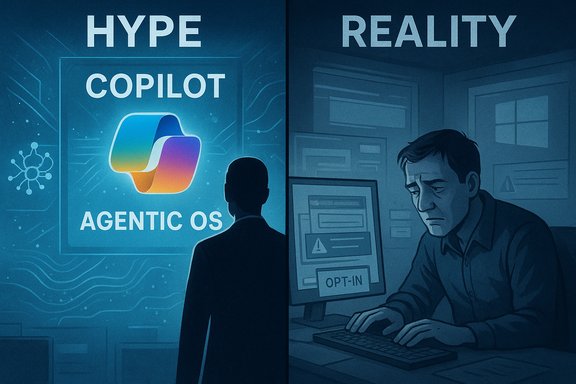
That strategy hit a milestone at Microsoft Ignite in November 2025, when the company outlined a vision for Windows to become more than an operating system: an agentic OS where AI agents proactively assist, automate and coordinate tasks across apps and cloud services. The pitch is being sold as a productivity and security upgrade for organizations, but for a large segment of long‑time Windows users the rollout feels like feature overload — an experience that has spawned sustained backlash on social platforms and in specialist forums.
The message is short, emotive and defensive. It came shortly after a wave of public criticism sparked by Windows leadership language about an “agentic OS” and fresh reporting highlighting gaps between Microsoft’s Copilot ads and the assistant’s real‑world performance. The reaction was predictable: many users read the post as a tone‑deaf dismissal of legitimate grievances. Others portrayed it as emblematic of a tech leadership that measures success in demo‑stage wow moments rather than stable, unobtrusive product experiences.
The exchange is noteworthy because it exposes an emotional as well as a strategic rift. At one end sits a company that views generative AI as the single biggest product opportunity in decades. At the other sits a user base that prizes reliability, control, and the ability to decline unsolicited automation.
These execution gaps are especially damaging when a feature is promoted as a replacement for a familiar workflow. Users who try a promised shortcut and end up doing more work — or, worse, lose time or data — become vocal critics quickly. That frustration accumulates on social channels and highly visible forums, where anecdotes spread faster than bug fixes.
That sentiment deepens when the company’s communications reduce human choice to inevitability: “Windows will become agentic” reads as a roadmap that presumes users will accept, rather than opt in to, profound UI and behavior changes.
Separate watchdog activity also questioned the verifiability of some marketing claims about productivity gains — a regulatory friction point that large software vendors can ill afford as AI features move to core product messaging.
These independent findings are significant because they validate user anecdotes at scale and convert disgruntled social posts into an evidentiary record that product teams and regulators can — and will — cite.
But technological possibility is not the same as product readiness. Technical breakthroughs require careful integration into user workflows, especially when those workflows are entrenched and mission‑critical. The core problem in this moment is less about whether AI can be impressive and more about whether it can be reliably useful without being intrusive.
Suleyman’s public frustration captures a common executive instinct — incredulity that people don’t share the same enthusiasm — but it also underlines the cultural work that remains: turning lab wow moments into dependable, controllable experiences that respect user choices. For Microsoft, the next phase of the AI story will be defined less by demos and more by discipline: measured rollouts, transparent claims, granular controls, and an explicit priority on user trust.
The company can still make Windows and Copilot central to the AI era, but only if it recognizes that genuine adoption grows from earned confidence, not executive incredulity.
Source: eBaum's World Microsoft AI CEO Says He’s Frustrated and Confused by the Fact that No One Likes AI
 Background
Microsoft reorganized its consumer AI efforts in 2024 to form a centralized division now known internally as Microsoft AI, placing Mustafa Suleyman — a co‑founder of DeepMind and a high‑profile figure in the AI industry — at the head. That unit was built to unite Copilot, Bing, Edge, and other generative and agentic initiatives under a single leadership structure and accelerate deployment of large language models, image and voice generators, and agent features across the Windows ecosystem.That strategy hit a milestone at Microsoft Ignite in November 2025, when the company outlined a vision for Windows to become more than an operating system: an agentic OS where AI agents proactively assist, automate and coordinate tasks across apps and cloud services. The pitch is being sold as a productivity and security upgrade for organizations, but for a large segment of long‑time Windows users the rollout feels like feature overload — an experience that has spawned sustained backlash on social platforms and in specialist forums.
What happened: the tweet and the backlash
On November 19, Mustafa Suleyman posted on X: “Jeez there so many cynics! It cracks me up when I hear people call AI underwhelming. I grew up playing Snake on a Nokia phone! The fact that people are unimpressed that we can have a fluent conversation with a super smart AI that can generate any image/video is mindblowing to me.”The message is short, emotive and defensive. It came shortly after a wave of public criticism sparked by Windows leadership language about an “agentic OS” and fresh reporting highlighting gaps between Microsoft’s Copilot ads and the assistant’s real‑world performance. The reaction was predictable: many users read the post as a tone‑deaf dismissal of legitimate grievances. Others portrayed it as emblematic of a tech leadership that measures success in demo‑stage wow moments rather than stable, unobtrusive product experiences.
The exchange is noteworthy because it exposes an emotional as well as a strategic rift. At one end sits a company that views generative AI as the single biggest product opportunity in decades. At the other sits a user base that prizes reliability, control, and the ability to decline unsolicited automation.
Overview: Why users are reacting negatively
Three broad drivers explain the intensity of the backlash.1) Performance gaps and unmet expectations
Marketing demos for Copilot and agentic Windows features have shown seamless, high‑fidelity scenarios: converting a slideshow into a polished presentation, reading and summarizing long documents, or controlling the system by natural voice. Independent testing and longform reporting on Copilot’s real‑world behavior, however, found frequent failures: misidentifications in vision tasks, wrong or irrelevant answers, slow responses, and brittle behavior around file I/O and system toggles.These execution gaps are especially damaging when a feature is promoted as a replacement for a familiar workflow. Users who try a promised shortcut and end up doing more work — or, worse, lose time or data — become vocal critics quickly. That frustration accumulates on social channels and highly visible forums, where anecdotes spread faster than bug fixes.
2) Perceived loss of control and “forced AI”
Users report that AI elements feel pervasive rather than optional: Copilot icons appear in many places, agentic suggestions interrupt workflows, and tooling that previously felt local now routes data to cloud services. The result is a consent problem: many customers want the benefits of AI but not the presumption that automation should be enabled by default on their devices.That sentiment deepens when the company’s communications reduce human choice to inevitability: “Windows will become agentic” reads as a roadmap that presumes users will accept, rather than opt in to, profound UI and behavior changes.
3) Confusing branding and advertising claims
Microsoft’s broad “Copilot” brand spans many different products and licensing tiers. That creates confusion about what consumers and businesses are actually buying or getting for free. Regulatory and watchdog reviews have questioned certain productivity and ROI claims made in advertising, and those official inquiries have amplified user skepticism, especially among enterprise buyers who want verifiable improvements in efficiency.The journalism: what independent reporting found
Recent investigative and hands‑on coverage of Copilot and agent features identified recurring failure modes: hallucinations, unstable long‑conversation behavior, unreliable image/video recognition in complex real‑world inputs, and an interface that sometimes conflates file metadata with file content. Testers described scenarios where Copilot could not perform a task shown in marketing material, or where a supposedly simple command triggered long, irrelevant responses that slowed rather than sped up work.Separate watchdog activity also questioned the verifiability of some marketing claims about productivity gains — a regulatory friction point that large software vendors can ill afford as AI features move to core product messaging.
These independent findings are significant because they validate user anecdotes at scale and convert disgruntled social posts into an evidentiary record that product teams and regulators can — and will — cite.
Why Suleyman’s reaction matters (and why it landed poorly)
Mustafa Suleyman stands at the intersection of credibility and responsibility. His background as a DeepMind co‑founder and his profile as an industry thought leader make his words consequential. Publicly dismissing criticism as cynicism may energize loyal engineers, but it has three strategic downsides:- Brand tone‑deafness: Calling critics “cynics” risks alienating the very users Microsoft needs to retain. Empathy is often a more effective product strategy than scorn.
- PR amplification: Sharp executive comments become headlines that distract from product messaging and refill the complaint pipeline for journalists and watchdogs.
- Operational complacency: Framing criticisms as a failure of imagination rather than a signal of product issues reduces pressure to fix fundamental reliability problems that drive churn and enterprise resistance.
The technical realities Microsoft must face
Delivering a reliable AI‑first Windows is not merely a design problem; it’s a systems engineering and infrastructure challenge at scale.- Models vs. product: Cutting‑edge models can generate staggering outputs in lab conditions, but production systems require predictable behavior across millions of varied files, locales, and real‑world edge cases. Model updates can help, but product engineering — prompt engineering, context management, safety guards, and fallbacks — is essential.
- Latency and bandwidth: Many AI features rely on cloud compute. That introduces latency and connectivity dependencies that degrade experience on slower networks or in disconnected scenarios. Offline or hybrid modes remain a competitive differentiator.
- State and memory: Long conversations and multi‑step agents need robust session state management. Without that, assistants “forget” prior context and produce inconsistent results.
- Security and privacy: Routing documents and images through cloud models raises compliance and data‑governance questions for regulated industries. Enterprises demand audit trails, data minimization and opt‑out for sensitive data processing.
- Resource and battery use: On laptops and tablets, constant background AI processing can affect thermal profiles and battery life.
Business and competitive risks
Microsoft’s AI strategy is a major bet with multi‑front implications.- User retention and platform loyalty: Persistent friction or perceived bloat could push certain user segments (developers, privacy‑conscious professionals) toward alternatives like macOS, Linux, or browser‑based workflows.
- Enterprise adoption: Businesses care about predictable ROI, compliance, and manageability. Even if Copilot delivers productivity on average, inconsistent results and opaque data flows slow purchasing decisions and renewals.
- Regulatory exposure: Advertising claims that aren’t substantiated invite scrutiny from consumer protection bodies. Meanwhile, privacy regulators in Europe and several U.S. states are increasingly aggressive on automated decision‑making and data flows.
- Market positioning: Competitors (Google, Anthropic, independent LLM vendors) are pursuing different tradeoffs: some emphasize privacy and on‑device models; others emphasize raw capability. Microsoft’s hybrid cloud approach must be defended on both capability and governance fronts.
Where Microsoft can — and should — change course
The company’s opportunity is to combine its deep technical resources with some well‑established product management practices. Practical, immediate moves would include:- Make AI features optional by default: Ship with sensible defaults that minimize interruptions and give clear, discoverable opt‑in paths.
- Granular controls and admin tooling: Enterprise admins should have out‑of‑the‑box controls to authorize, quarantine or restrict agent usage across an organization. Publicly commit to a consistent admin policy surface and user settings that work across Windows, 365, and Edge.
- Transparent performance claims: Align marketing with measured, independently verifiable outcomes. If a feature depends on specific network, device, or licensing conditions, state that clearly.
- Phased rollouts with telemetry‑driven gating: Expand availability only after targeted performance and reliability thresholds are met in staged user groups.
- Better error messaging and fallbacks: When AI can’t complete a request, surface concise, actionable guidance rather than verbose non‑answers.
- Protect privacy with defaults: For sensitive content (health, legal, finance), disable cloud processing unless explicitly enabled by the user or admin.
- Invest in offline and local‑first options: For many users, a partially offline Copilot that runs core features locally would be a major usability win.
- Executive communications recalibration: Encourage public messaging that acknowledges issues, demonstrates responsive fixes, and highlights opt‑outs and controls.
For IT administrators and advanced users: practical steps
Enterprise technical teams and power users can curb the worst of forced behavior now by:- Reviewing Microsoft licensing and Copilot feature matrices for role‑based entitlements.
- Using centralized management tools to set default policy: restrict agent creation, disable certain integrations, or route processing through dedicated Cloud Entra tenants.
- Employing network and identity controls to minimize unintentional data exfiltration to third‑party models.
- Communicating clearly with end users about what AI features will do and how to disable them locally.
- Piloting any agentic workflows in a sandbox environment before broad deployment.
Regulatory and ethical considerations
Beyond product fixes, Microsoft faces systemic questions:- Advertising transparency: Claims about productivity and ROI must be supported by representative, reproducible studies. Where independent watchdogs demand clarification, companies should comply proactively rather than reactively.
- Auditability and explainability: Enterprises and regulators will increasingly ask for logs and reasoning trails for decisions made by agents — not only the final outputs.
- Bias and fairness: Generative systems continue to show demographic biases in vision and language tasks. Microsoft must publish mitigation strategies, metrics and ongoing evaluation results.
- Liability and misuse: As agents take on automated actions that affect schedules, financial decisions or content distribution, responsibility lines must be clear: who is accountable when an agent acts incorrectly?
A pragmatic roadmap for rebuilding trust
Restoring user confidence is not a short sprint; it’s an iterative program that blends engineering, policy, and humility. A compact roadmap looks like this:- Stabilize core experiences: prioritize reliability fixes in Copilot and vision features that have the highest complaint volumes.
- Introduce explicit consent flows and opt‑outs across the OS.
- Publish measurable SLAs or performance baselines for enterprise features.
- Provide admins with transparent telemetry and forensic tools.
- Use staged rollouts with user feedback loops and public issue trackers for high‑visibility features.
- Recalibrate external messaging: replace rhetorical triumphalism with concrete commitments and timelines.
Final analysis: optimism tempered by discipline
There is a real technological milestone at play. Fluent conversational models and generative image/video systems are, in capability terms, transformative in many domains. That’s partly why Microsoft is so invested and why executives like Mustafa Suleyman are visibly passionate.But technological possibility is not the same as product readiness. Technical breakthroughs require careful integration into user workflows, especially when those workflows are entrenched and mission‑critical. The core problem in this moment is less about whether AI can be impressive and more about whether it can be reliably useful without being intrusive.
Suleyman’s public frustration captures a common executive instinct — incredulity that people don’t share the same enthusiasm — but it also underlines the cultural work that remains: turning lab wow moments into dependable, controllable experiences that respect user choices. For Microsoft, the next phase of the AI story will be defined less by demos and more by discipline: measured rollouts, transparent claims, granular controls, and an explicit priority on user trust.
The company can still make Windows and Copilot central to the AI era, but only if it recognizes that genuine adoption grows from earned confidence, not executive incredulity.
Source: eBaum's World Microsoft AI CEO Says He’s Frustrated and Confused by the Fact that No One Likes AI
