

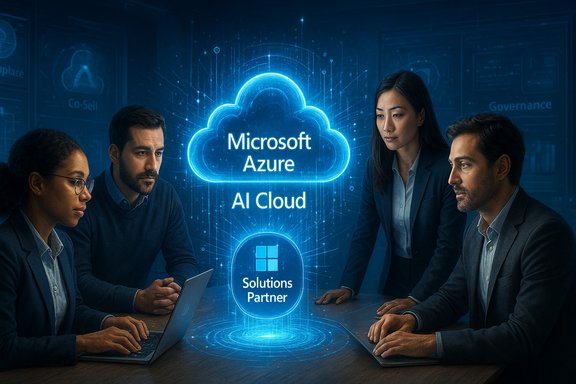
Microsoft’s partner program has been remade for the AI era: the old Silver/Gold competencies are being replaced by the Microsoft AI Cloud Partner Program and Solutions Partner designations, incentives and benefits are being restructured around measurable performance, skilling and customer success, and partners are being asked to become AI practitioners — not just AI resellers — if they want to capture the richest opportunities.
Microsoft’s platform strategy has shifted from pure product distribution to an ecosystem play that centers on cloud, AI, and partner-led delivery. Under Satya Nadella’s leadership the company has prioritized Azure and AI primitives as the core revenue and go-to-market drivers, which has pushed Microsoft to convert partner engagement from licensing resale to outcome-driven services and co-sell models. Annual revenue scale and cloud growth reinforce this strategy: Microsoft reported robust revenue growth with a material lift in Azure contribution, a trend that underpins its partner incentives.
That strategic pivot shapes the partner program in three visible ways:
For partners, the opportunity is clear but conditioned: those who internalize AI, build predictable packages and maintain ongoing performance and skilling will capture the disproportionately large margins Microsoft now promises for consumption-led outcomes. For buyers, the path to safer procurement is equally clear — treat Solutions Partner badges as a positive filter, then demand Partner Center exports, audit letters and production references before awarding critical work.
Microsoft’s partner program is now less an honorary club and more an operational scorecard. For IT pros managing vendor risk, procurement and digital transformation, that is both an opportunity and a responsibility: use the program’s signals, but verify them with the artifacts that matter for reliability, security and long-term business outcomes.
Source: IT Pro Channel focus: All you need to know about Microsoft's partner program
 Background
Microsoft’s platform strategy has shifted from pure product distribution to an ecosystem play that centers on cloud, AI, and partner-led delivery. Under Satya Nadella’s leadership the company has prioritized Azure and AI primitives as the core revenue and go-to-market drivers, which has pushed Microsoft to convert partner engagement from licensing resale to outcome-driven services and co-sell models. Annual revenue scale and cloud growth reinforce this strategy: Microsoft reported robust revenue growth with a material lift in Azure contribution, a trend that underpins its partner incentives.That strategic pivot shapes the partner program in three visible ways:
- Program recognition is now tied to measurable outcomes (consumption, certified headcount, customer success metrics).
- Microsoft privileges co-sell, marketplace and CSP pathways for partners who demonstrate ongoing performance.
- New program tracks and specializations (Copilot, Data & AI, Fabric, SAP on Azure, etc. reward partners who operationalize AI internally.
Overview: What the Microsoft AI Cloud Partner Program actually is
The program at a glance
The Microsoft AI Cloud Partner Program centralizes partner management in Partner Center and replaces legacy competency labels with a structured system built on three pillars:- Performance (measured commonly via Azure Consumed Revenue / ACR),
- Skilling (role-based certifications and sustained enablement), and
- Customer success (usage growth, validated deployments, or audited evidence).
Why Microsoft moved to this model
Microsoft’s goal is to shift partners from transactional resellers into repeatable service providers who drive long-term Azure consumption and measurable customer outcomes. The company views skilling and internal AI adoption as essential differentiators — partners who become so-called Frontier Firms (internalizing AI across operations) are promoted as the model for how partners will capture larger margins and more co-sell opportunities.Key partner pathways and offerings
Solutions Partner designations and specializations
- Solutions Partner designations are awarded based on a partner capability score that aggregates ACR, skilling and customer success points; the baseline guardrail commonly referenced is a 70/100 capability score, though details and thresholds vary by solution and region.
- Specializations (e.g., Copilot Advanced Specialization, Data Warehouse Migration) require stricter gates: minimum ACR tied to eligible workloads, defined numbers of certified practitioners, and either third‑party audits or validated customer references demonstrating repeatable delivery practices. These specializations are delivery‑facing and intended to certify production readiness rather than PoC capability.
Microsoft for Startups, ISV Success and Founders Hub
- Microsoft for Startups offers substantive Azure credits (examples include six‑figure model credits for eligible startups), technical advisory, and access to Microsoft developer ecosystem perks to accelerate product-market fit on Azure. The Founder's Hub bundles benefits like GitHub Enterprise, VS Code features, Azure OpenAI Service access and LinkedIn Premium trials. These channels are aimed at early-stage innovation that feeds into partner-managed commercial opportunities.
- The ISV Success pathways provide packaged value tied to publishing on AppSource/Marketplace, app sandboxing, Copilot developer events, and discounted renewals — with tiered packages (Core, Expanded, Advanced) that increase support and consumption credits.
Surface Reseller Alliance & device programs
Microsoft continues to offer hardware-focused incentive tracks through the Surface Reseller Alliance Program and related device reseller initiatives, providing defined incentives, volume licensing bundles and commercial support for resellers who combine device sales with managed services.Partner benefits, packages and commercial mechanics
Microsoft sells partner benefits packages and offers tiered, paid benefit bundles that grant internal software licenses, advisory hours, and Azure credits. Typical publicly referenced packages include:- Partner Launch Benefits — entry-level package with modest Azure credits and a small seat count for internal use.
- Partner Success Core Benefits — mid-level with larger Azure credit allotments, advisory hours, limited Partner Cloud Support incidents and Microsoft Concierge access.
- Partner Success Expanded Benefits — premium package with maximum product seats, higher Azure credits, unlimited technical sales support, and more advisory and support incidents.
Skilling, certification and the new currency of partner reputation
Role-based skilling
Microsoft Learn, Partner Skilling Hub, and applied skills courses form the backbone of partner skilling. Partners must invest in role-based certifications for presales, sales and technical practitioners to accumulate skilling points required for Solutions Partner designation and for certain advanced specializations. Microsoft now emphasizes certificate counts, active certified headcount, and sustained training programs as procurement signals to customers.Certification churn and transitional rules
As Microsoft retires older certification tracks and introduces new Fabric or Azure AI related credentials, transitional rules apply. Partners need disciplined certification tracking to avoid sudden eligibility gaps caused by exam retirements or newly introduced certification requirements for a specialization.Co-sell, marketplace and incentives: how partners make money
Microsoft has reworked incentives to push partners toward strategic workloads (Data & AI, Modern Work, Business Applications), with growth accelerators and targeted rewards for net-new revenue. Co-sell eligibility, marketplace placement and Partner Center deal registration are the practical tools Microsoft uses to funnel customers to qualified partners. Key commercial mechanics include:- Co-sell: partners who meet the Solutions Partner thresholds and maintain skilling/customer success can access field-seller motions and co-sell referrals.
- Marketplace (AppSource): listed solutions gain easier procurement and standardized onboarding for enterprise customers.
- CSP channels: partners that qualify as Cloud Solution Providers can bundle licensing, implementation and managed services for unified billing and an end-to-end relationship.
The Frontier Firm concept and what Microsoft expects of partners in the AI era
Microsoft’s “Frontier Firms” framing requires partners to internalize AI and demonstrate operationalized AI at scale — not only to deliver AI projects for customers but to run AI themselves (Customer Zero). This includes:- Embedding Copilots and agents internally,
- Demonstrating governance, observability and responsible AI practices,
- Packaging reproducible, measurable offerings (e.g., Copilot deployments with MAU commitments, Fabric-based data governance frameworks).
Critical analysis — strengths and commercial upside
- Strategic alignment with enterprise buyer priorities. By matching partner recognition to Azure consumption and demonstrable customer outcomes, Microsoft helps procurement teams filter vendors based on operational metrics, which shortens evaluation cycles for cloud and AI projects.
- Stronger GTM and co‑sell potential. A validated Solutions Partner designation makes partners discoverable in Partner Center and eligible for co-sell motions, potentially accelerating pipeline and shortening procurement timelines.
- Skilling raises baseline quality. Role-based skilling and certification requirements mean customers can expect a minimum bench of certified practitioners from accredited partners, increasing the odds of repeatable delivery.
- Marketplace and CSP integration enable consolidated commercial relationships. For customers who want a single vendor to own licensing, integration and operations, CSP-enabled Solutions Partners can provide an appealing single-invoice model.
Risks, caveats and practical guardrails
- Badges are an entry signal, not a guarantee. A Solutions Partner designation verifies that Microsoft recorded measurable activity at audit time; it does not substitute for production references, runbooks or security attestations that matter in mission-critical engagements. Buyers should request Partner Center evidence and audited specialization letters.
- Program complexity and shifting thresholds. ACR thresholds, skilling counts and incentive mechanics have moved during the AI Cloud Partner Program rollout; some public Microsoft pages and partner materials can show inconsistent numbers. Validate requirements in Partner Center for the relevant region and fiscal year.
- Maintenance risk. Designations depend on ongoing performance and customer success metrics. A badge today can disappear if a partner’s consumption falls or certified headcount is not sustained — procurement should require current Partner Center evidence at contract signature.
- Marketing compression. Partners’ press releases sometimes conflate meeting prerequisites with receiving audited specializations. Buyers must ask for the specialization certification letter or third‑party audit summary before treating a claim as fully validated.
Practical due‑diligence checklist for IT buyers (actionable)
- Request an exported Partner Center screenshot showing the partner capability score and active Solutions Partner designations.
- For workload specializations (SAP, Copilot, Data Warehouse Migration), obtain the Microsoft specialization certification letter or the third‑party audit executive summary (redacted if necessary).
- Ask for at least three named, contactable references for similar projects, including measurable outcomes: uptime, cost/usage metrics, migration cutover timelines.
- Validate security posture: request SOC 2 or ISO 27001 reports, incident response playbooks, and vulnerability management evidence if the partner manages production systems.
- Include contractual protections: SLAs, rollback/migration warranties, acceptance milestones tied to runbooks and DR tests before major payments.
How partners should convert badges into repeatable customer value
- Map each Solutions Partner designation to a productized offering with clear scope, outcomes and fixed deliverables (for example: a “Data & AI analytics factory starter kit” with governance checkpoints and a 60‑day migration sprint).
- Publish sanitized audit summaries or redacted case studies (under NDA) that align with Microsoft’s audit artifacts so buyers can validate claims without exposing IP.
- Invest in continuous enablement — keep certification rosters current and run internal recertification cadences to avoid sudden skilling gaps.
- Operationalize co-sell and referral workflows inside Partner Center and CRM to make partner-to-partner co-sell repeatable instead of ad-hoc.
Where AI and Copilot change the equation
Copilot and agentic-product integrations are central to Microsoft’s partner pivot. Partners who can:- Provide governed Copilot deployments (observability, adoption metrics, responsible AI guardrails),
- Integrate Fabric/OneLake for reliable RAG (retrieval-augmented generation) data estates, and
- Demonstrate measurable adoption (MAUs, reduction in time-to-value, improved employee productivity)
will be prioritized for deeper GTM motions and co-innovation programs. However, customers should insist on data governance and lineage proofs — AI outcomes heavily depend on data quality and governance work that partners must deliver before Copilot yields measurable business value.
Final verdict — what IT pros should take away
Microsoft’s partner program changes are systematic and intentional: the company has moved from status-based recognition to a metrics-first model that privileges partners who drive Azure consumption, maintain certified benches, and demonstrate customer value. For IT pros and procurement teams, that makes partner selection more evidence-based — but also requires new diligence steps to convert badges into operational assurances.For partners, the opportunity is clear but conditioned: those who internalize AI, build predictable packages and maintain ongoing performance and skilling will capture the disproportionately large margins Microsoft now promises for consumption-led outcomes. For buyers, the path to safer procurement is equally clear — treat Solutions Partner badges as a positive filter, then demand Partner Center exports, audit letters and production references before awarding critical work.
Microsoft’s partner program is now less an honorary club and more an operational scorecard. For IT pros managing vendor risk, procurement and digital transformation, that is both an opportunity and a responsibility: use the program’s signals, but verify them with the artifacts that matter for reliability, security and long-term business outcomes.
Source: IT Pro Channel focus: All you need to know about Microsoft's partner program
