

Microsoft’s recent slide has left value hunters and AI skeptics facing the same paradox: a company that looks unassailable on long-term fundamentals is being re-priced today because investors are wrestling with the short-term economics of AI infrastructure and the headaches of capacity, margins, and concentrated customer exposure.
Microsoft (NASDAQ: MSFT) has spent the last two years positioning itself as the enterprise’s go-to supplier of AI-capable cloud infrastructure, software and productivity tools. That strategic pivot has pulled two forces in opposite directions: a surge in contractually committed demand for AI-hosted services, and an unprecedented level of capital spending to supply those services at scale. The combination has created an unusual earnings dynamic: very strong top-line demand and backlog, paired with near-term earnings pressure driven by heavy infrastructure investment and operational execution issues.
Investors responded harshly to the mismatch between demand and capacity. The argument advanced by some market commentators — neatly captured by the Seeking Alpha piece that framed the pullback as a “gift” — is that the fundamentals remain intact and the sell-off is an overreaction, creating a buying opportunity for longer-term holders. That view is rooted in Microsoft’s broad customer base, recurring-revenue mix, and enormous commercial backlog.
On the more concrete market-impact side, coverage after Microsoft’s latest quarterly update described a dramatic down‑revaluation tied to cloud execution and capacity concerns. Major financial outlets documented a swift market cap haircut as investors digested results that showed strong demand but heavy reinvestment and some near-term execution friction. One leading financial report put the market‑value loss into stark relief after cloud revenue surprised on the downside compared with very high investor expectations.
Analysts responded in different ways: many retained buy or overweight stances but trimmed price targets and warned that the market may be re-rating the company to reflect lower near‑term margin visibility and a higher capital intensity profile tied to AI infrastructure. This combination of retained confidence and lower targets is characteristic of an industry that believes in long‑run opportunity but is uncertain about the near‑term path.
However, the market immediately focused on two sub‑items in that total: the timing of conversion (multi‑year recognition) and concentration. About 45% of the reported commercial RPO has been widely reported as linked to OpenAI-related commitments, which creates an asymmetric risk profile — the backlog is enormous, but a meaningful slice depends on a concentrated counterparty. That raises questions investors must evaluate: how much of that contracted backlog is economically secure, how quickly it converts to revenue, and how much pricing power Microsoft retains as AI workloads scale.
Where the argument is less robust is in underplaying the near‑term cash‑burn and unit‑economics risk. Calling the dip a “gift” implies the downside is limited and the path to upside is largely mechanical. That understates the possibility that execution challenges could force longer-term margin adjustments or that contractual revenue in the backlog could be reweighted or renegotiated over time. In short: the “gift” thesis is directionally sensible for long‑dated investors, but it relies on a successful and timely infrastructure roll‑out.
I also want to flag one practical point: much of the uncertainty is not about demand — enterprises want AI capacity — it’s about the pace and cost of delivery. That makes Microsoft’s story highly operational; management’s ability to extract margin from capex will be the deciding factor for returns, not the raw size of the backlog alone.
For shorter-term or risk-averse investors, the plunge is instead a warning sign: the company’s near-term cash flow and margin profile look different today than they did in the pre‑AI era, and the path to a full payoff is lumpy, operational and contingent on execution, pricing, and a small set of major counterparties. Monitoring Azure growth, RPO conversion, capex efficiency, and customer concentration will provide the clearest read on whether this is merely a temporary repricing or the start of a structural reset.
In plain language: the dip signals risk, but not necessarily permanent impairment. Whether it’s a genuine gift depends on execution. Investors who treat the pullback as a cheap entry must also be disciplined about the specific operational milestones that will ultimately determine the outcome.
End of article.
Source: Seeking Alpha https://seekingalpha.com/article/4872986-microsoft-plunge-a-gift/
 Background
Microsoft (NASDAQ: MSFT) has spent the last two years positioning itself as the enterprise’s go-to supplier of AI-capable cloud infrastructure, software and productivity tools. That strategic pivot has pulled two forces in opposite directions: a surge in contractually committed demand for AI-hosted services, and an unprecedented level of capital spending to supply those services at scale. The combination has created an unusual earnings dynamic: very strong top-line demand and backlog, paired with near-term earnings pressure driven by heavy infrastructure investment and operational execution issues.Investors responded harshly to the mismatch between demand and capacity. The argument advanced by some market commentators — neatly captured by the Seeking Alpha piece that framed the pullback as a “gift” — is that the fundamentals remain intact and the sell-off is an overreaction, creating a buying opportunity for longer-term holders. That view is rooted in Microsoft’s broad customer base, recurring-revenue mix, and enormous commercial backlog.
What happened to the stock — the market reaction in plain terms
In recent quarters Microsoft’s share price underperformed peers even as revenue and headline profits beat expectations. The Seeking Alpha write-up highlights that the stock’s relative underperformance recently left it materially cheaper versus historical multiples and peer valuations — a central reason the author labeled the decline “a gift.”On the more concrete market-impact side, coverage after Microsoft’s latest quarterly update described a dramatic down‑revaluation tied to cloud execution and capacity concerns. Major financial outlets documented a swift market cap haircut as investors digested results that showed strong demand but heavy reinvestment and some near-term execution friction. One leading financial report put the market‑value loss into stark relief after cloud revenue surprised on the downside compared with very high investor expectations.
Analysts responded in different ways: many retained buy or overweight stances but trimmed price targets and warned that the market may be re-rating the company to reflect lower near‑term margin visibility and a higher capital intensity profile tied to AI infrastructure. This combination of retained confidence and lower targets is characteristic of an industry that believes in long‑run opportunity but is uncertain about the near‑term path.
Overview: The two central facts that moved the market
1) A huge contracted backlog (RPO) — demand visibility is real, but lumpy
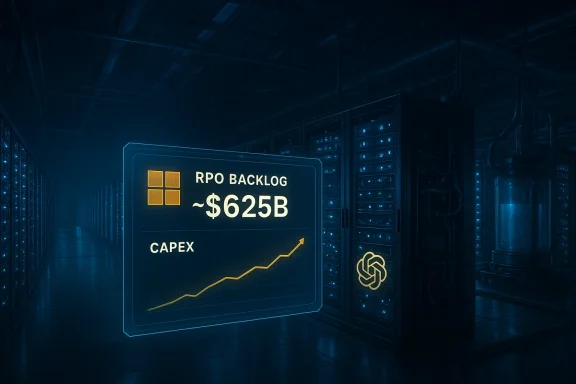
Microsoft’s commercial remaining performance obligations (commercial RPO) spiked dramatically, rising to roughly $625 billion — an increase of about 110% year-over-year in the quarter that recalibrated how investors think about future revenue streams. That backlog is a powerful argument for durable long-term revenue growth: these are contractual commitments that, if honored and converted, imply a long runway of monetization.However, the market immediately focused on two sub‑items in that total: the timing of conversion (multi‑year recognition) and concentration. About 45% of the reported commercial RPO has been widely reported as linked to OpenAI-related commitments, which creates an asymmetric risk profile — the backlog is enormous, but a meaningful slice depends on a concentrated counterparty. That raises questions investors must evaluate: how much of that contracted backlog is economically secure, how quickly it converts to revenue, and how much pricing power Microsoft retains as AI workloads scale.
2) Capital spending and capacity constraints — supply lags demand
Microsoft disclosed a massive surge in capital expenditures as it races to add GPU capacity, datacenter power and cooling to meet AI workloads. Quarterly capex came in well above recent comparables — figures reported in the market commentary put the number near $37.5 billion for the quarter, markedly higher than the prior year and signaling that Microsoft is in the middle of the largest infrastructure investment cycle in its history. Those investments are essential if Microsoft is to monetize the RPO, but they compress near-term cash flow and can push gross margins lower while new capacity is brought online.Why the market punishments make sense — and why they’re not the whole story
When the market re-acts to a company the size of Microsoft it’s rarely about a single number. Instead, the sell-off reflects a confluence of concerns:- Margin uncertainty: AI infrastructure is capital and energy intensive. Building GPU farms and specialized cooling changes the cost base relative to traditional software, where marginal costs were near zero. Investors re-priced for lower near‑term margins even as the company reported strong sales.
- Execution risk: Any signals in the quarter that customers faced provisioning delays, throttled deployments, or deferred projects will cause short‑term downgrades in growth expectations. Execution issues on the supply side matter more in an environment where customers are willing to pay premiums for scarce GPU capacity.
- Concentration and counterparty risk: A large portion of Microsoft’s backlog being tied to a small number of mega‑contracts increases the perceived downside if those counterparties shift strategy or face their own financial stress. The OpenAI concentration is the clearest example that commentators call out.
- Multiple compression for mega-caps: Even high-quality companies can have their multiples trimmed when investors question the long-term free-cash‑flow curve or when the broader sector de-rates. Several sell‑side shops trimmed targets, citing a changed margin story rather than a collapse in demand.
Deep dive: Commercial RPO and what it actually means for investors
Remaining performance obligations represent the dollar value of contracted work that has not yet been recognized as revenue. For Microsoft, the headline RPO of ~$625 billion is compelling because it implies multi-year locked-in demand. But investors must parse three dimensions:- Scale: $625 billion is a staggering number in aggregate and implies years of conversion if recognized at historical cadence.
- Timing: RPO is not immediate revenue. Only a portion (often a quarter’s to a year’s worth) is recognized in the near term, and the remainder stretches across contract lengths.
- Concentration and variability: If a large share is driven by a single or a few mega‑contracts (OpenAI is consistently cited as a major share), the economic risk rises: renegotiation, underperformance by the counterparty, or shifting providers could alter the expected cash flows materially.
The capital-spend paradox: grow now, profit later — or not?
Microsoft’s capex spike is the clearest proximate driver of investor anxiety: when a historically software‑centric company talks like a hyperscaler building industrial AI capacity, financial modelers must revisit assumptions across depreciation schedules, useful life of specialized gear, energy costs, and utilization rates.- Capex magnitude: Market reporting put quarterly capex well above prior-year levels and at historic highs (reported around $37.5 billion for the quarter), which is a material cash outflow and materially changes free cash flow profiles in the near term.
- Unit economics: GPUs, liquid cooling, power contracts and datacenter real estate create a factory-like cost structure. The question is whether the revenue per GPU (or per watt) justifies that capex once depreciation and utilization are fully accounted for.
- Time to monetize: Adding capacity is necessary but takes months to produce revenue. The market penalized Microsoft because it saw strong demand that could not be immediately monetized, which produced a temporary gap between bookings/backlog and recognized revenue.
Strengths that argue against panic selling
- Scale and product breadth — Microsoft is not a single‑product company; its productivity software, enterprise services, and cloud all create cross‑sell and retention advantages that smaller vendors lack. That mix creates defensive cash flow even when infrastructure spending is high.
- Contracted demand — the $625B commercial RPO is not vanity; it is a signal of long‑term enterprise commitments that provide visibility. Even a fraction of that converting at reasonable margins is a material growth engine.
- Balance sheet and capital allocation — Microsoft has the balance-sheet flexibility to fund large capex and continue returning capital through buybacks and dividends, which supports the “wait it out” investor playbook. Professional observers note that the company’s capital allocation remains disciplined despite elevated capex.
- Strategic partner positions and enterprise lock-in — large enterprise customers that standardize on Microsoft’s stack create switching costs that are empirically hard to overcome, especially in regulated or mission-critical use cases. This increases the odds that large portions of the backlog translate into long-term revenue.
Material risks that justify caution
- OpenAI concentration: A large single-customer exposure in the RPO introduces tail risk. If OpenAI shifts providers, renegotiates, or faces financial stress, the implications for Microsoft’s conversion rates and growth outlook would be non-trivial. Analysts flag this as a central risk to the “buy-the-dip” case.
- Execution / timing risk: Building and bringing AI-first datacenters online is a complex, multi-year project. Any slips on power agreements, supply chain, liquid cooling installations, or regulatory hurdles could delay monetization and amplify the margin squeeze.
- Commoditization and competition: If competitors (other hyperscalers, specialized AI infrastructure vendors, or lower‑cost regional providers) win on price or capability, Microsoft’s premium will shrink and expected returns on new capex could fall.
- Multiple contraction & macro risk: The broader de-rating of large-cap tech can exacerbate stock declines even for high-quality names, particularly if investors collectively decide the sector needs lower forward multiples because of higher capital intensity.
Practical signals and metrics to watch (investor checklist)
If you’re considering this as a buying opportunity, these are the specific, observable metrics and milestones to track before committing capital or adding to positions:- Sequential Azure growth and bookings — look for stability or re-acceleration in Azure (and AI segment) revenue growth on a constant‑currency basis.
- RPO conversion cadence — monitor the portion of RPO expected to convert in the next 12 months and any shift in the share of RPO tied to single counterparties.
- Capex efficiency — watch gross margin trends and free cash flow per dollar of incremental capex. Improvements here signal better monetization of new capacity.
- Pricing and contract terms — evidence that Microsoft can sustain pricing for AI compute (or capture premium pricing for latency, security, or scale) will be a sign the unit economics are intact.
- Analyst revisions and guidance quality — changes in consensus forecasts and management guidance that narrow uncertainty will tend to stabilize the multiple.
A framework for action: tactical options for different investor types
- For long‑term, conviction investors: consider phased buying or dollar‑cost averaging rather than a lump-sum “now or never” purchase. Microsoft’s strategic position implies high optionality, but the path to improved returns is uneven. Phasing reduces timing risk tied to noisy quarterly prints.
- For value traders: identify a target valuation band based on normalized margins after capex amortization and buy when price-to-earnings or price-to-free-cash-flow metrics fall materially below that band. Make sure you have an exit plan tied to clear catalysts (RPO conversion cadence, margin stabilization, or capex efficiency metrics).
- For yield-seeking investors: the dividend and buyback story remains intact; if you prioritize cash returns, evaluate yield relative to opportunity cost and be mindful of the long-term nature of the required capex.
Critical reading of the Seeking Alpha “gift” thesis
The Seeking Alpha article’s central argument — that the plunge is a gift — rests on the following claims: Microsoft remains dominant, the valuation now looks cheaper compared with peers, and the company’s backlog and product set ensure long-term upside. Those are fair points; they are the reason many professional investors are still constructive.Where the argument is less robust is in underplaying the near‑term cash‑burn and unit‑economics risk. Calling the dip a “gift” implies the downside is limited and the path to upside is largely mechanical. That understates the possibility that execution challenges could force longer-term margin adjustments or that contractual revenue in the backlog could be reweighted or renegotiated over time. In short: the “gift” thesis is directionally sensible for long‑dated investors, but it relies on a successful and timely infrastructure roll‑out.
I also want to flag one practical point: much of the uncertainty is not about demand — enterprises want AI capacity — it’s about the pace and cost of delivery. That makes Microsoft’s story highly operational; management’s ability to extract margin from capex will be the deciding factor for returns, not the raw size of the backlog alone.
Scenarios: how this plays out (probabilities are illustrative)
- Base case (most likely, in my judgment): Microsoft successfully scales capacity over 12–24 months, utilization improves, and margins recover gradually. Stock re-rates as investors gain confidence in capex returns. The RPO converts over several years into strong recurring revenue. (Outcome: slow but persistent share appreciation; multiple stabilizes around a modest premium to large-cap peers.)
- Bull case: Monetization is faster than feared, pricing holds due to scarcity, and Microsoft executes capex with better-than-expected efficiency. Backlog turns into outsized free cash flow growth. (Outcome: sharp multiple expansion and significant upside.)
- Bear case: Competition and commoditization reduce pricing power, capex monetization is slower, and a meaningful portion of contracted backlog faces renegotiation or delayed recognition. Margin pressure persists for multiple quarters. (Outcome: prolonged underperformance or re-rating to lower structural multiple.)
Conclusion — what Microsoft’s plunge means to different readers
For long-term, technology‑oriented investors willing to tolerate near-term margin cyclicality, Microsoft’s sell-off presents an asymmetric opportunity: the company’s scale, product breadth, and enormous backlog create the potential for high returns if capex converts efficiently. That’s the core of the “gift” thesis advocated by value-minded commentators.For shorter-term or risk-averse investors, the plunge is instead a warning sign: the company’s near-term cash flow and margin profile look different today than they did in the pre‑AI era, and the path to a full payoff is lumpy, operational and contingent on execution, pricing, and a small set of major counterparties. Monitoring Azure growth, RPO conversion, capex efficiency, and customer concentration will provide the clearest read on whether this is merely a temporary repricing or the start of a structural reset.
In plain language: the dip signals risk, but not necessarily permanent impairment. Whether it’s a genuine gift depends on execution. Investors who treat the pullback as a cheap entry must also be disciplined about the specific operational milestones that will ultimately determine the outcome.
Quick reference: what to watch next (summary checklist)
- Azure and AI services sequential revenue growth and margin trends.
- Quarterly capex and commentary on utilization and depreciation schedules.
- RPO composition and the share attributable to a small group of counterparties.
- Management commentary on pricing power, allocation policies for scarce GPUs, and customer prioritization.
- Analyst revisions around targets and consensus free cash flow assumptions.
End of article.
Source: Seeking Alpha https://seekingalpha.com/article/4872986-microsoft-plunge-a-gift/
