

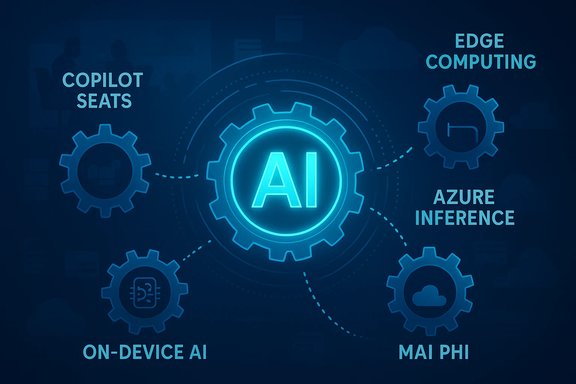
Microsoft’s sudden place at the center of headlines isn’t the result of a single watershed moment — it’s the product of several high‑visibility threads snapping into alignment: a fresh investor thesis built on AI monetization, a major restructuring with OpenAI, big model and on‑device AI announcements, public executive soundbites that went viral, and a high‑severity security disclosure that forced enterprises to reassess the new attack surface AI introduces. Together, these dynamics explain why everyone from retail investors to sysadmins and privacy watchdogs is suddenly obsessed with MSFT.
Background / Overview
Microsoft has been repositioning itself for years from a software and OS company to an integrated cloud + productivity + AI platform. That strategy — stitch generative AI into Office, Windows, Azure, GitHub and Surface — is now maturing into a concrete monetization path: seat‑based Copilot revenue combined with metered Azure inference and storage consumption. Analysts and CIO surveys see this combination as a “seat-to-cloud” flywheel that could convert product integration into durable revenue. Recent community analyses and analyst notestecture and why the market is paying attention. The reason the story intensified in public discourse this month is simple: the slow grind of technology rollouts intersected with several splashy events — a high-profile executive post that inflamed social media, Satya Nadella’s public essay reframing the debate around "slop," new in‑house model launches and on‑device ambitions, and a serious AI‑agent vulnerability that made security and compliance teams sit up. Each is material to a different audien produf coverage, shorthand memes, investor speculation, and enterprise reassessment.What actually happened — the visible triggers
Executive rhetoric that became a headline
Mustafa Suleyman, CEO of Microsoft AI, posted blunt reactions to the wave of consumer and enthusiast criticism aimed at Microsoft’s “agentic OS” roadmap; his comments — calling the degree of skepticism “mind‑blowing” — were widely quoted and framed as an executive pushback against public cynicism. That sort of soundbite traves about corporate tone and priorities. At the same time, Satya Nadella published a longform reflection urging the industry to “get beyond the arguments of slop vs sophistication,” reframing the conversation from spectacle to engineering, governance and measurable outcomes. Nadella’s essay was quickly picked up by trade press and amplified across social platforms, becoming the CEO‑level counterpoint to the on‑the‑ground pushback. Why this matters: when both the head of product engineering and the CEO are publicly engaged in a debate over AI’s usefulness and framing, the conversation moves from fandom and fandom backlash to procurement, policy and regulatory risk.Model and product announcements (real engineering traction)
Microsoft has moved aggressively to own more of the model stack. The Phi family (Phi‑4, Phi‑4‑mini, Phi‑4‑multimodal) and the MAI in‑house models (MAI‑1‑preview, MAI‑Voice‑1, MAI‑Image‑1) represent a tangible pivot from third‑party model reliance toward building and shipping Microsoft’s own foundation and small language models across cloud and devices. These launches are technically substantive: Phi‑4‑mini and Phi‑4‑multimodal are explicitly optimized for on‑device efficiency and multimodal inputs, and MAI models are now live in select Copilot experiences. Those releases generated developer experimentation, benchmark comparisons and product coverage that spurred sustained attention.A major re‑structuring with commercial teeth
The recapitalization and re‑structuring of OpenAI’s corporate form changed the public calculus. Microsoft now holds a large equity stake in the new OpenAI structure and negotiated long‑term commercial commitments from OpenAI for Azure services — figures widely reported in the market include an approximate 27% equity position and an OpenAI commitment to purchase hundreds of billions in Azure services over time. That arrangement materially increases revenue visibility for Azure and solidifies Microsoft’s position in enterprise AI infrastructure planning. The scale and publicity of that deal — and the way it reduces uncertainty about a major model provider’s long‑term cloud footprint — helped re‑rate investor expectations.Security drama — EchoLeak and the new AI attack surface
A red‑flag security discovery — dubbed “EchoLeak” by researchers — exposed how retrieval‑augmented generation (RAG) agents could be manipulated into exfiltrating sensitive tenant data without user interaction. The vulnerability (CVE‑2025‑32711) was disclosed responsibly, Microsoft mitigated the issue server‑side, and publicly stated there was no evidence of in‑the‑wild exploitation. Still, the discovery crystallized a new class of zero‑click AI threats and triggered enterprise checklists and policy reviews. Security coverage of EchoLeak moved the debate from hypothetical risk to real mitigation and governance work.The technical truth: models, hardware and economics
Models: from OpenAI ties to a hybrid model ecosystem
Microsoft’s technical posture is now multi‑pronged. It continues to integrate OpenAI models where appropriate, but has simultaneously launched its own Phi and MAI model families designed to be efficient, multimodal, and deployable on device or edge nodes. Phi‑4‑mini, for example, is explicitly built for constrained hardware while preserving reasoning performance; Phi‑4‑multimodal supports text, audio and image inputs natively. Meanwhile, MAI models cover speech and image generation for productized Copilot features. This reduces Microsoft’s product risk from third‑party changes while letting it tune models to product constraints.Hardware and capex: the $80B infrastructure bet
Microsoft publicly signaled a multibillion‑dollar infrastructure escalation to secure GPU capacity and datacenter scale for AI workloads. The company confirmed plans to spend roughly $80 billion on AI‑optimized infrastructure within the fiscal year window reported — money aimed at GPUs, liquid cooling, power and regional capacity provisioning. The economics of that investment are central: Azure hosts metered inference workloads that can be highly profitable, but only if capacity utilization is high and customers consume inference at scale. That’s the core execution risk investors are watching.Copilot monetization: seats + metered consumption
Microsoft’s product and revenue thesis rests on two complementary levers:- Seat monetization: Microsoft 365 Copilot is priced for enterprises; public list pricing cites roughly $30 per user per month for the full Microsoft 365 Copilot enterprise SKU. This gives analysts a concrete per‑seat ARPU to model.
- Metered cloud consumption: Copilot and vertical copilots will generate inference and storage usage on Azure, which is billed as variable cloud consumption — a high‑margin revenue stream if customers scale workloads.
Why Wall Street and CIOs care — the Morgan Stanley case study
Morgan Stanley’s CIO survey is the kind of industry signal that translates boardroom intent into analyst models. The survey found modestly higher planned software budgets for 2026 (about 3.8%) and reported significant intent to adopt Microsoft‑centric AI services: notable fractions of CIOs indicated plans to use Azure OpenAI Services, GitHub Copilot and Microsoft 365 Copilot, and that a majority of surveyed application workloads already run on Azure (the survey cohort reported ~53% on Azure). Analysts used those directional signals to argue Microsoft is the “#1 share gainer” from incremental AI and cloud spend. That narrative — corroborated across multiple analyst notes — is a central reason MSFT is back in investor focus. Treat the survey as directional but not determinative: intent must convert into bookings and consumption to flow through to revenue.Strengths: why Microsoft is receiving sincere, structural attention
- Scale and integration: Microsoft’s cross‑product network (Office → Teams → Azure → Windows → GitHub) is uniquely positioned to convert seats into cloud spend. Once Copilot workloads run across a tenant’s Microsoft stack, the switching cost is real.
- Enterprise trust and contracts: Long enterprise procurement cycles, compliance offerings and hybrid cloud options favor incumbents who can deliver governance and SLAs.
- Multi‑model strategy: Maintaining OpenAI ties while building Phi and MAI reduces external dependency risk and lets Microsoft tailor models to product, cost and *Visible revenue anchors**: Seat pricing, multi‑year OpenAI commitments to Azure, and public capex plans give analysts inputs for long‑term cashflow modeling.
Risks and the balancing act: where the obsession could sour
1. Execution risk on capital efficiency
Large capital outlays only pay off if capacity utilization is high. The $80B infrastructure plan is defensible as “necessary” but will pressure margins unless Microsoft efficiently converts capacity into paying workloads. Analysts have flagged both the upside and the danger of over‑build.2. Adoption friction and behavioural limits
Enterprise intent surveys show willingness to pilot AI, but operationalizing Copilot across tens of thousands of seats is nontrivial: governance, FinOps, integration, and the human change management required are real bottlenecks. Early Copilot pricing and the required security posture means adoption willustries and tenant sizes.3. Security and new attack classes
EchoLeak crystallized a novel class of AI attack patterns — LLM scope violations — where a retrieval or agent component inadvertently brings external, malicious prompts into a model’s context. While Microsoft mitigated the reported issue and sees no evidence of exploitation, the conceptual risk remains: as agents gain broader access to tenant resources, novel vulnerabilities will emerge that require a fundamentally new set of DLP, isolation and threat modeling tools. Enterprises must assume continuous insecurity until robust agent‑centric defenses mature.4. Reputational friction and consumer pushback
The “Microslop” meme, browser extensions that mock the brand, and vocal community resistance to baked‑in AI demonstrate that consumer trust is a fragile asset. Aggressive defaults, poor reliability, or tone‑deaf messaging can compound into brand‑level reputational costs — and potentiiny. Community coverage and subculture protests are small now; they can influence policy discussions and enterprise sentiment if they broaden.5. Regulatory and antitrust risk
Microsoft’s scale and the OpenAI pact have drawn scrutiny. Regulators globally are laser‑focused on potential anti‑competitive bundling and data‑practice risks in AI and cloud. Any regulatory intervention that restricts packaging, data access or commercial arrangements could materially change the monetization thesis. The interplay of competition law and national security concerns over AI compute could produce hard constraints in some jurisdictions.Practical KPIs to watch (what IT pros and investors should track)
- Copilot seat adoption and billed seats (not just trials).
- Azure AI revenue mix and percent of Azure growth attributable to AI inference; margin trajectory of Microsoft Cloud.
- CapEx cadence: actual spend vs guidance and the conversion of capacity into paying inference hours.
4.(>$100M) and incremental remaining performance obligations tied to AI workloads. - Security disclosure cadence: agent/LLM vulnerabilities discovered and whether mitigations are server‑side or require tenant action.
What this means for Windows users, IT admins and enterprise buyers
- For IT: treat Copilot as an application platform that must be governed like email or identity. Expect to revise DLP, audit, conditional access and FinOps processes, and test agent privileges in staging environments before production rollout. EchoLeak showed that standard app defenses are insufficient against crafted RAG attacks.
- For security teams: add agent‑aware monitoring and anomaly detection to the baseline. Validate data‑exfiltration detection across model outputs and network egress. Prioritize server‑side mitigations and lean on vendor advisories for immediate patches.
- For procurement: price per seat is now a real economic input. Model seat adoption, expected per‑seat AI credit consumption, and manage expectations for the transition from pilot to enterprise scale.
- For Windows end users: expect more AI‑first features and deeper Copilot integration in the OS. That can boost productivity but can also change defaults and privacy surfaces; check settings and corporate policy if you care about telemetry and local vs cloud processing.
The reputational and cultural fault lines
Two cultural dynamics matter. First, Microsoft executives’ public frustration with critics — whether Suleyman’s “mind‑blowing” remark or the CEO’s reframing of the “slop” debate — can look tone‑deaf if product reliability issues persist. Second, the grassroots “Microslop” backlash signals that enthusiasts and everyday users will amplify and meme‑ify perceived missteps faster than corporate PR can correct them. The company’s branding, messaging cadence and default options will determine whether this engagement is constructive or corrosive.Verdict — the near‑term scorecard
- The bullish thesis is real and structurally plausible: Microsoft holds important distribution, a path to monetize AI across seats and cloud, and a large, public multi‑year commitment from OpenAI that adds revenue visibility. Those are not trivial advantages.
- The execution risks are also real and measurable: massive capex must be absorbed, enterprise adoption must accelerate from pilots to broad seat purchases, security and be closed, and regulatory pressure could constrain packaging and data practices.
Practical next steps for readers (concise checklist)
- If you manage IT budgets: model Copilot adoption conservatively—assume incremental pilots, governance overhead, and phased seat purchasing.
- If you run security: allocate time to test agent controls, DLP integration with RAG systems, and to validate vendor mitigations for agent‑related CVEs.
- If you invest: size positions to reflect both the structural upside and the nontrivial execution risk; watch the five KPIs above each quarter.
- If you build Windows apps: begin assessing how Copilot‑native experiences change UX flows and what privacy/consent overlays you must surface.
Microsoft’s current limelight is the product of engineering, commercial, cultural and security threads all converging. The company’s scale and integration give it a credible shot at shaping the next decade of enterprise AI — but the path is not a straight line. The market’s obsession is justified by the potential; the skepticism is justified by the execution challenges and emergent risks. The next several quarters will show whether Microsoft can turn this intense attention into durable, predictable value for customers and shareholders — or whether the narrative will tilt toward a cautionary tale about scale, speed and the hard work of responsibly operationalizing AI.
Source: AD HOC NEWS https://www.ad-hoc-news.de/boerse/n...-everyone-is-suddenly-obsessed-with/68493722]
