• Thread Author
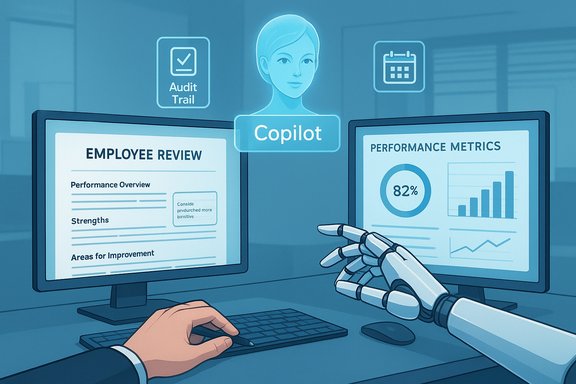
Human and robotic Copilot review employee performance on dual monitors.
Microsoft’s push to have employees lean on AI for routine work—including the way performance reviews are written—has rippled through the company and beyond. In June 2025 a division leader’s internal note made clear that AI adoption would be treated as a core expectation, and reporters and commentators have since connected that directive to a broader industry trend of tying AI fluency to performance and career outcomes. The result: a debate that mixes practical productivity questions, concerns about quality (what people call “AI slop”), fairness in evaluation, and basic questions of trust and governance.
Why this matters now (short version)
  • A June 2025 internal message from Julia Liuson — who runs Microsoft’s developer tools / GitHub-related organization — asked managers to consider employees’ use of internal AI tooling as part of “holistic reflections” on performance. That memo included the line that “using AI is no longer optional,” and it explicitly encouraged managers to factor AI adoption into how they evaluate people.
  • Several outlets have reported that some teams are considering or piloting formal metrics that would measure AI tooling usage as part of reviews; other companies in Big Tech are moving in the same direction.
  • That shift has practical consequences for everyday work (what tools you use and how you document output), for how managers assess staff, and for the culture inside organizations that now see AI as central to “how we work.”
What the memo said, in context
  • The core message attributed to Julia Liuson in reporting was: “AI is now a fundamental part of how we work. Just like collaboration, data-driven thinking, and effective communication, using AI is no longer optional — it’s core to every role and every level.” Managers were asked to make AI usage “part of your holistic reflections on an individual’s performance and impact.” That line is what sparked headlines about mandatory AI adoption and the idea that AI could affect reviews and promotions.
  • Reporters framing the story noted the memo is one signal among many: product teams want higher internal adoption of Copilot and other Microsoft AI services; investors and analysts are watching adoption metrics; and leadership is signalling that the company’s strategy depends on the workforce actually using the tools it sells. Those dynamics help explain the urgency in the language.
“AI slop”: the quality problem and why people use that phrase
  • When people call model output “AI slop” they’re pointing to the common experience of receiving plausible-sounding but low-quality, weakly specific, or factually shaky text from generative models—boilerplate that needs heavy editing to actually be useful. This term has moved from forums into journalism because employees and managers often describe AI drafts of reviews, emails, or design documents as “slop” when they’re repetitive, generic, or obviously machine-generated.
  • That quality problem matters here because the very thing leaders want—faster drafting and consistent language—can backfire if the output is impersonal, inaccurate, or misapplied in decisions that affect careers. An AI-written paragraph about someone’s “impact” that contains errors or obvious generic phrasing can feel insulting to the employee and risky for a manager who later has to justify ratings or promotions.
How reporters and analysts corroborated the memo (two independent sources)
  • Business Insider obtained reporting about the internal note and published the key quotes and context around managers being asked to consider AI use when reflecting on employee performance. That article is the primary outlet most other writeups cite.
  • Forbes and other business outlets framed the same development as part of an industry trend: companies are increasingly asking staff to show “AI-driven impact” and sometimes offering internal tools (or assistants) to help staff write reviews. That trend is visible across multiple large employers.
What this looks like in practice (scenarios)
  1. The manager who uses AI to draft 20 reviews in an afternoon
    • A manager might feed bullet notes into Copilot, get first-draft paragraphs back, edit, and finalize. That saves time—but if editing is cursory, the voice becomes generic and employees notice the boilerplate. Over-reliance without human personalization produces feedback that undermines morale.
  2. The engineer told to use Copilot every day
    • Developer teams are being asked to experiment with and use internal coding assistants in their workflow. For some engineers, this genuinely speeds debugging and scaffolding; for others, it’s an added review burden because the generated code needs careful inspection and fixes.
  3. The employee who pastes a generic AI self-evaluation into the form
    • Workers tempted to paste AI output into self-assessments risk misrepresenting facts or losing the authenticity of their voice. HR practices and calibration meetings may catch some errors, but inconsistent editing and the presence of “AI disclaimers” (or even obvious template text) have surfaced in real internal examples and public anecdotes.
Risks and critiques (what advocates and critics both point to)
  • Quality and accuracy: Generative models can hallucinate facts, misstate dates, or invent metrics. Using them to draft review language that feeds compensation decisions raises clear accuracy and fairness issues.
  • Dehumanization: Boilerplate AI language reduces the personal tone of feedback, making recognition feel transactional. That damages morale and trust if employees feel their manager didn’t meaningfully evaluate them.
  • Incentive misalignment: If adoption metrics are tracked (raw Copilot calls, number of queries, etc., teams may gamify the measures—calling “use of AI” a proxy for performance rather than a demonstrable impact on outcomes.
  • Legal and compliance exposure: Depending on data handling and model training, using AI to process proprietary documents or sensitive performance notes can create privacy or IP risk if not governed properly.
  • Unequal access and skill gaps: Not everyone is equally skilled at prompting or evaluating AI output. Turning AI fluency into a performance criterion without training or remediation risks penalizing those who lack access or prompt-engineering experience.
Why leadership is pushing this: the logical case
  • Product-market alignment: Microsoft (and other Big Tech companies) earn revenue from AI products; higher internal adoption helps product teams find bugs, improve UX, and demonstrate enterprise ROI to customers. There’s a strategic carrot-and-stick element: the company wants its own employees to be flagship users.
  • Productivity hypothesis: Leaders argue that AI frees time from routine tasks to concentrate on higher-value work. Where that happens, it can boost throughput and allow people to focus on judgment-intensive tasks.
  • Competitive posture: In a market where rivals loudly say “you must use AI,” not using it can be framed internally as falling behind on the firm’s core strategic capabilities.
Why “mandatory” language is different from mandatory audits
  • Saying “using AI is no longer optional” is rhetorical pressure to adopt tools, not necessarily a straight rule that an employee must submit evidence of X Copilot actions. The nuance matters: managers were told to include AI adoption in their reflections about performance, not to grade people solely on raw usage counters. How teams operationalize that guidance will determine whether it becomes punitive, developmental, or merely descriptive.
Practical guardrails managers should apply (recommended)
  1. Human-in-the-loop requirement
    • Never accept an AI draft as final. Require managers to edit and personalize every review paragraph and to document what was changed.
  2. Source-provenance checks
    • If the AI produced a fact (e.g., “you increased conversion by 32%”), ensure the manager attaches or references the data source.
  3. Train-and-test
    • Provide mandatory, role-specific AI-skilling sessions that include safe prompting, bias detection, and validation techniques before usage affects formal assessments.
  4. Transparency with employees
    • If a manager used AI to draft feedback, the review meeting should include a human explanation of the reasoning behind the rating and specifics that the AI could not produce (context, trade-offs, subjective judgments).
  5. Don’t turn adoption into a raw metric
    • Measure outcomes (time saved, features shipped, customer impact), not raw Copilot query counts. Raw usage is a poor proxy for impact.
Policy levers HR and legal should consider
  • Audit trails: Implement logging that records AI outputs, prompts used, and edits made for performance-critical documents (with employee notice).
  • Privacy guardrails: Block high-risk data from being sent to external models; vet allowed models for training-data provenance and retention policies.
  • Dispute-resolution mechanisms: Create a clear path for employees to contest review language that appears inaccurate or machine-generated without human context.
  • Calibration and bias mitigation: Use diverse calibration panels to spot patterns where AI-assisted reviews systematically under- or over-value certain groups.
What employees should do (practical steps)
  • Own your narrative: Keep notes throughout the year (achievements, metrics, feedback) so you can feed accurate inputs to any AI tool and then verify the output.
  • Use AI as a drafting partner, not an autopilot: Use prompts to produce drafts, then edit heavily to add voice and specificity.
  • Document sources: When you paste AI-crafted claims into a self-evaluation, attach links or evidence (dashboards, PRs, customer quotes).
  • Push for transparency: Ask HR or managers how they expect AI to be used in your review cycle and whether there are support resources or training.
Broader governance and public policy considerations
  • Fairness and auditability: If AI adoption influences pay and promotion, regulators and labor advocates may demand auditability and a clearer definition of what metrics are used and why.
  • Worker upskilling and access: Firms should fund equitable training programs; otherwise, tying outcomes to AI fluency will advantage already-resourced employees.
  • Disclosure and consent: Employers should disclose if parts of reviews will be AI-assisted and should obtain employee consent for how their data is used in the generation/editing pipeline.
Voices from the field (what community threads and reporting reveal)
  • Public anecdotes—forum threads and internal leak reporting—show managers sometimes copy-pasting AI drafts with minimal edits; employees notice canned language and sometimes find factual errors or embarrassing boilerplate. That phenomenon is what people often refer to as “AI slop.”
  • Commentary from analysts and business outlets contextualizes the memo as part of a larger push across major tech firms to make AI fluency a career currency. Some see this as inevitable; others warn it’s premature without proper guardrails and training.
What a sensible rollout might look like (step-by-step)
  1. Pilot phase with opt-in teams (3–6 months)
    • Select teams, provide training, instrument tools to measure both usage and the quality of outputs.
  2. Measurement design (concurrent)
    • Define outcome-based KPIs (e.g., time saved on administrative tasks, defect reduction in code generated with AI, customer-facing metrics) instead of raw usage counters.
  3. Transparency and consent (policy)
    • Publish an internal AI use policy that clarifies permitted models, data handling, and disclosure requirements for performance documentation.
  4. Calibration and audit (quarterly)
    • Run blind calibration sessions to check for biasing patterns and adjust guidance.
  5. Company-wide rollout with remediation
    • Scale only after pilots show meaningful productivity or quality gains and after training and governance structures are in place.
A closing assessment
  • The technology’s promise is real: AI can reduce grunt work, surface forgotten accomplishments for reviews, and help managers synthesize feedback. But the promise is conditional on human oversight, governance, and a careful focus on outcomes rather than raw usage tallies. Without those precautions, the risk is a culture that rewards quantity of AI queries rather than quality of work, or a workplace where people feel their careers hinge on ability to “prompt-engineer” rather than deliver sustained impact.
Final takeaway (for managers, employees, and policy makers)
  • Managers: Use AI to help organize facts and craft first drafts, but always add human judgment, context, and specificity before a review is final.
  • Employees: Treat AI as a drafting assistant—keep evidence, own your story, and ask for clarity on how AI will be used in any evaluation that affects pay or promotion.
  • HR and leaders: If you plan to embed AI use in reviews, design outcome-focused measures, provide training, ensure auditability, and be transparent with employees.
Notes on sources and verification
  • This feature is grounded in contemporaneous reporting of an internal Microsoft memo first reported in late June 2025 and widely discussed thereafter. Business Insider reported the memo and provided the direct quote attributed to Julia Liuson; analysis and context are available in business coverage that followed.
  • Community and internal discussion fragments reflecting the phrase “AI slop” and examples of low-quality AI output are captured in public forum archives and internal commentary that we reviewed as part of this piece. Those excerpts illustrate the lived experience that drives employee skepticism about boilerplate AI reviews.
Conclusion
The debate is not whether AI will be used at work—AI is already here—but how it will be integrated into managerial practice in a way that protects fairness, accuracy, and the human relationships that make feedback — and careers — meaningful. Microsoft’s memo signalled a clear strategic direction; how that direction is operationalized will determine whether the outcome is better, more consistent reviews or a proliferation of impersonal “AI slop” that destroys trust. The choice between those futures is not automated—it's managerial.

If you’d like, I can:
  • Expand any of the sections above into a standalone deep-dive (for example, a manager’s playbook with editable templates and a sample training curriculum).
  • Produce a short policy memo HR could use to pilot an AI-assisted review program (with suggested wording for disclosure, audit trails, and appeals).
  • Create a primer for employees on how to craft evidence-backed self-evaluations that pair well with AI drafting tools.

Source: Neowin https://www.neowin.net/news/microso...te-ai-slop-for-performance-reviews-this-year/
 

Wipro’s new three‑year strategic partnership with Microsoft aims to accelerate enterprise AI adoption by converting clients into so‑called Frontier Firms—organizations that embed Copilot and agentic AI into core workflows, build industry‑specific copilots, and scale human+agent operating models across business functions. The agreement combines Wipro’s consulting‑led delivery and branded suite Wipro Intelligence™ with Microsoft’s cloud and AI stack — including Azure, Microsoft 365 Copilot, GitHub Copilot, and Azure AI Foundry — and establishes a Microsoft Innovation Hub inside Wipro’s Partner Labs in Bengaluru to co‑innovate, prototype, and commercialize vertical solutions.

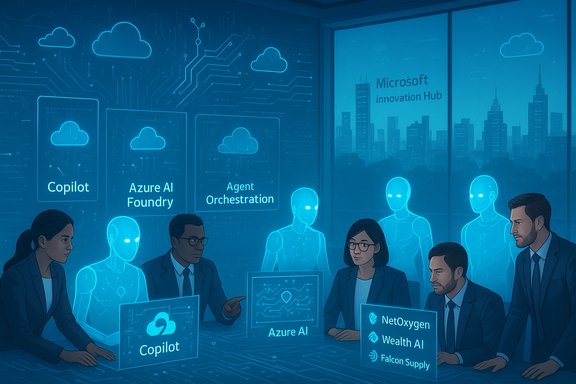
Professionals in a Microsoft Innovation Hub gather around holographic AI panels, including Copilot and Azure AI Foundry.Background​

Microsoft used a high‑profile India AI tour event to frame a broader partner strategy that elevates a handful of global systems integrators as “Frontier Firms” capable of industrializing agentic AI at scale. The announcement links a large Microsoft infrastructure and skilling commitment in India to partner‑led Copilot rollouts across enterprise services. In this context, Wipro’s three‑year pact with Microsoft signals a deeper, industry‑focused co‑innovation approach centered on enterprise copilots, agent marketplaces, and vertical IP integration. Wipro’s announcement highlights three concrete pillars:
  • Platform integration: Azure + Microsoft Copilot family + Azure AI Foundry.
  • Internal modernization and Client Zero: deployment of Copilot internally to package proof points into client offerings.
  • Co‑innovation: a physical Microsoft Innovation Hub and an Agent Marketplace to accelerate prepacks and pilots.

What the partnership actually includes​

Core product and platform elements​

  • Microsoft Azure as the cloud and data platform backbone.
  • Microsoft 365 Copilot for knowledge‑worker augmentation and enterprise workflows.
  • GitHub Copilot to accelerate engineering productivity and code generation.
  • Azure AI Foundry and Copilot Studio for model routing, governance, and agent orchestration.
  • Integration with Wipro’s proprietary IP — NetOxygen, Wealth AI, and Falcon Supply Chain — to create sector‑specific copilots and accelerators.

Scale and skilling commitments (public claims)​

Wipro publicly states the internal deployment of over 50,000 Microsoft Copilot licences and an upskilling program covering more than 25,000 Wipro employees on Microsoft Cloud and GitHub technologies. These figures are presented as part of Wipro’s Customer Zero play and are being repeated in industry coverage. Independent coverage corroborates the headline seat and training numbers as partner commitments announced during Microsoft’s India events. Treat these as material commercial commitments and staged rollouts rather than instantaneous, fully activated seat counts.

Joint GTM and industry focus​

The collaboration targets industry verticals where Wipro already has established capabilities: Financial Services, Retail, Manufacturing, Healthcare & Life Sciences, and Airports, with a go‑to‑market that emphasizes consulting‑led outcomes and packaged vertical solutions built on Wipro Intelligence™ and Microsoft’s agent platform. The Microsoft Innovation Hub will host client workshops, co‑development sprints, and demonstrations of Wipro’s Agent Marketplace agents built on Microsoft technology.

Why this matters: the strategic logic​

Platform + partner = faster scale​

Hyperscalers and systems integrators have complementary assets: Microsoft supplies the cloud, models, orchestration tooling, and platform governance; Wipro supplies vertical IP, delivery capacity, and customer relationships. When an SI adopts a platform internally at scale (Customer Zero), it shortens time‑to‑market for client offerings and provides reusable templates for industry copilots. This alignment accelerates enterprise adoption by reducing friction in integration, compliance, and skilling.

Signal to market: Frontier Firms and agentic AI​

Microsoft’s “Frontier Firm” framing is intentionally signal‑driven: it positions early adopters who commit Copilot seats and agentic workflows as leaders that will capture disproportionate productivity and revenue benefits. The partner play amplifies Microsoft’s infrastructure investment in India and creates a distribution channel for Copilot‑based offerings across global enterprise accounts.

Vertical IP and reuse​

Wipro brings three named IP platforms — NetOxygen, Wealth AI, and Falcon Supply Chain — that act as accelerators when married to Microsoft’s stack. These vertical frameworks reduce engineering lift and provide industry semantics and connectors so copilots can interact with ERPs, core banking platforms, and manufacturing execution systems faster. Using vertical IP with a common cloud and agent orchestration layer is a textbook way to productize AI services at scale.

Technical and operational implications​

Architecture patterns enterprises will need​

  • Data fabric and identity: Agents need access to timely, governed data. Robust data pipelines, catalogues, and identity/access policies are prerequisites for safe agent behavior.
  • Agent registry and governance: Treat agents as production services with registries, least‑privilege execution roles, audit trails, and observability.
  • Model routing and provenance: Azure AI Foundry/Foundry‑style model catalogues must be configured to route inference to appropriate model endpoints and to record provenance for regulatory and compliance audits.
  • Human‑in‑the‑loop controls: For high‑risk operations, design agent workflows to require explicit human approval or staged escalation.

Cost and capacity realities​

Large Copilot seat numbers signal license commitments, but operational activation involves inference costs, data storage, pipeline engineering, and managed services. Enterprises should budget for:
  • Ongoing inference and vector store costs.
  • Integration and connector development to legacy systems.
  • Monitoring, retraining, and model maintenance.
  • Expanded security operation center (SOC) and AI ops roles.
The headline license counts are important, but total cost of ownership depends on how many agents interact with transactional systems and the frequency of inference calls.

Developer velocity vs governance tradeoffs​

Embedding GitHub Copilot and developer CoEs will raise velocity, but organizations must harden CI/CD pipelines and code review practices to avoid insecure or non‑compliant generated code entering production. Wipro’s GitHub Center of Excellence and upskilling programs are designed to balance speed and control, but buyer contracts should require enforceable security SLAs.

Validation and cross‑checks (what’s verified vs what requires caution)​

  • Verified: Microsoft publicly announced a large India infrastructure and skilling commitment and elevated several systems integrators as partners for Copilot/agentic AI deployments. Independent reporting and Microsoft’s own channels support this narrative.
  • Verified (partner claims): Wipro’s communications describe a three‑year strategic partnership, the launch of a Microsoft Innovation Hub in Bengaluru, the integration of Wipro Intelligence™ with Microsoft platforms, and internal commitments like Copilot licences and upskilling targets. These points are stated in Wipro’s press materials and corroborated by multiple news outlets.
  • Cautionary note: Public “seat” or licence counts and large investment commitments are commonly announced as staged programs. A partner’s statement that it will deploy 50,000+ licences does not necessarily mean all seats are active, billable, or in production on day one. Enterprises and procurement teams should treat such numbers as contractual milestones to be validated with activation metrics, timelines, and commercial terms. Independent analysis and media reporting raise this as a key caveat.

Risks and governance: what enterprises must watch​

Data residency and regulatory exposure​

Agentic AI often requires broad data access. Microsoft’s push for in‑country processing options and sovereign‑ready cloud constructs addresses regulatory concerns in sensitive geographies, but implementation details matter. Organizations in regulated industries should demand:
  • Clear data flow diagrams and in‑country inference guarantees.
  • Auditability of inference logs and model inputs/outputs.
  • Contractual commitments on data retention and breach responsibilities.

Operational safety and agent risk​

Agents that can initiate multi‑step actions introduce new operational risks: unintended transactions, privacy violations, or automated policy breaches. Treat agents like application code:
  • Apply least privilege to agent identities.
  • Require human approvals for outbound transactions above risk thresholds.
  • Maintain end‑to‑end observability and rollback paths.

Vendor lock‑in and portability​

Platform‑specific agent orchestrations and marketplace assets can create lock‑in. Enterprises should insist on:
  • Portability clauses for agent logic and data exports.
  • Open standards or documented APIs for rehosting agents on other clouds.
  • Clear IP ownership rules for jointly built copilots.

Security: model integrity and prompt injection​

Model tampering, prompt injection, and adversarial inputs remain real threats. Ensure:
  • Model governance that defines who can publish or tune models used by agents.
  • Input sanitization, content filtering, and anomaly detection for agent actions.
  • Secure credential handling for agents that integrate with transactional systems.

Competitive landscape and market dynamics​

Microsoft’s coordinated partner strategy is both defensive and offensive: defensive against other hyperscalers and offensive to lock in enterprise consumption of Azure, Copilot subscriptions, and managed services. Rival clouds and platforms are pushing agent and model marketplaces aggressively, so systems integrators will hedge by maintaining multi‑cloud connectors and partner relationships. Wipro’s choice to marry its vertical IP with Microsoft gives it a favored position in Microsoft’s commercial ecosystem, but it also increases its exposure to Microsoft’s platform choices and pricing.
For enterprises, this dynamic means more packaged offerings and faster time‑to‑pilot — but also a denser vendor ecosystem to evaluate when choosing the right long‑term architecture.

Practical playbook for enterprise IT leaders​

  • Pilot with measurable KPIs
  • Start with a narrowly scoped production pilot (customer support triage, automated invoice processing, or sales enablement workflows).
  • Define activation metrics (active seat usage, task completion rates, error rates) and a 3–6 month gating criterion.
  • Treat agents like software
  • Require agent registries, versioning, test harnesses, and stage‑gate approvals for production deployment.
  • Insist on activation evidence for vendor claims
  • If a vendor or partner claims thousands of Copilot seats, ask for activation dashboards, anonymized usage patterns, and a timeline for enterprise‑grade rollouts.
  • Build the least‑privilege access model
  • Ensure agents cannot act beyond narrowly defined roles and that every action is logged and reversible where possible.
  • Plan for portability and exit scenarios
  • Negotiate data export rights, model artifacts, and documented APIs to minimize lock‑in risk.
  • Invest in skilling and organizational change
  • Upskill staff for agent supervision roles, prompt engineering, and AI ops. This is as important as tooling.
  • Create a cross‑functional AI governance council
  • Bring together security, legal, privacy, compliance, and business stakeholders to set policy guardrails and SLA expectations.
These steps align with the disciplined approach Microsoft and its partners say is required to move from pilots to production, and they mitigate many of the operational risks that accelerate with scale.

Strengths and potential weaknesses of the Wipro–Microsoft approach​

Notable strengths​

  • Speed to market: Combining Wipro’s vertical IP and Microsoft’s agent platform reduces engineering cycles for industry copilots.
  • Scale and credibility: Large seat commitments and an on‑site Innovation Hub provide visible proof points for clients.
  • Integrated governance tooling: Azure AI Foundry and Copilot Studio offer model routing and oversight primitives that enterprises need for auditable deployments.

Potential weaknesses and risks​

  • Activation vs purchase gap: Public licence numbers can overstate immediate operational scale; real value depends on activation, integration, and demonstrated ROIs.
  • Concentration risk: Deep dependence on a single hyperscaler increases exposure to pricing, policy, and platform changes.
  • Operational complexity: Agentic AI is more than models; it requires data engineering, governance, and organizational redesign, which many enterprises underestimate.

What success looks like — and how to measure it​

Success for a Frontier Firm is not just seat counts; it’s measurable business outcomes enabled by agentic AI:
  • Clear improvements in cycle time for critical processes (e.g., loan origination time reduced by X%).
  • Measurable uplift in knowledge‑worker productivity (time‑saved metrics with validated baselines).
  • Monetized industry solutions (revenue generated from AI‑enabled services or new products).
  • Mature governance: audit trails, reduced incident rates, and documented ROI reporting.
Enterprises should demand quantifiable KPIs in vendor SOWs and require milestone‑based payments tied to activation and measurable business impact.

Conclusion​

The Wipro–Microsoft three‑year strategic partnership crystallizes the next phase of enterprise AI: platform‑driven, partner‑enabled, and verticalized. It pairs Microsoft’s agent orchestration, model routing, and Copilot family with Wipro’s industry IP and delivery capacity to accelerate the shift from point experiments to production‑grade agentic workflows. The announcement’s strength lies in scale, tooling, and go‑to‑market clarity; its weaknesses live in activation risk, operational complexity, and potential vendor concentration.
Enterprises evaluating or adopting these offerings should take a measured path: pilot with narrow KPIs, insist on activation evidence for headline license claims, architect least‑privilege access and auditable agent registries, and bind vendor economics to demonstrable business outcomes. When done with disciplined governance and clear measurement, agentic AI deployed through platform‑partner plays like Wipro and Microsoft can unlock substantial productivity and innovation — but the true test will be activation, safety, and measurable business value realized over the coming quarters.

Source: CXOToday.com Accelerating the AI-Powered Future: Wipro & Microsoft to Empower Enterprises to Transform as Frontier Firms
 

Wipro and Microsoft have signed a three‑year strategic partnership to accelerate enterprise adoption of agentic AI, and have opened a Microsoft Innovation Hub inside Wipro’s Partner Labs in Bengaluru to co‑develop industry‑specific copilots, scale internal “Client Zero” deployments and commercialize AI agents built on Microsoft’s cloud and Copilot stack.

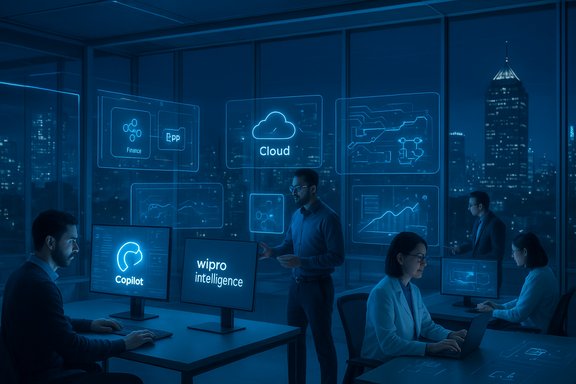
Team of analysts in a futuristic command center with holographic cloud dashboards.Background / Overview​

The collaboration pairs Wipro’s consulting‑led delivery and Wipro Intelligence™ platform with Microsoft’s cloud and AI stack — notably Microsoft Azure, Microsoft 365 Copilot, GitHub Copilot and Azure AI Foundry — to produce verticalized, production‑grade AI workflows for sectors such as financial services, retail, manufacturing, healthcare and airports. Microsoft framed this announcement as part of a broader India strategy in which it committed US$17.5 billion for cloud, AI infrastructure, skilling and operations across calendar years 2026–2029 — a backing intended to expand hyperscale regions, enable in‑country processing and speed enterprise adoption of agentic AI at scale. Taken together, the two announcements — the Wipro–Microsoft three‑year pact and Microsoft’s multibillion dollar India investment — are designed to shift enterprise AI from pilots to production by combining platform investment, partner delivery capacity and large‑scale skilling commitments.

What the deal actually is​

Core commitments and visible deliverables​

  • A formal three‑year strategic partnership between Wipro and Microsoft to co‑develop and commercialize AI‑driven solutions for enterprises.
  • Launch of a Microsoft Innovation Hub at Wipro’s Partner Labs in Bengaluru to host immersive workshops, rapid prototyping sprints and client co‑innovation sessions.
  • Integration of Wipro’s branded delivery suite — Wipro Intelligence™ — with Microsoft’s Copilot family, Azure AI Foundry and GitHub tooling to create vertical copilots, agents and managed services.
  • Public scale and skilling targets: Wipro states plans to deploy over 50,000 Microsoft Copilot licences internally and to upskill more than 25,000 employees on Microsoft Cloud and GitHub technologies as part of a “Client Zero” posture.

What’s being built together​

  • Industry copilots — domain‑aware assistants that combine enterprise data, Wipro’s vertical IP (for example, NetOxygen, Wealth AI and Falcon Supply Chain) and Microsoft’s Copilot tooling to automate multi‑step business processes.
  • Agent Marketplace — a catalog of AI agents and copilots that clients can evaluate, license and customize; the Innovation Hub provides a physical runway to test these agents against real workflows.
  • Operationalization stack — Azure infrastructure for compute and data, Copilot Studio and Azure AI Foundry for orchestration, and GitHub CoE practices to accelerate engineering productivity while embedding governance.

Why this matters: strategic logic and market timing​

Microsoft’s broad investment in India and the elevation of large IT services firms as “Frontier Firms” aim to solve three interlocking enterprise problems: scale, sovereignty, and skills. The Wipro tie‑up illustrates each:
  • Scale: Hyperscalers provide the compute, model hosting and orchestration primitives; systems integrators provide connectors, vertical semantics and global delivery capacity, compressing time from proof‑of‑concept to enterprise rollout.
  • Sovereignty: Local hyperscale regions and in‑country processing reduce regulatory and procurement friction in regulated sectors (banking, healthcare, government). Microsoft’s investment explicitly funds hyperscale capacity and sovereign‑ready cloud constructs in India.
  • Skills & adoption: Large seat deployments and training programs intent on creating AI‑fluent workforces — both inside partners (Client Zero) and for customers — lower the organizational barriers to wide Copilot adoption.
This partner‑plus‑platform design is the hyperscaler playbook for industrializing AI: the tech owner supplies platform and governance surfaces, while systems integrators convert general capability into industry‑specific outcomes and repeatable IP.

Technical architecture and integration patterns​

The stack they will use​

  • Azure as the cloud and data fabric backbone for storage, compute and secure tenancy.
  • Microsoft 365 Copilot for knowledge‑worker augmentation and contextual productivity features.
  • GitHub Copilot for developer productivity, code generation and automation across CI/CD pipelines.
  • Copilot Studio / Azure AI Foundry for agent authoring, model routing, governance, telemetry and model provenance.

Engineering and systems integration realities​

Delivering agentic AI at enterprise scale is non‑trivial. Effective production deployments require:
  • Robust data pipelines and catalogues so agents have accurate, timely context.
  • Identity, access and least‑privilege controls so agents act only where authorized.
  • Observability, audit trails and human‑in‑the‑loop checkpoints for high‑risk operations.
  • Connectors and integration adapters to ERPs, core banking systems, manufacturing execution systems and other transactional platforms.
Wipro’s claimed advantage lies in packaging vertical IP and pre‑built connectors into Wipro Intelligence™ accelerators so agent authors can focus on domain logic rather than plumbing. However, the heavy lifting remains in engineering integrations, data governance and ongoing model operations.

Commercial math: costs, licensing and economics​

Microsoft’s published pricing for Microsoft 365 Copilot (enterprise list tiers) has historically placed the product at a non‑negligible add‑on fee (public list pricing in prior rollouts was in the ballpark of $30 per user per month, with agent metering and inference billed separately). Large seat counts therefore translate into meaningful recurring license revenue plus substantial Azure consumption for inference, vector stores, storage and observability.
Operational costs to budget for:
  • Licence fees for Copilot seats (per‑user subscriptions).
  • Azure inference and model hosting (metered compute, GPUs, accelerators).
  • Vector stores and embedding/serving costs for retrieval‑augmented workflows.
  • Professional services for integration, prompt engineering, validation and governance.
  • Ongoing MLOps and AI Ops staffing for patching, retraining and monitoring.
For CIOs, the headline licence numbers are only the start: the real recurring cost profile is driven by inference volumes, vector store usage, connector throughput and the human costs of operating the system safely.

Skilling, Client Zero and organizational change​

Wipro’s stated plan to upskill “more than 25,000 employees” on Microsoft Cloud and GitHub technologies is central to its Client Zero strategy: use large internal deployment to create repeatable use cases and packaged offerings for clients. Operational implications of a Client Zero posture:
  • Faster formation of internal playbooks and runbooks for agent governance.
  • A library of internal use cases and performance metrics to sell into clients.
  • Risk: if internal deployments are rushed without adequate governance, early missteps become packaged and amplified into customer projects.
Upskilling at scale is necessary but not sufficient; firms also need to create new operating roles — AI ops, model risk officers, prompt engineering standards and compliance checkpoints — to ensure safe, auditable agent behavior.

Benefits for customers and partners​

  • Faster time‑to‑value from pre‑built vertical copilots and agents.
  • Reduced integration friction through packaged connectors and an Agent Marketplace.
  • Access to sovereign‑ready deployments for regulated data and low‑latency inference.
  • Availability of combined Microsoft/Wipro skilling and change programs to accelerate adoption.
For Microsoft, the partnership expands the Copilot footprint and anchors enterprise adoption through trusted systems integrators. For Wipro, it strengthens differentiated vertical IP and provides preferential access to Microsoft technical investments and co‑sell channels.

Risks, open questions and where to be cautious​

Seat‑count and activation caveats​

Public announcements headline “over 50,000 Copilot licences” for Wipro and similar numbers for other partners, and Microsoft presented a combined figure that exceeds 200,000 licences across the four announced partners. Those figures are credible as program commitments, but they should be treated as staged commercial rollouts rather than uniformly activated, audited seat‑ledgers. Independent coverage and partner statements corroborate the commitments, while analysts caution that activation timing, internal vs. client‑assigned seats, and contractual pricing tiers will vary. In short: the headline is real as intent; verify activation and seat‑mix during procurement.

Governance and compliance risks​

Agentic AI elevates the governance bar. Risks include:
  • Agents making unauthorized changes if identity and authorization boundaries are not strictly enforced.
  • Data leakage across contexts if tenant boundaries, DLP and vector store controls are misconfigured.
  • Lack of auditability where model routing and provenance are not retained for critical decisions.
Microsoft provides governance tooling (Copilot Studio, Azure AI Foundry), but enterprises and integrators must codify policies and implement enforcement — tooling alone is insufficient.

Vendor lock‑in and portability​

Large, platform‑specific investments (deep integrations with Copilot and Azure Foundry) accelerate time‑to‑value but increase portability costs if an enterprise decides to migrate to another cloud or adopt a multi‑cloud strategy. The legal and economic lock‑in risk must be explicitly assessed in contractual negotiations.

Operational scaling complexity​

Moving from dozens of pilots to tens of thousands of seats introduces scaling problems beyond compute: governance operations, human review queues, model performance drift and the need for regulated escalation pathways all grow with usage and require substantial organizational investment.

Practical guidance for CIOs, CPOs and AI leaders​

  • Validate commitments, not just headlines.
  • Ask partners for a breakdown of licence activation schedules, internal vs. client seats, and contractual pricing over the full term. The headline “50k seats” can represent staged rollouts or options.
  • Insist on explainability, logs and model routing details.
  • Require detailed runbooks for Copilot Studio / Azure AI Foundry configurations that include provenance, model selection rules and telemetry schemas.
  • Design agent safeguards from day one.
  • Treat agents as production services: registries, least‑privilege roles, approval gates for actioning systems and human‑in‑the‑loop controls for high‑risk flows.
  • Budget beyond licences.
  • Include inference, vector stores, storage, connector engineering, and AI Ops staffing in TCO models, not just seat subscriptions.
  • Run Client Zero proofs that demonstrate safe outcomes.
  • If engaging a partner, require customer‑facing case studies that include governance outcomes, not only productivity metrics.
  • Preserve portability and exit options.
  • Negotiate data export, model retraining portability and contract clauses that permit migration planning to avoid future lock‑in.

How Wipro’s Innovation Hub will function in practice​

The Microsoft Innovation Hub inside Wipro’s Partner Labs is positioned as a physical, experiential space where:
  • Clients can run scenario labs that simulate end‑to‑end workflows using Wipro Intelligence™ copilots.
  • Engineering teams from both companies co‑author agents and rapidly iterate on Copilot Studio prototypes.
  • Governance and security teams validate sovereign processing and compliance configurations at scale before production rollouts.
The hub model is sensible: having a shared, hands‑on environment shortens co‑development cycles and makes demonstrations materially closer to client production realities than slide decks or isolated demos. However, the proof will be in demonstrable, auditable deployments that go live in customer environments with full governance and measurable outcomes.

Competitive context: not the only game in town​

Microsoft’s partner play mirrors similar moves by other hyperscalers to lock in systems integrators as delivery channels for AI. AWS, Oracle and others are pushing agent and model marketplaces as well, and enterprise customers should compare vendor roadmaps, governance tooling and total cost profiles across providers. Wipro’s choice to double down on Microsoft — and Microsoft’s investment in India — is a strategic pairing, but it is not the only path to industrializing AI.

Strengths and likely near‑term outcomes​

  • Speed to market: Wipro’s vertical IP plus Microsoft tooling will shorten the time required to produce vertical copilots that have real business value.
  • Skilling scale: Large training targets and Client Zero playbooks will produce engineering and operational playbooks that are repeatable for clients.
  • Sovereignty enablement: Local hyperscale regions and in‑country processing address compliance needs for regulated workloads, opening markets that previously resisted cloud AI.
If executed cleanly, expect to see packaged, industry‑specific copilots and agent templates that reduce integration time and demonstrate measurable productivity gains within 12–24 months.

Weaknesses, open risks and regulatory friction​

  • Execution risk: Integration complexity and data governance failures are the primary threats to the promised outcomes.
  • Auditability & safety: Without strong instrumentation and human oversight, agentic systems can introduce operational and reputational risk.
  • Commercial opacity: Seat‑count headlines can obscure contractual realities — buyers must insist on activation and billing transparency.
Regulators are also paying attention to large platform‑led rollouts; enterprises operating in multiple jurisdictions should expect extra scrutiny around data residency, algorithmic transparency and liability for automated actions.

Conclusion​

The Wipro–Microsoft three‑year partnership and the launch of a Microsoft Innovation Hub at Wipro’s Partner Labs in Bengaluru represent a pragmatic and high‑stakes attempt to move enterprise AI from experimental pilots into industrial practice. The combination of Wipro’s vertical IP and Microsoft’s Copilot and Azure infrastructure — backed by a US$17.5 billion investment in India — creates the conditions for rapid diffusion of agentic AI across regulated industries and high‑value workflows. That potential comes with clear caveats: headline licence counts should be treated as program commitments rather than instantaneous seat activations, and delivering safe, auditable agentic systems requires sustained investment in data governance, human oversight and operational controls. Enterprises and procurement teams should verify activation schedules, demand governance runbooks, budget for inference and AI Ops, and preserve portability in contracts.
In short: this is a decisive move toward industrialized, partner‑driven AI. The next 12–24 months will show whether these kinds of platform‑plus‑partner plays deliver the promised productivity gains while maintaining the safety, transparency and vendor flexibility that enterprise customers require.

Source: theweek.in Wipro Microsoft ink 3-year AI partnership launch innovation hub in Bengaluru
 

Wipro’s three‑year strategic partnership with Microsoft — announced Dec. 12, 2025 — pairs Wipro Intelligence™ and Wipro’s Partner Labs with Microsoft’s Azure cloud, Microsoft 365 Copilot, GitHub Copilot and Azure AI Foundry to accelerate enterprise adoption of agentic AI, launch a Microsoft Innovation Hub in Bengaluru, and commit to large internal Copilot deployments and skilling targets that together signal a major push to industrialize AI for regulated industries and global customers.

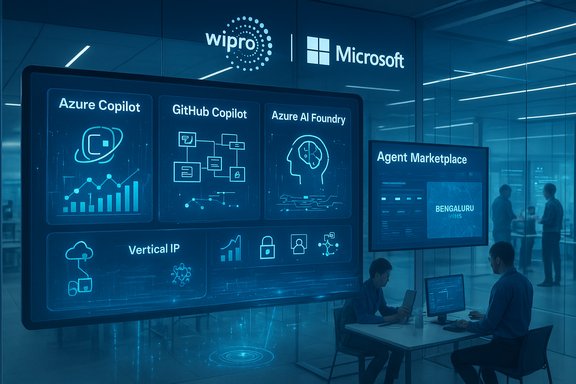
Tech workspace with AI dashboards for Azure Copilot, GitHub Copilot, and Azure AI Foundry.Background / Overview​

Wipro and Microsoft have signed a formal three‑year collaboration intended to turn enterprises into so‑called Frontier Firms — organisations that embed AI and copilots into core operations rather than treating them as point solutions. The partnership brings Wipro’s consulting‑led engineering, vertical IP (for example, NetOxygen, Wealth AI and Falcon Supply Chain) and the Wipro Intelligence™ delivery stack together with Microsoft’s product portfolio: Azure for cloud hosting and sovereign options, Microsoft 365 Copilot for knowledge‑worker augmentation, GitHub Copilot for developer productivity, and Azure AI Foundry (Copilot Studio) for model lifecycle, routing and agent orchestration. The announcement was published by Wipro and widely reported by major outlets, which also placed the deal within Microsoft’s broader India investment narrative — Microsoft publicly announced a US$17.5 billion commitment to India for cloud, AI infrastructure, skilling and sovereign‑ready services for calendar years 2026–2029 earlier in the same week.

What’s in the deal: the headline commitments​

  • A three‑year strategic partnership between Wipro and Microsoft focused on co‑developing industry‑specific AI solutions and copilots for financial services, retail, manufacturing, healthcare & life sciences, airports and other verticals.
  • Launch of a Microsoft Innovation Hub at Wipro’s Partner Labs in Bengaluru to host immersive client workshops, co‑innovation sprints, prototyping and access to Wipro’s Agent Marketplace of prebuilt AI agents.
  • Public scale targets: deployment of more than 50,000 Microsoft Copilot licences within Wipro and upskilling of 25,000+ Wipro employees on Microsoft Cloud and GitHub technologies to build an AI‑fluent workforce. These figures are presented as part of Wipro’s “Client Zero” strategy to convert internal activation into client products.
  • Joint use of Wipro’s vertical IP and Microsoft tooling to productize industry copilots and to surface agents in an Agent Marketplace for customers to trial and adopt.
These commitments are the commercial and marketing centrepiece; they show where Microsoft hopes to drive enterprise consumption of Copilot‑based services and where Wipro aims to convert internal modernization into monetizable services.

Why this matters now: platform + partner + scale​

Three converging forces make this announcement strategically significant:
  • Hyperscaler infrastructure investment: Microsoft’s multibillion dollar India investment increases local hyperscale capacity and enables in‑country processing for Copilot, which is a practical requirement for regulated workloads in banking, healthcare and government.
  • Partner‑led industrialization: Large systems integrators (SIs) like Wipro provide domain connectors, packaged IP and global delivery scale that hyperscalers lack; pairing the two compresses time from pilot to production.
  • Signalling and skilling: Large internal seat counts and training commitments are intended to create case studies and accelerate customer confidence — but they are also a commercial signal to the market about where Microsoft expects demand to grow.
Taken together, the playbook is familiar: the cloud owner supplies compute, governance primitives and Copilot tooling; the SI provides domain logic, connectors to ERPs/core systems and the commercial muscle to drive enterprise adoption.

Technical scope and architecture (practical view)​

Core building blocks​

  • Microsoft Azure: cloud, data fabric, sovereign tenancy and hyperscale compute for hosting models, vector stores and inference.
  • Microsoft 365 Copilot: the primary productivity and knowledge worker surface for copilots and prompts that interact with enterprise data stores.
  • GitHub Copilot: developer productivity tooling to accelerate engineering cycles and embed AI into CI/CD pipelines.
  • Azure AI Foundry (Copilot Studio): model cataloging, routing, agent orchestration and governance telemetry necessary for multi‑agent workflows.
  • Wipro Intelligence™ and vertical IP: domain models, connectors, and prebuilt workflows that speed industry deployments.

What the Innovation Hub will do​

The Microsoft Innovation Hub in Bengaluru is positioned as both a technical runway and a commercial showroom: it will host scenario labs where agents can be tested on representative enterprise data, workshops that validate business outcomes, governance reviews (identity, audit trails, human‑in‑the‑loop), and the Agent Marketplace where vetted agents are presented to customers. This model is designed to reduce perceived risk for regulated buyers by demonstrating compliance and observable metrics before procurement.

Strengths: why this could work​

  • Speed to market: Combining Wipro’s vertical IP with Microsoft’s platform reduces engineering cycles for industry copilots, often the longest part of enterprise AI projects.
  • Scale credibility: Large public commitments (50k Copilot licences, 25k trained staff) plus a physical Innovation Hub give buyers visible proof points that can reduce procurement friction.
  • Governance tooling: Copilot Studio / Azure AI Foundry include primitives for model provenance, routing and lifecycle controls that enterprise risk teams need to see before approving production deployments.
  • Commercial alignment: Microsoft’s India investment (US$17.5 billion for 2026–2029) builds hyperscale capacity and sovereign options that materially lower the barriers of latency, residency and compliance for regulated sectors.
These strengths make the partnership a credible candidate to accelerate the transition from pilots to production for many enterprise use cases.

Risks & caveats: where the headline claims require scrutiny​

  • Activation vs. purchase gap: Public licence purchase announcements and seat counts do not equal fully activated production users. The headline “50,000 Copilot licences” is a large purchase/commitment figure; buyers and observers should treat it as a staged rollout target rather than immediate, uniform adoption. Wipro and independent reporting have themselves noted the difference between commitments and activation metrics.
  • Vendor concentration / lock‑in risk: Deep technical and commercial coupling to a single hyperscaler can increase exposure to future pricing changes, policy shifts, or service discontinuations. Enterprises that centralize core workflows on one platform should weigh multi‑cloud or portability strategies.
  • Operational complexity: Agentic AI is fundamentally about multi‑step workflows that touch transactional back‑ends. Successful productionization requires robust data pipelines, identity and least privilege controls, observability, and human‑in‑the‑loop guardrails — all of which are far more demanding than single‑prompt generative use cases. Many enterprises underestimate the engineering and change management scope.
  • Regulatory and sovereignty nuance: Microsoft’s in‑country Copilot processing options reduce friction, but regulatory regimes differ by sector and country. Enterprises operating across jurisdictions will still face complex compliance and cross‑border data transfer requirements.
  • Commercial economics: Large Copilot deployments create ongoing inference and cloud costs. Enterprises must model total cost of ownership — subscription + Azure compute for model inference + integration and monitoring — and should insist on usage‑based or milestone‑driven commercial terms that align supplier incentives with activation and measurable outcomes.

Measuring success: what enterprise buyers should demand​

Success for any “Frontier Firm” is not seat counts alone. Procurement and CIO teams should insist on quantifiable outcomes tied to contracts:
  • Baseline KPIs and targets: Define pre‑deployment baselines for the processes to be automated (cycle times, error rates, FTE hours) and clear uplift targets.
  • Activation metrics: Require dashboards showing daily/weekly active users, session length, task completion rates and escalation counts for agents.
  • Data and identity attestations: Proof of least‑privilege access, tokenization/DPoP mechanisms, and sample audit logs demonstrating agent actions on production systems.
  • Governance artifacts: Model cards, lineage, drift detection thresholds, and test suites for safety/regulatory scenarios.
  • Commercial levers: Milestone payments linked to activation and business outcomes rather than unincentivized seat counts.
  • Portability commitments: APIs, data export mechanisms and documentation to reduce vendor lock‑in risk over time.
These measurement guardrails turn marketing claims into enforceable business results and reduce the risk of stalled deployments.

Practical roadmap for CIOs evaluating a Wipro + Microsoft offering​

Phase 1 — Pilot (0–3 months)​

  • Select a narrowly scoped, high‑value process with clear KPIs (for example, loan origination triage or supply chain exception handling).
  • Insist on a proof‑of‑value SOW that includes data access patterns, identity integration and human‑in‑the‑loop thresholds.
  • Run the pilot in the Microsoft Innovation Hub (or an on‑prem staging environment) to validate agent behaviour on scrubbed production data.

Phase 2 — Scale (3–12 months)​

  • Move from pilot to phased rollouts by vertical and department, instrumenting activation dashboards and ROI reporting.
  • Implement agent registries, model versioning and automated drift alerts via Azure AI Foundry / Copilot Studio.

Phase 3 — Governance & Optimization (12–24 months)​

  • Mature governance by embedding audit trails, human escalation rules and compliance certs into production workflows.
  • Negotiate TCO reviews and usage‑based pricing models to align costs with realized business value.

Vendor and architecture considerations​

  • Identity: Plan Entra / Azure AD integration with conditional access and just‑in‑time elevation for agents performing sensitive actions.
  • Data fabric: Use a governed data mesh or catalog so agents consume authoritative, labeled sources rather than ad‑hoc extracts.
  • Observability: Instrument agent actions via centralized logging and SIEM integration; expect the need for action‑level traceability.
  • Least privilege: Use role‑based agent execution contexts; adopt ephemeral credentials where possible.
  • Portability: Specify exportable connectors and documented APIs so workloads are not locked irreversibly to one stack.

Commercial and market implications​

For Microsoft, partnering with SIs like Wipro accelerates enterprise consumption of Copilot and Azure AI services while leveraging Wipro’s global client reach. For Wipro, deeper partnership grants preferential access to Microsoft product roadmaps, co‑sell channels and the credibility of early Client Zero deployments that can be productized and sold to customers. The larger industry effect is a push toward packaged, verticalized AI services sold as outcomes — an attractive model for buyers, but one that requires careful vendor selection and contractual disciplines.
Microsoft’s concurrent public commitment of US$17.5 billion to India’s cloud and AI infrastructure further reorients procurement and regulatory calculus: more localized hyperscale capacity and sovereign cloud options make it technically feasible for regulated sectors in India (and global firms with India operations) to consider larger Copilot deployments.

What to watch next (short term signals)​

  • Activation dashboards and published case studies that quantify time saved, error reduction or revenue uplift from Wipro’s Client Zero deployments. If the 50k seat claim is followed by robust activation metrics, it will materially de‑risk the commercial story.
  • Pricing announcements and commercial models for Copilot + Azure inference at scale. Expect cloud‑cost and inference pricing to be a major driver of total cost and buyer negotiations.
  • Regulator engagement and certification examples, particularly in BFSI and healthcare, which will demonstrate the sovereign and compliance readiness Microsoft claims via in‑country processing.
  • The pace at which Wipro’s Agent Marketplace grows with vetted, instrumented agents that customers can trial in the Innovation Hub — a large marketplace will shorten buyer evaluation cycles but must be accompanied by governance artifacts.

Verdict: an important but conditional inflection point​

The Wipro–Microsoft partnership is an archetypal hyperscaler + SI playbook: platform capability plus verticalized delivery to accelerate enterprise AI adoption. The public commitments — a Microsoft Innovation Hub in Bengaluru, the Wipro Intelligence™ integration, and large Copilot and skilling targets — create a credible runway for production deployments. However, the true test will be activation, governance maturity, demonstrable ROI and clear commercial alignment over the coming quarters. Enterprises should treat headline figures like “50,000 Copilot licences” as staged commitments and demand activation evidence, auditable governance artifacts, and outcome‑linked commercial terms before committing core business processes to agentic AI at scale.

Practical checklist for procurement and IT leaders (quick reference)​

  • Require an activation dashboard and minimum active‑user SLAs tied to payments.
  • Demand model cards, lineage and a published incident response playbook for agent misbehavior.
  • Insist on least‑privilege agent execution contexts and identity governance integration.
  • Model total cost of ownership including inference and data egress; negotiate usage‑aligned pricing.
  • Pilot narrow, measure outcomes against baselines, and gate scale on measurable impact.
  • Keep portability clauses and documented APIs to mitigate lock‑in risk.

Wipro’s announcement, embedded in Microsoft’s wider India investment narrative, represents a major push toward production‑grade, industry‑specific agentic AI at scale. The engineering and governance foundations exist on paper — the crucial question for enterprises, regulators and investors is whether activation, cost discipline and robust governance will follow at the speed and scale the market now expects.
Source: Free Press Journal IT Services Major Wipro Announces Strategic Partnership With Microsoft, Aimed At Propelling AI Adoption
 

Back
Top