Microsoft’s latest quarter confirms one clear fact: AI has moved from a promising growth theme into the center of the company’s business model—and into the center of investor scrutiny. The company reported $81.3 billion in revenue for the quarter, a 17% year‑over‑year increase, while Microsoft Cloud crossed the $50‑billion mark in a single quarter for the first time. Yet the market’s reaction was sobering: shares slid sharply after the announcement as investors digested a dramatically larger revenue backlog tied to AI customers, a surge in capital expenditure, and the risks of heavy dependence on a small number of AI model makers. In short, Microsoft’s results are both a triumph and a cautionary tale for a company pivoting its vast platform to the economics of generative AI.
This quarter’s numbers reflected two parallel forces. First, steady, broad‑based growth across Microsoft’s core franchises—Office, Dynamics, LinkedIn, and Azure—continued to deliver double‑digit revenue gains. Second, AI‑driven demand concentrated a large portion of future contracted cloud consumption into a much smaller set of customers, dramatically increasing the company’s commercial remaining performance obligations (RPO), the accounting metric that represents contracted revenue yet to be recognized.
Management’s messaging was consequently twofold: celebrate scale and product traction, while trying to reassure markets that the company’s long‑term cash flows remain diversified and under control.
This is not just an accounting or investor relations issue. For customers, the concentration raises questions about data governance, pricing leverage, and supply allocation when demand outstrips available GPU capacity.
The immediate market reaction was negative because investors worry about the timing and returns on that spending. Heavy CapEx can be justified if it drives durable, high‑margin revenue for years to come—but the revenue in question is contingent on other companies’ decisions and on ongoing demand for expensive compute.
In the months ahead, independent validation of hardware performance, the rate at which RPO converts into recognized revenue, and how Microsoft manages capital intensity without eroding margins will determine whether investors reward the company’s aggressive posture—or demand a course correction. For now, Microsoft sits at the industry’s fulcrum: it has the assets and relationships to lead, but the stakes—and the scrutiny—have never been higher.
Source: TechRadar 'We are pushing the frontier across our entire AI stack': Microsoft's latest results show new cloud and AI returns - but reliance on OpenAI causes concerns
 Background: what changed this quarter
This quarter’s numbers reflected two parallel forces. First, steady, broad‑based growth across Microsoft’s core franchises—Office, Dynamics, LinkedIn, and Azure—continued to deliver double‑digit revenue gains. Second, AI‑driven demand concentrated a large portion of future contracted cloud consumption into a much smaller set of customers, dramatically increasing the company’s commercial remaining performance obligations (RPO), the accounting metric that represents contracted revenue yet to be recognized.- Total revenue: $81.3 billion, up 17% year over year.
- Microsoft Cloud: crossed the $50+ billion quarterly threshold.
- Azure and other cloud services: grew at roughly high‑30s percent year over year.
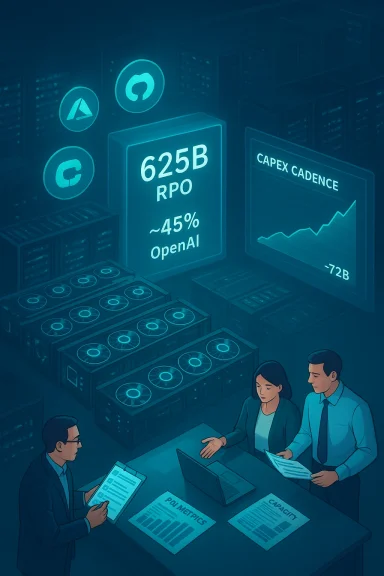
- Commercial RPO: ballooned to roughly $625 billion, more than doubling sequentially.
- Capital expenditures (CapEx): surged to $37.5 billion for the quarter—an unusually large, near‑term cash outflow.
Overview: what executives told investors
Company leadership framed the quarter as evidence that Microsoft has built a material AI business that already rivals its largest franchises. Management repeatedly emphasized a multi‑layer strategy across the AI stack:- a massive, planet‑scale cloud and compute footprint (the “cloud and token factory”),
- an agent platform layer for orchestrating model calls and workflows,
- and high‑value, agentic experiences—products like Copilots embedded into Office, Dynamics, GitHub, and vertical applications.
Management’s messaging was consequently twofold: celebrate scale and product traction, while trying to reassure markets that the company’s long‑term cash flows remain diversified and under control.
Financial breakdown: the good, the unusual, and the accounting effects
This quarter contains both straightforward operational results and some accounting complexity that matters to investors and analysts.The operational wins
- Microsoft Cloud contributing north of $50 billion in a single quarter is a milestone in both scale and monetization. That’s a rare level of quarterly cloud revenue and underlines the breadth of Microsoft’s enterprise relationships and product bundle.
- Azure continued its high‑teens-to‑40% growth cadence—proof that enterprises are shifting workloads to cloud platforms, and that new AI workloads in particular are driving incremental demand.
- Productivity and business processes (Microsoft 365, Dynamics) showed ongoing subscription resilience, supported by growth in paid seats and adoption of AI features such as Copilot integrations.
Accounting and one‑off gains
- The company reported a significant net gain tied to its investment in an AI model maker, boosting GAAP net income for the quarter. Removing that one‑time accounting effect returns a more conservative view of operating profit—still strong, but less dramatic.
- The RPO jump is especially material: a more than 100% increase to roughly $625 billion versus the prior quarter. A large share of this increase was attributable to long‑term commitments from an AI model maker that agreed to purchase a multihundred‑billion‑dollar commitment in cloud services.
OpenAI and the model‑maker concentration question
One of the clearest storylines this quarter is the degree to which Microsoft’s revenue outlook—and infrastructure plans—are intertwined with the largest model makers. A significant slice of Microsoft’s RPO now ties back to one or two AI labs that signed long‑term, multibillion‑dollar Azure commitments. That concentration raises several obvious questions:- Does Microsoft now have a single point of failure in its forward revenue visibility?
- What happens if one of these model makers shifts its compute mix, moves workloads to competitors, or reduces committed spend?
- How should investors value a company whose future cash flows increasingly depend on multiyear compute contracts from external partners?
This is not just an accounting or investor relations issue. For customers, the concentration raises questions about data governance, pricing leverage, and supply allocation when demand outstrips available GPU capacity.
CapEx, GPU economics, and the race for compute
A defining feature of the quarter was the scale of capital spending. Microsoft reported roughly $37.5 billion in CapEx during the quarter—an eye‑watering figure that reflects a concerted build‑out of GPU‑dense data center capacity to serve inference and training workloads.- Management said roughly two‑thirds of the CapEx was dedicated to “short‑lived” assets—GPUs, CPUs, and specialized accelerators—that get replaced more frequently than standard datacenter gear.
- This is a structural shift in cloud economics: a larger share of the balance sheet is now spent on compute gear whose useful life is measured in a few years rather than a decade.
The immediate market reaction was negative because investors worry about the timing and returns on that spending. Heavy CapEx can be justified if it drives durable, high‑margin revenue for years to come—but the revenue in question is contingent on other companies’ decisions and on ongoing demand for expensive compute.
In‑house silicon vs. Nvidia: the arms race continues
Microsoft has publicly acknowledged that its future infrastructure strategy will be heterogeneous—mixing third‑party GPUs with in‑house accelerators and other vendors’ chips. This quarter brought a concrete development: Microsoft announced a new inference accelerator designed to improve the economics of token generation.- The company claims the new custom inference chip delivers meaningful improvements in performance per dollar and is already rolling into selected data centers.
- Microsoft’s message is that custom silicon will reduce dependence on third‑party GPUs over time and improve total cost of ownership for inference workloads.
- Custom chips can materially alter cost curves—but only once they are deployed at scale and validated in production across many real‑world workloads.
- Independent benchmarks and time‑to‑scale are the gating factors. Performance claims made by vendors are important, but they require third‑party validation and widespread production to affect industry economics meaningfully.
- Even with in‑house silicon, Microsoft will continue to rely on a mix of accelerators. Nvidia remains a critical partner because of its ecosystem, software maturity, and market share across cloud providers and enterprises.
Investor reaction: why shares fell
Shares declined notably after the earnings release. Several interlocking reasons explain the sell‑off:- The CapEx spike raised questions about near‑term free cash flow and when the heavy investment will return durable, high‑margin revenue.
- The RPO concentration—a large portion tied to one or two big model makers—made future revenue appear less diversified and more contingent.
- Slowing momentum or even minor deceleration in Azure growth (still in the high‑30s) can translate into aggressive multiple re‑ratings for cloud names that trade on near‑term growth prospects.
- Accounting one‑offs related to investments in AI model makers can inflate GAAP net income in ways that are hard to extrapolate.
Strategic implications for Microsoft and the broader cloud landscape
Microsoft is at the center of an industry reset. The decisions it makes about compute allocation, pricing, and partner terms will reverberate across enterprises, developers, and competitors.For Microsoft
- The company is locking in scale and preferential integration with model makers while trying to diversify cloud demand across other enterprise verticals.
- In‑house silicon is a critical strategic bet aimed at lowering per‑token costs and improving margins for inference services.
- Microsoft’s expansive cloud footprint, enterprise relationships, and product portfolio (Office, Dynamics, LinkedIn, Xbox) give it structural advantages other pure‑play model vendors lack.
For competitors
- AWS and Google face the same compute pressure but also have their own hardware programs and long enterprise track records. Expect more aggressive compute partnerships and pricing structures across the hyperscalers.
- Nvidia remains indispensable for many workloads, but hyperscalers’ internal silicon efforts will intensify competition and reduce long‑term vendor pricing power.
For customers and enterprises
- Customers will need to evaluate not only price and performance, but also supply assurance, data governance, and dependency on specific cloud providers or model vendors.
- The market may bifurcate between organizations that accept some single‑vendor risk for performance and those that pursue multi‑cloud and multi‑model strategies to mitigate vendor concentration.
Risks that deserve scrutiny
Microsoft’s strategy is compelling yet carries elevated, measurable risks:- Concentration risk: When a large share of future contracted cloud revenue comes from a single partner, the company’s forward visibility becomes vulnerable to that partner’s business choices.
- Capital efficiency risk: Heavy, upfront CapEx on rapidly depreciating assets requires accurate forecasts of utilization and model economics. Mismatches between capacity and demand will pressure margins.
- Execution risk on custom silicon: Building chips at scale is notoriously hard. Design, validation, supply chain, and software toolchain maturity all matter. Early performance claims should be treated cautiously until third‑party benchmarks validate them at scale.
- Regulatory and geopolitical risk: The growing strategic importance of AI will invite regulatory scrutiny—including national security considerations, export controls on high‑end chips, and competition reviews—particularly where government contracts and national data residency are involved.
- Partner risk: The model makers themselves are building faster and could choose a mix of cloud providers, direct infrastructure purchases, or on‑prem solutions. Microsoft must balance close partnership with maintaining broad customer trust.
Strengths and durable advantages
Despite the risks, Microsoft has several durable advantages that explain why it remains a favored strategic foothold in the AI era:- Platform breadth: Few companies combine productivity software, developer tools, a global cloud, and enterprise sales channels at Microsoft’s scale.
- Deep enterprise relationships: Longstanding commercial contracts, seat counts, and customer stickiness provide a baseline revenue stream beyond AI model makers.
- Integrated product monetization: Embedding Copilot‑style features across Office, Dynamics, and other high‑value applications creates higher‑value propositions and stickier customer relationships.
- Engineering scale: Microsoft’s ability to design custom silicon, build highly instrumented data centers, and integrate hardware and software gives it technical levers many competitors lack.
What to watch next: indicators and milestones
Investors and enterprise customers should watch several concrete indicators to assess whether Microsoft’s strategy is paying off:- Quarterly CapEx trajectory and the split between short‑lived compute assets and long‑lived facilities.
- RPO composition and how much of it converts to recognized revenue within 12–24 months.
- Azure utilization metrics—are new AI workloads filling capacity, and is utilization improving as custom silicon enters the fleet?
- Independent performance benchmarks for Microsoft’s custom inference accelerators versus incumbent GPUs.
- The trajectory of OpenAI and other model makers’ cloud commitments—are they additive, stable, or consolidating across providers?
- Regulatory developments that could affect cross‑border compute, hardware export controls, or commercial terms between cloud providers and AI labs.
Practical takeaways for different audiences
For investors
Treat the quarter as evidence of scale and execution, but adjust expectations for lumpy conversion of contracted revenues and near‑term cash intensity. If you’re a long‑term investor, focus on Microsoft’s ability to convert RPO into recurring revenue at attractive margins. If you focus on shorter horizons, the capital cycle and model‑maker concentration increase valuation risk.For enterprise customers
Ask your cloud provider how they prioritize capacity during demand surges, and insist on contract terms that protect data sovereignty, pricing transparency, and service levels. Consider multi‑cloud strategies for critical workloads to avoid single‑vendor dependencies.For tech partners and developers
Monitor how Microsoft’s SDKs and toolchains evolve around custom silicon. Early adopters may benefit from preferential pricing or performance access, but mature ecosystems require broad toolchain compatibility and open standards to reduce lock‑in.Conclusion: an inflection point, not a foregone conclusion
Microsoft’s quarterly report is an inflection point: it shows a company that has successfully turned scale and enterprise reach into a genuine AI business, but it also exposes the operational and financial tradeoffs of that transformation. The headlines—$81.3 billion revenue, Microsoft Cloud crossing the $50‑billion mark, a $625‑billion RPO, and $37.5 billion of CapEx—are unprecedented in scale. Those numbers validate Microsoft’s strategy, but they also raise fresh questions about concentration, capital efficiency, and the timelines for custom silicon to make a meaningful dent in per‑token cost.In the months ahead, independent validation of hardware performance, the rate at which RPO converts into recognized revenue, and how Microsoft manages capital intensity without eroding margins will determine whether investors reward the company’s aggressive posture—or demand a course correction. For now, Microsoft sits at the industry’s fulcrum: it has the assets and relationships to lead, but the stakes—and the scrutiny—have never been higher.
Source: TechRadar 'We are pushing the frontier across our entire AI stack': Microsoft's latest results show new cloud and AI returns - but reliance on OpenAI causes concerns