

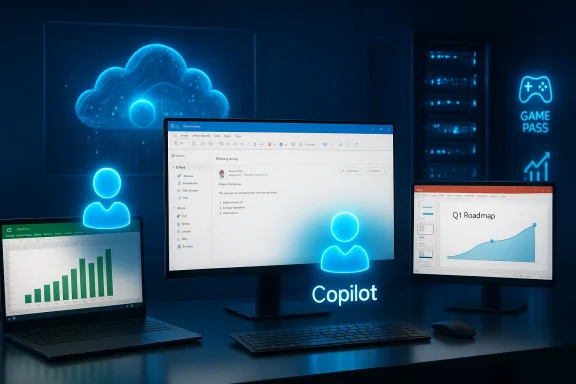
Microsoft just flipped the switch on an AI-first strategy that no longer feels experimental — it now looks like default behavior for Windows, Office, Azure-hosted apps, and even parts of gaming and investing, and that matters to the way you work, the services you pay for, and how portfolios are being positioned on Wall Street.
Background / Overview
Microsoft’s pivot from “software company” to “AI platform” is deliberate, multi-layered, and already measurable across product lines. The company has moved Copilot from a helpful sidebar into a system-level assistant across Windows and Microsoft 365, expanded Azure into the plumbing for third‑party AI deployments, and concentrated gaming and subscription strategies around recurring revenue and cloud delivery. Those shifts show up as product changes for everyday users and as structural business changes investors must price into Microsoft stock (MSFT).This transition combines three durable threads: an integrated AI assistant (Copilot) at the user level, cloud and model monetization (Azure + OpenAI + in‑house models) behind the scenes, and a subscription/recurring-revenue push in consumer businesses like Xbox Game Pass. Each thread is mutually reinforcing: broader Copilot adoption drives Azure consumption, Azure scale enables more advanced models, and subscription models convert that adoption into recurring cash flow. Independent reporting and Microsoft’s own filings confirm each of these pieces.
Copilot: the new default assistant (and what that means for daily use)
What Copilot is today
Copilot is no longer a boxed feature tucked into one app — Microsoft has recast it as a platform that runs across Windows 11, Microsoft 365 apps (Word, Excel, PowerPoint, Outlook, Teams), Edge, GitHub, and native Copilot apps on macOS and mobile. For many users the change is subtle: a contextual prompt, a system-level shortcut, or a right‑click action that can summarize files, draft emails, rewrite slides, or walk through multi‑step workflows. But the user experience is the critical pathway to scale: by embedding Copilot where people already work, Microsoft lowers the friction for AI-first workflows.Microsoft has also made some of Copilot’s most resource-intensive capabilities — notably Voice and Think Deeper (the reasoning-focused mode powered by OpenAI’s o1 model) — available without hard daily limits to free users, while preserving paid tiers for priority access and early features. That move democratizes access and increases usage volume, which in turn drives cloud consumption. Multiple outlets reported the rollout of unlimited Voice and Think Deeper in early 2025.
What you can actually do with it (short list)
- Summarize long email threads or meeting recordings into bullet points.
- Convert messy data into clean Excel models, then ask Copilot to generate charts and forecasts.
- Use voice to interact hands‑free with your PC and get extended reasoning for complex queries.
- Ask Copilot to perform file‑scoped actions (summarize, compare, extract highlights) directly inside File Explorer and OneDrive when you have an eligible Microsoft 365 subscription.
Practical advice for users
- Experiment deliberately: try Copilot on one repetitive task (inbox triage, weekly reports) to measure time saved.
- Treat Copilot outputs as assisted drafts — verify facts, numbers, and sensitive language before sharing externally.
- Check your licensing and privacy settings: richer Copilot features are often tied to commercial plans or enterprise add‑ons, and admins can control what data Copilot may use.
The engine: Azure, OpenAI, and the monetization pipeline
Azure as the AI backbone
Azure is no longer just "infrastructure"; it’s Microsoft’s productized route to monetize third‑party AI workloads. Microsoft has publicly broken out Azure revenue figures — Azure surpassed $75 billion in annual revenue in the fiscal year disclosed in the company report — underscoring the scale of cloud demand for AI compute and services. That revenue disclosure was tied to the company’s explicit AI narrative: customers are deploying generative AI and copilots on Azure at scale.For enterprises and software vendors, the most direct path to ship an AI feature is to host inference and connectors on Azure and plug Microsoft’s commercial models (or integrate OpenAI models via Azure OpenAI Services). That creates a steady, metered revenue stream every time an app invokes a model, runs an agent, or stores AI‑related data. And because enterprises rarely rip out cloud providers, the result is durable consumption growth when AI deployments scale.
The OpenAI relationship — restructured and strategic
Microsoft’s relationship with OpenAI has evolved from a large early investment into a commercial pact that now includes deep equity and multi‑year commitments. In late 2025 Microsoft and OpenAI finalized a recapitalization that left Microsoft with a sizable equity position and extended commercial terms that guarantee model access (with specific IP and timeline clauses). This restructured partnership reduces uncertainty around Microsoft’s access to leading models and amplifies Azure’s role as a preferred — but no longer exclusive — host for OpenAI services. Multiple major outlets reported the terms and the accompanying Azure commitments.Why this structure matters for costs and supply
Running large models at the scale of an enterprise‑grade Copilot requires massive GPU farms and network scale. Microsoft’s strategy mixes:- Hosting OpenAI‑built models via Azure OpenAI Services.
- Building or co‑designing in‑house models where it makes economic sense.
- Offering metered, pay‑as‑you‑go capacity and pre‑paid capacity packs for enterprise agents.
Gaming and subscriptions: Xbox’s AI and recurring‑revenue pivot
The Game Pass strategy
Microsoft is leaning heavily into subscription economics for gaming. Xbox Game Pass — the company’s subscription streaming and access bundle — has become the primary monetization vehicle for Xbox content and cloud streaming, and Microsoft publicly confirmed Game Pass reached record revenue levels in its fiscal coverage period. Microsoft also reported hundreds of millions of monthly active users across gaming platforms in recent fiscal disclosures; those engagement figures matter because they convert a large player base into recurring spend and incremental Azure consumption for cloud streaming.AI shows up in gaming in two big ways: developer productivity and player experience. Game studios increasingly use generative models to accelerate asset creation, script variations, and QA; on the player side, expect more AI‑driven NPC behavior, procedural content generation, and moderation tools — all of which can differentiate subscription offerings and create perceived value for Game Pass subscribers.
What gamers should watch for
- More day‑one releases on Game Pass and deeper cross‑platform availability.
- Incremental features powered by AI (smarter matchmaking, in‑game assistants) that may be limited to higher Game Pass tiers.
- Price and tier changes: subscription services will be the lever Microsoft uses to extract higher ARPU (average revenue per user) if engagement stabilizes but infrastructure costs rise.
Money matters: why investors treat Microsoft like an AI proxy
The Wall Street narrative
Wall Street now treats Microsoft as three stories in one: enterprise cloud leader, AI monetizer, and durable cash‑flow machine. Prominent analysts have assigned premium valuations to Microsoft because the market expects AI-driven revenue to accelerate Azure consumption and to create new monetizable layers across productivity and gaming. Firms such as Wedbush have explicitly framed Microsoft as a core AI holding, putting multi‑hundred‑dollar price targets on the stock and describing an AI growth inflection. Those analyst views are widely reported in financial press.What the financials say (and what they don't)
- Azure’s scale: Microsoft disclosed Azure surpassed roughly $75 billion in annual revenue in the fiscal year cited, a hard data point that institutional investors are using to size AI TAM (total addressable market) exposure. This is not projection — it’s a company disclosure.
- Copilot adoption: Microsoft has pointed to massive Copilot usage numbers in investor materials and public statements, and independent reporting has shown rapid MAU growth. But revenue attribution — exactly how much Copilot contributes to Azure/Office revenue — is still being parsed and modeled by analysts. That gap between usage signals and line-item monetization is where valuation debates happen.
Risk versus reward for investors
- Reward: Microsoft controls both the UI (Windows, Office) and the cloud (Azure) — a rare combination that lets it drive adoption across both ends of the stack. If enterprises scale Copilot and agents, Azure consumption could compound for years.
- Risk: high capital intensity for AI infrastructure; rising CapEx to add data‑center and GPU capacity can compress margins temporarily. Regulation and antitrust scrutiny can alter packaging and pricing of AI features. And the market already prices a lot of that upside, so any slowdown in commercialization could rachet the stock down quickly.
The hard questions: privacy, lock‑in, and regulation
Privacy and data handling
Copilot is only as useful as the data it can access in context. That implies Copilot features will need to touch email, documents, calendar entries, and other sensitive data — exactly the sorts of data that raise privacy and compliance requirements for companies. Privacy advocates have repeatedly asked for more transparency around training data, retention policies, and how enterprise prompts are logged or used for model improvement. Microsoft provides enterprise controls, but the scale and sensitivity of data involved mean risk remains. Treat any Copilot integration involving sensitive workflows cautiously until governance is well‑defined.Lock‑in and pricing power
The more a business standardizes on Microsoft — Azure, Microsoft 365 with Copilot, identity via Azure AD — the more switching costs rise. That creates genuine value for Microsoft but also concentrates a systemic vendor risk for customers and invites regulatory pushback. In the EU and other jurisdictions, Microsoft has already faced antitrust scrutiny and compelled packaging changes (for example, decisions around Teams bundling). Expect regulators to focus on whether AI bundling or preferential access to models amounts to anti‑competitive behavior.Regulatory tailwinds and headwinds
- Headwinds: antitrust enforcement, AI safety rules (national and EU frameworks), and consumer protection lawsuits (e.g., claims about misleading bundling or pricing) can slow rollouts, force product unbundling, or create fines and remedies.
- Tailwinds: clarity from regulation that enables enterprise adoption with consistent compliance requirements could accelerate corporate deployments if Microsoft can provide the compliant, auditable stack enterprises demand.
Cross-checks and independent validation
I verified the major, load-bearing claims below against more than one reputable source when possible:- Azure annual revenue (company report) and independent reporting: Microsoft’s annual report shows Azure surpassed ~$75 billion; Bloomberg and other finance outlets corroborate the disclosure.
- Copilot free Voice and Think Deeper rollouts: The Verge, Engadget, and technology press documented Microsoft removing rate limits on Voice and Think Deeper in early 2025.
- GitHub Copilot billing and pricing: GitHub’s own documentation lists consumer and business pricing tiers and the billing mechanics for premium requests.
- Xbox/Game Pass economics and engagement: Microsoft’s public statements and earnings commentary — amplified by outlets and statistical services — show Game Pass at tens of millions of subscribers and the company reporting record Game Pass revenue within the referenced financial period.
- OpenAI recapitalization and Microsoft stake: Microsoft and major business outlets reported the recapitalization and the resulting Microsoft stake and extended IP/usage terms in late 2025. Those reports confirm the revised, long‑term arrangement.
I also cross‑referenced relevant community and industry discussions from the uploaded forum material you provided, which capture on‑the‑ground user and administrator concerns about Copilot, agent workspaces, and security trade‑offs — useful color on how the rollout feels to IT admins and enthusiasts.
Practical checklist: what to do this week (users, IT, and investors)
If you’re a knowledge worker or creator
- Try Copilot on a low‑risk task (e.g., draft an internal memo, summarize notes). Compare time saved vs. verification overhead.
- Turn on privacy and consent options where available; avoid pasting confidential PII into free chat prompts.
- Track output accuracy: keep a short log of hallucinations or inaccuracies to inform safe use patterns.
If you’re an IT leader or security professional
- Map Copilot touchpoints in your environment (email, SharePoint, HR systems). Decide what Copilot can and cannot access.
- Review licensing: enterprise Copilot add‑ons, Copilot Studio capacity, and Azure OpenAI consumption all create line‑items that must be budgeted.
- Test agent workspaces and sandbox them before broad rollouts — Microsoft warns of “novel security risks” with autonomous agents and has shipped containment tools that should be validated.
If you’re an investor
- Understand the long‑run vs. near‑term trade: AI adoption supports higher Azure consumption but also raises CapEx for data centers and GPUs.
- Read the fine print in earnings calls: watch the cadence of Azure AI billings, Microsoft 365 Copilot commercial adoption, and Game Pass ARPU trends.
- Consider valuation discipline: many analysts are bullish, but the market is already pricing in substantial AI revenue — decide whether your time horizon and risk tolerance match that expectation.
Strengths, risks, and the final read
Notable strengths
- Ecosystem depth: Microsoft owns the productivity layer (Office), the operating system (Windows), and a global cloud (Azure) — a rare combination that supports broad AI adoption.
- Balance sheet and scale: Microsoft can underwrite CapEx and sustain price‑to‑scale experiments that smaller companies cannot.
- Commercial positioning: By packaging Copilot features into enterprise licensing and metered Azure services, Microsoft creates multiple revenue channels that feed each other.
Material risks
- Cost and marginal economics: Running generative AI at scale is capital intensive; the path to margin expansion depends on software‑driven leverage and successful packaging of higher‑value features.
- Regulatory uncertainty: Antitrust and AI governance could restrict bundling, require interoperability, or impose usage constraints that change the business model. Microsoft has historical and ongoing regulatory engagements to navigate.
- Trust, safety, and accuracy: Hallucinations, data privacy concerns, and misuse scenarios create real operational and reputational risk for customers and Microsoft alike.
My verdict (short)
Microsoft’s AI pivot is real, deep, and already reshaping product experiences and commercial dynamics. For users, that means practical productivity boosts and a new set of governance questions. For investors, Microsoft sits at the center of the AI value chain — a high‑quality but expensive exposure that requires conviction about multi‑year cloud adoption and careful monitoring of CapEx and regulatory developments.Ignore Microsoft’s AI pivot at your own risk — but don’t confuse scale with inevitability. The long‑term returns depend on execution: keeping Copilot useful and trustworthy, managing infrastructure costs, and navigating regulatory headwinds while converting usage into measurable revenue.
The operating system for the next tech cycle is being written in code and billed by the cloud — Microsoft just made itself one of the primary authors.
Source: AD HOC NEWS Microsoft Just Flipped the Switch: What Its AI Pivot Means for You (and Your Money)
