

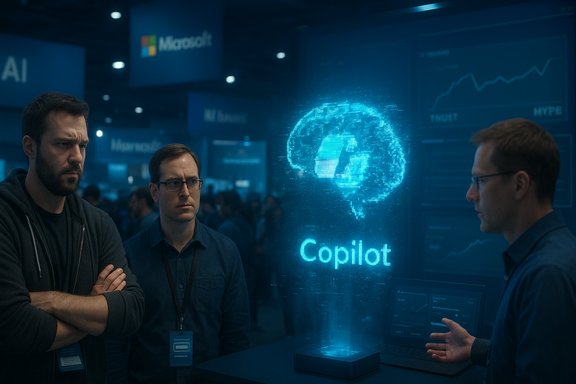
Microsoft’s AI chief publicly dismissed pushback as “mindblowing” this week, calling out what he described as a sea of “cynics” who remain unimpressed by contemporary generative systems — a remark that crystallized a broader story about tone‑deaf marketing, shaky product demos, and an accelerating trust deficit between Microsoft and many of the people who actually use Windows and developer tools.
On November 19, 2025, Mustafa Suleyman — the head of Microsoft’s AI organization — posted a blunt message on X (formerly Twitter) reacting to intense user criticism of Microsoft’s recent AI messaging. Suleyman’s post said, in part, “Jeez there so many cynics! … The fact that people are unimpressed that we can have a fluent conversation with a super smart AI that can generate any image/video is mindblowing to me.” The comment landed squarely during Microsoft’s largest autumn trade show, Microsoft Ignite (November 18–21, 2025, Moscone Center, San Francisco), and followed weeks in which the company’s Windows leadership had doubled down on an “agentic OS” vision — language that signaled an operating system increasingly capable of acting autonomously on behalf of users.
The social media flareups were fed by a cascade of events: a brisk marketing post touting “Copilot finishing your code before you finish your coffee,” visible hands‑on tests and reproductions showing Copilot features failing to replicate ad scenarios, and a high‑profile comment from CEO Satya Nadella earlier in 2025 that up to roughly 20–30% of the code inside Microsoft’s repositories today is being written by AI. Taken together, the messaging, demonstrations and confessions of AI‑authored code created a combustible environment where customers, developers and the press questioned whether Microsoft was shipping substance or script.
This feature unpacks the facts, separates verified claims from hype and rumor, and offers pragmatic analysis: where Microsoft’s AI strategy contains real technical strengths and where it is dangerously close to eroding the trust that underpins large enterprise relationships and developer ecosystems.
From an engineering standpoint, advances in pattern recognition, large multimodal models and on‑device inference mean that some previously manual tasks — code completion, rudimentary document drafting, image editing scaffolding — can be automated or augmented. For certain workflows, a supervised, AI‑assisted path genuinely accelerates outcomes, cuts repetitive work and increases throughput.
The business driver is clear: AI is now foundational to Microsoft’s platform narrative and revenue strategy. The company’s public statements and partnerships signal an intention to make AI a core OS capability rather than a bolt‑on feature. That bet has high potential upside, but it also shifts the risk profile of Windows and related products toward trust and reliability — two attributes historically non‑negotiable for enterprise buyers.
Important technical caveats:
The result is predictable: regulators, watchdogs and industry analysts raise concerns about overstated productivity claims, while developers and IT admins complain about reliability and performance regressions when AI features run persistently in the background.
This gap has near‑term consequences:
However, transformation in a platform used by billions requires more than engineering breakthroughs: it demands humility, rigorous reproducibility from marketing, and an active, reciprocal dialogue with users. Promises about “agentic” assistance must be met with transparent risk mitigations, clear opt‑outs and a slow, measured escalation into users’ most sensitive workflows.
Technology alone will not carry this transition. Credible change requires:
Conclusion
The Suleyman tweet was not the problem; it was the symptom. Microsoft stands at a critical inflection point between bold technical bets and the simple, unforgiving economics of trust. The future of an AI‑first Windows depends less on flashy demos and more on disciplined engineering, clearer controls, and a visible commitment to users who still, sensibly, demand reliability before magic.
Source: theregister.com Microsoft exec finds AI cynicism 'mindblowing'
 Background / Overview
On November 19, 2025, Mustafa Suleyman — the head of Microsoft’s AI organization — posted a blunt message on X (formerly Twitter) reacting to intense user criticism of Microsoft’s recent AI messaging. Suleyman’s post said, in part, “Jeez there so many cynics! … The fact that people are unimpressed that we can have a fluent conversation with a super smart AI that can generate any image/video is mindblowing to me.” The comment landed squarely during Microsoft’s largest autumn trade show, Microsoft Ignite (November 18–21, 2025, Moscone Center, San Francisco), and followed weeks in which the company’s Windows leadership had doubled down on an “agentic OS” vision — language that signaled an operating system increasingly capable of acting autonomously on behalf of users.The social media flareups were fed by a cascade of events: a brisk marketing post touting “Copilot finishing your code before you finish your coffee,” visible hands‑on tests and reproductions showing Copilot features failing to replicate ad scenarios, and a high‑profile comment from CEO Satya Nadella earlier in 2025 that up to roughly 20–30% of the code inside Microsoft’s repositories today is being written by AI. Taken together, the messaging, demonstrations and confessions of AI‑authored code created a combustible environment where customers, developers and the press questioned whether Microsoft was shipping substance or script.
This feature unpacks the facts, separates verified claims from hype and rumor, and offers pragmatic analysis: where Microsoft’s AI strategy contains real technical strengths and where it is dangerously close to eroding the trust that underpins large enterprise relationships and developer ecosystems.
What actually happened — a concise timeline
- April 29, 2025: At a public industry event, Microsoft CEO Satya Nadella said that “maybe 20, 30 percent” of certain code inside Microsoft repos is now being produced by AI‑driven tools. He framed the figure as an early sign of a structural shift in software development workflows.
- November 10, 2025: Pavan Davuluri, President of Windows & Devices, posted that “Windows is evolving into an agentic OS,” a short message intended to preview Ignite sessions and platform direction.
- Mid‑November 2025: Independent hands‑on testing and community reproductions began circulating that suggested Copilot and agentic features in Windows did not consistently deliver the ad‑style outcomes Microsoft demonstrated.
- November 18–21, 2025: Microsoft Ignite took place in San Francisco; messaging around “agentic” Windows, Copilot integrations and product showcases dominated sessions and partner booths.
- November 19, 2025: Mustafa Suleyman posted his “so many cynics” message on X, arguing incredulity at the negative reception.
- November 18–20, 2025: A Microsoft marketing post (social channel) referencing Copilot “finishing your code before you finish your coffee” triggered widespread developer ridicule and pointed commentary about product quality and the company’s priorities.
Background context: why Microsoft is pushing an “agentic” future
Microsoft’s strategic pivot toward pervasive AI is neither whimsical nor isolated. The company has publicly invested heavily in AI infrastructure, models, cloud compute, and end‑user productization. The Copilot brand has been stretched across developer tooling (GitHub Copilot), Office productivity (Copilot for Microsoft 365), Windows system features (Copilot Vision, Copilot Voice, Copilot Actions) and Azure developer services. The logic is straightforward: embedding generative AI and agent‑style assistants across the stack promises new productivity models, stickier subscriptions, and differentiation from other platform providers.From an engineering standpoint, advances in pattern recognition, large multimodal models and on‑device inference mean that some previously manual tasks — code completion, rudimentary document drafting, image editing scaffolding — can be automated or augmented. For certain workflows, a supervised, AI‑assisted path genuinely accelerates outcomes, cuts repetitive work and increases throughput.
The business driver is clear: AI is now foundational to Microsoft’s platform narrative and revenue strategy. The company’s public statements and partnerships signal an intention to make AI a core OS capability rather than a bolt‑on feature. That bet has high potential upside, but it also shifts the risk profile of Windows and related products toward trust and reliability — two attributes historically non‑negotiable for enterprise buyers.
Strengths: what Microsoft’s AI push actually delivers
- Rapid productivity gains in bounded tasks. In carefully defined domains — single‑file edits, scaffolding for routine API calls, or boilerplate construction — Copilot‑style models can reduce keystrokes and accelerate iteration.
- Scale and integration. Microsoft controls an end‑to‑end stack: cloud capacity, model hosting, developer tools and the OS itself. That verticality makes it easier to integrate features (for better or worse) and to tune inference workloads across local and cloud resources.
- Enterprise tooling improvements. Agentic workflows, when correctly gated and audited, can automate repetitive IT support tasks, consolidate knowledge bases and reduce time‑to‑resolution for common problems.
- Developer acceleration at scale. When acceptance metrics and gating are applied in CI pipelines, automated code generation can be used to rapidly scaffold new modules — particularly in Python and other high‑level languages where AI performance has been strongest.
Where the strategy is breaking down — trust, demos and tone
Microsoft’s public reactions — the coffee tweet, the agentic OS proclamation, and Suleyman’s dismissal of skeptics — revealed three structural missteps.- Messaging disconnected from user experience. Marketing that promises near‑magical results invites rigorous reproduction. When independent testers and community users fail to replicate advertised scenarios, the brand impact is immediate and severe.
- Demonstration over‑reach. Several high‑visibility Copilot demos shown in promotional material did not consistently work in real‑world hands‑on tests. That gap converts a marketing mistake into a product credibility problem.
- Tone and community alienation. Executive responses that frame criticism as mere cynicism — instead of listening and acting — exacerbate the perception that Microsoft is out of touch. That perception is particularly dangerous among developers and IT pros who influence buying and deployment decisions.
The technical reality of “AI writing code” and the 20–30% claim
Satya Nadella’s public remark that roughly 20–30% of some code inside corporate repos is now being produced by AI is an important and vivid data point. It signals a real change in development workflows: teams increasingly accept AI artifacts as draft work, to be reviewed, corrected and integrated.Important technical caveats:
- The figure describes an internal, project‑level snapshot and not a sweeping statement about all code across all repos. Measurement methodology matters: inclusion or exclusion of autocomplete tokens, precommit generation, formatting, and test scaffolding can materially change such percentages.
- AI‑generated code is often best at creating new code in well‑scoped contexts or suggesting straightforward implementations. It is weaker at architectural reasoning, deep system design, and understanding business‑domain constraints without repeated iterative prompting.
- Hallucinations and subtle security regressions remain prominent risks. Generated code can look plausible while containing deprecated APIs, insecure defaults, or logic that fails under edge cases.
Advertising vs reality: the reproducibility problem
A recurring theme across recent coverage and community testing is that Microsoft’s marketing snippets — short clips showing Copilot performing a complex cross‑app workflow — frequently present a best‑case scenario rather than a reproducible baseline. Independent hands‑on reports documented cases where Copilot Vision misidentified objects, gave verbose or irrelevant guidance, or required manual corrections to finish tasks depicted in ads.The result is predictable: regulators, watchdogs and industry analysts raise concerns about overstated productivity claims, while developers and IT admins complain about reliability and performance regressions when AI features run persistently in the background.
This gap has near‑term consequences:
- Brand credibility suffers when marketing outpaces engineering verification.
- Enterprise procurement teams become more conservative, demanding proof of concept results and extended pilots.
- Independent oversight (advertising regulators, privacy watchdogs) begins to pressure clearer disclosures and tighter messaging guardrails.
Risks: privacy, security, resource cost, and workforce disruption
- Privacy and data sovereignty. Agentic features that “look at your screen” or assemble context across apps raise immediate questions about what data is transmitted to cloud models, how it is stored, and whether enterprises retain control over audit logs and retention.
- Security and supply‑chain risk. Automatically generated code inserted into a codebase without adequate vetting can introduce vulnerabilities, accidental secrets leakage or logic errors that propagate into production.
- Resource and sustainability costs. Always‑on vision and large‑model interactions increase device CPU/GPU usage and cloud inference charges. For organizations optimizing cost and carbon, these are non‑trivial considerations.
- Workforce and skill shifts. Widespread code generation changes what developers do day to day. Without strategic reskilling, teams risk losing deep diagnostic competency while gaining speed for routine construction — a tradeoff that must be managed intentionally.
- Reputational and product risk. Repeated PR missteps (deleted ads, tone‑deaf posts, inconsistent demos) create a brand headwind that can limit adoption even of functionally good features.
What Microsoft should do next — practical, accountable steps
- Recalibrate public messaging. Emphasize measured benefits, include explicit limits, and show reproducible demos that third parties can validate.
- Institute publication‑grade reproducibility for ads. Treat marketing demos like short scientific experiments: include a reproducibility checklist and a note on environment, permissions, and fallbacks.
- Make AI features opt‑in by default in consumer SKUs and provide enterprise group policy controls that genuinely disable agentic features and telemetry without leaving residual agents running.
- Publish transparent metrics on model acceptance rates, review latency, and human‑in‑the‑loop gating for AI‑authored code so customers can evaluate the risk/benefit tradeoff.
- Invest in hardened QA for multimodal features (Vision/Voice/Actions) and add verifiable end‑to‑end tests that mirror the advertised scenarios.
- Strengthen security scanning and SCA for AI‑generated code, and require documented signoffs for any AI changes that touch critical systems.
- Accelerate developer outreach and governance: create open forums, bug bounties for agentic failure modes and a fast feedback loop to engineering with transparent response SLAs.
What enterprises and IT admins should do now
- Treat Copilot features as augmentations, not absolutes. Apply human review gates, static analysis, and policy checks before merging AI‑suggested code into main branches.
- Use group policy and licensing controls to enforce opt‑out where necessary. Configure telemetry and data flows explicitly; do not assume defaults protect your data.
- Run controlled pilots that mirror your production workloads. Measure not just time‑saved but defect injection rates and maintenance costs over months.
- Budget for compute and cloud inference charges. Agentic and multimodal use at scale can change operating cost profiles dramatically.
- Require vendor transparency: demand documentation about model lineage, data retention, and redress for hallucinated outputs that cause compliance issues.
For developers: thoughtful adoption and defensive practice
- Verify: treat AI suggestions as drafts. Run static analysis, unit tests and security scans against every AI‑generated snippet.
- Audit: maintain clear commit metadata identifying AI‑authored code, and include human reviewer signoffs in PR templates.
- Teach: evolve onboarding and code‑review checklists to cover AI artifacts and common hallucination patterns.
- Advocate: push product teams to expose opt‑out switches and to document model behavior for the languages and frameworks you care about.
Strengths, but not a blank check
Microsoft’s investments in models, tooling and infrastructure are substantial, and the potential for well‑governed AI to increase productivity is real. The engineering innovations that enable robust multimodal interfaces, agent orchestration, and improved developer workflows deserve attention and can be transformative.However, transformation in a platform used by billions requires more than engineering breakthroughs: it demands humility, rigorous reproducibility from marketing, and an active, reciprocal dialogue with users. Promises about “agentic” assistance must be met with transparent risk mitigations, clear opt‑outs and a slow, measured escalation into users’ most sensitive workflows.
Final analysis: why tone and trust matter as much as technology
The recent media swirl — from the office coffee quip to Suleyman’s “mindblowing” rebuke of critics — revealed a deeper dynamic: Microsoft is vowing to re‑architect how people interact with Windows and with software broadly, but public perception has not kept pace with internal confidence. For the company, the cost of that perception gap is not merely PR; it is the potential loss of enterprise goodwill, developer loyalty and long‑term brand equity.Technology alone will not carry this transition. Credible change requires:
- reproducible marketing,
- robust QA that proves edge cases,
- simpler, transparent controls for privacy and telemetry,
- and above all, listening to users when they say “not yet” or “we want this optional.”
Conclusion
The Suleyman tweet was not the problem; it was the symptom. Microsoft stands at a critical inflection point between bold technical bets and the simple, unforgiving economics of trust. The future of an AI‑first Windows depends less on flashy demos and more on disciplined engineering, clearer controls, and a visible commitment to users who still, sensibly, demand reliability before magic.
Source: theregister.com Microsoft exec finds AI cynicism 'mindblowing'
