

Microsoft has outlined an “AI Railroad Brain” concept for freight operators: a network-level intelligence layer that combines real-time operational data, digital twins, optimization tools, and AI copilots to coordinate decisions across dispatching, maintenance, safety, crews, and fuel use.
In a July 16 Microsoft Cloud blog post, the company positioned the idea as an operating model rather than a packaged product. The premise is straightforward: freight railroads already collect large volumes of telemetry, asset, yard, crew, weather, and customer data, but many decisions remain localized and reactive. Microsoft argues that linking those signals could help operators optimize the network as a whole instead of improving one terminal or department at the expense of another.
The proposed system targets five familiar rail problems: congestion and railcar dwell time, predictive maintenance, safety risk, workforce knowledge loss, and fuel consumption.
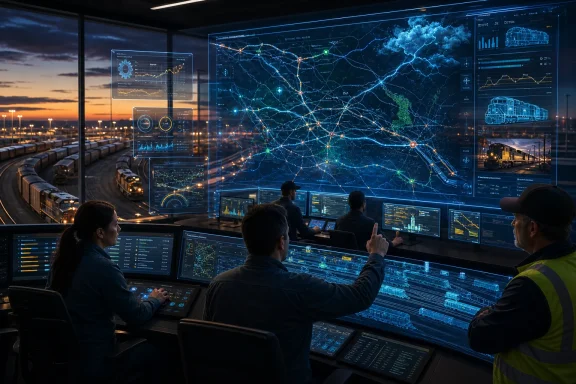
A digital twin would provide a continuously updated model of tracks, yards, rolling stock, crews, terminals, and operating constraints. A shared data platform would bring together sources such as GPS data, maintenance history, wayside-detector readings, weather, and service commitments. AI models and optimization engines would then simulate options and recommend actions.
The important distinction is that Microsoft is describing cross-domain decision support. For example, a maintenance recommendation could account for the dispatching disruption caused by taking equipment out of service. A safety alert could be weighed against weather, track conditions, asset health, and traffic density. Fuel-efficiency guidance could consider train handling, congestion, consists, routing, and crew availability rather than relying only on static rules.
That is a more ambitious use of AI than a chatbot layered over maintenance manuals or an isolated prediction model. It also creates a harder integration problem, since useful recommendations depend on operational data quality, model accuracy, and the ability to reflect real-world railroad rules and constraints.
The company explicitly frames this as decision support rather than replacing railroad staff. That matters in an industry where dispatching, safety, and field operations involve tightly controlled procedures, experienced judgment, and consequences that can extend well beyond a single delayed train.
For IT teams, the practical requirements resemble those behind other industrial AI deployments: connect operational technology and enterprise systems securely, establish trusted data governance, define where automated recommendations end and human authority begins, and measure results against specific operational metrics.
Microsoft recommends starting with a narrow, measurable use case—such as reducing dwell, prioritizing maintenance, detecting safety risks, improving workforce decision support, or cutting fuel use—before linking adjacent workflows. The concept will ultimately be judged by whether railroads can turn those pilots into dependable operational processes rather than another layer of dashboards.
In a July 16 Microsoft Cloud blog post, the company positioned the idea as an operating model rather than a packaged product. The premise is straightforward: freight railroads already collect large volumes of telemetry, asset, yard, crew, weather, and customer data, but many decisions remain localized and reactive. Microsoft argues that linking those signals could help operators optimize the network as a whole instead of improving one terminal or department at the expense of another.
 A coordination problem, not simply a data problem
The proposed system targets five familiar rail problems: congestion and railcar dwell time, predictive maintenance, safety risk, workforce knowledge loss, and fuel consumption.A digital twin would provide a continuously updated model of tracks, yards, rolling stock, crews, terminals, and operating constraints. A shared data platform would bring together sources such as GPS data, maintenance history, wayside-detector readings, weather, and service commitments. AI models and optimization engines would then simulate options and recommend actions.
The important distinction is that Microsoft is describing cross-domain decision support. For example, a maintenance recommendation could account for the dispatching disruption caused by taking equipment out of service. A safety alert could be weighed against weather, track conditions, asset health, and traffic density. Fuel-efficiency guidance could consider train handling, congestion, consists, routing, and crew availability rather than relying only on static rules.
That is a more ambitious use of AI than a chatbot layered over maintenance manuals or an isolated prediction model. It also creates a harder integration problem, since useful recommendations depend on operational data quality, model accuracy, and the ability to reflect real-world railroad rules and constraints.
Copilots remain in the human approval loop
Microsoft’s model puts copilots and AI agents into existing workflows for dispatchers, maintenance planners, safety teams, and operators. The systems would surface relevant context, explain trade-offs, and propose actions using rail-specific terminology and relationships.The company explicitly frames this as decision support rather than replacing railroad staff. That matters in an industry where dispatching, safety, and field operations involve tightly controlled procedures, experienced judgment, and consequences that can extend well beyond a single delayed train.
For IT teams, the practical requirements resemble those behind other industrial AI deployments: connect operational technology and enterprise systems securely, establish trusted data governance, define where automated recommendations end and human authority begins, and measure results against specific operational metrics.
Microsoft recommends starting with a narrow, measurable use case—such as reducing dwell, prioritizing maintenance, detecting safety risks, improving workforce decision support, or cutting fuel use—before linking adjacent workflows. The concept will ultimately be judged by whether railroads can turn those pilots into dependable operational processes rather than another layer of dashboards.
References
- Primary source: Microsoft
Published: 2026-07-16T16:00:00+00:00
Loading…
www.microsoft.com
