

Microsoft’s rapid retreat from an apparent plan to “rewrite Windows with AI” crystallizes a deeper story about how research, recruitment language, and public perception can collide — and why the difference between research experiment and product roadmap matters for every IT pro who manages Windows in production. The week’s flashpoint began with a high-profile LinkedIn hiring post by Microsoft Distinguished Engineer Galen Hunt that set an audacious target — “eliminate every line of C and C++ from Microsoft by 2030” — and offered a provocative productivity north star: “1 engineer, 1 month, 1 million lines of code.” The post quickly became shorthand for an AI-driven Rust rewrite of Windows, prompting immediate denial from Microsoft and an edited clarification from Hunt that reframed the work as a research-and-tooling effort, not a shipped plan to rewrite Windows 11.
However, the public reaction reveals two enduring truths:
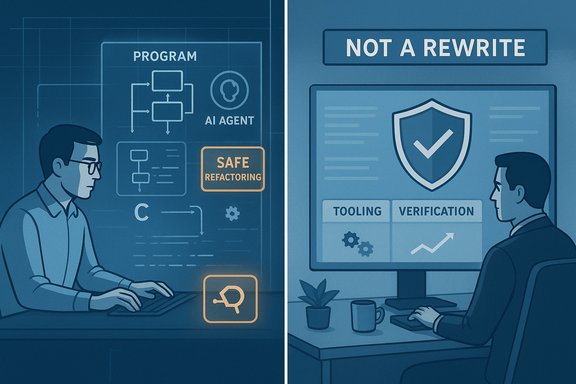
Source: Red94 Microsoft walks back Windows AI rewriting plan after engineer's bombshell post sparks massive backlash
 Background
The post that ignited the debate
On December 23, 2025, a public LinkedIn hiring message tied to Galen Hunt’s CoreAI team described a charter to build a “powerful code processing infrastructure” that combines deterministic program analysis with AI agents to enable large-scale language migration — specifically exploring C/C++ → Rust pathways. The message included the 2030 target and the million-line productivity metric, language that many readers interpreted as a corporate commitment to rewrite Windows itself. Within days Hunt edited the post and explicitly clarified: “Windows is NOT being rewritten in Rust with AI.” Microsoft communications also told press the company had no plan to rewrite Windows 11 using AI-generated Rust code.Why the wording mattered
A hiring post from a senior engineer that uses collective pronouns like “our” naturally reads as strategic. Recruiter language frequently telegraphs priorities, and a Distinguished Engineer’s public note carries outsized weight. The combination of an absolute-sounding end date (2030), a sweeping target (eliminate all C/C++), and a catchy throughput metric made the message irresistible to headline writers and forum thread participants — and that’s what turned a research staffing call into a platform-level controversy.Overview of Microsoft’s clarification
What Microsoft actually said
Microsoft’s communications team, represented in press replies by corporate spokespeople, made an important distinction: the LinkedIn post described an internal research effort to develop tooling for language migration, not a product plan to hand the Windows kernel or shipping Windows 11 to an automated rewrite pipeline. The company emphasized staged pilots, tooling, and human verification rather than unsupervised AI-driven mass replacements. Galen Hunt’s own edited note reinforced that the project is research-focused and recruiting for systems and compiler engineers to build the tooling.The “research vs. roadmap” gap
The clarification matters because the engineering work described — program graphs, deterministic analysis layers, AI-assisted transformations and verification tooling — is squarely in the domain of research and internal platform tooling. Those are legitimate and valuable activities for a large vendor that needs to modernize decades-old C/C++ code. But research programs are exploratory; they produce prototypes and tooling that may or may not become mainstream product paths. Confusing the two harms trust and foments fear among developers, OEMs, driver authors, and enterprises that depend on ABI stability.The research project: what’s credible and what’s aspirational
Pillars of the research charter
The components Hunt described are plausible engineering building blocks for a scalable migration pipeline:- Deterministic program analysis: building typed intermediate representations, whole-program graphs, and ABI reasoning.
- Algorithmic constraints: rule-based transformations that guard correctness and preserve calling conventions.
- AI-assisted agents: language models that propose refactorings, idiomatic translations, and tests under algorithmic guardrails.
- Verification and testing: fuzzing, equivalence testing, and staged rollouts that validate behavior before any shipping changes.
The demonstrator language: why Rust is mentioned
Rust is repeatedly used as a demonstration target because its ownership and borrow semantics provide compile-time guarantees that drastically reduce memory-safety vulnerabilities common in C/C++. Microsoft’s prior pilot projects and community investments in Rust (bindings, small kernel-adjacent components, tooling) make Rust a sensible example for experiments aimed at reducing memory-safety bugs. However, Hunt’s post and Microsoft’s response both stress that Rust was a demonstration target for research, not necessarily the single mandatory endpoint for every migration.Technical realism: can AI plus algorithms translate Windows safely at scale?
Short answer: not without enormous verification effort
Translating isolated libraries is feasible today with advanced tooling. Translating an OS kernel, drivers, and ABI-sensitive system services — the heart of Windows — is a fundamentally different engineering problem. The barriers are concrete, measurable, and familiar to systems engineers:- Undefined behavior and fragile semantics: C/C++ code frequently depends (intentionally or accidentally) on platform-specific behavior. Mechanical translations that do not preserve semantics or make implicit assumptions explicit can break correctness in subtle ways.
- ABI and binary contracts: Drivers, firmware, and third-party binaries depend on exact memory layouts and calling conventions. Any change that violates these contracts breaks compatibility.
- Concurrency, timing, and non-functional attributes: Lock-free data structures, interrupt handling, and timing-sensitive code can behave differently when language-level layouts and optimizations change.
- The “unsafe” trap: A naive transpilation that wraps translated regions in Rust’s unsafe blocks preserves the original risk surface and defeats the security rationale for migration. The goal must be idiomatic Rust that reduces unsafe surface area.
What a credible production approach looks like
A realistic pipeline is hybrid. Algorithms and compilers produce rigorous intermediate representations and preserve ABI constraints. AI suggests transformations and scaffolding. Human engineers review critical changes. Automated equivalence checks, fuzzing campaigns, and hardware-in-the-loop tests validate behavior across millions of permutations. Staged pilots and dual-stack servicing models preserve compatibility for long-tail drivers. That layered approach limits hallucination risks inherent to pure LLM rewriting.Why Microsoft is exploring this — the compelling case for migration
Memory safety and security economics
Memory-safety bugs remain a dominant root cause of severe vulnerabilities. For a vendor with vast legacy C/C++ code, the long-term security gains of moving towards memory-safe languages like Rust are attractive on technical and risk-management grounds. Industry-level research and internal Microsoft analyses have repeatedly shown the disproportionate impact of memory-safety issues on security posture, justifying serious exploration of migrations at scale.Efficiency gains that motivate tooling
AI-powered tooling can accelerate repetitive porting tasks, automatically generate test harnesses, scaffold interop layers, and surface risky code patterns for targeted human effort. Viewed as assistive technology inside a verification pipeline, AI can make multi-year migrations tractable by reducing manual toil and focusing skilled engineers on the hardest, hand-crafted parts. Hunt’s productivity north star — “1 engineer, 1 month, 1 million lines” — should be read as a throughput goal for tooling infrastructure, not a literal promise that one engineer will single-handedly convert mission-critical kernel code overnight.The risks: what could go wrong if communication or engineering controls fail
Reputational and operational risks
A poorly communicated research announcement can erode trust. For platform vendors, trust is a technical asset: driver authors, ISVs, and enterprises depend on predictable behavior and clear upgrade paths. A perception that core OS contracts might be suddenly altered by AI-driven automation can prompt developers to withhold investment, push back on certification, or accelerate plans to decouple workloads from the platform. The episode shows how easily a research signal can become an operational liability.Security and supply-chain hazards
Automated transformations that introduce logically valid but insecure changes are possible. If humans are not deeply involved in review loops, new vulnerabilities could be created rather than removed. Moreover, transformations must be reproducible and auditable; otherwise the update supply chain loses its integrity. Tools must generate deterministic artifacts, maintain immutable audit trails for changes, and integrate into secure build systems to keep risk bounded.The logisitics and cost of compatibility
Dual-stack testing (supporting both legacy C/C++ and migrated Rust modules), compatibility shims for binary interfaces, and long-tail support for third-party drivers impose real engineering costs. The timeline is multi-year and expensive; framing such a program as short-term underestimates the complexity. If the company were to pursue a rapid timeline without commensurate investment in verification and staged rollouts, user-facing regressions could be severe and visible.The communication failure: lessons in tone, channels, and context
Why a hiring post sparked a crisis
Public recruitment language is optimized to attract talent: it uses aspirational phrasing, bolder goals, and vivid metrics. But when that language comes from a high-status engineer and goes public, the audience interprets it as a signal of strategic priority. The mismatch between recruitment rhetoric and product roadmap clarity created the core confusion. Hunt’s edit and Microsoft’s press clarifications corrected the record, but only after the message had already amplified.Best-practice framing for research announcements
Large vendors should consider simple guardrails when posting public research recruitment or demo notices:- Explicitly label experimental work as “research” and state that it is not part of current shipping plans.
- Add short, plain-language summaries of real-world impact and timelines for production adoption.
- Provide links to archived job descriptions or research briefs that maintain a verbatim record for transparency.
- Pre-coordinate with communications teams to ensure the message is calibrated for external audiences, including partners and enterprise admins who will assess operational risk.
What this means for Windows users, admins, and partners
Immediate practical takeaway
There is no imminent, company-wide rewrite of Windows 11 happening today. Microsoft and Hunt both clarified that the work is research, and Microsoft publicly denied plans to rewrite Windows 11 with AI-driven Rust translations. Administrators and OEMs therefore have no immediate platform-level disruption to plan for as a result of this announcement.Longer-term strategic implications
The episode signals that Microsoft is investing in tooling and infrastructure that could, over many years, make migration and incremental modernization more feasible. IT leaders should treat this as a signal of longer-term interest in memory safety and tooling investments rather than an operational alarm. Practical steps for the mid-term:- Continue to prioritize compatibility testing and driver validation in your release pipelines.
- Monitor Microsoft’s official engineering publications and Insider builds for concrete pilot results or tooling releases.
- Prepare change-control processes that assume incremental, well-documented migration steps rather than wholesale rewrites.
Verdict: ambition, caution, and governance
Microsoft’s research charter — pairing algorithmic analysis with AI assistance to explore large-scale language migration — is a technically sensible line of inquiry for a vendor with vast C/C++ code assets and a strong security motivation to reduce memory-safety bugs. The research pillars described are credible engineering building blocks and could create valuable tooling that reduces manual toil and improves long-term maintainability.However, the public reaction reveals two enduring truths:
- Research language matters. Recruitment and demo wording must be paired with explicit product disclaimers to avoid alarming customers and partners.
- AI is an enabler, not a substitute for systems engineering. Any credible migration to a memory-safe language at OS scale requires deterministic analysis, exhaustive testing, staged pilots, and deep human review. Attempts to shortcut these steps would risk severe regressions, security issues, and a loss of trust.
Recommendations for Microsoft and other platform vendors
- Label research clearly: Public posts that use strategic language should include explicit "research-only" labels and short non-technical summaries of expected product impact.
- Publish pilot metrics: If tooling is being developed, publish repeatable pilot benchmarks and verification artifacts that demonstrate preservation of ABI, performance, and semantics in controlled scenarios.
- Open verification tooling where safe: Release non-sensitive parts of the pipeline as community tools to allow independent validation and to create external trust signals.
- Invest in governance: Build clear human-in-the-loop gates, reproducible builds, and auditable change logs for any automated transformation pipelines.
- Engage partners early: Driver authors, OEMs, and enterprise ISVs should be invited to early pilots so that compatibility concerns are surfaced and addressed before broader rollouts.
Conclusion
This episode should not be reduced to simple “AI will rewrite Windows” fearmongering nor to naive cheerleading about the inevitability of automated rewriting. It is a nuanced moment that demonstrates the power of research to generate plausible technical futures and the fragility of public understanding when aspirational language meets real-world platform dependencies. Microsoft’s walkback and the engineer’s clarification returned the conversation to reality: the work is research, the goal is tooling, and the path from prototypes to production is long, verifiable, and human-centered. For IT professionals, the sensible posture is steady: continue to manage compatibility and risk in production environments, watch for concrete pilot artifacts and tooling releases, and demand rigorous verification and staged rollouts before treating research announcements as operational roadmaps.Source: Red94 Microsoft walks back Windows AI rewriting plan after engineer's bombshell post sparks massive backlash
