

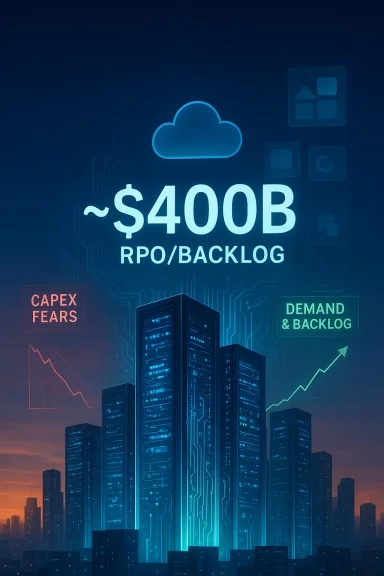
Microsoft’s AI spending spree looks unsettling at first glance because the bill is real, the data-center buildout is massive, and the payoff is still unfolding. But the latest investor materials show why the bear case may be too simple: Microsoft Cloud demand remains strong, Azure continues to post robust growth, and the company’s commercial remaining performance obligation has climbed to nearly $400 billion, signaling a huge pipeline of contracted business that still has to be delivered. In other words, the market may be reacting to the pace of spending while underestimating the scale of demand already locked in.
Microsoft is in the middle of a very expensive transition, and that is exactly why investors are nervous. The company has been pouring money into AI infrastructure, cloud capacity, and product integration at the same time that Wall Street is becoming more demanding about short-term efficiency and monetization. That tension is not unusual in platform shifts, but it does create the kind of stock volatility that can make a dominant company look fragile.
The article’s core claim is simple: the sell-off may be more about timing than thesis. That is a credible argument when a company is building capacity ahead of demand, because the market often wants revenue recognition now while management is planning for years ahead. Microsoft’s own earnings commentary suggests it sees AI not as a side project, but as a new layer on top of the cloud business, with demand broadening across workloads rather than concentrating in a single use case.
The most important number in the debate is not a flashy product launch or a one-quarter margin dip. It is the size of Microsoft’s commercial backlog / remaining performance obligation, which management said was nearly $400 billion in the first quarter of fiscal 2026 and later described as $368 billion in the prior quarter, depending on the reporting date. That backlog matters because it tells investors that a great deal of future revenue is already under contract, even before the full AI monetization story matures.
Still, it would be a mistake to treat backlog as a magical shield. Backlog is a promise, not cash, and it does not eliminate execution risk, partner concentration risk, or the possibility that Microsoft spends too aggressively in front of actual usage. The right question is not whether the AI buildout is expensive. It is whether Microsoft can keep converting that spending into durable enterprise consumption, Copilot adoption, and cloud lock-in faster than depreciation and competition catch up.
The partnership has also helped Microsoft position Copilot as a real commercial product rather than a marketing label. Copilot is not one thing; it is a family of AI features embedded into Microsoft 365, security tools, developer tools, and consumer services. That breadth matters because it spreads monetization opportunities across large installed bases instead of forcing AI revenue to come from a single new app.
That creates a narrative vacuum. When the market sees rising capex, it often assumes the worst-case interpretation: excess spending, falling returns, or customer hesitation. But when the company’s core cloud business is still growing rapidly and backlog is expanding, the more likely explanation is that Microsoft is building ahead of a demand curve it expects to steepen further.
A useful way to frame the situation is this: Microsoft is not simply buying GPUs to chase headlines. It is building a platform stack where infrastructure, models, and software tools reinforce one another. That sort of strategy is expensive early, but it can become extremely efficient once scale, usage, and renewals begin compounding. That is the long-game logic behind the buildout.
It is also notable that Microsoft described the weighted average duration of that commercial RPO as only two years in its first-quarter FY26 call. That implies a large share of the backlog converts relatively quickly, which reduces some of the fear that the number is merely a far-off promise with no near-term economic benefit. Shorter duration is better than a distant backlog fantasy.
That said, it is difficult to square a nearly $400 billion contracted demand pool with a thesis that Microsoft’s AI strategy is broken. A company with weak demand usually does not advertise this kind of forward visibility. The more plausible concern is execution pacing: whether Microsoft can build efficiently enough to satisfy the demand already in the queue.
That means the backlog should be read alongside the capex story, not separately from it. When viewed together, they form a more coherent picture: Microsoft is front-loading costs into a demand environment that is already visible in the pipeline. That does not eliminate risk, but it changes the burden of proof.
The significance of Azure growth is that it shows Microsoft is not relying only on “future potential.” Customers are already consuming cloud services at scale, and AI-related infrastructure is being layered into a business that remains one of the largest and most important enterprise cloud platforms on the market. That combination is hard for rivals to match quickly.
But margin compression is not the same thing as margin destruction. If the company is investing into capacity that supports future consumption, then lower percentages can coexist with higher absolute profit dollars. Microsoft’s earnings releases show revenue, gross margin dollars, and operating income continuing to rise even as the mix shifts toward heavier AI investment.
The takeaway is not that Azure is invincible. It is that Azure remains the clearest monetization path for AI at Microsoft, and the numbers show that the path is still active. A business growing at this scale can absorb more AI expense than the market often assumes.
Microsoft also has the advantage of distribution. It already owns the identity, collaboration, document, security, and endpoint surfaces where knowledge work happens. That gives it a highly privileged place to monetize AI assistants, especially in organizations that prefer purchasing through a single vendor relationship rather than stitching together multiple point solutions.
There is also a product-design issue: users may love AI assistance, but organizations may remain wary of workflow disruption, governance, hallucination risk, and change management costs. Microsoft can reduce those frictions, but it cannot make them disappear. That means Copilot’s monetization curve could be slower than enthusiasts expect, even if the strategic value is real.
The strongest interpretation is that Copilot is acting as a strategic wedge rather than a fully mature earnings driver. It is helping Microsoft justify its infrastructure buildout, but the full payoff will depend on whether the company can convert novelty into normalized usage. That conversion is the real test.
The value is not just technical. It is also commercial. OpenAI drives interest, workload demand, and ecosystem legitimacy around Microsoft’s AI layer, which helps the company justify infrastructure investment and customer acquisition. Even if OpenAI is not the only AI engine that matters, it remains a major reference point for the broader market.
This is where the market can swing too far in either direction. It can treat Microsoft as if it owns the entire AI value chain, or it can assume the partner risk invalidates the thesis altogether. Neither extreme is correct. The more accurate view is that Microsoft has meaningful leverage, but also meaningful dependence, and the balance of that relationship will matter for years. That is a manageable risk, not a trivial one.
The real question is whether Microsoft can make OpenAI one pillar among several rather than the single point of failure critics fear. The company’s work on Azure AI Foundry and its broader model access strategy suggests that is precisely what it is trying to do.
Microsoft has acknowledged that the AI buildout is affecting gross margin percentages, and that admission is helpful because it makes the tradeoff explicit. The company is not pretending the cost is trivial. Instead, it is effectively arguing that this is the price of remaining competitive in a market where compute capacity has become strategic.
There is also a difference between capital intensity and capital waste. A company can spend heavily and still be doing the right thing if the investments align with a platform shift. Microsoft’s backlog growth, Azure growth, and Copilot traction suggest this is not random spending; it is a coordinated strategy around an expanding AI stack. That is why the sell-off may be overdone.
The commercial RPO also matters more for enterprises because it reflects multiyear contractual demand. When Microsoft says it has nearly $400 billion of future obligations, it is signaling that the enterprise pipeline is not hypothetical. That should give long-term investors some confidence that the AI rollout is finding real business adoption.
The consumer market also tends to be more fickle. Features that are popular in demos may not sustain daily engagement at the same rate as enterprise tools embedded in work. Microsoft understands this, which is why the company keeps emphasizing commercial productivity and cloud services rather than only consumer-facing AI experiences.
The threat extends beyond cloud. Productivity vendors, security vendors, and developer platform vendors all face a Microsoft that is increasingly able to monetize AI across multiple layers of the stack. That creates a compounded challenge for rivals, who may need to offer either lower prices, more specialized functionality, or superior model performance to stay relevant.
At the same time, Microsoft must prove that scale still creates returns. Competitors will watch margin pressure closely and argue that being first to spend is not the same thing as being first to win. That argument is not frivolous, but it becomes less persuasive if Azure demand and backlog continue to expand at the current pace. Execution will decide the argument.
Source: AOL.com Microsoft's AI Buildout Looks Risky Until You See This Number
 Overview
Microsoft is in the middle of a very expensive transition, and that is exactly why investors are nervous. The company has been pouring money into AI infrastructure, cloud capacity, and product integration at the same time that Wall Street is becoming more demanding about short-term efficiency and monetization. That tension is not unusual in platform shifts, but it does create the kind of stock volatility that can make a dominant company look fragile.The article’s core claim is simple: the sell-off may be more about timing than thesis. That is a credible argument when a company is building capacity ahead of demand, because the market often wants revenue recognition now while management is planning for years ahead. Microsoft’s own earnings commentary suggests it sees AI not as a side project, but as a new layer on top of the cloud business, with demand broadening across workloads rather than concentrating in a single use case.
The most important number in the debate is not a flashy product launch or a one-quarter margin dip. It is the size of Microsoft’s commercial backlog / remaining performance obligation, which management said was nearly $400 billion in the first quarter of fiscal 2026 and later described as $368 billion in the prior quarter, depending on the reporting date. That backlog matters because it tells investors that a great deal of future revenue is already under contract, even before the full AI monetization story matures.
Still, it would be a mistake to treat backlog as a magical shield. Backlog is a promise, not cash, and it does not eliminate execution risk, partner concentration risk, or the possibility that Microsoft spends too aggressively in front of actual usage. The right question is not whether the AI buildout is expensive. It is whether Microsoft can keep converting that spending into durable enterprise consumption, Copilot adoption, and cloud lock-in faster than depreciation and competition catch up.
Background
Microsoft’s AI push did not appear overnight. The company has spent nearly a decade positioning Azure as the backbone for enterprise AI, and that long runway matters because today’s capital intensity is the result of a multi-year strategic decision, not a sudden craze. The firm’s partnership with OpenAI has been central to that strategy, and Microsoft has repeatedly framed the relationship as one that combines model access, cloud infrastructure, and product distribution across its ecosystem.The OpenAI relationship as a strategic anchor
The OpenAI partnership gives Microsoft something many rivals cannot easily replicate: model access plus infrastructure plus distribution. Microsoft has said it retains exclusive Azure API rights for stateless OpenAI models and continues to be OpenAI’s frontier model partner, even as the partnership has evolved to allow more flexibility for OpenAI’s broader compute plans. That flexibility is important, but it also creates a more nuanced competitive picture than the old “exclusive Azure tie-up” narrative suggested.The partnership has also helped Microsoft position Copilot as a real commercial product rather than a marketing label. Copilot is not one thing; it is a family of AI features embedded into Microsoft 365, security tools, developer tools, and consumer services. That breadth matters because it spreads monetization opportunities across large installed bases instead of forcing AI revenue to come from a single new app.
Why investors got anxious
Investor anxiety intensified because AI infrastructure spending is hard to model. Capex rises before the revenue is fully visible, gross margins can get pressured by AI-heavy usage, and demand signals can be obscured by the timing of deployments. Microsoft’s own disclosures show that gross margin percentage has been affected by scaling AI infrastructure and increased product usage, even as the underlying businesses keep growing.That creates a narrative vacuum. When the market sees rising capex, it often assumes the worst-case interpretation: excess spending, falling returns, or customer hesitation. But when the company’s core cloud business is still growing rapidly and backlog is expanding, the more likely explanation is that Microsoft is building ahead of a demand curve it expects to steepen further.
Why this story matters now
The timing matters because Microsoft is now in the phase where AI is becoming operational rather than experimental. That means more customers are not just testing models; they are integrating them into workflows, security stacks, developer pipelines, and enterprise contracts. The transition is slower than hype cycles suggest, but it is more durable than one-off product launches.A useful way to frame the situation is this: Microsoft is not simply buying GPUs to chase headlines. It is building a platform stack where infrastructure, models, and software tools reinforce one another. That sort of strategy is expensive early, but it can become extremely efficient once scale, usage, and renewals begin compounding. That is the long-game logic behind the buildout.
The Backlog Signal
The headline number behind the bullish case is the company’s massive commercial obligation pool. Microsoft said its commercial remaining performance obligation reached about $392 billion as of September 30, 2025, and later said commercial RPO increased over 50% to nearly $400 billion in its first-quarter fiscal 2026 call. That is not a casual metric; it is the accumulated value of business already contracted to be delivered in future periods.Why backlog matters more than a single quarter
Backlog is important because it exposes the gap between near-term market sentiment and medium-term revenue visibility. Investors can get fixated on AI capex and margin compression, but if the company has a giant book of future deliveries, then the spending is easier to contextualize as pre-investment rather than waste. In Microsoft’s case, the backlog suggests that enterprise demand is not evaporating.It is also notable that Microsoft described the weighted average duration of that commercial RPO as only two years in its first-quarter FY26 call. That implies a large share of the backlog converts relatively quickly, which reduces some of the fear that the number is merely a far-off promise with no near-term economic benefit. Shorter duration is better than a distant backlog fantasy.
The backlog is not a free pass
Still, backlog can be misunderstood. It does not mean every dollar will arrive perfectly on schedule, and it does not guarantee the economics will stay intact if AI usage patterns shift. It also includes a mix of services, timing assumptions, and contractual structures that can be harder to unpack than a simple revenue forecast.That said, it is difficult to square a nearly $400 billion contracted demand pool with a thesis that Microsoft’s AI strategy is broken. A company with weak demand usually does not advertise this kind of forward visibility. The more plausible concern is execution pacing: whether Microsoft can build efficiently enough to satisfy the demand already in the queue.
What the market may be missing
The market often treats spending and returns as if they are simultaneous. In infrastructure businesses, they are not. Microsoft is paying for capacity now because the workload mix it expects later will require more scale, more power, and more specialized deployment across its cloud stack.That means the backlog should be read alongside the capex story, not separately from it. When viewed together, they form a more coherent picture: Microsoft is front-loading costs into a demand environment that is already visible in the pipeline. That does not eliminate risk, but it changes the burden of proof.
- The backlog suggests future revenue visibility is still strong.
- The two-year duration points to a faster conversion profile than many assume.
- Backlog does not eliminate execution risk.
- The size of the number implies real enterprise demand, not just hype.
Azure Growth Still Matters
The second pillar of the bull case is Azure itself. Microsoft reported Azure and other cloud services revenue growth of 40% in fiscal Q1 2026 and 39% in fiscal Q2 2026, both driven by demand across workloads. That is still an aggressive growth rate for a business of this size, especially one that is simultaneously funding a major AI infrastructure expansion.Why Azure is the real AI monetization engine
For Microsoft, Azure is not just a cloud product. It is the distribution layer through which enterprise AI usage gets routed, monetized, and integrated into existing customer relationships. That makes Azure the economic engine beneath a large part of the company’s AI story.The significance of Azure growth is that it shows Microsoft is not relying only on “future potential.” Customers are already consuming cloud services at scale, and AI-related infrastructure is being layered into a business that remains one of the largest and most important enterprise cloud platforms on the market. That combination is hard for rivals to match quickly.
Margin pressure is the price of scale
Microsoft has been clear that AI infrastructure is pressuring gross margin percentages. In fiscal Q1 2026, Microsoft Cloud gross margin percentage fell to 68% because of scaling AI infrastructure and growing product usage; in fiscal Q2 2026, it fell to 67% for similar reasons. That is a real cost, and the market is right to pay attention to it.But margin compression is not the same thing as margin destruction. If the company is investing into capacity that supports future consumption, then lower percentages can coexist with higher absolute profit dollars. Microsoft’s earnings releases show revenue, gross margin dollars, and operating income continuing to rise even as the mix shifts toward heavier AI investment.
The competitive implication
Azure’s growth also matters because it keeps Microsoft in the front rank of enterprise AI infrastructure providers. Rivals may tout model innovation, but Microsoft can pair models with cloud services, identity, security, productivity software, and developer tooling. That integrated stack makes switching more difficult and increases the chance that AI workloads expand inside the Microsoft ecosystem rather than outside it.The takeaway is not that Azure is invincible. It is that Azure remains the clearest monetization path for AI at Microsoft, and the numbers show that the path is still active. A business growing at this scale can absorb more AI expense than the market often assumes.
- Azure growth remains in the high-30s to 40% range.
- AI spending is pressuring margins, but not stopping growth.
- Azure is the core monetization layer for Microsoft AI.
- The integrated Microsoft stack strengthens customer stickiness.
Copilot Traction Is Real, But Still Early
Copilot is the product investors love to debate because it sits at the intersection of excitement and uncertainty. Microsoft says Microsoft 365 Commercial cloud revenue has grown, with revenue per user supported by Microsoft 365 E5 and Microsoft 365 Copilot, and its FY26 metrics page shows the commercial cloud growth series still trending positively. That is meaningful, but it is not the same thing as saying Copilot has already become a runaway profit engine.Why Copilot matters strategically
Copilot is important because it turns AI from a speculative add-on into a recurring workflow feature. That matters for enterprise customers who want productivity gains inside tools they already use, rather than forcing employees into separate AI destinations. The deeper Microsoft can embed Copilot into Office, security, developer, and business workflows, the more naturally AI monetization can spread.Microsoft also has the advantage of distribution. It already owns the identity, collaboration, document, security, and endpoint surfaces where knowledge work happens. That gives it a highly privileged place to monetize AI assistants, especially in organizations that prefer purchasing through a single vendor relationship rather than stitching together multiple point solutions.
What is still uncertain
The hard part is adoption depth. Many enterprise pilots look promising before companies decide whether they will pay broadly, configure securely, and measure productivity impact rigorously. Copilot may be widely visible, but broad visible usage does not automatically mean full paid penetration at attractive margins. The market still wants to see proof at scale.There is also a product-design issue: users may love AI assistance, but organizations may remain wary of workflow disruption, governance, hallucination risk, and change management costs. Microsoft can reduce those frictions, but it cannot make them disappear. That means Copilot’s monetization curve could be slower than enthusiasts expect, even if the strategic value is real.
Enterprise and consumer split
Enterprise is the more important near-term battleground. Microsoft’s commercial seat base and integrated cloud offering make enterprise adoption the higher-value opportunity, while consumer AI can help broaden reach and brand familiarity. But consumer usage often monetizes more slowly, so investors should not expect personal AI features alone to carry the thesis.The strongest interpretation is that Copilot is acting as a strategic wedge rather than a fully mature earnings driver. It is helping Microsoft justify its infrastructure buildout, but the full payoff will depend on whether the company can convert novelty into normalized usage. That conversion is the real test.
The OpenAI Risk Is Real, But Manageable
A lot of skepticism about Microsoft’s AI spend centers on OpenAI exposure. That concern is understandable because a large partner relationship can create concentration risk, especially when the partner is expensive, strategically important, and still evolving. Yet Microsoft’s most recent public statements suggest the relationship remains intact and operationally central even as both sides pursue more flexibility.Why the relationship still supports Microsoft
Microsoft says it retains exclusive IP rights and Azure API exclusivity for OpenAI’s stateless APIs, and that OpenAI’s first-party products continue to be hosted on Azure. That gives Microsoft continuing relevance even as OpenAI explores additional capacity arrangements and broader ecosystem partnerships. The relationship is less rigid than it once was, but it still remains deeply favorable to Microsoft’s cloud strategy.The value is not just technical. It is also commercial. OpenAI drives interest, workload demand, and ecosystem legitimacy around Microsoft’s AI layer, which helps the company justify infrastructure investment and customer acquisition. Even if OpenAI is not the only AI engine that matters, it remains a major reference point for the broader market.
Why investors are still uneasy
The uneasy part is that Microsoft’s AI story is not wholly self-contained. If a major slice of backlog and workload demand is linked to a partner relationship, investors will naturally ask how durable that revenue stream is over time. That is especially true when the partner is becoming more independent and when the economics of frontier model training remain uncertain.This is where the market can swing too far in either direction. It can treat Microsoft as if it owns the entire AI value chain, or it can assume the partner risk invalidates the thesis altogether. Neither extreme is correct. The more accurate view is that Microsoft has meaningful leverage, but also meaningful dependence, and the balance of that relationship will matter for years. That is a manageable risk, not a trivial one.
The strategic upside
If Microsoft can keep OpenAI anchored while also broadening its own model and platform offerings, it could end up with a very powerful hybrid position. That would let the company participate in frontier AI while retaining the enterprise trust and distribution advantages that come from Microsoft-owned surfaces. Such a position could be even more valuable than simple exclusivity.The real question is whether Microsoft can make OpenAI one pillar among several rather than the single point of failure critics fear. The company’s work on Azure AI Foundry and its broader model access strategy suggests that is precisely what it is trying to do.
- OpenAI remains strategically important to Microsoft.
- The partnership still supports Azure demand and AI credibility.
- Dependence on a single partner is a real concentration risk.
- Microsoft is trying to broaden beyond a pure OpenAI dependency.
Capital Expenditure and the Margin Debate
The market’s biggest emotional reaction has been to Microsoft’s rising AI capital expenditures. That reaction is understandable because capex is visible, large, and immediate, while revenue is often deferred. Yet Microsoft’s own comments indicate the company is making a deliberate tradeoff: invest now in infrastructure and talent so the platform can support future workload expansion.Why capex scares investors
Capex scares investors because it changes the story from “software-like margins forever” to “cloud-like investment cycles.” That shift matters in valuation, especially for a company that had long been rewarded for scale, predictability, and recurring revenue. Once AI infrastructure enters the picture, the market starts worrying about depreciation, returns on invested capital, and whether every new datacenter will actually be monetized.Microsoft has acknowledged that the AI buildout is affecting gross margin percentages, and that admission is helpful because it makes the tradeoff explicit. The company is not pretending the cost is trivial. Instead, it is effectively arguing that this is the price of remaining competitive in a market where compute capacity has become strategic.
Why the math may still work
The key to the math is utilization. If Microsoft can keep datacenters, GPUs, and AI services highly utilized across Azure, Copilot, and enterprise workloads, then the investment can become more efficient over time. Infrastructure businesses usually look best when early demand proves stronger than the model and scale starts creating operating leverage.There is also a difference between capital intensity and capital waste. A company can spend heavily and still be doing the right thing if the investments align with a platform shift. Microsoft’s backlog growth, Azure growth, and Copilot traction suggest this is not random spending; it is a coordinated strategy around an expanding AI stack. That is why the sell-off may be overdone.
Sequential checklist for investors
- Watch whether Azure growth stays in the high-30s to 40% range.
- Track whether commercial RPO remains near $400 billion or keeps rising.
- Monitor Copilot monetization inside Microsoft 365 commercial revenue.
- Compare AI capex growth with gross margin dollar expansion.
- Look for signs that OpenAI dependence is decreasing over time.
Enterprise versus Consumer Impact
For enterprise customers, Microsoft’s AI buildout is about scale, security, and procurement simplicity. Corporate buyers want AI tools that fit their existing identity, compliance, collaboration, and data governance systems, and Microsoft is unusually well positioned to sell that bundle. That is why the enterprise story is likely to matter more than consumer excitement in the next several quarters.Enterprise value proposition
Microsoft can offer an integrated stack that spans Azure, Microsoft 365, security, developer tools, and model access. That means a company can adopt AI without completely reinventing its tech architecture, which lowers friction and increases the odds of contract renewal. In enterprise software, reduced friction is often a stronger moat than flashy feature launches.The commercial RPO also matters more for enterprises because it reflects multiyear contractual demand. When Microsoft says it has nearly $400 billion of future obligations, it is signaling that the enterprise pipeline is not hypothetical. That should give long-term investors some confidence that the AI rollout is finding real business adoption.
Consumer impact is broader, but less immediate
Consumer AI is important for brand awareness and long-run product expansion, but it tends to monetize less efficiently than enterprise software. Microsoft 365 Consumer and related products can certainly benefit from AI-enhanced features, but those gains are usually slower and more diffuse. That makes consumer AI a helpful complement, not the central valuation driver.The consumer market also tends to be more fickle. Features that are popular in demos may not sustain daily engagement at the same rate as enterprise tools embedded in work. Microsoft understands this, which is why the company keeps emphasizing commercial productivity and cloud services rather than only consumer-facing AI experiences.
- Enterprise is the primary monetization engine.
- Consumer AI supports reach and ecosystem familiarity.
- Commercial RPO is a stronger signal than vanity adoption metrics.
- Integration with Microsoft 365 reduces switching friction.
Competitive Implications
Microsoft’s AI strategy puts pressure on multiple competitors at once. Cloud rivals must compete on infrastructure, model hosting, and enterprise trust, while productivity rivals must compete on workflow integration and seat expansion. This is why Microsoft’s buildout is not just a cost story; it is a competitive moat-building exercise.How rivals are affected
If Microsoft keeps bundling AI into the software and cloud tools enterprises already buy, competitors may have a harder time winning standalone AI budgets. The more AI is embedded into existing contracts, the less likely customers are to experiment widely with separate vendors. That is especially true for large organizations that prefer fewer suppliers and stronger support guarantees.The threat extends beyond cloud. Productivity vendors, security vendors, and developer platform vendors all face a Microsoft that is increasingly able to monetize AI across multiple layers of the stack. That creates a compounded challenge for rivals, who may need to offer either lower prices, more specialized functionality, or superior model performance to stay relevant.
Microsoft’s strengths are structural
The reason Microsoft can do this is structural. It owns the enterprise operating surface, has deep relationships with IT buyers, and can route AI value through products that customers already budget for. That gives it multiple paths to monetization even if one product line underperforms.At the same time, Microsoft must prove that scale still creates returns. Competitors will watch margin pressure closely and argue that being first to spend is not the same thing as being first to win. That argument is not frivolous, but it becomes less persuasive if Azure demand and backlog continue to expand at the current pace. Execution will decide the argument.
Strengths and Opportunities
Microsoft’s AI story is stronger than the stock’s recent volatility suggests because the company has several reinforcing advantages at once: scale, backlog, cloud growth, product distribution, and a deep enterprise footprint. The opportunity is not just to sell more AI features, but to make AI a structural layer across the Microsoft ecosystem.- Massive commercial RPO provides unusually strong revenue visibility.
- Azure growth shows the AI buildout is landing in real demand.
- Copilot integration gives Microsoft a direct monetization path.
- Enterprise distribution lowers customer acquisition friction.
- OpenAI partnership keeps Microsoft close to frontier model innovation.
- Platform bundling can increase switching costs over time.
- Scale economics may improve once infrastructure utilization rises.
Risks and Concerns
The bear case is not imaginary. Microsoft is spending heavily into AI infrastructure, and the return profile will depend on utilization, pricing, and sustained customer demand. If adoption slows, if partner dynamics become less favorable, or if rival platforms become more attractive, the market could decide that the spend was ahead of itself.- Capex intensity could outpace near-term monetization.
- Margin pressure may last longer than investors want.
- OpenAI concentration risk remains an issue.
- Copilot adoption may prove slower in broad enterprise rollouts.
- Backlog timing does not guarantee smooth revenue conversion.
- Competitive response from cloud and software rivals could intensify.
- AI economics may shift if model costs or usage patterns change.
Looking Ahead
The next few quarters should tell investors whether Microsoft’s AI strategy is becoming a compounding engine or merely an expensive transition. The company has already given the market enough evidence to reject the simplest bearish take, but not enough to declare victory. What matters now is the relationship between infrastructure spending, enterprise utilization, and commercial conversion.What to watch
- Azure revenue growth versus continued capex expansion.
- Whether commercial RPO stays near the $400 billion level.
- The pace of Microsoft 365 Copilot monetization.
- Evidence that gross margin pressure is stabilizing.
- The evolution of Microsoft’s relationship with OpenAI.
Source: AOL.com Microsoft's AI Buildout Looks Risky Until You See This Number
