

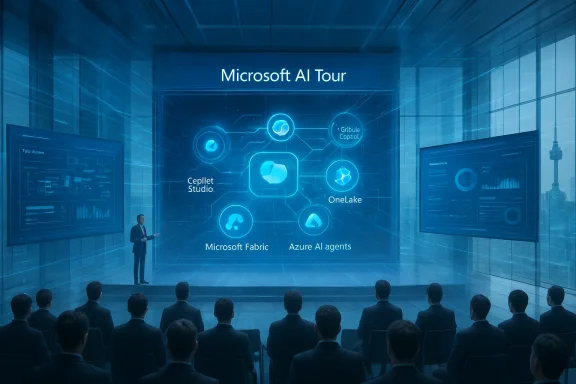
Microsoft will bring its high-profile Microsoft AI Tour to Seoul on March 26, staging a full-day program at COEX that Microsoft Korea says will translate enterprise AI strategy into practical roadmaps for companies intent on becoming “frontier enterprises” in the AI era. ttps://m.news.nate.com/view/20260305n10636)
The Microsoft AI Tour is a global, city-by-city program designed to move beyond product demos and deliver frameworks, governance guidance, and hands-on tooling for enterprise AI adoption. Seoul joins a rolling calendar of events where Microsoft pairs executive keynotes with breakout sessions, customer case studies, and developer- and IT-focused workshops. The Seoul stop explicitly targets business leaders, IT decision-makers, developers, and startups who need concrete steps for moving from pilot projects governed AI systems.
For Seoul, Microsoft Korea has positioned the event as a practical, action-oriented day: the keynote will present a strategic “framing” for national and corporate AI initiatives, while breakout tracks and workshops drill into agentic AI, data modernization, and security and governance — the three pillars most organizations must reconcile to scale AI responsibly.
Microsoft’s message in Korea mirrors its global platform narrative: make AI accessible through integrated tooling (Copilot Studio, Microsoft 365 Copilot, GitHub Copilot), unify and govern data estates (Microsoft Fabric and OneLake), and provide runtime and governance controls for agentic workflows. Seoul is an opportunity for customers to see those pieces demonstrated together and to test them in hands‑on workshops.
Note: Microsoft’s global AI Tour has at times also featured other senior executives in Korea (including CEO-level appearances in prior years). Seoul’s 2025 and 2026 editions have shown a pattern where Microsoft mixes global platform messaging with a strong slate of local partners and customer stories. Readers looking for exact speaker lineups or livestream links on the day should check the official Microsoft Korea channels and registration pages.
That said, real transformation will depend on each organization’s ability to make the technical changes stick. The Tour can catalyze momentum; long-term success will hinge on governance, operational discipline, and clear ROI tracking. For companies that treat the event as a starting point rather than an endpoint, the practical tools and partner connections on display can deliver material competitive advantage.
At the same time, attendees must treat platform demos and lab successes as first steps, not completed projects. The true work starts after the event — in governance design, operational maturity, cost control, model lifecycle management, and continuous observability. Organizations that pair the Tour’s learnings with a disciplined, cross-functional implementation plan will be the ones that move from pilot novelty to sustained AI-driven advantage.
In short: attend with a short, prioritized list of use cases, bring the right mix of business, engineering, and security stakeholders, and plan a realistic 6–12 month adoption roadmap that emphasizes governance, monitoring, and cost management as much as model performance.
Source: thelec.net Microsoft to Host AI Tour Seoul on March 26
 Background / Overview
The Microsoft AI Tour is a global, city-by-city program designed to move beyond product demos and deliver frameworks, governance guidance, and hands-on tooling for enterprise AI adoption. Seoul joins a rolling calendar of events where Microsoft pairs executive keynotes with breakout sessions, customer case studies, and developer- and IT-focused workshops. The Seoul stop explicitly targets business leaders, IT decision-makers, developers, and startups who need concrete steps for moving from pilot projects governed AI systems.For Seoul, Microsoft Korea has positioned the event as a practical, action-oriented day: the keynote will present a strategic “framing” for national and corporate AI initiatives, while breakout tracks and workshops drill into agentic AI, data modernization, and security and governance — the three pillars most organizations must reconcile to scale AI responsibly.
Why this matters: Seoul as an AI battleground
South Korea is already a hotbed for technology adoption: major conglomerates and a dense startup ecosystem mean rapid uptake, but also complex enterprise estates to modernize. Microsoft’s AI Tour Seoul is both symbolic and tactical — symbolic because it signals continued investment and partnership in the Korean market, and tactical because the program is built to help enterprises modernize data, deploy Copilot-driven productivity workflows, and operationalize agents for domain-specific tasks. Local case studies slated for the Seoul stage — from Samsung’s Big Data Center to Yonsei University Health System, Kakaopay Securities, Hyundai Department Store Group, K LG Electronics — are chosen to illustrate exactly that transition from experimentation to impact.Microsoft’s message in Korea mirrors its global platform narrative: make AI accessible through integrated tooling (Copilot Studio, Microsoft 365 Copilot, GitHub Copilot), unify and govern data estates (Microsoft Fabric and OneLake), and provide runtime and governance controls for agentic workflows. Seoul is an opportunity for customers to see those pieces demonstrated together and to test them in hands‑on workshops.
What to expect at the event
Keynotes and leadership message
The Seoul keynote — listed in announcements for the March 26 COEX program — will feature Scott Guthrie, Executive Vice President of Microsoft’s Cloud + AI Group, alongsisted in some local reports as 조원우), CEO of Microsoft Korea, under the theme “Building South Korea’s AI Frontier.” Their session is framed to show how enterprises can adopt success frameworks and scale AI investments, and to share examples of industry-specific innovation.Note: Microsoft’s global AI Tour has at times also featured other senior executives in Korea (including CEO-level appearances in prior years). Seoul’s 2025 and 2026 editions have shown a pattern where Microsoft mixes global platform messaging with a strong slate of local partners and customer stories. Readers looking for exact speaker lineups or livestream links on the day should check the official Microsoft Korea channels and registration pages.
Breakout sessions — agentic AI, governance, and industry playbooks
Breakouts will focus on three cluster areas:- Agentic AI and Copilot-driven workflows — how enterprises build and scale agents using Azure AI agents, Copilot Studio, GitHub Copilot, and Foundry. These sessions aim to move beyond “what AI can do” to how teams design agents that perform multi-step tasks, integrate with business systems, and remain auditable.
- Data modernization and analytic foundations — practical sessions on Microsoft Fabric, OneLake, and interoperability with Azure Databricks to modernize data estates for analytics and agentic workloads. Expect demos on connecting Databricks assets into Fabric, syncing metadata, and deploying fabric-based agents that leverage unified data.
- Security, governance, and digital trust — prescriptive guidance for building governance frameworks that cover model grounding, access controls, telemetry, and compliance-ready workflows. A pre-event Microsoft Security Summit focused on “AI & Digital Trust” runs the day before, underlining how central security is to any enterprise deployment.
Hands-on workshops and developer labs
Microsoft is emphasizing hands-on learning. Planned workshops let participants:- Build customized AI agents using Copilot Studio and GitHub Copilot.
- Experiment with Foundry-hosted models and local deployment options.
- Modernize data pipelines using Fabric and Databricks patterns.
- Test governance controls and threat-model agent interactions with security specialists on hand.
Technical context: the platform pieces you’ll hear a lot about
Copilot Studio, GitHub Copilot, and Foundry — what they do in the enterprise
- Copilot Studio: Microsoft’s low-code/no-code environment for composing agents and Copilots that integrate with enterprise content, connectors, and workflows. It's designed to let non‑AI-specialists configure agents while letting developers extend with code for complex behaviors. Industry feedback shows Studio accelerates prototype-to-pilot cycles but still requires solid data hygiene and secure connectors to be production‑ready.
- GitHub Copilot: Positioned as the developer-facing Copilot, it speeds code creation and increasingly acts as an agent for DevOps tasks. Attendees should expect practical demos of Copilot in developer workflows and in automating repeatable software engineering tasks.
- Foundry: Microsoft’s model-hosting and integration layer (sometimes referred to in vendor messaging as Azure AI Foundry or Microsoft Foundry) that gives enterprises flexibility to run a portfolio of models — from OpenAI engines to third‑party models — with governance, routing, and observability. Foundry’s presence in the workshop lineup signals Microsoft’s continued focus on multi‑model enterprise architectures.
Microsoft Fabric + Databricks — interoperable, not mutually exclusive
A core takeaway Microsoft has pushed is that Fabric and Databricks can be complementary: Fabric (with OneLake) offers a unified, Microsoft-first data layer and analytics workloads, while Databricks remains an important partner for Spark-based engineering and advanced analytics. Microsoft has published guidance on integrating Databricks artifacts with Fabric (Unity Catalog shortcuts, mirrored catalogs, OneLake integration), and recent product updates emphasize easier data movement and shared governance between the two. For enterprises with existing Databricks investments, hybrid patterns that combine Fabric’s semantic layers and Databricks’ engineering strengths are commonly recommended.Customer case studies: what to watch for on stage
The Seoul agenda highlights short case studies from a cross-section of Korean organizations. Each case study is a practical signal of where enterprise AI is heading:- Samsung Big Data Center — likely focused on large-scale data estate modernization and Copilot-enabled knowledge workflows.
- Yonsei University Health System — expected to showcase clinical data workflows, AI-assisted documentation, and governance around sensitive health data.
- Kakaopay Securities — a fintech angle: regulatory-sensitive AI in finance, scaling models while keeping traceability.
- Hyundai Department Store Group — retail use cases such as conversational agents for shoppers and demand forecasting.
- KB Life Insurance and LG Electronics — insurance claims automation and product/repair-assist agents respectively.
Critical analysis: strengths, blind spots, and enterprise risks
Strengths: clarity, tooling breadth, and practical focus
- Practical, workshop-first approach — Microsoft is deliberately shifting from keynote theater to hands-on enablement. That’s valuable: governance, data integration, and agent design are operational problems that require labs, not just slides.
- Platform breadth — Copilot Studio, Fabric, Foundry, GitHub Copilot, and Azure AI agents form a broad stack that covers the developer, data, and business user surfaces. For organizations willing to adopt a Microsoft-first path, the integrated tooling can reduce friction between teams.
- Local partner and customer showcases — Presenting relevant local customers lowers the barrier for Korean organizations to see themselves in the stories and to map learnings to their own operations.
Blind spots and areas Microsoft must address
- Vendor lock-in vs. heterogeneity — The tighter the integration across Fabric, OneLake, Foundry, and Copilot, the more attractive the platform — but also the greater the risk of lock-in. Large enterprises with multi-cloud strategies or long-standing Databricks estates will need clear escape hatches and interoperability guarantees. Microsoft’s public guidance on Databricks integration helps, but real-world migration complexity remains non-trivial.
- Operational readiness is underestimated — Building agents that survive production requires ongoing model lifecycle operations, observability, data quality workflows, and human‑in‑the‑loop processes. Workshops can accelerate learning, but long-term ops and governance frameworks will be the real determinant of success. Organizations should not mistake a successful proof-of-concept in a lab for a production-grade system.
- Security and privacy nuance — Pre-event security summits are positive, but agentic AI raises nuanced risks: prompt injection, data exfiltration, drift, and inadvertent disclosure of sensitive records. Enterprises must adopt a layered approach: Entra identity controls, least-privilege connectors, telemetry/observability, and strict retraining and validation pipelines. Short workshops can introduce the controls, but security teams will need time and tooling to operationalize them.
Practical enterprise risks to anticipate
- Model grounding and hallucination — Agentic systems that synthesize across email, documents, and systems must be explicitly grounded to avoid plausible-but-false outputs. Enterprises must demand explainability traces and evidence links in agent responses.
- Data lineage and compliance — Regulatory regimes in finance and healthcare require auditable lineage; integrating Fabric and Databricks without unified lineage tools is a governance risk.
- Cost surprise — Agentic workloads, long context windows, and model chaining can incur steep inference costs; capacity planning and model routing (e.g., cheaper models for routine tasks, larger models for deep reasoning) are essential.
What enterprises should do before and after attending
Before the event: alignment checklist
- Map three high-impact use cases — pick one developer, one data/analytics, and one business workflow use case to explore in workshops.
- Inventory your data estate — know where critical data lives (OneLake, ADLS Gen2, Databricks). Bring a short list of connectors you need.
- Identify your governance owners — bring folks from security, privacy, and legal to translate workshop learnings into policies.
At the event: practical sessions to prioritize
- Workshops on Copilot Studio to prototype a domain agent end‑to‑end.
- Fabric + Databricks sessions that show concrete integration patterns for your data stack.
- Security Summit sessions focused on telemetry, prompt-injection mitigation, and regulatory controls.
After the event: a three-step adoption approach
- Proof-of-value (Pov) — run a 6–8 week lab with clear KPIs (time saved, error reduction, throughput).
- MLOps and governance gating — implement model versioning, CI/CD for agents, retraining cadence, and deployment approvals.
- Scale with observability — embed monitoring for accuracy, user feedback, cost, and data lineage before large-scale rollout.
The bigger picture: Microsoft’s platform play and the Korean market
Microsoft’s AI Tour Seoul is both marketing and capacity-building: it’s a platform play that simultaneously sells integrated Microsoft value and tries to accelerate local adoption by removing knowledge gaps through hands-on guidance. For Korea — a market with aggressive digital transformation goals — a Microsoft‑led program that pairs technical labs with concrete case studies is a logical avenue for many enterprises to accelerate AI adoption.That said, real transformation will depend on each organization’s ability to make the technical changes stick. The Tour can catalyze momentum; long-term success will hinge on governance, operational discipline, and clear ROI tracking. For companies that treat the event as a starting point rather than an endpoint, the practical tools and partner connections on display can deliver material competitive advantage.
How to read the vendor messaging vs. what actually happens in large organizations
Microsoft’s public messaging focuses on accessibility and integration. Onstage demos and partner showcases illustrate what’s possible when everything is well-architected. In contrast, enterprise reality is messy: many organizations juggle legacy systems, multiple cloud vendor relationships, and fragmented data governance.- If your organization’s leadership expects overnight transformation after a single workshop, you will be disappointed.
- If instead you treat the AI Tour as a concentrated learning sprint — one that surfaces technical patterns, governance pitfalls, and partner options — you can accelerate a multi-quarter transformation plan with measurable deliverables.
Quick glossary of terms you’ll hear at the event
- Agentic AI — systems that act on behalf of users to perform multi-step tasks, often coordinating across applications.
- Copilot Studio — Microsoft’s environment for building and tuning Copilot experiences and custom agents.
- Microsoft Fabric — Microsoft’s unified data and analytics platform with OneLake as the storage layer and multiple workloads for analytics and AI.
- Foundry — Microsoft’s model-hosting and orchestration layer enabling enterprises to run a mix of models with governance.
- Unity Catalog / OneLake — metadata and unified storage concepts for governed data access across Fabric and partner integrations.
- Prompt injection — a class of attacks where malicious inputs cause the model to produce unsafe outputs or leak data.
Final verdict: what the AI Tour Seoul delivers — and where attendees should be cautious
Microsoft AI Tour Seoul is a strong, pragmatic offering for organizations that need both the strategy and the tools to accelerate AI adoption. The program’s mix of executive framing, customer case studies, hands-on labs, and security-focused pre-events creates a rounded agenda designed to produce operational next steps, not just inspiration. For Korean enterprises eager to modernize data estates, adopt agentic workflows, and integrate Copilot-driven experiences, the program represents a concentrated opportunity to learn from peer case studies and Microsoft specialists.At the same time, attendees must treat platform demos and lab successes as first steps, not completed projects. The true work starts after the event — in governance design, operational maturity, cost control, model lifecycle management, and continuous observability. Organizations that pair the Tour’s learnings with a disciplined, cross-functional implementation plan will be the ones that move from pilot novelty to sustained AI-driven advantage.
In short: attend with a short, prioritized list of use cases, bring the right mix of business, engineering, and security stakeholders, and plan a realistic 6–12 month adoption roadmap that emphasizes governance, monitoring, and cost management as much as model performance.
Source: thelec.net Microsoft to Host AI Tour Seoul on March 26
