

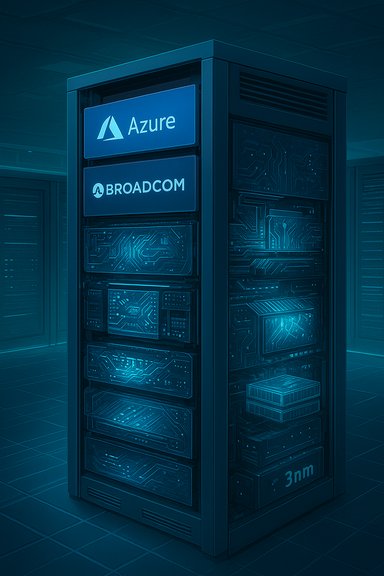
Microsoft’s hardware strategy appears to be entering a new phase: industry reports say the company is in advanced talks with Broadcom to co-develop custom AI chips for Azure, a move that could recalibrate supplier relationships, ease capacity constraints for large-scale inference workloads, and accelerate Microsoft’s long-standing push toward first‑party and co‑designed silicon.
Microsoft’s cloud business is still growing rapidly, but the company has repeatedly warned that demand is outpacing available compute capacity. In its first quarter of fiscal 2026 results, Microsoft disclosed capital expenditures of $34.9 billion and a record commercial remaining performance obligation (RPO) of $392 billion, while Azure capacity remained constrained even as revenue growth for Azure and related cloud services accelerated. That context helps explain why talks with a major systems‑and‑silicon supplier like Broadcom would matter: Broadcom is already publicly tied to OpenAI’s custom‑silicon program, and Microsoft’s reported discussions would position Azure to acquire or co‑design specialized accelerators and system‑level components that match the real‑world needs of inference and production AI at hyperscale. Multiple industry threads and internal briefings in the tech press emphasize that this is less about a single SKU and more about a systems play — die, packaging, switch fabric and rack‑scale economics combined.
Key technical attributes commonly mentioned:
Microsoft’s existing investment in cross‑platform runtimes (ONNX Runtime and other compilation layers) positions it ahead of many peers, but a full migration path — particularly for larger training workflows — will take years and substantial engineering work.
In short: the Microsoft–Broadcom reports mark a potentially significant step in the industrialization of AI infrastructure, but the path from talks to tens of thousands of production racks is long and full of technical, commercial and geopolitical hurdles. The story is worth watching closely, but it is not yet settled.
Source: NewsCase Microsoft Explores Strategic Chip Alliance to Power AI Ambitions | NewsCase
 Background and overview
Microsoft’s cloud business is still growing rapidly, but the company has repeatedly warned that demand is outpacing available compute capacity. In its first quarter of fiscal 2026 results, Microsoft disclosed capital expenditures of $34.9 billion and a record commercial remaining performance obligation (RPO) of $392 billion, while Azure capacity remained constrained even as revenue growth for Azure and related cloud services accelerated. That context helps explain why talks with a major systems‑and‑silicon supplier like Broadcom would matter: Broadcom is already publicly tied to OpenAI’s custom‑silicon program, and Microsoft’s reported discussions would position Azure to acquire or co‑design specialized accelerators and system‑level components that match the real‑world needs of inference and production AI at hyperscale. Multiple industry threads and internal briefings in the tech press emphasize that this is less about a single SKU and more about a systems play — die, packaging, switch fabric and rack‑scale economics combined. Why Microsoft would pursue a Broadcom partnership
Addressing capacity and cost at hyperscale
Microsoft has signaled publicly that accelerating AI workloads — especially inference for Copilot and other embedded services — are driving material increases in cloud consumption and capital spending. The company’s reported $34.9 billion capex for the quarter is concentrated on both short‑lived assets (GPUs/CPUs) and long‑lived datacenter investments, with Microsoft explicitly noting it expected capacity constraints to persist. A source of predictable, tailored accelerator supply would reduce both operating cost per inference and the supply‑risk premium paid for spot GPU capacity.- Short-term: shift inference volume to cheaper, inference‑optimized ASICs to lower $/token.
- Medium-term: negotiate better foundry and packaging commitments by consolidating demand with a partner.
- Long-term: build proprietary tools and stacks that reduce dependency on a single external GPU supplier.
Tactical control: design leverage and optionality
Microsoft already has internal silicon programs — notably the Maia accelerator family and Cobalt CPU efforts — but integrating third‑party system designs (or co‑designing hardware with an established ASIC systems vendor) can shorten development cycles. Industry reporting suggests Microsoft’s strategy is pragmatic: do not replace GPUs overnight, but gain optionality to route workloads to the most cost‑effective or capable backend. The arrangement would let Microsoft evaluate microarchitectural blocks from other designs and selectively adopt what fits Azure’s operational model.Competitive diversification and supplier dynamics
Shifting design collaboration from Marvell (or augmenting it) to Broadcom would change bargaining dynamics. Broadcom brings deep competencies in networking, PCIe and Ethernet fabrics — essential components for rack‑scale accelerator systems — and its scale and supply relationships differ from the foundry‑centric model some ASIC vendors follow. An Azure–Broadcom axis could reduce Microsoft’s exposure to single‑supplier constraints and create a negotiating lever against high‑volume GPU vendors.The technical case: what “custom chips” means in 2026
ASICs optimized for inference, not immediate training replacement
Multiple technical briefings and reporting — including those embedded in industry threads — describe the wave of custom AI chips coming online as inference‑focused. These designs frequently favor systolic‑array or other matrix‑centric microarchitectures, HBM stacks for local weight storage, and packaging choices that favor energy efficiency and predictable throughput at scale. The economics are straightforward: inference costs dominate operational spending, so even moderate efficiency gains at hyperscale yield large dollar savings.Key technical attributes commonly mentioned:
- Systolic arrays or tiled matrix engines optimized for low‑precision tensor math.
- HBM (high‑bandwidth memory) stacks and wide memory buses to reduce network transfers.
- Rack‑scale system integration — switch fabrics, aggregation, and thermal/power design — where Broadcom’s networking IP can add disproportionate value.
- Target process nodes in the 3nm class (TSMC N3 or equivalent) for power/performance; timelines conditioned on tape‑out success and packaging availability.
The software and ecosystem gap
Even with promising ASIC designs, the software ecosystem remains a gating factor. Training toolchains, optimizers and production runtimes have been heavily optimized for GPU platforms (CUDA, cuDNN and their ecosystem). A successful ASIC rollout requires compilers, runtime support and portability layers that translate model inference graphs into highly optimized accelerator kernels.Microsoft’s existing investment in cross‑platform runtimes (ONNX Runtime and other compilation layers) positions it ahead of many peers, but a full migration path — particularly for larger training workflows — will take years and substantial engineering work.
Evidence check: What is verified and what remains speculative
- Verified: OpenAI publicly announced a large‑scale partnership with Broadcom to develop custom accelerators and rack‑scale systems for its infrastructure plans; major outlets (Reuters, Bloomberg) reported on that agreement and its intended 2026–2029 rollout window.
- Verified: Microsoft’s Q1 FY2026 numbers show heavy capex ($34.9B), robust cloud revenue and a commercial remaining performance obligation of $392B; the company publicly acknowledged capacity constraints as a limiting factor for Azure growth. Those figures are confirmed in Microsoft’s investor materials and public earnings commentary.
- Reported but not fully confirmed: that Microsoft is finalizing a pivot from Marvell to Broadcom for future custom‑chip design. The Information reported the talks and several outlets summarized that report; neither Microsoft nor Broadcom has publicly confirmed a finalized, binding contract at the time of reporting. Treat this as an active negotiation-level story rather than a closed transaction.
- Unclear/contradicted assertions: some outlets have paraphrased executive comments into sweeping claims (e.g., “Microsoft now owns OpenAI’s chips”). Public filings and official comments indicate Microsoft has rights to access certain OpenAI research and product IP under the updated Microsoft–OpenAI agreements, but the exact scope and whether that equates to a manufacture‑ready license are matters of public debate and differing reportage. Readers should avoid conflating access to system‑level IP with immediate manufacturing control or mass‑production readiness.
Financial and market reaction — short term vs long term
The market response to the Broadcom‑Microsoft rumor has been predictable: vendors perceived as potential winners (Broadcom) gained while incumbent chip subcontractors like Marvell experienced pressure. Analysts and market commentaries flagged this as a risk to Marvell’s customer concentration thesis and temporarily adjusted price targets or ratings. Market moves have been driven by the report’s potential implications for future revenue pools rather than confirmed business changes. From Microsoft’s investor perspective:- Upside: Successful deployment of custom ASICs for inference could materially lower operating costs per token and improve long‑run infrastructure margins, with some analysts expecting margin benefits to be visible in fiscal 2027 onward if design, foundry, and ramp go well.
- Downside: Massive capex (already visible at $34.9B) raises scrutiny about execution and capital allocation; if custom silicon efforts suffer delays, Microsoft could face a prolonged period of heavy spending with limited near‑term margin improvement. Microsoft’s RPO ($392B) does give revenue visibility, but visibility does not erase execution risk.
Execution risks and supply‑chain realities
- Foundry and packaging bottlenecks: Leading process nodes and advanced packaging (HBM stacks, interposers, chiplet integration) remain capacity‑constrained. Winning a design or IP license is not the same as securing wafer allocations in a congested foundry calendar.
- NRE and amortization: Non‑recurring engineering for custom accelerators and rack designs is expensive. Hyperscale rollouts require hundreds of millions, sometimes billions, in upfront work before per‑unit savings appear.
- Software migration and tooling: Without robust compiler and runtime support, theoretical hardware gains won’t translate into tangible performance or cost improvements for customers.
- Vendor and customer dynamics: A pivot away from an incumbent vendor (Marvell) risks souring supplier relationships and could invite legal or commercial friction depending on the scale and terms of any shift.
- Regulatory and geopolitical constraints: Advanced node manufacturing, export controls and cross‑border supply agreements can complicate deployment across global Azure regions.
What this means for enterprise IT teams and WindowsForum readers
Microsoft’s potential Broadcom engagement is not an ordinary vendor update — it has product, procurement, and architectural implications for enterprise cloud users and IT architects.- Expect more heterogeneous Azure hardware SKUs in time: dedicated inference tiers on custom accelerators, Maia‑based offerings, and traditional GPU instances for training.
- Portability will become a major purchasing concern. Enterprises should:
- Prioritize hardware‑agnostic tooling (e.g., ONNX Runtime, vendor‑neutral compilers).
- Insist on contractual portability provisions and clear SLAs about performance and data residency.
- Require transparent benchmarking on representative workloads before committing to large migrations.
- Integrators and system architects will gain importance: firms that can benchmark, profile and map workloads to the optimal Azure backend will be in demand.
- Catalog high‑volume inference workloads and measure current $/inference.
- Pilot Azure inference tiers when custom ASICs become available to validate cost and latency claims.
- Keep critical training workloads on proven GPU fleets until software and toolchain maturity allow safe migration.
Investor take: should holders buy, sell, or hold?
The click‑bait framing of “Should investors sell immediately?” — common in pop finance stories — is the wrong lens. Corporate strategy and semiconductor transitions are multi‑year plays.- Bull case: Microsoft has strong cash flow and an enormous commercial backlog (RPO $392B) that underpins long‑term revenue visibility. Investments in data‑center and accelerator capacity are core to Microsoft’s product monetization for Copilot, Azure AI and enterprise services. If Microsoft can scale lower‑cost inference silicon and secure foundry capacity, operating leverage and margins improve materially over time.
- Bear case: The pathway from design talks to hyperscale deployment is littered with delays, yield problems and ecosystem lock‑in. Excessive capex without commensurate cost recovery — or a failed attempt to diversify away from critical suppliers — would pressure near‑term returns.
How to read conflicting or sensational claims
- Distinguish access to IP from exclusive manufacturing rights. Contracts can grant usage rights, design access or limited licenses without conferring ownership of finished product IP.
- Treat single‑source reports (e.g., “Microsoft now owns OpenAI’s chips”) with skepticism unless corroborated by company filings or primary investor materials.
- Market reactions — share moves in Broadcom or Marvell — reflect expectations and sentiment, not guarantees.
Strategic implications for the broader AI ecosystem
If Microsoft and Broadcom formalize a partnership to co‑design inference accelerators, the implications will ripple across the industry:- Supplier consolidation: Hyperscalers with the ability to internalize or co‑design parts of their hardware stack gain leverage in supplier negotiations, increasing pressure on traditional ASIC and GPU vendors to differentiate.
- Faster move toward hardware–software co‑design: Model developers and cloud providers that embrace co‑designed stacks will realize greater efficiency per watt/dollar, but at the cost of greater ecosystem fragmentation.
- Regulatory attention: Large multi‑party compute and supply agreements — especially those touching advanced packaging and export‑controlled nodes — will invite closer regulatory review.
- New market niches for tooling: Portability layers, workload profilers and vendor‑agnostic orchestration will be hot areas for independent software vendors and integrators.
Conclusion
The report that Microsoft is exploring a chip design partnership with Broadcom is material because it sits at the intersection of demand (surging cloud AI workloads), supply (strained foundries and specialized packaging), and strategy (the shift toward hardware–software co‑design). Verified corporate numbers show Microsoft is already spending at scale to build “a planet‑scale cloud and AI factory,” and the company’s public statements confirm capacity is the current gating constraint. At the same time, the core claim remains a negotiation‑level story: industry reporting (notably The Information) indicates talks, and other trade reporting has summarized the market reaction; but neither Microsoft nor Broadcom has announced a definitive, public agreement to replace or supplement existing suppliers at hyperscale. Readers should treat the rumor as strategically important and invest time in understanding the practical technical, commercial and legal steps required to convert design access into rack‑level deployments. For IT decision‑makers and WindowsForum readers, the takeaway is immediate and pragmatic: plan for greater hardware heterogeneity, insist on portability and workload benchmarking, and calibrate migration plans to the reality that commodity GPU ecosystems will remain central for training for the foreseeable future while inference accelerators become an increasingly important part of the cost and performance calculus.In short: the Microsoft–Broadcom reports mark a potentially significant step in the industrialization of AI infrastructure, but the path from talks to tens of thousands of production racks is long and full of technical, commercial and geopolitical hurdles. The story is worth watching closely, but it is not yet settled.
Source: NewsCase Microsoft Explores Strategic Chip Alliance to Power AI Ambitions | NewsCase
