

Microsoft and G42’s planned $1 billion-plus Kenya data center has reportedly slowed after the companies sought guaranteed annual cloud-capacity payments from the Kenyan government, complicating a May 2024 deal meant to create a new Azure region for East Africa. The snag is not simply a procurement dispute. It is a preview of the next phase of cloud expansion, where hyperscale ambition runs into sovereign budgets, grid physics, and the uncomfortable question of who absorbs demand risk before demand fully arrives.
For Microsoft, the Kenya project was supposed to be a clean story: Azure closer to East African customers, AI infrastructure powered by geothermal energy, and a high-profile partnership spanning the United States, Kenya, and the UAE. Instead, it has become a reminder that the cloud is not weightless. Every new region is a political bargain, an energy bet, and increasingly a request that governments underwrite capacity built for a future that may not arrive on the vendor’s preferred schedule.
When Microsoft and G42 announced the Kenya initiative in May 2024, the language was deliberately expansive. The project was framed as a comprehensive digital ecosystem investment, not merely a facility with servers and cooling equipment. It promised a new East Africa Cloud Region for Azure, local-language AI development, digital skills programs, connectivity investments, and a “trusted data zone” designed to reassure governments and regulated industries about data governance.
That framing mattered. Cloud regions are no longer just commercial infrastructure; they are diplomatic instruments. A local Azure region can help governments keep sensitive workloads closer to home, reduce latency for businesses, and give Microsoft a stronger claim in markets where AWS, Google, Oracle, and regional operators are all chasing the next wave of cloud adoption.
Kenya was a logical place to make that bet. The country has a relatively mature technology sector by regional standards, a strong mobile-money and startup ecosystem, access to undersea connectivity, and a long-running pitch that it can serve as a digital hub for East Africa. Add geothermal power around Olkaria, and Microsoft could tell a story that fit both AI growth and sustainability rhetoric.
But the same announcement also carried the seeds of today’s problem. A large-scale cloud region requires demand concentration, stable power, long-term policy alignment, and a customer base able to consume enough capacity to justify the capital expenditure. In mature markets, hyperscalers can rely on a broad mix of enterprise, public-sector, developer, and AI demand. In emerging regions, the first anchor customer is often the state itself.
That is where the politics begin.
From the vendor side, the logic is not hard to understand. A data center campus, especially one built for hyperscale cloud and AI workloads, is expensive before the first customer deploys a virtual machine. Land, grid connections, power-purchase arrangements, fiber, cooling systems, security, and imported equipment all create obligations long before revenue catches up. A government capacity commitment gives investors confidence that the site will not sit underused.
From the government side, the same arrangement can look like a blank check. Guaranteed cloud spending locks future administrations into a technology platform, narrows procurement flexibility, and may force public agencies to buy capacity before they are ready to use it. For a country balancing debt pressures, infrastructure needs, and power constraints, an annual capacity guarantee is not a minor commercial clause. It is a fiscal commitment.
That tension is especially sharp because cloud migration is not automatic. Ministries, hospitals, schools, tax authorities, and public corporations do not simply flip from legacy systems to Azure because a region exists nearby. They need procurement reform, cybersecurity baselines, identity systems, application modernization, training, and budget lines that survive political cycles.
The guarantee dispute therefore exposes a deeper mismatch. Microsoft and G42 appear to be trying to finance infrastructure at hyperscale speed. Kenya’s public-sector cloud demand may grow, but it likely grows at bureaucratic speed. The gap between those timelines is where negotiations stall.
For Microsoft, G42 offered capital, regional relationships, and a vehicle for expanding Azure-backed AI services in markets where building alone might be slower or politically more complicated. For G42, the Microsoft partnership provided global credibility and access to one of the world’s most important cloud platforms. Kenya was a showcase opportunity for both.
It was also a geopolitical choreography. The original announcement was tied to Kenyan President William Ruto’s state visit to Washington, with the United States, Kenya, and the UAE all present in the background. That is how modern cloud deals increasingly work: the technical architecture is inseparable from diplomatic signaling.
But geopolitical deals still have to clear domestic constraints. Kenya is not merely a stage for U.S.-UAE cloud strategy. It has its own budget, grid, regulators, opposition politics, and development priorities. A deal that looks elegant in a Washington ceremony can become much harder when the invoice, megawatt requirements, and procurement commitments land in Nairobi.
This is the part of the story that should interest WindowsForum readers beyond the Kenya angle. The Microsoft cloud now expands through partnerships that blend commercial technology, sovereign cloud concerns, AI geopolitics, and public infrastructure. That makes Azure more global, but it also makes Azure regions more exposed to non-technical risk.
The initial phase of the Kenya project was reportedly around 100 MW, with discussion of much larger future capacity. For a hyperscale operator, 100 MW is no longer outlandish; AI training and inference have pushed the industry toward ever-larger power envelopes. For a national grid, however, a new load of that scale can be a major planning event.
Kenya’s geothermal resources are real, and the original plan leaned heavily on them. A “green” data center near geothermal power sounds like the ideal compromise: local renewable energy, economic development, and digital infrastructure in one package. But renewable generation does not automatically solve transmission, grid-balancing, reservation, and opportunity-cost problems.
If a hyperscale data center gets dedicated access to a large block of reliable power, someone else may not. That someone could be industry, households, public services, or future electrification projects. Even where generation is comparatively clean, the distribution of power becomes political.
This is now the defining infrastructure question for AI. The industry spent years talking as if cloud growth was constrained mostly by chips and developer demand. The next constraint is electricity: how much is available, where it is available, how quickly it can be connected, and whether communities are willing to allocate it to server farms.
AI workloads are different from traditional cloud consumption in two important ways. First, they can require enormous clusters of GPUs or accelerators, which concentrate power and cooling needs. Second, demand is volatile. Enterprises want AI capability, but many are still discovering which use cases justify sustained spending.
That uncertainty makes capacity guarantees attractive to infrastructure builders. If a government or large anchor customer commits to a minimum spend, the economics become easier. If the government refuses, the investor has to decide whether projected private-sector and regional demand is enough.
For Kenya, that is a difficult proposition. East Africa needs more local cloud capacity, but the customer base may not yet resemble the demand profile of Western Europe, the United States, or the Gulf. Developers, banks, telecoms, logistics firms, and government agencies may all benefit from local Azure services, but converting that need into contracted revenue takes time.
Microsoft’s problem is that the AI buildout does not reward patience. Hyperscalers are racing to secure sites, power, chips, and sovereign partnerships before competitors do. The danger is overbuilding ahead of monetization. The Kenya delay shows what happens when the capital machine asks a developing-market government to bridge that uncertainty.
But sovereignty has costs. If a country wants a local cloud region, the provider wants scale. If the provider wants scale, it wants customers. If the government is the most reliable customer, the provider may ask it to guarantee demand. Suddenly, sovereign cloud stops being a product brochure and becomes a negotiation over public money.
This is a subtle but important shift. Governments used to worry that moving to foreign cloud platforms would reduce sovereignty. Now vendors can argue that sovereignty requires domestic infrastructure—and that domestic infrastructure requires public commitments. That flips the burden back onto the state.
Kenya appears to be resisting that burden at the level requested. That does not mean the government is anti-cloud or that the project is dead. It means officials are drawing a line between welcoming foreign digital investment and underwriting its economics.
Other countries will face the same choice. Smaller markets want local regions, local AI capability, and data-residency assurances. Hyperscalers want those markets to prove there is enough revenue. The compromise may be smaller deployments, regional hubs, hybrid arrangements, or phased capacity that grows only as demand materializes.
Azure customers know this already in quieter ways. Not every region has every service on day one. GPU availability varies. Compliance coverage varies. Pricing can differ. Disaster-recovery design depends on paired regions, network paths, and service maturity. A new region is useful only when it meets the operational requirements of the workload.
The Kenya delay is a macro version of that familiar problem. The announcement created expectations for an East Africa Azure footprint. The negotiations now show that the hard part is not naming the region; it is aligning demand, power, financing, and governance.
For Windows administrators and Microsoft-centric shops in East Africa, the practical implication is caution. A future local Azure region could be valuable, especially for latency-sensitive services, regulated data, backup architectures, identity-dependent applications, and AI services. But until the infrastructure and commercial terms are settled, planning should not assume imminent availability.
Enterprises should treat the delay as a reminder to design for portability within reason. That does not mean pretending every cloud is interchangeable. It means avoiding unnecessary region lock-in, documenting data-residency assumptions, and keeping network and identity architectures flexible enough to adapt if a promised region slips by months or years.
That aspiration is legitimate. Latency matters. Data jurisdiction matters. Local jobs matter. A cloud region can help local startups build faster, help banks modernize systems, help governments deliver services, and help universities access modern AI infrastructure.
But the hyperscale model was built around enormous concentration. The cloud works economically because vast facilities serve huge pools of demand. Bringing that model into smaller or still-developing markets requires someone to absorb the difference between present demand and future ambition.
Vendors prefer governments to absorb it. Governments prefer vendors to absorb it. Citizens may ask why either side should prioritize data centers over hospitals, schools, factories, transmission lines, or household electrification. That is the real debate beneath the Kenya story.
The most optimistic outcome is a resized or restructured project that still gives East Africa meaningful local cloud capacity without forcing Kenya into an excessive guarantee. The least attractive outcome is a stalemate that leaves the region dependent on distant cloud infrastructure while reinforcing the perception that hyperscale announcements are partly diplomatic theater.
Yet even a renewable-backed project can strain the grid. That is the paradox. A data center may claim clean energy procurement while still competing for transmission capacity, grid stability, and planning resources. The climate accounting may look good in a corporate report, while the local energy politics remain messy.
Microsoft has made sweeping commitments around carbon, water, and renewable energy. At the same time, AI demand has made those commitments harder to meet. The company is not alone; every major hyperscaler is trying to reconcile explosive compute growth with public sustainability promises. But Microsoft is particularly exposed because it has placed AI at the center of its operating-system, productivity, developer, and cloud strategies.
Kenya therefore becomes more than a regional delay. It is a visible example of the gap between sustainability branding and infrastructure reality. “Green” power does not mean free power. Renewable abundance does not mean unlimited grid capacity. A clean-energy data center can still be too large for the system around it.
For Microsoft, the solution cannot simply be better messaging. It will need more granular phasing, more local grid investment, clearer public accounting, and perhaps a willingness to build smaller before building enormous. Otherwise, the company risks turning every ambitious cloud announcement into a referendum on energy allocation.
Capacity guarantees go further. They do not merely reduce the cost of building; they promise revenue after the build. That makes them more sensitive, especially when the buyer is the public sector and the seller is one of the richest companies in the world, operating with a powerful foreign-backed partner.
Defenders will argue that guarantees are normal for infrastructure. Power plants, roads, ports, and telecom networks often rely on long-term commitments. If Kenya wants a world-class cloud region, it may need to share risk.
Critics will respond that cloud demand should prove itself. If Microsoft and G42 believe East Africa is a major opportunity, they should build for that market rather than asking Kenyan taxpayers to secure the downside. They will also ask whether guaranteed spending would crowd out local providers or lock public agencies into Azure before competitive procurement can mature.
Both arguments have force. The question is not whether guarantees are inherently illegitimate. The question is whether the size, duration, flexibility, and public value of the guarantee are defensible. On the available reporting, Kenya’s answer appears to be: not at the requested level.
But the delay changes the meaning of the original announcement. In 2024, the story was about acceleration: a major cloud region, a historic private-sector investment, and a near-term path toward East African Azure capacity. In 2026, the story is about conditionality: if power can be secured, if guarantees can be agreed, if the economics can be made politically acceptable.
That shift matters for investors. It suggests that AI infrastructure growth is not limited by abstract global demand but by highly local constraints. Every market has its own grid politics, procurement rules, currency risks, land issues, and public tolerance for foreign technology dependency.
It also matters for Microsoft’s customers. A delayed region can affect cloud migration plans, disaster-recovery designs, compliance roadmaps, and latency-sensitive application strategies. Even organizations that never planned to use the Kenya region directly should pay attention, because the same dynamic can affect future Azure expansion elsewhere.
The industry’s habit is to treat hyperscaler roadmaps as if they are inevitable. Kenya is a useful corrective. Roadmaps are promises until they become substations, fiber routes, contracts, cooling systems, and live service endpoints.
Organizations that hoped for a local East Africa Azure region should keep their architecture flexible. That means separating what must be local for legal or performance reasons from what merely benefits from proximity. It also means asking vendors for explicit region-availability commitments rather than relying on launch-window optimism.
Regulated sectors should be especially careful. Data residency, backup location, identity logs, encryption-key management, and disaster-recovery patterns all depend on region maturity. A promised future region does not solve today’s compliance problem unless contracts, regulators, and technical controls agree that it does.
The same applies to AI projects. If local GPU-backed Azure capacity is part of a roadmap, teams should identify fallback regions and cost implications now. AI pilots have a way of becoming production dependencies faster than governance catches up.
Source: TradingView Microsoft's Kenya data center plans hit a new hurdle
For Microsoft, the Kenya project was supposed to be a clean story: Azure closer to East African customers, AI infrastructure powered by geothermal energy, and a high-profile partnership spanning the United States, Kenya, and the UAE. Instead, it has become a reminder that the cloud is not weightless. Every new region is a political bargain, an energy bet, and increasingly a request that governments underwrite capacity built for a future that may not arrive on the vendor’s preferred schedule.
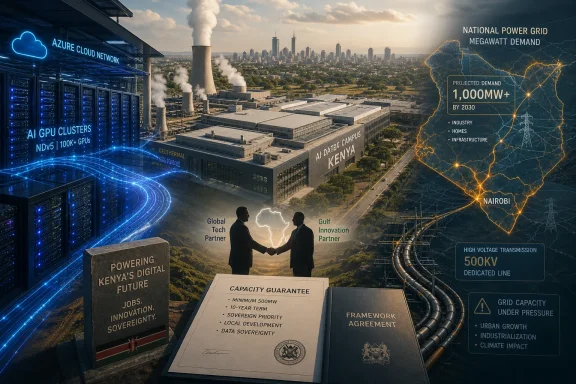 Microsoft’s East Africa Bet Was Always Bigger Than a Data Center
When Microsoft and G42 announced the Kenya initiative in May 2024, the language was deliberately expansive. The project was framed as a comprehensive digital ecosystem investment, not merely a facility with servers and cooling equipment. It promised a new East Africa Cloud Region for Azure, local-language AI development, digital skills programs, connectivity investments, and a “trusted data zone” designed to reassure governments and regulated industries about data governance.That framing mattered. Cloud regions are no longer just commercial infrastructure; they are diplomatic instruments. A local Azure region can help governments keep sensitive workloads closer to home, reduce latency for businesses, and give Microsoft a stronger claim in markets where AWS, Google, Oracle, and regional operators are all chasing the next wave of cloud adoption.
Kenya was a logical place to make that bet. The country has a relatively mature technology sector by regional standards, a strong mobile-money and startup ecosystem, access to undersea connectivity, and a long-running pitch that it can serve as a digital hub for East Africa. Add geothermal power around Olkaria, and Microsoft could tell a story that fit both AI growth and sustainability rhetoric.
But the same announcement also carried the seeds of today’s problem. A large-scale cloud region requires demand concentration, stable power, long-term policy alignment, and a customer base able to consume enough capacity to justify the capital expenditure. In mature markets, hyperscalers can rely on a broad mix of enterprise, public-sector, developer, and AI demand. In emerging regions, the first anchor customer is often the state itself.
That is where the politics begin.
The Guarantee Fight Turns Cloud Demand Into a Public Liability
The reported sticking point is a classic infrastructure problem wearing cloud clothing. Microsoft and G42 reportedly wanted Kenya to commit to paying for a defined amount of cloud capacity each year. Kenyan officials, according to reports, were unable or unwilling to meet the requested level of guarantee, while also insisting the project has not collapsed.From the vendor side, the logic is not hard to understand. A data center campus, especially one built for hyperscale cloud and AI workloads, is expensive before the first customer deploys a virtual machine. Land, grid connections, power-purchase arrangements, fiber, cooling systems, security, and imported equipment all create obligations long before revenue catches up. A government capacity commitment gives investors confidence that the site will not sit underused.
From the government side, the same arrangement can look like a blank check. Guaranteed cloud spending locks future administrations into a technology platform, narrows procurement flexibility, and may force public agencies to buy capacity before they are ready to use it. For a country balancing debt pressures, infrastructure needs, and power constraints, an annual capacity guarantee is not a minor commercial clause. It is a fiscal commitment.
That tension is especially sharp because cloud migration is not automatic. Ministries, hospitals, schools, tax authorities, and public corporations do not simply flip from legacy systems to Azure because a region exists nearby. They need procurement reform, cybersecurity baselines, identity systems, application modernization, training, and budget lines that survive political cycles.
The guarantee dispute therefore exposes a deeper mismatch. Microsoft and G42 appear to be trying to finance infrastructure at hyperscale speed. Kenya’s public-sector cloud demand may grow, but it likely grows at bureaucratic speed. The gap between those timelines is where negotiations stall.
G42 Made the Deal More Ambitious—and More Geopolitical
G42’s role in the Kenya plan was never incidental. The Abu Dhabi-based AI and cloud company was expected to build the data center infrastructure that would support Microsoft Azure’s East Africa region. That arrangement reflected Microsoft’s broader partnership with G42, including Microsoft’s 2024 investment in the company and a push to position the UAE firm as a key AI infrastructure ally outside the United States.For Microsoft, G42 offered capital, regional relationships, and a vehicle for expanding Azure-backed AI services in markets where building alone might be slower or politically more complicated. For G42, the Microsoft partnership provided global credibility and access to one of the world’s most important cloud platforms. Kenya was a showcase opportunity for both.
It was also a geopolitical choreography. The original announcement was tied to Kenyan President William Ruto’s state visit to Washington, with the United States, Kenya, and the UAE all present in the background. That is how modern cloud deals increasingly work: the technical architecture is inseparable from diplomatic signaling.
But geopolitical deals still have to clear domestic constraints. Kenya is not merely a stage for U.S.-UAE cloud strategy. It has its own budget, grid, regulators, opposition politics, and development priorities. A deal that looks elegant in a Washington ceremony can become much harder when the invoice, megawatt requirements, and procurement commitments land in Nairobi.
This is the part of the story that should interest WindowsForum readers beyond the Kenya angle. The Microsoft cloud now expands through partnerships that blend commercial technology, sovereign cloud concerns, AI geopolitics, and public infrastructure. That makes Azure more global, but it also makes Azure regions more exposed to non-technical risk.
The Power Problem Is No Longer a Footnote
President Ruto’s reported warning that powering a data center of this size would require switching off half the country was a striking line because it stripped away the abstraction. Cloud capacity is measured in availability zones, virtual CPUs, and GPU clusters in marketing decks. On the ground, it is measured in megawatts.The initial phase of the Kenya project was reportedly around 100 MW, with discussion of much larger future capacity. For a hyperscale operator, 100 MW is no longer outlandish; AI training and inference have pushed the industry toward ever-larger power envelopes. For a national grid, however, a new load of that scale can be a major planning event.
Kenya’s geothermal resources are real, and the original plan leaned heavily on them. A “green” data center near geothermal power sounds like the ideal compromise: local renewable energy, economic development, and digital infrastructure in one package. But renewable generation does not automatically solve transmission, grid-balancing, reservation, and opportunity-cost problems.
If a hyperscale data center gets dedicated access to a large block of reliable power, someone else may not. That someone could be industry, households, public services, or future electrification projects. Even where generation is comparatively clean, the distribution of power becomes political.
This is now the defining infrastructure question for AI. The industry spent years talking as if cloud growth was constrained mostly by chips and developer demand. The next constraint is electricity: how much is available, where it is available, how quickly it can be connected, and whether communities are willing to allocate it to server farms.
AI Has Changed the Economics of Every Cloud Region
If this were only about ordinary enterprise cloud workloads, the Kenya dispute would still matter. But AI changes the scale and urgency. Microsoft’s cloud capital spending has been driven heavily by AI demand, especially after the company’s deep alignment with OpenAI and its wider Copilot strategy across Windows, Microsoft 365, GitHub, and Azure.AI workloads are different from traditional cloud consumption in two important ways. First, they can require enormous clusters of GPUs or accelerators, which concentrate power and cooling needs. Second, demand is volatile. Enterprises want AI capability, but many are still discovering which use cases justify sustained spending.
That uncertainty makes capacity guarantees attractive to infrastructure builders. If a government or large anchor customer commits to a minimum spend, the economics become easier. If the government refuses, the investor has to decide whether projected private-sector and regional demand is enough.
For Kenya, that is a difficult proposition. East Africa needs more local cloud capacity, but the customer base may not yet resemble the demand profile of Western Europe, the United States, or the Gulf. Developers, banks, telecoms, logistics firms, and government agencies may all benefit from local Azure services, but converting that need into contracted revenue takes time.
Microsoft’s problem is that the AI buildout does not reward patience. Hyperscalers are racing to secure sites, power, chips, and sovereign partnerships before competitors do. The danger is overbuilding ahead of monetization. The Kenya delay shows what happens when the capital machine asks a developing-market government to bridge that uncertainty.
Sovereign Cloud Is Becoming a Negotiation, Not a Product
The “trusted data zone” language in the original Microsoft-G42-Kenya announcement was not accidental. Governments increasingly want cloud services that promise local control, compliance with domestic law, and protection from foreign jurisdictional pressure. Microsoft has leaned into this language around the world, offering variations of sovereign cloud, local data residency, and controlled operations.But sovereignty has costs. If a country wants a local cloud region, the provider wants scale. If the provider wants scale, it wants customers. If the government is the most reliable customer, the provider may ask it to guarantee demand. Suddenly, sovereign cloud stops being a product brochure and becomes a negotiation over public money.
This is a subtle but important shift. Governments used to worry that moving to foreign cloud platforms would reduce sovereignty. Now vendors can argue that sovereignty requires domestic infrastructure—and that domestic infrastructure requires public commitments. That flips the burden back onto the state.
Kenya appears to be resisting that burden at the level requested. That does not mean the government is anti-cloud or that the project is dead. It means officials are drawing a line between welcoming foreign digital investment and underwriting its economics.
Other countries will face the same choice. Smaller markets want local regions, local AI capability, and data-residency assurances. Hyperscalers want those markets to prove there is enough revenue. The compromise may be smaller deployments, regional hubs, hybrid arrangements, or phased capacity that grows only as demand materializes.
The Forum-Relevant Lesson Is That Azure’s Map Is Not the Same as Azure’s Reality
For IT pros, cloud-region announcements can seem like straightforward news. A vendor says a region is coming, businesses plan for lower latency and data residency, and architects start imagining workloads closer to users. But a planned cloud region is not the same thing as a live, resilient, fully stocked region with the services customers actually need.Azure customers know this already in quieter ways. Not every region has every service on day one. GPU availability varies. Compliance coverage varies. Pricing can differ. Disaster-recovery design depends on paired regions, network paths, and service maturity. A new region is useful only when it meets the operational requirements of the workload.
The Kenya delay is a macro version of that familiar problem. The announcement created expectations for an East Africa Azure footprint. The negotiations now show that the hard part is not naming the region; it is aligning demand, power, financing, and governance.
For Windows administrators and Microsoft-centric shops in East Africa, the practical implication is caution. A future local Azure region could be valuable, especially for latency-sensitive services, regulated data, backup architectures, identity-dependent applications, and AI services. But until the infrastructure and commercial terms are settled, planning should not assume imminent availability.
Enterprises should treat the delay as a reminder to design for portability within reason. That does not mean pretending every cloud is interchangeable. It means avoiding unnecessary region lock-in, documenting data-residency assumptions, and keeping network and identity architectures flexible enough to adapt if a promised region slips by months or years.
Kenya Is a Test Case for the Global South’s Cloud Bargain
There is a broader development story here, and it deserves more than easy cynicism. Countries across Africa, Latin America, and parts of Asia want to move beyond being consumers of distant cloud services. They want local infrastructure, AI skills, data governance capacity, and a share of the economic activity created by digital platforms.That aspiration is legitimate. Latency matters. Data jurisdiction matters. Local jobs matter. A cloud region can help local startups build faster, help banks modernize systems, help governments deliver services, and help universities access modern AI infrastructure.
But the hyperscale model was built around enormous concentration. The cloud works economically because vast facilities serve huge pools of demand. Bringing that model into smaller or still-developing markets requires someone to absorb the difference between present demand and future ambition.
Vendors prefer governments to absorb it. Governments prefer vendors to absorb it. Citizens may ask why either side should prioritize data centers over hospitals, schools, factories, transmission lines, or household electrification. That is the real debate beneath the Kenya story.
The most optimistic outcome is a resized or restructured project that still gives East Africa meaningful local cloud capacity without forcing Kenya into an excessive guarantee. The least attractive outcome is a stalemate that leaves the region dependent on distant cloud infrastructure while reinforcing the perception that hyperscale announcements are partly diplomatic theater.
Microsoft’s Sustainability Story Is Getting Harder to Tell
The Kenya plan originally had one of the cleanest sustainability narratives available to a hyperscaler: geothermal-powered data center infrastructure supporting cloud and AI services in a region with strong renewable potential. That is exactly the kind of story Microsoft wants as scrutiny rises over AI’s energy appetite.Yet even a renewable-backed project can strain the grid. That is the paradox. A data center may claim clean energy procurement while still competing for transmission capacity, grid stability, and planning resources. The climate accounting may look good in a corporate report, while the local energy politics remain messy.
Microsoft has made sweeping commitments around carbon, water, and renewable energy. At the same time, AI demand has made those commitments harder to meet. The company is not alone; every major hyperscaler is trying to reconcile explosive compute growth with public sustainability promises. But Microsoft is particularly exposed because it has placed AI at the center of its operating-system, productivity, developer, and cloud strategies.
Kenya therefore becomes more than a regional delay. It is a visible example of the gap between sustainability branding and infrastructure reality. “Green” power does not mean free power. Renewable abundance does not mean unlimited grid capacity. A clean-energy data center can still be too large for the system around it.
For Microsoft, the solution cannot simply be better messaging. It will need more granular phasing, more local grid investment, clearer public accounting, and perhaps a willingness to build smaller before building enormous. Otherwise, the company risks turning every ambitious cloud announcement into a referendum on energy allocation.
The Capacity Guarantee Is the New Cloud Subsidy Debate
The reported guarantee request should also be understood as part of a larger subsidy debate. For years, governments have offered tax breaks, land, utility arrangements, and infrastructure support to attract data centers. The pitch is familiar: bring investment, create jobs, improve digital competitiveness, and anchor an ecosystem.Capacity guarantees go further. They do not merely reduce the cost of building; they promise revenue after the build. That makes them more sensitive, especially when the buyer is the public sector and the seller is one of the richest companies in the world, operating with a powerful foreign-backed partner.
Defenders will argue that guarantees are normal for infrastructure. Power plants, roads, ports, and telecom networks often rely on long-term commitments. If Kenya wants a world-class cloud region, it may need to share risk.
Critics will respond that cloud demand should prove itself. If Microsoft and G42 believe East Africa is a major opportunity, they should build for that market rather than asking Kenyan taxpayers to secure the downside. They will also ask whether guaranteed spending would crowd out local providers or lock public agencies into Azure before competitive procurement can mature.
Both arguments have force. The question is not whether guarantees are inherently illegitimate. The question is whether the size, duration, flexibility, and public value of the guarantee are defensible. On the available reporting, Kenya’s answer appears to be: not at the requested level.
The Delay Does Not Kill the Project, but It Changes Its Meaning
Kenyan officials have reportedly said the project has not failed. That is plausible. Large infrastructure deals often stall, shrink, restructure, or reappear under revised terms. A pause in negotiations is not the same as cancellation.But the delay changes the meaning of the original announcement. In 2024, the story was about acceleration: a major cloud region, a historic private-sector investment, and a near-term path toward East African Azure capacity. In 2026, the story is about conditionality: if power can be secured, if guarantees can be agreed, if the economics can be made politically acceptable.
That shift matters for investors. It suggests that AI infrastructure growth is not limited by abstract global demand but by highly local constraints. Every market has its own grid politics, procurement rules, currency risks, land issues, and public tolerance for foreign technology dependency.
It also matters for Microsoft’s customers. A delayed region can affect cloud migration plans, disaster-recovery designs, compliance roadmaps, and latency-sensitive application strategies. Even organizations that never planned to use the Kenya region directly should pay attention, because the same dynamic can affect future Azure expansion elsewhere.
The industry’s habit is to treat hyperscaler roadmaps as if they are inevitable. Kenya is a useful corrective. Roadmaps are promises until they become substations, fiber routes, contracts, cooling systems, and live service endpoints.
The Practical Signal for Windows and Azure Shops Is Patience With a Plan
For Microsoft-focused IT teams, the Kenya story should not trigger panic. Azure is not disappearing from East Africa because one project has slowed, and regional customers can still use existing Azure regions elsewhere. But it should temper assumptions about timing and availability.Organizations that hoped for a local East Africa Azure region should keep their architecture flexible. That means separating what must be local for legal or performance reasons from what merely benefits from proximity. It also means asking vendors for explicit region-availability commitments rather than relying on launch-window optimism.
Regulated sectors should be especially careful. Data residency, backup location, identity logs, encryption-key management, and disaster-recovery patterns all depend on region maturity. A promised future region does not solve today’s compliance problem unless contracts, regulators, and technical controls agree that it does.
The same applies to AI projects. If local GPU-backed Azure capacity is part of a roadmap, teams should identify fallback regions and cost implications now. AI pilots have a way of becoming production dependencies faster than governance catches up.
The Kenya Snag Reveals the Cloud’s Hard Edges
The concrete takeaways are less about one delayed campus than about the new rules of hyperscale expansion. Microsoft’s Kenya plan remains strategically important, but its reported slowdown shows that AI-era cloud infrastructure is governed by power, politics, and public finance as much as by software demand.- Microsoft and G42’s Kenya project was announced in May 2024 as a $1 billion-plus digital ecosystem initiative centered on a new Azure East Africa Cloud Region.
- The reported dispute centers on guaranteed annual cloud-capacity payments that Kenya was not prepared to meet at the level requested.
- The project’s power requirements have become a central obstacle, with Kenyan officials warning that a facility of this scale could place severe pressure on the national grid.
- The delay does not necessarily mean cancellation, but it weakens the assumption that announced cloud regions will arrive on vendor timelines.
- Azure customers in East Africa should plan for flexibility until Microsoft, G42, and Kenya settle the project’s financing, power, and deployment structure.
- The episode shows that AI infrastructure growth is increasingly constrained by electricity and public-sector risk sharing, not just chips and customer demand.
Source: TradingView Microsoft's Kenya data center plans hit a new hurdle
