

Microsoft and NVIDIA’s joint announcements at GTC DC mark a decisive step toward turning rack-scale supercomputing and multimodal reasoning models into enterprise-grade, production-ready tools — from on‑premises Azure Local appliances to cloud‑scale GB300 NVL72 clusters and new model families in Azure AI Foundry.
For years Microsoft and NVIDIA have co‑engineered both hardware and software to accelerate AI in the cloud. The latest wave of announcements — expanded GPU support on Azure Local, NVIDIA Nemotron and Cosmos models in Azure AI Foundry, NVIDIA Run:ai availability on Azure, the first production‑scale GB300 NVL72 cluster in Azure, and Dynamo‑powered inference demonstrations — are intended to move organizations from experimentation to production at scale. These changes combine vendor‑provided hardware topologies, open and proprietary model families, and orchestration software designed for hybrid and rack‑scale deployments. This article synthesizes the technical claims, verifies hard numbers against vendor documentation and independent reporting, assesses enterprise impact, and flags areas where customers must balance capability against cost, risk, and governance. Where possible, the most consequential specifications and performance claims are cross‑checked with at least two independent sources. Key vendor statements referenced in this piece are available in the Azure announcement and NVIDIA product/press pages.
However, two important cautions remain: first, vendor performance claims must be validated with customer‑specific workloads; second, deploying at the scale and density implied by GB300 requires serious facility, security, and budget planning. The technical promise is real and corroborated across vendor documentation and independent reporting, but the operational realities mean adoption will be staged and selective for most organizations.
Microsoft’s Azure blog and the corresponding NVIDIA materials present a well‑coordinated product story: more powerful on‑prem GPUs for edge and sovereign use, a curated model catalog for enterprises, orchestration software for better GPU economics, and a rack‑scale supercomputing topology for frontier reasoning AI — all intended to move customers from experimentation to production. These are meaningful advances, but sensible adoption requires hardened benchmarks, facility readiness, and a clear cost and governance plan before committing to the largest scale deployments. Conclusion: the partnership has delivered a full‑stack blueprint for enterprise‑grade AI — from microservices at the edge to exascale‑class rack clusters — and the practical work for enterprises now turns to measured validation, governance, and cost‑aware deployment planning.
Source: Microsoft Azure Building the future together: Microsoft and NVIDIA announce AI advancements at GTC DC | Microsoft Azure Blog
 Background / Overview
For years Microsoft and NVIDIA have co‑engineered both hardware and software to accelerate AI in the cloud. The latest wave of announcements — expanded GPU support on Azure Local, NVIDIA Nemotron and Cosmos models in Azure AI Foundry, NVIDIA Run:ai availability on Azure, the first production‑scale GB300 NVL72 cluster in Azure, and Dynamo‑powered inference demonstrations — are intended to move organizations from experimentation to production at scale. These changes combine vendor‑provided hardware topologies, open and proprietary model families, and orchestration software designed for hybrid and rack‑scale deployments. This article synthesizes the technical claims, verifies hard numbers against vendor documentation and independent reporting, assesses enterprise impact, and flags areas where customers must balance capability against cost, risk, and governance. Where possible, the most consequential specifications and performance claims are cross‑checked with at least two independent sources. Key vendor statements referenced in this piece are available in the Azure announcement and NVIDIA product/press pages. What Microsoft announced (short form)
- Expanded availability of the NVIDIA RTX PRO 6000 Blackwell Server Edition on Azure Local appliances for edge and sovereign deployments.
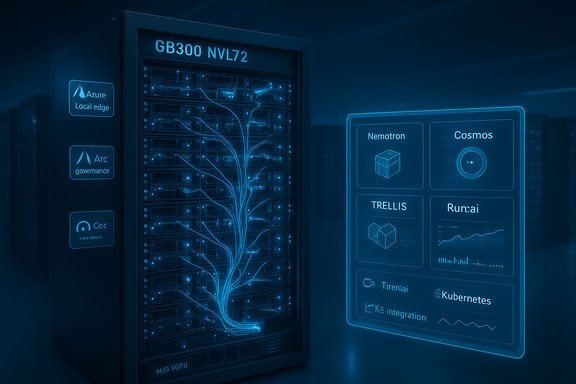
- New NVIDIA Nemotron and NVIDIA Cosmos models delivered via Azure AI Foundry as NVIDIA NIM microservices, including Nemotron Nano VL 8B, Nemotron Nano 9B, and Cosmos Reason‑1 7B, plus Microsoft TRELLIS for 3D asset generation.
- NVIDIA Run:ai on Azure to improve GPU utilization and orchestration across AKS, Azure Machine Learning, and NC/ND instance families.
- Microsoft’s claim of the first at‑scale production deployment of NVIDIA GB300 NVL72 racks on Azure (an NDv6 GB300 VM family), aggregating “over 4,600” Blackwell Ultra GPUs into a Quantum‑X800 InfiniBand fabric for reasoning and multimodal workloads.
Azure Local and NVIDIA RTX PRO 6000 Blackwell: Edge + sovereign AI
What changed
Microsoft is making the RTX PRO 6000 Blackwell Server Edition available through Azure Local appliances (Azure Arc‑enabled on‑prem or disconnected deployments), and lists validated appliance partners such as Dell, HPE, and Lenovo. The stated goal is to provide the same orchestration and management model customers use in cloud Azure while meeting strict latency, residency, and regulatory requirements.Technical verification
NVIDIA’s product page for the RTX PRO 6000 Blackwell Server Edition documents core specs: a Blackwell architecture GPU with 96 GB GDDR7, up to ~600 W TDP in server configurations, PCIe Gen5, and features such as Multi‑Instance GPU (MIG) that enable partitioning for higher utilization. Independent coverage summarized the 96 GB VRAM and 600 W power characteristics. These vendor and press sources align on the headline hardware attributes. Key takeaways for operations teams:- RTX PRO 6000 Blackwell is aimed at mixed workloads that combine high‑performance visual compute (rendering, VDI) and inference/agentic AI at the edge. The device supports vGPU and MIG, which are valuable for multi‑tenant virtual desktop and inferencing scenarios.
- Azure Local (Arc) enables central policy and monitoring while data and inference remain on‑prem — useful for healthcare, defense, and other regulated sectors that require local processing.
Risks and operational notes
- Power, cooling, and space requirements for server Blackwell cards are nontrivial compared with mainstream server GPUs; planning must include rack cooling capacity and power provisioning.
- Licensing, support, and lifecycle for on‑prem appliances remain a mix of provider contracts (Microsoft + OEM + NVIDIA), so procurement teams should validate SLA responsibilities and firmware/update flows.
Azure AI Foundry: Nemotron, Cosmos, and TRELLIS — enterprise model distribution
New model families and what they target
Azure AI Foundry is being populated with NVIDIA’s NIM‑packaged models, which Microsoft presents as deployable microservices for enterprise workloads:- NVIDIA Nemotron family — reasoning‑focused derivatives (Nemotron Nano VL 8B, Nemotron Nano 9B, Nemotron Super 49B) optimized for multimodal vision‑language tasks, document intelligence, coding, math, and agentic applications.
- NVIDIA Cosmos family — models such as Cosmos Reason‑1 7B aimed at physical AI: robotics planning, video analytics agents, and world‑state prediction.
- Microsoft TRELLIS — a Microsoft Research model for 3D asset generation intended to speed workflows for digital twins, retail AR, and game content production.
Why this matters to enterprises
- The packaging of models as microservices lowers the friction for secure, containerized deployment while giving IT teams more control over updates and monitoring.
- The Nemotron/Cosmos families aim to balance accuracy and deployability, addressing enterprise needs for multimodal reasoning and robotics/physical AI — use cases that require real‑time inferencing, explainability, and deterministic behavior.
Caveats and verification
- Model accuracy and throughput claims are vendor‑stated; customers should validate model performance on representative data in private tests. NVIDIA’s press materials indicate inference speed and accuracy gains versus baseline open models — but those improvements depend heavily on dataset, prompt engineering, and runtime stack. Treat vendor numbers as indicative, not guaranteed.
NVIDIA Run:ai on Azure — squeezing more from GPU fleets
What Run:ai brings
Run:ai is a GPU virtualization and orchestration layer that helps teams dynamically allocate GPUs, schedule AI jobs, and implement governance & quota policies. Microsoft’s announcement emphasizes integration points with AKS, Azure Machine Learning, NC/ND VM series, and Azure Identity.Cross‑checks and documentation
- Run:ai’s documentation and the NVIDIA‑branded Run:ai docs confirm support for AKS and major Kubernetes distributions and describe cluster prerequisites and version compatibility. The joint Azure/partner materials and a Microsoft blog with Run:ai/NetApp references show practical joint deployments for distributed training and utilization improvements.
Enterprise implications
- Run:ai can materially reduce idle GPU time and simplify multi‑team GPU sharing — meaningful for organizations paying by the hour for cloud GPU capacity.
- Integrated governance features (quota, priority, job queueing) reduce operational friction compared with ad‑hoc GPU lease models.
Practical notes
- Run:ai requires a Kubernetes base (various flavors supported); AKS integration exists but integration details (e.g., supported Kubernetes versions, container runtimes) must be validated against the Run:ai release being deployed.
- Migration and cost planning: Run:ai reallocates but does not remove the need to plan for peak capacity; compute, storage IO, and network bottlenecks still matter.
The GB300 NVL72 rack and NDv6 GB300 VM family: a new rack‑as‑accelerator model
Microsoft’s claim
Microsoft says it has deployed the world’s first production‑scale cluster built from NVIDIA GB300 NVL72 racks and exposes the topology as NDv6 GB300 VMs: “over 4,600” Blackwell Ultra GPUs connected via NVIDIA Quantum‑X800 InfiniBand, with each GB300 NVL72 rack containing 72 Blackwell Ultra GPUs and 36 Grace CPUs and offering roughly 130 TB/s of intra‑rack NVLink bandwidth. Microsoft also mentions per‑rack power up to ~136 kW and pooled fast memory in the tens of terabytes.Independent verification
- NVIDIA’s GB300 product pages explicitly document the NVL72 rack configuration and the same 130 TB/s NVLink intra‑rack figure and report pooled fast memory in the ~37–40 TB range. Those vendor pages also specify per‑rack FP4/FP8/Tensor performance figures and the 72 GPU/36 CPU topology.
- Independent technical coverage (e.g., Tom’s Hardware) corroborates Microsoft’s "more than 4,600 GPUs" clustering arithmetic (64 racks × 72 GPUs ≈ 4,608 GPUs) and quotes similar intra‑rack bandwidth and per‑rack memory numbers. That alignment across vendor docs and reporting supports the authenticity of the headline specs.
Why rack‑as‑accelerator matters
Traditional cloud GPU designs expose individual servers or small multi‑GPU nodes. NVL72’s design collapses 72 GPUs and co‑located Grace CPUs under a single NVLink/NVSwitch fabric to present a shared‑memory domain that reduces cross‑host synchronization overhead for very large models and long context windows — a topology that targets “reasoning” models where memory bandwidth and inter‑GPU communication dominate performance.Power, cooling, and footprint
Per‑rack power draw and liquid‑cooling requirements are significant. Microsoft’s own materials and reporting note per‑cabinet power up to ~136 kW in dense configurations — this is consistent with the liquid‑cooled, high‑density engineering of GB300 racks and underscores that deploying such systems has datacenter infrastructure implications (PDUs, chilled water, floor loading).Dynamo + ND GB200‑v6 (and AKS) — a 1.2M tokens/sec demo and what it proves
The claim
Microsoft and NVIDIA published a demonstration combining the open‑source NVIDIA Dynamo distributed inference framework, Azure ND GB200‑v6 VM family (GB200 NVL72), and AKS, showing an inference throughput for the open GPT‑OSS 120B model of 1.2 million tokens per second in a production‑style AKS cluster. Azure has published a deployment recipe and an AKS Engineering blog describing the results.Verification
- The Azure blog references the 1.2M tokens/sec result; the AKS Engineering blog provides a deployment walk‑through and reproduction notes that echo the number and explain the methodology and recipe for replication on ND GB200/GB200 NVL72 hardware and Dynamo. These two Azure sources jointly corroborate the claim and provide practical deployment guidance.
What the number means (and doesn’t)
- Reaching 1.2M tokens/sec is a throughput benchmark under a specific architecture and workload; real customer performance will vary by model variant, request mix (prefill vs decode), latency SLOs, and KV cache behavior. The demo proves the feasibility of very high throughput inference on rack‑scale Blackwell hardware when combined with a distributed serving stack — not a universal guarantee for every workload.
Strengths: what enterprises gain
- Scale and throughput: The GB300 NVL72 racks and NDv6 family deliver unprecedented aggregate NVLink bandwidth and pooled memory that materially reduces inter‑GPU communication overhead for reasoning and multimodal models. This enables larger context windows and more efficient KV caches for agents and reasoning systems.
- Hybrid and sovereign options: RTX PRO 6000 Blackwell on Azure Local + Azure Arc enables regulated industries to keep data and inference local while preserving centralized management and policy enforcement.
- Faster time‑to‑production: Packaging NVIDIA models as NIM microservices in Azure AI Foundry and supplying orchestration tools such as Run:ai and Dynamo on AKS reduces operational friction for deploying secure, monitored model inference at scale.
- Improved utilization: Run:ai and Dynamo’s architecture designs (GPU pooling, LLM‑aware routing, KV caching, disaggregated serving) point to better GPU utilization and lower operational cost per inference, when integrated effectively.
Risks, limitations, and the things IT teams must validate
- Vendor bias and measurement context: Many headline throughput and accuracy claims come from vendor publications or vendor‑coauthored engineering blogs. They are useful benchmarks but require independent validation against your workload and data distributions. Treat vendor numbers as starting points for proof‑of‑concept assessments. If an organization plans to rely on these numbers for budgeting or SLAs, run in‑house benchmarks.
- CapEx/Opex and cloud economics: Dense rack deployments and high‑performance instances deliver massive capability but are expensive. Customers should run cost‑per‑request models that include compute, storage IO, ingress/egress, and engineering overhead. Moving to rack‑scale hardware may shift costs from per‑instance to integrated rack provisioning, with different pricing dynamics.
- Infrastructure constraints: Liquid cooling, power delivery, and datacenter retrofit needs for GB300 racks are nontrivial. For on‑prem or co‑located deployments, facilities teams must be involved early. Microsoft’s per‑rack power figures reinforce that these systems require purpose‑built infrastructure.
- Supply chain and availability: High‑demand GPUs and fully integrated racks may be constrained by production schedules and OEM integration timelines. Expectations for immediate wide availability should be managed. Vendor press materials sometimes list “preliminary” specs and phased rollouts; roadmap items (e.g., “many AI factories”) are objectives, not guaranteed delivery schedules. Flag any such future‑tense claims for caution.
- Security, governance, and data residency: While Azure Local and Foundry provide governance controls, deploying third‑party models requires careful review of licensing, telemetry, and data handling — especially in regulated sectors. Validate auditing, HSM integration, and the microservice update chains before placing models into production.
Practical guidance: how to approach adoption (for IT and AI ops)
- Proof of concept first: Benchmark Nemotron/Cosmos models on a representative dataset in a controlled environment (cloud or Azure Local) before committing to large instances or racks.
- Validate end‑to‑end: Test network, storage IO, and latency SLOs with your actual inference traffic (prefill vs decode patterns matter). Use Dynamo recipes and AKS deployment guides where applicable.
- Right‑size hardware: Use MIG/vGPU for multi‑tenant or VDI scenarios with RTX PRO 6000; reserve full GPU resources for memory‑bound, large‑context reasoning models.
- Cost modeling: Include sustained run time, peak provisioning needs, and specialized rack overhead when estimating TCO. Factor in cooling and facilities for any on‑prem rack placements.
- Governance and monitoring: Leverage Azure AI Foundry’s safety and red‑teaming tooling, integrate HSMs where required, and define incident response for model drift and misuse.
Final analysis — strengths balanced with prudence
The Microsoft‑NVIDIA announcements move the industry closer to a consistent, enterprise‑grade stack for large‑scale reasoning, multimodal agents, and edge AI. The combination of rack‑scale hardware (GB300 NVL72), enterprise model distribution (Nemotron/Cosmos via Azure AI Foundry), and orchestration/optimization tooling (Run:ai, Dynamo on AKS) addresses many of the practical challenges enterprises face when moving from prototypes to production.However, two important cautions remain: first, vendor performance claims must be validated with customer‑specific workloads; second, deploying at the scale and density implied by GB300 requires serious facility, security, and budget planning. The technical promise is real and corroborated across vendor documentation and independent reporting, but the operational realities mean adoption will be staged and selective for most organizations.
What to watch next
- Availability and pricing for NDv6 GB300 and ND GB200‑v6 VM SKUs in specific Azure regions. Azure’s announcements indicate staged rollouts; procurement and platform teams should monitor region availability windows.
- Independent third‑party benchmarks of Nemotron/Cosmos models on enterprise tasks (document intelligence, robotics planning, and multimodal reasoning). Vendor claims on accuracy and latency improvements require corroboration.
- Run:ai and Dynamo integration maturity (enterprise features, managed offerings, and AKS control plane considerations) and how these affect operational overhead.
Microsoft’s Azure blog and the corresponding NVIDIA materials present a well‑coordinated product story: more powerful on‑prem GPUs for edge and sovereign use, a curated model catalog for enterprises, orchestration software for better GPU economics, and a rack‑scale supercomputing topology for frontier reasoning AI — all intended to move customers from experimentation to production. These are meaningful advances, but sensible adoption requires hardened benchmarks, facility readiness, and a clear cost and governance plan before committing to the largest scale deployments. Conclusion: the partnership has delivered a full‑stack blueprint for enterprise‑grade AI — from microservices at the edge to exascale‑class rack clusters — and the practical work for enterprises now turns to measured validation, governance, and cost‑aware deployment planning.
Source: Microsoft Azure Building the future together: Microsoft and NVIDIA announce AI advancements at GTC DC | Microsoft Azure Blog
