

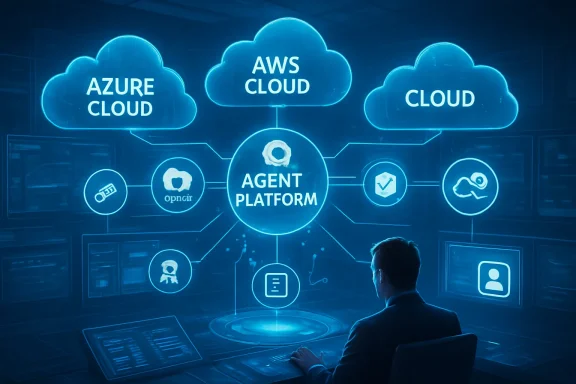
Microsoft and OpenAI’s revised partnership marks one of the most important resets in the commercial AI market since ChatGPT turned generative AI into an enterprise priority. By ending Microsoft’s exclusive grip on OpenAI model and product distribution while preserving a deep strategic relationship through 2032, the two companies have moved from a single-cloud alignment to a more flexible, multi-cloud power structure. The timing is especially consequential because OpenAI’s Amazon partnership gives AWS a major role in distributing OpenAI’s Frontier agent platform, putting Azure, AWS, and eventually other cloud ecosystems into a sharper contest for enterprise AI workloads. For IT leaders, the change promises more choice, stronger negotiating leverage, and a new layer of operational complexity.
The Microsoft-OpenAI partnership began in 2019 as an ambitious bet on frontier AI at a time when most enterprises still treated large language models as experimental research. Microsoft’s early investment gave OpenAI the compute scale it needed, while Azure gained a defining AI identity just as cloud growth was entering a more competitive phase. That arrangement helped transform OpenAI from a high-profile research lab into one of the central infrastructure companies of the AI economy.
The original logic was straightforward: OpenAI needed enormous compute capacity, and Microsoft needed a durable advantage against AWS and Google Cloud. Azure became the natural home for OpenAI’s commercial services, and Microsoft embedded OpenAI technology across Microsoft 365 Copilot, GitHub Copilot, Azure AI, security products, developer tools, and business applications. For several years, that alignment gave Microsoft a uniquely integrated AI story.
But the AI market has changed faster than the contracts that shaped it. OpenAI now serves consumers, developers, enterprises, and government agencies at a scale that no single provider can comfortably satisfy alone. The company also faces pressure to distribute models wherever customers already run workloads, especially as AI shifts from isolated chat interfaces to deeply integrated business systems.
The revised agreement reflects that reality. Microsoft remains OpenAI’s primary cloud partner, and OpenAI products are still expected to arrive first on Azure when Microsoft can support the required capabilities. Yet OpenAI can now serve products across any cloud provider, Microsoft’s license to OpenAI IP remains in place through 2032, and that license is now non-exclusive.
Enterprises rarely operate on a single cloud anymore. They maintain AWS footprints for infrastructure, Azure estates for identity and productivity, Google Cloud deployments for analytics and AI, and specialized providers for high-performance workloads. OpenAI’s broader distribution acknowledges that enterprise AI adoption now follows existing architecture, not the other way around.
The most important contractual change is the move from exclusive licensing to non-exclusive licensing. Microsoft keeps access to OpenAI models and products through 2032, which protects its Copilot roadmap and Azure AI business. But OpenAI can now license and distribute the same underlying capabilities through other channels.
This creates a more mature market structure. Microsoft still benefits from early integration, product depth, and shareholder exposure to OpenAI’s growth. OpenAI gains freedom to meet customers on the cloud platforms they already use, reducing friction in enterprise procurement.
Key changes include:
The Amazon partnership is also notable because it pairs capital, silicon, distribution, and enterprise procurement. Amazon’s planned $50 billion investment gives OpenAI financial support, while AWS’s Trainium capacity gives OpenAI another path to scale inference and agent workloads. For AWS customers, the appeal is obvious: they may be able to access OpenAI capabilities through the same procurement, security, identity, networking, and logging systems they already use.
This is a major shift for enterprise AI buying behavior. Instead of asking whether OpenAI is available only through Azure, customers can start asking which platform delivers the best operational fit. That moves competition from model access alone to governance, latency, cost, tooling, and workflow integration.
For enterprise teams, this matters in practical ways:
OpenAI’s Frontier platform is designed around enterprise agents that can operate across business systems with shared context and built-in controls. This changes the AI buying decision from “which model answers best?” to “which platform can safely act inside my company?” That second question is much harder and more valuable.
Agents are not simply better chatbots. They need permissions, memory, workflow awareness, system access, audit trails, and human approval paths. They also need to operate across CRM platforms, data repositories, email, codebases, ticketing tools, analytics systems, and collaboration environments.
A typical enterprise agent workflow now looks like this:
That explains the importance of Copilot Cowork and Microsoft’s broader Wave 3 Copilot strategy. Microsoft is repositioning Copilot from an assistant that generates content to a work system that can execute tasks over time. This is a direct answer to the agent-platform race.
Copilot Cowork brings long-running, multi-step work into Microsoft 365 Copilot. It can reason across tools and files, show progress, ask for user input, and support approvals before sensitive actions. Microsoft’s message is that agents must be useful, but also observable and governable.
Copilot Cowork illustrates several important product trends:
The new AI stack is not just model plus API. It includes orchestration tools, retrieval systems, vector databases, agent runtimes, observability platforms, policy engines, prompt management, evaluation harnesses, and human approval workflows. These components are rarely identical across providers.
That means enterprise architecture teams need to treat AI platforms like they treat databases or ERP systems. Once a company builds business processes around a specific control plane, switching costs emerge quickly. The lock-in may be less about where the model runs and more about how decisions, permissions, and workflows are encoded.
IT leaders should evaluate:
This is where many organizations are underprepared. Most companies have acceptable-use policies for generative AI, but fewer have mature controls for autonomous or semi-autonomous agents. Even fewer can answer who is accountable when an agent acts under an employee’s identity but follows a flawed instruction.
Good governance cannot simply block everything. If controls are too strict, agents become glorified search boxes and the productivity case collapses. If controls are too loose, organizations risk data leakage, unauthorized actions, compliance failures, and reputational damage.
A practical governance framework should include:
Google Cloud may benefit from the normalization of multi-cloud AI, particularly because it has strong infrastructure, TPUs, data analytics, and Vertex AI capabilities. If OpenAI services become more cloud-neutral over time, Google can compete on performance, cost, and integration with data workloads. But Google must also defend its own Gemini ecosystem from becoming a secondary option in accounts that standardize on OpenAI agents.
Anthropic faces a different dynamic. Microsoft’s Copilot Cowork uses Anthropic technology in a way that shows how model suppliers can become embedded inside larger platforms. That strengthens Anthropic’s enterprise credibility, but it also illustrates a risk: model companies may gain distribution while losing direct control over the customer relationship.
The competitive implications include:
Developers will notice the change sooner. If OpenAI models, Codex, and managed agents become available through AWS and other platforms, developers can build where their infrastructure already lives. That reduces switching friction and may accelerate enterprise experimentation.
The biggest developer impact may be procurement rather than code. Teams that were blocked from using OpenAI because they were standardized on AWS may now have a sanctioned path. Conversely, teams inside Microsoft-heavy organizations may have to justify why they need OpenAI through AWS when Azure and Copilot already provide approved options.
Developer and consumer-facing changes may include:
This does not mean every enterprise will immediately split OpenAI workloads across multiple clouds. Most will start by mapping which business units already have mature cloud operations. A bank might prefer Azure for productivity-integrated Copilot scenarios, AWS for application modernization, and Google Cloud for analytics-heavy AI workloads.
Procurement will also need to evolve beyond per-seat and per-token thinking. Agentic AI introduces costs tied to long-running tasks, tool calls, storage, retrieval, memory, sandboxed execution, and human review. Traditional software licensing models do not fully capture this usage pattern.
A modern AI procurement checklist should ask:
For Microsoft, the challenge is to prove that Copilot is more than a wrapper around frontier models. Its advantage lies in Windows, Microsoft 365, Entra, Defender, Purview, GitHub, Dynamics, and Power Platform working together as a governed work environment. If Copilot Cowork succeeds, Microsoft can remain the default AI interface for many enterprises even as OpenAI becomes more widely distributed.
For OpenAI, the opportunity is to become the intelligence layer across clouds without becoming trapped inside any one partner’s strategy. That is powerful but difficult. The more places OpenAI appears, the more it must maintain consistency, trust, performance, and enterprise-grade accountability.
Watch these developments closely:
Source: VoIP Review Microsoft, OpenAI Diversify Partners, Transform AI Landscape | VoIP Review
 Background
The Microsoft-OpenAI partnership began in 2019 as an ambitious bet on frontier AI at a time when most enterprises still treated large language models as experimental research. Microsoft’s early investment gave OpenAI the compute scale it needed, while Azure gained a defining AI identity just as cloud growth was entering a more competitive phase. That arrangement helped transform OpenAI from a high-profile research lab into one of the central infrastructure companies of the AI economy.The original logic was straightforward: OpenAI needed enormous compute capacity, and Microsoft needed a durable advantage against AWS and Google Cloud. Azure became the natural home for OpenAI’s commercial services, and Microsoft embedded OpenAI technology across Microsoft 365 Copilot, GitHub Copilot, Azure AI, security products, developer tools, and business applications. For several years, that alignment gave Microsoft a uniquely integrated AI story.
But the AI market has changed faster than the contracts that shaped it. OpenAI now serves consumers, developers, enterprises, and government agencies at a scale that no single provider can comfortably satisfy alone. The company also faces pressure to distribute models wherever customers already run workloads, especially as AI shifts from isolated chat interfaces to deeply integrated business systems.
The revised agreement reflects that reality. Microsoft remains OpenAI’s primary cloud partner, and OpenAI products are still expected to arrive first on Azure when Microsoft can support the required capabilities. Yet OpenAI can now serve products across any cloud provider, Microsoft’s license to OpenAI IP remains in place through 2032, and that license is now non-exclusive.
Why the 2019 model no longer fit
The 2019 model assumed that compute access and strategic ownership could be tightly bundled. In 2026, the market is moving toward distributed capacity, agent platforms, and workflow-level integration. That makes exclusive cloud distribution harder to defend and less practical for large customers.Enterprises rarely operate on a single cloud anymore. They maintain AWS footprints for infrastructure, Azure estates for identity and productivity, Google Cloud deployments for analytics and AI, and specialized providers for high-performance workloads. OpenAI’s broader distribution acknowledges that enterprise AI adoption now follows existing architecture, not the other way around.
The End of Cloud Exclusivity
Microsoft is not walking away from OpenAI, and OpenAI is not abandoning Microsoft. The better interpretation is that both sides are trading exclusivity for scale. That is a significant strategic shift because it separates commercial reach from strategic partnership.The most important contractual change is the move from exclusive licensing to non-exclusive licensing. Microsoft keeps access to OpenAI models and products through 2032, which protects its Copilot roadmap and Azure AI business. But OpenAI can now license and distribute the same underlying capabilities through other channels.
This creates a more mature market structure. Microsoft still benefits from early integration, product depth, and shareholder exposure to OpenAI’s growth. OpenAI gains freedom to meet customers on the cloud platforms they already use, reducing friction in enterprise procurement.
What actually changed
The revised partnership changes the balance of power without ending the relationship. Microsoft remains central, but it is no longer the only practical commercial route for OpenAI capabilities. That distinction matters for CIOs planning multi-year AI architecture.Key changes include:
- Microsoft remains OpenAI’s primary cloud partner, preserving Azure’s privileged role.
- OpenAI products are expected to ship first on Azure when Azure can support the necessary capabilities.
- OpenAI can now serve products across any cloud provider, widening enterprise distribution.
- Microsoft’s IP license continues through 2032, protecting Copilot and Azure AI roadmaps.
- That license is now non-exclusive, allowing OpenAI to work more freely with rivals.
- Revenue-sharing terms continue in modified form, giving both sides financial continuity.
- Microsoft remains a major shareholder, meaning it still participates in OpenAI’s upside.
AWS Moves from Infrastructure Supplier to AI Distribution Channel
Amazon’s role is the clearest sign that the OpenAI ecosystem is becoming more distributed. AWS is no longer merely a possible source of compute for OpenAI; it is now positioned as a major enterprise route to OpenAI models, Codex, managed agents, and the Frontier platform. That gives AWS a powerful response to years of Azure advantage in OpenAI-backed AI services.The Amazon partnership is also notable because it pairs capital, silicon, distribution, and enterprise procurement. Amazon’s planned $50 billion investment gives OpenAI financial support, while AWS’s Trainium capacity gives OpenAI another path to scale inference and agent workloads. For AWS customers, the appeal is obvious: they may be able to access OpenAI capabilities through the same procurement, security, identity, networking, and logging systems they already use.
This is a major shift for enterprise AI buying behavior. Instead of asking whether OpenAI is available only through Azure, customers can start asking which platform delivers the best operational fit. That moves competition from model access alone to governance, latency, cost, tooling, and workflow integration.
Bedrock becomes a front door
Amazon Bedrock is central to AWS’s strategy because it already serves as a model access and orchestration layer for enterprise customers. Adding OpenAI models, Codex, and managed agents makes Bedrock more credible as a broad AI control plane. It also reduces the risk that AWS customers will need to move sensitive workloads into a rival cloud simply to use OpenAI technology.For enterprise teams, this matters in practical ways:
- Existing AWS commitments may become more useful for AI adoption.
- IAM, PrivateLink, encryption, and logging can remain part of standard operating models.
- Codex inside AWS environments may appeal to platform engineering and DevOps teams.
- Managed agents on Bedrock could simplify deployment for production workloads.
- Frontier distribution through AWS gives Amazon a stronger story for enterprise agents.
- Trainium capacity gives OpenAI another route to cost and performance optimization.
Why Agents Change the Enterprise Conversation
The revised Microsoft-OpenAI agreement would be important even if AI were still mostly about chatbots. It becomes more consequential because the industry is shifting toward AI agents that can execute multi-step work across systems. That is where cloud distribution, identity, data access, and governance become inseparable.OpenAI’s Frontier platform is designed around enterprise agents that can operate across business systems with shared context and built-in controls. This changes the AI buying decision from “which model answers best?” to “which platform can safely act inside my company?” That second question is much harder and more valuable.
Agents are not simply better chatbots. They need permissions, memory, workflow awareness, system access, audit trails, and human approval paths. They also need to operate across CRM platforms, data repositories, email, codebases, ticketing tools, analytics systems, and collaboration environments.
From prompts to process
The enterprise opportunity is the automation of work that previously required humans to jump between systems. Agents can assemble context, propose plans, execute approved actions, and produce structured outputs. That is where productivity claims become more measurable and where risk becomes more serious.A typical enterprise agent workflow now looks like this:
- The user describes a goal, such as preparing a customer renewal plan or investigating a service incident.
- The agent identifies relevant systems, including email, documents, CRM records, tickets, dashboards, and code repositories.
- The agent builds a plan and asks for clarification when business context is missing.
- The agent performs low-risk steps, such as summarization, search, drafting, or data extraction.
- The agent requests approval for higher-risk actions, such as sending messages, changing records, or triggering workflows.
- The agent logs actions, produces artifacts, and updates the user or team as work progresses.
Microsoft’s Copilot Countermove
Microsoft is not defenseless in this new environment. Its strongest asset is the depth of its workplace graph: email, documents, meetings, chats, calendars, Teams conversations, SharePoint files, Entra identity, Purview compliance, Defender security, and Power Platform workflows. OpenAI can diversify clouds, but Microsoft still owns one of the richest enterprise context layers in the world.That explains the importance of Copilot Cowork and Microsoft’s broader Wave 3 Copilot strategy. Microsoft is repositioning Copilot from an assistant that generates content to a work system that can execute tasks over time. This is a direct answer to the agent-platform race.
Copilot Cowork brings long-running, multi-step work into Microsoft 365 Copilot. It can reason across tools and files, show progress, ask for user input, and support approvals before sensitive actions. Microsoft’s message is that agents must be useful, but also observable and governable.
Cowork and Work IQ
The most strategic concept in Microsoft’s story is Work IQ, the context layer that grounds Copilot in a user’s work relationships, files, meetings, and organizational knowledge. If OpenAI’s advantage is frontier model capability, Microsoft’s advantage is enterprise context. The company wants to make that context the reason customers stay inside Microsoft 365.Copilot Cowork illustrates several important product trends:
- AI is moving from answers to execution, especially for repetitive knowledge work.
- Multi-model orchestration is becoming normal, with Microsoft willing to use models beyond OpenAI where appropriate.
- Human approval remains central, especially for actions that affect other people or systems.
- Enterprise data protection is a selling point, not a back-office feature.
- Productivity gains depend on workflow integration, not just model benchmark improvements.
- The Microsoft 365 tenant becomes an AI operating environment, not just a productivity suite.
Multi-Cloud AI Will Not Mean Simple Portability
Many CIOs will welcome OpenAI’s move toward multi-cloud distribution, but they should not confuse broader availability with effortless portability. The same model offered through Azure, AWS, or another provider may behave similarly at the reasoning layer while differing sharply in networking, security controls, logging, data residency, identity integration, cost management, and service-level commitments. Choice increases, but so does architectural burden.The new AI stack is not just model plus API. It includes orchestration tools, retrieval systems, vector databases, agent runtimes, observability platforms, policy engines, prompt management, evaluation harnesses, and human approval workflows. These components are rarely identical across providers.
That means enterprise architecture teams need to treat AI platforms like they treat databases or ERP systems. Once a company builds business processes around a specific control plane, switching costs emerge quickly. The lock-in may be less about where the model runs and more about how decisions, permissions, and workflows are encoded.
The new lock-in
Cloud exclusivity is weakening, but ecosystem dependency is strengthening. Enterprises may gain more vendors while becoming more dependent on agent frameworks, governance schemas, and proprietary workflow integrations. That is a subtler form of lock-in and one that procurement teams may underestimate.IT leaders should evaluate:
- Where identity and permissions are enforced across agent actions.
- How logs are captured and retained for audit and incident response.
- Whether prompts, workflows, and evaluations are portable between environments.
- How data residency and sovereignty rules apply to model inference and agent memory.
- Whether agent behavior can be tested before production deployment.
- How costs are allocated across model calls, tools, storage, and workflow execution.
Governance Becomes the Control Plane
The more agents do, the more governance matters. A chatbot that writes a draft creates one class of risk; an agent that sends emails, updates records, runs scripts, or changes permissions creates another. The end of OpenAI exclusivity will make AI more available, but it also increases the number of paths through which AI can enter the enterprise.This is where many organizations are underprepared. Most companies have acceptable-use policies for generative AI, but fewer have mature controls for autonomous or semi-autonomous agents. Even fewer can answer who is accountable when an agent acts under an employee’s identity but follows a flawed instruction.
Good governance cannot simply block everything. If controls are too strict, agents become glorified search boxes and the productivity case collapses. If controls are too loose, organizations risk data leakage, unauthorized actions, compliance failures, and reputational damage.
Identity, approvals, and audit
The governance model for agentic AI should be built around least privilege, human-in-the-loop approvals, and continuous auditability. These principles are familiar from cybersecurity, but agents apply them to everyday business processes. The challenge is that AI actions can be probabilistic, contextual, and difficult to predict.A practical governance framework should include:
- Clear ownership for every deployed agent, including business and technical accountable parties.
- Risk tiers for actions, separating drafting from sending, recommending from executing, and reading from writing.
- Approval thresholds for medium- and high-risk actions, especially external communications or data changes.
- Comprehensive logging of prompts, tools, data sources, outputs, and approvals.
- Regular evaluation of agent accuracy, bias, security behavior, and business impact.
- Incident response plans for agent failures, including rollback procedures and notification rules.
- Employee training that explains delegation limits, not just prompt-writing techniques.
Competitive Implications for Google, Anthropic, Oracle, and NVIDIA
The Microsoft-OpenAI reset does not only affect Microsoft, OpenAI, and Amazon. It changes the competitive map for every major AI infrastructure and platform player. Google Cloud, Anthropic, Oracle, CoreWeave, NVIDIA, AMD, Broadcom, and specialized data-center providers all have a stake in how frontier AI gets distributed.Google Cloud may benefit from the normalization of multi-cloud AI, particularly because it has strong infrastructure, TPUs, data analytics, and Vertex AI capabilities. If OpenAI services become more cloud-neutral over time, Google can compete on performance, cost, and integration with data workloads. But Google must also defend its own Gemini ecosystem from becoming a secondary option in accounts that standardize on OpenAI agents.
Anthropic faces a different dynamic. Microsoft’s Copilot Cowork uses Anthropic technology in a way that shows how model suppliers can become embedded inside larger platforms. That strengthens Anthropic’s enterprise credibility, but it also illustrates a risk: model companies may gain distribution while losing direct control over the customer relationship.
Competition shifts up the stack
The old question was which company had the most capable model. The new question is which company can combine capable models with reliable infrastructure, trusted governance, developer reach, and business-process depth. This favors companies with broad ecosystems rather than isolated technical strengths.The competitive implications include:
- AWS gains a stronger OpenAI story after years of Microsoft differentiation.
- Azure must compete on integration quality, not exclusive model access.
- Google Cloud can argue for open, multi-model enterprise AI, especially around data and analytics.
- Anthropic benefits from platform partnerships, particularly where trust and agent behavior matter.
- NVIDIA remains central, but custom silicon such as Trainium and TPUs gains strategic importance.
- Oracle and CoreWeave remain relevant because frontier AI demand still exceeds conventional cloud capacity.
Consumer and Developer Impact
For consumers, the immediate impact may be subtle. ChatGPT will still feel like ChatGPT, Copilot will still live inside Microsoft products, and most people will not care which cloud processes a request. But over time, broader infrastructure access could improve reliability, availability, and feature velocity.Developers will notice the change sooner. If OpenAI models, Codex, and managed agents become available through AWS and other platforms, developers can build where their infrastructure already lives. That reduces switching friction and may accelerate enterprise experimentation.
The biggest developer impact may be procurement rather than code. Teams that were blocked from using OpenAI because they were standardized on AWS may now have a sanctioned path. Conversely, teams inside Microsoft-heavy organizations may have to justify why they need OpenAI through AWS when Azure and Copilot already provide approved options.
Choice with trade-offs
More choice rarely means less responsibility. Developers will need to understand subtle differences in API behavior, quotas, regional availability, monitoring, cost attribution, and enterprise controls. The model may be the same, but the operating environment will not be.Developer and consumer-facing changes may include:
- More OpenAI access points across enterprise cloud platforms.
- Better fit for AWS-native development teams that want OpenAI without leaving AWS.
- More competition on coding agents, especially around Codex and cloud IDE workflows.
- Potentially faster rollout of agent features as providers race to differentiate.
- More confusion over which version of a model or agent is being used in each environment.
- Greater need for internal AI platform teams to define approved routes and patterns.
Enterprise Procurement Enters a New Phase
Enterprise procurement teams will be among the biggest beneficiaries of the revised partnership. For years, Microsoft’s privileged OpenAI position gave Azure a compelling differentiator in AI negotiations. Now, large customers can compare OpenAI access across cloud providers and use that competition to press for better pricing, commitments, compliance terms, and support.This does not mean every enterprise will immediately split OpenAI workloads across multiple clouds. Most will start by mapping which business units already have mature cloud operations. A bank might prefer Azure for productivity-integrated Copilot scenarios, AWS for application modernization, and Google Cloud for analytics-heavy AI workloads.
Procurement will also need to evolve beyond per-seat and per-token thinking. Agentic AI introduces costs tied to long-running tasks, tool calls, storage, retrieval, memory, sandboxed execution, and human review. Traditional software licensing models do not fully capture this usage pattern.
The buying checklist changes
The most important procurement questions now blend commercial, technical, legal, and operational concerns. AI buying can no longer be delegated entirely to innovation teams or individual business units. It belongs in a cross-functional process that includes IT, security, legal, finance, compliance, and data governance.A modern AI procurement checklist should ask:
- Which cloud will host inference, logs, agent memory, and tool execution?
- Can usage count against existing cloud commitments or enterprise agreements?
- What happens to prompts, outputs, embeddings, and uploaded files?
- How are model updates communicated and validated before production use?
- Can the organization export workflows, logs, and evaluation data?
- Who is liable when an AI agent performs an approved but harmful action?
- How will costs be charged back to business units and projects?
Strengths and Opportunities
The revised Microsoft-OpenAI structure creates a more competitive and resilient AI market. It gives OpenAI room to scale, gives Microsoft continuity without total exclusivity, gives AWS a major enterprise AI win, and gives customers more leverage than they had under a single-cloud model.- More enterprise choice should reduce dependency on one cloud provider for OpenAI capabilities.
- Stronger competition between Azure and AWS may improve pricing, reliability, and support.
- OpenAI can scale faster by tapping broader infrastructure and distribution channels.
- Microsoft can focus on differentiated Copilot experiences grounded in Microsoft 365 context.
- AWS can bring OpenAI to customers through familiar security and governance tooling.
- Agent platforms can accelerate real workflow automation beyond basic content generation.
- Multi-cloud access may help regulated industries align AI deployments with existing controls.
Risks and Concerns
The same shift that creates opportunity also raises serious concerns. Multi-cloud AI can become fragmented, agentic systems can behave unpredictably, and enterprises may underestimate the governance effort required to deploy AI safely at scale.- Operational complexity will rise as OpenAI capabilities appear through multiple providers.
- Governance gaps may widen if business units adopt agents through different cloud channels.
- New forms of lock-in may emerge around agent runtimes, workflow tools, and memory systems.
- Cost visibility may worsen as agent workloads trigger many hidden compute and tool calls.
- Security teams may struggle to monitor AI actions across clouds and SaaS platforms.
- Employees may over-trust agents that appear authoritative but still make reasoning errors.
- Regulatory scrutiny may increase as AI agents act inside sensitive business processes.
Looking Ahead
The next phase of the AI market will be defined less by exclusive partnerships and more by execution quality. Microsoft, OpenAI, Amazon, Google, Anthropic, and NVIDIA are all trying to occupy different layers of the same stack. The companies that win enterprise trust will be those that combine capability with controls that CIOs, CISOs, developers, and business leaders can actually operate.For Microsoft, the challenge is to prove that Copilot is more than a wrapper around frontier models. Its advantage lies in Windows, Microsoft 365, Entra, Defender, Purview, GitHub, Dynamics, and Power Platform working together as a governed work environment. If Copilot Cowork succeeds, Microsoft can remain the default AI interface for many enterprises even as OpenAI becomes more widely distributed.
For OpenAI, the opportunity is to become the intelligence layer across clouds without becoming trapped inside any one partner’s strategy. That is powerful but difficult. The more places OpenAI appears, the more it must maintain consistency, trust, performance, and enterprise-grade accountability.
Watch these developments closely:
- How quickly OpenAI capabilities expand across AWS production environments beyond limited previews.
- Whether Google Cloud gains a more formal OpenAI distribution role or focuses on Gemini differentiation.
- How Microsoft prices and packages Copilot Cowork, Agent 365, and Microsoft 365 E7 for mainstream customers.
- Whether enterprises standardize on one AI control plane or allow department-level platform fragmentation.
- How regulators and auditors respond to agents that perform real business actions under delegated authority.
Source: VoIP Review Microsoft, OpenAI Diversify Partners, Transform AI Landscape | VoIP Review
