

Microsoft appointed Ayman AlGhamdi as President of Microsoft Arabia effective July 5, 2026, putting a 14-year Microsoft veteran and former Saudi public-sector cloud executive in charge as the company prepares to open its Saudi Arabia cloud region later this year. The appointment, announced by Microsoft Source EMEA, is not merely a local leadership reshuffle. It is Microsoft placing a familiar public-sector operator at the center of one of its most politically sensitive and commercially important cloud expansions. In Saudi Arabia, cloud and AI are no longer just enterprise products; they are instruments of state modernization, industrial policy, and national branding.
AlGhamdi’s résumé explains the appointment better than any executive quote could. Microsoft says he spent the past 14 years at the company, most recently as Vice President for Public Sector in Saudi Arabia, working with government entities and national institutions on AI transformation, cloud adoption, and digital services. That is precisely the customer set Microsoft needs to win over as its Saudi Arabia East datacenter region moves from promise to operational reality.
The timing matters. Microsoft confirmed earlier this year that customers are expected to begin running workloads from the Saudi Arabia East cloud region in the fourth quarter of 2026. That turns the new president’s job into something more concrete than evangelism. AlGhamdi will be judged on whether agencies, regulated industries, and large national enterprises actually move sensitive workloads into Microsoft’s local cloud rather than merely praise the roadmap from conference stages.
Microsoft’s own language is revealing. The company frames AlGhamdi as someone who can bring together cloud, AI, cybersecurity, data, productivity tools, partner capability, and skilling programs. That is the modern Microsoft field playbook in one sentence: sell Azure, attach Copilot and security, wrap it in compliance, and build enough local capability to make the migration politically and operationally defensible.
This is also why a public-sector leader makes sense. In a market like Saudi Arabia, the hardest cloud conversations are not just about price, latency, or feature parity. They are about data residency, sovereign requirements, procurement confidence, cyber risk, and whether ministries and national institutions believe the vendor understands the operating environment.
For years, global cloud providers have sold regional transformation stories before the physical infrastructure arrived. That can work for pilots, analytics experiments, and non-sensitive workloads. It works less well for agencies and enterprises that need in-country hosting, regulatory certainty, and a credible disaster-recovery architecture before they can move core systems.
Saudi Arabia is exactly the kind of market where local cloud capacity can change the conversation. Government platforms, healthcare systems, financial institutions, energy companies, aviation operators, manufacturers, and education providers all face different versions of the same question: which workloads can move to public cloud without creating unacceptable sovereignty, compliance, or operational risk?
AlGhamdi’s appointment therefore lands at the hinge point between pre-region selling and post-region delivery. Before a cloud region opens, a vendor sells confidence. After it opens, the vendor must deliver migrations, uptime, governance, security posture, and a partner ecosystem capable of making the platform useful beyond headline accounts.
That is where Microsoft has an advantage and a burden. Its stack is already deeply embedded in enterprises through Windows, Microsoft 365, Active Directory and Entra, SQL Server, Teams, Defender, Power Platform, Dynamics, and Azure. The Saudi cloud region gives Microsoft a stronger infrastructure argument. But it also raises expectations that the company can meet local demand with the reliability and compliance discipline it promises globally.
Microsoft’s announcement leans heavily into that context. Naim Yazbeck, President of Microsoft Middle East and Africa, described the appointment as coming at a defining moment for Saudi Arabia’s AI journey, with government leaders, customers, and partners moving from ambition to execution. That phrase, “ambition to execution,” is doing a lot of work.
The first wave of generative AI adoption was easy to narrate and hard to govern. Every board wanted pilots. Every ministry wanted a strategy. Every vendor had a model, a copilot, and a slide deck promising productivity gains. The harder phase is now arriving: production AI systems that touch citizen services, regulated data, procurement processes, customer records, industrial operations, and national infrastructure.
That is where a local cloud region and a local president intersect. AI at scale is hungry for compute, data governance, identity controls, security monitoring, and integration with existing enterprise systems. Microsoft’s advantage is that it can pitch those pieces as a unified platform rather than a bag of parts.
But the same integration that makes Microsoft attractive also makes the stakes higher. If Copilot, Azure AI, Fabric, Defender, Entra, and Microsoft 365 become part of Saudi Arabia’s digital operating layer, Microsoft Arabia will not be treated like an ordinary software supplier. It will be expected to behave like a long-term infrastructure partner.
That is why Microsoft’s announcement name-checks sectors including government, energy, aviation, manufacturing, healthcare, education, and major national projects. These are not random verticals. They are the arenas where cloud adoption becomes politically visible and operationally consequential.
In mature cloud markets, a CIO can move workloads to Azure and frame it as a modernization program. In Saudi Arabia, the same migration may be tied to national capability, skills development, Arabic-language services, cybersecurity resilience, and the country’s desire to be seen as a regional AI leader. The procurement decision becomes part of a larger national story.
That can benefit Microsoft. Few companies are better at selling the “platform for national transformation” story, especially when the pitch combines productivity software, cloud infrastructure, developer tooling, security products, and training. But the story also exposes Microsoft to scrutiny. If national cloud and AI programs stall, overrun, or produce disappointing results, the vendor cannot hide behind the language of experimentation forever.
AlGhamdi’s job is to keep the rhetoric connected to implementation. His public-sector background suggests Microsoft wants someone who knows how government buyers think, how national institutions move, and where the friction appears when strategy meets procurement, compliance, data classification, and workforce readiness.
Cloud regions do not become profitable simply because servers are switched on. They need developers, administrators, security teams, data engineers, partners, consultants, and business users who know how to build and operate on the platform. A skilling program is a demand-generation engine with a public-benefit wrapper.
That does not make it cynical. Skills shortages are real, and AI adoption will fail without people who understand data pipelines, prompt governance, model evaluation, identity controls, compliance, and secure deployment. But Microsoft’s ecosystem benefits when those skills are Azure-shaped, Copilot-shaped, Defender-shaped, and Microsoft Learn-shaped.
This is the quiet logic behind much of Big Tech’s national investment diplomacy. A vendor promises local infrastructure, local skills, local partners, and support for national priorities. In return, it earns credibility with government, expands its enterprise footprint, and increases the likelihood that the next generation of developers and administrators grows up inside its ecosystem.
For Saudi Arabia, the challenge is to turn vendor-led skilling into durable national capability rather than product familiarity. Training millions of people in AI sounds impressive. The harder question is how many become builders, auditors, architects, security professionals, and domain specialists capable of deploying AI responsibly in Arabic-language, Saudi-regulated, mission-critical environments.
Saudi Arabia is not alone in wanting cloud capability without surrendering policy control. Across Europe, the Middle East, and Asia, governments are asking sharper questions about data residency, operational control, legal jurisdiction, supply-chain resilience, and the dependence that comes with hyperscale cloud adoption. Microsoft has responded globally with sovereignty offerings, local regions, compliance commitments, and partnerships designed to reassure governments without fragmenting the economics of Azure.
The Saudi region fits that pattern. It gives Microsoft a way to say that sensitive workloads can be hosted in-country while still benefiting from the company’s global cloud engineering, security systems, and AI services. For customers, that may be enough to unlock projects that were previously stuck in policy limbo.
But sovereignty is not a binary switch. Local datacenters help with residency and latency, but they do not automatically answer every question about support access, encryption controls, law enforcement demands, model governance, software supply chains, or dependency risk. Those questions become more important as AI systems consume more local data and become embedded in workflows that affect citizens and critical industries.
AlGhamdi will have to sell trust in practical terms. That means not just repeating Microsoft’s global assurances, but showing Saudi customers how identity, encryption, auditability, incident response, compliance mapping, and data governance actually work in the local operating model.
For enterprises, Windows endpoints are increasingly managed through Intune, secured through Defender, authenticated through Entra ID, monitored through cloud portals, and connected to Microsoft 365 and Copilot services. A new Azure region in Saudi Arabia can affect where identity-adjacent data, security telemetry, productivity workloads, and application backends are hosted or integrated.
For sysadmins in Saudi Arabia and nearby markets, the practical implications will emerge slowly. New regional availability can improve latency for some services, simplify compliance narratives for some workloads, and make cloud migration proposals easier to defend internally. It may also create new architecture decisions: which workloads should move to the local region, which should remain in existing regions, and how disaster recovery should be designed across geographies.
The same applies to developers. A local region changes the calculus for applications serving Saudi users, especially where data residency or low-latency access matters. Azure services that become available locally can make it easier to build public-sector, healthcare, education, energy, and financial applications without sending core data outside the country.
Security teams should pay attention as well. The combination of local cloud, AI adoption, and national-scale digital services will expand the attack surface. Microsoft will pitch Defender, Sentinel, Entra, Purview, and its broader security portfolio as part of the answer. Customers will still need their own controls, logging discipline, incident response plans, and uncomfortable conversations about who can access what data under which circumstances.
What distinguishes the current phase is that the easy announcements are giving way to operational accountability. Announcing a region is easier than filling it with production workloads. Announcing AI training targets is easier than producing a workforce that can build, govern, and secure AI systems. Announcing partnerships is easier than proving they generate measurable improvements in public services and business productivity.
Microsoft’s appointment of AlGhamdi should be read in that light. The company is not parachuting in a generic international executive to run a sales territory. It is elevating someone who has spent years inside Microsoft’s Saudi public-sector business and who can plausibly navigate the relationship-heavy, policy-sensitive, execution-driven environment that the next phase requires.
That local credibility will matter, but it will not eliminate competition. Hyperscalers are increasingly selling similar bundles: local regions, AI platforms, security services, sovereign cloud language, startup programs, public-sector partnerships, and training commitments. Microsoft’s differentiation will come from execution, existing enterprise penetration, and its ability to make AI useful inside the workflows organizations already use.
The risk is that every vendor’s narrative starts to sound identical. Everyone supports Vision 2030. Everyone believes in trusted AI. Everyone wants to build skills. Everyone says local infrastructure will accelerate innovation. AlGhamdi’s Microsoft Arabia will need to prove that Microsoft can turn those words into systems that agencies and enterprises depend on every day.
If the rollout goes well, Microsoft Arabia can tell a powerful story: local leadership, local cloud capacity, national AI alignment, broad skilling, and a platform that connects government modernization with enterprise productivity. If it stumbles, the same ingredients become liabilities. Customers will ask whether the region has the services they need, whether migrations are moving fast enough, whether partners are ready, and whether Microsoft’s AI pitch is ahead of its cloud reality.
AlGhamdi’s own quoted remarks emphasize staying close to customers, partners, and teams. That sounds like standard executive language, but in this case it is also the job description. The Saudi market is moving quickly, but large institutions still move through trust networks, regulatory reviews, budget cycles, and implementation constraints.
The cloud region will not succeed merely because Microsoft has global scale. It will succeed if customers believe the local Microsoft organization can help them modernize without losing control. That is a harder, more human problem than provisioning compute.
There is also a procurement lesson here. Microsoft’s Saudi strategy is likely to arrive as a bundle: Azure region readiness, AI use cases, Copilot adoption, security modernization, data governance, and skilling. Customers should resist evaluating those pieces only as a grand transformation slogan. Each component needs its own architecture, cost model, risk assessment, and success metric.
The best organizations will use the new region to solve specific problems. They may move latency-sensitive services, host regulated datasets locally, build AI pilots around governed data, modernize disaster recovery, or consolidate identity and endpoint management. The worst will treat cloud region availability as permission to migrate indiscriminately.
That distinction matters because AI raises the cost of sloppy cloud decisions. Poorly governed data estates produce poor AI outcomes. Weak identity controls become AI-era security risks. Unclear residency requirements can derail projects late. Microsoft can provide tools, but customers still own the hard work of knowing their data, their users, their regulatory exposure, and their appetite for dependency.
The public-sector measure will be especially important. If ministries and national institutions become reference customers for production AI and cloud workloads, Microsoft’s credibility will compound quickly. If they remain stuck in pilots and memoranda, the appointment will look more like brand alignment than execution muscle.
Partners will be another test. A cloud region without a capable local partner ecosystem is just infrastructure. Systems integrators, managed service providers, independent software vendors, training organizations, and security specialists will determine whether Microsoft’s platform reaches beyond the largest accounts.
There is also a developer test. If Saudi developers see Azure as a local, reliable, well-supported platform for building AI-enabled applications, Microsoft gains a long-term advantage. If they see it as a procurement-driven enterprise cloud with too much friction, the company leaves room for rivals and open-source alternatives.
The concrete signals are worth separating from the corporate gloss.
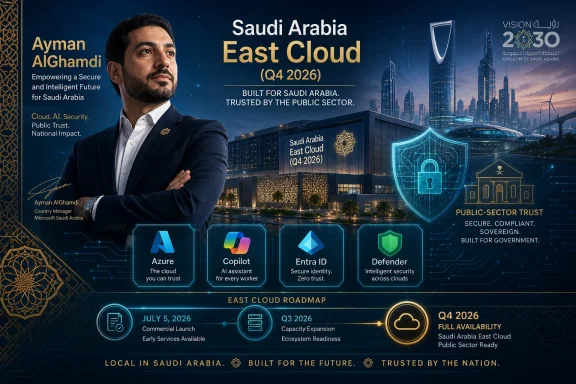 Microsoft Chooses a Public-Sector Insider for a Public-Sector Moment
AlGhamdi’s résumé explains the appointment better than any executive quote could. Microsoft says he spent the past 14 years at the company, most recently as Vice President for Public Sector in Saudi Arabia, working with government entities and national institutions on AI transformation, cloud adoption, and digital services. That is precisely the customer set Microsoft needs to win over as its Saudi Arabia East datacenter region moves from promise to operational reality.The timing matters. Microsoft confirmed earlier this year that customers are expected to begin running workloads from the Saudi Arabia East cloud region in the fourth quarter of 2026. That turns the new president’s job into something more concrete than evangelism. AlGhamdi will be judged on whether agencies, regulated industries, and large national enterprises actually move sensitive workloads into Microsoft’s local cloud rather than merely praise the roadmap from conference stages.
Microsoft’s own language is revealing. The company frames AlGhamdi as someone who can bring together cloud, AI, cybersecurity, data, productivity tools, partner capability, and skilling programs. That is the modern Microsoft field playbook in one sentence: sell Azure, attach Copilot and security, wrap it in compliance, and build enough local capability to make the migration politically and operationally defensible.
This is also why a public-sector leader makes sense. In a market like Saudi Arabia, the hardest cloud conversations are not just about price, latency, or feature parity. They are about data residency, sovereign requirements, procurement confidence, cyber risk, and whether ministries and national institutions believe the vendor understands the operating environment.
The Cloud Region Is the Real Appointment
Microsoft first announced its intent to invest in a Saudi cloud datacenter region in February 2023, and the company has since sharpened that promise into a more specific delivery window. The 2026 confirmation that workloads are expected to run from the Saudi Arabia East region in Q4 gives customers a planning horizon. It also gives Microsoft a deadline.For years, global cloud providers have sold regional transformation stories before the physical infrastructure arrived. That can work for pilots, analytics experiments, and non-sensitive workloads. It works less well for agencies and enterprises that need in-country hosting, regulatory certainty, and a credible disaster-recovery architecture before they can move core systems.
Saudi Arabia is exactly the kind of market where local cloud capacity can change the conversation. Government platforms, healthcare systems, financial institutions, energy companies, aviation operators, manufacturers, and education providers all face different versions of the same question: which workloads can move to public cloud without creating unacceptable sovereignty, compliance, or operational risk?
AlGhamdi’s appointment therefore lands at the hinge point between pre-region selling and post-region delivery. Before a cloud region opens, a vendor sells confidence. After it opens, the vendor must deliver migrations, uptime, governance, security posture, and a partner ecosystem capable of making the platform useful beyond headline accounts.
That is where Microsoft has an advantage and a burden. Its stack is already deeply embedded in enterprises through Windows, Microsoft 365, Active Directory and Entra, SQL Server, Teams, Defender, Power Platform, Dynamics, and Azure. The Saudi cloud region gives Microsoft a stronger infrastructure argument. But it also raises expectations that the company can meet local demand with the reliability and compliance discipline it promises globally.
Saudi Arabia’s AI Push Gives Microsoft a Bigger Prize—and a Sharper Test
Saudi Arabia has designated 2026 as the Year of Artificial Intelligence, according to the Saudi Data and Artificial Intelligence Authority and state media reporting. That designation is not symbolic window dressing. It is part of a broader effort to align ministries, national programs, and private-sector investment around AI deployment under Vision 2030.Microsoft’s announcement leans heavily into that context. Naim Yazbeck, President of Microsoft Middle East and Africa, described the appointment as coming at a defining moment for Saudi Arabia’s AI journey, with government leaders, customers, and partners moving from ambition to execution. That phrase, “ambition to execution,” is doing a lot of work.
The first wave of generative AI adoption was easy to narrate and hard to govern. Every board wanted pilots. Every ministry wanted a strategy. Every vendor had a model, a copilot, and a slide deck promising productivity gains. The harder phase is now arriving: production AI systems that touch citizen services, regulated data, procurement processes, customer records, industrial operations, and national infrastructure.
That is where a local cloud region and a local president intersect. AI at scale is hungry for compute, data governance, identity controls, security monitoring, and integration with existing enterprise systems. Microsoft’s advantage is that it can pitch those pieces as a unified platform rather than a bag of parts.
But the same integration that makes Microsoft attractive also makes the stakes higher. If Copilot, Azure AI, Fabric, Defender, Entra, and Microsoft 365 become part of Saudi Arabia’s digital operating layer, Microsoft Arabia will not be treated like an ordinary software supplier. It will be expected to behave like a long-term infrastructure partner.
Vision 2030 Turns Enterprise Software Into National Infrastructure
Vision 2030 is often described in economic terms: diversification, private-sector growth, new industries, and reduced dependence on oil. For Microsoft, the more immediate interpretation is simpler. Saudi Arabia is digitizing public services, industrial systems, education, healthcare, energy, tourism, logistics, and major national projects, and it needs platforms that can scale across them.That is why Microsoft’s announcement name-checks sectors including government, energy, aviation, manufacturing, healthcare, education, and major national projects. These are not random verticals. They are the arenas where cloud adoption becomes politically visible and operationally consequential.
In mature cloud markets, a CIO can move workloads to Azure and frame it as a modernization program. In Saudi Arabia, the same migration may be tied to national capability, skills development, Arabic-language services, cybersecurity resilience, and the country’s desire to be seen as a regional AI leader. The procurement decision becomes part of a larger national story.
That can benefit Microsoft. Few companies are better at selling the “platform for national transformation” story, especially when the pitch combines productivity software, cloud infrastructure, developer tooling, security products, and training. But the story also exposes Microsoft to scrutiny. If national cloud and AI programs stall, overrun, or produce disappointing results, the vendor cannot hide behind the language of experimentation forever.
AlGhamdi’s job is to keep the rhetoric connected to implementation. His public-sector background suggests Microsoft wants someone who knows how government buyers think, how national institutions move, and where the friction appears when strategy meets procurement, compliance, data classification, and workforce readiness.
The Skilling Promise Is a Business Strategy in Public-Interest Clothing
Microsoft says one of its recent Saudi milestones is a commitment to help 3 million people acquire AI skills by 2030. The company announced that skilling push earlier this year, positioning it as part of the Kingdom’s broader AI readiness agenda. It is a generous-sounding promise, but it is also commercially astute.Cloud regions do not become profitable simply because servers are switched on. They need developers, administrators, security teams, data engineers, partners, consultants, and business users who know how to build and operate on the platform. A skilling program is a demand-generation engine with a public-benefit wrapper.
That does not make it cynical. Skills shortages are real, and AI adoption will fail without people who understand data pipelines, prompt governance, model evaluation, identity controls, compliance, and secure deployment. But Microsoft’s ecosystem benefits when those skills are Azure-shaped, Copilot-shaped, Defender-shaped, and Microsoft Learn-shaped.
This is the quiet logic behind much of Big Tech’s national investment diplomacy. A vendor promises local infrastructure, local skills, local partners, and support for national priorities. In return, it earns credibility with government, expands its enterprise footprint, and increases the likelihood that the next generation of developers and administrators grows up inside its ecosystem.
For Saudi Arabia, the challenge is to turn vendor-led skilling into durable national capability rather than product familiarity. Training millions of people in AI sounds impressive. The harder question is how many become builders, auditors, architects, security professionals, and domain specialists capable of deploying AI responsibly in Arabic-language, Saudi-regulated, mission-critical environments.
Microsoft’s Local Bet Is Also a Sovereignty Bet
The phrase trusted AI partner appears in Microsoft’s announcement, and it is easy to skim past as corporate boilerplate. It should not be. Trust is the central currency of cloud and AI in 2026, especially for governments and regulated sectors deciding how much of their digital future should run on foreign-owned hyperscale infrastructure.Saudi Arabia is not alone in wanting cloud capability without surrendering policy control. Across Europe, the Middle East, and Asia, governments are asking sharper questions about data residency, operational control, legal jurisdiction, supply-chain resilience, and the dependence that comes with hyperscale cloud adoption. Microsoft has responded globally with sovereignty offerings, local regions, compliance commitments, and partnerships designed to reassure governments without fragmenting the economics of Azure.
The Saudi region fits that pattern. It gives Microsoft a way to say that sensitive workloads can be hosted in-country while still benefiting from the company’s global cloud engineering, security systems, and AI services. For customers, that may be enough to unlock projects that were previously stuck in policy limbo.
But sovereignty is not a binary switch. Local datacenters help with residency and latency, but they do not automatically answer every question about support access, encryption controls, law enforcement demands, model governance, software supply chains, or dependency risk. Those questions become more important as AI systems consume more local data and become embedded in workflows that affect citizens and critical industries.
AlGhamdi will have to sell trust in practical terms. That means not just repeating Microsoft’s global assurances, but showing Saudi customers how identity, encryption, auditability, incident response, compliance mapping, and data governance actually work in the local operating model.
The WindowsForum Angle Is Bigger Than Windows
At first glance, a Microsoft Arabia leadership appointment may seem distant from the usual WindowsForum diet of Windows builds, update channels, Copilot features, security patches, and admin headaches. It is not. The modern Windows estate lives inside Microsoft’s cloud strategy.For enterprises, Windows endpoints are increasingly managed through Intune, secured through Defender, authenticated through Entra ID, monitored through cloud portals, and connected to Microsoft 365 and Copilot services. A new Azure region in Saudi Arabia can affect where identity-adjacent data, security telemetry, productivity workloads, and application backends are hosted or integrated.
For sysadmins in Saudi Arabia and nearby markets, the practical implications will emerge slowly. New regional availability can improve latency for some services, simplify compliance narratives for some workloads, and make cloud migration proposals easier to defend internally. It may also create new architecture decisions: which workloads should move to the local region, which should remain in existing regions, and how disaster recovery should be designed across geographies.
The same applies to developers. A local region changes the calculus for applications serving Saudi users, especially where data residency or low-latency access matters. Azure services that become available locally can make it easier to build public-sector, healthcare, education, energy, and financial applications without sending core data outside the country.
Security teams should pay attention as well. The combination of local cloud, AI adoption, and national-scale digital services will expand the attack surface. Microsoft will pitch Defender, Sentinel, Entra, Purview, and its broader security portfolio as part of the answer. Customers will still need their own controls, logging discipline, incident response plans, and uncomfortable conversations about who can access what data under which circumstances.
Big Tech’s Gulf Strategy Is Moving From Announcements to Accountability
The Gulf has become one of the world’s most aggressive markets for cloud, AI, and digital infrastructure investment. Saudi Arabia in particular is trying to convert capital, government coordination, and demographic scale into technological influence. That creates a natural opening for Microsoft, Amazon, Google, Oracle, Huawei, and others competing to become the default infrastructure layer for the region’s next decade.What distinguishes the current phase is that the easy announcements are giving way to operational accountability. Announcing a region is easier than filling it with production workloads. Announcing AI training targets is easier than producing a workforce that can build, govern, and secure AI systems. Announcing partnerships is easier than proving they generate measurable improvements in public services and business productivity.
Microsoft’s appointment of AlGhamdi should be read in that light. The company is not parachuting in a generic international executive to run a sales territory. It is elevating someone who has spent years inside Microsoft’s Saudi public-sector business and who can plausibly navigate the relationship-heavy, policy-sensitive, execution-driven environment that the next phase requires.
That local credibility will matter, but it will not eliminate competition. Hyperscalers are increasingly selling similar bundles: local regions, AI platforms, security services, sovereign cloud language, startup programs, public-sector partnerships, and training commitments. Microsoft’s differentiation will come from execution, existing enterprise penetration, and its ability to make AI useful inside the workflows organizations already use.
The risk is that every vendor’s narrative starts to sound identical. Everyone supports Vision 2030. Everyone believes in trusted AI. Everyone wants to build skills. Everyone says local infrastructure will accelerate innovation. AlGhamdi’s Microsoft Arabia will need to prove that Microsoft can turn those words into systems that agencies and enterprises depend on every day.
The New President Inherits a Deadline, Not a Victory Lap
The most important date in Microsoft’s Saudi story is not July 5, 2026, even though that is when AlGhamdi’s appointment takes effect. The more consequential window is Q4 2026, when Microsoft says customers are expected to begin running cloud workloads from the Saudi Arabia East datacenter region. That is when the sales narrative becomes an operational benchmark.If the rollout goes well, Microsoft Arabia can tell a powerful story: local leadership, local cloud capacity, national AI alignment, broad skilling, and a platform that connects government modernization with enterprise productivity. If it stumbles, the same ingredients become liabilities. Customers will ask whether the region has the services they need, whether migrations are moving fast enough, whether partners are ready, and whether Microsoft’s AI pitch is ahead of its cloud reality.
AlGhamdi’s own quoted remarks emphasize staying close to customers, partners, and teams. That sounds like standard executive language, but in this case it is also the job description. The Saudi market is moving quickly, but large institutions still move through trust networks, regulatory reviews, budget cycles, and implementation constraints.
The cloud region will not succeed merely because Microsoft has global scale. It will succeed if customers believe the local Microsoft organization can help them modernize without losing control. That is a harder, more human problem than provisioning compute.
The Practical Reading for Microsoft Customers in the Kingdom
For IT leaders, the appointment is a signal to start treating Microsoft’s Saudi cloud plans as a near-term planning issue rather than a distant roadmap item. That does not mean rushing every workload into the new region on day one. It means preparing inventories, governance models, data classifications, identity architectures, and migration priorities before the sales pressure arrives.There is also a procurement lesson here. Microsoft’s Saudi strategy is likely to arrive as a bundle: Azure region readiness, AI use cases, Copilot adoption, security modernization, data governance, and skilling. Customers should resist evaluating those pieces only as a grand transformation slogan. Each component needs its own architecture, cost model, risk assessment, and success metric.
The best organizations will use the new region to solve specific problems. They may move latency-sensitive services, host regulated datasets locally, build AI pilots around governed data, modernize disaster recovery, or consolidate identity and endpoint management. The worst will treat cloud region availability as permission to migrate indiscriminately.
That distinction matters because AI raises the cost of sloppy cloud decisions. Poorly governed data estates produce poor AI outcomes. Weak identity controls become AI-era security risks. Unclear residency requirements can derail projects late. Microsoft can provide tools, but customers still own the hard work of knowing their data, their users, their regulatory exposure, and their appetite for dependency.
What AlGhamdi’s First Year Will Really Measure
Microsoft will likely measure AlGhamdi’s first year through revenue, cloud consumption, strategic account wins, partner momentum, and AI adoption. Customers will measure it differently. They will look for service availability, migration support, compliance clarity, local responsiveness, and whether Microsoft can deliver on promises without forcing every organization into the same template.The public-sector measure will be especially important. If ministries and national institutions become reference customers for production AI and cloud workloads, Microsoft’s credibility will compound quickly. If they remain stuck in pilots and memoranda, the appointment will look more like brand alignment than execution muscle.
Partners will be another test. A cloud region without a capable local partner ecosystem is just infrastructure. Systems integrators, managed service providers, independent software vendors, training organizations, and security specialists will determine whether Microsoft’s platform reaches beyond the largest accounts.
There is also a developer test. If Saudi developers see Azure as a local, reliable, well-supported platform for building AI-enabled applications, Microsoft gains a long-term advantage. If they see it as a procurement-driven enterprise cloud with too much friction, the company leaves room for rivals and open-source alternatives.
A Saudi Cloud Story Written in Operational Details
Microsoft’s appointment of Ayman AlGhamdi is easy to summarize as a personnel move, but the more accurate reading is that Microsoft is localizing accountability before a major infrastructure launch. The company has spent years preparing the market. Now it needs someone who can turn national ambition, enterprise demand, and hyperscale promises into working deployments.The concrete signals are worth separating from the corporate gloss.
- Microsoft appointed Ayman AlGhamdi as President of Microsoft Arabia effective July 5, 2026.
- AlGhamdi has spent 14 years at Microsoft and most recently led public-sector work in Saudi Arabia.
- Microsoft expects customers to begin running workloads from the Saudi Arabia East cloud region in Q4 2026.
- The company is tying the leadership change to Saudi Arabia’s AI agenda, Vision 2030 priorities, cybersecurity, cloud adoption, and national skilling.
- Microsoft has committed to helping 3 million people in Saudi Arabia acquire AI skills by 2030.
- The appointment raises the practical stakes for Saudi customers preparing data governance, cloud migration, security, and AI deployment plans.