

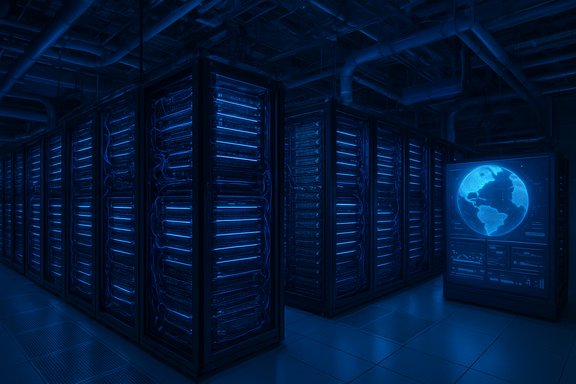
Microsoft says it has flipped the switch on a second Fairwater-class Azure AI datacenter in Atlanta and — by linking it over dedicated fiber to its Wisconsin Fairwater campus — is building what it calls the world’s first planet‑scale AI superfactory, a purpose‑built, rack‑first infrastructure designed to run single, frontier‑scale AI jobs across geographically distributed sites.
Microsoft’s new Atlanta Fairwater site is the second public installment of a deliberately engineered family of AI datacenters that the company says are built to operate together as a single logical compute plane. The company outlines a repeatable design: ultra‑dense NVIDIA GB‑family racks (NVL72‑style), advanced closed‑loop liquid cooling, two‑story halls to compress cable lengths and latency, and a dedicated AI wide‑area network (AI WAN) that stitches sites into an elastic, continent‑spanning fabric. Microsoft reports that the Atlanta facility entered production in October and is now connected to its Wisconsin Fairwater campus; the vendor frames the combined system as an enterprise offering for frontier model training and high‑throughput inference. Independent trade reporting and press coverage confirm the same high‑level narrative: Microsoft is moving from isolated hyperscale datacenters toward purpose‑built, networked AI campuses optimized to treat a rack — and ultimately a multi‑site cluster — as the primary unit of acceleration.
Benefits of the rack‑first model:
For enterprises and WindowsForum readers, the practical takeaway is twofold: expect a future where truly massive model training is commodified as an Azure service option, shortening research cycles and lowering time‑to‑market for AI‑driven products; and anticipate new vendor and policy conversations around concentration, energy usage and responsible access to planet‑scale compute.
Finally, treat promotional headline metrics with appropriate skepticism until independent, third‑party audits or benchmark studies appear. Microsoft has publicly documented many of the engineering choices and early operational steps; industry reporters and trade outlets have independently confirmed core design elements. But several of the most dramatic performance and capacity numbers remain marketing‑level claims that will require transparent inventories and consistent benchmarking to fully verify.
Summary of the most load‑bearing, verified facts:
Source: Telecompaper Telecompaper
 Background / Overview
Microsoft’s new Atlanta Fairwater site is the second public installment of a deliberately engineered family of AI datacenters that the company says are built to operate together as a single logical compute plane. The company outlines a repeatable design: ultra‑dense NVIDIA GB‑family racks (NVL72‑style), advanced closed‑loop liquid cooling, two‑story halls to compress cable lengths and latency, and a dedicated AI wide‑area network (AI WAN) that stitches sites into an elastic, continent‑spanning fabric. Microsoft reports that the Atlanta facility entered production in October and is now connected to its Wisconsin Fairwater campus; the vendor frames the combined system as an enterprise offering for frontier model training and high‑throughput inference. Independent trade reporting and press coverage confirm the same high‑level narrative: Microsoft is moving from isolated hyperscale datacenters toward purpose‑built, networked AI campuses optimized to treat a rack — and ultimately a multi‑site cluster — as the primary unit of acceleration. What Microsoft actually announced
Key claims Microsoft is making
- The Atlanta Fairwater site joins the Wisconsin Fairwater campus to form a planet‑scale “AI superfactory” that enables synchronous, multi‑site training jobs across hundreds of thousands of GPUs.
- The design centers on NVL72 rack‑scale systems using NVIDIA Blackwell (GB200/GB300) GPUs and Grace‑class CPUs, presenting an entire rack as a single accelerator domain to reduce cross‑host communication overhead.
- The sites use closed‑loop liquid cooling, a two‑story building footprint to shorten cable runs and reduce latency, and an AI WAN built from dedicated fiber to minimize congestion between sites.
Verified technical points
Multiple Microsoft posts and independent datacenter outlets corroborate several concrete, verifiable engineering details: the rack‑as‑accelerator approach (72 GPUs per NVL72 rack is the canonical configuration), liquid cooling with external heat rejection, per‑rack power density designed to support very high GPU counts, and the AI WAN concept using newly built or repurposed dedicated fiber. These are substantive, engineering‑level claims that are confirmed by company materials and multiple industry reporters.Claims that need caution
Some headline metrics published in promotional copy are workload‑dependent or not independently auditable today. For example:- Microsoft’s marketing references “hundreds of thousands of NVIDIA GPUs” across Fairwater sites and a claim that the superfactory can deliver “10× the performance of today’s fastest supercomputers” for certain AI workloads. These statements are plausible given the scale and rack designs, but they depend on how you measure performance (throughput for specific model classes vs. general HPC benchmarks) and on undisclosed per‑site inventories. Treat these numbers as high‑level targets or marketing frames pending independent audits.
- Telecompaper’s summary that the network will be “fully operational in 2026” is not explicitly mirrored in Microsoft’s primary technical posts; Microsoft says Atlanta began operating in October and emphasizes ongoing site rollouts, but public materials do not publish a single global timeline that declares a 2026 full‑fleet operational date. That timeline may reflect external editorial interpretation. Flag as unverified in company materials.
Deep dive: architecture, hardware and software
Rack‑as‑accelerator: why Microsoft emphasizes NVL72
Fairwater’s central design principle is a shift in the unit of compute from an individual server to the whole rack. NVL72‑style racks interconnect up to 72 NVIDIA Blackwell‑class GPUs with very high‑bandwidth NVLink/NVSwitch topologies and pooled fast memory. Presenting a rack as a contiguous accelerator reduces the number of cross‑host collective communications that can throttle large‑model training, improving per‑step throughput and utilization for synchronized training. This architecture is validated by vendor NVL72 documentation and Microsoft’s own technical disclosures.Benefits of the rack‑first model:
- Faster gradient exchange and lower effective latency inside a rack versus server‑level sharding.
- Simpler scheduler semantics — the scheduler treats a rack like a single high‑capacity accelerator unit instead of juggling many small hosts.
- Higher utilization for large models and long‑context workloads because more data and model state can be held in the rack’s pooled memory.
- Racks become larger failure domains for tightly synchronized jobs, which requires software that tolerates stragglers and hardware faults at scale.
- Valuable for large monolithic workloads, less flexible for many small, variable tasks that cloud customers run today.
Networking: the AI WAN and internal fabrics
Microsoft’s architectural posts describe a two‑tier networking approach: ultra‑low latency NVLink inside racks, very high‑throughput RDMA‑capable fabrics between racks and pods (800 Gbps‑class links in many descriptions), and a dedicated AI WAN — a congestion‑free, optical backbone that links Fairwater sites to behave more like nodes in a single supercomputer. Trade press reporting corroborates the presence of heavy fiber builds and a design goal of minimizing cross‑site bottlenecks. Operational consequences:- Distributed synchronous training across hundreds of miles is still fundamentally limited by physics and speed‑of‑light latency; the AI WAN minimizes congestion and variable queuing delays but cannot erase propagation delay. That means Microsoft will design workloads, parallelism schemes and checkpointing to trade off bandwidth, latency and consistency.
- The network allows fungibility — workloads can land on different Fairwater racks or sites based on policy, costs and availability while appearing to the training stack as a single elastic pool.
Cooling, power and the two‑story hall
Fairwater’s closed‑loop liquid cooling moves heat out of the building to external heat exchangers and returns chilled fluid to the racks, a design Microsoft says reduces routine water use to near‑zero after initial fill. The two‑story datacenter hall — a physical innovation — shortens cable paths and lets Microsoft pack racks vertically to increase GPU density per square foot. Both design choices raise engineering and community questions (structural loads, conduit and piping complexity, grid interactions) that Microsoft says it addressed in site planning. Verified facility numbers and nuance:- DatacenterDyanmics and Microsoft materials reference per‑rack density targets up to ~140 kW and row densities in the megawatt range for these designs; those are engineering figures that require site‑level confirmation and are tied to specific rack models and operating profiles.
Commercial and strategic implications
For Microsoft, OpenAI and enterprise customers
Fairwater is explicitly pitched as a platform for “frontier” AI work: model pre‑training, fine‑tuning, reinforcement learning and large‑scale inference for products like Copilot and partner workloads. Microsoft positions Fairwater as both an internal backbone for its own model development and a differentiated Azure service offering (new ND‑class SKUs optimized for GB‑family GPUs are already being surfaced in platform materials). The architecture gives Microsoft a commercial asset that can shorten iteration cycles for large models — turning training jobs measured in months into schedules of weeks, according to company messaging. From a market perspective:- Fairwater strengthens Microsoft’s competitive moat in cloud AI by co‑engineering hardware, networking and orchestration to host frontier models at scale.
- The approach commoditizes very large compute runs for customers that cannot build their own physical infrastructure, creating new revenue and long‑term capacity commitments.
Impacts on vendor ecosystems and reliance on NVIDIA
Fairwater is built around NVIDIA Blackwell GB‑family platforms in NVL72 rack topologies. That tight coupling reinforces NVIDIA’s dominant role in large‑scale training today and increases cloud providers’ dependence on a small set of accelerator vendors. Microsoft’s design choices make high‑end GPUs and associated interconnects central to performance; any supply constraints or vendor ecosystem shifts would have immediate ripple effects. Independent reporting repeatedly highlights the co‑design with NVIDIA as core to Fairwater’s technical feasibility.Local community, grid and environmental considerations
Microsoft highlights sustainability measures — matching fossil‑fuel electricity with carbon‑free sources, minimizing ongoing water use through closed‑loop cooling, and siting on resilient grid corridors to avoid heavy reliance on diesel generation. Those are important mitigations, but the net environmental footprint depends on grid carbon intensity at each site, the lifecycle impact of manufacturing and deploying hundreds of thousands of accelerators, and the embodied carbon in the massive construction projects. Journalists and analysts are rightly treating environmental claims with scrutiny and asking for measurable, third‑party audited KPIs on energy use intensity (EUI), water use effectiveness (WUE), and scope‑1/2 emissions per effective unit of AI throughput. Community and workforce effects:- Construction and operational jobs and local investments are positive near‑term economic impacts Microsoft emphasizes.
- Large grid loads and new fiber builds require careful municipal coordination; Microsoft says it is prepaying and partnering with local utilities to avoid upward pressure on consumer rates, but independent verification is needed over time.
Risks, tradeoffs and governance concerns
The Fairwater program escalates several systemic and governance risks that deserve scrutiny. These are ranked by likelihood and near‑term impact.- Concentration risk: A handful of cloud providers and a small set of accelerator vendors now carry outsized influence over the economic and technical infrastructure for frontier AI. That concentration raises supply‑chain and geopolitical vulnerabilities in addition to commercial lock‑in.
- Energy and grid stress: Even with renewable contracts and energy storage, sustained high‑density AI farms create new, predictable megawatt‑scale loads that alter local grid dynamics; contingency planning and long‑duration storage commitments will be essential.
- Operational fragility for synchronous workloads: Multi‑site synchronous training pushes the boundaries of distributed systems engineering. While dedicated fiber and tuned protocols reduce congestion, long‑distance propagation latency and heterogeneous site reliability still create failure modes that can waste vast compute hours. Microsoft’s orchestration stack will need advanced fault tolerance and preemption policies to avoid catastrophic job losses.
- Environmental transparency: Closed‑loop cooling reduces operational water usage but does not eliminate embodied carbon from chip and building manufacture. Independent measurement and verified reporting of end‑to‑end environmental metrics will be necessary to substantiate sustainability claims.
- Concentrated capabilities and policy oversight: The creation of planet‑scale supercomputing capability concentrated in private hands brings regulatory and policy questions about access, export controls, national security, and the ethical governance of frontier model development. Those debates will intensify as these facilities come fully online.
What to watch next (practical signals)
- Inventory transparency: independent, peer‑auditable disclosures of rack counts, GPU counts and sustained utilization rates across Fairwater sites. Microsoft’s promotional numbers are directional; verification will matter for market sizing and environmental accounting.
- Benchmark context: third‑party workload benchmarks that compare Fairwater throughput against public supercomputers using consistent metrics (preferably beyond producer‑defined training throughput numbers). This will clarify claims such as “10× the performance” for specific workloads.
- Grid and community agreements: signed utility contracts, energy storage rollouts, and municipal memoranda of understanding that show how Microsoft will manage peak loads and local rate impacts.
- Software and orchestration maturity: evidence that Microsoft’s orchestration and fault‑tolerance layers can routinely run large synchronous jobs across sites without catastrophic loss of progress or cost overruns. Technical papers, SDK releases and case studies will be informative.
Conclusion — what Fairwater means for WindowsForum readers and enterprise IT
Microsoft’s Atlanta Fairwater announcement is more than another datacenter expansion; it’s a statement of architectural intent. By designing for the rack as the atomic accelerator, deploying closed‑loop cooling and linking sites with a purpose‑built AI WAN, Microsoft is optimizing Azure for the scaling patterns of frontier AI models rather than for the multi‑tenant elasticity that dominated cloud design for a decade. That shift has immediate technical benefits for large‑model training — higher per‑step throughput, denser GPU packing and more fungible capacity — but it also amplifies supply‑chain, environmental and governance risks that will need active mitigation.For enterprises and WindowsForum readers, the practical takeaway is twofold: expect a future where truly massive model training is commodified as an Azure service option, shortening research cycles and lowering time‑to‑market for AI‑driven products; and anticipate new vendor and policy conversations around concentration, energy usage and responsible access to planet‑scale compute.
Finally, treat promotional headline metrics with appropriate skepticism until independent, third‑party audits or benchmark studies appear. Microsoft has publicly documented many of the engineering choices and early operational steps; industry reporters and trade outlets have independently confirmed core design elements. But several of the most dramatic performance and capacity numbers remain marketing‑level claims that will require transparent inventories and consistent benchmarking to fully verify.
Summary of the most load‑bearing, verified facts:
- Atlanta Fairwater is online and linked to Wisconsin to form a multi‑site AI superfactory.
- The architecture centers on NVL72 rack‑scale NVIDIA GB‑family systems and closed‑loop liquid cooling.
- Microsoft is deploying a dedicated AI WAN (large‑scale fiber and optimized protocols) to reduce cross‑site congestion for synchronous training.
- Several high‑level capacity and performance claims (hundreds of thousands of GPUs, “10×” throughput, a 2026 full‑operational timeline in some press summaries) are plausible but should be treated as aspirational or editorial unless Microsoft publishes detailed, auditable inventories and benchmarks.
Source: Telecompaper Telecompaper
