

Microsoft and Mercedes‑AMG PETRONAS have converted a paddock sponsorship into a strategic, multi‑year technology alliance that places Microsoft Azure, GitHub and Microsoft 365 at the center of Mercedes’ engineering, simulation and trackside decision systems as Formula 1 enters its 2026 technical reset.
The 2026 F1 regulations represent a structural shift toward greater electrification, energy recovery, and tighter efficiency constraints — a change that makes simulation fidelity, energy‑strategy modelling and telemetry analytics as critical as aerodynamic development. Teams face a marked increase in the complexity of thermal, electrical and battery‑management problems, and they must translate telemetry into actionable strategy in narrower energy windows than before. The Microsoft–Mercedes announcement explicitly frames the partnership as a response to that challenge: apply cloud scale, AI and developer tooling to accelerate iteration cycles and sharpen race‑time decisioning.
Teams already gather enormous telemetry: Mercedes’ public materials and industry reporting cite figures in the range of hundreds of sensors per car and roughly 1.1 million data points per second, creating terabytes of high‑velocity time‑series data across sessions. That telemetry scale both motivates and constrains any cloud‑backed architecture intended to deliver real‑time or near‑real‑time insights.
However, the path from cloud capability to on‑track performance is not automatic. The partnership’s success will hinge on operational discipline around latency‑sensitive architecture, rigorous FinOps and cost governance, airtight cybersecurity and transparent IP governance. The widely‑reported commercial estimate (often cited at roughly USD 60 million per year in industry commentary) remains unconfirmed and should be treated with caution.
If Mercedes and Microsoft execute the integration with appropriate edge‑cloud balancing, clear ownership of models, and strict cost and security controls, the collaboration could become a blueprint for how elite engineering teams convert raw telemetry into seconds gained on track and transferable road‑car innovation off it. If those operational pieces are neglected, the partnership risks being an expensive but under‑utilised capability that raises governance headaches more than it wins races.
Source: Data Centre Magazine Can Microsoft Power Mercedes F1 Performance with Data & AI?
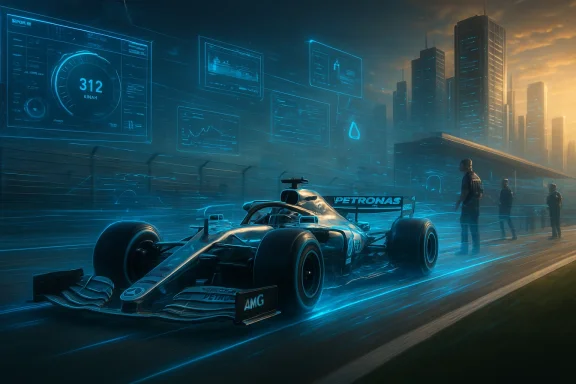 Background: why this partnership matters now
The 2026 F1 regulations represent a structural shift toward greater electrification, energy recovery, and tighter efficiency constraints — a change that makes simulation fidelity, energy‑strategy modelling and telemetry analytics as critical as aerodynamic development. Teams face a marked increase in the complexity of thermal, electrical and battery‑management problems, and they must translate telemetry into actionable strategy in narrower energy windows than before. The Microsoft–Mercedes announcement explicitly frames the partnership as a response to that challenge: apply cloud scale, AI and developer tooling to accelerate iteration cycles and sharpen race‑time decisioning.Teams already gather enormous telemetry: Mercedes’ public materials and industry reporting cite figures in the range of hundreds of sensors per car and roughly 1.1 million data points per second, creating terabytes of high‑velocity time‑series data across sessions. That telemetry scale both motivates and constrains any cloud‑backed architecture intended to deliver real‑time or near‑real‑time insights.
What Microsoft is bringing to Mercedes: the technical stack
Microsoft’s contribution is presented as an end‑to‑end stack that maps naturally onto the lifecycle of modern race engineering: telemetry ingestion, simulation, model training, deployment and collaborative decision workflows. Publicly flagged components include:- Azure High‑Performance Compute (HPC) for burstable CFD, multi‑body dynamics and hardware‑in‑the‑loop simulation.
- Azure Kubernetes Service (AKS) to run containerised pipelines and scale model serving and inference workloads during peak windows.
- Azure AI and managed model hosting for inference, virtual sensors and predictive models such as tire wear, battery state and energy deployment.
- GitHub as the single source for code, model artifacts and reproducible CI/CD pipelines across simulation and control software.
- Microsoft 365 to streamline cross‑discipline collaboration between aerodynamicists, power unit engineers, strategists and pit crews.
Why cloud + AI is a natural fit for 2026 problems
The new power units will demand more nuanced energy strategies and specialized thermal/electrical modelling. Cloud and AI address three practical needs:- Elastic compute to run vastly more design permutations and Monte Carlo strategy simulations without huge capital outlay.
- Faster model training and deployment so teams can iterate rapidly on battery management, regenerative strategies and control‑software parameters.
- Centralised data and reproducible pipelines that allow cross‑domain analytics and traceable experiments across aerodynamic and powertrain disciplines.
Practical, race‑centric use cases to expect
The announcement and accompanying technical commentary outline several pragmatic ways Microsoft technologies could deliver lap‑time gains:- Real‑time race strategy engines that ingest live telemetry, run probabilistic scenarios in the cloud, and return ranked strategy recommendations during safety‑car windows or energy deployment windows.
- Cloud‑burst CFD and optimization runs that compress validation cycles and enable more design variants to be tested before part manufacture.
- Virtual sensors and digital twins that infer sensor readings or backfill lost telemetry in tests, enabling experimentation without additional on‑car hardware.
- GitOps and CI/CD for simulation and control software to reduce manual handoffs, improve reproducibility and accelerate deployment of validated models to trackside stacks.
Strengths and immediate advantages
The partnership offers multiple tangible strengths that make it more than a branding exercise:- Immediate elastic compute: Azure’s ability to scale means Mercedes can run more parallel simulations and compress turnaround times, shifting CapEx into controllable OpEx.
- Integrated toolchain maturity: Microsoft 365 and GitHub are already embedded in the team’s operations, reducing friction for adoption and enabling reproducible engineering workflows.
- Pilot evidence: Public disclosures describe pilot projects (AKS scaling, virtual sensors), indicating the move stems from demonstrated capability rather than pure marketing hype.
- Commercial and marketing value: The deal provides Microsoft a marquee engineering use case and Mercedes both revenue and an operational halo that can be leveraged across their corporate R&D. Industry reports have placed the deal’s annual value in the tens of millions, although exact financial terms remain unconfirmed. Treat commercial estimates as unverified until published by either party.
Risks, caveats and governance challenges
The technical potential is clear, but execution and governance determine whether cloud and AI become a sustainable competitive edge or a source of operational headaches.1. Latency and trackside constraints
Race‑critical, sub‑10ms decisions cannot rely on long network hops to Hyperscale datacenters. Circuits have variable connectivity and sometimes constrained bandwidth. The pragmatic architecture is hybrid:- Keep ultra‑low‑latency control and immediate pit‑wall decisioning local (edge inference).
- Use cloud for heavy model training, large scenario simulations, and non‑microsecond critical inference.
2. Security, IP and supply‑chain risk
Telemetry and simulation artifacts are strategic IP. Moving them into third‑party clouds increases the attack surface and requires strict contractual controls:- Robust encryption, identity management and segmented tenancy.
- Clear ownership clauses for telemetry, models and derivative works.
- Independent security attestations and SLAs for confidentiality and availability.
3. Vendor lock‑in and portability
Deep integration with proprietary PaaS services, managed model runtimes, or specialised accelerators can make migration to alternate platforms costly. Mercedes must:- Containerise pipelines and use open model formats.
- Maintain on‑prem or multi‑cloud fallbacks for critical workloads.
- Invest in portability layers so negotiation leverage and operational flexibility remain achievable.
4. FinOps and cost predictability
Cloud elasticity is powerful but can generate large, recurring OpEx if left unchecked. High‑volume simulation and ML training are heavy‑consumption activities that require:- Rigorous FinOps practices.
- Quotas and automated cost governance.
- Clear internal accounting models for FIA cost‑cap reporting.
5. Regulatory and sporting governance
If cloud‑derived models materially affect car performance, the FIA and stakeholders may seek clarity on:- Where and how models are used in car control and homologation.
- Whether virtual testing produces unfair advantage if not all teams can access equivalent compute.
- How automated recommendations preserve driver agency and conform to sporting rules.
Plausible near‑term indicators of success
The initial announcement is high level; the first season will reveal whether this partnership yields measurable advantage. Observable milestones to watch:- Evidence of live, cloud‑augmented strategy recommendations being used in practice sessions, qualifying or race windows.
- Public or indirect disclosures showing increased simulation throughput, reduced iteration times, or specific aerodynamic/powertrain upgrades tied to cloud‑enabled cycles.
- Independent security attestations and published governance frameworks that reassure the paddock about IP protection and data residency.
- Transparent accounting for cloud OpEx relative to the FIA cost cap, or at least clear internal controls that show the team is not trading short‑term compute for long‑term budget risk.
What this means for rivals, sponsors and enterprise IT
This partnership raises the bar for “cloud maturity” across the grid. Expect:- Rival teams to accelerate their own cloud partnerships or publish bespoke on‑premise HPC strategies.
- Suppliers and OEMs to highlight compute and AI features as part of their technology pitches to teams and consumers.
- Enterprise IT leaders to study F1 as a high‑velocity benchmark for secure telemetry ingestion, model governance and reproducible CI/CD for engineering workloads.
Balanced conclusion: upside with caveats
The Microsoft–Mercedes alliance is a logical and strategically timed marriage of hyperscale cloud, enterprise AI and elite motorsport engineering. On paper, the combination addresses three urgent needs for F1 in 2026: elastic compute for simulation, AI‑driven strategy modelling, and reproducible developer workflows. Early pilots and public statements provide credible evidence that this is not merely a marketing partnership; the teams have already trialled virtual sensors and AKS scaling.However, the path from cloud capability to on‑track performance is not automatic. The partnership’s success will hinge on operational discipline around latency‑sensitive architecture, rigorous FinOps and cost governance, airtight cybersecurity and transparent IP governance. The widely‑reported commercial estimate (often cited at roughly USD 60 million per year in industry commentary) remains unconfirmed and should be treated with caution.
If Mercedes and Microsoft execute the integration with appropriate edge‑cloud balancing, clear ownership of models, and strict cost and security controls, the collaboration could become a blueprint for how elite engineering teams convert raw telemetry into seconds gained on track and transferable road‑car innovation off it. If those operational pieces are neglected, the partnership risks being an expensive but under‑utilised capability that raises governance headaches more than it wins races.
Key takeaways (quick bulletin)
- Strategic shift: Microsoft will provide Azure, AKS, GitHub and Microsoft 365 as core technology for Mercedes’ factory and track operations in a multi‑year partnership.
- Technical fit: Cloud + AI address 2026 priorities — energy management, battery strategy and heavier simulation needs — but require hybrid edge architectures for latency‑sensitive tasks.
- Measured expectations: Pilots exist (virtual sensors, AKS bursts), but measurable advantage will be visible only after live, repeatable race‑week deployments and demonstrable improvements in iteration cadence.
- Watchpoints: security/IP governance, FinOps, portability and FIA reporting for cloud OpEx are the governance issues most likely to determine long‑term success.
Source: Data Centre Magazine Can Microsoft Power Mercedes F1 Performance with Data & AI?
