

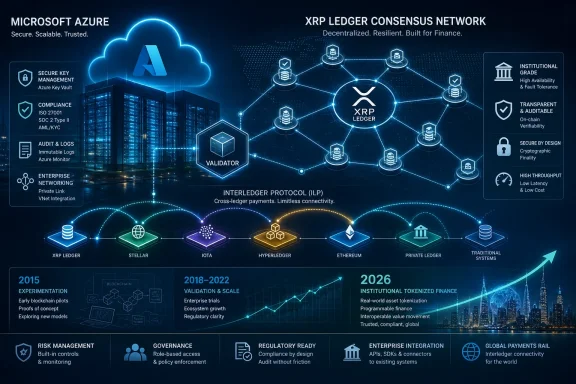
Microsoft’s Azure Blockchain as a Service operated a Ripple validator node in 2015 as part of an early enterprise blockchain experiment, placing Microsoft cloud infrastructure inside a live XRP Ledger consensus network while Azure explored distributed ledgers, Interledger, and financial-infrastructure use cases. The rediscovered detail matters less as crypto trivia than as a reminder of how early the cloud giants understood the institutional problem blockchain was trying to solve. Before tokenization became a boardroom word, Microsoft was already testing whether cloud platforms could become neutral ground for distributed finance. That bet did not mature in a straight line, but the blueprint is now easier to see.
The most tempting reading of Microsoft’s old Ripple validator is the simplest one: a tech giant touched XRP, therefore the market should retrofit a grand strategy onto the event. That is the wrong way to understand it. In late 2015, Azure Blockchain as a Service was not a production financial network in disguise; it was a deliberately broad sandbox for enterprises trying to understand whether distributed ledgers could solve coordination problems that conventional databases handled poorly.
Microsoft’s language at the time was pragmatic. Azure BaaS was pitched as a “fail fast and cheap” environment where developers, banks, and partners could test blockchain frameworks without spending weeks building infrastructure. Ethereum and ConsenSys were the most visible early names in the program, but Ripple’s presence showed that Microsoft was not simply chasing smart-contract fashion. It was examining different models for settlement, consensus, and interoperability.
That distinction matters because Ripple never fit neatly into the retail crypto narrative. The XRP Ledger was designed around fast settlement and validator consensus, not mining culture. For banks, payment companies, and market infrastructure operators, that made it more legible than proof-of-work networks whose security model depended on expensive, adversarial computation.
Azure running a Ripple validator did not mean Microsoft controlled Ripple, endorsed XRP as an investment, or committed to building its financial future around one ledger. It meant Microsoft saw value in hosting real consensus infrastructure for a network aimed at banking users. In enterprise technology, that is often how the future starts: not with a product launch, but with a node in a lab that is connected to something real.
That design is fundamentally different from proof-of-work. There is no mining race, no block subsidy, and no reward stream for burning electricity. Validators matter because other servers choose to trust their published validations as part of a broader consensus process. The model is social and infrastructural as much as computational.
That is why Microsoft’s old Azure node carried significance beyond its raw technical function. A validator operated by a major cloud provider could be seen as a credible participant in a network whose value depends partly on the diversity and reliability of its validating infrastructure. For a bank evaluating Ripple-era technology in 2015, seeing Azure involved would have reduced the sense that this was merely a startup experiment running on fragile rails.
It also pointed toward a future in which cloud providers do not own financial networks but host pieces of them. That is a familiar pattern in enterprise IT. Banks may not want a cloud vendor to define the rules of settlement, but they may accept cloud infrastructure as a scalable, audited, operationally mature place to run components of that settlement stack.
The nuance is important. A validator is not a central bank. It is not a clearinghouse. It is not even, by itself, a guarantee of decentralization. But in a consensus network, the identity and operational reliability of validators affect trust. Microsoft’s participation suggested that the institutional blockchain story would be written not only by protocol designers, but also by infrastructure operators.
That was classic Azure platform thinking. Microsoft did not need every blockchain experiment to succeed. It needed enterprises to do their experimentation on Azure rather than elsewhere. By packaging infrastructure, templates, partner tools, and developer environments, Azure turned blockchain from a specialist deployment problem into something closer to a cloud workload.
The Ripple validator should be read inside that strategy. Ripple represented a financial-services-oriented network with different assumptions from Ethereum. Interledger represented a protocol-level attempt to connect payment systems rather than replace them. Together, they showed that Microsoft was exploring both ledgers and the connective tissue between ledgers.
In hindsight, that was the more interesting bet. The institutional world was never likely to consolidate around one universal blockchain. Banks, exchanges, payment networks, stablecoin issuers, central banks, and asset managers all have their own regulatory constraints and incentives. The real prize was not a single chain; it was interoperability across incompatible systems.
That is where Azure’s early experimentation feels prescient. Cloud platforms are already the place where incompatible enterprise systems are made to talk to each other. Blockchain did not change that need. It merely added new settlement layers, new custody models, and new security assumptions to the old integration problem.
Interledger was not designed as another blockchain. It was a routing protocol for value, intended to move payments across different ledgers and networks. In plain English, it addressed the problem every financial institution understands: the world runs on many ledgers, and nobody wants to throw them all away just to make a new system work.
That premise aged better than many early blockchain slogans. The industry spent years pitching replacement narratives: replace banks, replace clearinghouses, replace card networks, replace fiat, replace trust. Institutional adoption has moved in a more conservative direction. The durable demand is for faster settlement, better collateral mobility, programmable compliance, and improved access to liquidity without requiring every participant to abandon existing rails overnight.
Interledger fit that world because it accepted fragmentation as a fact. Different ledgers would continue to exist. Different jurisdictions would continue to regulate differently. Different institutions would maintain different risk tolerances. The useful infrastructure would be the layer that lets value move across those boundaries.
Microsoft’s interest in ILP therefore reads less like a crypto detour and more like enterprise middleware thinking applied to money. Azure has always been in the business of connecting identity, data, applications, and devices across messy hybrid environments. Financial interoperability is the same architectural problem with higher stakes.
The answer is that products can fail even when the architectural instinct survives. Azure Blockchain Service belonged to a particular enterprise blockchain cycle, one dominated by proofs of concept, consortium rhetoric, and uncertainty about which ledgers mattered. By 2021, much of that market had not grown into the kind of repeatable, high-margin managed service Microsoft wanted to operate directly.
But Microsoft did not abandon the underlying enterprise themes. It continued to invest in cloud security, confidential computing, identity, data governance, and partner-led financial workloads. Those are the components that serious blockchain deployments eventually need. The blockchain-branded wrapper went away; the infrastructure substrate remained.
That pattern is common in Microsoft’s history. The company often experiments with a named product, retires it, and later reabsorbs the useful pieces into broader platforms. Not every early Azure service becomes a durable SKU. Some become lessons about customer demand, operational complexity, and where partners are better positioned.
The old Ripple validator belongs in that category. It was not proof of a secret decade-long XRP strategy. It was evidence that Microsoft had already identified distributed financial infrastructure as a cloud workload. The nameplate changed. The problem did not.
Ripple Prime’s recently announced $200 million debt facility from Neuberger Specialty Finance is a good example. The facility is designed to expand margin financing and prime services for institutional clients operating across traditional and digital markets. That is a very different story from retail token speculation. It is about balance sheet, collateral, lending capacity, and counterparty trust.
The same is true of Ripple’s broader push into stablecoins and liquidity services. The important development is not that every product uses XRP in a maximalist sense. It is that Ripple is trying to position itself where tokenized money, digital assets, and institutional credit meet. In that world, a ledger is only one component of a much larger financial operating system.
That makes the old Azure-Ripple link more interesting as an early sign of convergence. Cloud infrastructure, validator networks, payment interoperability, stablecoins, custody, and prime brokerage are no longer separate conversations. They are becoming different layers of the same institutional stack.
For WindowsForum readers, the familiar analogy is enterprise hybrid cloud. Nobody moved everything to one platform overnight. Instead, identity, networking, monitoring, policy, and data services became the connective layer across old and new systems. Institutional blockchain is following a similar path, with settlement and collateral replacing compute and storage as the objects being coordinated.
That explains Microsoft’s cautious posture. Running infrastructure for blockchain networks is a cloud business. Promoting speculative assets is not. Azure can host nodes, key-management systems, analytics pipelines, compliance tooling, confidential workloads, and disaster-recovery infrastructure without becoming a crypto exchange or a monetary authority.
This distinction will become more important as tokenized finance matures. Institutions do not need cloud providers to promise revolution. They need resilient infrastructure, identity controls, auditability, jurisdictional compliance, and service-level discipline. Those are boring requirements, but they are exactly where Microsoft makes money.
The validator story therefore shows an early version of a likely endgame. Cloud platforms become the neutral execution environment for financial networks they do not own. They provide compute, security, developer tooling, observability, and integration. The networks provide settlement logic, asset issuance, and domain-specific rules.
That arrangement is not risk-free. If too much blockchain infrastructure runs on the same handful of cloud providers, decentralization becomes partly cosmetic. Outages, sanctions compliance, account terminations, and jurisdictional pressure can all affect networks that imagine themselves independent. The enterprise answer to that risk is not to avoid cloud entirely, but to design for multi-cloud, geographic distribution, and operational transparency.
If a bank, asset manager, or payment provider runs blockchain infrastructure, someone has to patch servers, rotate keys, monitor latency, verify backups, manage access, and satisfy auditors. Someone has to decide whether validators sit on bare metal, public cloud, private cloud, or a hybrid architecture. Someone has to integrate ledger data into SIEM systems, reporting pipelines, and compliance workflows.
That makes the Azure-Ripple experiment surprisingly relevant to sysadmins and IT pros. The blockchain story is no longer only about wallets and traders. It is about whether distributed financial systems can be operated with the same discipline expected of databases, domain controllers, and payment gateways.
The challenge is that blockchain infrastructure violates some old assumptions. Finality may be probabilistic or consensus-driven. Transaction errors may be irreversible. Keys may be production assets with no password-reset equivalent. Network governance may sit outside the enterprise boundary. These are not reasons to dismiss the technology; they are reasons to treat it as critical infrastructure rather than a developer toy.
Microsoft understood at least part of that early. Azure BaaS was not just about spinning up nodes. It was about reducing operational friction so enterprises could test the technology under familiar cloud-management patterns. That is still the adoption path: make the unfamiliar manageable without pretending it is riskless.
The XRP Ledger’s consensus model depends on validators and trusted lists rather than mining. Supporters argue that this avoids the waste and concentration pressures of proof-of-work. Critics argue that trust-list dynamics and ecosystem influence can create softer forms of centralization. Both points deserve more than slogan treatment.
Microsoft’s old validator node sits right in the middle of that debate. On one hand, adding a major independent infrastructure operator can strengthen a network’s credibility. On the other hand, if institutional adoption means validators cluster among cloud providers, financial firms, and foundation-approved entities, decentralization may become a governance claim that requires continuous proof.
This is not unique to Ripple. Ethereum staking has its own concentration worries. Bitcoin mining has industrial and geographic concentration concerns. Stablecoin networks depend heavily on issuers, custodians, banks, and regulators. The mature view is not that one architecture is pure and the others are compromised. It is that every financial network has a power map.
For enterprise users, the question is practical. Who can halt, censor, fork, influence, or degrade the system? Who operates the critical infrastructure? What happens during legal conflict, cloud outage, validator failure, or software bug? The answers matter more than branding.
That shift changes how we should view Azure’s early experiments. The point was never that every enterprise would put its supply chain or cap table on a blockchain. The point was that shared ledgers and interoperability protocols might become useful where multiple parties need synchronized state without a single operator everyone fully trusts.
Finance is full of those situations. Settlement delays create capital costs. Collateral trapped in one venue cannot easily support obligations in another. Cross-border payments move through layered correspondent networks. Reconciliation consumes armies of people and software. These are not ideological problems; they are balance-sheet problems.
Ripple’s current institutional push, including prime brokerage and liquidity services, sits inside that broader trend. Whether XRP itself becomes a dominant collateral asset is still an open market question. But the direction of travel is clear: digital assets are being pulled into the machinery of institutional finance, and institutional finance is demanding infrastructure that looks less like a crypto casino and more like a regulated operating layer.
That is where cloud providers return to the story. Tokenization at scale requires APIs, uptime, identity, compliance, analytics, disaster recovery, and integration with existing systems. It needs boring technology executed well. Microsoft’s early Ripple validator was a small preview of that convergence.
Microsoft did not pick one chain to rule them all. It explored a portfolio of distributed-ledger technologies because enterprise customers were exploring a portfolio of use cases. Ripple mattered because it represented one credible approach to financial settlement and interoperability. Ethereum mattered for programmable contracts and developer energy. Quorum and other permissioned systems mattered because regulated institutions wanted control.
The lesson is that institutional blockchain adoption has always been plural. There will be public networks, permissioned networks, stablecoin rails, bank-led ledgers, tokenized-deposit systems, and interoperability protocols. Some will compete. Some will interconnect. Some will be absorbed into conventional financial software until the word blockchain disappears from the procurement conversation.
That is exactly why the Azure validator story should not be inflated into a secret alliance narrative. Its importance lies in what it revealed about architecture. Microsoft saw that financial networks might become cloud workloads. Ripple saw that institutional adoption required credible infrastructure and interoperability. Both instincts now look more durable than the specific Azure BaaS product that carried them.
The concrete takeaways are narrower, but stronger:
Source: Cryptonews.net https://cryptonews.net/news/blockchain/32863203/
 Microsoft Was Not Chasing Crypto Hype So Much as Enterprise Plumbing
The most tempting reading of Microsoft’s old Ripple validator is the simplest one: a tech giant touched XRP, therefore the market should retrofit a grand strategy onto the event. That is the wrong way to understand it. In late 2015, Azure Blockchain as a Service was not a production financial network in disguise; it was a deliberately broad sandbox for enterprises trying to understand whether distributed ledgers could solve coordination problems that conventional databases handled poorly.Microsoft’s language at the time was pragmatic. Azure BaaS was pitched as a “fail fast and cheap” environment where developers, banks, and partners could test blockchain frameworks without spending weeks building infrastructure. Ethereum and ConsenSys were the most visible early names in the program, but Ripple’s presence showed that Microsoft was not simply chasing smart-contract fashion. It was examining different models for settlement, consensus, and interoperability.
That distinction matters because Ripple never fit neatly into the retail crypto narrative. The XRP Ledger was designed around fast settlement and validator consensus, not mining culture. For banks, payment companies, and market infrastructure operators, that made it more legible than proof-of-work networks whose security model depended on expensive, adversarial computation.
Azure running a Ripple validator did not mean Microsoft controlled Ripple, endorsed XRP as an investment, or committed to building its financial future around one ledger. It meant Microsoft saw value in hosting real consensus infrastructure for a network aimed at banking users. In enterprise technology, that is often how the future starts: not with a product launch, but with a node in a lab that is connected to something real.
A Validator Is a Small Machine With Large Institutional Meaning
The word validator can sound underwhelming, especially to readers used to the spectacle of Bitcoin mining farms or Ethereum’s billion-dollar staking economy. On the XRP Ledger, validators perform a quieter job. They participate in the consensus process by helping the network agree which transactions should be included in validated ledger versions.That design is fundamentally different from proof-of-work. There is no mining race, no block subsidy, and no reward stream for burning electricity. Validators matter because other servers choose to trust their published validations as part of a broader consensus process. The model is social and infrastructural as much as computational.
That is why Microsoft’s old Azure node carried significance beyond its raw technical function. A validator operated by a major cloud provider could be seen as a credible participant in a network whose value depends partly on the diversity and reliability of its validating infrastructure. For a bank evaluating Ripple-era technology in 2015, seeing Azure involved would have reduced the sense that this was merely a startup experiment running on fragile rails.
It also pointed toward a future in which cloud providers do not own financial networks but host pieces of them. That is a familiar pattern in enterprise IT. Banks may not want a cloud vendor to define the rules of settlement, but they may accept cloud infrastructure as a scalable, audited, operationally mature place to run components of that settlement stack.
The nuance is important. A validator is not a central bank. It is not a clearinghouse. It is not even, by itself, a guarantee of decentralization. But in a consensus network, the identity and operational reliability of validators affect trust. Microsoft’s participation suggested that the institutional blockchain story would be written not only by protocol designers, but also by infrastructure operators.
Azure’s Blockchain Sandbox Was Built for Optionality
Azure Blockchain as a Service arrived in an era when enterprise blockchain meant many things at once. For some companies, it meant permissioned Ethereum networks. For others, it meant consortium ledgers, shared audit trails, tokenized assets, or cross-border settlement. Microsoft’s strategic advantage was not picking a single winner; it was offering an environment where customers could test multiple architectures.That was classic Azure platform thinking. Microsoft did not need every blockchain experiment to succeed. It needed enterprises to do their experimentation on Azure rather than elsewhere. By packaging infrastructure, templates, partner tools, and developer environments, Azure turned blockchain from a specialist deployment problem into something closer to a cloud workload.
The Ripple validator should be read inside that strategy. Ripple represented a financial-services-oriented network with different assumptions from Ethereum. Interledger represented a protocol-level attempt to connect payment systems rather than replace them. Together, they showed that Microsoft was exploring both ledgers and the connective tissue between ledgers.
In hindsight, that was the more interesting bet. The institutional world was never likely to consolidate around one universal blockchain. Banks, exchanges, payment networks, stablecoin issuers, central banks, and asset managers all have their own regulatory constraints and incentives. The real prize was not a single chain; it was interoperability across incompatible systems.
That is where Azure’s early experimentation feels prescient. Cloud platforms are already the place where incompatible enterprise systems are made to talk to each other. Blockchain did not change that need. It merely added new settlement layers, new custody models, and new security assumptions to the old integration problem.
Interledger Was the Quiet Clue in the Microsoft-Ripple Story
The validator node gets the attention because it is concrete. There was a node, it participated in consensus, and Microsoft said so. But the more revealing part of the old Azure update may have been Microsoft’s interest in the Interledger Protocol.Interledger was not designed as another blockchain. It was a routing protocol for value, intended to move payments across different ledgers and networks. In plain English, it addressed the problem every financial institution understands: the world runs on many ledgers, and nobody wants to throw them all away just to make a new system work.
That premise aged better than many early blockchain slogans. The industry spent years pitching replacement narratives: replace banks, replace clearinghouses, replace card networks, replace fiat, replace trust. Institutional adoption has moved in a more conservative direction. The durable demand is for faster settlement, better collateral mobility, programmable compliance, and improved access to liquidity without requiring every participant to abandon existing rails overnight.
Interledger fit that world because it accepted fragmentation as a fact. Different ledgers would continue to exist. Different jurisdictions would continue to regulate differently. Different institutions would maintain different risk tolerances. The useful infrastructure would be the layer that lets value move across those boundaries.
Microsoft’s interest in ILP therefore reads less like a crypto detour and more like enterprise middleware thinking applied to money. Azure has always been in the business of connecting identity, data, applications, and devices across messy hybrid environments. Financial interoperability is the same architectural problem with higher stakes.
The Service Died, but the Architecture Escaped
There is an obvious counterpoint to any grand reading of Azure BaaS: Microsoft eventually retired Azure Blockchain Service. The company gave customers a migration path and moved away from running its own managed blockchain offering. If the early experiment was so important, why did the product disappear?The answer is that products can fail even when the architectural instinct survives. Azure Blockchain Service belonged to a particular enterprise blockchain cycle, one dominated by proofs of concept, consortium rhetoric, and uncertainty about which ledgers mattered. By 2021, much of that market had not grown into the kind of repeatable, high-margin managed service Microsoft wanted to operate directly.
But Microsoft did not abandon the underlying enterprise themes. It continued to invest in cloud security, confidential computing, identity, data governance, and partner-led financial workloads. Those are the components that serious blockchain deployments eventually need. The blockchain-branded wrapper went away; the infrastructure substrate remained.
That pattern is common in Microsoft’s history. The company often experiments with a named product, retires it, and later reabsorbs the useful pieces into broader platforms. Not every early Azure service becomes a durable SKU. Some become lessons about customer demand, operational complexity, and where partners are better positioned.
The old Ripple validator belongs in that category. It was not proof of a secret decade-long XRP strategy. It was evidence that Microsoft had already identified distributed financial infrastructure as a cloud workload. The nameplate changed. The problem did not.
Ripple’s Institutional Pivot Makes the Old Azure Experiment Look Less Isolated
The reason this 2015 detail is resurfacing now is not nostalgia. It is that Ripple in 2026 looks more like an institutional infrastructure company than a single-network crypto startup. Its payments, custody, liquidity, stablecoin, and prime brokerage moves have gradually shifted the company’s center of gravity toward the capital markets stack.Ripple Prime’s recently announced $200 million debt facility from Neuberger Specialty Finance is a good example. The facility is designed to expand margin financing and prime services for institutional clients operating across traditional and digital markets. That is a very different story from retail token speculation. It is about balance sheet, collateral, lending capacity, and counterparty trust.
The same is true of Ripple’s broader push into stablecoins and liquidity services. The important development is not that every product uses XRP in a maximalist sense. It is that Ripple is trying to position itself where tokenized money, digital assets, and institutional credit meet. In that world, a ledger is only one component of a much larger financial operating system.
That makes the old Azure-Ripple link more interesting as an early sign of convergence. Cloud infrastructure, validator networks, payment interoperability, stablecoins, custody, and prime brokerage are no longer separate conversations. They are becoming different layers of the same institutional stack.
For WindowsForum readers, the familiar analogy is enterprise hybrid cloud. Nobody moved everything to one platform overnight. Instead, identity, networking, monitoring, policy, and data services became the connective layer across old and new systems. Institutional blockchain is following a similar path, with settlement and collateral replacing compute and storage as the objects being coordinated.
Cloud Providers Want the Toll Road, Not the Casino
The cloud giants have always had a complicated relationship with crypto. They want the workloads, developer ecosystems, and data gravity. They do not necessarily want the reputational volatility, regulatory exposure, or token-price theater.That explains Microsoft’s cautious posture. Running infrastructure for blockchain networks is a cloud business. Promoting speculative assets is not. Azure can host nodes, key-management systems, analytics pipelines, compliance tooling, confidential workloads, and disaster-recovery infrastructure without becoming a crypto exchange or a monetary authority.
This distinction will become more important as tokenized finance matures. Institutions do not need cloud providers to promise revolution. They need resilient infrastructure, identity controls, auditability, jurisdictional compliance, and service-level discipline. Those are boring requirements, but they are exactly where Microsoft makes money.
The validator story therefore shows an early version of a likely endgame. Cloud platforms become the neutral execution environment for financial networks they do not own. They provide compute, security, developer tooling, observability, and integration. The networks provide settlement logic, asset issuance, and domain-specific rules.
That arrangement is not risk-free. If too much blockchain infrastructure runs on the same handful of cloud providers, decentralization becomes partly cosmetic. Outages, sanctions compliance, account terminations, and jurisdictional pressure can all affect networks that imagine themselves independent. The enterprise answer to that risk is not to avoid cloud entirely, but to design for multi-cloud, geographic distribution, and operational transparency.
Institutional Blockchain Is Becoming a Windows Admin Problem
The first wave of blockchain culture framed infrastructure as something radically outside traditional IT. Run your own node. Hold your own keys. Distrust the middleman. That ethos still matters, but institutional adoption moves the center of gravity back toward the people who manage systems for a living.If a bank, asset manager, or payment provider runs blockchain infrastructure, someone has to patch servers, rotate keys, monitor latency, verify backups, manage access, and satisfy auditors. Someone has to decide whether validators sit on bare metal, public cloud, private cloud, or a hybrid architecture. Someone has to integrate ledger data into SIEM systems, reporting pipelines, and compliance workflows.
That makes the Azure-Ripple experiment surprisingly relevant to sysadmins and IT pros. The blockchain story is no longer only about wallets and traders. It is about whether distributed financial systems can be operated with the same discipline expected of databases, domain controllers, and payment gateways.
The challenge is that blockchain infrastructure violates some old assumptions. Finality may be probabilistic or consensus-driven. Transaction errors may be irreversible. Keys may be production assets with no password-reset equivalent. Network governance may sit outside the enterprise boundary. These are not reasons to dismiss the technology; they are reasons to treat it as critical infrastructure rather than a developer toy.
Microsoft understood at least part of that early. Azure BaaS was not just about spinning up nodes. It was about reducing operational friction so enterprises could test the technology under familiar cloud-management patterns. That is still the adoption path: make the unfamiliar manageable without pretending it is riskless.
The Decentralization Debate Gets Harder in the Enterprise Era
Ripple and XRP have long attracted arguments about decentralization, control, and trust. Those arguments will not disappear simply because more institutions enter the market. If anything, they become more important.The XRP Ledger’s consensus model depends on validators and trusted lists rather than mining. Supporters argue that this avoids the waste and concentration pressures of proof-of-work. Critics argue that trust-list dynamics and ecosystem influence can create softer forms of centralization. Both points deserve more than slogan treatment.
Microsoft’s old validator node sits right in the middle of that debate. On one hand, adding a major independent infrastructure operator can strengthen a network’s credibility. On the other hand, if institutional adoption means validators cluster among cloud providers, financial firms, and foundation-approved entities, decentralization may become a governance claim that requires continuous proof.
This is not unique to Ripple. Ethereum staking has its own concentration worries. Bitcoin mining has industrial and geographic concentration concerns. Stablecoin networks depend heavily on issuers, custodians, banks, and regulators. The mature view is not that one architecture is pure and the others are compromised. It is that every financial network has a power map.
For enterprise users, the question is practical. Who can halt, censor, fork, influence, or degrade the system? Who operates the critical infrastructure? What happens during legal conflict, cloud outage, validator failure, or software bug? The answers matter more than branding.
Tokenization Gives the Old Experiment a New Context
In 2015, enterprise blockchain often sounded like a solution hunting for a budget. In 2026, tokenization has given the sector a more concrete business case. Tokenized treasuries, stablecoins, collateral mobility, on-chain settlement, and programmable compliance are all attempts to reduce friction in markets that already exist.That shift changes how we should view Azure’s early experiments. The point was never that every enterprise would put its supply chain or cap table on a blockchain. The point was that shared ledgers and interoperability protocols might become useful where multiple parties need synchronized state without a single operator everyone fully trusts.
Finance is full of those situations. Settlement delays create capital costs. Collateral trapped in one venue cannot easily support obligations in another. Cross-border payments move through layered correspondent networks. Reconciliation consumes armies of people and software. These are not ideological problems; they are balance-sheet problems.
Ripple’s current institutional push, including prime brokerage and liquidity services, sits inside that broader trend. Whether XRP itself becomes a dominant collateral asset is still an open market question. But the direction of travel is clear: digital assets are being pulled into the machinery of institutional finance, and institutional finance is demanding infrastructure that looks less like a crypto casino and more like a regulated operating layer.
That is where cloud providers return to the story. Tokenization at scale requires APIs, uptime, identity, compliance, analytics, disaster recovery, and integration with existing systems. It needs boring technology executed well. Microsoft’s early Ripple validator was a small preview of that convergence.
The Real Lesson Is Not That Microsoft Picked Ripple
Crypto communities often search for validation from large brands. A Microsoft mention becomes a talisman. A bank pilot becomes proof of destiny. A cloud integration becomes a price thesis. That habit obscures the more useful lesson.Microsoft did not pick one chain to rule them all. It explored a portfolio of distributed-ledger technologies because enterprise customers were exploring a portfolio of use cases. Ripple mattered because it represented one credible approach to financial settlement and interoperability. Ethereum mattered for programmable contracts and developer energy. Quorum and other permissioned systems mattered because regulated institutions wanted control.
The lesson is that institutional blockchain adoption has always been plural. There will be public networks, permissioned networks, stablecoin rails, bank-led ledgers, tokenized-deposit systems, and interoperability protocols. Some will compete. Some will interconnect. Some will be absorbed into conventional financial software until the word blockchain disappears from the procurement conversation.
That is exactly why the Azure validator story should not be inflated into a secret alliance narrative. Its importance lies in what it revealed about architecture. Microsoft saw that financial networks might become cloud workloads. Ripple saw that institutional adoption required credible infrastructure and interoperability. Both instincts now look more durable than the specific Azure BaaS product that carried them.
The Old Azure Node Still Has a Message for 2026
The rediscovered Microsoft-Ripple connection is useful because it cuts through two bad narratives at once. It challenges the idea that institutional blockchain is a recent invention, and it challenges the idea that early enterprise experiments were meaningless because many branded services were later retired.The concrete takeaways are narrower, but stronger:
- Microsoft’s Azure Blockchain as a Service operated a Ripple validator node in 2015 as part of a real enterprise blockchain experimentation program.
- The validator did not imply Microsoft control of the XRP Ledger or a permanent strategic commitment to XRP.
- Azure’s interest in Ripple and Interledger showed that Microsoft was examining both ledger infrastructure and cross-network payment interoperability.
- The later retirement of Azure Blockchain Service weakened the product story, but not the broader thesis that cloud infrastructure would support distributed financial systems.
- Ripple’s 2026 institutional moves make the old Azure experiment look less like a historical curiosity and more like an early signal of cloud, liquidity, and tokenized-finance convergence.
Source: Cryptonews.net https://cryptonews.net/news/blockchain/32863203/
