

AMD’s AI infrastructure strategy has moved beyond selling individual accelerators: the company is now positioning Helios as a complete, rack-scale system for hyperscale cloud deployments, and Microsoft’s commitment to bring the platform to Azure is the clearest evidence yet that AMD’s approach is gaining meaningful traction.
The most consequential development is not simply another entry in the AMD Instinct product roadmap. It is Microsoft’s plan to deploy Helios at scale for frontier-model inference, Azure AI services, and customer-facing workloads. That endorsement adds one of the world’s most important cloud operators to AMD’s emerging ecosystem at a pivotal moment in the AI infrastructure market.
For Windows users, enterprise IT teams, developers, and Azure customers, the news matters because cloud AI capacity increasingly determines which tools, models, and services become available in everyday business software. The race between AMD, Nvidia, custom cloud silicon, and other AI hardware suppliers will influence the performance, availability, and cost of the AI services that eventually reach Windows PCs, Copilot-style applications, developers, and corporate data centers.
AMD Helios is best understood as a rack-scale AI platform, not as a single GPU product. Instead of asking cloud providers to assemble a cluster from separate accelerators, CPUs, networking equipment, software layers, cooling components, and management tools, AMD is packaging those elements into an integrated system designed for deployment at extreme scale.
The core configuration combines:
That distinction is crucial. A hyperscaler can have access to leading silicon and still lose months to rack engineering, network tuning, firmware coordination, software validation, storage integration, and thermal constraints. AMD’s Helios strategy addresses that deployment challenge directly.
Rather than selling a collection of parts, AMD is attempting to offer an AI factory building block.
The partnership covers:
That creates a powerful form of validation. Microsoft’s decision does not automatically prove that Helios will outperform every competing system in every workload. It does, however, signal that AMD’s hardware and software stack has reached a level of maturity where one of the largest cloud platforms is prepared to build services around it.
For AMD, that is especially important because its historical challenge in AI has not been a lack of ambitious hardware specifications. The harder question has been whether large customers would commit to AMD systems in visible, production-scale environments.
Microsoft’s answer appears to be yes.
That approach is logical. No single chip architecture is ideal for every workload.
That philosophy could be beneficial to Windows-centric enterprises already using Azure for development, analytics, Microsoft Foundry services, identity, data platforms, and hybrid cloud operations. More infrastructure choice can improve procurement leverage, availability, and workload placement options.
Those are extraordinary figures, but they require careful interpretation.
A system with extensive HBM capacity can hold larger models, larger context windows, more concurrent sessions, or more model shards closer to the compute engines. That can reduce costly data movement and improve utilization.
For inference, memory matters because an AI service must repeatedly access model weights while generating outputs. For training, memory affects the size of models and batch configurations that can be handled efficiently. For agentic workloads, memory performance can influence the responsiveness of systems that combine model execution with search, retrieval, and orchestration.
The Helios configuration therefore addresses one of the central bottlenecks in AI infrastructure: keeping massive quantities of data moving quickly enough to feed the accelerators.
Peak performance figures vary based on:
The most useful performance data will come later: independent benchmarks, cloud availability, model-serving measurements, throughput-per-dollar comparisons, latency tests, power-efficiency reports, and evidence from real customers running real production services.
A customer buying individual accelerators still has to solve a long list of problems:
This is how AMD is seeking to compete with tightly integrated rack-scale offerings from Nvidia and with the increasingly customized AI systems being developed by major cloud companies. The contest has shifted from which GPU is faster to which platform can be installed, scaled, and operated most effectively.
An open design can offer several potential advantages:
AMD is trying to occupy a distinctive position: offering an integrated design while avoiding the perception that customers must accept a fully closed ecosystem.
That balance will be difficult to maintain. Customers want flexibility, but they also want a single party to take responsibility when an AI rack, driver stack, network fabric, or model-serving workflow fails. AMD’s ability to coordinate OEMs, cloud providers, networking partners, and the ROCm ecosystem will be just as important as the hardware specifications.
The exact nature, scale, timing, and product configuration of those relationships differ. That distinction matters. A multi-generation agreement, an infrastructure commitment, a lead-customer role, and a public cloud deployment are not interchangeable terms.
Still, the collective picture is significant.
That is one of the more concrete signs that AMD’s rack-scale AI roadmap is connected to meaningful capacity plans rather than only conceptual product presentations.
Oracle’s role is especially important because it operates a public cloud and serves enterprise customers that want AI capacity without building their own data centers. If Oracle can successfully make AMD-powered AI capacity broadly available, it could strengthen AMD’s position in the cloud market and create another channel through which enterprises can access alternative AI infrastructure.
The presence of these companies does not mean AMD has solved its software and execution challenges. It does mean AMD is no longer trying to persuade the market that it belongs in conversations about frontier AI infrastructure.
It is already in those conversations.
Nvidia’s dominant position has been reinforced for years by CUDA, a mature ecosystem of libraries, frameworks, developer tools, optimized kernels, documentation, and trained engineering talent. AMD’s answer is ROCm, its open software platform for GPU computing and AI workloads.
Microsoft’s willingness to deploy Helios and expose MI455X-based infrastructure through Azure is a positive sign for ROCm’s progress. Cloud providers do not need a software stack to be perfect before deploying it, but they need enough confidence that customers can use it without excessive friction.
The benefits of this approach are clear:
Potential users will be watching for:
AMD’s challenge is therefore not only to make ROCm better. It must make switching feel safe.
Venice is based on AMD’s Zen 6 architecture and is ramping on TSMC’s advanced 2 nm process technology. AMD has positioned it as a major CPU platform for cloud, enterprise, high-performance computing, and AI infrastructure.
The timing matters. AI infrastructure depends on far more than GPUs.
CPUs handle critical tasks involving:
That does not mean every buyer will choose a single-vendor design. Many hyperscalers deliberately diversify suppliers. But AMD’s ability to offer a more complete stack makes it easier for customers to consider the company as a strategic infrastructure partner rather than merely a component vendor.
That headline should be treated with appropriate caution.
The comparison is a vendor engineering projection based on specific assumptions. It is not a universal measurement that applies equally to every model, every precision format, every deployment, or every customer workload.
A thousandfold claim may combine several years of architectural improvements, larger rack-scale configurations, precision changes, software improvements, and platform-level scaling. It should not be interpreted as a promise that an MI500 GPU will make every AI task run 1,000 times faster than an MI300X GPU.
The useful takeaway is more strategic: AMD is signaling that it intends to maintain an aggressive annual AI accelerator roadmap, rather than treating MI400 and Helios as a one-off response to market pressure.
That roadmap credibility matters. Hyperscalers make capital decisions years in advance. They need to know not only what is shipping next quarter, but what platform they will be able to scale through the next generation of models.
The more useful question is whether AMD can convert announced demand into recognized sales, installed systems, cloud services, and repeat orders.
Several milestones deserve attention:
A rack-scale AI system can generate substantial revenue per deployment, but it also introduces substantial operational and supply-chain complexity. Advanced packaging capacity, high-bandwidth memory availability, power density, cooling infrastructure, networking equipment, and customer acceptance all become potential constraints.
AMD can win meaningful share without overtaking Nvidia. But it must demonstrate that its systems can deliver compelling cost, performance, availability, and software usability in the workloads customers actually care about.
Microsoft’s deployment is a strong validation event. It is not, by itself, a revenue forecast.
AMD must coordinate silicon production, memory supply, advanced packaging, OEM assembly, cooling, networking, software, logistics, installation, and support. Every layer is a possible bottleneck.
The integrated-system strategy can create higher-value opportunities, but it also means delivery delays or interoperability problems may have a greater impact than they would for a standalone GPU launch.
Microsoft’s decision to deploy Helios on Azure is the defining validation point. It gives AMD a high-profile cloud platform for its MI455X accelerators, strengthens confidence in the company’s broader software and systems strategy, and expands the competitive options available to enterprise AI customers.
The underlying hardware specifications are formidable: 72 accelerators per rack, approximately 31 TB of HBM4 memory, massive aggregate bandwidth, and multi-exaflop AI compute targets. But the real test will not be the specification sheet. It will be whether Azure customers can access the platform smoothly, whether ROCm supports their software needs, and whether Helios can be deployed at scale without compromising cost, reliability, or time to service.
Venice adds another dimension to the story. By pairing next-generation EPYC CPUs with its AI accelerators and networking portfolio, AMD is presenting a coherent infrastructure roadmap rather than a narrow GPU bet. That could prove increasingly valuable as AI workloads spread across inference, search, agents, data pipelines, simulation, and enterprise cloud services.
AMD is still operating under the shadow of Nvidia’s vast AI ecosystem advantage, and ambitious future performance claims should be read carefully. Yet Helios and the Azure agreement show that AMD is no longer defined solely by potential. The company now has a more credible route to turning its AI roadmap into deployed, customer-facing infrastructure at hyperscale.
The most consequential development is not simply another entry in the AMD Instinct product roadmap. It is Microsoft’s plan to deploy Helios at scale for frontier-model inference, Azure AI services, and customer-facing workloads. That endorsement adds one of the world’s most important cloud operators to AMD’s emerging ecosystem at a pivotal moment in the AI infrastructure market.
For Windows users, enterprise IT teams, developers, and Azure customers, the news matters because cloud AI capacity increasingly determines which tools, models, and services become available in everyday business software. The race between AMD, Nvidia, custom cloud silicon, and other AI hardware suppliers will influence the performance, availability, and cost of the AI services that eventually reach Windows PCs, Copilot-style applications, developers, and corporate data centers.
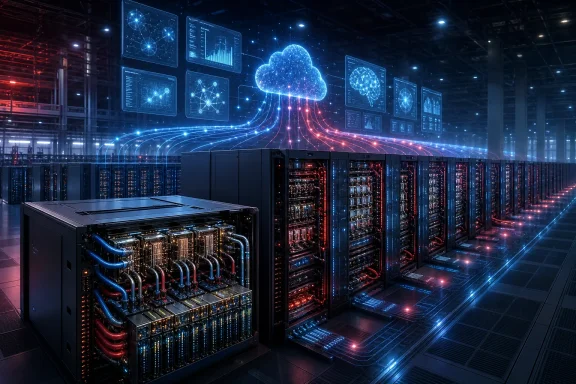 Overview: Helios Is AMD’s Attempt to Sell the Whole AI Factory
AMD Helios is best understood as a rack-scale AI platform, not as a single GPU product. Instead of asking cloud providers to assemble a cluster from separate accelerators, CPUs, networking equipment, software layers, cooling components, and management tools, AMD is packaging those elements into an integrated system designed for deployment at extreme scale.The core configuration combines:
- 72 AMD Instinct MI455X accelerators
- AMD EPYC “Venice” server processors
- AMD Pensando networking technology
- ROCm software
- High-speed scale-up and scale-out interconnects
- A liquid-cooled, open rack-oriented system design
That distinction is crucial. A hyperscaler can have access to leading silicon and still lose months to rack engineering, network tuning, firmware coordination, software validation, storage integration, and thermal constraints. AMD’s Helios strategy addresses that deployment challenge directly.
Rather than selling a collection of parts, AMD is attempting to offer an AI factory building block.
The Microsoft Azure Commitment Changes the Narrative
Microsoft’s announcement is significant because Azure is not merely adding another AMD virtual machine family. The company is integrating AMD’s latest AI and data-center technologies across several layers of its cloud infrastructure.The partnership covers:
- Helios rack-scale AI infrastructure for large-scale AI inference
- ND MI455X v7 virtual machines for production AI workloads
- EPYC Venice-powered Azure HDv2 VMs for data processing and AI pipelines
- EPYC Venice-powered HXv2 VMs for chip design and technical computing
- Broader deployment of Pensando DPUs in Azure networking infrastructure
- Integration work involving Azure Boost networking and storage acceleration
Why Azure Matters So Much
A public cloud provider must meet a higher operational bar than a company deploying hardware for internal use. Azure needs hardware that works consistently across customer environments, supports service-level expectations, fits into a large-scale network architecture, and can be exposed through cloud services without creating excessive operational complexity.That creates a powerful form of validation. Microsoft’s decision does not automatically prove that Helios will outperform every competing system in every workload. It does, however, signal that AMD’s hardware and software stack has reached a level of maturity where one of the largest cloud platforms is prepared to build services around it.
For AMD, that is especially important because its historical challenge in AI has not been a lack of ambitious hardware specifications. The harder question has been whether large customers would commit to AMD systems in visible, production-scale environments.
Microsoft’s answer appears to be yes.
A Broader Azure Portfolio, Not a One-Workload Bet
Microsoft is also taking a notably heterogeneous approach. Azure continues to invest in its own silicon, works with Nvidia, uses CPUs and accelerators from multiple suppliers, and is now expanding its use of AMD across AI and high-performance computing.That approach is logical. No single chip architecture is ideal for every workload.
- Large-model training demands enormous compute density and high-bandwidth communication.
- Inference requires efficient serving, predictable latency, and flexible scaling.
- Data preparation benefits from powerful CPUs, memory capacity, fast storage, and networking.
- Agentic AI adds orchestration, retrieval, tool use, search, reinforcement learning, and data-processing needs.
- Electronic design automation depends heavily on CPU performance, cache capacity, memory throughput, and licensing efficiency.
That philosophy could be beneficial to Windows-centric enterprises already using Azure for development, analytics, Microsoft Foundry services, identity, data platforms, and hybrid cloud operations. More infrastructure choice can improve procurement leverage, availability, and workload placement options.
What Helios Brings to the Rack
The technical headline is density. A Helios rack integrates 72 Instinct MI455X accelerators and roughly 31 TB of HBM4 memory across the system. AMD has also outlined aggregate memory bandwidth of approximately 1.4 PB/s for the rack.Those are extraordinary figures, but they require careful interpretation.
HBM4 Capacity Is About More Than a Bigger Number
High-bandwidth memory is central to modern AI infrastructure because large language models, multimodal models, retrieval systems, and inference workloads are often constrained by memory capacity and memory bandwidth rather than raw arithmetic throughput alone.A system with extensive HBM capacity can hold larger models, larger context windows, more concurrent sessions, or more model shards closer to the compute engines. That can reduce costly data movement and improve utilization.
For inference, memory matters because an AI service must repeatedly access model weights while generating outputs. For training, memory affects the size of models and batch configurations that can be handled efficiently. For agentic workloads, memory performance can influence the responsiveness of systems that combine model execution with search, retrieval, and orchestration.
The Helios configuration therefore addresses one of the central bottlenecks in AI infrastructure: keeping massive quantities of data moving quickly enough to feed the accelerators.
AI Exaflops Require Context
AMD has cited roughly 1.4 AI exaflops at FP8 precision and up to 2.9 AI exaflops at FP4 precision for a full Helios rack. These numbers are impressive, but they should never be read as a direct prediction of real-world application performance.Peak performance figures vary based on:
- Numeric precision
- Model architecture
- Batch size
- Sparsity assumptions
- Memory behavior
- Communication overhead
- Software maturity
- Kernel optimization
- Power limits
- Cooling conditions
- The ratio of compute to data movement
The most useful performance data will come later: independent benchmarks, cloud availability, model-serving measurements, throughput-per-dollar comparisons, latency tests, power-efficiency reports, and evidence from real customers running real production services.
The Rack Is the Product
The critical insight is that Helios is not only a compute platform. It is a response to the operational reality that AI clusters have become extremely difficult to build.A customer buying individual accelerators still has to solve a long list of problems:
- Select compatible CPUs, NICs, DPUs, storage, and switching equipment.
- Design the rack layout and cooling system.
- Validate firmware, drivers, management software, and security controls.
- Tune the network topology.
- Configure workload orchestration.
- Optimize model frameworks and software libraries.
- Qualify the system for continuous operation.
This is how AMD is seeking to compete with tightly integrated rack-scale offerings from Nvidia and with the increasingly customized AI systems being developed by major cloud companies. The contest has shifted from which GPU is faster to which platform can be installed, scaled, and operated most effectively.
Open Rack Design Could Be an Important Differentiator
Helios is aligned with an open rack approach based on the Open Rack Wide design associated with Meta’s Open Compute Project work. That matters because data-center customers often want more control over physical infrastructure, vendor selection, and long-term system evolution.An open design can offer several potential advantages:
- Greater flexibility for OEM and ODM partners
- More room for customized networking and cooling choices
- A less proprietary physical infrastructure model
- Easier alignment with hyperscaler data-center standards
- More competition among system builders
- Reduced risk of being locked into a single end-to-end supplier
AMD is trying to occupy a distinctive position: offering an integrated design while avoiding the perception that customers must accept a fully closed ecosystem.
That balance will be difficult to maintain. Customers want flexibility, but they also want a single party to take responsibility when an AI rack, driver stack, network fabric, or model-serving workflow fails. AMD’s ability to coordinate OEMs, cloud providers, networking partners, and the ROCm ecosystem will be just as important as the hardware specifications.
The Customer List Is Becoming a Strategic Asset
Microsoft joins a customer and partner picture that already includes major names connected to AMD’s next-generation AI roadmap, including Meta, OpenAI, and Oracle.The exact nature, scale, timing, and product configuration of those relationships differ. That distinction matters. A multi-generation agreement, an infrastructure commitment, a lead-customer role, and a public cloud deployment are not interchangeable terms.
Still, the collective picture is significant.
Oracle’s Large-Scale Deployment Plans
Oracle Cloud Infrastructure has announced plans to deploy a large AI supercluster based on AMD Instinct MI450-series GPUs, with an initial target involving tens of thousands of accelerators beginning in the second half of 2026.That is one of the more concrete signs that AMD’s rack-scale AI roadmap is connected to meaningful capacity plans rather than only conceptual product presentations.
Oracle’s role is especially important because it operates a public cloud and serves enterprise customers that want AI capacity without building their own data centers. If Oracle can successfully make AMD-powered AI capacity broadly available, it could strengthen AMD’s position in the cloud market and create another channel through which enterprises can access alternative AI infrastructure.
Meta and OpenAI Provide Ecosystem Credibility
Meta has influenced the physical design direction of Helios through the Open Rack Wide ecosystem and has also been tied to AMD’s broader server and AI roadmaps. OpenAI, meanwhile, represents the type of high-intensity AI customer that every accelerator supplier wants to win.The presence of these companies does not mean AMD has solved its software and execution challenges. It does mean AMD is no longer trying to persuade the market that it belongs in conversations about frontier AI infrastructure.
It is already in those conversations.
ROCm Is Still the Make-or-Break Software Story
Hardware alone does not determine success in the AI accelerator market. The software stack remains the central competitive battleground.Nvidia’s dominant position has been reinforced for years by CUDA, a mature ecosystem of libraries, frameworks, developer tools, optimized kernels, documentation, and trained engineering talent. AMD’s answer is ROCm, its open software platform for GPU computing and AI workloads.
Microsoft’s willingness to deploy Helios and expose MI455X-based infrastructure through Azure is a positive sign for ROCm’s progress. Cloud providers do not need a software stack to be perfect before deploying it, but they need enough confidence that customers can use it without excessive friction.
Where ROCm Has Improved
AMD has steadily expanded the scope of ROCm support, framework compatibility, optimization work, and enterprise tooling. The company’s strategy increasingly emphasizes the full stack: accelerator hardware, CPUs, networking, libraries, containers, model frameworks, and cloud deployment pathways.The benefits of this approach are clear:
- Developers gain more options beyond a single proprietary ecosystem.
- Cloud providers can use competitive pressure to negotiate better terms.
- Enterprises may gain better price-performance alternatives.
- Open-source AI projects can potentially optimize across more hardware targets.
- Hardware innovation is less constrained by one vendor’s platform dominance.
The Remaining Risks
ROCm still faces a steep challenge. Compatibility is not the same as parity, and broad framework support is not the same as having every high-value workload perfectly optimized on day one.Potential users will be watching for:
- Ease of migrating CUDA-based code
- Availability of optimized kernels
- Reliability of framework releases
- Debugging and profiling quality
- Documentation depth
- Model-serving performance
- Third-party application support
- Enterprise support responsiveness
- Developer familiarity
- Long-term platform stability
AMD’s challenge is therefore not only to make ROCm better. It must make switching feel safe.
Venice Adds CPU Strength to AMD’s Full-Stack Argument
The Helios story is heavily focused on accelerators, but AMD’s 6th Generation EPYC “Venice” processors may be equally important to the broader data-center strategy.Venice is based on AMD’s Zen 6 architecture and is ramping on TSMC’s advanced 2 nm process technology. AMD has positioned it as a major CPU platform for cloud, enterprise, high-performance computing, and AI infrastructure.
The timing matters. AI infrastructure depends on far more than GPUs.
CPUs handle critical tasks involving:
- Data preparation
- Storage coordination
- Networking
- Scheduling
- Security
- Service orchestration
- Search pipelines
- Retrieval systems
- Simulation
- Pre- and post-processing
- Virtualization and cloud fleet management
A Two-Front Data-Center Competition
AMD is effectively competing on two fronts:- AI accelerators and rack-scale systems against Nvidia and custom cloud silicon.
- Server CPUs against Intel and Arm-based alternatives.
That does not mean every buyer will choose a single-vendor design. Many hyperscalers deliberately diversify suppliers. But AMD’s ability to offer a more complete stack makes it easier for customers to consider the company as a strategic infrastructure partner rather than merely a component vendor.
MI500’s 1,000x Claim Needs a Disciplined Reading
AMD has also pointed toward the MI500 generation, expected in 2027, with CDNA 6 architecture, 2 nm process technology, HBM4E memory, and a claim of up to a 1,000x increase in AI performance versus the MI300X platform.That headline should be treated with appropriate caution.
The comparison is a vendor engineering projection based on specific assumptions. It is not a universal measurement that applies equally to every model, every precision format, every deployment, or every customer workload.
A thousandfold claim may combine several years of architectural improvements, larger rack-scale configurations, precision changes, software improvements, and platform-level scaling. It should not be interpreted as a promise that an MI500 GPU will make every AI task run 1,000 times faster than an MI300X GPU.
The useful takeaway is more strategic: AMD is signaling that it intends to maintain an aggressive annual AI accelerator roadmap, rather than treating MI400 and Helios as a one-off response to market pressure.
That roadmap credibility matters. Hyperscalers make capital decisions years in advance. They need to know not only what is shipping next quarter, but what platform they will be able to scale through the next generation of models.
What the Stock Snapshot Does and Does Not Prove
The supplied market snapshot places AMD around $553.22, roughly 17% below a prior high. However, a single intraday figure should not be treated as a definitive measurement of valuation or a complete investment case. Reported regular-session data for July 22 placed the stock near that range, but price movement alone says little about whether Helios will translate into durable revenue and profitability.The more useful question is whether AMD can convert announced demand into recognized sales, installed systems, cloud services, and repeat orders.
Several milestones deserve attention:
- Helios customer shipments beginning in the second half of 2026
- Azure availability of MI455X-based AI infrastructure
- The scale of Microsoft’s actual deployment
- Oracle’s planned MI450-series capacity rollout
- Evidence of broader cloud and enterprise adoption
- ROCm software maturity in real production environments
- AMD data-center revenue growth and margins
- Supply-chain execution for HBM4, advanced packaging, and liquid-cooled systems
A rack-scale AI system can generate substantial revenue per deployment, but it also introduces substantial operational and supply-chain complexity. Advanced packaging capacity, high-bandwidth memory availability, power density, cooling infrastructure, networking equipment, and customer acceptance all become potential constraints.
Risks AMD Still Has to Navigate
The Microsoft Azure commitment is a major achievement, but it does not remove AMD’s competitive risks.Nvidia’s Ecosystem Advantage Remains Enormous
Nvidia remains the benchmark against which accelerator platforms are judged. Its installed base, developer ecosystem, software maturity, customer relationships, networking capabilities, and pace of product delivery give it formidable advantages.AMD can win meaningful share without overtaking Nvidia. But it must demonstrate that its systems can deliver compelling cost, performance, availability, and software usability in the workloads customers actually care about.
Hyperscaler Commitments Can Be Fluid
Cloud providers often announce long-term partnerships, but deployment schedules, order volumes, internal workload priorities, and capital budgets can change. A public commitment to deploy a platform does not disclose how many racks will be installed, how quickly capacity will come online, or how much revenue AMD will recognize in a given quarter.Microsoft’s deployment is a strong validation event. It is not, by itself, a revenue forecast.
Rack-Scale Complexity Raises the Stakes
Selling chips is difficult. Selling complete rack-scale infrastructure is harder.AMD must coordinate silicon production, memory supply, advanced packaging, OEM assembly, cooling, networking, software, logistics, installation, and support. Every layer is a possible bottleneck.
The integrated-system strategy can create higher-value opportunities, but it also means delivery delays or interoperability problems may have a greater impact than they would for a standalone GPU launch.
Peak AI Performance Is Not Customer Experience
The industry will scrutinize Helios not only for theoretical exaflops, but for practical results:- Tokens per second
- Tokens per dollar
- Tokens per watt
- Time to train
- Cluster uptime
- Inference latency
- Multi-node scaling
- Framework compatibility
- Developer productivity
- Ease of deployment
The Bottom Line: AMD Has Earned a Bigger Place in the AI Infrastructure Debate
AMD’s Helios announcement is more important than a conventional accelerator refresh. It marks the company’s effort to become a full-stack supplier of AI infrastructure, from server CPUs and GPUs to networking, software, and rack-scale systems.Microsoft’s decision to deploy Helios on Azure is the defining validation point. It gives AMD a high-profile cloud platform for its MI455X accelerators, strengthens confidence in the company’s broader software and systems strategy, and expands the competitive options available to enterprise AI customers.
The underlying hardware specifications are formidable: 72 accelerators per rack, approximately 31 TB of HBM4 memory, massive aggregate bandwidth, and multi-exaflop AI compute targets. But the real test will not be the specification sheet. It will be whether Azure customers can access the platform smoothly, whether ROCm supports their software needs, and whether Helios can be deployed at scale without compromising cost, reliability, or time to service.
Venice adds another dimension to the story. By pairing next-generation EPYC CPUs with its AI accelerators and networking portfolio, AMD is presenting a coherent infrastructure roadmap rather than a narrow GPU bet. That could prove increasingly valuable as AI workloads spread across inference, search, agents, data pipelines, simulation, and enterprise cloud services.
AMD is still operating under the shadow of Nvidia’s vast AI ecosystem advantage, and ambitious future performance claims should be read carefully. Yet Helios and the Azure agreement show that AMD is no longer defined solely by potential. The company now has a more credible route to turning its AI roadmap into deployed, customer-facing infrastructure at hyperscale.
References
- Primary source: Phemex
Published: 2026-07-23T04:43:05.314000+00:00
Loading…
phemex.com