

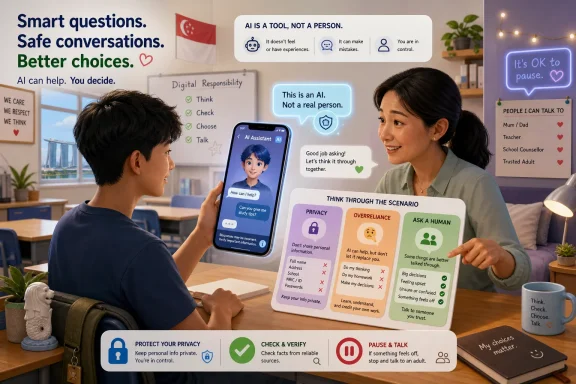
Microsoft launched Behind The Chat: A Human Guide to Safe AI Conversations in Singapore on June 25, 2026, offering scenario-based digital safety resources for teenagers, parents, caregivers, and educators navigating AI companions and chatbots. The release is small compared with Microsoft’s platform announcements, but it says something larger about where the AI debate is moving. After two years of treating artificial intelligence as a productivity revolution, the industry is beginning to concede that the social contract around chatbots will be written in classrooms, bedrooms, and family conversations as much as in datacenters. Microsoft’s new guide is not just a safety handout; it is an attempt to define what responsible AI literacy should mean before habits harden.
The most revealing thing about Behind The Chat is not that Microsoft is warning teens about chatbots. It is that Microsoft is framing those warnings as part of AI literacy rather than as a separate “online safety” annex. That distinction matters, because it rejects the convenient idea that young people can first learn to use AI and later learn how not to be harmed by it.
For years, digital literacy programs chased the last platform shift. Schools taught password hygiene after breaches became routine, cyberbullying awareness after social media had remade adolescence, and misinformation spotting after feeds had already become political infrastructure. Generative AI is forcing a faster response because the tool is not merely a place where teens gather. It talks back, remembers context, simulates empathy, and rewards disclosure.
Microsoft’s guide, developed with Cyberlite and supported by Singapore’s Infocomm Media Development Authority through its Digital for Life movement, is built around fictional teen scenarios. That sounds modest, even old-fashioned. But the scenario format is also a recognition that AI safety cannot be reduced to a settings page.
A chatbot interaction is not like clicking a suspicious link. It is a conversation, and conversations blur categories. A teen may start with homework help, drift into friendship anxiety, ask for advice on family conflict, and then reveal personal information because the machine appears patient, private, and nonjudgmental. The risk is not one bad prompt. The risk is the habit.
The students’ ranking of AI’s usefulness is especially important. Across the cohort, teens reportedly saw “completing tasks faster” as AI’s top benefit, while emotional support ranked last across countries and age groups. In other words, the teenagers in Microsoft’s research were not asking for a synthetic best friend. They were asking for leverage.
That should be reassuring, but only up to a point. Productivity use is often the front door to deeper dependency. A tool that helps draft a paragraph can become a tool that decides whether an argument is worth making; a tool that summarizes a reading can become a tool that substitutes for reading; a tool that suggests what to say to a friend can become a quiet arbiter of social judgment.
This is why the workshops’ concern about overreliance lands harder than the usual “AI may be inaccurate” warning. A third of participants worried that heavy AI use could cause young people to “stop thinking for themselves,” according to Microsoft’s summary. That is not a technical critique of hallucination. It is a cognitive critique of outsourcing.
The students were identifying the same problem many adults still avoid naming: the most durable AI risk for everyday users may not be that the machine is wrong, but that it is useful enough to make independent judgment feel inefficient.
The appeal is obvious. Adolescence is full of questions that feel too embarrassing, too messy, or too repetitive to ask another person. A chatbot does not roll its eyes. It does not interrupt. It does not gossip in the cafeteria, or appear disappointed, or tell a parent.
But “nonjudgmental” is not the same thing as safe. A system can feel private while being logged, analyzed, retained, reviewed, or used to shape future outputs. Even when a service has strong privacy commitments, the teen’s experience of disclosure is psychologically different from the architecture that governs the data.
That gap is where safety education has to operate. Telling teens “do not overshare” is unlikely to work when the entire interface is optimized for a relaxed, conversational rhythm. A more realistic approach is to teach them to notice when a tool is inviting intimacy, when a prompt crosses into personal vulnerability, and when a real person should replace the machine.
Microsoft’s fictional scenarios are designed to create distance: students can discuss what a character should do without admitting what they themselves have done. That is a smart pedagogical move. Shame kills disclosure, and safety education that feels like surveillance tends to produce better hiding rather than better judgment.
That distinction matters less to teens than adults may assume. A product does not need to market itself as a companion to be used as one. If it answers at midnight, remembers the last message, mirrors tone, and responds with warmth, it can become emotionally salient even when its official label is “assistant.”
This is the uncomfortable part for Microsoft and every other AI vendor. The more natural, helpful, and emotionally fluent these systems become, the harder it is to maintain a clean line between utility and attachment. The industry sells conversational AI by promising frictionless interaction. Then it asks users not to mistake frictionless interaction for relationship.
Behind The Chat appears to understand that contradiction better than many corporate safety campaigns. Its themes include privacy and oversharing, dependency and decision-making, emotional attachment, and critical evaluation of AI outputs. Those are not edge cases. They are the ordinary failure modes of a technology designed to be conversational.
The danger is not that every teen will fall in love with a chatbot. The danger is that millions of small acts of reliance will become invisible: asking the bot what to think, how to feel, whether to apologize, whether a friend is wrong, whether a fear is reasonable. At that point the tool is no longer merely producing text. It is participating in judgment formation.
That does not make Behind The Chat cynical. It does make it strategic. Educational resources are part of the trust layer around AI adoption, especially in markets where governments are trying to build digital capability without importing the worst habits of platform capitalism.
Singapore is a telling venue. The city-state has long treated digital competency as a national capability, and IMDA’s Digital for Life movement fits a governance model that sees public education, industry partnership, and citizen resilience as intertwined. Microsoft’s collaboration with Cyberlite and IMDA places the guide inside that civic framing rather than presenting it as a standalone corporate brochure.
Still, users should read the move with both appreciation and skepticism. It is good that Microsoft is investing in teen-facing AI safety materials shaped by youth input. It is also true that the company benefits when AI use is treated as inevitable and the debate shifts from “should young people use this?” to “how can they use this well?”
That is the familiar platform bargain, updated for generative AI. The vendor offers tools, training, and safeguards. Society accepts the platform’s presence and asks for better guardrails. The hard question is whether the guardrails are strong enough when the business logic still rewards deeper engagement.
A teen can spend ten minutes with an AI tool and reveal more than they would in two hours on a video app. Another teen can use a chatbot for homework without cheating, or cheat without copying, or learn more effectively than they would from a worksheet. Duration is a poor proxy for risk, and traditional plagiarism detection is a poor proxy for learning.
That is why conversation starters matter. Adults need ways to ask about AI use without sounding punitive or clueless. “Did you use AI?” is a dead-end question. “What did the AI help you decide?” is better. “What did you check against another source?” is better still. “Was there anything you asked it because you did not want to ask a person?” is the question many families and schools will find hardest, and perhaps the one most worth asking.
Educators face a parallel challenge. If AI safety is treated only as a compliance module, students will tune it out. If it is integrated into writing, research, citizenship, mental health, and computing curricula, it becomes part of how students learn to reason. Behind The Chat’s scenario approach gives teachers a way to discuss messy situations without turning the classroom into a confession booth.
The deeper pedagogical shift is from detection to discernment. Schools have spent much of the generative AI era trying to determine whether students used AI. The more important task is teaching students to explain how they used it, why they trusted or rejected it, and where human judgment had to take over.
Copilot is already positioned across Windows and Microsoft 365 as an ambient assistant rather than a single destination. That matters because safety guidance built for a chatbot website may not map neatly onto a future where AI appears inside Word, Edge, Teams, Outlook, Paint, Settings, and classroom platforms. The interface becomes less like “going to an AI” and more like computing with AI always nearby.
For administrators, the lesson is that policy cannot stop at blocking a category of websites. AI features are being embedded into sanctioned tools. Schools and enterprises will need governance that covers account controls, data boundaries, retention, auditing, age-appropriate access, and user education. The old shadow IT problem is becoming a shadow cognition problem: users may follow approved workflows while silently outsourcing decisions they do not know how to defend.
The guide’s emphasis on critical thinking is therefore not soft language. It is an operational requirement. An employee who cannot evaluate AI output is a security risk, a compliance risk, and a quality risk. A student who cannot do so is simply an earlier version of the same problem.
This is where Microsoft’s youth safety project intersects with its enterprise ambitions. The company wants AI to become ordinary infrastructure. Ordinary infrastructure requires ordinary people to understand its failure modes. Behind The Chat is a small attempt to teach those failure modes before they become workplace incidents.
The abstraction gap is enormous. A model may be safer in aggregate and still produce a bad interaction at the wrong moment. A platform may have privacy settings and still be misunderstood by the user. A chatbot may refuse the most dangerous requests and still encourage subtle dependency through tone, availability, and personalization.
Behind The Chat implicitly admits that responsibility has to be socialized, not merely engineered. The user must learn. The parent must learn. The teacher must learn. The institution must learn. That is a less glamorous story than model capability, but it is probably the story that determines whether AI becomes a durable public good or another platform crisis managed after the fact.
There is also a regulatory subtext. Governments are increasingly attentive to children’s online safety, age-appropriate design, algorithmic harms, and AI governance. Companies that can demonstrate youth consultation, educational investment, and public-sector partnership are better positioned in that environment. Microsoft is not just educating users; it is documenting a posture.
That posture will be tested. Educational resources are easy to praise and hard to measure. The real questions are whether teens change behavior, whether parents use the materials, whether teachers have time to integrate them, and whether product teams internalize the same lessons the guide teaches.
If a chatbot is built to maximize engagement, it will tend to reward continued disclosure. If it uses anthropomorphic cues too aggressively, it will invite attachment. If its privacy explanations are buried in legal language, teens will not understand the trade. If it appears inside school tools without clear boundaries, students may assume it has institutional endorsement for uses the school never intended.
The healthiest version of AI literacy is paired with product restraint. That means age-aware defaults, clear data practices, friction around sensitive disclosures, escalation paths toward human support, and user interfaces that do not pretend the machine has feelings. It also means administrators need controls that are understandable enough to use before a crisis.
Microsoft knows this. Its broader responsible AI messaging regularly emphasizes safety by design, governance, transparency, and human oversight. Behind The Chat translates that language into a teen context, but translation is not implementation. The company’s credibility will depend on whether the products young people actually use reflect the same caution.
There is a danger that AI safety education becomes the new privacy policy: a ritual disclosure that shifts liability without changing much behavior. The better outcome is that resources like this create demand for safer defaults. Once students, parents, and teachers can name the risks, they can ask sharper questions of the tools themselves.
The regional context also matters because AI safety conversations can look different outside Silicon Valley. In many education systems, the priority is not whether AI should exist in learning environments at all, but how quickly institutions can prepare students for a world where it already does. The question becomes less ideological and more practical: what should a 13-year-old know before treating a chatbot as a study partner?
Behind The Chat’s answer is that teens should know AI can be useful without being authoritative, responsive without being trustworthy, and comforting without being a substitute for care. That is a compact but demanding curriculum. It asks young people to hold two truths at once: the tool may help them, and the tool may distort their habits if used uncritically.
This is why the guide belongs in the same conversation as cybersecurity education. A generation ago, students learned not to download unknown attachments. Then they learned not to post every detail of their lives on social media. Now they must learn how to maintain intellectual and emotional boundaries with systems designed to converse.
That is not merely a personal skill. It is civic infrastructure. Societies that fail to teach it will produce users who are easier to manipulate, workers who are less able to audit automation, and citizens less equipped to distinguish persuasion from assistance.
Restraint is difficult to teach because it feels like inefficiency. If a chatbot can answer instantly, why struggle? If it can draft a message, why sit with discomfort? If it can offer reassurance, why risk a human response? The answer is that some forms of struggle are not bugs in adolescence. They are the process by which judgment develops.
That does not mean romanticizing frustration or banning tools. A calculator does not destroy mathematics education when students understand what it is doing and when mental or conceptual work is still required. AI is harder because it does not merely compute; it explains, persuades, and performs confidence. It can make dependence feel like fluency.
The “loss of critical thinking” concern raised by students is therefore not a moral panic. It is the natural consequence of a tool that reduces cognitive friction across many domains at once. The danger is not that teens will never think. It is that they will practice thinking less often in the moments when practice matters.
A good AI safety curriculum should teach refusal as a skill. Not only how to refuse harmful chatbot suggestions, but how to refuse convenience when convenience would weaken understanding. That is a more mature message than “AI is the future.” It says AI is part of the future, and so is the discipline to leave it unused.
That makes traditional supervision weaker. A parent can glance at a public profile or a video feed and get some sense of what is happening. A chatbot conversation may be private, ephemeral, context-heavy, and emotionally nuanced. Even when logs exist, reviewing them can feel invasive and may discourage teens from seeking help elsewhere.
The better model is not total monitoring. It is shared vocabulary. Teens need words for oversharing, dependency, manipulation, hallucination, emotional attachment, and human escalation. Parents and teachers need those words too. Behind The Chat’s contribution is to make that vocabulary less abstract.
But vocabulary is only the beginning. If conversational AI becomes as common as search, then every institution that serves young people will need policies for it. Schools will need to decide when AI assistance is allowed, when it must be disclosed, and when it undermines learning. Families will need norms around sensitive topics. Vendors will need to prove that teen safety is not a marketing page.
Microsoft’s announcement does not solve those problems. It does, however, mark a shift in what major AI companies believe they must be seen addressing. The frontier is no longer only model capability. It is the everyday psychology of use.
That is a useful corrective to the industry’s automation fever. The past few years have been dominated by promises that AI will remove friction, accelerate work, and personalize everything. For teens, some friction is protective. Waiting to ask a trusted adult, wrestling with a decision, checking a claim, or choosing not to disclose a private detail can all be signs of healthy development.
Parents and educators should resist the temptation to turn this into another lecture about screen danger. The teens in Microsoft’s workshops were not clueless. They saw the productivity upside, identified the cognitive risk, and understood why someone might confide in a machine. The adult role is not to sneer at their tools, but to help them build boundaries around tools that are intentionally boundary-blurring.
The strongest part of Microsoft’s approach is the recognition that young people should help shape the guidance they receive. Resources built with teens are more likely to respect the reality of their use. They are also more likely to avoid the patronizing tone that makes safety advice sound like it was written for a previous internet.
 Microsoft Moves the AI Safety Fight From the Model Lab to the Classroom
The most revealing thing about Behind The Chat is not that Microsoft is warning teens about chatbots. It is that Microsoft is framing those warnings as part of AI literacy rather than as a separate “online safety” annex. That distinction matters, because it rejects the convenient idea that young people can first learn to use AI and later learn how not to be harmed by it.For years, digital literacy programs chased the last platform shift. Schools taught password hygiene after breaches became routine, cyberbullying awareness after social media had remade adolescence, and misinformation spotting after feeds had already become political infrastructure. Generative AI is forcing a faster response because the tool is not merely a place where teens gather. It talks back, remembers context, simulates empathy, and rewards disclosure.
Microsoft’s guide, developed with Cyberlite and supported by Singapore’s Infocomm Media Development Authority through its Digital for Life movement, is built around fictional teen scenarios. That sounds modest, even old-fashioned. But the scenario format is also a recognition that AI safety cannot be reduced to a settings page.
A chatbot interaction is not like clicking a suspicious link. It is a conversation, and conversations blur categories. A teen may start with homework help, drift into friendship anxiety, ask for advice on family conflict, and then reveal personal information because the machine appears patient, private, and nonjudgmental. The risk is not one bad prompt. The risk is the habit.
The Teens in the Study Were Not the Naïve Users Adults Expected
The launch is grounded in youth co-design workshops with 131 students aged 12 to 18 across nine schools in Singapore and India. Microsoft says those workshops found that young people were already thinking critically about AI companionship, including risks around overreliance, privacy, and emotional manipulation. That finding cuts against a lazy adult narrative in which teens are simply dazzled by whatever the latest interface offers.The students’ ranking of AI’s usefulness is especially important. Across the cohort, teens reportedly saw “completing tasks faster” as AI’s top benefit, while emotional support ranked last across countries and age groups. In other words, the teenagers in Microsoft’s research were not asking for a synthetic best friend. They were asking for leverage.
That should be reassuring, but only up to a point. Productivity use is often the front door to deeper dependency. A tool that helps draft a paragraph can become a tool that decides whether an argument is worth making; a tool that summarizes a reading can become a tool that substitutes for reading; a tool that suggests what to say to a friend can become a quiet arbiter of social judgment.
This is why the workshops’ concern about overreliance lands harder than the usual “AI may be inaccurate” warning. A third of participants worried that heavy AI use could cause young people to “stop thinking for themselves,” according to Microsoft’s summary. That is not a technical critique of hallucination. It is a cognitive critique of outsourcing.
The students were identifying the same problem many adults still avoid naming: the most durable AI risk for everyday users may not be that the machine is wrong, but that it is useful enough to make independent judgment feel inefficient.
The Privacy Paradox Starts With the Absence of Judgment
Behind The Chat also focuses on what Microsoft calls the privacy paradox around teen use of AI. Fifty-nine percent of workshop participants said someone their age might open up to AI because it does not judge them. That single data point may be the emotional center of the whole project.The appeal is obvious. Adolescence is full of questions that feel too embarrassing, too messy, or too repetitive to ask another person. A chatbot does not roll its eyes. It does not interrupt. It does not gossip in the cafeteria, or appear disappointed, or tell a parent.
But “nonjudgmental” is not the same thing as safe. A system can feel private while being logged, analyzed, retained, reviewed, or used to shape future outputs. Even when a service has strong privacy commitments, the teen’s experience of disclosure is psychologically different from the architecture that governs the data.
That gap is where safety education has to operate. Telling teens “do not overshare” is unlikely to work when the entire interface is optimized for a relaxed, conversational rhythm. A more realistic approach is to teach them to notice when a tool is inviting intimacy, when a prompt crosses into personal vulnerability, and when a real person should replace the machine.
Microsoft’s fictional scenarios are designed to create distance: students can discuss what a character should do without admitting what they themselves have done. That is a smart pedagogical move. Shame kills disclosure, and safety education that feels like surveillance tends to produce better hiding rather than better judgment.
AI Companions Are Different Because They Simulate Care at Scale
The phrase “AI companion” still sounds slightly futuristic, but the behavior is already mainstream. General-purpose chatbots have become tutors, brainstorming partners, planners, coding assistants, writing coaches, and confessional boxes. Purpose-built companion apps go further, explicitly presenting themselves as friends, romantic partners, mentors, or always-available listeners.That distinction matters less to teens than adults may assume. A product does not need to market itself as a companion to be used as one. If it answers at midnight, remembers the last message, mirrors tone, and responds with warmth, it can become emotionally salient even when its official label is “assistant.”
This is the uncomfortable part for Microsoft and every other AI vendor. The more natural, helpful, and emotionally fluent these systems become, the harder it is to maintain a clean line between utility and attachment. The industry sells conversational AI by promising frictionless interaction. Then it asks users not to mistake frictionless interaction for relationship.
Behind The Chat appears to understand that contradiction better than many corporate safety campaigns. Its themes include privacy and oversharing, dependency and decision-making, emotional attachment, and critical evaluation of AI outputs. Those are not edge cases. They are the ordinary failure modes of a technology designed to be conversational.
The danger is not that every teen will fall in love with a chatbot. The danger is that millions of small acts of reliance will become invisible: asking the bot what to think, how to feel, whether to apologize, whether a friend is wrong, whether a fear is reasonable. At that point the tool is no longer merely producing text. It is participating in judgment formation.
Microsoft Is Selling Responsibility While Expanding the Market
There is a corporate tension running through the launch that should not be ignored. Microsoft is one of the companies most responsible for pushing generative AI into schools, offices, operating systems, search, and productivity software. It has every incentive to normalize early AI use while assuring parents, teachers, and regulators that the normalization is safe.That does not make Behind The Chat cynical. It does make it strategic. Educational resources are part of the trust layer around AI adoption, especially in markets where governments are trying to build digital capability without importing the worst habits of platform capitalism.
Singapore is a telling venue. The city-state has long treated digital competency as a national capability, and IMDA’s Digital for Life movement fits a governance model that sees public education, industry partnership, and citizen resilience as intertwined. Microsoft’s collaboration with Cyberlite and IMDA places the guide inside that civic framing rather than presenting it as a standalone corporate brochure.
Still, users should read the move with both appreciation and skepticism. It is good that Microsoft is investing in teen-facing AI safety materials shaped by youth input. It is also true that the company benefits when AI use is treated as inevitable and the debate shifts from “should young people use this?” to “how can they use this well?”
That is the familiar platform bargain, updated for generative AI. The vendor offers tools, training, and safeguards. Society accepts the platform’s presence and asks for better guardrails. The hard question is whether the guardrails are strong enough when the business logic still rewards deeper engagement.
The Guide’s Real Audience Is Adults Who Are Behind the Curve
Although Behind The Chat is aimed at teens, the supporting materials for parents and educators may be the more consequential piece. Adults are often the weak link in youth technology governance, not because they do not care, but because they lack a usable mental model. Many parents understand screen time as a quantity problem. Many teachers understand AI as an academic integrity problem. Chatbots scramble both frames.A teen can spend ten minutes with an AI tool and reveal more than they would in two hours on a video app. Another teen can use a chatbot for homework without cheating, or cheat without copying, or learn more effectively than they would from a worksheet. Duration is a poor proxy for risk, and traditional plagiarism detection is a poor proxy for learning.
That is why conversation starters matter. Adults need ways to ask about AI use without sounding punitive or clueless. “Did you use AI?” is a dead-end question. “What did the AI help you decide?” is better. “What did you check against another source?” is better still. “Was there anything you asked it because you did not want to ask a person?” is the question many families and schools will find hardest, and perhaps the one most worth asking.
Educators face a parallel challenge. If AI safety is treated only as a compliance module, students will tune it out. If it is integrated into writing, research, citizenship, mental health, and computing curricula, it becomes part of how students learn to reason. Behind The Chat’s scenario approach gives teachers a way to discuss messy situations without turning the classroom into a confession booth.
The deeper pedagogical shift is from detection to discernment. Schools have spent much of the generative AI era trying to determine whether students used AI. The more important task is teaching students to explain how they used it, why they trusted or rejected it, and where human judgment had to take over.
The Windows Angle Is Bigger Than Another Microsoft Education Project
For WindowsForum readers, this may look at first like a regional Microsoft education announcement rather than a Windows story. That would be too narrow. Microsoft’s AI strategy increasingly collapses the distance between operating system, productivity suite, cloud identity, browser, search, and assistant. Teen AI habits formed today will become workplace AI habits tomorrow, and many of those habits will run through Microsoft-controlled surfaces.Copilot is already positioned across Windows and Microsoft 365 as an ambient assistant rather than a single destination. That matters because safety guidance built for a chatbot website may not map neatly onto a future where AI appears inside Word, Edge, Teams, Outlook, Paint, Settings, and classroom platforms. The interface becomes less like “going to an AI” and more like computing with AI always nearby.
For administrators, the lesson is that policy cannot stop at blocking a category of websites. AI features are being embedded into sanctioned tools. Schools and enterprises will need governance that covers account controls, data boundaries, retention, auditing, age-appropriate access, and user education. The old shadow IT problem is becoming a shadow cognition problem: users may follow approved workflows while silently outsourcing decisions they do not know how to defend.
The guide’s emphasis on critical thinking is therefore not soft language. It is an operational requirement. An employee who cannot evaluate AI output is a security risk, a compliance risk, and a quality risk. A student who cannot do so is simply an earlier version of the same problem.
This is where Microsoft’s youth safety project intersects with its enterprise ambitions. The company wants AI to become ordinary infrastructure. Ordinary infrastructure requires ordinary people to understand its failure modes. Behind The Chat is a small attempt to teach those failure modes before they become workplace incidents.
The Industry Is Learning That “Responsible AI” Cannot Stay Abstract
For much of the generative AI boom, responsible AI has been expressed in the language of model cards, red-teaming, benchmark evaluations, content filters, and policy frameworks. Those remain necessary. They are also insufficient for a teenager deciding whether to tell a chatbot about loneliness, family conflict, academic pressure, or a secret they are afraid to share.The abstraction gap is enormous. A model may be safer in aggregate and still produce a bad interaction at the wrong moment. A platform may have privacy settings and still be misunderstood by the user. A chatbot may refuse the most dangerous requests and still encourage subtle dependency through tone, availability, and personalization.
Behind The Chat implicitly admits that responsibility has to be socialized, not merely engineered. The user must learn. The parent must learn. The teacher must learn. The institution must learn. That is a less glamorous story than model capability, but it is probably the story that determines whether AI becomes a durable public good or another platform crisis managed after the fact.
There is also a regulatory subtext. Governments are increasingly attentive to children’s online safety, age-appropriate design, algorithmic harms, and AI governance. Companies that can demonstrate youth consultation, educational investment, and public-sector partnership are better positioned in that environment. Microsoft is not just educating users; it is documenting a posture.
That posture will be tested. Educational resources are easy to praise and hard to measure. The real questions are whether teens change behavior, whether parents use the materials, whether teachers have time to integrate them, and whether product teams internalize the same lessons the guide teaches.
Safety Materials Cannot Substitute for Safer Products
The most important limitation of Behind The Chat is also the most obvious: guidance places responsibility on the user. That is appropriate up to a point. Young people should learn not to overshare, not to outsource thinking, and not to treat AI as a replacement for human care. But no amount of literacy can absolve platforms from designing systems that reduce foreseeable harm.If a chatbot is built to maximize engagement, it will tend to reward continued disclosure. If it uses anthropomorphic cues too aggressively, it will invite attachment. If its privacy explanations are buried in legal language, teens will not understand the trade. If it appears inside school tools without clear boundaries, students may assume it has institutional endorsement for uses the school never intended.
The healthiest version of AI literacy is paired with product restraint. That means age-aware defaults, clear data practices, friction around sensitive disclosures, escalation paths toward human support, and user interfaces that do not pretend the machine has feelings. It also means administrators need controls that are understandable enough to use before a crisis.
Microsoft knows this. Its broader responsible AI messaging regularly emphasizes safety by design, governance, transparency, and human oversight. Behind The Chat translates that language into a teen context, but translation is not implementation. The company’s credibility will depend on whether the products young people actually use reflect the same caution.
There is a danger that AI safety education becomes the new privacy policy: a ritual disclosure that shifts liability without changing much behavior. The better outcome is that resources like this create demand for safer defaults. Once students, parents, and teachers can name the risks, they can ask sharper questions of the tools themselves.
The Lesson From Singapore Is That AI Literacy Has Become Civic Infrastructure
Singapore and India are not incidental to the research design. Both are societies where education, technology adoption, and economic competitiveness are tightly linked, and both contain young populations whose AI habits will shape future labor markets. By grounding the resources in workshops across schools in those countries, Microsoft is gesturing toward a global AI literacy challenge rather than a narrow U.S. platform debate.The regional context also matters because AI safety conversations can look different outside Silicon Valley. In many education systems, the priority is not whether AI should exist in learning environments at all, but how quickly institutions can prepare students for a world where it already does. The question becomes less ideological and more practical: what should a 13-year-old know before treating a chatbot as a study partner?
Behind The Chat’s answer is that teens should know AI can be useful without being authoritative, responsive without being trustworthy, and comforting without being a substitute for care. That is a compact but demanding curriculum. It asks young people to hold two truths at once: the tool may help them, and the tool may distort their habits if used uncritically.
This is why the guide belongs in the same conversation as cybersecurity education. A generation ago, students learned not to download unknown attachments. Then they learned not to post every detail of their lives on social media. Now they must learn how to maintain intellectual and emotional boundaries with systems designed to converse.
That is not merely a personal skill. It is civic infrastructure. Societies that fail to teach it will produce users who are easier to manipulate, workers who are less able to audit automation, and citizens less equipped to distinguish persuasion from assistance.
The Hardest Part Is Teaching Teens When Not to Use the Tool
Most AI education still begins from usefulness. Here is how to prompt. Here is how to summarize. Here is how to brainstorm. Here is how to code, revise, translate, plan, and study faster. Behind The Chat is more interesting because its center of gravity is restraint.Restraint is difficult to teach because it feels like inefficiency. If a chatbot can answer instantly, why struggle? If it can draft a message, why sit with discomfort? If it can offer reassurance, why risk a human response? The answer is that some forms of struggle are not bugs in adolescence. They are the process by which judgment develops.
That does not mean romanticizing frustration or banning tools. A calculator does not destroy mathematics education when students understand what it is doing and when mental or conceptual work is still required. AI is harder because it does not merely compute; it explains, persuades, and performs confidence. It can make dependence feel like fluency.
The “loss of critical thinking” concern raised by students is therefore not a moral panic. It is the natural consequence of a tool that reduces cognitive friction across many domains at once. The danger is not that teens will never think. It is that they will practice thinking less often in the moments when practice matters.
A good AI safety curriculum should teach refusal as a skill. Not only how to refuse harmful chatbot suggestions, but how to refuse convenience when convenience would weaken understanding. That is a more mature message than “AI is the future.” It says AI is part of the future, and so is the discipline to leave it unused.
The Small Guide Points to a Much Larger Platform Reckoning
Behind The Chat arrives at a moment when the public conversation about teen technology is shifting from content moderation to relationship moderation. Social networks raised questions about exposure, comparison, harassment, and virality. AI companions raise questions about intimacy, reliance, simulated empathy, and private persuasion. The harms are less visible to outsiders because they happen inside a conversational loop.That makes traditional supervision weaker. A parent can glance at a public profile or a video feed and get some sense of what is happening. A chatbot conversation may be private, ephemeral, context-heavy, and emotionally nuanced. Even when logs exist, reviewing them can feel invasive and may discourage teens from seeking help elsewhere.
The better model is not total monitoring. It is shared vocabulary. Teens need words for oversharing, dependency, manipulation, hallucination, emotional attachment, and human escalation. Parents and teachers need those words too. Behind The Chat’s contribution is to make that vocabulary less abstract.
But vocabulary is only the beginning. If conversational AI becomes as common as search, then every institution that serves young people will need policies for it. Schools will need to decide when AI assistance is allowed, when it must be disclosed, and when it undermines learning. Families will need norms around sensitive topics. Vendors will need to prove that teen safety is not a marketing page.
Microsoft’s announcement does not solve those problems. It does, however, mark a shift in what major AI companies believe they must be seen addressing. The frontier is no longer only model capability. It is the everyday psychology of use.
The Human Guide Works Only If Humans Stay in the Loop
Behind The Chat’s title is doing more work than it first appears. “A Human Guide to Safe AI Conversations” is both a description and a warning. It suggests that the safest AI conversation is one framed by human judgment before, during, and after the interaction.That is a useful corrective to the industry’s automation fever. The past few years have been dominated by promises that AI will remove friction, accelerate work, and personalize everything. For teens, some friction is protective. Waiting to ask a trusted adult, wrestling with a decision, checking a claim, or choosing not to disclose a private detail can all be signs of healthy development.
Parents and educators should resist the temptation to turn this into another lecture about screen danger. The teens in Microsoft’s workshops were not clueless. They saw the productivity upside, identified the cognitive risk, and understood why someone might confide in a machine. The adult role is not to sneer at their tools, but to help them build boundaries around tools that are intentionally boundary-blurring.
The strongest part of Microsoft’s approach is the recognition that young people should help shape the guidance they receive. Resources built with teens are more likely to respect the reality of their use. They are also more likely to avoid the patronizing tone that makes safety advice sound like it was written for a previous internet.
The Practical Read for Families, Schools, and Admins
Behind The Chat is not a product launch in the usual Microsoft sense, and that is precisely why it deserves attention. It is a signal about the next phase of AI adoption: less awe at what the systems can do, more concern about what repeated use does to the user. The concrete lessons are narrow enough to act on and broad enough to matter.- Teens in Microsoft’s workshops primarily described AI as a productivity tool, but productivity use can still create dependency if students stop practicing independent judgment.
- The most serious privacy risk may come from the feeling that AI is nonjudgmental, because that feeling can encourage disclosures users would treat more carefully elsewhere.
- Parents and educators need conversation prompts more than scare scripts, because punitive questioning will push teen AI use out of view.
- Schools should treat AI safety as part of learning design, not merely as an academic integrity or device-management problem.
- Administrators should expect AI governance to move beyond blocked websites, because assistant features are increasingly embedded in approved platforms and productivity tools.
- Microsoft’s guide is useful, but its principles will matter most if they are reflected in product defaults, classroom practice, and family norms.
References
- Primary source: Microsoft Source
Published: Thu, 25 Jun 2026 09:33:48 GMT
- Official source: microsoft.com
- Official source: blogs.microsoft.com
AI alone won't change your business. The system running it will. - The Official Microsoft Blog
Become an AI-first enterprise with Microsoft’s agent platform.blogs.microsoft.com - Official source: support.microsoft.com
Transparency Note for Microsoft Copilot | Microsoft Support
Transparency Note for Microsoft Copilotsupport.microsoft.com - Related coverage: adcouncil.org
AI for Good: The Ad Council, Microsoft, DEPT® and RSM Join Together to Responsibly Enable Gun Safety Conversations
New “Agree to Agree” AI-powered chatbot directly connects individuals with helpful resources to prevent firearm injurieswww.adcouncil.org - Related coverage: pewresearch.org

- Official source: microsoft.ai
- Related coverage: techxplore.com
