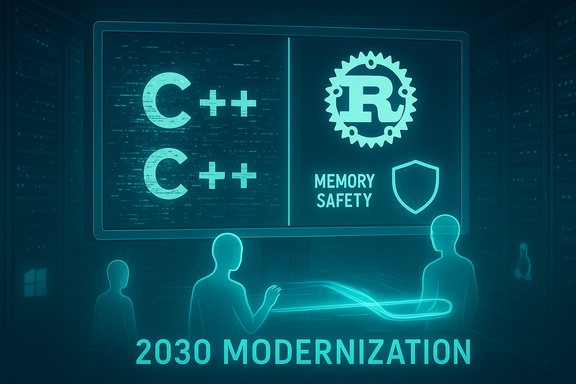
Microsoft’s blunt new engineering ambition — to use AI and algorithmic tooling to remove C and C++ from major system codebases and replace them with memory‑safe Rust — has vaulted a quiet, multi‑year shift into the headlines and forced an overdue reckoning about how operating systems will be written and maintained in the AI era. The story is not a simple language war; it’s a multi‑front transformation that pairs memory safety with automation at scale, and it is already reshaping both Windows and Linux engineering practices while exposing practical limits, real risks, and a handful of early surprises that make clear no single technology is a panacea.
At the same time, advances in large language models (LLMs), program analysis, and AI‑driven developer tools are changing how engineers write and refactor code. Major vendors now report that non‑trivial fractions of new code are produced or assisted by AI, raising both hopes for accelerated modernization and alarms about automation‑driven regressions. The combination of Rust’s safety model and AI’s potential for scale is what underpins the current wave of activity.
Yet the transformation is neither instantaneous nor automatic. Early CVEs in Rust kernel components and a high‑profile Rust GDI bug in Windows show that defects do not vanish with language change. The engineering challenge ahead is one of layered controls: algorithmic program analysis, human review, rigorous testing, and disciplined verification must be combined with AI assistance to realize the security and reliability benefits without introducing new systemic risks.
The operating‑system world is changing quietly but rapidly: Rust is no longer an experiment in major kernels and distributions, and AI is moving from novelty to a material force multiplier for engineering productivity. The sensible bet for the next decade is a pragmatic hybrid world — more Rust where safety matters, continued C where compatibility demands it, and increasing reliance on AI‑driven tooling that is governed, auditable, and proven by strong verification pipelines. The shape of systems software in 2035 will be different — safer in many ways, more complex in others — and the winners will be the organizations that pair ambition with the discipline to verify every automated change.
Source: ZDNET The great programming transformation: How AI and Rust are quietly dethroning C in Linux - and Windows
 Background
Why this moment matters
For decades, C was the language of choice for operating systems because it delivered unmatched control and raw performance. That control came at a cost: memory‑safety bugs — buffer overflows, use‑after‑free, double free — have been the root cause of a very large share of exploitable operating‑system vulnerabilities. Shifting parts of the stack to Rust promises to eliminate a large class of these issues at compile time through ownership and borrowing rules, without giving up low‑level performance.At the same time, advances in large language models (LLMs), program analysis, and AI‑driven developer tools are changing how engineers write and refactor code. Major vendors now report that non‑trivial fractions of new code are produced or assisted by AI, raising both hopes for accelerated modernization and alarms about automation‑driven regressions. The combination of Rust’s safety model and AI’s potential for scale is what underpins the current wave of activity.
The provocation that broke cover
A public hiring post from a senior Microsoft engineer crystallized these two trends into a provocative goal: a chartered effort to “eliminate every line of C and C++ from Microsoft by 2030” by combining algorithmic program analysis with AI agents that aid large‑scale translation and refactoring, and an audacious throughput “north star” — one engineer, one month, one million lines of code. The posting and its explosive reception forced clarifications from Microsoft (the effort is framed as tooling + research, not an unsupervised rewrite of Windows), but the underlying intent — to massively reduce legacy memory‑unsafe code using automation plus human review — remains an explicit priority.Where AI fits: augmentation, not magic
Microsoft’s scale experiment with AI
Executives at large companies are explicit about the impact AI is already having. Microsoft’s CEO said that roughly 20–30% of code in some Microsoft repositories is today generated or substantially produced by AI tooling — a striking indicator that AI is now a material contributor to engineering output. That statistic is a real operational input to decisions: if code is already being assisted by AI, then it becomes plausible to layer AI into migration pipelines — but only if strong verification and human oversight guard every step. Microsoft’s public posture — heavy investment in Copilot and agentic developer tools, plus internal programs that couple deterministic code analysis with LLMs — shows the company betting that the productivity gains from AI will become trustworthy once appropriate guardrails are in place. Executives and engineering leaders, however, explicitly warn that LLMs hallucinate, are vulnerable to prompt‑injection, and can leak data — meaning adoption must include provenance, non‑repudiation, and rigorous testing.Linux’s pragmatic approach
The Linux developer community is far more conservative about using AI for code creation but actively embraces AI for maintenance tasks — triage, patch classification, CVE handling, and automated test generation. Linus Torvalds and kernel maintainers see AI as a force multiplier for review and automation, not as an autonomous author of long‑lived, critical kernel logic. They emphasize transparency, disclosure, and human final‑authority for changes that touch the kernel’s core. That approach is already showing up at conferences and in the kernel’s governance conversations.Rust’s rise: from experiment to mainstream
Linux: Rust graduates from “experiment” to a core language
What was an explicit experiment in the Linux kernel since the Rust support merged in 6.1 is now officially over: kernel maintainers concluded that Rust has proven its value and should no longer be treated as merely experimental. Miguel Ojeda, who leads the Rust‑for‑Linux effort, formally proposed removing the “experiment” label; maintainers agreed that Rust is “here to stay.” That change reflects years of incremental work — driver pilots, toolchain improvements, and real‑world deployments (Android 16 ships Rust kernel components) — and signals a long‑term pivot: Rust will be treated as a first‑class option alongside C for new kernel code. The Linux project also signaled a fast‑moving adoption curve inside specific subsystems: the Direct Rendering Manager (DRM) — the graphics subsystem — is explicitly moving to require Rust for new drivers within a relatively short timeframe, according to maintainer commentary at the Maintainers Summit. In practice this means new drivers for many GPUs and display controllers are expected to be written in Rust, while legacy C drivers will continue to exist until replacement or targeted rework. That announcement compresses the expected timeline for Rust adoption in high‑impact areas like graphics.Debian and the distribution ecosystem
The change in kernel status is mirrored in distribution maintenance decisions. Debian developers have signaled that APT — the Advanced Package Tool — will begin to incorporate Rust code and require a Rust toolchain as a hard dependency from around May 2026 onward, compelling ports without working Rust toolchains to either add support or consider sunsetting. This is a concrete example of how userland infrastructure (not just the kernel) is adopting Rust to improve safety for critical system utilities. The change has sparked active debate about portability and legacy architectures, but it is emblematic of a wider movement across distros to prefer memory safety for central tooling.Windows: measured but aggressive Rust adoption
Microsoft has embedded Rust in the Windows ecosystem for several years through official language projections, crates, and driver frameworks (the windows‑rs project and companion driver tooling). The company has added Rust components to Windows 11 builds (for example, a Rust implementation of parts of the Graphics Device Interface, shipped as win32kbase_rs.sys in 24H2) and maintains active repositories for Rust interop and driver work. That activity demonstrates a pragmatic Microsoft strategy: use Rust for new, security‑sensitive components and to harden kernel‑adjacent code while preserving backward ABI and compatibility for the vast C/C++ ecosystem.Early evidence and the reality checks
Rust does not guarantee perfection — early CVEs and crashes
The practical lesson is immediate: memory safety reduces a class of bugs, but does not remove all bugs. The first CVE assigned to Rust code in the Linux kernel — a race condition in the Rust Android Binder driver (CVE‑2025‑68260) — demonstrates that unsafe blocks, concurrency mistakes, and logic errors still produce exploitable and crash‑causing defects. The issue was a race in usage of linked‑list operations within an unsafe region; it resulted in denial‑of‑service (kernel crash) conditions and was tracked and patched upstream. That event underscores that Rust reduces certain bug classes but does not eliminate the need for careful concurrency design, fuzzing, and system‑level testing. On Windows, independent fuzzing by Check Point Research discovered a vulnerability in a Rust‑based GDI kernel component. The research team described how intensive fuzzing of EMF+/metafile processing triggered kernel crashes in win32kbase_rs.sys; Microsoft issued a quality update that included hardening fixes. This shows two things at once: Rust is now used in high‑risk, attack‑surface code paths on Windows, and security researchers must expand fuzzing and tooling to exercise those Rust components as thoroughly as they do C code.What these incidents mean in practice
- Rust reduces the density of memory‑safety vulnerabilities, but the attack surface remains. Logic errors, concurrency races, incorrect bounds checks inside unsafe blocks, and incorrect use of third‑party crates can still lead to significant issues.
- Tooling maturity matters. Supply‑chain, build, and compiler verification become first‑order problems as projects depend on Rust toolchains, versions, and the interplay between GCC/LLVM and Rust compilers.
- Human processes still matter. LLMs or transpilers cannot replace rigorous test suites, fuzzing, and staged rollouts that emulate real‑world workloads and service conditions.
Strengths: Why vendors and maintainers are betting on Rust + AI
- Memory safety by design. Rust’s ownership model prevents whole classes of buffer overruns and use‑after‑free bugs without a garbage collector, making it naturally attractive for kernel and driver code.
- Modern tooling and ecosystems. Cargo, crate registries, and integrated static analysis paths make certain types of module‑level maintenance easier than ad hoc C ecosystems.
- AI as force multiplier. Where translation tasks are routine — updating API uses, generating idiomatic wrappers, or scaffolding refactors — AI can accelerate human engineers tremendously if paired with algorithmic checks and human review.
- Real deployments and momentum. Android inclusion of Rust kernel components, Microsoft’s windows‑rs work and Rust drivers in Windows test builds, and Debian’s APT decisions are proof points that this is not a futuristic experiment but a present‑day engineering choice.
Risks and limits: what to watch for
1) Semantic equivalence and undefined behavior
Automatic translation from C/C++ to Rust may preserve shape but not semantics. Undefined behavior in C code — which real‑world code sometimes depends on implicitly — is a principal obstacle to safe mechanical translation. Preserving ABI and timing semantics is essential for drivers and kernel modules and cannot be reliably automated without whole‑program reasoning and exhaustive validation.2) Unsafe surface remains
Transpiled Rust that simply wraps legacy operations in unsafe blocks yields safety theater rather than safety. Gains require idiomatic Rust that minimizes unsafe code and rethinks ownership models — something that demands human design work, not just text replacement.3) Toolchain and supply‑chain complexity
A hard dependency on Rust (as Debian’s APT decision illustrates) forces distributions, ports, and CI systems to carry Rust toolchains and manage versioning. This increases build complexity, may strand legacy architectures, and creates new vectors for supply‑chain issues (malicious crates, compiler bugs, SBOM tracking).4) Over‑reliance on AI and hallucination risk
LLMs are fallible; they hallucinate, they can be tricked via prompt injection, and they are not substitutes for deterministic compilers and provable transformations. Microsoft’s approach — combine deterministic program graphs with LLM repair inside strong verification loops — is the correct technical posture, but it requires significant infrastructure and careful configuration management.5) New operational failure modes
Converting certain classes of memory corruption into deterministic panics or crashes can be safer from an exploitability perspective but worse for availability. Systems designers must balance safety and resilience in production environments where deterministic failure is visible to end users. Historical servicing incidents in large platform updates underscore the need for staged rollouts and canary telemetry.Realistic scenarios and timelines
- Pragmatic hybrid migration (most likely): Target the highest‑risk subsystems for Rust (drivers, networking, parsers, cryptographic code) while retaining C/C++ for performance‑critical or ABI‑sensitive artifacts. Use AI tooling to accelerate scaffolding and localized refactors. This yields measurable security wins without intolerable risk.
- Tool‑assisted re‑engineering (plausible): Build strong algorithmic pipeline + LLMs to automate mechanically tractable translations (API calls, boilerplate) and reserve human engineers for ownership model decisions and verification. This is the plan Microsoft is funding and recruiting for, but it is not an overnight rewrite of Windows.
- Aggressive full migration (optimistic): Significant breakthroughs in program analysis and verification might allow much broader automation, but this requires advances in handling undefined behavior, preserving binary interfaces, and proving behavioral equivalence — all unsolved at scale today.
Practical guidance for engineers, ISVs, and administrators
- Prioritize migration candidates:
- High priority: code that handles untrusted inputs (parsers), drivers, crypto primitives.
- Medium priority: complex libraries with history of memory bugs.
- Low priority: tightly optimized inner loops with fragile UB reliance.
- Treat AI as an assistant, not an authority:
- Generate candidate changes with AI.
- Use deterministic program analysis to verify interface and control/data‑flow invariants.
- Run exhaustive CI + fuzzing + equivalence tests.
- Conduct staged rollouts with canary telemetry and opt‑in early adopters.
- Invest in governance and provenance:
- Record prompt history, model versions, and training data provenance for any AI‑assisted change.
- Require reproducible build artifacts and SBOMs for Rust dependencies.
- Harden verification:
- Expand fuzzing to cover Rust modules as aggressively as C ones.
- Adopt cross‑compiler verification and diverse compiler builds (GCC/LLVM/rustc) where feasible.
- Train and hire for mixed skill sets:
- Expect demand for engineers who know both low‑level systems programming and modern Rust idioms.
- Provide retraining tracks for large legacy teams to avoid productivity cliffs.
What to expect next
- More public prototypes and tooling artifacts from major vendors (Microsoft and others) as research teams publish translation pipelines and verification techniques.
- Accelerated adoption in specific subsystems: graphics (DRM) and package managers (APT) are near‑term hotbeds for Rust conversion.
- Continued scrutiny from researchers via fuzzing and independent security audits that will reveal both gains and weaknesses in deploying Rust at scale.
- Evolving standards for AI‑assisted code provenance, disclosure, and legal/contractual clarity around generated code.
Conclusion
The combined pressure of increased AI capability and Rust’s memory safety guarantees marks the most consequential shift in systems programming in decades. This is not simply a language migration; it is a re‑wiring of how large, mission‑critical software is maintained: safer language choices to reduce entire classes of vulnerabilities, plus automation to manage the enormous scale of legacy code. That union offers real promise — fewer memory‑corruption CVEs, cleaner abstractions, and faster modernization cycles.Yet the transformation is neither instantaneous nor automatic. Early CVEs in Rust kernel components and a high‑profile Rust GDI bug in Windows show that defects do not vanish with language change. The engineering challenge ahead is one of layered controls: algorithmic program analysis, human review, rigorous testing, and disciplined verification must be combined with AI assistance to realize the security and reliability benefits without introducing new systemic risks.
The operating‑system world is changing quietly but rapidly: Rust is no longer an experiment in major kernels and distributions, and AI is moving from novelty to a material force multiplier for engineering productivity. The sensible bet for the next decade is a pragmatic hybrid world — more Rust where safety matters, continued C where compatibility demands it, and increasing reliance on AI‑driven tooling that is governed, auditable, and proven by strong verification pipelines. The shape of systems software in 2035 will be different — safer in many ways, more complex in others — and the winners will be the organizations that pair ambition with the discipline to verify every automated change.
Source: ZDNET The great programming transformation: How AI and Rust are quietly dethroning C in Linux - and Windows