

Microsoft used its Build 2026 developer moment to push a more self-reliant AI strategy, promoting proprietary Microsoft AI models and Azure alternatives that reduce its dependence on OpenAI while keeping the partnership alive for Copilot, Azure AI, and enterprise customers. This is not a divorce. It is Microsoft doing what platform companies always do when a supplier becomes too powerful: turning the supplier into one option among many. The message to developers is simple enough, but the strategic subtext is louder: Microsoft wants to own the AI stack, not merely rent the most important layer of it.
For years, Microsoft’s AI story was almost inseparable from OpenAI’s. The company invested billions, integrated GPT models into Bing, Office, Windows, GitHub, Azure, and Copilot, and positioned itself as the enterprise channel for the most famous AI lab in the world. That gamble helped Microsoft look prescient while Google appeared briefly flat-footed and Amazon seemed oddly quiet.
But the same deal that made Microsoft look ahead of the market also exposed a classic platform risk. If the intelligence layer belongs to someone else, Microsoft can own the cloud bill, the product shell, the compliance wrapper, and the sales motion — yet still depend on another company for the capability customers actually recognize. In enterprise software, that is tolerable only as a temporary advantage.
The new wave of Microsoft-built models should be read in that context. They are not merely product announcements or another pile of AI acronyms for developers to sort through. They are a statement that Microsoft does not intend to be the world’s most successful OpenAI reseller forever.
That matters because OpenAI is no longer a research partner quietly powering Microsoft’s ambitions from the background. It is a product company, a developer platform, a consumer brand, and a cloud-scale infrastructure customer with its own incentives. Microsoft may remain OpenAI’s most important partner, but OpenAI is also the one company that can make Microsoft’s AI ambitions feel strategically dependent.
Yet the arrangement always had an awkward internal logic. Microsoft was simultaneously OpenAI’s investor, infrastructure provider, enterprise distributor, product integrator, and potential competitor. The more successful generative AI became, the harder it was to pretend those roles would remain neatly aligned.
At first, the benefits overwhelmed the tension. Microsoft needed state-of-the-art models quickly, and OpenAI needed compute, cash, distribution, and credibility with large organizations. Azure became the AI cloud that could credibly claim proximity to the most-watched model developer on earth.
Now the incentives are more complicated. OpenAI wants freedom to raise capital, build infrastructure, strike partnerships, and own customer relationships. Microsoft wants guaranteed access to top models, predictable economics, and enough internal capability to avoid being boxed in by a single lab’s roadmap. Both sides still need each other, but both sides also need leverage.
That is why Microsoft’s in-house model strategy feels less like a breakup and more like an insurance policy. The company does not have to replace OpenAI outright to change the balance of power. It only has to make OpenAI less singular.
Developers building AI applications are discovering that “best model” is not a stable category. The best model for coding may not be the best model for document extraction, voice generation, image creation, spreadsheet reasoning, customer support triage, or low-latency mobile inference. Enterprise buyers increasingly want model choice because model choice lets them manage cost, compliance, latency, geography, vendor lock-in, and failure risk.
Microsoft is well positioned to exploit that shift. Azure AI Foundry already points toward a world where developers choose among OpenAI, Microsoft, open-source, and third-party models depending on workload. Copilot Studio has similarly moved toward a multi-model posture, including support for Anthropic models in many enterprise scenarios. The company’s own models make that marketplace more powerful because Microsoft is no longer just curating other people’s intelligence.
That changes the economics. If Microsoft can route simpler tasks to cheaper in-house models, reserve OpenAI for the workloads that truly require frontier reasoning, and offer developers a unified toolchain across both, it can improve margins without asking customers to care about the plumbing. This is the cloud business playbook applied to AI: abstract the messy layer, meter the usage, and make switching feel like a configuration choice rather than a migration.
The danger for OpenAI is not that Microsoft instantly builds a better GPT. The danger is that Microsoft teaches enterprise customers to stop treating GPT as the default answer to every problem.
For consumer chatbots, raw model quality often dominates the conversation. For enterprise software, the calculation is messier. A model that is 85 percent as capable but far cheaper, faster, easier to govern, and available under clearer data-handling terms may be the better product. In the real world, most AI tasks are not grand demonstrations of general intelligence; they are summarizing tickets, drafting emails, classifying records, searching documents, generating images, transcribing meetings, and filling in workflow gaps.
That is where Microsoft’s approach could bite. The company does not need every proprietary model to beat OpenAI’s flagship systems in public benchmarks. It needs enough good-enough models that are deeply integrated into Azure, Microsoft 365, Windows, GitHub, and Copilot to make the overall bundle compelling.
This is an old Microsoft trick. Windows did not win every technical argument. Office did not always have the most elegant individual applications. Azure did not become relevant because it was first to cloud computing. Microsoft wins by packaging capability into ecosystems where distribution, identity, management, developer tooling, and enterprise procurement all pull in the same direction.
AI models are starting to look like another layer in that machine. Once models become interchangeable enough for many tasks, Microsoft’s advantage shifts from having the single smartest model to having the most useful system around the model.
But Microsoft’s language and product architecture increasingly suggest a different hierarchy. OpenAI is still a premier model supplier. It is no longer the entire strategy.
That distinction is crucial. A platform company can tolerate a powerful partner if the platform retains control over distribution and integration. It becomes a problem when the partner threatens to become the platform. OpenAI’s ChatGPT is already a consumer destination, a developer surface, and a workplace assistant in its own right. Microsoft cannot assume that customers will always enter AI through Windows, Office, Teams, or Azure.
Building its own models gives Microsoft a counterweight. Even if OpenAI remains the top frontier supplier, Microsoft gains bargaining power, internal expertise, and product independence. It can optimize models for its own services rather than wait for another company’s priorities to align.
The move also gives Microsoft a cleaner story for regulators and enterprise buyers. Dependence on one dominant AI lab invites questions about resilience, pricing, concentration, and governance. A multi-model Microsoft can argue that it is building choice into the platform rather than forcing customers through a single proprietary funnel.
At the top are frontier models, the expensive systems that define the public imagination of AI capability. Beneath that are specialized models tuned for modality, latency, cost, safety, or enterprise workflow. Beneath that again are local and edge models designed to run on PCs, phones, and private infrastructure. Microsoft wants to operate across all of those layers.
That is why its proprietary model push sits alongside its Phi small-language-model work, Azure AI model catalog, Copilot infrastructure, and Windows AI ambitions. The company is not betting on one giant model to rule them all. It is betting that AI will look more like cloud computing: heterogeneous, workload-specific, and managed through a platform.
This is also why the comparison with OpenAI, Anthropic, and Google can mislead. Microsoft does compete with those companies in model development, but its deeper competition is for control of the enterprise AI operating environment. If a CIO chooses Azure AI Foundry as the place where model decisions are made, Microsoft wins even when the selected model comes from someone else.
That is the most important part of the strategy. Microsoft can profit from the model wars without winning every model war.
Copilot+ PCs already established the pattern. Microsoft wants AI workloads to move fluidly between local neural processing units and cloud models, depending on privacy, latency, cost, and capability. Smaller in-house models make that strategy more plausible because Microsoft can tune them for Windows scenarios without waiting for OpenAI to prioritize the same use cases.
The value of that control is easy to underestimate. A Windows feature that summarizes local content, automates settings, searches across files, or assists with accessibility does not necessarily need the world’s most powerful frontier model. It needs a reliable, fast, safe model that understands the operating system context and can be governed according to Microsoft’s policies.
That is where Microsoft-built models could matter most. They allow the company to optimize for the mundane but valuable parts of computing: search, shell interactions, task automation, media generation, help systems, and device-aware agents. These are not glamorous benchmark demos, but they are exactly the kinds of features that could make AI feel native rather than bolted on.
The risk is that Microsoft repeats the mistakes of earlier Windows AI pushes: too much branding, too much telemetry anxiety, not enough user control, and features that feel like advertising for the cloud. If proprietary models make Windows smarter while respecting user agency, they help the platform. If they become another channel for forced Copilot surfaces, they will deepen skepticism.
The appeal is obvious. If a Microsoft model can handle a workload at lower cost, with predictable integration into Azure security, monitoring, and compliance tooling, many organizations will choose it even if it does not top every leaderboard. Procurement departments do not buy benchmark trophies. They buy risk reduction, support contracts, and cost curves they can explain.
This also changes how developers think about application design. Instead of hard-coding a single model into an app, teams increasingly need routing, fallback, evaluation, and observability. The winning AI applications will not merely call a model; they will decide which model to call, when to escalate, when to cache, when to run locally, and when to refuse.
Microsoft would love to make Azure the default place where those decisions happen. That is why the company’s model strategy is inseparable from its developer tooling strategy. The models matter, but the orchestration layer may matter more.
There is a catch. Microsoft must prove that its models are not just cheaper, but dependable. Developers have long memories when preview services change names, pricing shifts, or capabilities arrive with caveats. If Microsoft wants its proprietary models to become a serious alternative, it needs stable APIs, transparent pricing, clear deprecation policies, and honest documentation about strengths and weaknesses.
A CIO adopting generative AI at scale must answer uncomfortable questions. What happens if the model provider changes terms? What happens if a frontier model becomes unavailable in a region? What happens if sensitive workloads require stronger contractual controls? What happens if the model produces unacceptable outputs, and who is accountable when it does?
A Microsoft-owned model does not magically solve those problems, but it changes the support chain. Enterprises already have relationships with Microsoft for identity, security, productivity, endpoint management, and cloud infrastructure. Folding models into that existing governance structure is easier than adding another critical vendor to the stack.
That convenience is powerful. It is also exactly why Microsoft’s move deserves scrutiny. The company is not merely reducing dependence on OpenAI; it is inviting customers to increase dependence on Microsoft. For many organizations, that may be a rational trade. For regulators and competitors, it will look like the next stage of platform consolidation.
This is the paradox of enterprise AI. Customers want choice, but they also want someone else to integrate the choices. Microsoft is betting that most will choose the integrated platform, even if they occasionally complain about lock-in.
That stack has several pieces: compute, models, agents, developer tools, data connectors, identity, security, compliance, endpoint integration, and productivity surfaces. OpenAI gave Microsoft a head start in one of the hardest pieces. Now Microsoft is filling in the parts that make the stack defensible without relying on a single partner.
This is why the proprietary model push should not be judged only by whether Microsoft has a GPT-class chatbot. The company’s real advantage lies in integration. A model that plugs naturally into Entra ID, Purview, Defender, Azure, Microsoft 365, GitHub, and Windows can be more valuable to an enterprise than a slightly smarter model that lives outside the governance boundary.
The strategy also helps Microsoft respond to Google. Google has deep model research, custom AI silicon, a massive cloud, Android, Workspace, Chrome, and unmatched experience running AI at web scale. Microsoft cannot afford to be the company that sells someone else’s intelligence while Google sells a full stack of its own.
Anthropic presents a different challenge. Its models have become especially attractive to developers and enterprises that prize coding ability, long-context reasoning, and safety positioning. By bringing third-party models into its ecosystem while building its own, Microsoft avoids making Azure feel like an OpenAI-only house.
The result is a more pragmatic Microsoft than the marketing sometimes suggests. The company is not betting on purity. It is betting on aggregation.
A useful Microsoft model must be reliable under repetitive workloads. It must behave predictably when wrapped in business processes. It must be affordable at scale. It must integrate with monitoring and policy controls. It must improve without breaking applications. And it must do all of this while users compare it, fairly or not, with whatever OpenAI, Anthropic, and Google are offering that month.
That is a hard bar. Microsoft has world-class research depth, massive infrastructure, and enormous distribution, but frontier model development is not a side quest. It requires talent, compute, data, evaluation discipline, and a culture comfortable with fast-moving research bets. The company has hired aggressively and reorganized around Microsoft AI, but it still has to prove that it can ship models developers actively prefer.
The first generation of Microsoft-owned models may not settle that question. In fact, they probably will not. The more important test is whether Microsoft can establish a cadence: regular releases, credible improvements, visible adoption, and pricing that makes developers experiment without executive sponsorship.
If Microsoft can do that, it does not need to win the AI narrative overnight. It needs to become impossible to ignore in model selection meetings.
That was inevitable. OpenAI could not remain simply Microsoft’s secret weapon. Microsoft could not remain simply OpenAI’s infrastructure arm. Both companies have grown too large, too visible, and too strategically ambitious for that arrangement to stay simple.
For Microsoft, the challenge is to avoid undermining the very partner that helped make its AI pivot credible. For OpenAI, the challenge is to preserve access to Microsoft’s infrastructure and enterprise channel while keeping enough independence to pursue its own platform ambitions. Neither side benefits from a rupture, but neither side benefits from unchecked dependence either.
This is why Microsoft’s in-house models are best understood as a pressure valve. They reduce strategic anxiety without requiring immediate separation. They give Microsoft options in pricing, product design, and negotiation. They also give OpenAI a clearer signal: Microsoft’s patience for single-supplier dependence has limits.
In that sense, the move is not hostile. It is rational. And in technology markets, rational moves by platform owners can be more disruptive than dramatic ones.
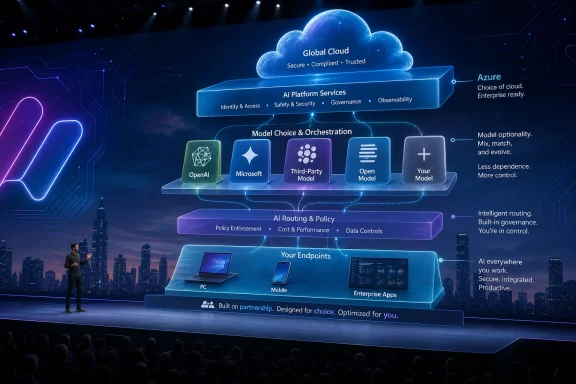 Microsoft Is Turning Its OpenAI Bet Into a Hedge
For years, Microsoft’s AI story was almost inseparable from OpenAI’s. The company invested billions, integrated GPT models into Bing, Office, Windows, GitHub, Azure, and Copilot, and positioned itself as the enterprise channel for the most famous AI lab in the world. That gamble helped Microsoft look prescient while Google appeared briefly flat-footed and Amazon seemed oddly quiet.But the same deal that made Microsoft look ahead of the market also exposed a classic platform risk. If the intelligence layer belongs to someone else, Microsoft can own the cloud bill, the product shell, the compliance wrapper, and the sales motion — yet still depend on another company for the capability customers actually recognize. In enterprise software, that is tolerable only as a temporary advantage.
The new wave of Microsoft-built models should be read in that context. They are not merely product announcements or another pile of AI acronyms for developers to sort through. They are a statement that Microsoft does not intend to be the world’s most successful OpenAI reseller forever.
That matters because OpenAI is no longer a research partner quietly powering Microsoft’s ambitions from the background. It is a product company, a developer platform, a consumer brand, and a cloud-scale infrastructure customer with its own incentives. Microsoft may remain OpenAI’s most important partner, but OpenAI is also the one company that can make Microsoft’s AI ambitions feel strategically dependent.
The Partnership Worked Almost Too Well
Microsoft’s OpenAI investment remains one of the most consequential corporate bets of the modern software era. It gave Microsoft early access to frontier models, made Azure the default home for an enormous amount of AI demand, and allowed the company to reframe nearly every product line around Copilot. For a company that had spent years trying to make Cortana relevant, the reversal was stunning.Yet the arrangement always had an awkward internal logic. Microsoft was simultaneously OpenAI’s investor, infrastructure provider, enterprise distributor, product integrator, and potential competitor. The more successful generative AI became, the harder it was to pretend those roles would remain neatly aligned.
At first, the benefits overwhelmed the tension. Microsoft needed state-of-the-art models quickly, and OpenAI needed compute, cash, distribution, and credibility with large organizations. Azure became the AI cloud that could credibly claim proximity to the most-watched model developer on earth.
Now the incentives are more complicated. OpenAI wants freedom to raise capital, build infrastructure, strike partnerships, and own customer relationships. Microsoft wants guaranteed access to top models, predictable economics, and enough internal capability to avoid being boxed in by a single lab’s roadmap. Both sides still need each other, but both sides also need leverage.
That is why Microsoft’s in-house model strategy feels less like a breakup and more like an insurance policy. The company does not have to replace OpenAI outright to change the balance of power. It only has to make OpenAI less singular.
The Real Product Is Optionality
The easy interpretation is that Microsoft wants cheaper models for Azure developers. That is true as far as it goes, but it undersells the ambition. Cost is the visible hook; optionality is the strategic product.Developers building AI applications are discovering that “best model” is not a stable category. The best model for coding may not be the best model for document extraction, voice generation, image creation, spreadsheet reasoning, customer support triage, or low-latency mobile inference. Enterprise buyers increasingly want model choice because model choice lets them manage cost, compliance, latency, geography, vendor lock-in, and failure risk.
Microsoft is well positioned to exploit that shift. Azure AI Foundry already points toward a world where developers choose among OpenAI, Microsoft, open-source, and third-party models depending on workload. Copilot Studio has similarly moved toward a multi-model posture, including support for Anthropic models in many enterprise scenarios. The company’s own models make that marketplace more powerful because Microsoft is no longer just curating other people’s intelligence.
That changes the economics. If Microsoft can route simpler tasks to cheaper in-house models, reserve OpenAI for the workloads that truly require frontier reasoning, and offer developers a unified toolchain across both, it can improve margins without asking customers to care about the plumbing. This is the cloud business playbook applied to AI: abstract the messy layer, meter the usage, and make switching feel like a configuration choice rather than a migration.
The danger for OpenAI is not that Microsoft instantly builds a better GPT. The danger is that Microsoft teaches enterprise customers to stop treating GPT as the default answer to every problem.
Cheaper Models Are Not Just Cheaper Models
The phrase “lower cost” sounds tactical, almost boring. In AI infrastructure, it is anything but. The cost of serving models is now one of the defining constraints on product design, and every percentage point matters when companies are embedding AI into workflows used millions of times a day.For consumer chatbots, raw model quality often dominates the conversation. For enterprise software, the calculation is messier. A model that is 85 percent as capable but far cheaper, faster, easier to govern, and available under clearer data-handling terms may be the better product. In the real world, most AI tasks are not grand demonstrations of general intelligence; they are summarizing tickets, drafting emails, classifying records, searching documents, generating images, transcribing meetings, and filling in workflow gaps.
That is where Microsoft’s approach could bite. The company does not need every proprietary model to beat OpenAI’s flagship systems in public benchmarks. It needs enough good-enough models that are deeply integrated into Azure, Microsoft 365, Windows, GitHub, and Copilot to make the overall bundle compelling.
This is an old Microsoft trick. Windows did not win every technical argument. Office did not always have the most elegant individual applications. Azure did not become relevant because it was first to cloud computing. Microsoft wins by packaging capability into ecosystems where distribution, identity, management, developer tooling, and enterprise procurement all pull in the same direction.
AI models are starting to look like another layer in that machine. Once models become interchangeable enough for many tasks, Microsoft’s advantage shifts from having the single smartest model to having the most useful system around the model.
OpenAI Remains Central, But No Longer Untouchable
None of this means Microsoft is walking away from OpenAI. That would be a dramatic reading unsupported by the business reality. OpenAI still provides frontier capabilities that Microsoft relies on across Copilot and Azure, and the partnership remains a core part of Microsoft’s AI credibility.But Microsoft’s language and product architecture increasingly suggest a different hierarchy. OpenAI is still a premier model supplier. It is no longer the entire strategy.
That distinction is crucial. A platform company can tolerate a powerful partner if the platform retains control over distribution and integration. It becomes a problem when the partner threatens to become the platform. OpenAI’s ChatGPT is already a consumer destination, a developer surface, and a workplace assistant in its own right. Microsoft cannot assume that customers will always enter AI through Windows, Office, Teams, or Azure.
Building its own models gives Microsoft a counterweight. Even if OpenAI remains the top frontier supplier, Microsoft gains bargaining power, internal expertise, and product independence. It can optimize models for its own services rather than wait for another company’s priorities to align.
The move also gives Microsoft a cleaner story for regulators and enterprise buyers. Dependence on one dominant AI lab invites questions about resilience, pricing, concentration, and governance. A multi-model Microsoft can argue that it is building choice into the platform rather than forcing customers through a single proprietary funnel.
The Foundation Model Market Is Starting to Fragment
For the past few years, AI competition has often been described as a race among a few frontier labs: OpenAI, Anthropic, Google, Meta, and a rotating set of challengers. That framing is useful but incomplete. The market is splitting into layers.At the top are frontier models, the expensive systems that define the public imagination of AI capability. Beneath that are specialized models tuned for modality, latency, cost, safety, or enterprise workflow. Beneath that again are local and edge models designed to run on PCs, phones, and private infrastructure. Microsoft wants to operate across all of those layers.
That is why its proprietary model push sits alongside its Phi small-language-model work, Azure AI model catalog, Copilot infrastructure, and Windows AI ambitions. The company is not betting on one giant model to rule them all. It is betting that AI will look more like cloud computing: heterogeneous, workload-specific, and managed through a platform.
This is also why the comparison with OpenAI, Anthropic, and Google can mislead. Microsoft does compete with those companies in model development, but its deeper competition is for control of the enterprise AI operating environment. If a CIO chooses Azure AI Foundry as the place where model decisions are made, Microsoft wins even when the selected model comes from someone else.
That is the most important part of the strategy. Microsoft can profit from the model wars without winning every model war.
Windows Is the Sleeping Distribution Channel
For WindowsForum readers, the obvious question is what any of this means for Windows. The answer is not that every new Microsoft AI model will immediately appear as a visible Windows feature. The more likely path is quieter and more consequential: Windows becomes one endpoint in a Microsoft-controlled AI fabric that spans cloud, device, identity, and application data.Copilot+ PCs already established the pattern. Microsoft wants AI workloads to move fluidly between local neural processing units and cloud models, depending on privacy, latency, cost, and capability. Smaller in-house models make that strategy more plausible because Microsoft can tune them for Windows scenarios without waiting for OpenAI to prioritize the same use cases.
The value of that control is easy to underestimate. A Windows feature that summarizes local content, automates settings, searches across files, or assists with accessibility does not necessarily need the world’s most powerful frontier model. It needs a reliable, fast, safe model that understands the operating system context and can be governed according to Microsoft’s policies.
That is where Microsoft-built models could matter most. They allow the company to optimize for the mundane but valuable parts of computing: search, shell interactions, task automation, media generation, help systems, and device-aware agents. These are not glamorous benchmark demos, but they are exactly the kinds of features that could make AI feel native rather than bolted on.
The risk is that Microsoft repeats the mistakes of earlier Windows AI pushes: too much branding, too much telemetry anxiety, not enough user control, and features that feel like advertising for the cloud. If proprietary models make Windows smarter while respecting user agency, they help the platform. If they become another channel for forced Copilot surfaces, they will deepen skepticism.
Azure Developers Get a New Bargaining Position
For developers, Microsoft’s in-house model push is primarily about leverage. Teams building AI applications on Azure have spent the last two years navigating a world where model selection can dictate architecture, cost, and vendor exposure. A broader set of Microsoft-controlled models gives them more room to negotiate those trade-offs.The appeal is obvious. If a Microsoft model can handle a workload at lower cost, with predictable integration into Azure security, monitoring, and compliance tooling, many organizations will choose it even if it does not top every leaderboard. Procurement departments do not buy benchmark trophies. They buy risk reduction, support contracts, and cost curves they can explain.
This also changes how developers think about application design. Instead of hard-coding a single model into an app, teams increasingly need routing, fallback, evaluation, and observability. The winning AI applications will not merely call a model; they will decide which model to call, when to escalate, when to cache, when to run locally, and when to refuse.
Microsoft would love to make Azure the default place where those decisions happen. That is why the company’s model strategy is inseparable from its developer tooling strategy. The models matter, but the orchestration layer may matter more.
There is a catch. Microsoft must prove that its models are not just cheaper, but dependable. Developers have long memories when preview services change names, pricing shifts, or capabilities arrive with caveats. If Microsoft wants its proprietary models to become a serious alternative, it needs stable APIs, transparent pricing, clear deprecation policies, and honest documentation about strengths and weaknesses.
Enterprise IT Will Read This as a Risk Story
The developer community may focus on capability and cost. Enterprise IT will focus on dependency. That is where Microsoft’s move becomes especially interesting.A CIO adopting generative AI at scale must answer uncomfortable questions. What happens if the model provider changes terms? What happens if a frontier model becomes unavailable in a region? What happens if sensitive workloads require stronger contractual controls? What happens if the model produces unacceptable outputs, and who is accountable when it does?
A Microsoft-owned model does not magically solve those problems, but it changes the support chain. Enterprises already have relationships with Microsoft for identity, security, productivity, endpoint management, and cloud infrastructure. Folding models into that existing governance structure is easier than adding another critical vendor to the stack.
That convenience is powerful. It is also exactly why Microsoft’s move deserves scrutiny. The company is not merely reducing dependence on OpenAI; it is inviting customers to increase dependence on Microsoft. For many organizations, that may be a rational trade. For regulators and competitors, it will look like the next stage of platform consolidation.
This is the paradox of enterprise AI. Customers want choice, but they also want someone else to integrate the choices. Microsoft is betting that most will choose the integrated platform, even if they occasionally complain about lock-in.
The AI Stack Is Becoming a Microsoft Stack Again
The deeper pattern is familiar to anyone who watched Microsoft in the Windows and Office eras. The company wants to own the layer where complexity is simplified for everyone else. In the 1990s, that layer was the PC operating system. In the 2000s, it was productivity and enterprise server software. In the 2010s, it was cloud and identity. In the 2020s, it is increasingly the AI application stack.That stack has several pieces: compute, models, agents, developer tools, data connectors, identity, security, compliance, endpoint integration, and productivity surfaces. OpenAI gave Microsoft a head start in one of the hardest pieces. Now Microsoft is filling in the parts that make the stack defensible without relying on a single partner.
This is why the proprietary model push should not be judged only by whether Microsoft has a GPT-class chatbot. The company’s real advantage lies in integration. A model that plugs naturally into Entra ID, Purview, Defender, Azure, Microsoft 365, GitHub, and Windows can be more valuable to an enterprise than a slightly smarter model that lives outside the governance boundary.
The strategy also helps Microsoft respond to Google. Google has deep model research, custom AI silicon, a massive cloud, Android, Workspace, Chrome, and unmatched experience running AI at web scale. Microsoft cannot afford to be the company that sells someone else’s intelligence while Google sells a full stack of its own.
Anthropic presents a different challenge. Its models have become especially attractive to developers and enterprises that prize coding ability, long-context reasoning, and safety positioning. By bringing third-party models into its ecosystem while building its own, Microsoft avoids making Azure feel like an OpenAI-only house.
The result is a more pragmatic Microsoft than the marketing sometimes suggests. The company is not betting on purity. It is betting on aggregation.
The Biggest Unknown Is Quality
All of Microsoft’s strategic logic collapses if the models are not good enough. “Good enough,” however, needs definition. Public AI discourse tends to reduce quality to leaderboard placement, viral demos, or whether a model can solve a particularly weird coding puzzle. Enterprise quality is broader and less theatrical.A useful Microsoft model must be reliable under repetitive workloads. It must behave predictably when wrapped in business processes. It must be affordable at scale. It must integrate with monitoring and policy controls. It must improve without breaking applications. And it must do all of this while users compare it, fairly or not, with whatever OpenAI, Anthropic, and Google are offering that month.
That is a hard bar. Microsoft has world-class research depth, massive infrastructure, and enormous distribution, but frontier model development is not a side quest. It requires talent, compute, data, evaluation discipline, and a culture comfortable with fast-moving research bets. The company has hired aggressively and reorganized around Microsoft AI, but it still has to prove that it can ship models developers actively prefer.
The first generation of Microsoft-owned models may not settle that question. In fact, they probably will not. The more important test is whether Microsoft can establish a cadence: regular releases, credible improvements, visible adoption, and pricing that makes developers experiment without executive sponsorship.
If Microsoft can do that, it does not need to win the AI narrative overnight. It needs to become impossible to ignore in model selection meetings.
The OpenAI Relationship Enters Its Most Adult Phase
The Microsoft-OpenAI partnership is often described in emotional terms: dependency, betrayal, divorce, rivalry. The more accurate frame is maturation. The relationship is moving from an extraordinary early alliance into a more conventional big-tech partnership, where shared interests coexist with competitive boundaries.That was inevitable. OpenAI could not remain simply Microsoft’s secret weapon. Microsoft could not remain simply OpenAI’s infrastructure arm. Both companies have grown too large, too visible, and too strategically ambitious for that arrangement to stay simple.
For Microsoft, the challenge is to avoid undermining the very partner that helped make its AI pivot credible. For OpenAI, the challenge is to preserve access to Microsoft’s infrastructure and enterprise channel while keeping enough independence to pursue its own platform ambitions. Neither side benefits from a rupture, but neither side benefits from unchecked dependence either.
This is why Microsoft’s in-house models are best understood as a pressure valve. They reduce strategic anxiety without requiring immediate separation. They give Microsoft options in pricing, product design, and negotiation. They also give OpenAI a clearer signal: Microsoft’s patience for single-supplier dependence has limits.
In that sense, the move is not hostile. It is rational. And in technology markets, rational moves by platform owners can be more disruptive than dramatic ones.
The Build Message Hiding Under the Model Demos
The practical lesson from Microsoft’s Build-era AI push is not that OpenAI is finished, or that Microsoft has suddenly become the dominant foundation model lab. It is that the center of gravity in enterprise AI is shifting from model access to model control. The companies that win will not merely have smart models; they will decide how models are selected, routed, governed, paid for, and embedded into daily work.- Microsoft is reducing its strategic dependence on OpenAI without abandoning the partnership that made its AI surge possible.
- Azure developers should expect more model choice, but also more pressure to build applications that can evaluate, route, and swap models over time.
- Windows users are likely to see the effects indirectly through Copilot, local AI features, and cloud-connected agents rather than through model branding.
- Enterprise IT buyers will view Microsoft-owned models as a governance and procurement advantage, especially when workloads already sit inside Microsoft’s security and compliance stack.
- OpenAI remains central to Microsoft’s AI business, but it is no longer positioned as the only credible intelligence layer in Microsoft’s ecosystem.
References
- Primary source: The Tech Buzz
Published: Tue, 02 Jun 2026 21:19:00 GMT
Microsoft Unveils Own AI Models to Cut OpenAI Dependence | The Tech Buzz
Microsoft launches proprietary AI models at Build to reduce OpenAI reliance and slash costswww.techbuzz.ai - Related coverage: techradar.com
10 products that launched at Microsoft Build — and what happened to them | TechRadar
From Windows 8 to Copilot, here’s everything that was born at Buildwww.techradar.com - Related coverage: windowscentral.com
How to watch Microsoft Build 2026: Windows 11, NVIDIA RTX Spark, AI agents, and more | Windows Central
Build isn't just some boring developer conference. It showcases the future of Windows and computing.www.windowscentral.com - Related coverage: techspot.com
Microsoft debuts in-house AI models as it builds independence from OpenAI | TechSpot
Microsoft is developing and testing proprietary large language models, signaling a shift from its previous heavy reliance on OpenAI technology.www.techspot.com - Related coverage: computerworld.com
Microsoft builds its own AI stack to help wean it from its reliance on OpenAI – Computerworld
New proprietary models reduce Microsoft's dependence on its biggest AI partner, even as the two maintain a fragile alliance. www.computerworld.com
- Official source: blogs.microsoft.com
The next phase of the Microsoft-OpenAI partnership - The Official Microsoft Blog
Amended Agreement Provides Long-Term Clarity The rapid pace of innovation requires us to continue to evolve our partnership to benefit our customers and both companies. Today, we are announcing an amended agreement to simplify our partnership and the way we work together, grounded in...blogs.microsoft.com
- Related coverage: techcrunch.com
Microsoft takes on AI rivals with three new foundational models | TechCrunch
MAI released models that can transcribe voice into text as well as generate audio and images after the group's formation six months ago.techcrunch.com - Related coverage: geekwire.com
Microsoft releases new AI models to expand further beyond OpenAI – GeekWire
Microsoft announced MAI-Transcribe-1, a new speech-to-text model, and made its in-house MAI-Voice-1 and MAI-Image-2 models broadly available to developers for commercial use for the first time, expanding its proprietary AI capabilities beyond its OpenAI partnership.www.geekwire.com - Official source: microsoft.com
Anthropic joins the multi-model lineup in Microsoft Copilot Studio | Microsoft Copilot Blog
In addition to default OpenAI models, Copilot Studio customers can now build agents with Anthropic models Claude Sonnet 4 and Claude Opus 4.1www.microsoft.com - Related coverage: theinformation.com
Microsoft Unveils AI Models to Lessen Its Reliance on OpenAI’s — The Information
Microsoft on Thursday debuted two new large language models it developed over the past year to reduce its reliance on OpenAI’s artificial intelligence in powering Copilot products. Microsoft will start swapping in the new models, dubbed MAI, to power Copilot features in the coming weeks...www.theinformation.com - Related coverage: forbes.com
Microsoft Builds Its Own AI Model Stack To Reduce OpenAI Dependence
Microsoft launches three in-house MAI models for transcription, voice and image generation through Foundry, hedging its reliance on OpenAI.www.forbes.com - Related coverage: winbuzzer.com
Microsoft Ships 3 In-House AI Models to Rival OpenAI
Microsoft has launched three in-house AI models — MAI-Transcribe-1, MAI-Voice-1, and MAI-Image-2 — through Foundry, undercutting OpenAI and Google on price. winbuzzer.com
- Related coverage: tomshardware.com
Broadcom to supply Anthropic with 3.5 gigawatts of Google TPU capacity from 2027 — Claude pioneer says its annual revenue run rate has passed $30 billion | Tom's Hardware
Securities filing confirms multi-year supply agreement runs through 2031.www.tomshardware.com - Related coverage: livescience.com
Microsoft says its newest AI chip Maia 200 is 3 times more powerful than Google's TPU and Amazon's Trainium processor | Live Science
The Maia 200 AI chip is described as an inference powerhouse — meaning it could lead AI models to apply their knowledge to real-world situations much faster and more efficiently. www.livescience.com
- Related coverage: arstechnica.com
With new in-house models, Microsoft lays the groundwork for independence from OpenAI - Ars Technica
Microsoft is still deeply tied to OpenAI, but who knows what the future holds.arstechnica.com - Related coverage: axios.com
Microsoft research tools uses Anthropic and OpenAI models
The multi-model method is designed to improve accuracy.www.axios.com
- Related coverage: techxplore.com
