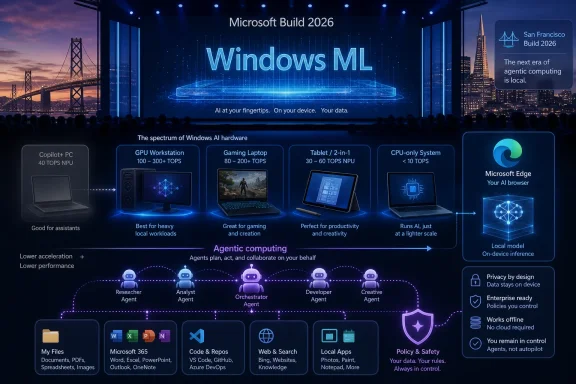
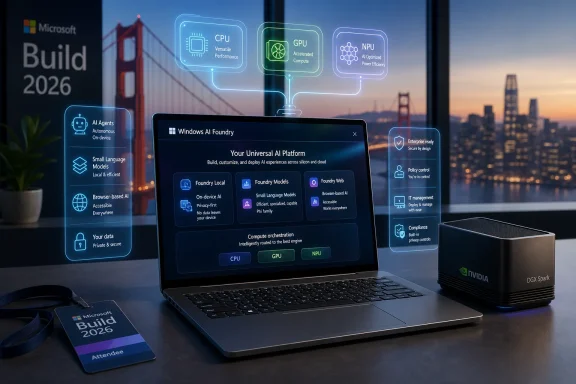
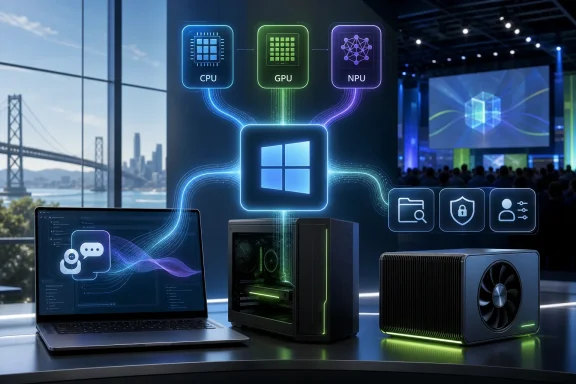
At Microsoft Build 2026, held this week in San Francisco, Microsoft shifted its Windows AI pitch away from the Copilot+ PC brand and toward local agents and models that can run across CPUs, GPUs, NPUs, and new Nvidia-powered developer hardware. That is not the death of AI on PCs; it is the demotion of a branding strategy that made Microsoft’s most ambitious Windows features feel artificially fenced off. The company still wants Windows to be the place where AI runs close to the user, close to their files, and close to their workflows. But the hardware gate is opening, and that changes the story for buyers, developers, and IT departments.
Copilot+ PCs arrived in 2024 with the kind of confidence Microsoft usually reserves for platform resets. The pitch was simple enough: buy a new Windows 11 machine with a sufficiently powerful neural processing unit, 16GB of RAM, and modern silicon, and you would get access to the next generation of local AI experiences. Recall, Cocreator, semantic search, live translation, and other features were supposed to make the NPU feel like the missing organ in the modern PC.
Two years later, Build 2026 told a different story. Microsoft did not abandon local AI, but it stopped treating Copilot+ as the only doorway into it. The company’s language moved from “this class of PC unlocks these features” to “Windows is a runtime for local AI across the installed base.” That may sound like a subtle distinction, but in platform terms it is enormous.
Satya Nadella’s keynote framed the PC less as a branded AI appliance and more as one node in a broader agentic computing stack. Developers were told they could target Windows ML across a fuller range of GPUs and onboard compute, rather than thinking first about a narrow NPU threshold. The old message was about buying the right machine; the new message is about building software that adapts to the machine in front of it.
That is the right pivot. Copilot+ was always an awkward brand because it bundled three different ideas into one label: a hardware spec, a set of Windows features, and Microsoft’s broader Copilot marketing push. Users could reasonably wonder whether they were buying better battery life, better AI, a better Windows license, or simply a sticker.
But Microsoft’s problem was never that it valued NPUs. The problem was that it turned the NPU into a platform border. Many powerful desktops, gaming laptops, and workstation-class PCs were left outside the Copilot+ feature set despite having far more raw AI horsepower than the first wave of qualifying thin-and-light laptops.
That contradiction was always going to become harder to defend. A desktop with a modern Nvidia GPU can be a formidable local AI machine, even if it lacks a Copilot+ badge. A workstation used by a developer, researcher, or creator may have the compute to run models that would flatten a low-power laptop NPU. Yet Microsoft’s early Windows AI story made the brand look more important than the workload.
Build 2026 appears to acknowledge that reality. Windows AI cannot become a serious development target if it begins with “first, buy one of these laptops.” Developers need an abstraction layer that can use the CPU, GPU, or NPU depending on availability, performance, power, privacy, and policy. Users need features that degrade gracefully instead of disappearing behind a marketing label.
The NPU still has a role. It may remain the best silicon for always-on, low-power, background AI tasks. But it should be treated as one accelerator among several, not as the only credential that proves a PC is worthy of modern Windows features.
The backlash was not merely anti-AI reflex. Recall touched a nerve because it sat at the intersection of screenshots, search, encryption, authentication, workplace policy, and user trust. Even after Microsoft revised the feature, delayed broader rollout, and added stronger controls, the first impression lingered. For a category meant to make local AI feel safe and personal, Recall made many users ask whether “local” was enough.
That damaged the Copilot+ brand in a way benchmark slides could not easily repair. Microsoft could say that local processing kept data on device, but skeptics could respond that sensitive data on device is still sensitive data. A local AI feature that captures too much can feel more invasive than a cloud feature that captures less.
Build 2026’s more diffuse AI message may be partly strategic damage control. By talking about agents, runtimes, security primitives, model choice, and developer tooling, Microsoft can move beyond the single feature that became a lightning rod. The company does not have to renounce Recall to stop making Copilot+ the emotional center of Windows AI.
That is good for Microsoft, but it is also good for users. The future of AI in Windows should not be judged solely by one controversial feature. It should be judged by whether users can understand what runs locally, what leaves the device, what data is accessed, and what controls exist before anything acts on their behalf.
That matters because it gives Windows a more credible place in the AI development chain. For years, many AI developers have treated Windows as a client OS and Linux as the natural habitat for serious model work. Microsoft has spent a long time trying to collapse that distinction through WSL, Visual Studio Code, GitHub integration, Azure tooling, and now better local GPU acceleration.
A GPU-first AI box is not a mass-market answer to the question “should I buy a Copilot+ laptop?” It is an answer to a different question: can Windows be a first-class environment for building AI software? That is a more important question for Microsoft than whether a consumer recognizes the Copilot+ label at Best Buy.
The Nvidia partnership also exposes the limits of the original Copilot+ framing. If local AI is about agents, model execution, developer pipelines, and multimodal workloads, then the PC ecosystem needs tiers of capability. A low-power NPU laptop, a gaming notebook, a compact AI dev box, and a workstation are not interchangeable. They should not be forced into a single consumer-facing category.
Microsoft’s better play is to make Windows aware of all that hardware and let software choose the right execution path. That is less tidy than a sticker, but platforms are rarely built by tidy marketing.
That is the practical future most Windows users should care about. The average person does not need a local 120-billion-parameter model. They need browser summarization that does not send every page to a cloud service, translation that works reliably, speech features that feel instant, and system intelligence that respects battery and privacy.
Small language models are not magic, and they will not match frontier cloud models at every task. But they are well suited to narrow, latency-sensitive, privacy-sensitive features that live close to the user interface. If Microsoft can ship useful models inside Edge and Windows, then local AI becomes less of a demo and more of a utility.
This also gives Microsoft a way to escape the upgrade trap. Windows has a vast installed base, and most of it will not become Copilot+ hardware overnight. If Microsoft wants developers to build against Windows AI APIs, those APIs must reach enough real machines to matter. A feature that works only on a small premium slice of the market is a showcase; a feature that adapts to CPU, GPU, and NPU capability can become a platform.
The risk is that Microsoft repeats old mistakes by making availability confusing. Users should not need a spreadsheet to know whether a feature runs locally, requires a cloud call, needs an NPU, or performs better with a GPU. If Microsoft wants trust, the user experience must be clearer than the branding that preceded it.
But a hardware baseline is not the same thing as a moral law. The PC market still contains price-sensitive education machines, business fleets, entry-level laptops, and compact systems where 8GB configurations remain common. Apple’s pressure at the low end, OEM competition, and the stubborn economics of RAM all make it difficult for Microsoft to pretend that every AI-capable machine must start at 16GB.
This is where the Copilot+ brand boxed Microsoft in. If the company tied AI features too tightly to a high baseline, it risked making Windows AI look like a luxury upsell. If it relaxed the baseline, it risked admitting that the original threshold was partly a product segmentation choice. Build 2026 suggests Microsoft is trying to slip out of that bind by shifting the focus from a rigid badge to scalable local intelligence.
That does not mean 8GB Windows laptops are suddenly ideal AI machines. They are not. Memory pressure remains real, and local models can be demanding even when they are small. But the right answer is not to hide all AI features from those systems. The right answer is to run smaller models, limit background work, offer cloud fallback where appropriate, and be honest about performance.
For IT departments, that nuance matters. A fleet manager may decide that 16GB or 32GB is the new minimum for business laptops. But that decision should be based on workload, lifecycle, support cost, and user role—not on whether a consumer marketing label says the machine is officially part of the future.
A narrow Copilot+ target made Windows AI feel like a preview program attached to new hardware sales. That may have been acceptable for Microsoft’s own first-party experiences, but it was a poor foundation for a broader ecosystem. Third-party developers cannot assume that their users own the latest NPU laptop, especially in enterprise environments where hardware refresh cycles are slow.
By expanding Windows AI and Windows ML across more CPUs and GPUs, Microsoft is trying to make the platform more credible. A developer can write an AI-enabled feature that runs well on premium machines, adequately on midrange systems, and perhaps with reduced capability on older PCs. That is how durable Windows software has traditionally worked.
The abstraction is the point. Developers should not need to handcraft separate logic for every silicon vendor and every accelerator class. They need tooling that exposes capability, chooses execution providers, manages models, and respects policy. Microsoft’s job is to make the heterogeneity of the PC ecosystem feel like strength rather than chaos.
If it succeeds, the Copilot+ label becomes less important because the platform does the work. If it fails, Windows AI will fragment into a mess of feature flags, driver dependencies, OEM promises, and unsupported edge cases. Windows users have seen that movie before.
The core enterprise questions are not glamorous. Which models are allowed? Where are they stored? How are they updated? What telemetry is collected? Can local AI access corporate data protected by sensitivity labels? Can an agent click, send, delete, move, or modify content? Can those actions be audited?
Microsoft knows this, which is why the company increasingly talks about identity, containment, and manageability around agents. But the proof will be in administrative controls, not keynote language. IT departments will want policy knobs that are boring, explicit, and enforceable.
The shift beyond Copilot+ may actually make those controls more urgent. When AI features were limited to a small subset of new devices, enterprises could slow-roll adoption by controlling procurement. If more AI capabilities arrive across existing Windows 11 PCs, administrators need software policy rather than hardware scarcity to manage risk.
That is the real test of Microsoft’s “trusted platform” claim. Trust does not come from saying the model runs locally. It comes from giving organizations clear authority over what the model can see, what it can do, and how mistakes are contained.
That is healthier for the PC market. Copilot+ created a sense that Microsoft wanted to restart the Windows upgrade cycle by tying marquee features to new machines. Some of that was inevitable; new hardware often enables new software. But when features appear artificially limited, users become cynical, especially if their supposedly unsupported PC has a powerful GPU sitting idle.
A scalable model is more honest. Microsoft can say that some features run everywhere, some run better with an NPU, some need a GPU, and some are intended for workstation-class hardware. That maps to reality. It also lets buyers make rational decisions instead of chasing a brand whose meaning keeps shifting.
The same applies to OEMs. PC makers should be free to sell thin-and-light battery champions, affordable school laptops, gaming systems, creator workstations, and AI dev boxes without forcing every machine into one Copilot-shaped story. Windows is at its best when it supports variety.
The challenge for Microsoft is restraint. If every Windows feature becomes an AI feature, and every AI feature becomes a Copilot upsell, users will tune out. The company needs to make local intelligence feel useful before it makes it feel inevitable.
But the category is no longer the whole map. It is becoming one tier in a broader Windows AI landscape. That is a demotion from the original rhetoric, but it is also a necessary maturation.
The first phase of AI PCs was about proving that local inference could matter. The second phase is about making it useful across messy, real-world hardware. That means desktops with GPUs, laptops with NPUs, CPUs running small models, browser-integrated AI, cloud fallback, and enterprise policy all have to coexist.
This is where Microsoft has an advantage if it can avoid overcomplicating the message. Windows already lives on heterogeneous hardware. The platform has decades of experience abstracting device differences behind APIs, drivers, compatibility layers, and management tools. AI should become another capability Windows schedules and governs, not a separate temple guarded by a sticker.
The irony is that Copilot+ may have been most useful as a forcing function. It pushed OEMs to ship NPUs, gave Microsoft a launch vehicle for local AI, and made the industry argue about what an AI PC should be. Now the brand has done its job, and the platform has to take over.
Microsoft does not want a boutique category of AI laptops. It wants Windows to be the operating system where agents run, tools are invoked, models are hosted, enterprise context is governed, and developers can move between local and cloud execution. That vision cannot depend on a single hardware badge.
This is also why the company’s Nvidia work matters. It gives Microsoft a developer and workstation story at the high end while small models in Edge and Windows serve the broad base. The result is less like one product category and more like a ladder: CPU-capable features at the bottom, NPU-optimized experiences in the middle, GPU-heavy local AI at the top, and cloud services spanning all of it.
That ladder will be messy. Some features will be region-limited. Some will require newer Windows builds. Some will depend on drivers, silicon vendor support, and OEM choices. Some will be delayed because Microsoft has learned, painfully, that shipping invasive AI features before the trust model is ready is a bad idea.
Still, messiness is preferable to artificial scarcity. A platform that adapts is more durable than a platform that excludes.
Microsoft’s next challenge is to prove that this broader approach is not merely a softer sales pitch. If local agents are going to act on our PCs, browse our files, summarize our work, and help operate our apps, the company must make capability, consent, and control clearer than they were in the first Copilot+ wave. The future Windows PC probably will have AI hardware, but the more important question is whether Windows itself can become an AI platform without making users feel trapped inside another marketing experiment.
 Microsoft Quietly Moves the Center of Gravity
Copilot+ PCs arrived in 2024 with the kind of confidence Microsoft usually reserves for platform resets. The pitch was simple enough: buy a new Windows 11 machine with a sufficiently powerful neural processing unit, 16GB of RAM, and modern silicon, and you would get access to the next generation of local AI experiences. Recall, Cocreator, semantic search, live translation, and other features were supposed to make the NPU feel like the missing organ in the modern PC.Two years later, Build 2026 told a different story. Microsoft did not abandon local AI, but it stopped treating Copilot+ as the only doorway into it. The company’s language moved from “this class of PC unlocks these features” to “Windows is a runtime for local AI across the installed base.” That may sound like a subtle distinction, but in platform terms it is enormous.
Satya Nadella’s keynote framed the PC less as a branded AI appliance and more as one node in a broader agentic computing stack. Developers were told they could target Windows ML across a fuller range of GPUs and onboard compute, rather than thinking first about a narrow NPU threshold. The old message was about buying the right machine; the new message is about building software that adapts to the machine in front of it.
That is the right pivot. Copilot+ was always an awkward brand because it bundled three different ideas into one label: a hardware spec, a set of Windows features, and Microsoft’s broader Copilot marketing push. Users could reasonably wonder whether they were buying better battery life, better AI, a better Windows license, or simply a sticker.
The NPU Was Useful, but the Wall Around It Was Not
The original Copilot+ PC requirements were not irrational. Local AI workloads benefit from dedicated acceleration, and NPUs are attractive because they can run inference more efficiently than a CPU and often with less power draw than a discrete GPU. For laptops, that matters. A feature that constantly indexes, summarizes, captions, or interprets user activity cannot behave like a gaming workload without wrecking battery life.But Microsoft’s problem was never that it valued NPUs. The problem was that it turned the NPU into a platform border. Many powerful desktops, gaming laptops, and workstation-class PCs were left outside the Copilot+ feature set despite having far more raw AI horsepower than the first wave of qualifying thin-and-light laptops.
That contradiction was always going to become harder to defend. A desktop with a modern Nvidia GPU can be a formidable local AI machine, even if it lacks a Copilot+ badge. A workstation used by a developer, researcher, or creator may have the compute to run models that would flatten a low-power laptop NPU. Yet Microsoft’s early Windows AI story made the brand look more important than the workload.
Build 2026 appears to acknowledge that reality. Windows AI cannot become a serious development target if it begins with “first, buy one of these laptops.” Developers need an abstraction layer that can use the CPU, GPU, or NPU depending on availability, performance, power, privacy, and policy. Users need features that degrade gracefully instead of disappearing behind a marketing label.
The NPU still has a role. It may remain the best silicon for always-on, low-power, background AI tasks. But it should be treated as one accelerator among several, not as the only credential that proves a PC is worthy of modern Windows features.
Recall Made the Brand Carry Too Much Baggage
No discussion of Copilot+ can avoid Recall, because Recall became the feature that defined the category for many people who never bought one. Microsoft intended Recall to be the flagship local AI experience: a searchable memory of what the user had seen and done on the PC. It was also the feature that turned Copilot+ from a hardware story into a privacy controversy.The backlash was not merely anti-AI reflex. Recall touched a nerve because it sat at the intersection of screenshots, search, encryption, authentication, workplace policy, and user trust. Even after Microsoft revised the feature, delayed broader rollout, and added stronger controls, the first impression lingered. For a category meant to make local AI feel safe and personal, Recall made many users ask whether “local” was enough.
That damaged the Copilot+ brand in a way benchmark slides could not easily repair. Microsoft could say that local processing kept data on device, but skeptics could respond that sensitive data on device is still sensitive data. A local AI feature that captures too much can feel more invasive than a cloud feature that captures less.
Build 2026’s more diffuse AI message may be partly strategic damage control. By talking about agents, runtimes, security primitives, model choice, and developer tooling, Microsoft can move beyond the single feature that became a lightning rod. The company does not have to renounce Recall to stop making Copilot+ the emotional center of Windows AI.
That is good for Microsoft, but it is also good for users. The future of AI in Windows should not be judged solely by one controversial feature. It should be judged by whether users can understand what runs locally, what leaves the device, what data is accessed, and what controls exist before anything acts on their behalf.
Nvidia Gives Microsoft a Better AI PC Story Than the Sticker Did
The biggest hardware signal around Build was not a refreshed Copilot+ slogan. It was Microsoft’s embrace of Nvidia-powered local AI systems, including the Surface RTX Spark Dev Box and related RTX Spark-class hardware. These machines are not aimed at the average laptop buyer. They are aimed at developers who want to build, test, tune, and run serious AI workloads on Windows without treating the cloud as the only viable backend.That matters because it gives Windows a more credible place in the AI development chain. For years, many AI developers have treated Windows as a client OS and Linux as the natural habitat for serious model work. Microsoft has spent a long time trying to collapse that distinction through WSL, Visual Studio Code, GitHub integration, Azure tooling, and now better local GPU acceleration.
A GPU-first AI box is not a mass-market answer to the question “should I buy a Copilot+ laptop?” It is an answer to a different question: can Windows be a first-class environment for building AI software? That is a more important question for Microsoft than whether a consumer recognizes the Copilot+ label at Best Buy.
The Nvidia partnership also exposes the limits of the original Copilot+ framing. If local AI is about agents, model execution, developer pipelines, and multimodal workloads, then the PC ecosystem needs tiers of capability. A low-power NPU laptop, a gaming notebook, a compact AI dev box, and a workstation are not interchangeable. They should not be forced into a single consumer-facing category.
Microsoft’s better play is to make Windows aware of all that hardware and let software choose the right execution path. That is less tidy than a sticker, but platforms are rarely built by tidy marketing.
Edge Shows the More Important Direction
The Aion-1.0-Instruct model in Microsoft Edge may prove more important for ordinary users than any showcase machine on the Build stage. Microsoft described it as a smaller, faster, more efficient on-device model for everyday text intelligence, including summarization, rewriting, intent handling, and accessibility scenarios. Crucially, the message around Edge was not “buy a Copilot+ PC.” It was that on-device AI can expand to more machines, including devices without premium accelerators.That is the practical future most Windows users should care about. The average person does not need a local 120-billion-parameter model. They need browser summarization that does not send every page to a cloud service, translation that works reliably, speech features that feel instant, and system intelligence that respects battery and privacy.
Small language models are not magic, and they will not match frontier cloud models at every task. But they are well suited to narrow, latency-sensitive, privacy-sensitive features that live close to the user interface. If Microsoft can ship useful models inside Edge and Windows, then local AI becomes less of a demo and more of a utility.
This also gives Microsoft a way to escape the upgrade trap. Windows has a vast installed base, and most of it will not become Copilot+ hardware overnight. If Microsoft wants developers to build against Windows AI APIs, those APIs must reach enough real machines to matter. A feature that works only on a small premium slice of the market is a showcase; a feature that adapts to CPU, GPU, and NPU capability can become a platform.
The risk is that Microsoft repeats old mistakes by making availability confusing. Users should not need a spreadsheet to know whether a feature runs locally, requires a cloud call, needs an NPU, or performs better with a GPU. If Microsoft wants trust, the user experience must be clearer than the branding that preceded it.
The 16GB Line Was Always a Policy Masquerading as Destiny
The original 16GB memory floor for Copilot+ PCs was defensible from a performance standpoint. Windows 11, modern browsers, collaboration apps, security software, and local AI workloads can quickly make 8GB feel cramped. For years, enthusiasts and IT pros have argued that 16GB should be the realistic baseline for a good Windows experience.But a hardware baseline is not the same thing as a moral law. The PC market still contains price-sensitive education machines, business fleets, entry-level laptops, and compact systems where 8GB configurations remain common. Apple’s pressure at the low end, OEM competition, and the stubborn economics of RAM all make it difficult for Microsoft to pretend that every AI-capable machine must start at 16GB.
This is where the Copilot+ brand boxed Microsoft in. If the company tied AI features too tightly to a high baseline, it risked making Windows AI look like a luxury upsell. If it relaxed the baseline, it risked admitting that the original threshold was partly a product segmentation choice. Build 2026 suggests Microsoft is trying to slip out of that bind by shifting the focus from a rigid badge to scalable local intelligence.
That does not mean 8GB Windows laptops are suddenly ideal AI machines. They are not. Memory pressure remains real, and local models can be demanding even when they are small. But the right answer is not to hide all AI features from those systems. The right answer is to run smaller models, limit background work, offer cloud fallback where appropriate, and be honest about performance.
For IT departments, that nuance matters. A fleet manager may decide that 16GB or 32GB is the new minimum for business laptops. But that decision should be based on workload, lifecycle, support cost, and user role—not on whether a consumer marketing label says the machine is officially part of the future.
Developers Needed an Install Base, Not a Velvet Rope
The strongest argument against Copilot+ exclusivity was always developer economics. Developers do not flock to a platform because a vendor says it is strategic. They build when the addressable market is large enough, the APIs are stable enough, and the user benefits are visible enough to justify the work.A narrow Copilot+ target made Windows AI feel like a preview program attached to new hardware sales. That may have been acceptable for Microsoft’s own first-party experiences, but it was a poor foundation for a broader ecosystem. Third-party developers cannot assume that their users own the latest NPU laptop, especially in enterprise environments where hardware refresh cycles are slow.
By expanding Windows AI and Windows ML across more CPUs and GPUs, Microsoft is trying to make the platform more credible. A developer can write an AI-enabled feature that runs well on premium machines, adequately on midrange systems, and perhaps with reduced capability on older PCs. That is how durable Windows software has traditionally worked.
The abstraction is the point. Developers should not need to handcraft separate logic for every silicon vendor and every accelerator class. They need tooling that exposes capability, chooses execution providers, manages models, and respects policy. Microsoft’s job is to make the heterogeneity of the PC ecosystem feel like strength rather than chaos.
If it succeeds, the Copilot+ label becomes less important because the platform does the work. If it fails, Windows AI will fragment into a mess of feature flags, driver dependencies, OEM promises, and unsupported edge cases. Windows users have seen that movie before.
Enterprise IT Will Ask the Questions Microsoft Marketing Avoids
For sysadmins, the end of Copilot+ exclusivity is not automatically good news. A broader local AI footprint means more devices may run models, index data, summarize content, and invoke tools. That creates opportunities for productivity, but it also expands the surface area for governance.The core enterprise questions are not glamorous. Which models are allowed? Where are they stored? How are they updated? What telemetry is collected? Can local AI access corporate data protected by sensitivity labels? Can an agent click, send, delete, move, or modify content? Can those actions be audited?
Microsoft knows this, which is why the company increasingly talks about identity, containment, and manageability around agents. But the proof will be in administrative controls, not keynote language. IT departments will want policy knobs that are boring, explicit, and enforceable.
The shift beyond Copilot+ may actually make those controls more urgent. When AI features were limited to a small subset of new devices, enterprises could slow-roll adoption by controlling procurement. If more AI capabilities arrive across existing Windows 11 PCs, administrators need software policy rather than hardware scarcity to manage risk.
That is the real test of Microsoft’s “trusted platform” claim. Trust does not come from saying the model runs locally. It comes from giving organizations clear authority over what the model can see, what it can do, and how mistakes are contained.
The Consumer Benefit Is Less Lock-In and More Honesty
For consumers, the best part of Microsoft’s pivot is simple: fewer people should have to buy a new PC just to discover whether Windows AI is useful. If summarization, search, translation, accessibility, and agent features can reach more existing machines, users can evaluate the software before treating AI hardware as a must-have.That is healthier for the PC market. Copilot+ created a sense that Microsoft wanted to restart the Windows upgrade cycle by tying marquee features to new machines. Some of that was inevitable; new hardware often enables new software. But when features appear artificially limited, users become cynical, especially if their supposedly unsupported PC has a powerful GPU sitting idle.
A scalable model is more honest. Microsoft can say that some features run everywhere, some run better with an NPU, some need a GPU, and some are intended for workstation-class hardware. That maps to reality. It also lets buyers make rational decisions instead of chasing a brand whose meaning keeps shifting.
The same applies to OEMs. PC makers should be free to sell thin-and-light battery champions, affordable school laptops, gaming systems, creator workstations, and AI dev boxes without forcing every machine into one Copilot-shaped story. Windows is at its best when it supports variety.
The challenge for Microsoft is restraint. If every Windows feature becomes an AI feature, and every AI feature becomes a Copilot upsell, users will tune out. The company needs to make local intelligence feel useful before it makes it feel inevitable.
The Copilot+ Brand Is Becoming a Tier, Not a Destiny
Copilot+ PCs are not disappearing. Microsoft still has every reason to keep the category alive for premium laptops with efficient NPUs and polished local experiences. OEMs need simple retail language, and Microsoft needs a way to identify machines that deliver a baseline level of AI performance.But the category is no longer the whole map. It is becoming one tier in a broader Windows AI landscape. That is a demotion from the original rhetoric, but it is also a necessary maturation.
The first phase of AI PCs was about proving that local inference could matter. The second phase is about making it useful across messy, real-world hardware. That means desktops with GPUs, laptops with NPUs, CPUs running small models, browser-integrated AI, cloud fallback, and enterprise policy all have to coexist.
This is where Microsoft has an advantage if it can avoid overcomplicating the message. Windows already lives on heterogeneous hardware. The platform has decades of experience abstracting device differences behind APIs, drivers, compatibility layers, and management tools. AI should become another capability Windows schedules and governs, not a separate temple guarded by a sticker.
The irony is that Copilot+ may have been most useful as a forcing function. It pushed OEMs to ship NPUs, gave Microsoft a launch vehicle for local AI, and made the industry argue about what an AI PC should be. Now the brand has done its job, and the platform has to take over.
The Real Build 2026 Message Was Not That AI PCs Failed
It would be tempting to read Microsoft’s Build 2026 posture as an admission that Copilot+ failed. That is too neat. The better reading is that the first version of the AI PC story was too narrow for the scale of Microsoft’s ambitions.Microsoft does not want a boutique category of AI laptops. It wants Windows to be the operating system where agents run, tools are invoked, models are hosted, enterprise context is governed, and developers can move between local and cloud execution. That vision cannot depend on a single hardware badge.
This is also why the company’s Nvidia work matters. It gives Microsoft a developer and workstation story at the high end while small models in Edge and Windows serve the broad base. The result is less like one product category and more like a ladder: CPU-capable features at the bottom, NPU-optimized experiences in the middle, GPU-heavy local AI at the top, and cloud services spanning all of it.
That ladder will be messy. Some features will be region-limited. Some will require newer Windows builds. Some will depend on drivers, silicon vendor support, and OEM choices. Some will be delayed because Microsoft has learned, painfully, that shipping invasive AI features before the trust model is ready is a bad idea.
Still, messiness is preferable to artificial scarcity. A platform that adapts is more durable than a platform that excludes.
The Sticker Fades, but the Platform Fight Gets Bigger
The practical read for Windows users is not that Copilot+ PCs are worthless. It is that they should no longer be treated as the only safe bet for the future of Windows AI.- Copilot+ PCs will still matter for efficient local AI workloads, especially on laptops where battery life and thermals constrain what Windows can do in the background.
- More Windows AI features are likely to reach ordinary Windows 11 PCs through small models, CPU inference, GPU acceleration, browser integration, and cloud-assisted fallbacks.
- Developers should watch Windows ML and Windows AI APIs more closely than retail branding, because the API surface will determine whether local AI becomes a real ecosystem.
- Enterprise administrators should prepare for AI governance across existing fleets, not just newly purchased Copilot+ hardware.
- Buyers should judge new PCs by memory, battery life, GPU and NPU capability, serviceability, support lifecycle, and workload fit rather than assuming one AI badge answers every question.
Microsoft’s next challenge is to prove that this broader approach is not merely a softer sales pitch. If local agents are going to act on our PCs, browse our files, summarize our work, and help operate our apps, the company must make capability, consent, and control clearer than they were in the first Copilot+ wave. The future Windows PC probably will have AI hardware, but the more important question is whether Windows itself can become an AI platform without making users feel trapped inside another marketing experiment.
References
- Primary source: PCMag UK
Published: Sun, 07 Jun 2026 16:00:00 GMT
At Build 2026, Microsoft Sent a Clear Message: Copilot+ PCs No Longer Matter
The company is moving beyond restrictive AI hardware requirements—and Windows users will benefit from the change.uk.pcmag.com - Related coverage: windowscentral.com
Microsoft is making a Surface mini PC for AI developers: Meet the Surface RTX Spark Dev Box, featuring 128GB RAM and one petaflop of AI compute power | Windows Central
Coming later this year, Microsoft is shipping its first Surface branded mini PC, aimed solely at AI developers looking to adopt NVIDIA's new RTX Spark platform.www.windowscentral.com - Related coverage: techradar.com
From Quantum to Containers - 4 big things you might have missed at Microsoft Build 2026 | TechRadar
We round up some of the other major news from Microsoft Build 2026www.techradar.com - Official source: blogs.windows.com
Expanding on‑device AI in Microsoft Edge: New models and APIs for the web
At Build 2025, we introduced the Prompt and Writing Assistance APIs in Microsoft Edge with the Phi-4-mini language model. Since then, we'blogs.windows.com - Related coverage: windowslatest.com
Microsoft says you should upgrade to Windows 11 AI PCs if you want to be prepared for the next generation of computing
Microsoft says you may not be prepared for the next generation of computing if you don't upgrade to a Copilot+ PC with Windows 11. www.windowslatest.com
- Official source: blogs.microsoft.com
Microsoft Build 2026: Be yourself at work - The Official Microsoft Blog
Platforms shift when developers build. We explore, choose tools, dream, create. This platform shift comes with more information than ever, ready at your fingertips. This shift, it’s about building fast AND THEN: it’s about building, operating, optimizing and observing. Securing your...blogs.microsoft.com
- Official source: news.microsoft.com
- Official source: microsoft.com
Copilot+ PCs and AI Features for Businesses | Microsoft
Discover Microsoft Copilot+ PCs for your business. Learn how these AI-powered computers and laptops deliver business solutions with Copilot+ PC AI features that streamline work.www.microsoft.com
- Related coverage: pcworld.com
Microsoft Copilot+ PCs are a bust, but AI PCs still feel inevitable | PCWorld
One year after PC makers began shipping Copilot+ PCs, they remain a tiny, tiny fraction of all PCs sold. Let's explore the reasons why.www.pcworld.com - Related coverage: tomsguide.com
Biggest Microsoft Build 2026 announcements — agentic AI, RTX Spark Dev Box, GitHub Copilot app, new MAI models, and more | Tom's Guide
All the big news from Microsoft's AI-focused eventwww.tomsguide.com - Related coverage: techdemis.com
Microsoft Edge Embeds On-Device AI Model, Adds Translation and Speech APIs
Microsoft is building a new small language model and on-device translation and speech tools directly into its Edge browser, reducing reliance on cloud services. www.techdemis.com
- Related coverage: msthesource.thesourcemediaassets.com
06012026_Nadella_TRANSCRIPT_Build Dress Rehearsal
Microsoft Build 2026msthesource.thesourcemediaassets.com