

Microsoft enters Build week in San Francisco with a redesigned Microsoft 365 Copilot, a unified Copilot organization announced in March 2026, and a partner strategy that increasingly depends on firms such as Sonata Software to turn AI infrastructure into working enterprise systems. The timing matters because Microsoft’s AI story is no longer just about models, chips, or keynote demos. It is about whether the company can make agentic software boring enough, governed enough, and useful enough to run inside real businesses.
That is the harder phase of the AI boom. Microsoft has spent the past three years putting Copilot into nearly every corner of its stack; now it has to prove that the sprawl can become a system. Sonata’s role as an early Microsoft Frontier Partner is a useful lens on the shift: the next competitive frontier is not merely who owns the best model, but who can make AI survive procurement, compliance, messy data, and the habits of office work.
For much of the generative AI cycle, Microsoft’s advantage looked straightforward. It had the OpenAI relationship, Azure capacity, GitHub Copilot’s developer credibility, and the enterprise distribution muscle to push Copilot across Windows, Microsoft 365, Dynamics, Power Platform, and security products. That was enough to make Microsoft look like the default winner in corporate AI, even when the products themselves felt uneven.
But enterprise software does not become critical infrastructure because it appears in a ribbon bar. It becomes critical infrastructure when organizations redesign workflows around it, assign budgets to it, trust its outputs, and build governance around its failures. Microsoft’s challenge is that the same ubiquity that gives it leverage also creates confusion: Copilot can mean a chatbot, a coding assistant, an Office feature, a Windows affordance, an agent builder, a security product, or a platform layer.
The latest Copilot redesign is best understood as a response to that confusion. Microsoft is trying to make Copilot feel less like a brand umbrella and more like an operating layer for work. The company’s March move to unify commercial and consumer Copilot efforts around Copilot experience, Copilot platform, Microsoft 365 apps, and AI models was not just an org-chart adjustment; it was an admission that AI cannot scale if every surface behaves like a separate experiment.
Build, in that sense, is less a developer conference than a stress test of Microsoft’s AI architecture. Developers and IT leaders will be looking for SDKs, model options, agent tooling, and governance controls. But beneath the technical announcements sits a simpler question: can Microsoft make AI adoption repeatable?
The old partner motion was easier to describe. A systems integrator helped customers migrate workloads, modernize applications, move data to the cloud, deploy productivity suites, or manage security tooling. The new partner motion is more ambiguous: help a business decide which processes should be delegated to software agents, which should remain human-led, which data sources can safely be exposed, and which outputs must be auditable.
That is not a license-resale problem. It is an organizational design problem wearing a software costume.
Sonata’s positioning as an “AI-first Modernization Engineering” company fits neatly into Microsoft’s current pitch because modernization is the prerequisite Microsoft cannot solve alone. A company with fragmented ERP data, inconsistent identity controls, brittle legacy apps, and no clear ownership of business processes will not become agentic because someone buys Microsoft 365 Copilot seats. It will become agentic only after the plumbing is made coherent enough for AI to act on it.
This is why the Frontier Partner label matters. Microsoft is telling customers that AI transformation will not be delivered purely from Redmond. It will be delivered through an ecosystem of partners that can turn broad platform primitives into industry-specific systems.
The newer pitch is more ambitious. Microsoft wants Copilot to become the interface through which workers create, coordinate, and supervise agents. Instead of asking Copilot to summarize a document, a user might assign an agent to monitor a sales pipeline, prepare a renewal package, update a CRM record, check policy compliance, and hand off an exception to a manager.
That future runs directly into the reality of enterprise work: processes are rarely clean. They cross systems, departments, geographies, and regulatory boundaries. They depend on tacit knowledge, spreadsheet folklore, undocumented approvals, and employees who know which system of record is technically official and which one the business actually trusts.
This is where Microsoft’s platform breadth becomes both strength and burden. Microsoft 365, Dynamics 365, Fabric, Dataverse, Power Platform, Entra, Defender, Purview, and Azure AI can form a plausible end-to-end foundation for agentic work. They can also form a maze. The customer does not need more nouns; the customer needs a working path through them.
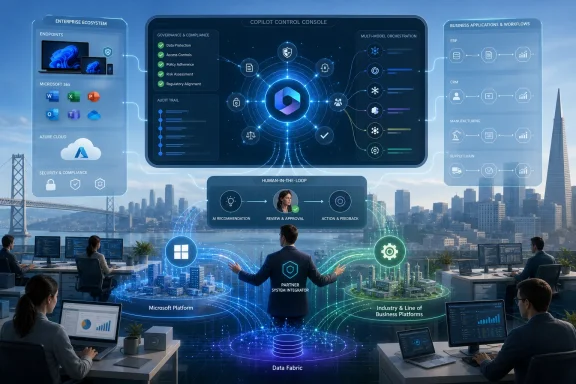
Sonata’s opportunity is to make that path legible. Its pitch around integrated agentic solutions spanning Copilot, orchestration, data platforms, and multi-model AI is really a pitch against fragmentation. The partner’s job is to turn Microsoft’s platform map into business outcomes that executives can fund and administrators can govern.
The market’s more recent enthusiasm reflects a belief that Microsoft can convert that spending into durable enterprise revenue. The company has the most obvious route: sell AI through products customers already use, bundle it into enterprise agreements, and make Azure the substrate for application modernization. But infrastructure spending cannot be justified by enthusiasm alone.
To make the economics work, Microsoft needs customers to move beyond pilots. A few Copilot licenses in legal, marketing, or engineering will not absorb the compute buildout. The prize is enterprise-wide deployment: agents embedded in workflows, AI features used daily in Microsoft 365, custom applications built on Azure AI, data consolidated in Fabric, and security controls wrapped around the whole thing.
That is why the partner ecosystem is not peripheral. It is a demand-conversion engine. Partners translate abstract AI capacity into projects with owners, timelines, success metrics, and renewal potential. Without that layer, Microsoft risks owning the highway before customers have built enough destinations.
Manufacturing is a useful test case because it exposes the limits of generic AI. A planner agent in that environment is not just a chatbot with a calendar. It must understand constraints, dependencies, inventory, production capacity, customer demand, timing, exceptions, and the business consequences of getting the answer wrong.
That sort of system requires domain modeling as much as model access. It also requires integration with the surrounding business software, because planning is not valuable if it lives outside the systems that execute and measure the plan. The agent must fit into the operational fabric of the company rather than sit beside it as a clever assistant.
This is the difference between AI as a feature and AI as process infrastructure. Sonata’s case study suggests that the practical route to agentic enterprise software is not “install Copilot, receive transformation.” It is modernization first, then data coherence, then agent design, then measurement, then scale.
For customers, this is mostly good news. Different workloads may require different models, price points, latency profiles, governance boundaries, and reasoning capabilities. A legal review agent may not need the same model as a customer-service summarizer. A manufacturing planning agent may require deterministic integration and auditability more than maximal conversational fluency.
But model choice adds complexity. Enterprises do not want every team selecting models ad hoc, sending sensitive data into poorly governed workflows, or creating agent systems that cannot be maintained after the pilot sponsor changes jobs. Multi-model AI increases the need for architecture, policy, observability, and cost management.
That is another reason partners matter. If the AI stack becomes more heterogeneous, customers will need help deciding where to use Microsoft-hosted models, where to use OpenAI models, where to use third-party models, and where smaller specialized models are sufficient. The model layer may be glamorous, but the durable value often sits one level up, in orchestration and governance.
Enterprise workflows are defined by exceptions. A purchase order is missing a field. A customer has a special contract term. A factory schedule changes because a supplier is late. A compliance rule differs by country. A document is outdated but still referenced by the team that knows the account best.
A useful agentic system must know when to proceed, when to ask, when to escalate, when to log, and when to stop. That is not just an AI problem. It is a policy problem, a systems-integration problem, and a human-factors problem.
Microsoft’s strongest argument is that it already owns many of the control planes enterprises use: identity, productivity, endpoint management, collaboration, security, compliance, developer tooling, and cloud infrastructure. If those controls can be applied coherently to agents, Microsoft can offer something smaller AI vendors struggle to match. If they cannot, Copilot risks becoming yet another layer of automation that IT departments have to contain.
That backlash matters. Users tolerate automation when it saves time, respects context, and stays out of the way. They resist it when it feels like branding stitched onto familiar tools. Microsoft appears to understand this more clearly now than it did during the early Copilot land grab.
The more coherent path is to make Windows a trusted endpoint for AI-assisted work rather than a billboard for every Copilot capability. That means secure local context, sensible handoffs to Microsoft 365, integration with identity and device policy, and clear boundaries between consumer assistance and enterprise data. It also means giving administrators controls that match the seriousness of what agents can do.
If Copilot becomes the front door to work agents, Windows cannot be treated as just another surface. It is the user’s daily environment, the endpoint IT must secure, and the place where convenience and governance collide. Microsoft’s success will depend on making that collision feel managed rather than imposed.
Still, IT leaders will not wave through agentic deployments because the vendor story is polished. They will ask hard questions about data residency, access controls, audit trails, hallucination handling, prompt injection, model updates, retention, cost allocation, and incident response. They will also ask who is accountable when an agent takes a wrong action inside a business process.
Those questions are not blockers; they are the market maturing. Early AI adoption often measured excitement. The next phase will measure reliability. An agent that saves ten hours but creates one compliance failure is not a productivity tool; it is a liability with a friendly interface.
Sonata and similar partners will have to prove that they can operationalize not just the happy path, but the control framework around it. That includes designing human-in-the-loop checkpoints, documenting agent behavior, defining escalation paths, and making sure business owners understand what has actually been automated. The enterprise buyer is not purchasing magic. The enterprise buyer is purchasing accountable change.
But there is a dependency hidden inside that advantage. If partners overpromise, customers will blame Microsoft’s AI stack. If implementations are too bespoke, projects will not scale efficiently. If the licensing model is confusing, partners will spend more time explaining SKUs than delivering value. If the underlying products shift too quickly, customers will hesitate to commit.
The Frontier Partner program is therefore a governance challenge for Microsoft as much as a go-to-market motion. The company needs partners to move fast, but not chaotically. It needs repeatable industry solutions, but not shallow templates. It needs co-sell velocity, but not at the expense of trust.
Sonata’s long Microsoft relationship gives it credibility here. Three decades of platform shifts — from client-server to cloud, from productivity suites to SaaS, from data modernization to AI — are useful experience when the customer’s central fear is not whether the technology is impressive, but whether it will still be supportable in five years.
That is why the redesigned Microsoft 365 Copilot matters. A cleaner interface is only the surface-level change. The deeper question is whether Microsoft can make Copilot the organizing layer for work without turning Microsoft 365 into an overstuffed command center.
The same applies to homegrown models. If Microsoft presents its own model suite as a way to reduce cost, improve enterprise fit, and diversify beyond OpenAI dependence, customers will listen. If the message becomes another round of model leaderboard theater, enterprise buyers will mentally file it under hype.
Microsoft’s advantage has never been that it is the purest AI company. It is that it can make complex technology administrable. The company won the enterprise not by being loved, but by being embedded, governable, and procurement-friendly. The agentic era will test whether that old formula still works when the software is no longer just displaying information, but acting on it.
That work is less glamorous than foundation-model research, but it may be more decisive for enterprise value. The companies that win will not be the ones with the most AI pilots. They will be the ones that convert AI into repeatable business capability.
That is the harder phase of the AI boom. Microsoft has spent the past three years putting Copilot into nearly every corner of its stack; now it has to prove that the sprawl can become a system. Sonata’s role as an early Microsoft Frontier Partner is a useful lens on the shift: the next competitive frontier is not merely who owns the best model, but who can make AI survive procurement, compliance, messy data, and the habits of office work.
 Microsoft’s AI Bet Has Moved From Demos to Deployment
For much of the generative AI cycle, Microsoft’s advantage looked straightforward. It had the OpenAI relationship, Azure capacity, GitHub Copilot’s developer credibility, and the enterprise distribution muscle to push Copilot across Windows, Microsoft 365, Dynamics, Power Platform, and security products. That was enough to make Microsoft look like the default winner in corporate AI, even when the products themselves felt uneven.But enterprise software does not become critical infrastructure because it appears in a ribbon bar. It becomes critical infrastructure when organizations redesign workflows around it, assign budgets to it, trust its outputs, and build governance around its failures. Microsoft’s challenge is that the same ubiquity that gives it leverage also creates confusion: Copilot can mean a chatbot, a coding assistant, an Office feature, a Windows affordance, an agent builder, a security product, or a platform layer.
The latest Copilot redesign is best understood as a response to that confusion. Microsoft is trying to make Copilot feel less like a brand umbrella and more like an operating layer for work. The company’s March move to unify commercial and consumer Copilot efforts around Copilot experience, Copilot platform, Microsoft 365 apps, and AI models was not just an org-chart adjustment; it was an admission that AI cannot scale if every surface behaves like a separate experiment.
Build, in that sense, is less a developer conference than a stress test of Microsoft’s AI architecture. Developers and IT leaders will be looking for SDKs, model options, agent tooling, and governance controls. But beneath the technical announcements sits a simpler question: can Microsoft make AI adoption repeatable?
The Frontier Partner Label Is a Signal, Not a Trophy
Sonata Software’s recognition as one of Microsoft’s first Frontier Partners is not interesting because partner badges are rare in enterprise technology. They are not. It is interesting because Microsoft is formalizing the channel it needs for the agentic era before the market has fully agreed what that era looks like.The old partner motion was easier to describe. A systems integrator helped customers migrate workloads, modernize applications, move data to the cloud, deploy productivity suites, or manage security tooling. The new partner motion is more ambiguous: help a business decide which processes should be delegated to software agents, which should remain human-led, which data sources can safely be exposed, and which outputs must be auditable.
That is not a license-resale problem. It is an organizational design problem wearing a software costume.
Sonata’s positioning as an “AI-first Modernization Engineering” company fits neatly into Microsoft’s current pitch because modernization is the prerequisite Microsoft cannot solve alone. A company with fragmented ERP data, inconsistent identity controls, brittle legacy apps, and no clear ownership of business processes will not become agentic because someone buys Microsoft 365 Copilot seats. It will become agentic only after the plumbing is made coherent enough for AI to act on it.
This is why the Frontier Partner label matters. Microsoft is telling customers that AI transformation will not be delivered purely from Redmond. It will be delivered through an ecosystem of partners that can turn broad platform primitives into industry-specific systems.
Copilot’s Real Enemy Is Fragmented Work
The original Copilot pitch was productivity: summarize meetings, draft emails, produce presentations, answer questions, write code. Those are useful capabilities, but they are not the same thing as transformation. They make existing work faster; they do not necessarily change how work is structured.The newer pitch is more ambitious. Microsoft wants Copilot to become the interface through which workers create, coordinate, and supervise agents. Instead of asking Copilot to summarize a document, a user might assign an agent to monitor a sales pipeline, prepare a renewal package, update a CRM record, check policy compliance, and hand off an exception to a manager.
That future runs directly into the reality of enterprise work: processes are rarely clean. They cross systems, departments, geographies, and regulatory boundaries. They depend on tacit knowledge, spreadsheet folklore, undocumented approvals, and employees who know which system of record is technically official and which one the business actually trusts.
This is where Microsoft’s platform breadth becomes both strength and burden. Microsoft 365, Dynamics 365, Fabric, Dataverse, Power Platform, Entra, Defender, Purview, and Azure AI can form a plausible end-to-end foundation for agentic work. They can also form a maze. The customer does not need more nouns; the customer needs a working path through them.
Sonata’s opportunity is to make that path legible. Its pitch around integrated agentic solutions spanning Copilot, orchestration, data platforms, and multi-model AI is really a pitch against fragmentation. The partner’s job is to turn Microsoft’s platform map into business outcomes that executives can fund and administrators can govern.
Microsoft’s Infrastructure Spending Only Pays Off If Customers Change Workflows
Microsoft’s reported plan to invest roughly $146 billion in infrastructure in 2026, about double the prior year’s $88 billion figure cited in the supplied material, captures the scale of the company’s AI wager. Investors initially had reason to flinch. AI infrastructure spending is capital-intensive, depreciation-heavy, and unforgiving if demand fails to materialize at profitable margins.The market’s more recent enthusiasm reflects a belief that Microsoft can convert that spending into durable enterprise revenue. The company has the most obvious route: sell AI through products customers already use, bundle it into enterprise agreements, and make Azure the substrate for application modernization. But infrastructure spending cannot be justified by enthusiasm alone.
To make the economics work, Microsoft needs customers to move beyond pilots. A few Copilot licenses in legal, marketing, or engineering will not absorb the compute buildout. The prize is enterprise-wide deployment: agents embedded in workflows, AI features used daily in Microsoft 365, custom applications built on Azure AI, data consolidated in Fabric, and security controls wrapped around the whole thing.
That is why the partner ecosystem is not peripheral. It is a demand-conversion engine. Partners translate abstract AI capacity into projects with owners, timelines, success metrics, and renewal potential. Without that layer, Microsoft risks owning the highway before customers have built enough destinations.
Sonata’s CPL Aromas Work Shows the Shape of the Market
The supplied example of Sonata’s work with CPL Aromas is exactly the sort of case Microsoft wants more of. An eight-year modernization effort is not as glamorous as a keynote demo, but it is more revealing. The company’s ability to deploy a custom planner agent for a complex manufacturing process depends on years of groundwork: modernized systems, accessible data, and enough trust in the architecture to let automation touch operational processes.Manufacturing is a useful test case because it exposes the limits of generic AI. A planner agent in that environment is not just a chatbot with a calendar. It must understand constraints, dependencies, inventory, production capacity, customer demand, timing, exceptions, and the business consequences of getting the answer wrong.
That sort of system requires domain modeling as much as model access. It also requires integration with the surrounding business software, because planning is not valuable if it lives outside the systems that execute and measure the plan. The agent must fit into the operational fabric of the company rather than sit beside it as a clever assistant.
This is the difference between AI as a feature and AI as process infrastructure. Sonata’s case study suggests that the practical route to agentic enterprise software is not “install Copilot, receive transformation.” It is modernization first, then data coherence, then agent design, then measurement, then scale.
The Multi-Model Era Makes Integration More Important, Not Less
Microsoft’s AI strategy has long rested on its OpenAI partnership, Azure infrastructure, and the Copilot brand. That triangle remains powerful, but it is also evolving. Microsoft has been emphasizing model diversity, enterprise-tuned models, and its own AI model work, not just dependence on a single external frontier lab.For customers, this is mostly good news. Different workloads may require different models, price points, latency profiles, governance boundaries, and reasoning capabilities. A legal review agent may not need the same model as a customer-service summarizer. A manufacturing planning agent may require deterministic integration and auditability more than maximal conversational fluency.
But model choice adds complexity. Enterprises do not want every team selecting models ad hoc, sending sensitive data into poorly governed workflows, or creating agent systems that cannot be maintained after the pilot sponsor changes jobs. Multi-model AI increases the need for architecture, policy, observability, and cost management.
That is another reason partners matter. If the AI stack becomes more heterogeneous, customers will need help deciding where to use Microsoft-hosted models, where to use OpenAI models, where to use third-party models, and where smaller specialized models are sufficient. The model layer may be glamorous, but the durable value often sits one level up, in orchestration and governance.
The Agentic Enterprise Will Be Judged by Exceptions
The phrase agentic AI has already acquired the usual enterprise sheen: promising, vague, and slightly overused. Stripped down, it means software that can take actions toward a goal rather than merely respond to prompts. That sounds revolutionary until it runs into the mundane reality of exceptions.Enterprise workflows are defined by exceptions. A purchase order is missing a field. A customer has a special contract term. A factory schedule changes because a supplier is late. A compliance rule differs by country. A document is outdated but still referenced by the team that knows the account best.
A useful agentic system must know when to proceed, when to ask, when to escalate, when to log, and when to stop. That is not just an AI problem. It is a policy problem, a systems-integration problem, and a human-factors problem.
Microsoft’s strongest argument is that it already owns many of the control planes enterprises use: identity, productivity, endpoint management, collaboration, security, compliance, developer tooling, and cloud infrastructure. If those controls can be applied coherently to agents, Microsoft can offer something smaller AI vendors struggle to match. If they cannot, Copilot risks becoming yet another layer of automation that IT departments have to contain.
Windows and Microsoft 365 Are Becoming the Front Door to Work Agents
For WindowsForum readers, the obvious question is where Windows fits into this. Microsoft’s AI story is now broader than the operating system, but Windows remains one of the places where the company’s ambitions become unavoidable to users. Copilot in Windows has already generated mixed reactions because Microsoft sometimes appeared more interested in surfacing AI everywhere than in making each surface clearly useful.That backlash matters. Users tolerate automation when it saves time, respects context, and stays out of the way. They resist it when it feels like branding stitched onto familiar tools. Microsoft appears to understand this more clearly now than it did during the early Copilot land grab.
The more coherent path is to make Windows a trusted endpoint for AI-assisted work rather than a billboard for every Copilot capability. That means secure local context, sensible handoffs to Microsoft 365, integration with identity and device policy, and clear boundaries between consumer assistance and enterprise data. It also means giving administrators controls that match the seriousness of what agents can do.
If Copilot becomes the front door to work agents, Windows cannot be treated as just another surface. It is the user’s daily environment, the endpoint IT must secure, and the place where convenience and governance collide. Microsoft’s success will depend on making that collision feel managed rather than imposed.
Where Enterprise IT Will Apply the Brakes
The pressure to “do AI” is now coming from boards, CEOs, business-unit leaders, and employees who are already using public tools. That creates a dangerous dynamic for IT: move too slowly and the organization builds shadow AI; move too quickly and the organization creates unmanaged risk. Microsoft’s partner-led strategy is partly designed to offer a middle path.Still, IT leaders will not wave through agentic deployments because the vendor story is polished. They will ask hard questions about data residency, access controls, audit trails, hallucination handling, prompt injection, model updates, retention, cost allocation, and incident response. They will also ask who is accountable when an agent takes a wrong action inside a business process.
Those questions are not blockers; they are the market maturing. Early AI adoption often measured excitement. The next phase will measure reliability. An agent that saves ten hours but creates one compliance failure is not a productivity tool; it is a liability with a friendly interface.
Sonata and similar partners will have to prove that they can operationalize not just the happy path, but the control framework around it. That includes designing human-in-the-loop checkpoints, documenting agent behavior, defining escalation paths, and making sure business owners understand what has actually been automated. The enterprise buyer is not purchasing magic. The enterprise buyer is purchasing accountable change.
Microsoft’s Partner Advantage Is Also a Dependency
Microsoft’s partner ecosystem is one of the company’s most durable advantages. It gives Microsoft reach into industries, geographies, and accounts that no central product team can serve deeply enough on its own. It also lets Microsoft turn platform announcements into packaged outcomes.But there is a dependency hidden inside that advantage. If partners overpromise, customers will blame Microsoft’s AI stack. If implementations are too bespoke, projects will not scale efficiently. If the licensing model is confusing, partners will spend more time explaining SKUs than delivering value. If the underlying products shift too quickly, customers will hesitate to commit.
The Frontier Partner program is therefore a governance challenge for Microsoft as much as a go-to-market motion. The company needs partners to move fast, but not chaotically. It needs repeatable industry solutions, but not shallow templates. It needs co-sell velocity, but not at the expense of trust.
Sonata’s long Microsoft relationship gives it credibility here. Three decades of platform shifts — from client-server to cloud, from productivity suites to SaaS, from data modernization to AI — are useful experience when the customer’s central fear is not whether the technology is impressive, but whether it will still be supportable in five years.
The Build Narrative Is Really About Control
The most interesting thing Microsoft can do at Build is not unveil another Copilot entry point. It is show that the company has learned from the first phase of AI proliferation. The market does not need a dozen more places to summon an assistant; it needs a clearer story about how AI is built, deployed, governed, measured, and improved.That is why the redesigned Microsoft 365 Copilot matters. A cleaner interface is only the surface-level change. The deeper question is whether Microsoft can make Copilot the organizing layer for work without turning Microsoft 365 into an overstuffed command center.
The same applies to homegrown models. If Microsoft presents its own model suite as a way to reduce cost, improve enterprise fit, and diversify beyond OpenAI dependence, customers will listen. If the message becomes another round of model leaderboard theater, enterprise buyers will mentally file it under hype.
Microsoft’s advantage has never been that it is the purest AI company. It is that it can make complex technology administrable. The company won the enterprise not by being loved, but by being embedded, governable, and procurement-friendly. The agentic era will test whether that old formula still works when the software is no longer just displaying information, but acting on it.
The Practical AI Race Now Runs Through Firms Like Sonata
The concrete lesson from Sonata’s positioning is that AI adoption is becoming less about isolated enthusiasm and more about industrialization. Microsoft can provide the platform, but customers need translation. They need someone to connect Copilot to their business processes, rationalize their data estate, and build agents that survive contact with real operations.That work is less glamorous than foundation-model research, but it may be more decisive for enterprise value. The companies that win will not be the ones with the most AI pilots. They will be the ones that convert AI into repeatable business capability.
- Microsoft’s unified Copilot organization is a sign that the company is trying to turn a sprawling set of AI features into a more coherent system.
- Sonata’s Frontier Partner status matters because enterprise AI adoption depends on modernization, integration, and governance as much as model quality.
- The CPL Aromas example illustrates that useful agents usually require years of platform and data groundwork before automation can touch complex operations.
- Microsoft’s infrastructure spending will be justified only if customers move from experimentation to broad, recurring, workflow-level AI usage.
- Multi-model AI gives enterprises more flexibility, but it also raises the need for stronger architecture, policy, and cost controls.
- Windows and Microsoft 365 users should expect AI to become less of a standalone assistant and more of a governed layer for delegating work.
References
- Primary source: StartUp Beat
Published: 2026-06-03T00:12:09.280222
As AI becomes a business imperative, Microsoft Frontier Partner Sonata is helping companies keep pace - StartUp Beat
This week will see the tech industry gather in San Francisco for Microsoft’s annual developer conference, Build. Ahead of this major event, the company has already released a first look at the revamped version of Microsoft 365 Copilot. This redesign follows on from an announcement in March of...startupbeat.com - Related coverage: techradar.com
10 products that launched at Microsoft Build — and what happened to them | TechRadar
From Windows 8 to Copilot, here’s everything that was born at Buildwww.techradar.com - Official source: blogs.microsoft.com
Introducing the First Frontier Suite built on Intelligence + Trust - The Official Microsoft Blog
Today Microsoft is announcing: Wave 3 of Microsoft 365 Copilot Expanded model diversity with Claude and next-gen OpenAI models available today General availability of Agent 365 on May 1 for $15 per user General availability of the new Microsoft 365 E7: The Frontier Suite on May 1 for $99 per...blogs.microsoft.com - Related coverage: sonata-software.com
Sonata Software Among the First Companies to Be Recognized as a Microsoft Frontier Partner | Sonata Software
Recognition underscores the company’s leadership in AI transformation, driven by an AI-first, human-led approach that scales innovation and impact across Cloud & AI Platforms, AI Business Solutions, and Securitywww.sonata-software.com
- Official source: news.microsoft.com
Introducing the Frontier Suite - Source EMEA
 news.microsoft.com
- Official source: learn.microsoft.com
Release Notes for Microsoft 365 Copilot | Microsoft Learn
Lists the features that reach General Availability in each release of Microsoft 365 Copilot.learn.microsoft.com
- Related coverage: windowscentral.com
Microsoft Copilot Wave 3 adds AI agents and E7 Frontier Suite | Windows Central
Microsoft Copilot is rolling out more agentic AI control and model support in a new subscription tier for Microsoft 365.www.windowscentral.com - Related coverage: geekwire.com
Microsoft revamps Copilot structure, elevating former Snap exec as Suleyman shifts to AI models – GeekWire
Microsoft is reorganizing its Copilot organization, unifying its consumer and commercial AI efforts under former Snap executive Jacob Andreou while narrowing the role of Microsoft AI leader Mustafa Suleyman to focus on superintelligence and frontier models.www.geekwire.com - Official source: microsoft.com
Microsoft 365 Roadmap | Microsoft 365
The Microsoft 365 Roadmap lists updates that are currently planned for applicable subscribers. Check here for more information on the status of new features and updates.www.microsoft.com
- Related coverage: mediapost.com
Microsoft Heads Toward AI Superintelligence, Reorganizes Copilot Teams 03/18/2026
Microsoft Heads Toward AI Superintelligence, Reorganizes Copilot Teams - 03/18/2026www.mediapost.com - Related coverage: pymnts.com
PYMNTS | Microsoft Combining Commercial and Consumer AI Efforts
Microsoft is reconfiguring the various teams working on its flagship artificial intelligence (AI) offering. www.pymnts.com
- Related coverage: itpro.com
Satya Nadella says “our multi-model approach goes beyond choice’ as Microsoft adds Claude AI models to 365 Copilot | IT Pro
Users can choose between both OpenAI and Anthropic models in Microsoft 365 Copilotwww.itpro.com - Official source: techcommunity.microsoft.com
- Official source: dmc.partner.microsoft.com
- Official source: download.microsoft.com
