

Microsoft’s newest climate play is as blunt as it is unconventional: buy millions of tons of “bioslurry” — a sludgy mix of human sewage, farm manure and industrial sludge — and pump it more than a mile underground so the carbon it contains stays put. The company has agreed to purchase up to 4.9 million metric tons of durable carbon dioxide removal from Vaulted Deep over 12 years, a deal designed to help offset emissions driven in large part by Microsoft’s rapidly expanding, energy‑intensive AI data‑center footprint. ps://techcrunch.com/2025/07/17/microsoft-is-buying-tons-of-carbon-removal-from-xprize-startup-vaulted-deep/)
Microsoft’s environmental commitments have evolved from renewable‑energy procurement to large-scale investment in carbon dioxide removal (CDR). The company formally pledged to be carbon negative by 2030 and to remove “more greenhouse gases than the company has emitted since its founding” by 2050, signalling that offsets and removals will be a central part of its strategy alongside efficiency and clean power. Microsoft’s own sustainability disclosures show rising emissions driven by the build‑out of datacenters and associated Scope 3 embodied emissions, and the company has pursued a diversified portfolio of removals to meet those goals.
Vaulted Deep is one of several younger carbon‑removal companies offering durable removal credits based on geological sequestration of organic material. Rather than relying on trees, biochar, or direct air capture, Vaulted Deep repurposes an existing industrial practice — deep well injection — to sequester organic waste as a means to prevent the release of CO₂ and methane that would otherwise occur during decomposition at the surface. The company has operational facilities and has been issuing credits under the Isometric registry standard, which positions itself as a high‑rigour protocol for durable removals.
However, the strategy is not without material caveats. The history of deep‑injection projects shows that geologic risk, induced seismicity and potential contamination are not theoretical. The permanence claims depend on long‑term monitoring, legally binding stewardship and transparent data that the public and regulators can examine. Market estimates on pricing and cumulative corporate purchase totals are helpful to understand scale, but they remain aggregate and should be verified against registries and audited corporate disclosures.
For Microsoft and other buyers, Vaulted Deep represents one piece of a multi‑pronged approach: accelerate energy efficiency and clean power, decarbonize supply chains, and invest in a diversified portfolio of removals. For policymakers and civil society, the transaction is a reminder that ambitious climate goals require not only financial muscle, but also rigorous science, accountable governance and community consent. The next several years will reveal whether this model can scale responsibly — and whether it will deliver the durable climate benefits buyers are buying.
Source: AOL.com Microsoft wants to use human poop to lower its vast carbon footprint
 Background
Microsoft’s environmental commitments have evolved from renewable‑energy procurement to large-scale investment in carbon dioxide removal (CDR). The company formally pledged to be carbon negative by 2030 and to remove “more greenhouse gases than the company has emitted since its founding” by 2050, signalling that offsets and removals will be a central part of its strategy alongside efficiency and clean power. Microsoft’s own sustainability disclosures show rising emissions driven by the build‑out of datacenters and associated Scope 3 embodied emissions, and the company has pursued a diversified portfolio of removals to meet those goals.Vaulted Deep is one of several younger carbon‑removal companies offering durable removal credits based on geological sequestration of organic material. Rather than relying on trees, biochar, or direct air capture, Vaulted Deep repurposes an existing industrial practice — deep well injection — to sequester organic waste as a means to prevent the release of CO₂ and methane that would otherwise occur during decomposition at the surface. The company has operational facilities and has been issuing credits under the Isometric registry standard, which positions itself as a high‑rigour protocol for durable removals.
How the Vaulted Deep method works
The feedstock: what “bioslurry” means
- “Bioslurry” describes an intermediate‑state waste stream: not fully solid, not purely liquid — a thick mix of biosolids, manure, paper‑mill sludge and other carbon‑rich organic residues.
- These materials are often costly to treat and, when applied to land or left in open disposal sites, can cause methane emissions, nutrient runoff and spread of contaminants such as PFAS. Vaulted Deep argues that diverting those streams into geological storage delivers both climate and local environmental co‑benefits.
The injection process
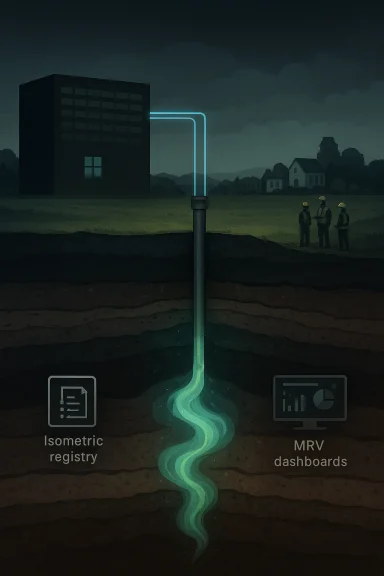
- Vaulted Deep grinds or homogenizes organic waste into a slurry, transports it by truck, and pumps it into porous rock formations thousands of feet below the surface — roughly 5,000 feet (approximately 1,500 meters) in public reporting — where impermeable caprock prevents upward migration.
- The company counts the avoided emissions and the carbon that becomes mineralized or otherwise immobilized in the subsurface and sells credits that correspond to those removals. The company reports early deliveries and small‑scale tonnage while scaling operations.
Verification and registry
- Vaulted Deep’s credits have been issued under the Isometric standard and registry, which stresses scientific rigour, transparency and long‑durability claims (Isometric defines durable removal with multi‑century permanence criteria). Isometric’s dMRV (digital measurement, reporting and verification) system has been highlighted as enabling faster, data‑rich verification cycles for Vaulted Deep.
Why Microsoft bought this removal
Microsoft’s public rationale is twofold: it needs durable, scalable removal to balance growing emissions tied to AI and datacenter expansion; and Vaulted Deep’s approach provides practical co‑benefits in waste management and pollution reduction.- The company has publicly said it is buying a “basket” of removal technologies — BECCS, direct air capture, and industrial storage among them — to both diversify risk and accelerate scalable solutions. Vaulted Deep fits the “low‑tech, fast deployment” corner of that portfolio: the method repurposes existing injection engineering and existing waste streams.
- Reported market pricing for Vaulted Deep credits is around $350 per metric ton, which, multiplied by 4.9 million tons, has led to public estimates of the deal’s nominal value in the ballpark of $1.6–$1.8 billion — though neither side disclosed definitive financial terms. These price levels reflect the current premium placed on durable, well‑verified removals in a market where credible permanent CDR remains scarce.
- Microsoft’s carbon procurement volumes are large and rising. Independent market trackers and reporting outlets note that the company has purchased tens of millions of tonnes of removal credits in recent years as its footprint expanded, with several large offtake agreements preceding this Vaulted Deep deal. Some reporters cite aggregated purchases of more than 80 million tonnes by Microsoft from a range of suppliers. These purchases are intended to help the company meet near‑term public commitments while technology and grid decarbonization continue.
The upside: practical benefits and why buyers like Microsoft
- Speed and scalability: Vaulted Deep’s model leans on established well‑drilling and injection technology; in regions with permitted geology this can be deployed quickly compared with still‑emerging chemical removal methods.
- Co‑benefits for local environments: Diverting bioslurry from land application and surface disposal can reduce nutrient runoff, pathogen exposure and the leaching of PFAS into waterways — outcomes that resonate with regulators and community stakeholders when properly managed. Vaulted Deep and Microsoft emphasize these local benefits in their public statements.
- High‑quality MRV and registries: Using Isometric’s protocol and digital MRV claims to deliver fully auditable, frequent verification of tonnes injected — addressing a major barrier in voluntary carbon markets where slow, opaque verification has historically undermined confidence.
- Cost relative to alternatives: At present price points for high‑quality permanent removal, certain biological or geological pathways can be cheaper than large‑scale direct air capture or BECCS, making them attractive as part of a diversified procurement strategy.
The risks and unresolved questions
Microsoft’s Vaulted Deep purchase illuminates strengths and real risks that should shape how the industry, regulators and communities evaluate such projects.1) Geologic and seismic risk
Injecting millions of gallons of fluid into deep formations has a documented history of inducing seismicity in some contexts. U.S. federal studies and USGS analyses have repeatedly linked certain deep‑injection wells — particularly those that alter pore pressure near pre‑existing faults — to increases in small to moderate earthquakes. Past cases (Rocky Mountain Arsenal, parts of Oklahoma and Ohio) show that pressure fronts can migrate and trigger faults months or years after injection operations begin or cease. That risk is real and site‑specific: careful geologic screening, continuous monitoring and conservative injection protocols are essential to mitigate it.2) Groundwater contamination and chemical mobility
The subsurface is not a perfect, impermeable vault. Concerns center on whether injected waste could mobilize contaminants — PFAS, heavy metals, pathogens, or naturally occurring radionuclides — into groundwater or otherwise alter subsurface geochemistry. Vaulted Deep and registries assert that site selection (deep formations with impermeable caprock) and permitting prevent upward migration, but long‑term monitoring and transparent data are required to validate those claims over decades and centuries. Public trust will hinge on the rigor and public availability of monitoring data.3) Permanence assumptions and measurement
Registries like Isometric apply stringent standards, but permanence remains both a scientific and legal claim: storage must remain secure over centuries to be considered durable. Questions include how permanence is modelled, what contingencies exist if leakage occurs, and how liability is assigned if sequestration fails in the future. The Isometric protocols and Vaulted Deep’s dMRV are advances, yet the carbon‑market community must hold ongoing scrutiny of the underlying science and long‑tail stewardship provisions.4) Additionality and incentive misalignment
Carbon markets historically struggled with additionality: did the buyer’s money cause removals that would not otherwise have occurred? Vaulted Deep’s argument is that the waste streams they use would otherwise emit greenhouse gases or pollute, so locking them underground is additive. But critics will ask whether those feedstocks could compete with other legitimate uses (e.g., anaerobic digestion for biogas or composting), or whether market demand for bioslurry will push up prices and divert material from lower‑carbon uses. Transparent supply chain accounting is necessary to show true additionality.5) Social license and local community concerns
Large‑scale, industrial disposal operations can generate community resistance. The history of injection wells includes contentious court fights and regulatory pushback when communities felt left out of permitting decisions. Microsoft and Vaulted Deep will need robust, inclusive community engagement and third‑party oversight to maintain social license — especially when facilities sit near towns or agricultural areas.6) Regulatory uncertainty
Deep geological injection for waste disposal occupies a patchwork of regulatory regimes (federal, state, local) with different classifications for waste and different permitting pathways. New categories of carbon removal may invite new oversight, and future regulations could change cost and liability. That regulatory uncertainty creates both project risk and investor exposure.Cross‑checking the big numbers and claims
Several widely reported quantitative claims deserve careful scrutiny.- The headline figure — 4.9 million metric tons over 12 years — appears consistently in news coverage of the Vaulted Deep purchase and in paid reporting. Independent outlets such as TechCrunch and the Wall Street Journal report the same 4.9 Mt figure as the deal’s maximum delivery volume and a 12‑year contract term. Those outlets also note the projected injection depth of ~5,000 feet.
- Reported market prices of about $350 per ton for Vaulted Deep’s durable credits are cited across multiple outlets; using that figure as an illustrative price point yields public estimates of the deal’s nominal value near $1.6–$1.8 billion. Microsoft and Vaulted Deep did not disclose exact financial terms publicly, and those dollar estimates depend on current market pricing and the precise tonnage actually delivered by Vaulted Deep over time. Readers should treat the dollar totals as estimates derived from published price ranges rather than contractually verified numbers.
- Claims about Microsoft’s cumulative emissions (for example, reporting that Microsoft emitted “75.5 million tons of CO₂ from 2020 to 2024”) appear in multiple press outlets quoting either independent trackers or aggregated readings from sustainability disclosures. Microsoft’s own public reporting details year‑to‑year totals and percentage changes but does not always present the exact cumulative five‑year total in a single headline figure; therefore, while the figure circulates in coverage it should be validated against Microsoft’s formal datasets and the consolidated reporting tables in the company’s environmental reports before being treated as an audited cumulative total. In short: well‑reported, but worth verifying with the primary company filings for precision.
- Large figures for Microsoft’s prior purchase volumes (for example, “more than 83 million tons” of carbon removal acquired historically and “59 million bought this year”) are attributed in reporting to market trackers and aggregator services such as AlliedOffsets and to registries. These aggregate numbers are useful to understand scale, but they combine multiple suppliers, registries and contract types and therefore mask the differing permanence, price and verification quality across suppliers. Cross‑referencing registry data and company disclosures is essential for precise accounting.
Legal, market and governance context
The Vaulted Deep transaction highlights the role of third‑party legal and market infrastructure in enabling big offtakes.- Legal counsel and transactional advisers have been actively involved; for example, law firms were publicly reported to have advised Vaulted Deep on the offtake transaction, underscoring the contractual complexity of long‑term CDR delivery and the liability allocations required when permanence and multi‑decade stewardship are in play.
- Registries and standards — notably Isometric in this case — are trying to raise the bar for what constitutes a high‑quality, durable removal. Their protocols address MRV cadence, permanence modelling, life‑cycle emissions accounting and disclosure requirements. Widespread adoption of rigorous standards matters because it aligns buyer incentives with verified climate outcomes.
What this means for the tech sector and the carbon market
Microsoft’s Vaulted Deep purchase is significant beyond its headline tonnage because it signals three market trends:- Hyperscalers will keep buying permanent removals. Large cloud and AI providers face rapidly growing operational footprints, so aggressive procurement of removals is now standard practice to meet public commitments. Microsoft’s portfolio approach — buying many removal types — will likely be copied across the sector.
- Premiums for high‑quality, verifiable durability persist. Buyers are willing to pay for removals that registries and third‑party verification deem long‑lasting. That dynamic supports rapid scaling of suppliers that can deliver audited, traceable tonnes quickly.
- Regulatory and reputational scrutiny will increase. As removals scale, so will demands for transparent monitoring, community engagement and legal clarity about long‑term stewardship. Firms that fail to demonstrate robust safety, monitoring and governance may face regulatory restrictions or public pushback.
Practical takeaways for policymakers, buyers and civil society
- Policymakers should require—and fund—robust monitoring regimes and public disclosure of long‑term injection data, including seismic monitoring, groundwater chemistry baselines and periodic third‑party verification.
- Buyers must demand contract clauses that allocate long‑term liability, guarantee remediation mechanisms and specify independent monitoring and public data release rather than opaque registry entries alone.
- Civil society and local communities should be given meaningful participation rights in permitting; companies should publish the technical evidence used in site selection and risk assessments in accessible form.
- Carbon‑market infrastructure (registries, verifiers, standard‑setters) must keep tightening protocols for permanence, leakage risk modelling and life‑cycle accounting, and buyers should prefer credits from registries with transparent, auditable data platforms.
Conclusion: pragmatic but not a panacea
Microsoft’s deal with Vaulted Deep is a clear example of pragmatic climate procurement: it pairs urgent corporate decarbonization needs with a removal method that is comparatively fast to deploy and, if executed with rigorous MRV and oversight, genuinely durable. The approach also converts a local nuisance and pollution risk (biosolids) into a claimed global climate benefit and, potentially, a local environmental benefit if it prevents PFAS and nutrient runoff.However, the strategy is not without material caveats. The history of deep‑injection projects shows that geologic risk, induced seismicity and potential contamination are not theoretical. The permanence claims depend on long‑term monitoring, legally binding stewardship and transparent data that the public and regulators can examine. Market estimates on pricing and cumulative corporate purchase totals are helpful to understand scale, but they remain aggregate and should be verified against registries and audited corporate disclosures.
For Microsoft and other buyers, Vaulted Deep represents one piece of a multi‑pronged approach: accelerate energy efficiency and clean power, decarbonize supply chains, and invest in a diversified portfolio of removals. For policymakers and civil society, the transaction is a reminder that ambitious climate goals require not only financial muscle, but also rigorous science, accountable governance and community consent. The next several years will reveal whether this model can scale responsibly — and whether it will deliver the durable climate benefits buyers are buying.
Source: AOL.com Microsoft wants to use human poop to lower its vast carbon footprint
