

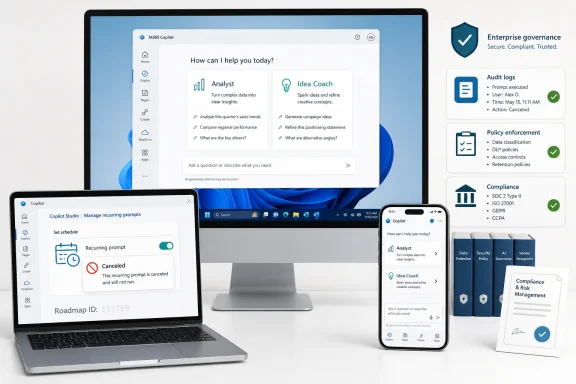
Microsoft cancelled Microsoft 365 Roadmap item 531759 on July 6, 2026, ending a planned Copilot feature that would have let users schedule recurring prompts for declarative agents such as Analyst and Idea Coach across desktop, Mac, and web clients. The decision matters less because one automation toggle disappeared than because it exposes the tension inside Microsoft’s Copilot strategy: the company is selling agents as work partners, while still deciding how much unattended work they should be trusted to do. The roadmap entry, updated by Microsoft and echoed in Microsoft 365 change-tracking archives, is a small cancellation with a large shadow.
The cancelled feature was straightforward on paper. A user would write a prompt for a Microsoft 365 Copilot agent, attach a recurrence to it, and let that agent produce scheduled outputs without requiring the user to remember the ritual. In the language of Microsoft’s roadmap, it would have applied to “declarative agents” such as Analyst and Idea Coach, with preview once planned for November 2025 and general availability for May 2026.
That timeline is now dead. Microsoft’s updated roadmap status says the company is “not moving forward with this feature,” followed by the familiar apology for inconvenience. The wording is terse, but the product implication is not: scheduled prompts for ordinary Copilot chat remain a supported concept, while this more agent-specific version has been cut from the plan.
That distinction is important. Microsoft already documents scheduled prompts for Microsoft 365 Copilot in places like Copilot Chat, Teams, and Outlook, with controls that allow users to automate recurring Copilot interactions. What has been cancelled is the extension of that idea into a broader agent surface where specialized assistants could repeatedly act on user intent.
The difference between those two worlds is the difference between “remind me to ask Copilot for a meeting summary” and “let this agent keep doing a job.” Microsoft has spent the past two years insisting that the second world is coming. This cancellation suggests that the company is still negotiating the boundary between useful automation and operational risk.
A scheduled prompt turns Copilot from an interactive assistant into a recurring process. It can produce Monday pipeline summaries, Friday risk reviews, morning inbox digests, daily competitive scans, or weekly project-status narratives. For knowledge workers, the appeal is obvious: the prompt you write once becomes a standing routine.
For administrators, that same appeal is the warning label. Recurrence creates persistence. Persistence creates an audit problem. An agent that answers one question in a chat window is one thing; an agent that wakes up every morning, reads business data, generates a conclusion, and leaves it in a conversation history is something closer to a workflow engine.
Microsoft’s Copilot positioning has increasingly leaned into this workflow language. The company describes declarative agents as a way to tailor Microsoft 365 Copilot to business scenarios using instructions, knowledge, and actions. Microsoft’s documentation also emphasizes that these agents run within the same broader Copilot infrastructure, inheriting enterprise data access and compliance boundaries.
That is the bet. The problem is that a scheduled agent is not merely a customized chatbot. It is a standing delegation.
Analyst and Idea Coach fit neatly into that pitch. Analyst is meant to help turn information into analysis. Idea Coach exists to help users refine concepts and brainstorm direction. In isolation, neither sounds especially dangerous; they are productivity characters in Microsoft’s expanding cast of Copilot helpers.
But agents become more consequential when they gain recurrence. A one-time brainstorming session is disposable. A weekly automatically generated market-positioning memo can influence meetings, priorities, and decisions before anyone remembers to question its assumptions. A daily data analysis generated by an agent can become a report of record through sheer repetition.
This is where Microsoft’s cancellation becomes more interesting than the feature itself. The company has not walked away from agents, and it has not walked away from scheduled prompts. It has walked away from their combination in this particular roadmap item. That looks less like a retreat from AI and more like a pause around product boundaries.
Roadmap item 531759 had enough specificity to be operationally meaningful. It named the product, platforms, release rings, cloud instance, preview date, general availability month, and target agent examples. That is the kind of entry IT teams watch because it affects readiness materials, admin policies, training, governance reviews, and support scripts.
Then the status changed to cancelled. Microsoft’s roadmap site says features can be cancelled, postponed, or removed as they evolve, and that all information is subject to change. That caveat is accurate, but it does not erase the cost of churn for tenants that use the roadmap as a planning calendar.
For WindowsForum readers in admin roles, this is the familiar Microsoft 365 rhythm: a capability appears, gets tracked, sometimes ships unevenly, sometimes changes names, and sometimes disappears. The operational discipline is not to ignore the roadmap, but to avoid treating every roadmap item as a project requirement before it reaches the tenant with stable controls.
In this case, the safest reading is blunt. If your Copilot adoption plan assumed recurring prompts for declarative agents in 2026, remove that assumption.
Human-triggered Copilot prompts have a natural checkpoint: a person decides to ask. Scheduled prompts weaken that checkpoint. The user may have forgotten the exact wording, the underlying files may have changed, the business context may have shifted, or the recipient may no longer be appropriate. Recurrence makes yesterday’s good idea tomorrow’s compliance ticket.
Microsoft’s existing scheduled-prompt documentation already hints at these complications. The feature depends on Microsoft 365 Copilot licensing and optional connected experiences, and administrators can affect availability through policy. Microsoft also notes limits and management controls, which is another way of saying that scheduled AI output is not just a convenience feature.
Declarative agents add another layer. They may be grounded in organizational knowledge, SharePoint material, connectors, and business-specific instructions. If an agent can invoke actions or draw from sensitive repositories, the scheduling layer becomes a governance multiplier.
That multiplier is probably why the cancellation is sensible, even if disappointing. Enterprise AI does not become trustworthy by acquiring more autonomy. It becomes trustworthy when autonomy is paired with visibility, policy, lifecycle management, and boring administrative levers.
The trouble is that a feature like this must succeed in the real Microsoft 365 mess, not in a launch demo. Tenants have mixed licensing, uneven app versions, optional connected experiences disabled for some groups, sensitivity labels, retention rules, conditional access policies, and users who do not distinguish between Copilot Chat, Copilot in Office, Copilot Studio, and agents built by Microsoft.
A scheduled agent feature would need to answer deceptively basic questions. Where does the output live? Who owns it when the creator leaves? What happens when an agent loses access to a data source? How does an admin find every recurring agent prompt in the tenant? What appears in audit logs? Can eDiscovery preserve the output? Can security teams disable one agent’s recurrence without disabling useful scheduled prompts elsewhere?
Those are not edge cases. They are the enterprise product.
Microsoft may have had answers internally, or it may have decided the answers were not ready for general availability. Either way, cancelling the roadmap item is better than shipping an automation layer that leaves administrators reverse-engineering the blast radius after users discover it.
Scheduled prompts raise that reliability bar. A chat response can be imperfect and still useful because the user is present to inspect it. A recurring response asks to be trusted in absentia. The less attention the user pays, the more robust the system must be.
That is why Microsoft’s cancellation should not be read as a failure of the agent concept. It is a reminder that agents are becoming software infrastructure, and infrastructure has a different standard than a clever assistant. A feature that runs on a calendar must be predictable, governable, observable, and supportable.
The company’s broader Copilot platform is moving toward agents anyway. Microsoft’s own documentation frames agents as extensions of Microsoft 365 Copilot, with organizational knowledge and actions available under enterprise security and compliance models. But moving from “agent available on demand” to “agent runs on schedule” is a product threshold.
Microsoft just declined to cross it here.
But the larger governance lesson is more useful. Organizations should inventory where scheduled Copilot prompts already exist, who can use them, and how optional connected experiences are configured. Microsoft’s existing scheduled-prompt support is not the same as the cancelled agent-specific capability, but it occupies the same risk family.
Admins should also separate three categories that users will often blur. There are scheduled prompts in Microsoft 365 Copilot experiences. There are declarative agents designed for specific tasks. And there are broader workflow and automation surfaces across Teams, Power Platform, and Copilot Studio. They may converge in user expectations even when Microsoft treats them as separate products.
That convergence is where help desks get tickets. A user sees scheduled prompts in one Copilot surface and assumes the same control exists for an agent. Another user reads old roadmap coverage and asks why a promised feature is missing. A third creates a workaround in a workflow tool that creates a larger governance problem than the cancelled feature would have.
The right response is not panic. It is documentation. Update internal Copilot guidance, remove references to the cancelled roadmap item, and make clear which scheduled AI capabilities are approved in your tenant.
Both can be true. Microsoft is trying to turn Copilot from a product into a platform while also competing in an AI market that punishes hesitation. Roadmap pressure is inevitable. So is cleanup.
The company’s challenge is that enterprise buyers hear “agent” and expect both magic and control. They want software that can act on their behalf, but they also want logs, policy, approvals, lifecycle controls, retention behavior, data boundaries, and predictable licensing. The more Microsoft emphasizes autonomous work, the more it must deliver the administrative machinery around that autonomy.
This is where scheduled prompts become symbolically important. They are not a flagship AI breakthrough. They are the mundane bridge between chat and operations. If that bridge is shaky, customers will notice.
Microsoft’s decision to cancel one scheduled-agent feature does not mean agents are receding. It means the company is still deciding which parts of agentic work belong inside Copilot Chat, which belong in workflow products, which belong in Copilot Studio, and which are not ready for general-purpose users.
Scheduled agent prompts would have accelerated that cycle. Users could have created recurring AI-generated business artifacts without necessarily involving IT, records managers, security teams, or process owners. That is the same shadow-IT story enterprises know well, but with language models attached to business data.
The solution is not to block every AI automation. That would be both unrealistic and strategically shortsighted. The solution is to treat AI recurrence as a change-control event, not a personal productivity preference.
If an agent produces a recurring output that influences work, it should have an owner. If it uses business data, it should have a data boundary. If it generates artifacts worth retaining, it should have a retention expectation. If it fails, someone should know.
This is not bureaucracy for its own sake. It is how organizations prevent automated assistance from becoming automated ambiguity.
 Microsoft Pulls Back From the Agent Alarm Clock
The cancelled feature was straightforward on paper. A user would write a prompt for a Microsoft 365 Copilot agent, attach a recurrence to it, and let that agent produce scheduled outputs without requiring the user to remember the ritual. In the language of Microsoft’s roadmap, it would have applied to “declarative agents” such as Analyst and Idea Coach, with preview once planned for November 2025 and general availability for May 2026.That timeline is now dead. Microsoft’s updated roadmap status says the company is “not moving forward with this feature,” followed by the familiar apology for inconvenience. The wording is terse, but the product implication is not: scheduled prompts for ordinary Copilot chat remain a supported concept, while this more agent-specific version has been cut from the plan.
That distinction is important. Microsoft already documents scheduled prompts for Microsoft 365 Copilot in places like Copilot Chat, Teams, and Outlook, with controls that allow users to automate recurring Copilot interactions. What has been cancelled is the extension of that idea into a broader agent surface where specialized assistants could repeatedly act on user intent.
The difference between those two worlds is the difference between “remind me to ask Copilot for a meeting summary” and “let this agent keep doing a job.” Microsoft has spent the past two years insisting that the second world is coming. This cancellation suggests that the company is still negotiating the boundary between useful automation and operational risk.
The Feature Was Small, but the Direction Was Strategic
Scheduled prompts are not glamorous. They do not demo as well as multimodal reasoning, autonomous coding, or an agent that rummages through your CRM and drafts a sales plan. But in daily enterprise software, scheduling is often the moment a novelty becomes infrastructure.A scheduled prompt turns Copilot from an interactive assistant into a recurring process. It can produce Monday pipeline summaries, Friday risk reviews, morning inbox digests, daily competitive scans, or weekly project-status narratives. For knowledge workers, the appeal is obvious: the prompt you write once becomes a standing routine.
For administrators, that same appeal is the warning label. Recurrence creates persistence. Persistence creates an audit problem. An agent that answers one question in a chat window is one thing; an agent that wakes up every morning, reads business data, generates a conclusion, and leaves it in a conversation history is something closer to a workflow engine.
Microsoft’s Copilot positioning has increasingly leaned into this workflow language. The company describes declarative agents as a way to tailor Microsoft 365 Copilot to business scenarios using instructions, knowledge, and actions. Microsoft’s documentation also emphasizes that these agents run within the same broader Copilot infrastructure, inheriting enterprise data access and compliance boundaries.
That is the bet. The problem is that a scheduled agent is not merely a customized chatbot. It is a standing delegation.
Declarative Agents Are Microsoft’s Low-Code Bet on Delegated Work
Declarative agents are designed to be less exotic than they sound. Instead of building a custom AI application from scratch, an organization can define an agent’s purpose, instructions, grounding sources, and capabilities. Microsoft wants these agents to feel like business tools rather than science projects.Analyst and Idea Coach fit neatly into that pitch. Analyst is meant to help turn information into analysis. Idea Coach exists to help users refine concepts and brainstorm direction. In isolation, neither sounds especially dangerous; they are productivity characters in Microsoft’s expanding cast of Copilot helpers.
But agents become more consequential when they gain recurrence. A one-time brainstorming session is disposable. A weekly automatically generated market-positioning memo can influence meetings, priorities, and decisions before anyone remembers to question its assumptions. A daily data analysis generated by an agent can become a report of record through sheer repetition.
This is where Microsoft’s cancellation becomes more interesting than the feature itself. The company has not walked away from agents, and it has not walked away from scheduled prompts. It has walked away from their combination in this particular roadmap item. That looks less like a retreat from AI and more like a pause around product boundaries.
The Roadmap Is a Promise With an Escape Hatch
Microsoft 365 Roadmap entries have always lived in a strange zone between commitment and forecast. Customers treat them as planning signals. Microsoft treats them as estimates subject to change. Both sides know the deal, but the friction appears whenever a roadmap item becomes part of someone’s internal deployment plan.Roadmap item 531759 had enough specificity to be operationally meaningful. It named the product, platforms, release rings, cloud instance, preview date, general availability month, and target agent examples. That is the kind of entry IT teams watch because it affects readiness materials, admin policies, training, governance reviews, and support scripts.
Then the status changed to cancelled. Microsoft’s roadmap site says features can be cancelled, postponed, or removed as they evolve, and that all information is subject to change. That caveat is accurate, but it does not erase the cost of churn for tenants that use the roadmap as a planning calendar.
For WindowsForum readers in admin roles, this is the familiar Microsoft 365 rhythm: a capability appears, gets tracked, sometimes ships unevenly, sometimes changes names, and sometimes disappears. The operational discipline is not to ignore the roadmap, but to avoid treating every roadmap item as a project requirement before it reaches the tenant with stable controls.
In this case, the safest reading is blunt. If your Copilot adoption plan assumed recurring prompts for declarative agents in 2026, remove that assumption.
Automation Is Where Copilot Governance Gets Real
The governance issue is not that agents might be malicious. It is that they might be confidently mundane. An automated agent can generate stale summaries, overfit to the wrong source, expose sensitive context to the wrong user, or create an output that looks official because it arrived on schedule.Human-triggered Copilot prompts have a natural checkpoint: a person decides to ask. Scheduled prompts weaken that checkpoint. The user may have forgotten the exact wording, the underlying files may have changed, the business context may have shifted, or the recipient may no longer be appropriate. Recurrence makes yesterday’s good idea tomorrow’s compliance ticket.
Microsoft’s existing scheduled-prompt documentation already hints at these complications. The feature depends on Microsoft 365 Copilot licensing and optional connected experiences, and administrators can affect availability through policy. Microsoft also notes limits and management controls, which is another way of saying that scheduled AI output is not just a convenience feature.
Declarative agents add another layer. They may be grounded in organizational knowledge, SharePoint material, connectors, and business-specific instructions. If an agent can invoke actions or draw from sensitive repositories, the scheduling layer becomes a governance multiplier.
That multiplier is probably why the cancellation is sensible, even if disappointing. Enterprise AI does not become trustworthy by acquiring more autonomy. It becomes trustworthy when autonomy is paired with visibility, policy, lifecycle management, and boring administrative levers.
The User Experience Was Easy to Imagine and Hard to Guarantee
The cancelled feature was attractive because everyone can imagine the use cases. Ask Analyst to review a workbook every Monday morning. Ask Idea Coach to generate campaign angles every Wednesday. Ask a departmental agent to produce a weekly synthesis of SharePoint updates, Teams threads, and unresolved customer issues.The trouble is that a feature like this must succeed in the real Microsoft 365 mess, not in a launch demo. Tenants have mixed licensing, uneven app versions, optional connected experiences disabled for some groups, sensitivity labels, retention rules, conditional access policies, and users who do not distinguish between Copilot Chat, Copilot in Office, Copilot Studio, and agents built by Microsoft.
A scheduled agent feature would need to answer deceptively basic questions. Where does the output live? Who owns it when the creator leaves? What happens when an agent loses access to a data source? How does an admin find every recurring agent prompt in the tenant? What appears in audit logs? Can eDiscovery preserve the output? Can security teams disable one agent’s recurrence without disabling useful scheduled prompts elsewhere?
Those are not edge cases. They are the enterprise product.
Microsoft may have had answers internally, or it may have decided the answers were not ready for general availability. Either way, cancelling the roadmap item is better than shipping an automation layer that leaves administrators reverse-engineering the blast radius after users discover it.
Copilot’s Biggest Challenge Is Not Intelligence but Reliability
The industry’s agent rhetoric tends to obsess over intelligence. Can the model reason? Can it plan? Can it use tools? Can it understand context? Those are real questions, but enterprise adoption often stalls on a less glamorous one: can the system be relied upon repeatedly under policy?Scheduled prompts raise that reliability bar. A chat response can be imperfect and still useful because the user is present to inspect it. A recurring response asks to be trusted in absentia. The less attention the user pays, the more robust the system must be.
That is why Microsoft’s cancellation should not be read as a failure of the agent concept. It is a reminder that agents are becoming software infrastructure, and infrastructure has a different standard than a clever assistant. A feature that runs on a calendar must be predictable, governable, observable, and supportable.
The company’s broader Copilot platform is moving toward agents anyway. Microsoft’s own documentation frames agents as extensions of Microsoft 365 Copilot, with organizational knowledge and actions available under enterprise security and compliance models. But moving from “agent available on demand” to “agent runs on schedule” is a product threshold.
Microsoft just declined to cross it here.
Admins Should Treat This as a Governance Signal, Not a Dead End
For IT departments, the practical consequence is simple: do not wait for Roadmap ID 531759. It is cancelled. If users ask why they cannot schedule recurring prompts to agents like Analyst or Idea Coach through this planned feature, the answer is that Microsoft is no longer shipping that roadmap item.But the larger governance lesson is more useful. Organizations should inventory where scheduled Copilot prompts already exist, who can use them, and how optional connected experiences are configured. Microsoft’s existing scheduled-prompt support is not the same as the cancelled agent-specific capability, but it occupies the same risk family.
Admins should also separate three categories that users will often blur. There are scheduled prompts in Microsoft 365 Copilot experiences. There are declarative agents designed for specific tasks. And there are broader workflow and automation surfaces across Teams, Power Platform, and Copilot Studio. They may converge in user expectations even when Microsoft treats them as separate products.
That convergence is where help desks get tickets. A user sees scheduled prompts in one Copilot surface and assumes the same control exists for an agent. Another user reads old roadmap coverage and asks why a promised feature is missing. A third creates a workaround in a workflow tool that creates a larger governance problem than the cancelled feature would have.
The right response is not panic. It is documentation. Update internal Copilot guidance, remove references to the cancelled roadmap item, and make clear which scheduled AI capabilities are approved in your tenant.
Microsoft’s AI Roadmap Is Learning the Cost of Ambition
There is a charitable interpretation of this cancellation and a cynical one. The charitable version is that Microsoft found enough complexity in scheduled agent prompts to pull back before customers inherited the mess. The cynical version is that Microsoft’s AI roadmap is still running ahead of product maturity, with some features announced before the platform can absorb them.Both can be true. Microsoft is trying to turn Copilot from a product into a platform while also competing in an AI market that punishes hesitation. Roadmap pressure is inevitable. So is cleanup.
The company’s challenge is that enterprise buyers hear “agent” and expect both magic and control. They want software that can act on their behalf, but they also want logs, policy, approvals, lifecycle controls, retention behavior, data boundaries, and predictable licensing. The more Microsoft emphasizes autonomous work, the more it must deliver the administrative machinery around that autonomy.
This is where scheduled prompts become symbolically important. They are not a flagship AI breakthrough. They are the mundane bridge between chat and operations. If that bridge is shaky, customers will notice.
Microsoft’s decision to cancel one scheduled-agent feature does not mean agents are receding. It means the company is still deciding which parts of agentic work belong inside Copilot Chat, which belong in workflow products, which belong in Copilot Studio, and which are not ready for general-purpose users.
The Agent Era Still Needs a Change-Control Mindset
Windows and Microsoft 365 administrators have seen this pattern before. A platform vendor introduces a capability as empowerment, users discover it as convenience, and IT eventually receives it as risk. The cycle is not new; AI only compresses it.Scheduled agent prompts would have accelerated that cycle. Users could have created recurring AI-generated business artifacts without necessarily involving IT, records managers, security teams, or process owners. That is the same shadow-IT story enterprises know well, but with language models attached to business data.
The solution is not to block every AI automation. That would be both unrealistic and strategically shortsighted. The solution is to treat AI recurrence as a change-control event, not a personal productivity preference.
If an agent produces a recurring output that influences work, it should have an owner. If it uses business data, it should have a data boundary. If it generates artifacts worth retaining, it should have a retention expectation. If it fails, someone should know.
This is not bureaucracy for its own sake. It is how organizations prevent automated assistance from becoming automated ambiguity.
The Cancelled Roadmap Item Leaves a Clear Admin To-Do List
The disappearance of scheduled prompts for declarative agents is not a crisis, but it is a useful forcing function. It tells Copilot customers to stop treating every agent feature as inevitable and to start separating shipped controls from roadmap intent.- Microsoft has cancelled Roadmap ID 531759, so scheduled recurring prompts for declarative agents such as Analyst and Idea Coach should no longer be treated as a May 2026 general-availability feature.
- Existing scheduled prompts for Microsoft 365 Copilot remain a separate capability, and administrators should not assume that support documentation for ordinary scheduled prompts applies to the cancelled agent-specific roadmap item.
- Organizations that wrote adoption plans, training decks, or governance notes around this roadmap item should revise them before users mistake a cancelled feature for a tenant configuration problem.
- IT teams should review optional connected experiences and Copilot policy settings because scheduled AI behavior already exists in related Microsoft 365 surfaces.
- The cancellation reinforces that recurring agent activity needs stronger ownership, auditability, and lifecycle controls than one-off Copilot chat interactions.
- Microsoft’s agent strategy remains intact, but this decision shows that the company is still drawing lines between chat assistance, scheduled productivity, and unattended business automation.
References
- Primary source: Microsoft 365 Roadmap
Published: 2026-07-06T23:00:50.6928566Z
Microsoft 365 Roadmap | Microsoft 365
The Microsoft 365 Roadmap lists updates that are currently planned for applicable subscribers. Check here for more information on the status of new features and updates.www.microsoft.com
- Official source: support.microsoft.com
Schedule your most used Copilot prompts | Microsoft Support
Learn how to set a schedule for a Copilot prompt so that you won't have to remember to run it manually.support.microsoft.com - Official source: learn.microsoft.com
Manage Scheduled Prompts for Microsoft 365 Copilot | Microsoft Learn
Learn how to manage scheduled prompts in Microsoft 365 Copilot. Configure admin controls, maintain compliance, and automate workflows effectively.learn.microsoft.com - Related coverage: windowsforum.com
Pilot Microsoft 365 Copilot Scheduled Prompts for Declarative Agents (2026) | Windows Forum
Verdict: deploy Microsoft 365 Copilot scheduled prompts to declarative agents now only for a controlled pilot of repetitive analyst-style workflows, not as...windowsforum.com - Related coverage: supersimple365.com
Scheduled prompts are coming to M365 Copilot - Super Simple 365
Update 5th June 2025. Microsoft: "Power Automate license is no longer required. Users only need a Microsoft Copilot for Microsoft 365 license to use Scheduled prompts". TL;DRScheduled prompts for Copilot will enable automated prompts at specific times in Teams... supersimple365.com
- Official source: cdn-dynmedia-1.microsoft.com
- Related coverage: techriver.com