

Satellite imagery analysts report a coordinated restart of construction across three Microsoft data center campuses in Catawba County, North Carolina, signaling a renewed build program that could add roughly 720–810 MW of IT capacity across the sites and reintroduce significant demand onto the regional grid over the coming years.
Microsoft first announced a multi-site build program in Catawba County as part of a broader expansion of Azure hyperscale infrastructure in the Southeastern United States. The cluster in Catawba County is frequently referenced by project names tied to local parcels—commonly described in filings and reporting as the Lyle Creek, Boyd Farm, and Stover North campuses. Public permitting records and regional economic development disclosures established early expectations for multi-building campuses served by dedicated utility substations, and local officials long described the investment as a multi-year program intended to scale with emerging customer demand.
Throughout 2025, third-party monitoring firms and press coverage recorded uneven progress at several hyperscale projects nationwide, with some campuses showing active mobilization while others paused or slowed due to a mix of permitting, energy, and supply-chain dynamics. Satellite-based monitoring firms that track large infrastructure development using high-resolution imagery flagged reduced activity at the Catawba County sites beginning in mid‑2025; those same firms report renewed, simultaneous activity across all three campuses in January–February 2026.
What makes this episode noteworthy is the simultaneity: three previously slow or dormant parcels in the same county have shown overlapping signs of construction re-mobilization, rather than isolated or staggered contractor visits. For infrastructure watchers and market modelers, that pattern is an early indicator that financing, energy agreements, or permitting milestones have been resolved or sufficiently de-risked to allow coordinated work to resume.
That said, satellite evidence is an observability layer: it documents what’s visible on the ground but usually does not capture contractual nuances (for example, whether the owner has executed all long-term power purchase agreements or whether final permits are fully cleared). To convert imagery signals into credible timelines and capacity forecasts, analysts combine observed activity with public filings (permit complaints, Army Corps public notices), utility interconnection releases, and corporate investor disclosures where available.
Recent utility disclosures show Duke Energy has materially expanded data center contracts and interconnection commitments in North Carolina. That corporate reporting aligns with the satellite-observed substation activity and strengthens confidence that the necessary grid-side resources are being provisioned.
For technologists and infrastructure planners, the episode underscores the value of combining remote sensing with regulatory and utility intelligence: imagery surfaces early movement, but the full operational and market implications only become clear when paired with filings and utility disclosures. For community stakeholders, the restart is a reminder that the long runway from groundbreaking to live capacity can carry material economic benefits and environmental trade-offs that deserve public scrutiny and transparent mitigation.
In the months ahead, follow-up indicators to watch include continued slab and substation completion visible from repeated imagery, formal interconnection milestones from the local utility, and permitting updates that confirm the staged timeline toward late‑2027 initial activations. If those elements align, Microsoft’s Catawba County cluster will join a growing list of hyperscale hubs anchoring the AI-era data center map—bringing scale, complexity, and a new set of planning challenges to the region.
Source: Construction Owners Club Microsoft Data Center Construction Resumes in North Carolina, Satellite Data Shows
 Background
Microsoft first announced a multi-site build program in Catawba County as part of a broader expansion of Azure hyperscale infrastructure in the Southeastern United States. The cluster in Catawba County is frequently referenced by project names tied to local parcels—commonly described in filings and reporting as the Lyle Creek, Boyd Farm, and Stover North campuses. Public permitting records and regional economic development disclosures established early expectations for multi-building campuses served by dedicated utility substations, and local officials long described the investment as a multi-year program intended to scale with emerging customer demand.Throughout 2025, third-party monitoring firms and press coverage recorded uneven progress at several hyperscale projects nationwide, with some campuses showing active mobilization while others paused or slowed due to a mix of permitting, energy, and supply-chain dynamics. Satellite-based monitoring firms that track large infrastructure development using high-resolution imagery flagged reduced activity at the Catawba County sites beginning in mid‑2025; those same firms report renewed, simultaneous activity across all three campuses in January–February 2026.
What makes this episode noteworthy is the simultaneity: three previously slow or dormant parcels in the same county have shown overlapping signs of construction re-mobilization, rather than isolated or staggered contractor visits. For infrastructure watchers and market modelers, that pattern is an early indicator that financing, energy agreements, or permitting milestones have been resolved or sufficiently de-risked to allow coordinated work to resume.
What the satellite record shows (and what it likely means)
Observable signals from space
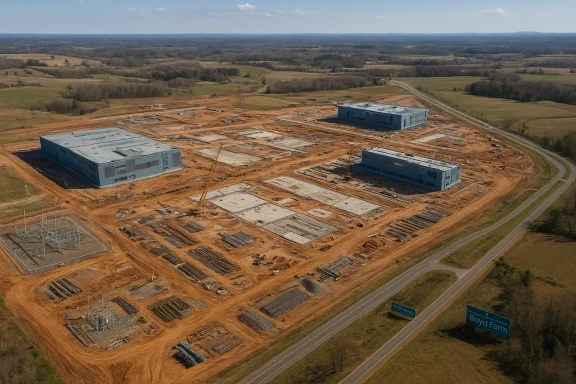
High-resolution satellite imagery captured in early 2026 reveals several distinct markers of renewed construction:- Re-mobilization of heavy equipment and vehicles across multiple pads.
- Consistent material staging (stockpiles of concrete forms, rebar, and aggregate).
- New or resumed work on concrete slabs and building pads.
- Visible progress on substation footprints and associated electrical corridors.
How to interpret imagery signals
Satellite-visible activity can be read at multiple confidence levels. Single, short-lived appearances of machinery may indicate preliminary site access or short-term maintenance. By contrast, sustained patterns—regular material deliveries, continued grading and slab pours, and multiple, repeated equipment movements—raise confidence that a substantive construction campaign is underway.That said, satellite evidence is an observability layer: it documents what’s visible on the ground but usually does not capture contractual nuances (for example, whether the owner has executed all long-term power purchase agreements or whether final permits are fully cleared). To convert imagery signals into credible timelines and capacity forecasts, analysts combine observed activity with public filings (permit complaints, Army Corps public notices), utility interconnection releases, and corporate investor disclosures where available.
Verified project parameters and cross-checks
A composite of public filings and third-party reporting yields a practical baseline for the scale and intent of the Catawba County program.- Planned facilities per campus: public notices filed with regulatory authorities identify program-level plans calling for five data center buildings per campus, with a canonical figure of 48 MW critical IT capacity cited per building. That produces 15 buildings across the three campuses.
- Generator and nameplate modeling: comparative analyses of Microsoft’s other hyperscale sites suggest a typical building configuration near 250,000 square feet, often paired with around 20 backup generator sets per building. Accounting for redundancy, cooling plant overhead, and electrical nameplate methodology, this generates an elevated “nameplate” figure in the mid‑50 MW range per building.
- Capacity estimates: using the filing-supported 48 MW figure yields approximately 720 MW of critical IT capacity across 15 buildings. Modeling the broader generator-backed nameplate assumption increases the total to roughly 810 MW.
Power architecture and grid implications
Substations, lines, and utility relationships
The Catawba County cluster is tightly coupled to Duke Energy’s distribution and transmission assets. Local filings and utility disclosures indicate dedicated substation builds to support the campuses: two substations associated with the Lyle Creek parcel, and one substation each serving Boyd Farm and Stover North. Those substations are the visible bookmarks for large-scale interconnection work and are a common early sign that major energy agreements are in place.Recent utility disclosures show Duke Energy has materially expanded data center contracts and interconnection commitments in North Carolina. That corporate reporting aligns with the satellite-observed substation activity and strengthens confidence that the necessary grid-side resources are being provisioned.
Backup generation and nameplate vs. critical IT capacity
Hyperscale data centers combine the following electrical layers:- Critical IT capacity: the power allocated directly to servers, storage, and networking gear—often reported in regulatory filings as “critical load” and commonly used for capacity declarations (for example, 48 MW per building).
- Building nameplate: the total installed generation and plant electrical capacity supporting redundancy (N+1 or 2N schemes), HVAC, pump systems, and other auxiliary loads. Generator counts and the electrical design margin push nameplate capacity above the critical IT figure.
Short- and mid-term grid impacts
A three-campus program delivering 720–810 MW of capacity will be a major incremental load in the region. Utilities, regulators, and system planners will consider:- Transmission upgrades: creating or reinforcing high-voltage ties to deliver stable power throughout peak demand and contingency events.
- Local distribution reinforcement: transformer sizing, substation switchgear, and fault-current management.
- Resource adequacy: scheduling generation and storage to meet the increased baseload and to support on-site plant testing, reliability runs, and redundancy operations.
Construction timeline — reality check
Satellite-observed construction resumption does not equal immediate operational capacity. Industry build patterns and the on-the-ground sequencing for hyperscale facilities indicate a multi-year timeline:- Site preparation, grading, and slab pours (visible in imagery) — early months of on‑site activity.
- Substation and primary electrical equipment installation — critical path for energization.
- Modular or in-scope mechanical, electrical, and IT plant outfitting — a longer phase often eating into year‑plus timelines per building.
- Staged energization and commissioning — each building is typically brought online in phases rather than all at once.
Economic and community impacts
Local investment and jobs
Local economic filings and development communications frame Microsoft’s Catawba County program as a minimum $1 billion investment over at least a decade. That level of capital creates immediate construction jobs, long-term operations roles (site technicians, facilities engineers, security and site services), and indirect economic activity. However, jobs during steady-state operations are far smaller than peak construction employment; the transition from construction to operations often reframes the local economic narrative from large temporary employment to a smaller permanent workforce supplemented by tax revenues and vendor ecosystems.Municipal and environmental considerations
Hyperscale campuses at this scale invariably raise community conversations about:- Water usage and cooling strategies: even with air-cooling designs, significant water and power infrastructure are necessary for certain configurations.
- Noise and emissions from backup generators during built-in testing and extended outages.
- Traffic and roadway impacts during months-long construction windows.
- Land use and long-term site management, including potential future expansions or repurposing.
Broader market and strategic context
Hyperscaler behavior and AI-driven demand
The hyperscaler landscape has shifted rapidly since the emergence of large-scale generative AI compute needs. Data center operators balance three priorities: access to low-cost, reliable power; proximity to major fiber and peering points; and favorable regulatory environments. When multiple campuses in a single county restart concurrently, market analysts read that as a calibrated response to two converging dynamics:- Renewed demand for on-premise training/inference capacity from enterprise and AI workloads.
- Improved clarity on long-term energy planning, including confirmed utility commitments or on-site power solutions.
Competitive and regional implications
A program in Catawba County approaching 800 MW places the cluster among the larger hyperscale concentrations in the Southeast. That concentration has knock-on effects:- Utilities may prioritize further transmission projects in the region, unlocking capacity for other industrial customers.
- Nearby counties may field inquiries from other hyperscalers and developers, potentially sparking land and interconnection competition.
- Regional labor markets could see a modest long-term uptick in specialized technical staffing and contractor capacity.
Risks, unknowns, and caveats
While the recent satellite signals are persuasive, several risk vectors could delay or alter the program:- Permit and environmental constraints: ongoing reviews, permit appeals, or mitigation requirements could slow progress even after construction begins.
- Grid delivery bottlenecks: interconnection agreements are necessary but not sufficient; physical transmission upgrades can face land-use, regulatory, and capital-construction delays.
- Supply-chain or workforce constraints: large builds require specialized mechanical, electrical, and civil contractors; shortages in equipment or skilled labor can extend timelines.
- Demand-side shifts: hyperscale capacity is tied to customer demand and the pace of AI adoption. If demand materially slows or changes (for example, if more workload migration to specialized on-prem solutions emerges), developers may re-phase builds.
- Unverifiable on-the-ground details: satellite imagery indicates activity visible from orbit, but it cannot confirm contract terms, exact generator models, or final installed IT architecture. Those finer-grained facts remain the domain of company disclosures, permitting documents, and utility filings.
What to watch next (practical monitoring checklist)
- Permitting records: new or updated Army Corps public notices, state 401 water certification filings, or county-level permits will signal regulatory progress or hurdles.
- Utility disclosures: Duke Energy and local transmission operators’ interconnection queues, advance-in-aid notices, or rate filings that reference Microsoft projects will provide the clearest indicator of grid readiness and scheduled energization windows.
- Satellite cadence: repeat imagery that shows continued slab pours, transformer set placements, or completed switchyards is a high-confidence marker that construction is progressing.
- Job postings and contractor awards: large-scale hiring drives or public contracting announcements (site electrical contractors, substation builders, or mechanical systems vendors) often appear ahead of major commissioning milestones.
- Corporate filings and investor communications: any Microsoft statements, investor call comments, or data center pipeline disclosures will confirm corporate intent and timing.
Strengths and strategic positives
- Coordinated restart signals lower project execution risk. Simultaneous activity across three campuses suggests the owner has cleared or materially reduced key barriers—likely including interconnection commitments and financing.
- Regional utility alignment. Utility reporting and the visible substation work indicate that grid partners are actively provisioning capacity, which is a necessary precondition for bringing hyperscale load online.
- Positioning for AI demand. A development this size provides Microsoft with a flexible capacity pool suited for large-scale training and latency-sensitive Azure workloads, aligning with enterprise and AI-driven market trends.
- Economic benefits. The multi-year capital program and associated contracting activity deliver short-term construction employment and long-term tax revenues and service contracts to the local economy.
Potential liabilities and community considerations
- Concentrated grid stress. An incremental 720–810 MW in a single county requires careful system planning to avoid bottlenecks and preserve resilience for other customers.
- Environmental and resource impacts. Noise and emissions from large backup generators, water and land-use implications, and potential habitat impacts are legitimate concerns for nearby communities.
- Political and permitting risk. Large hyperscaler projects can trigger opposition or heightened regulatory scrutiny that slows permitting or increases mitigation obligations.
- Dependence on external factors. The timeline remains sensitive to equipment availability, labor markets, and broader macroeconomic conditions that can influence commodity and contractor prices.
Conclusion — why this matters to Windows Forum readers
The satellite-detected restart of construction across Microsoft’s Catawba County campuses is a high-signal event for anyone tracking cloud capacity, AI infrastructure, and regional grid dynamics. If the observed activity continues and is matched by utility energization and formal permit progress, the cluster will become a significant addition to Azure’s U.S. footprint—one that will reshape local energy planning, contractor markets, and hyperscaler competition in the Southeast.For technologists and infrastructure planners, the episode underscores the value of combining remote sensing with regulatory and utility intelligence: imagery surfaces early movement, but the full operational and market implications only become clear when paired with filings and utility disclosures. For community stakeholders, the restart is a reminder that the long runway from groundbreaking to live capacity can carry material economic benefits and environmental trade-offs that deserve public scrutiny and transparent mitigation.
In the months ahead, follow-up indicators to watch include continued slab and substation completion visible from repeated imagery, formal interconnection milestones from the local utility, and permitting updates that confirm the staged timeline toward late‑2027 initial activations. If those elements align, Microsoft’s Catawba County cluster will join a growing list of hyperscale hubs anchoring the AI-era data center map—bringing scale, complexity, and a new set of planning challenges to the region.
Source: Construction Owners Club Microsoft Data Center Construction Resumes in North Carolina, Satellite Data Shows
