

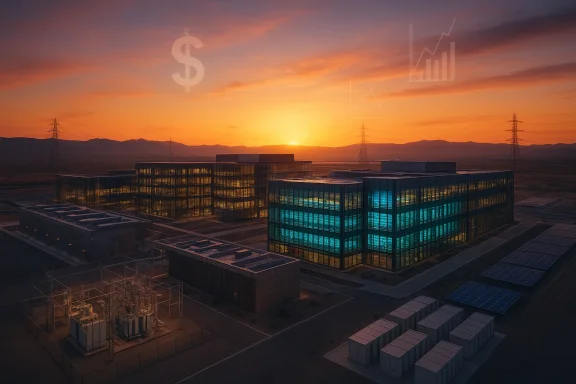
Nvidia is taking a long-term bet on dedicated AI capacity in Nevada: the chipmaker is reportedly set to sign a 16‑year lease (with two optional 10‑year renewals) for a 200‑megawatt data centre and substation being developed in Storey County, Nevada — a project financed in large part through a $3.8 billion high‑yield (junk) bond issuance arranged by an entity backed by Tract Capital.
Nvidia’s move, first reported via market wires and picked up across the trade press, underscores two linked trends: the hyperscaling of GPU‑heavy AI infrastructure, and the growing reliance on non‑investment‑grade capital to fund massive, power‑hungry facilities. The development in Storey County is described as a 200 MW campus and is financed through a Fleet‑backed borrowing vehicle whose planned $3.8 billion bond sale was reportedly increased by $150 million amid strong investor demand, with pricing discussions pointing to yields around ~6%.
Two corporate details are repeated across reporting: the borrower is tied to Tract Capital’s new Fleet strategy (Fleet I is the inaugural fund expected to contribute roughly $620 million of equity to the project), and the bond offering is being led by JPMorgan with Morgan Stanley as a co‑manager. Those financing mechanics materially change the capital stack and risk profile of a single‑tenant, large‑scale data centre built to host frontier AI compute.
The project has not been without controversy: a prior legal dispute involving a covenant tied to an adjacent campus operator (Switch) and the question of allowable development types in that corridor has previously drawn litigation and regulatory attention. Reports indicate those legal hurdles were addressed in rulings and negotiations through 2024–2025, clearing the path for single‑tenant, wholesale or cloud buildings under certain interpretations. Still, local permitting, transmission upgrades and community impacts remain execution risks.
That said, the deal stacks concentration, execution and market‑cycle risks atop the upside. Investors and market participants should treat reported terms as preliminary until firm pricing and official confirmations are published. If the transaction completes as reported, it will accelerate the trend toward single‑tenant, high‑density AI campuses and set a precedent for how much non‑investment‑grade capital the market will allocate to digital‑infrastructure projects — with important consequences for data‑centre economics, regional energy planning, and the competitive dynamics between chipmakers, cloud providers and specialized developers.
In short: this is a bet on scale and the future of centralized AI compute — one that looks sensible for a company building the underlying technology stack, but one that brings concentrated financial and execution risk that will be closely watched by the market as the bond prices and the site moves from paper to power.
Source: The News International Nvidia expands AI infrastructure with Nevada data centre lease
 Background: what was announced and why it matters
Nvidia’s move, first reported via market wires and picked up across the trade press, underscores two linked trends: the hyperscaling of GPU‑heavy AI infrastructure, and the growing reliance on non‑investment‑grade capital to fund massive, power‑hungry facilities. The development in Storey County is described as a 200 MW campus and is financed through a Fleet‑backed borrowing vehicle whose planned $3.8 billion bond sale was reportedly increased by $150 million amid strong investor demand, with pricing discussions pointing to yields around ~6%.Two corporate details are repeated across reporting: the borrower is tied to Tract Capital’s new Fleet strategy (Fleet I is the inaugural fund expected to contribute roughly $620 million of equity to the project), and the bond offering is being led by JPMorgan with Morgan Stanley as a co‑manager. Those financing mechanics materially change the capital stack and risk profile of a single‑tenant, large‑scale data centre built to host frontier AI compute.
Overview of the project and immediate facts
- Project scale: 200 megawatts of data‑centre capacity plus a dedicated substation reported for Storey County, Nevada.
- Lease term: 16 years initial, with two renewal options of 10 years each (effectively up to 36 years if all options are exercised).
- Financing: a $3.8 billion high‑yield bond sale (deal reportedly upsized $150 million), expected yield around 6%, with Fleet I equity of about $620 million slated for the project.
- Underwriters / financiers: JPMorgan Chase as lead, Morgan Stanley as co‑manager, with pricing expected to occur imminently at the time of the reports.
Why Nvidia would sign a long, single‑tenant lease
Securing predictable capacity for frontier AI work
Nvidia is more than a GPU vendor: it designs systems, models and bespoke platforms for training and inference, and its internal compute needs (for chip design, internal model development, large‑scale simulation and AI research) are enormous and steadily increasing. A dedicated 200 MW campus gives Nvidia predictable, controllable rack and power density, lower exposure to multi‑tenant contention, and the ability to specify customized power, cooling and networking architectures optimized for next‑generation accelerators. That operational leverage matters when racks of HBM‑heavy accelerators require specific thermal and electrical footprints.Long tenure reduces supply risk and lock‑in
A 16‑year initial lease with long extensions is functionally a form of long‑dated capacity reservation. It allows Nvidia to lock in proximity to power and transmission capacity and to plan multi‑generational hardware rollouts without the periodic renegotiation and relocation risk that comes with short leases. For AI teams designing multi‑rack systems, the ability to expect same‑site continuity across hardware refresh cycles is a non‑trivial operational advantage.Financing the boom: why junk bonds are showing up in data‑centre deals
The emergence of high‑yield capital for infrastructure
Traditionally, large data centres were financed with a mix of investment‑grade debt and sponsor equity. The recent trend — shown in this deal and others — is high‑yield bond markets stepping into early‑stage or speculative site financings, attracted by long leases, perceived structural demand for AI capacity, and yield differentials in a lower‑for‑long or stable rate outlook. The reported $3.8 billion junk‑bond sale demonstrates investor appetite, with the deal reportedly upsized amid demand and marketed at yields near 6%.Credit profile and market pricing
A ~6% yield on a junk‑grade bond can look reasonable to yield‑hungry institutional buyers when the asset promises long‑dated cashflows underpinned by a blue‑chip tenant like Nvidia. But the “junk” label reflects genuine sub‑investment‑grade credit risk for the borrower — in this case, a special purpose vehicle owned by Fleet I — and exposes investors to tenant concentration risk (single‑user campus), execution risk (construction, interconnection, permitting) and broader market cyclical risk affecting cloud demand and GPU purchasing patterns.Site context: Storey County and the Reno/Tahoe‑Reno data hub
Storey County and the Tahoe‑Reno industrial corridor have been an AI and data‑centre growth hotspot for years. The region’s proximity to transmission assets, renewable generation projects, and favorable business conditions has attracted both hyperscalers and specialist developers. Tract Capital has been assembling land in the broader Reno area for more than a year, growing a pipeline the company claims can support gigawatts of capacity; Fleet’s stated ambition in January was large single‑tenant campuses measured in hundreds of megawatts.The project has not been without controversy: a prior legal dispute involving a covenant tied to an adjacent campus operator (Switch) and the question of allowable development types in that corridor has previously drawn litigation and regulatory attention. Reports indicate those legal hurdles were addressed in rulings and negotiations through 2024–2025, clearing the path for single‑tenant, wholesale or cloud buildings under certain interpretations. Still, local permitting, transmission upgrades and community impacts remain execution risks.
Technical and operational considerations for a 200 MW AI campus
Power, cooling and density expectations
A 200 MW allocation is substantial. For context, modern GPU racks used for large‑model training can consume multiple kilowatts per rack; higher‑density deployments (liquid‑cooled racks, chiplet arrays, networked NVLink fabric) mean the overall footprint and power distribution are highly customized. Single‑tenant campuses let the tenant specify high‑voltage switchgear, bespoke substations, and on‑site or contracted renewable power strategies to control both cost and carbon footprint. The inclusion of a dedicated substation in reporting signals that the project will demand significant grid upgrades and firmed energy arrangements.Hardware lifecycle and interoperability
Nvidia’s own systems — from DGX racks to upcoming rack‑scale platforms — evolve quickly. Owning or leasing a bespoke campus lets Nvidia coordinate architecture changes (e.g., rack form factor, coolant loops, NVLink topologies) without disrupting other tenants or being constrained by multi‑tenant colocation rules. It also simplifies deployment of next‑generation systems that may require denser power and tighter thermal envelopes.Strategic implications across the market
For hyperscalers and cloud providers
Nvidia’s securing of long‑dated capacity is an implicit signal: top AI players see value in guaranteed, purpose‑built physical infrastructure. Hyperscalers (AWS, Azure, Google Cloud) may respond by accelerating their own capacity commitments or locking in long‑term energy and land contracts to avoid being capacity‑constrained for GPU fleets. Conversely, the growth of single‑tenant campuses may reduce available colo inventory and drive pricing pressure in adjacent markets.For the financial markets and private infrastructure capital
The success of a large junk‑bond placement — if it prices as reported — will encourage other speculative or growth‑oriented developers to tap high‑yield markets. That supplies quicker access to capital but also shifts development risk onto bond investors who are less protected than senior bank lenders and who price concentration risk into yields. Expect increased scrutiny from credit analysts and rating desks on tenant creditworthiness, bond covenants, and operational milestones.For regional grids and energy markets
A 200 MW campus requires long‑term, reliable power. Developers increasingly pair site builds with dedicated substations, renewable contracts, battery or gas backup and grid partnerships. In markets with constrained transmission, these projects can accelerate local infrastructure upgrades — but they also intensify debates about industrial power draws versus community energy needs and the pace of renewable integration.Risks and red flags to watch
- Tenant concentration and demand risk
- Single‑tenant campuses magnify the consequences of a tenant scaling back or altering plans. If Nvidia’s needs shift (e.g., more reliance on hyperscaler capacity or different hardware footprints), the site’s revenue under the bond structure could be strained. Multiple outlets note that the deal’s reported structure concentrates operational risk on a single large tenant.
- Execution and permitting risk
- Large‑scale builds need timely permits, construction, and grid interconnection. Delays or cost overruns can erode the equity cushion (Fleet I’s ~$620M stake) and stress the debt service profile. Local legal history around prior covenants and litigation in Storey County is a reminder that land‑use disputes can resurface.
- Interest‑rate and market‑cycle exposure
- Junk bonds are sensitive to credit spreads and macro tightening. A 6% yield priced into the market today could widen under stress, making refinancing or secondary markets more volatile. If broader AI demand cools, asset valuations and rental economics could be affected.
- Technological obsolescence/performance mismatch
- Rapid shifts in accelerator architecture or a move to different data‑centre paradigms (e.g., on‑device or distributed inference) could reduce the value of a large centralized campus built to a specific rack spec.
Notable strengths and strategic upside
- Predictable, long‑dated capacity mitigates short‑term supply squeezes for Nvidia and supports multi‑generation hardware roadmaps.
- The bond market’s willingness to absorb a multi‑billion dollar issue indicates investor conviction in AI infrastructure as an asset class, potentially unlocking faster buildouts and economies of scale for the sector.
- A dedicated substation and site scale permit more aggressive sustainability engineering (on‑site renewables, battery storage) and power‑price hedging, which can materially reduce operating expense volatility over time.
What this means for Windows developers, enterprises and the broader AI ecosystem
For IT teams and developers operating in Windows ecosystems — from enterprise AI projects to on‑prem hybrid models — the trend toward large, single‑tenant GPU campuses has both practical and strategic implications.- Improved availability of dedicated inference and training capacity can accelerate large‑model development, model fine‑tuning and deployment of Windows‑integrated AI services. Enterprises that rely on latency‑sensitive inference may benefit from more geographically distributed, high‑density inference points.
- However, concentration of capacity in specialized campuses can increase dependency on a small set of suppliers and raise costs if colocations tighten. Organizations must keep multi‑cloud and on‑prem alternatives in their resiliency playbooks.
- For ISVs and systems integrators, the trend increases opportunity: more dedicated capacity means more chances to optimize software stacks and drivers for the latest Nvidia architectures and to offer differentiated managed services tuned to the hardware profile.
Immediate next milestones and what to watch
- Bond pricing and allocation — confirm the final yield, tranche structure and covenant package when the deal prices; that pricing will reveal investor appetite and perceived risk.
- Formal announcements from Tract Capital and Nvidia — market reports cite anonymous sources; an official press release or 8‑K/filing (if applicable) will validate terms and provide contractual detail.
- Permitting, interconnection timing and construction starts — the timeline for energization and initial rack install affects when Nvidia can migrate workloads and when investors receive expected cashflows.
- Local grid and energy deals — look for power purchase agreements, battery integrations or renewable commitments that will shape operating costs and carbon intensity.
Final assessment: an opportunistic but risky expansion of AI infrastructure
Nvidia’s reported lease of a 200 MW Storey County campus, financed through a $3.8 billion high‑yield bond, is a vivid snapshot of how AI demand is reshaping both the physical and financial infrastructure markets. The strategic logic is clear: secure long‑dated, high‑density, customizable capacity to support multi‑generational hardware and internal AI projects. The financing approach — tapping junk‑bond demand and reducing sponsor equity contributions via debt — demonstrates how developers will leverage capital markets to scale quickly.That said, the deal stacks concentration, execution and market‑cycle risks atop the upside. Investors and market participants should treat reported terms as preliminary until firm pricing and official confirmations are published. If the transaction completes as reported, it will accelerate the trend toward single‑tenant, high‑density AI campuses and set a precedent for how much non‑investment‑grade capital the market will allocate to digital‑infrastructure projects — with important consequences for data‑centre economics, regional energy planning, and the competitive dynamics between chipmakers, cloud providers and specialized developers.
In short: this is a bet on scale and the future of centralized AI compute — one that looks sensible for a company building the underlying technology stack, but one that brings concentrated financial and execution risk that will be closely watched by the market as the bond prices and the site moves from paper to power.
Source: The News International Nvidia expands AI infrastructure with Nevada data centre lease
