

Microsoft’s Community Library Creator proposes a consequential shift in how AI systems learn to depict people: instead of treating communities as passive subjects of scraped internet data, it gives them a structured role in defining, contributing, reviewing, and governing the material used to represent them in AI-generated imagery.
The idea is deceptively simple. If a generative AI system is expected to create believable, respectful images of people with specific identities, disabilities, cultural backgrounds, or lived experiences, the people represented should have a meaningful say in what accurate representation actually means. Microsoft’s research effort turns that principle into a workflow for advocacy organizations and communities, combining image curation, annotations, consent, evaluation, and ownership controls.
For the broader Windows, Microsoft 365, Azure AI, and Copilot ecosystem, the implications reach beyond image generation. The Community Library Creator is a test of whether the technology industry can move from generalized “responsible AI” statements toward practical, community-led processes for shaping the data, standards, and feedback loops behind AI products.
It is also a reminder that better AI does not come only from larger models, more GPUs, or more web-scale data. Sometimes it comes from asking a more basic question: Who gets to define what good output looks like?
Generative AI systems learn from enormous collections of images, captions, documents, and other material. Those datasets may be vast, but size does not guarantee balance, context, consent, or accuracy. A model trained on millions or billions of online examples can still produce narrow, stereotyped, or implausible depictions when the available data does not reflect the everyday lives of particular communities.
That weakness is especially visible in AI image generation. Models can create polished visuals in seconds, yet they often reveal the cultural and statistical patterns buried in their training data. If photographs of a community are limited, distorted, sensationalized, medicalized, or dominated by stock imagery, the model may reproduce those same limits.
For people with disabilities, this can lead to an especially familiar kind of failure. AI may depict disability primarily through clinical environments, elite sport, charity imagery, or visual clichés. A person with limb differences may be shown only as a patient or athlete, rather than as a colleague in an office, a parent at home, a student in class, or a friend having coffee.
The issue is not simply that a generated picture looks wrong. Representation affects assumptions. Repeated imagery shapes how people imagine who belongs in workplaces, public spaces, schools, social settings, families, and technology itself. When AI-generated media becomes part of advertising, presentations, search results, social content, training materials, and product experiences, those visual defaults can become more influential.
Microsoft’s Community Library Creator is designed around the view that these problems cannot be solved solely by technical teams selecting more data or adjusting a model after complaints emerge. Instead, the work treats representation as a collective and negotiated process that should involve the people most affected.
That is a significant conceptual change. The goal is not to find one supposedly universal “ground truth” for depicting a group. It is to help communities identify the experiences, contexts, values, visual details, and boundaries that matter to them.
This distinction is essential.
A conventional machine learning dataset might label an image with broad categories such as “person,” “wheelchair,” “office,” “hat,” or “outdoor scene.” Those labels help a system identify visual objects and settings. They do not necessarily explain the lived context behind them.
A community library aims to include that missing layer. An image might show a person wearing a hat, but the annotation can identify sun protection as a meaningful part of everyday life for a person with albinism. A photograph may show somebody seated close to a screen or document, with notes that explain how vision-related needs shape the arrangement. Another image may depict a person with dwarfism in a professional setting, explicitly countering the fantasy-oriented visual associations that can appear in online imagery.
In other words, the library helps preserve meaning, not just appearance.
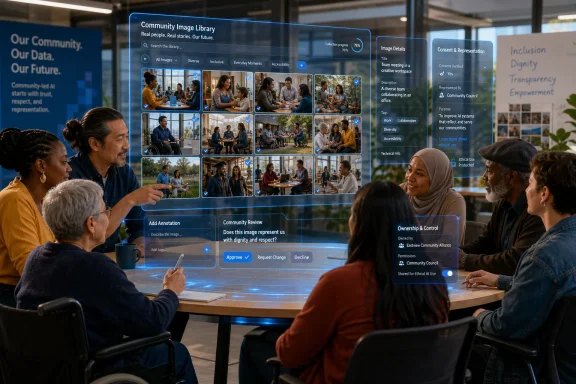
The Community Library Creator provides a structured method for groups to create these collections. Microsoft researchers developed the platform alongside accessibility specialists, while the communities themselves make the substantive decisions about what belongs in the library and how it should be explained.
The approach aims to replace a one-way extraction model with a participatory one:
But web-scale collection also creates a serious quality problem. The internet is not a neutral record of the world. It reflects unequal access to technology, unequal visibility, commercial incentives, cultural stereotypes, platform dynamics, and historical exclusions.
Some communities are heavily documented online but in narrow ways. Others are barely represented at all. Many people may appear in images without understanding that their likeness could be incorporated into future machine learning datasets or used to develop products they never encounter.
Even where plentiful data exists, it may reflect the wrong context.
A search for imagery relating to disability, for example, may produce an uneven mixture of medical photography, fundraising campaigns, specialist equipment, inspirational narratives, or stock images designed around the assumptions of marketers rather than disabled people. Such images are not necessarily false. The problem is that they become misleading when they are treated as the complete visual vocabulary of a community.
The Community Library Creator responds by prioritizing quality, relevance, and contextual knowledge over raw volume. Microsoft’s research describes community libraries that aim to assemble roughly 400 real-world images from participants. Compared with the internet-scale datasets behind foundation models, that number is tiny.
Yet a small collection can be valuable when it is intentional.
A set of hundreds of carefully selected, consented, and annotated examples may not retrain a frontier image model from scratch. It can, however, contribute to targeted training, fine-tuning, retrieval, evaluation, red-teaming, prompt development, and model adaptation. It can also show developers where a model’s visual assumptions break down.
That is an important technical and ethical point. Community libraries are not positioned as a magical replacement for broad datasets. They are a mechanism for improving the parts of AI development where generic data is insufficient and where lived expertise matters most.
A model may avoid blatantly harmful imagery and still fail to represent people as full participants in ordinary life. It may generate a person with a disability accurately enough in a visual sense while placing them in predictable, limited, or unnatural contexts. It may get physical details right while missing relationships, work, family, cultural practices, accessibility needs, and personal agency.
The Community Library Creator seeks to make evaluation more ambitious.
Instead of asking only whether an image contains a particular trait, participants can assess whether it reflects the kind of representation their community considers appropriate and meaningful. This creates an opening for evaluation that is not limited to traditional technical metrics such as similarity scores, object-recognition accuracy, or benchmark pass rates.
The question becomes: Does this image align with the community’s own description of good representation?
That is harder to measure. It is also more useful.
This early stage is important because it gives the community a chance to establish shared language before the collection expands. Rather than beginning with an abstract definition of representation, the participants begin with real examples.
Those examples may reveal recurring themes such as:
The target of roughly 400 images is notable because it signals an attempt to make participation practical. A community does not need the resources of a major technology company or stock-photo agency to contribute. At the same time, the collection must be broad enough to avoid turning a few participants into the visual stand-in for an entire population.
The challenge is balance.
Too few images can make the library unrepresentative. Too much emphasis on uniformity can erase diversity within the community. Excessive curation can lead to a polished but artificial version of life. Insufficient curation may reproduce the same inconsistencies and stereotypes the project is intended to address.
The value of the Community Library Creator lies in giving groups a repeatable process to navigate those choices.
Participants explain the relevant details in each scene, including elements an AI system might otherwise miss. They may identify what is typical, what is important, what should not be assumed, and what the image communicates from the community’s perspective.
A visual model can recognize a hat. It may not understand why the hat is present.
A model can identify a person leaning toward a monitor. It may not understand that proximity relates to vision accessibility.
A model can detect a prosthetic device, mobility aid, or assistive technology. It may not recognize that the person using it should be depicted in varied everyday circumstances rather than as a symbol of recovery, dependency, or inspiration.
These annotations allow the library to preserve intent. They also make the data more useful for prompt creation, model evaluation, and future training pipelines.
This moves participation into the evaluation phase, where many AI projects still rely on generic benchmarks or internal testers. Community reviewers can rate whether generated images align with their expectations and explain what works or fails.
Their feedback can identify problems such as:
AI discussions frequently center on model capability, benchmark performance, inference cost, safety filters, and enterprise integration. Those are all important. But the question of who owns the underlying data and who controls future use is often treated as secondary.
The Community Library Creator places it at the center.
Under the model described by Microsoft, the community — through the advocacy organization that creates the library — owns the collection and decides whether, when, and how it is shared. That may include making it available to researchers and developers through a data-sharing platform, or limiting access based on agreed conditions.
This gives organizations options that are uncommon in conventional web-scraped training pipelines:
A community-governed library does not eliminate those challenges. If data has already been used to train a model, removing it from a source collection does not automatically erase any learned influence from a deployed model. That is an important limitation that should not be glossed over.
However, establishing removal rights at the library level is still a significant improvement. It requires developers to design for traceability, versioning, access control, retention rules, and contractual accountability from the outset.
For organizations considering participation, the exact terms will matter enormously. A statement that communities own their data is promising, but ownership must be backed by practical answers:
Many existing benchmarks measure whether a model can follow a prompt, avoid prohibited content, recognize attributes, or produce visually coherent output. These tests are useful, but they can miss the social meaning of an image.
An AI system may generate an anatomically plausible image that is still culturally inappropriate. It may satisfy a generic fairness metric while repeatedly depicting a community through a narrow visual frame. It may produce “diverse” outputs in aggregate but fail to respect the specific needs or expectations of the people shown.
Community libraries offer a path toward community-specific evaluation criteria.
That does not mean every group should have to build a separate benchmark for every AI system. Such a burden would be unrealistic and unfair. It does mean that AI developers need better ways to incorporate community expertise when systems affect groups that have been historically underrepresented or misrepresented.
Microsoft’s broader research has also explored the idea of a Community Scorer, an automated measure intended to assess how closely a generated image aligns with a community’s preferred representation. That direction is promising, but it should be treated carefully.
But there is a risk in turning nuanced human judgment into another opaque score.
Representation is contextual. Communities change. People within the same community may disagree. A model trained to mimic a current evaluation standard could become overly rigid, rewarding familiar examples while discouraging variation. It could mistake a library’s initial curation choices for a permanent and exhaustive definition of identity.
The safest role for automated scoring is likely as decision support, not final authority.
Human review should remain central, particularly when the system is used in high-visibility, commercial, educational, health-related, or public-sector contexts. The goal should be to make community knowledge operational without reducing it to a fixed checklist.
The way Microsoft handles representation in research can eventually influence the expectations placed on AI experiences across that ecosystem.
Community-informed evaluation could give future AI products a stronger foundation for generating a wider range of ordinary, respectful, and contextually appropriate images.
Windows has a long history of accessibility features, including screen readers, voice access, magnification, captions, keyboard navigation, and adaptive input support. AI offers opportunities to extend those capabilities, but it also creates new failure modes.
If AI systems are trained on incomplete assumptions about disability, they can reproduce those assumptions in generated images, automated descriptions, recommendations, content moderation, hiring workflows, and product design decisions.
Community Library Creator offers a practical model for avoiding that trap. It embeds people with lived experience into the stages where definitions, data, and standards are created, rather than consulting them only after a product decision has already been made.
That is a more mature starting point than trying to solve representation solely through automated bias detection.
This creates a tighter feedback loop between input and outcome.
That makes the data potentially more useful for responsible image generation, model testing, and prompt development.
The model recognizes that depth of insight can matter as much as volume.
The project’s value depends on keeping the category open, diverse, and revisable.
Otherwise, “community-led” risks becoming another form of unpaid data work.
The legal promise of control must be matched by operational discipline.
Community participation should shape development, not merely decorate it.
For years, the dominant model has been centralized: organizations gather data, train models, establish benchmarks, and release products. Users and affected communities may provide feedback later, often through bug reports, criticism, complaints, or public pressure.
Microsoft’s research suggests a more plural model. Communities can contribute to the underlying definitions of success before a model reaches broad deployment. They can help shape datasets, annotations, evaluation methods, and rules for use.
That does not mean every AI decision can or should be outsourced to a community process. Technical development still requires engineering expertise, security controls, privacy safeguards, product management, and legal accountability. Nor does community participation eliminate disagreement.
In fact, disagreement is part of the point.
The assertion that representation should be “collectively defined and negotiated” recognizes that there may be no single neutral answer. Good governance does not always mean finding a universal rule. It may mean creating processes that allow affected people to express priorities, preserve differences, set boundaries, and revise decisions as technology changes.
That is a more demanding vision of responsible AI than a checklist. It requires institutions to share some authority.
Its most valuable contribution is not the prospect of a perfect dataset or a universal representation score. Neither is realistic. The value lies in the method: community members identify what matters, curate examples, explain context, evaluate outcomes, and retain meaningful control over the data they contribute.
That approach could help AI systems produce better images. More importantly, it could establish a healthier standard for AI development across Microsoft’s growing ecosystem and the wider technology industry.
As generative AI becomes woven into Windows workflows, enterprise software, creative tools, accessibility features, and cloud platforms, the question is no longer whether AI will shape how people are seen. It already does. The more urgent question is whether the people being represented will have a genuine role in shaping the systems that portray them.
Community libraries do not answer every technical, legal, or ethical challenge ahead. But they offer a credible and practical starting point: treat communities not as an afterthought in AI data, but as partners with knowledge, rights, and authority.
The idea is deceptively simple. If a generative AI system is expected to create believable, respectful images of people with specific identities, disabilities, cultural backgrounds, or lived experiences, the people represented should have a meaningful say in what accurate representation actually means. Microsoft’s research effort turns that principle into a workflow for advocacy organizations and communities, combining image curation, annotations, consent, evaluation, and ownership controls.
For the broader Windows, Microsoft 365, Azure AI, and Copilot ecosystem, the implications reach beyond image generation. The Community Library Creator is a test of whether the technology industry can move from generalized “responsible AI” statements toward practical, community-led processes for shaping the data, standards, and feedback loops behind AI products.
It is also a reminder that better AI does not come only from larger models, more GPUs, or more web-scale data. Sometimes it comes from asking a more basic question: Who gets to define what good output looks like?
 Overview: Why Representation in AI Is a Data Problem
Generative AI systems learn from enormous collections of images, captions, documents, and other material. Those datasets may be vast, but size does not guarantee balance, context, consent, or accuracy. A model trained on millions or billions of online examples can still produce narrow, stereotyped, or implausible depictions when the available data does not reflect the everyday lives of particular communities.That weakness is especially visible in AI image generation. Models can create polished visuals in seconds, yet they often reveal the cultural and statistical patterns buried in their training data. If photographs of a community are limited, distorted, sensationalized, medicalized, or dominated by stock imagery, the model may reproduce those same limits.
For people with disabilities, this can lead to an especially familiar kind of failure. AI may depict disability primarily through clinical environments, elite sport, charity imagery, or visual clichés. A person with limb differences may be shown only as a patient or athlete, rather than as a colleague in an office, a parent at home, a student in class, or a friend having coffee.
The issue is not simply that a generated picture looks wrong. Representation affects assumptions. Repeated imagery shapes how people imagine who belongs in workplaces, public spaces, schools, social settings, families, and technology itself. When AI-generated media becomes part of advertising, presentations, search results, social content, training materials, and product experiences, those visual defaults can become more influential.
Microsoft’s Community Library Creator is designed around the view that these problems cannot be solved solely by technical teams selecting more data or adjusting a model after complaints emerge. Instead, the work treats representation as a collective and negotiated process that should involve the people most affected.
That is a significant conceptual change. The goal is not to find one supposedly universal “ground truth” for depicting a group. It is to help communities identify the experiences, contexts, values, visual details, and boundaries that matter to them.
What a Community Library Is
A community library is a curated collection of images or videos developed by people with shared lived experience, usually working through an advocacy organization or similar community body. The collection is not merely a photo archive. Each image is paired with explanations and annotations that add context about what the image means, why it matters, and what it communicates about the community’s preferred representation.This distinction is essential.
A conventional machine learning dataset might label an image with broad categories such as “person,” “wheelchair,” “office,” “hat,” or “outdoor scene.” Those labels help a system identify visual objects and settings. They do not necessarily explain the lived context behind them.
A community library aims to include that missing layer. An image might show a person wearing a hat, but the annotation can identify sun protection as a meaningful part of everyday life for a person with albinism. A photograph may show somebody seated close to a screen or document, with notes that explain how vision-related needs shape the arrangement. Another image may depict a person with dwarfism in a professional setting, explicitly countering the fantasy-oriented visual associations that can appear in online imagery.
In other words, the library helps preserve meaning, not just appearance.
The Community Library Creator provides a structured method for groups to create these collections. Microsoft researchers developed the platform alongside accessibility specialists, while the communities themselves make the substantive decisions about what belongs in the library and how it should be explained.
The approach aims to replace a one-way extraction model with a participatory one:
- Communities identify themes that reflect their lives.
- Members select or contribute meaningful visual material.
- Participants annotate images with context and interpretation.
- Organizations build curated collections around agreed priorities.
- AI systems generate images based on prompts derived from the library.
- Community members review generated output.
- Their feedback contributes to evaluation criteria for representation quality.
The Problem With Internet-Scale Training Data
The modern AI industry has often depended on an assumption: more data is better data. There is some truth in that proposition. Large datasets have enabled models to recognize objects, translate languages, generate text, and synthesize realistic imagery at scales that were impossible a decade ago.But web-scale collection also creates a serious quality problem. The internet is not a neutral record of the world. It reflects unequal access to technology, unequal visibility, commercial incentives, cultural stereotypes, platform dynamics, and historical exclusions.
Some communities are heavily documented online but in narrow ways. Others are barely represented at all. Many people may appear in images without understanding that their likeness could be incorporated into future machine learning datasets or used to develop products they never encounter.
Even where plentiful data exists, it may reflect the wrong context.
A search for imagery relating to disability, for example, may produce an uneven mixture of medical photography, fundraising campaigns, specialist equipment, inspirational narratives, or stock images designed around the assumptions of marketers rather than disabled people. Such images are not necessarily false. The problem is that they become misleading when they are treated as the complete visual vocabulary of a community.
The Community Library Creator responds by prioritizing quality, relevance, and contextual knowledge over raw volume. Microsoft’s research describes community libraries that aim to assemble roughly 400 real-world images from participants. Compared with the internet-scale datasets behind foundation models, that number is tiny.
Yet a small collection can be valuable when it is intentional.
A set of hundreds of carefully selected, consented, and annotated examples may not retrain a frontier image model from scratch. It can, however, contribute to targeted training, fine-tuning, retrieval, evaluation, red-teaming, prompt development, and model adaptation. It can also show developers where a model’s visual assumptions break down.
That is an important technical and ethical point. Community libraries are not positioned as a magical replacement for broad datasets. They are a mechanism for improving the parts of AI development where generic data is insufficient and where lived expertise matters most.
Moving Beyond Stereotype Correction
There is a temptation to frame inclusive AI work as a simple matter of eliminating offensive results. That standard is too low.A model may avoid blatantly harmful imagery and still fail to represent people as full participants in ordinary life. It may generate a person with a disability accurately enough in a visual sense while placing them in predictable, limited, or unnatural contexts. It may get physical details right while missing relationships, work, family, cultural practices, accessibility needs, and personal agency.
The Community Library Creator seeks to make evaluation more ambitious.
Instead of asking only whether an image contains a particular trait, participants can assess whether it reflects the kind of representation their community considers appropriate and meaningful. This creates an opening for evaluation that is not limited to traditional technical metrics such as similarity scores, object-recognition accuracy, or benchmark pass rates.
The question becomes: Does this image align with the community’s own description of good representation?
That is harder to measure. It is also more useful.
How the Community Library Creator Workflow Operates
The Community Library Creator translates a complex social question into a more manageable sequence of activities. That does not make representation easy to define, but it gives participants a way to discuss it systematically rather than leaving the work to informal reactions after a model has already been deployed.Starting With Meaningful Images
The process begins with community members selecting a small number of images that feel personally or collectively meaningful. Participants explain why each image matters, what it shows, and what they want others to understand from it.This early stage is important because it gives the community a chance to establish shared language before the collection expands. Rather than beginning with an abstract definition of representation, the participants begin with real examples.
Those examples may reveal recurring themes such as:
- Family and relationships
- Work and professional identity
- Education and daily routines
- Recreation and social life
- Health and care practices
- Mobility and accessibility
- Cultural or religious expression
- Personal style and self-presentation
- Technology use
- Community events and advocacy
Building a Curated Collection
Once participants identify themes, they assemble a larger set of images or videos organized around those areas. The emphasis is on real-world material that reflects a range of experiences, rather than a narrow set of idealized examples.The target of roughly 400 images is notable because it signals an attempt to make participation practical. A community does not need the resources of a major technology company or stock-photo agency to contribute. At the same time, the collection must be broad enough to avoid turning a few participants into the visual stand-in for an entire population.
The challenge is balance.
Too few images can make the library unrepresentative. Too much emphasis on uniformity can erase diversity within the community. Excessive curation can lead to a polished but artificial version of life. Insufficient curation may reproduce the same inconsistencies and stereotypes the project is intended to address.
The value of the Community Library Creator lies in giving groups a repeatable process to navigate those choices.
Adding Context Through Annotation
Annotation is where a community library becomes more than a folder of pictures.Participants explain the relevant details in each scene, including elements an AI system might otherwise miss. They may identify what is typical, what is important, what should not be assumed, and what the image communicates from the community’s perspective.
A visual model can recognize a hat. It may not understand why the hat is present.
A model can identify a person leaning toward a monitor. It may not understand that proximity relates to vision accessibility.
A model can detect a prosthetic device, mobility aid, or assistive technology. It may not recognize that the person using it should be depicted in varied everyday circumstances rather than as a symbol of recovery, dependency, or inspiration.
These annotations allow the library to preserve intent. They also make the data more useful for prompt creation, model evaluation, and future training pipelines.
Using AI Output as a Feedback Loop
The workflow does not end when the library is assembled. Prompts derived from the collection are used to generate images, and community members assess the output.This moves participation into the evaluation phase, where many AI projects still rely on generic benchmarks or internal testers. Community reviewers can rate whether generated images align with their expectations and explain what works or fails.
Their feedback can identify problems such as:
- Unrealistic physical features or assistive devices
- Stereotyped or overly dramatic settings
- Missing everyday contexts
- Inappropriate clothing, architecture, or cultural cues
- Infantilization or loss of personal agency
- Lack of diversity in age, body type, gender expression, occupation, or family structure
- Inaccurate accessibility details
- Fantasy, medical, or charitable framing that does not fit the prompt
Ownership and Consent Are the Most Important Design Choices
The strongest part of Microsoft’s approach may be its focus on governance.AI discussions frequently center on model capability, benchmark performance, inference cost, safety filters, and enterprise integration. Those are all important. But the question of who owns the underlying data and who controls future use is often treated as secondary.
The Community Library Creator places it at the center.
Under the model described by Microsoft, the community — through the advocacy organization that creates the library — owns the collection and decides whether, when, and how it is shared. That may include making it available to researchers and developers through a data-sharing platform, or limiting access based on agreed conditions.
This gives organizations options that are uncommon in conventional web-scraped training pipelines:
- They can determine whether to share their data at all.
- They can specify how material may be used.
- They can decide which parties receive access.
- They can maintain oversight as research or development evolves.
- They can support removal requests if contributors later withdraw consent.
- They can choose to use data for evaluation without releasing it for model training.
Why Data Removal Matters
The ability to remove material deserves particular attention. In traditional dataset construction, data provenance can be unclear, and records may be replicated across preprocessing systems, model versions, repositories, and third-party services. Once information becomes part of a training pipeline, meaningful removal can be technically and contractually difficult.A community-governed library does not eliminate those challenges. If data has already been used to train a model, removing it from a source collection does not automatically erase any learned influence from a deployed model. That is an important limitation that should not be glossed over.
However, establishing removal rights at the library level is still a significant improvement. It requires developers to design for traceability, versioning, access control, retention rules, and contractual accountability from the outset.
For organizations considering participation, the exact terms will matter enormously. A statement that communities own their data is promising, but ownership must be backed by practical answers:
- Can the organization revoke access after sharing?
- What happens to copies held by researchers or partners?
- Is data used only for evaluation, or also for training and fine-tuning?
- Can it be used to produce commercial models or services?
- Are derivative datasets permitted?
- How are prompts, annotations, embeddings, or generated synthetic examples governed?
- What audit records exist?
- What happens if an individual contributor withdraws consent?
A More Useful Model for AI Evaluation
One of the most compelling aspects of the project is its potential to reshape how AI image systems are evaluated.Many existing benchmarks measure whether a model can follow a prompt, avoid prohibited content, recognize attributes, or produce visually coherent output. These tests are useful, but they can miss the social meaning of an image.
An AI system may generate an anatomically plausible image that is still culturally inappropriate. It may satisfy a generic fairness metric while repeatedly depicting a community through a narrow visual frame. It may produce “diverse” outputs in aggregate but fail to respect the specific needs or expectations of the people shown.
Community libraries offer a path toward community-specific evaluation criteria.
That does not mean every group should have to build a separate benchmark for every AI system. Such a burden would be unrealistic and unfair. It does mean that AI developers need better ways to incorporate community expertise when systems affect groups that have been historically underrepresented or misrepresented.
Microsoft’s broader research has also explored the idea of a Community Scorer, an automated measure intended to assess how closely a generated image aligns with a community’s preferred representation. That direction is promising, but it should be treated carefully.
The Risk of Automating Community Judgment
A Community Scorer could make evaluation more scalable. It could help researchers compare model versions, flag weak output, and detect patterns that human reviewers may not have time to examine at volume.But there is a risk in turning nuanced human judgment into another opaque score.
Representation is contextual. Communities change. People within the same community may disagree. A model trained to mimic a current evaluation standard could become overly rigid, rewarding familiar examples while discouraging variation. It could mistake a library’s initial curation choices for a permanent and exhaustive definition of identity.
The safest role for automated scoring is likely as decision support, not final authority.
Human review should remain central, particularly when the system is used in high-visibility, commercial, educational, health-related, or public-sector contexts. The goal should be to make community knowledge operational without reducing it to a fixed checklist.
Why This Matters for Windows, Copilot, and Enterprise AI
At first glance, a community-led image dataset project may feel distant from the daily concerns of Windows users. But Microsoft’s AI strategy increasingly spans operating systems, productivity software, developer platforms, cloud services, accessibility features, search, and content-generation tools.The way Microsoft handles representation in research can eventually influence the expectations placed on AI experiences across that ecosystem.
Better Visual AI Could Improve Everyday Tools
Generative imagery appears in more workplace and consumer scenarios each year:- Presentation design
- Marketing content
- Training and onboarding materials
- Educational resources
- Digital signage
- Social media campaigns
- Website creation
- Accessibility-related descriptions and communication tools
- Product mockups and concept art
- Internal communications
Community-informed evaluation could give future AI products a stronger foundation for generating a wider range of ordinary, respectful, and contextually appropriate images.
Accessibility Cannot Be an Afterthought
The project also reinforces a broader truth about accessibility technology: building features for people is not the same as building them with people.Windows has a long history of accessibility features, including screen readers, voice access, magnification, captions, keyboard navigation, and adaptive input support. AI offers opportunities to extend those capabilities, but it also creates new failure modes.
If AI systems are trained on incomplete assumptions about disability, they can reproduce those assumptions in generated images, automated descriptions, recommendations, content moderation, hiring workflows, and product design decisions.
Community Library Creator offers a practical model for avoiding that trap. It embeds people with lived experience into the stages where definitions, data, and standards are created, rather than consulting them only after a product decision has already been made.
The Major Strengths of Microsoft’s Approach
Microsoft’s Community Library Creator has several clear strengths that distinguish it from generic diversity initiatives.It Treats Communities as Experts
The project does not assume engineers, researchers, or dataset curators can independently define representation for every group. It acknowledges that lived experience includes knowledge that cannot be fully inferred from public data or technical labels.That is a more mature starting point than trying to solve representation solely through automated bias detection.
It Links Data Creation to Evaluation
Many data projects focus on collection while treating evaluation as a separate, technical exercise. Community libraries connect the two. The same groups that help define and curate examples also participate in judging whether AI output meets their standards.This creates a tighter feedback loop between input and outcome.
It Prioritizes Context, Not Just Categories
The annotations are as important as the images. They help explain why details matter and reduce the chance that systems interpret visible traits without understanding their real-world significance.That makes the data potentially more useful for responsible image generation, model testing, and prompt development.
It Includes Governance and Withdrawal
Consent and community control are not presented as minor administrative details. They are part of the design. The ability to decide how data is shared, and to support removal where appropriate, gives organizations a degree of agency that is rare in large-scale AI data practices.It Is Designed for Participation at a Manageable Scale
The target of about 400 images per library is not enough to rival a foundational dataset, but that is not the point. It offers an achievable starting place for organizations that cannot supply millions of examples.The model recognizes that depth of insight can matter as much as volume.
The Risks and Unresolved Questions
The initiative is promising, but it should not be treated as a complete solution to representational harm in AI.Small Datasets Can Be Overgeneralized
A library with hundreds of images may capture meaningful experience, but no collection can represent every person in a community. Developers must resist the urge to treat a community library as a definitive template for how all members of a group should look, live, or wish to be portrayed.The project’s value depends on keeping the category open, diverse, and revisable.
Participation Requires Resources
Curating images, holding discussions, writing annotations, reviewing AI output, and managing legal agreements all require time and labor. Advocacy organizations are often under-resourced. If technology companies benefit commercially from community expertise, they must consider whether participation is properly funded, compensated, and supported.Otherwise, “community-led” risks becoming another form of unpaid data work.
Data Governance Must Survive Scale
A controlled research setting can provide careful oversight. Scaling to many organizations, jurisdictions, models, partners, and product teams is much harder. Governance systems need to work not only when a small research group is involved, but when data flows through cloud infrastructure, model-training pipelines, APIs, external collaborators, and future product integrations.The legal promise of control must be matched by operational discipline.
Representation Can Become a Compliance Exercise
There is a danger that companies could use a community library as evidence of inclusion while continuing to deploy systems that create harm elsewhere. A carefully curated dataset does not replace broader work on model transparency, accessibility, employment practices, content policy, user reporting, bias monitoring, and accountability.Community participation should shape development, not merely decorate it.
Generated Images Still Need Human Judgment
No amount of training data guarantees that every output will be suitable. AI image generation remains probabilistic. It can create unexpected errors, combine attributes inappropriately, or fail to follow subtle instructions. Human review remains necessary, especially for public-facing or sensitive uses.The Broader Lesson: AI Needs Plural Governance
The Community Library Creator points to a larger debate about the future of AI governance.For years, the dominant model has been centralized: organizations gather data, train models, establish benchmarks, and release products. Users and affected communities may provide feedback later, often through bug reports, criticism, complaints, or public pressure.
Microsoft’s research suggests a more plural model. Communities can contribute to the underlying definitions of success before a model reaches broad deployment. They can help shape datasets, annotations, evaluation methods, and rules for use.
That does not mean every AI decision can or should be outsourced to a community process. Technical development still requires engineering expertise, security controls, privacy safeguards, product management, and legal accountability. Nor does community participation eliminate disagreement.
In fact, disagreement is part of the point.
The assertion that representation should be “collectively defined and negotiated” recognizes that there may be no single neutral answer. Good governance does not always mean finding a universal rule. It may mean creating processes that allow affected people to express priorities, preserve differences, set boundaries, and revise decisions as technology changes.
That is a more demanding vision of responsible AI than a checklist. It requires institutions to share some authority.
Conclusion: From Data Extraction to Data Partnership
Microsoft’s Community Library Creator is an important experiment in changing the relationship between AI systems and the people they depict. Instead of relying entirely on incomplete, uncontextualized, and often non-consensual data from the open web, the project creates a path for communities to define their own visual narratives and influence how AI learns from them.Its most valuable contribution is not the prospect of a perfect dataset or a universal representation score. Neither is realistic. The value lies in the method: community members identify what matters, curate examples, explain context, evaluate outcomes, and retain meaningful control over the data they contribute.
That approach could help AI systems produce better images. More importantly, it could establish a healthier standard for AI development across Microsoft’s growing ecosystem and the wider technology industry.
As generative AI becomes woven into Windows workflows, enterprise software, creative tools, accessibility features, and cloud platforms, the question is no longer whether AI will shape how people are seen. It already does. The more urgent question is whether the people being represented will have a genuine role in shaping the systems that portray them.
Community libraries do not answer every technical, legal, or ethical challenge ahead. But they offer a credible and practical starting point: treat communities not as an afterthought in AI data, but as partners with knowledge, rights, and authority.