

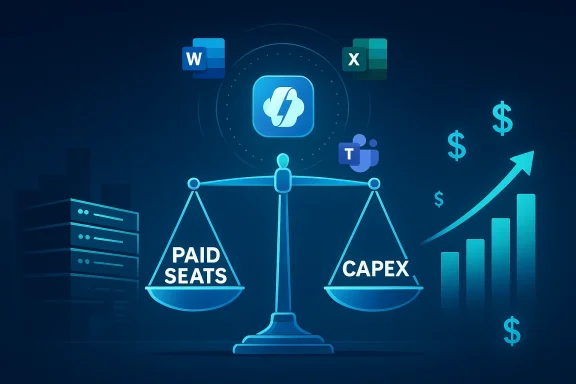
Microsoft’s decision to finally quantify how many customers are actually paying for Copilot — a disclosure that showed 15 million paid Microsoft 365 Copilot seats at the end of the company’s most recent quarter — rewired the conversation about AI monetization overnight. The raw number is both an accomplishment and a provocation: it proves Copilot is sellable at scale, but it also exposes a conversion gap when you stack that figure against Microsoft’s enormous installed base and its staggering AI infrastructure spend.
Microsoft has spent the last three years folding generative AI into everything from Windows and Edge to Teams, Outlook, Word and Excel. The company now operates a multi‑product Copilot family — consumer and enterprise chat interfaces, Microsoft 365 Copilot (the tenant‑aware, cross‑document add‑on), GitHub Copilot for developers, and productized vertical copilots like Security Copilot and Dragon Copilot for healthcare. During its Q2 FY2026 earnings, Microsoft reported several concrete adoption numbers for the first time: 15 million paid Microsoft 365 Copilot seats, 4.7 million paid GitHub Copilot subscribers, and what management described as “multiples more” enterprise chat users who are using the free Copilot Chat experiences.
Those disclosures arrived at a tense moment: Microsoft recorded $37.5 billion in capital expenditures for the quarter — roughly two‑thirds of which the company said went to short‑lived AI compute (GPUs and high‑end CPUs). That spend has investors expecting fast, measurable monetization from AI products; the Copilot numbers instantly became a key yardstick.
At the same time, Microsoft must deliver the mechanics: smoother procurement flows, clearer outcomes for buyers, price and packaging flexibility, and continued improvements in compute economics. If it does, the current small paid base is indeed a blessing disguised as a cautionary headline — a low bar that opens space for meaningful upside surprises. If it fails to close that conversion gap while capex remains elevated, the market’s patience will be tested.
Source: AOL.com Why Microsoft's Relatively Small Number of Paying Copilot Customers Could Be a Blessing in Disguise
 Background / Overview
Microsoft has spent the last three years folding generative AI into everything from Windows and Edge to Teams, Outlook, Word and Excel. The company now operates a multi‑product Copilot family — consumer and enterprise chat interfaces, Microsoft 365 Copilot (the tenant‑aware, cross‑document add‑on), GitHub Copilot for developers, and productized vertical copilots like Security Copilot and Dragon Copilot for healthcare. During its Q2 FY2026 earnings, Microsoft reported several concrete adoption numbers for the first time: 15 million paid Microsoft 365 Copilot seats, 4.7 million paid GitHub Copilot subscribers, and what management described as “multiples more” enterprise chat users who are using the free Copilot Chat experiences.Those disclosures arrived at a tense moment: Microsoft recorded $37.5 billion in capital expenditures for the quarter — roughly two‑thirds of which the company said went to short‑lived AI compute (GPUs and high‑end CPUs). That spend has investors expecting fast, measurable monetization from AI products; the Copilot numbers instantly became a key yardstick.
What Microsoft actually reported — the numbers that matter
- Microsoft publicly disclosed 15 million paid Microsoft 365 Copilot seats, with paid seat growth cited as around 160% year‑over‑year. Management also highlighted that the number of customers with very large Copilot deployments (tens of thousands of seats) has tripled.
- Microsoft reiterated that paid Microsoft 365 commercial seats overall grew to over 450 million, a base that analysts routinely cite when measuring Copilot penetration. That yields a headline paid penetration of roughly 3.3% when you compare 15 million Copilot seats to 450 million Microsoft 365 commercial seats.
- On developer tooling, GitHub Copilot reached about 4.7 million paid subscribers — a separate success story inside Microsoft’s AI portfolio.
- Microsoft also disclosed operational telemetry: Copilot interactions audited by Purview reached 24 billion in the quarter, reportedly up roughly 9× year‑over‑year, signaling heavy usage where Copilot is deployed. ([m.investing.com.com/news/transcripts/earnings-call-transcript-microsoft-q2-2026-sees-revenue-growth-stock-declines-93CH-4481140?ampMode=1&utm_source=openai))
Parsing the arithmetic: why 15 million looks small — and why that’s not the whole story
On its face, 15 million paid seats sounds like a big company achievement. But’s installed base, it appears small. A few simple facts drive that impression:- Microsoft 365 has hundreds of millions of commercial seats (the company reported over 450 million paid seats in the quarter). Against that backdrop, 15 million paid Copilot seats equals about 3.3% penetration. That math is why many analysts called the disclosure “underwhelming.”
- Microsoft has deliberately differentiated Copilot lines: a broadly available, free Copilot Chat embedded into qualifying Microsoft 365 plans and the deeper, tenant‑aware Microsoft 365 Copilot add‑on that is charged per seat. The corporate goal — make AI a baseline experience while monetizing the richer, tenant-aware capabilities — naturally depresses the share of users who pay for the premium SKU right away. Management itself described “multiples more” enterprise chat users beyond the paid seats.
- The growth rate is notable — paid Copilot seats grew ~160% year‑over‑year, which signals a fast adoption curve among the organizations that choose to buy. Rapid growth from a small base is different than stagnation.
- The 15 million figure measures paid seats, not active users across all free and paid Copilot surfaces. Microsoft has previously reported broader Copilot MAU figures (100–150 million MAUs across some Copilot surfaces in prior quarters), so the revenue‑bearing subset will always be smaller than total usage. That nuance matters for valuation and monetization debates.
Why a small paid base can be a strategic advantage — three practical arguments
- Long runway for monetization and upside surprises
- With 15 million paying seats, Microsoft has a massive upside if it can convert even a small slice of its remaining Microsoft 365 base. A back‑of‑the‑envelope shows that at a headline price of $30 per user per month for Microsoft 365 Copilot, each incremental million paid seats would add roughly $360 million in annual revenue (before discounts and cost). That’s material when scaled. The company’s structure — enormous seat base, strong channel, and deep enterprise relationships — gives Microsoft privileged cross‑sell options that pure‑play AI rivals lack.
- Controlled, staged adoption reduces churn and operational risk
- Slow, measured conversion lets Microsoft refine governance, security, and data‑use controls before Copilot becomes ubiquitous. Enterprise IT teams demand auditability, tenant separation, and careful data handling; Microsoft’s ability to gate premium features behind paid Copilot seats reduces the chance of a broad governance incident that could erode trust. That staged approach is a pragmatic tradeoff: monetize later, but with better controls.
- Ecosystem co‑benefits and option value
- Microsoft jointly benefits from the success of multiple AI players it is tied to (notably OpenAI) while also selling Copilot as a value‑add across existing franchises (Office, Azure, GitHub). That option‑value approach — owning platforms, tooling, and cloud capacity — amplifies returns if enterprise AI adoption accelerates. Microsoft’s stake in OpenAI and Anthropic and the integration of Copilot across Microsoft 365 mean the firm collects value in several ways, not only via a per‑seat Copilot license.
The commercialization challenge: why conversion is hard
Selling an add‑on like Microsoft 365 Copilot inside enterprise procurement is nontrivial. Several forces work against rapid conversion to paid seats:- Price sensitivity and procurement cycles. The historical list price for Microsoft 365 Copilot was announced at $30 per user per month for commercial customers — a substantial incremental cost on top of E3/E5 or Business plans. Microsoft has experimented with variants and SMB pricing (a $21 per user/month SMB option was reported later), but the list price created friction for widespread seat adoption. Enterprises have annual renewal cycles and cost‑justification gates that slow rollouts.
- Behavioral inertia. Knowledge workers adopt new workflows slowly; turning an AI assistant into a daily habit requires product‑market fit inside specific tasks (email triage, meeting summaries, spreadsheet analysis). Anecdotal and survey evidence suggests early adopters realize outsized gains, while broader populations need time, change management, and measurable ROI to get their IT procurement teams to green‑light enterprise licenses.
- Competing ecosystems and consumer mindshare. ChatGPT, Google’s Gemini, Claude and other AI products have strong consumer recognition. Some customers prefer best‑of‑breed conversational tools, while others prioritize deep tenant integration and governance. Microsoft must balance being “everywhere” (free chat surfaces) with being compelling enough to justify a paid license.
Cost structure and margin pressure: the infrastructure paradox
Microsoft is simultaneously a software company and an AI infrastructure operator. The company’s Q2 FY2026 results underline both sides of that paradox:- Microsoft reported $37.5 billion in quarterly capital expenditures, with management saying roughly two‑thirds was for short‑life assets such as GPUs and CPUs to support first‑party AI workloads and customer demand. That level of capex makes AI monetization an urgent priority, because compute costs are not immaterial and many GPU servers are depreciated over short horizons.
- Copilot usage is compute‑intensive. Heavy conversational and agentic workloads consume tokens and GPU cycles; the economics depend on both price per seat and per‑usage metering strategies (some Copilot services use capacity units or consumption billing for high‑compute features). The key challenge: delivering a premium AI experience while preserving attractive gross margins across the cloud and productivity businesses.
Where Microsoft can push next: concrete growth levers
Microsoft has multiple levers to accelerate Copilot monetization — each with distinct techniclenges.- Product bundling and SKU simplification
- Microsoft can further bundle Copilot into higher‑tier Microsoft 365 SKUs (themselves being reworked with E5/E7 experiments), simplifying procurement friction and nudging admins to accept AI in exchange for feature consolidation. Microsoft has already tested consumer bundling (Microsoft 365 Premium) and SMB price adjustments; expect more SKU engineering in 2026.
- Channel and monthly billing flexibility
- Offering month‑to‑month billing through Cloud Solution Providers and looser seat commitments reduces procurement friction for pilot projects. Microsoft has signalled this channel flexibility and partner programs geared to capture midmarket pilots.
- Industry verticalization and agents
- The most persuasive Copilot deployments will be domain‑specific agents (sales qualification agents, customer knowledge managers, healthcare Dragon Copilot use cases) where the assistant produces measurable time savings and revenue impact. Selling outcomes rather than seats can accelerate enterprise willingness to pay. Microsoft highlighted enterprise deployments in Dynamics and industry pilots during the call.
- Usage‑based pricing for high‑intensity workloads
- For teams that run agentic, compute‑heavy jobs, Microsoft can create consumption pricing or capacity‑based plans that align customer spend with actual AI costs, hedging margin risk while lowering upfront barriers. This hybrid model would mirror what many cloud and API providers do today.
Risks and open questions investors and IT leaders should watch
- Pace of cross‑sell and ARR uplift. The critical metric isn’t seat count alone but revenue per seat and whether Copilot produces sustainable ARPU expansion across Microsoft 365 commercial customers. Analysts worried that Copilot hadn’t yet accelerated Microsoft 365 revenue growth on the expected cadence. Watch sequential seat adds, ARPU, and renewal dynamics closely.
- Margins under capex pressure. Heavy AI capex and short‑life asset accounting magnify sensitivity to utilization. If Azure capacity remains supply constrained or if Microsoft reserves capacity for first‑party Copilot workloads, there’s an execution tension between serving external Azure customers and deploying capacity to Microsoft’s own products. Management comments about prioritizing first‑party AI workloads bear monitoring.
- Competitive displacement and product preference. If users favor third‑party chatbots or if rivals create more compelling agent tooling, Microsoft may have to increase promotional pricing, which compresses margins. Market share among AI assistants remains dynamic, and consumer mindshare often drives enterprise procurement indirectly.
- Regulatory and trust risks. Embedding Copilot deeply into enterprise workflows raises data governance, privacy, and antitrust scrutiny. Microsoft has already faced consumer regulatory scrutiny in some markets over Copilot bundling; further regulatory action could complicate pricing and go‑to‑market choices.
Practical advice for enterprise IT and procurement teams
- Treat Copilot deployment as a program, not a checkbox. Pilots should measure time saved, error reduction, and downstream impact on KPIs (e.g., sales pipeline conversion, helpdesk resolution times).
- Start with high‑value workflows. ,il triage, meeting summarization, lead qualification) generates quick wins and clearer ROI signals for expansion.
- Use governance controls from day one. Tenant‑aware Copilot features require consent frameworks, data handling policies, and audit trails. Purview integration and admin tooling should be part of any rollout plan.
- Negotiate pricing and flexibility. For pilots, insist on monthly billing, performance metrics, and exit clauses tied to demonstrable outcomes. Microsoft’s channel updates and SMB price experiments show the company is willing to refine commercial models.
What investors should look for in future quarters
- Sequential paid seat adds and the rate of seat growth (is 160% YoY repeatable as growth accelerates off a larger base?).
- ARPU movement for Microsoft 365 commercial — specifically whether Copilot drives consistent ARPU lift beyond short pilot pricing.
- Azure gross margins and how Microsoft allocates GPU capacity between first‑party workloads and external customers; any change in that allocation will affect both revenue growth and margin profile.
- The company’s ability to maintain or lower unit compute costs via software optimization, Maia accelerators, or custom silicon plays — a structural improvement in tokens per watt per dollar would change the long‑run economics of Copilot.
A balanced verdict
The 15 million paid Microsoft 365 Copilot seats number is a milestone that proves the product is monetizing at scale, but it is not yet a proof point that Copilot has become a pervasive revenue engine equivalent to the company’s core franchises. It is, crucially, a growth platform with significant option value: a massive installed base to cross‑sell into, multiple monetization pathways (seat licensing, consumption models, bundled SKUs), and enterprise use cases that can deliver clear ROI.At the same time, Microsoft must deliver the mechanics: smoother procurement flows, clearer outcomes for buyers, price and packaging flexibility, and continued improvements in compute economics. If it does, the current small paid base is indeed a blessing disguised as a cautionary headline — a low bar that opens space for meaningful upside surprises. If it fails to close that conversion gap while capex remains elevated, the market’s patience will be tested.
Final takeaways for readers who follow Microsoft Copilot adoption, pricing, and enterprise AI
- The core fact: Microsoft reported 15 million paid Microsoft 365 Copilot seats in its latest quarter, with paid seat growth of roughly 160% YoY, against a Microsoft 365 commercial installed base of over 450 million seats. That yields roughly 3.3% paid penetration today.
- Pricing and packaging matter: the headline Copilot list is $30 per user per month, but Microsoft has introduced alternative pricing moves and SMB offers to lower barriers. How Microsoft chooses to bundle or discount Copilot will materially affect adoption speed.
- Infrastructure spend is real: Microsoft’s $37.5 billion quarterly capex to build AI capacity changes the urgency of monetization conversations — the company has both the scale and the incentive to push Copilot adoption, but execution must follow.
- The community reaction is mixed but pragmatic: IT teams in our forums and in partner channels recognize Copilot’s productivity potential but stress the need for measured pilots, governance, and demonstrable ROI before broad paid rollouts.
Source: AOL.com Why Microsoft's Relatively Small Number of Paying Copilot Customers Could Be a Blessing in Disguise
