

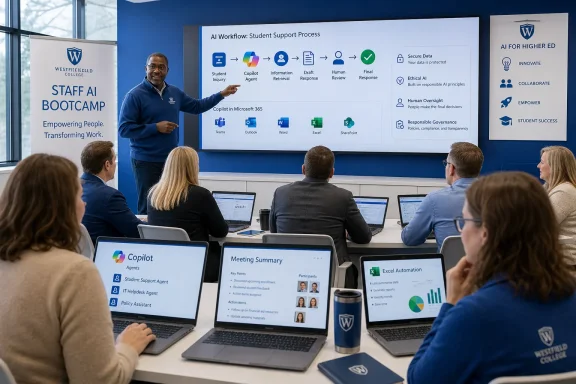
According to St. Lawrence College Communications, the session was delivered through the Microsoft Learning for Educators program by Dr. Alex Arnold and Dr. Robert “Bear” Ulrich of Black Dog Black Cat. It focused on practical use cases rather than broad AI theory: participants worked through ways AI agents could support teaching, learning, student services, and routine operational work.
The effort is part of the Ontario college’s wider Digital Transformation program and a multi-phase plan to improve AI literacy and confidence among faculty, staff, and leaders. The college said its approved AI Guidelines are intended to permit experimentation while setting expectations around secure, responsible, and ethical use.
Copilot moves from demo to workflow
The useful detail here is the emphasis on custom or task-focused agents. Rather than positioning Copilot as a generic chatbot, the bootcamp asked staff to consider where agent-assisted workflows could remove repetitive steps from real college processes.
Jamie Puddicombe, associate dean for Professional Services and Innovation, said the training covered complex-work scenarios and that agents were already helping streamline routine work. Puddicombe framed the intended outcome as creating more capacity for problem-solving, innovation, collaboration, and human connection—not replacing staff interaction.
John Wright, acting lead for Digital Learning Technology at St. Lawrence College’s Centre for Teaching and Learning, pointed to familiar Microsoft 365 work as likely early targets. These include:
- Summarizing meeting notes and identifying follow-up actions
- Building or refining complex Excel documents
- Editing and drafting email and Word content
- Applying AI tools to academic and administrative workflows
That list will sound familiar to Windows and Microsoft 365 administrators: the underlying technology may be new, but the first deployments typically land in document-heavy work where users already live in Outlook, Teams, Word, Excel, and SharePoint.
Governance remains part of the pitch
The college’s messaging is notably cautious. It is presenting AI capability-building alongside internal guidelines, rather than treating access to Copilot as sufficient preparation. That matters in higher education, where staff can encounter student information, institutional records, assessment material, and other data that should not be casually dropped into unapproved services.
For IT teams, the practical challenge is less about demonstrating that AI can draft a message or summarize a meeting than making sure users understand which tenant-backed tools, data sources, permissions, and sharing settings are appropriate. Training also needs to make clear when outputs require human review, especially when they influence student-facing decisions or official communications.
St. Lawrence College said it will offer additional AI learning opportunities in the fall as it continues the program.