

Microsoft’s AI message in London was unmistakable: make Copilot the interface for work, turn Microsoft 365 into the knowledge substrate for agentic AI, and give developers a full-stack platform to build, tune and govern enterprise agents at scale.
The London leg of Microsoft’s AI Tour — headlined by CEO Satya Nadella — was less a product launch than a status update on a multi-year platform play: embed agentic AI directly into Office apps, surface an intelligence layer that knows the people and artifacts inside an organisation, and provide the cloud middleware to build production-ready agents. Nadella framed the argument around the familiar productivity lens: Excel, PowerPoint and Word becoming places where users not only consume information but ask agents to create, analyze and act on it.
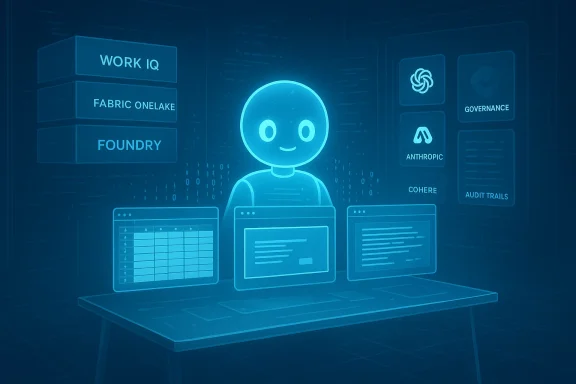
Underpinning that pitch are three concrete product families Microsoft has been assembling: Microsoft 365 Copilot (the user‑facing assistant and in‑app agents), Microsoft Fabric / OneLake (the data ingestion and analytics layer), and Microsoft Foundry (the cloud-native agent and model platform). Together, Microsoft presents a closed-loop stack: data collection, knowledge representation, agent development and runtime governance. Microsoft’s own documentation and product pages now list Foundry as a core middleware — advertising access to more than 11,000 models and a suite of agent frameworks and governance controls.
Enterprises already piloting Copilot and Foundry report real productivity wins for tasks such as report generation, code scaffolding and centralized analytics automation — provided they follow strict review workflows and keep model and data scope tightly controlled. Microsoft’s own case studies and Ignite announcements highlight large customers using Work IQ and Foundry to accelerate agent development and distribution across Teams and Microsoft 365.
That said, the announcements are an invitation to operational complexity. The technology’s value depends less on marketing claims about “11,000 models” and more on an organisation’s ability to design governance, testing, observability and human‑in‑the‑loop processes. Companies should pilot deliberately, treat agent rollouts as high‑risk identity and data projects, and insist on explainability and audit trails before widening deployment.
If you are an IT leader or developer in the Microsoft stack, the immediate opportunity is real: reduce repetitive work, compose knowledge‑grounded agents and experiment with new automation patterns. But success will require new operational muscle — policy, telemetry and human review — that most organisations have not yet built. The coming year will show whether agentic AI becomes a reliable productivity multiplier or a new domain of technical debt and compliance headaches.
Source: Computer Weekly Microsoft CEO opens London AI Tour with Copilot push | Computer Weekly
 Background
The London leg of Microsoft’s AI Tour — headlined by CEO Satya Nadella — was less a product launch than a status update on a multi-year platform play: embed agentic AI directly into Office apps, surface an intelligence layer that knows the people and artifacts inside an organisation, and provide the cloud middleware to build production-ready agents. Nadella framed the argument around the familiar productivity lens: Excel, PowerPoint and Word becoming places where users not only consume information but ask agents to create, analyze and act on it.Underpinning that pitch are three concrete product families Microsoft has been assembling: Microsoft 365 Copilot (the user‑facing assistant and in‑app agents), Microsoft Fabric / OneLake (the data ingestion and analytics layer), and Microsoft Foundry (the cloud-native agent and model platform). Together, Microsoft presents a closed-loop stack: data collection, knowledge representation, agent development and runtime governance. Microsoft’s own documentation and product pages now list Foundry as a core middleware — advertising access to more than 11,000 models and a suite of agent frameworks and governance controls.
What Nadella said — the key claims
Agentic workflows are now practical in Office
Nadella positioned Office apps as the front door for agentic productivity: Agent Mode inside Excel and PowerPoint (and Word) lets users ask an AI agent to act across sheets, slides and linked data, producing audit‑able artefacts and even generating code on prompt. He drew an analogy to the macro revolution in the 1990s — a democratizing moment for software creation — and said that the current Copilot/Agent Mode experience lets users produce code or new functionality from a single prompt.Microsoft 365 is the knowledge layer
Nadella described Microsoft 365 as a stateful system that represents “your people” — relationships, files, calendars and communications — and argued that this data can bootstrap agents through what Microsoft calls Work IQ, an intelligence layer that grounds agents in company knowledge and context. That grounding, he suggested, is the difference between a generic chatbot and an enterprise agent that understands roles, permissions and projects.Foundry is the agent factory
For enterprises that want to move beyond in‑app agents, Nadella discussed Microsoft Foundry: a middle‑tier platform with runtimes, guardrails, identity and observability to take agents into production. He cited Foundry’s model catalog as a strength — “11,000 AI models” available to developers for composable workflows — and called out capabilities for multi‑agent systems and safety controls. Microsoft’s product pages and technical blogs confirm the scale and features Nadella described.Overview: the product pieces that matter
Agent Mode and Copilot in Office
Agent Mode is the manifestation of agentic interaction inside apps. Rather than a single-turn query, Agent Mode can decompose tasks, run stepwise procedures and modify the document context iteratively. Microsoft has coupled this with an “Office Agent” surfaced in Copilot chat: a chat‑first experience that can hand off work back into Word, Excel or PowerPoint as final artefacts. For knowledge workers the promise is immediate: turn natural language briefs into audited spreadsheets, slide decks or reports.- Key capabilities announced:
- Agent Mode embedded in Excel, Word and PowerPoint for multi-step, steerable workflows.
- Office Agent in Copilot chat that can assemble and hand back finished Office artefacts.
- Tuning and model choice inside Copilot Studio (bring‑your‑own models and fine‑tuning).
Work IQ — the grounding layer
Work IQ is Microsoft’s term for the intelligence that maps people, work artefacts, calendars, email and files into a usable knowledge graph for agents. It's the mechanism Microsoft offers to make agents context-aware and permission-sensitive, so answers and actions respect company boundaries. Work IQ is central to the pitch that Copilot agents will be useful rather than generative curiosities.Microsoft Fabric and data plumbing
Microsoft Fabric (and OneLake) remain Microsoft’s data strategy for stitching Excel, Power BI and other Microsoft 365 content into analytic pipelines. Fabric is the ingestion and transformation layer that makes enterprise data accessible to agents and models, including retrieval and vectorisation where needed. Nadella highlighted Fabric’s role in exposing Excel and Power BI data to enterprise AI agents.Microsoft Foundry — scale, models and governance
Foundry is marketed as the enterprise “agent factory”: model catalog, runtime, control plane, knowledge bases (Foundry IQ), and multi‑agent orchestration. Microsoft’s site and product blogs describe features for model routing, benchmarking and governance; the model catalog alone lists 11,000+ models from multiple vendors (OpenAI, Anthropic, Cohere, Meta, and community models) and supports bring‑your‑own-model flows and fine‑tuning pipelines. Foundry includes observability controls and an agent control plane for lifecycle management.Close reading: what the announcements actually mean for IT and developers
1) Democratizing workflows, but not equally
The Excel analogy is useful: macros and formulas made power users into app creators. Agent Mode aims to recreate that pathway — a user in Excel types a prompt and the sheet generates code or new logic. That lowers the entry barrier for automation, but it also raises a governance challenge: who validates generated logic, who is accountable for errors, and how are changes tracked? Nadella acknowledged the need for precision augmentation — users should be able to understand AI‑generated artefacts — but executing that principle at scale is an unresolved operational problem.2) Data gravity and lock‑in
Microsoft’s stack sells an end‑to‑end story: keep data in Microsoft 365 / Fabric / OneLake, then Foundry and Copilot yield the best agentic experiences. That architecture offers convenience and deep integration, but it also increases data gravity — organisations that commit to this path will find their knowledge graphs and model training pipelines tightly coupled to Microsoft services. For many enterprises that tradeoff (integration vs vendor independence) will require formal evaluation.3) Choice of models — real or marketing?
Microsoft’s claim of “11,000+ models” in Foundry is true in the sense that Foundry provides access to a huge catalog of partner and open models. But volume isn’t identical to utility: many models are narrow specialists, earlier‑generation releases, or duplicates. The practical challenge for developers is model selection, benchmarking and cost optimisation — all areas Microsoft is trying to address with model routing and benchmarking tools. Organisations should assume model management will be a continuous operational discipline, not a one‑time choice.4) Governance, safety and observability are mandatory
Foundry includes a control plane, Entra‑based identity, and observability tools for agent fleets. Those features are necessary but not sufficient: the real work for enterprises is policy design, audit trails, incident response playbooks, and continuous monitoring of hallucinations, privacy leaks and access violations. The technology provides the knobs; the burden of governance still lies with engineering and security teams.Strengths: why Microsoft’s stack could work for enterprises
- Deep integration with existing Microsoft 365 assets gives Copilot‑based agents immediate contextual grounding; Work IQ simplifies the task of making agents aware of people, files and schedules. This reduces the initial data engineering burden when compared with building agents from scratch on third‑party stacks.
- Foundry’s multi‑model catalog and model routing let organisations experiment across model families (OpenAI, Anthropic, Meta, community models) without rewriting apps. That flexibility is valuable for matching the right model to the right task and cost target.
- Microsoft has built enterprise‑grade controls into Foundry and Copilot Studio — identity, audit, policy enforcement and observability — which reduces the integration work security and compliance teams must do. These features are a practical requirement for regulated enterprises.
- The no/low‑code entry points (Agent Builder, Agent Mode in Office) allow business users to prototype agentic workflows quickly — valuable for rapid experimentation and user empowerment.
Risks and red flags
- Explainability vs automation: Nadella’s phrase precision augmentation is a helpful framing, but implementing it is hard. AI artefacts that produce spreadsheets, calculations, or code will require traceable reasoning steps, provenance and human‑review workflows. Without rigorous audit trails, organisations risk operational errors and compliance failures.
- Data leakage and access control: grounding agents in Microsoft 365 means agents will have access to sensitive calendars, emails and files. Entra and Purview controls help, but misconfiguration or permissive training/grounding can expose data. Enterprises must treat agent provisioning as a high‑risk identity and access control problem.
- Over‑automation and liability: the pitch that “anyone can generate code from a prompt” is powerful — and potentially hazardous. Misgenerated formulas, macros or scripts could cause financial or operational damage if deployed without proper validation. Organisations should enforce staged review and release pipelines.
- Cost and complexity: model routing, fine‑tuning and runtime orchestration introduce new cost centers. Foundry’s platform helps with optimization, but teams will need new financial controls and telemetry to manage model spending and latency tradeoffs.
- Vendor dependency and portability: the integrated experience encourages sticking to Microsoft’s data and runtime stack. For organisations that must remain multi‑cloud or avoid vendor lock‑in, migration and interoperability plans are essential.
Practical checklist for IT leaders (what to do next)
- Run a controlled pilot that keeps data scope narrow (one department) and explicitly defines success metrics: accuracy, time saved, error rate and auditability.
- Map data flows: inventory what M365 artefacts will be used to ground agents, and apply Purview sensitivity labels and Entra access policies before any agent is provisioned.
- Establish a governance board: include security, compliance, legal, and business owners responsible for approving agent capabilities and audit logs.
- Use model selection guardrails: define which Foundry models are allowed for each use case (e.g., anthropic for reasoning tasks, smaller LLMs for cost-sensitive workflows).
- Enforce staging and review: require all agent-generated code or Excel macros to pass developer review and automated tests before production use.
- Monitor telemetry and cost: set alerts on model spend, invocation counts and unusual outputs; instrument for drift and error rates.
- Provide training: teach users about precision augmentation — how to interpret agent outputs and when to escalate to human experts.
- Plan for rollback: maintain straightforward procedures to pause or disable agents quickly if they act unexpectedly.
How developers should approach agentic apps
- Start with a narrowly scoped capability: e.g., a meeting‑prep agent that summarises recent threads and proposes actions. This reduces the grounding surface area and the attack surface.
- Use Copilot Studio and Foundry for prototyping: leverage templates, run small‑scale fine‑tuning if necessary, and benchmark models with Foundry’s router.
- Implement observability from day one: collect prompts, responses, token use, and post‑hoc human ratings to feed continuous improvement and guardrail tuning.
- Treat prompt engineering as first‑class testing: create prompt suites and expected outputs; include edge cases that test hallucination and privilege escalation scenarios.
- Design for explainability: when agents generate code, include an auto‑generated explanation section and a diff of changes; require user acceptance before applying changes.
Community reaction and practical deployments
Community threads and early adopter reports show excitement mixed with caution. Enthusiasts celebrate the productivity gains and the rapid prototyping possible with Agent Mode, while IT professionals flag governance, auditability and the operational burden of running multi‑agent fleets. The forum commentary mirrors the broader industry tension: the technology enables new value, but it also demands new processes and controls to be safe and reliable.Enterprises already piloting Copilot and Foundry report real productivity wins for tasks such as report generation, code scaffolding and centralized analytics automation — provided they follow strict review workflows and keep model and data scope tightly controlled. Microsoft’s own case studies and Ignite announcements highlight large customers using Work IQ and Foundry to accelerate agent development and distribution across Teams and Microsoft 365.
A skeptical lens: what to watch for in the next 6–12 months
- Accuracy and hallucinations: watch whether agentic apps reduce error rates in real workflows or simply shift the error mode to opaque artefacts (e.g., confident but incorrect spreadsheets). Organisations should measure both accuracy and downstream operational impact.
- Regulatory scrutiny: as agents handle personal data, EU and UK regulators will pay attention to consent, data export and profiling risks. Legal teams should evaluate how agent training and grounding interact with privacy obligations.
- Interoperability demands: customers working across multi‑cloud and multi‑vendor ML stacks will pressure Microsoft and partners for clearer export tools and open protocols for agent behavior and knowledge bases. Monitoring those developments is essential for long‑term portability.
- Human factors: adoption will depend on how well organisations embed precision augmentation — ensuring outputs are explainable, actionable and obviously owned by humans as decision-makers. Training and UX design will matter as much as model quality.
Final assessment
Microsoft’s London AI Tour crystallised a strategy that has been visible for months: make Copilot the primary interface for knowledge work, use Microsoft 365 as the grounding layer (Work IQ), and provide Foundry as the production platform with broad model choice and governance features. The approach is coherent and powerful for organisations already invested in Microsoft’s ecosystem: it reduces integration friction, supplies enterprise controls, and promises rapid productivity gains through agentic workflows.That said, the announcements are an invitation to operational complexity. The technology’s value depends less on marketing claims about “11,000 models” and more on an organisation’s ability to design governance, testing, observability and human‑in‑the‑loop processes. Companies should pilot deliberately, treat agent rollouts as high‑risk identity and data projects, and insist on explainability and audit trails before widening deployment.
If you are an IT leader or developer in the Microsoft stack, the immediate opportunity is real: reduce repetitive work, compose knowledge‑grounded agents and experiment with new automation patterns. But success will require new operational muscle — policy, telemetry and human review — that most organisations have not yet built. The coming year will show whether agentic AI becomes a reliable productivity multiplier or a new domain of technical debt and compliance headaches.
Practical next steps checklist (condensed)
- Pilot: single department, narrow scope, measurable KPIs.
- Secure: apply Entra, Purview labels, and least privilege before any agent access.
- Govern: charter a cross‑functional governance board and require staging/testing.
- Observe: instrument every agent for telemetry, cost and quality.
- Train: teach users to interpret and validate agent outputs.
- Iterate: treat models and prompts as software — version, test and roll back.
Source: Computer Weekly Microsoft CEO opens London AI Tour with Copilot push | Computer Weekly
