

Microsoft’s latest Copilot push is not merely another feature wave — it reads like a deliberate, high-conviction bet on AI as a piece of enterprise infrastructure. The company has shifted from scattering AI helpers across apps to building a unified, programmable layer that can host long-running, permissioned agents, and it is packaging that capability as a platform play: Copilot Studio for building agents, Agent 365 for governance and observability, model-choice partnerships such as Anthropic’s Claude for diversity, and a premium commercial bundle (Microsoft 365 E7) to monetize the stack. This repositioning, captured in the Bitget briefing and corroborated by product and earnings disclosures, reframes Copilot from a feature into an operating system for knowledge work — with the upside of exponential adoption and the downside of enormous execution and trust risks. eilot program has evolved quickly from a contextual assistant inside Word, Outlook, and Teams into a multi‑layered platform that supports agentic workflows and third‑party models. The last six months have seen three distinct moves that, taken together, mark a strategic pivot:
By packaging Agent 365 with Copilot Studio and Microsoft 365, Microsoft is trying to ensure the IT management story is not an afterthought — it’s baked into the platform. Independent reporting and Microsoft product blogs both highlight Agent 365 as the administrative spine for agent fleets.
Why this matters:
Concurrently, Microsoft disclosed record capital expenditures — $37.5 billion in a quarter — concentrated heavily in short‑lived assets like GPUs and CPUs for AI workloads. That capital allocation is the literal infrastructure: power, networking, datacenters and accelerators that underpin the agent economy. The quarterly investor materials and earnings call notes provide the line-item confirmation.
Finally, workforce realignment and restructuring — including prior rounds of job reductions and organizational resets — have been widely reported. The exact totals and the causal attribution (cost discipline vs. resource reallocation into AI) vary across reports; some outlets place recent reductions in the low thousands or single-digit thousands and others aggregate higher numbers if broader program changes are included. Where the reporting diverges, caution is warranted: the corporate narrative emphasizes reallocation to AI priorities while external analyses highlight the human cost. We flag that the “tens of thousands” phrasing is used by some summaries but is not a single, consistent disclosure from Microsoft’s public filings; treat that particular figure as aggregation-dependent and partially unverifiable without company confirmation.
But the path is narrow. Execution complexity, surface fragmentation, customer price sensitivity, competitive responses, and unresolved labor and regulatory questions make this a high-variance outcome. For IT leaders and investors, the smart posture is empirical: measure agent activity, validate ROI in pilots, and watch adoption and governance metrics rather than demos and press releases. Microsoft has built the rails; now the market — and Microsoft’s ability to deliver a seamless, secure, and compelling developer and administrative experience — will determine whether Copilot becomes the operating system of knowledge work or a costly experiment in platform ambition.
Source: Bitget Microsoft’s Copilot Unification Hides a High-Conviction AI Infrastructure Play | Bitget News
- Product: the rollouts of Copilot Studio (agent development), Agent 365 (control plane for observability, security, governance) and a new Copilot product variant called Copilot Cowork that can plan, execute, and return finished work across Microsoft 365 apps.
- Commercial: the introduction of a premium enterprise bundle, Microsoft 365 E7, positioned as the “First Frontier Suite” and priced at $99 per user per month — a material upsell that folds Copilot and agent-management into a single SKU.
- Organizational and capital: leadership alignment around a “humanist superintelligence” roadmap and record data-center spending (capital expenditures reported at $37.5 billion in the quarter), accompanied by workforce restructuring to reallocate resources to AI priorities.
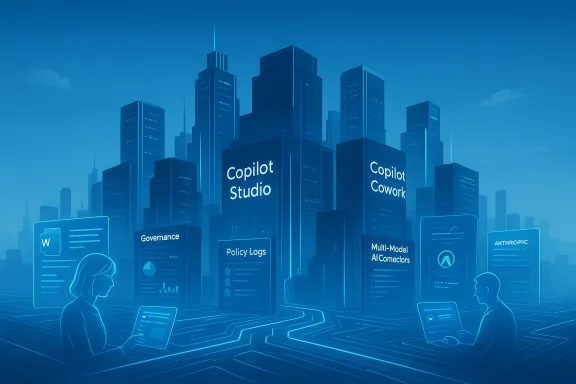 Building the rails: Copilot Studio, Agent 365, and Copilot Cowork
Copilot Studio — a developer and low-code engine
Copilot Studio is positioned as the development engine for agentic AI inside Microsoft 365. It provides:- A low-code agent builder and templates to create agents that combine conversational interfaces with autonomous task orchestration.
- Connectors to first‑party Microsoft data sources (SharePoint, Teams, OneDrive) and to Azure services, offering grounding in business data.
- Support for voice and multimodal inputs and a path from prototype to enterprise deployment.
Agent 365 — observability, governance, and the control plane
Agent 365 is the missing piece that converts prototype agents into enterprise-grade services. It provides centralized observability, role-based access controls, compliance and security controls, and policy enforcement. This matters because enterprises adopt technology only when operations and security teams can reason about risk, audit actions, and apply governance consistently.By packaging Agent 365 with Copilot Studio and Microsoft 365, Microsoft is trying to ensure the IT management story is not an afterthought — it’s baked into the platform. Independent reporting and Microsoft product blogs both highlight Agent 365 as the administrative spine for agent fleets.
Copilot Cowork — from “help me write” to “do it for me”
Copilot Cowork represents the conceptual leap from assistance to agency: permissioned, long-running agents that can read mail and calendar entries, manipulate spreadsheets, call APIs, and deliver finished outputs. Built in close technical collaboration with Anthropic’s Cowork technology, Copilot Cowork is shipping initially as a research preview and will gradually expand into Microsoft’s Frontier and enterprise programs. If Copilot Cowork works as marketed, it shifts where value is captured — from friction-reduction in drafting to actual automation of knowledge work.The model strategy: multi-provider and pragmatic
A key infrastructural calculation is model diversification. Microsoft’s decision to open parts of the Copilot model stack to Anthropic (making Claude models available inside Copilot) is a strategic hedge against single‑vendor risk and a signal to enterprise customers that Microsoft will let them choose model behavior and tradeoffs.Why this matters:
- Different providers offer different safety guardrails, latency/throughput tradeoffs, and licensing terms. Enterprises will seek flexibility for compliance, cost control, and risk management.
- A multi‑model platform encourages an ecosystem: independent ISVs and partners can build agents optimized for particular verticals or workloads, increasing stickiness.
Commercialization: E7 pricing, adoption math, and the revenue bet
The economics of this play are explicit and audacious.- Microsoft disclosed 15 million paid Microsoft 365 Copilot seats in its recent earnings commentary, against a Microsoft 365 installed base that exceeds 450 million commercial seats. That equates to roughly a 3.3% paid penetration — a huge runway if Microsoft can convert more users to paid Copilot and premium bundles.
- The new E7 bundle, described as the “First Frontier Suite,” is priced at $99/user/month and folds advanced Copilot capabilities, Agent 365, and security tooling into a premium SKU. Agent 365 reportedly will be available as a separate charge as well (reports put Agent 365 list pricing around $15/user/month for control-plane consumption).
What the numbers imply
- If Microsoft converts a small fraction of the dormant base (for example, an additional 10% of the 450M base) to E7 at $99/mo, the revenue implications are massive. But adoption won’t be linear: customers will evaluate ROI, governance overhead, and integration complexity.
- The immediate metric to watch is not just seats sold but agent activity: are corporate IT teams and developers building and publishing agents at scale? Revenue follows utility, not marketing copy.
Organizational moves, capital allocation, and the leadership signal
Microsoft’s infrastructure bet is not only product-level; it’s organizational. The public narrative around Mustafa Suleyman and “humanist superintelligence” — a dedicated focus on building advanced AI that is aligned to human goals — is emblematic of leadership prioritization. Suleyman’s role and public commentary have positioned him at the center of Microsoft’s AI ambitions and safety narrative. Reports across outlets document his leadership of Microsoft AI and his public framing of “humanist superintelligence” as a guiding principle.Concurrently, Microsoft disclosed record capital expenditures — $37.5 billion in a quarter — concentrated heavily in short‑lived assets like GPUs and CPUs for AI workloads. That capital allocation is the literal infrastructure: power, networking, datacenters and accelerators that underpin the agent economy. The quarterly investor materials and earnings call notes provide the line-item confirmation.
Finally, workforce realignment and restructuring — including prior rounds of job reductions and organizational resets — have been widely reported. The exact totals and the causal attribution (cost discipline vs. resource reallocation into AI) vary across reports; some outlets place recent reductions in the low thousands or single-digit thousands and others aggregate higher numbers if broader program changes are included. Where the reporting diverges, caution is warranted: the corporate narrative emphasizes reallocation to AI priorities while external analyses highlight the human cost. We flag that the “tens of thousands” phrasing is used by some summaries but is not a single, consistent disclosure from Microsoft’s public filings; treat that particular figure as aggregation-dependent and partially unverifiable without company confirmation.
Investor lens: an MSFT momentum trading backtest included in the briefing
The provided material also included a concrete, rules-based trading approach to MSFT equities: a 252‑day rate‑of‑change trigger to go long when positive and when price closes above the 200‑day simple moving average, with multiple exit rules (close below 200‑day SMA, 20 trading days max hold, +8% take‑profit or −4% stop‑loss). The backtest summary showed:- Strategy Return: 5.12%
- Annualized Return: 2.95%
- Max Drawdown: 12.91%
- Profit-Loss Ratio: 1.09
- Total Trades: 11 (Win rate 54.55%)
- Average Hold Days: 14.64
Strengths of Microsoft’s infrastructure-first approach
- Scale and distribution advantage
- Microsoft already reaches hundreds of millions of commercial seats and has deep enterprise relationships, identity and compliance integrations, and a global datacenter footprint. Those moats lower the barrier to platform adoption in regulated industries where trust and data locality matter. The installed base and technical control-plane make it substantially easier to roll out agents in large organizations than starting from a point product.
- Integrated governance story
- Agent 365 and the platform’s “stay‑in‑tenant” data architecture reduce one of the biggest adoption frictions: data governance and compliance. Embedding security and observability into the platform is a major commercial enabler for conservative enterprise buyers. Microsoft’s messaging and product docs stress this as a core capability.
- Openness to model choice
- The Anthropic tie and multi‑model support signal a pragmatic approach to model sourcing and fallback. Enterprises will prefer options that let them pick behavior profiles and compliance postures. This fosters a partner and ISV ecosystem around agents.
- Capital commitment to compute
- The enormous capex outlay (GPUs, data centers) is a credible bet that Microsoft can host and scale agent workloads with service-level guarantees, latency choices, and cost controls that enterprises require. That physical infrastructure is a non-trivial moat.
Key risks, operational frictions, and unanswered questions
- Execution complexity and fragmentation
- The very thing Microsoft is trying to fix — a fragmented Copilot experience across products — is also the immediate execution risk. Rolling several Copilot variants, aligning data contracts, plugin APIs, and agent semantics across Word, Teams, Outlook and SharePoint is a monumental engineering and UX challenge. Early user reports and community threads show agents and studio artifacts don’t always behave consistently across surfaces. That gap between promise and integrated reality is the most immediate product risk.
- Price sensitivity and commercial acceptance
- E7 at $99/user/month is a bold price point. It assumes enterprises will pay materially more for governance, agent management, and premium models. Early sales will test whether that premium is justified in practice, particularly in mid-market and price-sensitive segments. The product economics must show measurable time savings or revenue uplift to overcome budget-approval friction.
- Competitive counter‑moves
- Google, Meta, Anthropic, and other cloud players are all building agent frameworks and competing for the same developer ecosystem. If competitors deliver comparable agent tooling with lower integration friction or better pricing, Microsoft will need to lean on its installed base and governance story to retain leadership. Watch for rapid feature convergence and price competition.
- Trust, safety, and regulatory scrutiny
- Agents that can act on email and file content raise new regulatory and legal questions about liability, record‑keeping, and sectoral rules (healthcare, finance, government). Microsoft’s “data stays within tenant” framing is necessary but not sufficient — enterprises will demand certification, audit logs, and legal guarantees. Regulatory bodies may scrutinize platform-level steering (e.g., preferential Copilot placement in Bing) and antitrust dynamics.
- Human capital and morale cost
- Reallocating headcount to AI infrastructure while cutting other roles creates transition costs: knowledge loss, morale drag, and the need for reskilling at scale. Reported layoff figures vary by outlet; some summaries aggregate larger totals while Microsoft’s direct disclosures cover discrete rounds. Where reporting diverges, treat large aggregate layoff claims as estimates rather than precise company disclosures.
What to watch next — measurable proof points
The pivot is now in the validation phase. The next quarters will either validate Microsoft’s infrastructure thesis or expose gaps. Key signals to monitor:- E7 sales and Agent 365 uptake: early enterprise contracts, renewals, and attach rates will be the clearest commercial signals that customers value the bundled governance and agent control plane. Pay attention to whether Agent 365 is sold as an add-on or adopted organically by existing E5/E3 customers.
- Copilot Studio activity metrics: published metrics on number of agents created, active agent instances, and third‑party agent apps in the Microsoft Agent Store will indicate platform health. High agent churn or minimal reuse would be a red flag.
- Customer case studies in regulated industries: healthcare, financial services, and government pilots that publish measurable ROI and compliance outcomes will be persuasive evidence of the platform’s fit for mission-critical use. Microsoft’s enterprise program materials emphasize such vertical plays as proof points.
- Execution o Copilot-built agents indistinguishable in behavior and capabilities across Word, Teams, Outlook, and SharePoint? If not, fragmentation will be a persistent friction point. Community signals and Microsoft Learn documentation will reflect progress here.
- Competitive responses: watch for Google, Meta, and Anthropic announcements that either integrate deeply into enterprise workflows or undercut Microsoft’s pricing or model strategy. Platform leadership will depend on developer mindshare as much as customer logos.
Practical guidance for IT leaders and decision makers
If you’re an enterprise IT leader evaluating Copilot and the new Microsoft AI stack, consider a staged, risk-controlled approach:- Start with non-sensitive pilots
- Build pilots in well-scoped domains (meeting summaries, scheduling automation, knowledge retrieval) where correctness is verifiable and regulatory exposure is low.
- Define success metrics up front
- Quantify time saved, error rates, and value capture. Tie pilot outcomes to the cost of E7 vs. incremental ROI.
- Make governance first-class
- Use Agent 365 or equivalent control planes to enforce policy, audit agent actions, and manage credentials. Require agent manifests that document data sources and permitted actions.
- Insist on model choice and explainability
- Where possible, demand visibility into model provenance, hallucination rates for high-risk prompts, and testing environments that mimic production data.
- Plan for reskilling
- Move beyond cost-cutting narratives: prioritize skilling for employees whose work will be augmented, not just replaced, by agents.
Conclusion
Microsoft’s Copilot unification is an infrastructure bet dressed up as product strategy. The company is no longer only shipping assistants — it is packaging the tools needed to build, govern, and scale doing software across the enterprise. That thesis leverages Microsoft’s deep enterprise distribution, identity and security capabilities, and massive capital investment in compute. Early indicators — Anthropic integration, Copilot Studio, Agent 365, and the $99 E7 bundle — show a coherent product and commercial axis that, if executed cleanly, could become the substrate for a new wave of agentic automation.But the path is narrow. Execution complexity, surface fragmentation, customer price sensitivity, competitive responses, and unresolved labor and regulatory questions make this a high-variance outcome. For IT leaders and investors, the smart posture is empirical: measure agent activity, validate ROI in pilots, and watch adoption and governance metrics rather than demos and press releases. Microsoft has built the rails; now the market — and Microsoft’s ability to deliver a seamless, secure, and compelling developer and administrative experience — will determine whether Copilot becomes the operating system of knowledge work or a costly experiment in platform ambition.
Source: Bitget Microsoft’s Copilot Unification Hides a High-Conviction AI Infrastructure Play | Bitget News
