
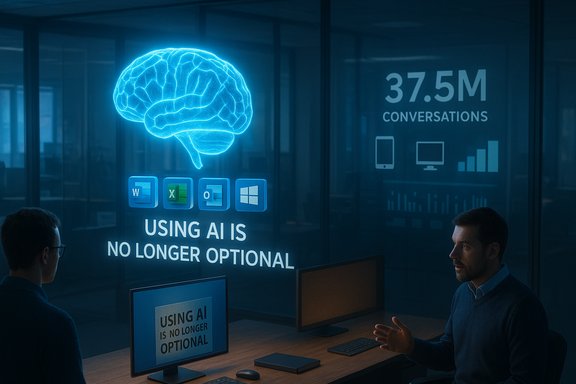
Microsoft’s big bet on Copilot — the promise to make generative AI the quiet backbone of everyday work — is at a strategic inflection point: internal memos now insist “using AI is no longer optional,” while Microsoft’s own usage report claims wide engagement, and independent testing and employee signals paint a far messier reality. The contrast between the company’s public narrative and on-the-ground experience matters because Copilot is both Microsoft’s marquee AI product and the proof point for Satya Nadella’s vision of AI as the next platform for productivity.
Microsoft launched Microsoft 365 Copilot as more than a chatbot — a productivity assistant woven into Word, Excel, Outlook, Teams and Windows. The pitch: language models that write, summarize, analyze and automate inside the everyday apps people already use, making AI the new operating layer for work rather than a novelty you open in a browser. That ambition has shaped massive technical and commercial investments across Azure, OpenAI partnerships and product teams.
But strategic bets are tested by adoption and perception. Internally, Microsoft leaders now treat employee fluency with Copilot and other internal AI tools as material to performance assessments. Externally, Microsoft published a Copilot Usage Report for 2025 that analyzes tens of millions of conversations and highlights how people use Copilot across devices and times of day. At the same time, journalists and independent reviewers have repeatedly documented gaps between marketing demonstrations and real-world behavior for features such as Copilot Vision. Together, these signals show a company racing to convert capability into habit — and finding the conversion harder than expected.
Competitors are also moving fast. Google is folding Gemini into Search, Android and Workspace; OpenAI continues to iterate on ChatGPT with new models and features; and nimble startups produce specialized assistants that satisfy narrow needs quickly. Microsoft’s response — building on Azure, using multiple models (including in‑house models) and tightly integrating Copilot into Windows and Office — is strategically coherent, but execution risk remains high. If users experience inconsistent quality, the contextual advantage becomes noise.
But the stakes cut both ways:
Turning Copilot into everyday habit requires an unglamorous focus on reliability, human‑centered defaults, clear governance, and measurable ROI. Without those, mandates and glossy marketing will at best speed early trials and at worst erode trust. If Microsoft can close the gap between aspiration and repeatable value, Copilot will vindicate Nadella’s platform play. If it cannot, the company will still have an enormous cloud franchise — but it may lose the unique consumer and cultural mindshare that anchors the next generation of computing.
Source: digit.in AI isn’t optional: As Microsoft Copilot falls short, Satya Nadella guns for relevance
 Background: Copilot’s promise and the moment of truth
Microsoft launched Microsoft 365 Copilot as more than a chatbot — a productivity assistant woven into Word, Excel, Outlook, Teams and Windows. The pitch: language models that write, summarize, analyze and automate inside the everyday apps people already use, making AI the new operating layer for work rather than a novelty you open in a browser. That ambition has shaped massive technical and commercial investments across Azure, OpenAI partnerships and product teams.But strategic bets are tested by adoption and perception. Internally, Microsoft leaders now treat employee fluency with Copilot and other internal AI tools as material to performance assessments. Externally, Microsoft published a Copilot Usage Report for 2025 that analyzes tens of millions of conversations and highlights how people use Copilot across devices and times of day. At the same time, journalists and independent reviewers have repeatedly documented gaps between marketing demonstrations and real-world behavior for features such as Copilot Vision. Together, these signals show a company racing to convert capability into habit — and finding the conversion harder than expected.
What Microsoft says — and what its report actually shows
The Copilot Usage Report 2025: scale with nuance
Microsoft’s Copilot Usage Report 2025 presents a large-scale study of user conversations: the company states it analyzed approximately 37.5 million de‑identified interactions to surface usage patterns, device differences and intent categories. The report emphasizes that Copilot is used not just for work tasks on desktops but also for personal advice and health questions on mobile, giving the product a broader role than purely enterprise productivity. Those findings are important because they document real, repeated behavior across millions of sessions, and they show that Copilot is evolving into a multi‑context assistant. However, raw scale in conversations is not the same as habit formation or deep, transform‑the‑workflow adoption. Microsoft’s report is explicit about methodology (de‑identified samples, topic/intent classification) but it does not — and cannot, from anonymized conversation data alone — prove that Copilot is central to most users’ daily work in the way email or spreadsheets are. The company can legitimately show growing engagement and interesting behavior patterns; but translating that into an argument that Copilot is “the next OS for work” requires deeper, longitudinal evidence about repeat dependency, task-critical usage, and ROI.What to watch in the report (claims that matter)
- The sample size (37.5M conversations) is large, and Microsoft’s breakdowns by device and time-of-day are credible signals of contextual use.
- The report privileges behavioral patterns (what people ask and when) over value metrics such as time saved, revenue impact, or task success rates — those harder economics are necessary to justify enterprise buy‑in at scale.
- The data excludes enterprise and education tenants in many analyses, which understates or skews how Copilot is used inside organizations versus consumer pockets. That omission matters when assessing Microsoft’s enterprise pitch.
The internal push: “AI is no longer optional”
A blunt memo and the manager playbook
Internally, Microsoft has signaled urgency: a memo from Julia Liuson, who oversees developer tools inside Microsoft, told managers to treat AI usage as a core expectation, stating that “using AI is no longer optional — it’s core to every role and every level.” Reporters and insiders say managers were asked to consider employees’ use of internal AI tooling as part of their performance reflections, and some teams are pilot‑testing formal metrics that could feed into future reviews. That push is intended to accelerate adoption among the very engineers and product teams building Copilot and related services. Framing AI fluency as a cultural competence — like communication or collaboration — is defensible in a company remaking itself around a platform-level technology. But tying it to performance evaluations is consequential: it changes incentives, risks encouraging superficial use, and can create fairness concerns when tool quality is uneven. Multiple internal observers and executives have publicly or privately described the memo as a clear sign that leadership sees day‑to‑day employee usage as a leading indicator of product-market fit for Copilot.Cultural and operational risk
- Forcing usage or over-emphasizing raw adoption numbers can produce checkbox behavior, where employees use the tool to “hit the metric” rather than integrate it with judgment. That magnifies the cost of low‑quality outputs and risks institutionalizing “AI slop” — plausible but unreliable output that needs heavy human correction.
- The memo signals to enterprise customers that Microsoft expects employees to adopt its tools — a credible sales argument only if the tools are consistently reliable and clearly beneficial. Until then, the internal mandate could come off as managerial coercion to compensate for product weaknesses.
Reality checks: product gaps, marketing, and independent testing
Hands-on testing vs. advertising
Several high-profile technology publications and independent labs have stressed a recurring theme: Microsoft’s Copilot advertising often shows seamless, ad‑scripted interactions that are hard to reproduce in real-world testing. Reviewers testing Copilot Vision and the Windows Copilot assistant reported misidentified objects, inconsistent behavior in video and image tasks, and responses that fail to complete the advertised workflows. Those gaps damage credibility because when marketing sets audience expectations, everyday failures are perceived as regressions rather than incremental improvements.Community feedback and stability problems
Public forums and user threads show a familiar pattern: new Copilot features like Vision and voice interaction have experienced partial rollouts, regional availability limits, and sporadic outages. Developers and enterprise pilots have reported brittle integrations where small changes break agents or connectors, and some enterprise sales teams have adjusted growth expectations for agent-style products after pilots failed to translate into broad deployments. Those operational realities matter for enterprise procurement, which is risk‑sensitive and requires clear SLAs and predictable TCO.The hype-versus-utility gap
- Marketing demonstrates possibility; product teams must deliver consistently across millions of varied environments. Copilot shows interesting wins in pockets (power users, specific enterprise automations), but it still struggles with broad, cross-context reliability.
- The consequence: customers who might trial Copilot use free tools (ChatGPT, Gemini or specialist agents) for quick wins, reducing the urgency to pay for tightly integrated Copilot seats until performance is demonstrable.
Competitive landscape: cultural mindshare vs. contextual integration
Microsoft’s competitive challenge is both technical and rhetorical. ChatGPT — and to a growing extent Google’s Gemini — dominates cultural conversations about AI: people think “ChatGPT” when they think of generative AI experiences in browsers and casual productivity tasks. Copilot, by contrast, is contextual: it shines when embedded in a workflow (drafting an email, summarizing a meeting), but that contextual advantage doesn’t easily translate into ubiquitous mindshare. That difference matters for adoption because many users discover AI in a browser and then decide whether to adopt enterprise‑grade integrations.Competitors are also moving fast. Google is folding Gemini into Search, Android and Workspace; OpenAI continues to iterate on ChatGPT with new models and features; and nimble startups produce specialized assistants that satisfy narrow needs quickly. Microsoft’s response — building on Azure, using multiple models (including in‑house models) and tightly integrating Copilot into Windows and Office — is strategically coherent, but execution risk remains high. If users experience inconsistent quality, the contextual advantage becomes noise.
Business and strategic stakes for Nadella and Microsoft
Satya Nadella has remade Microsoft around cloud and platforms; AI is the logical extension. Copilot is a flagship product that justifies billions in infrastructure, OpenAI partnership costs, and a reorganized sales and product ecosystem. For Nadella, internal adoption isn’t a vanity metric — it’s a proof point: if Microsoft employees don’t incorporate Copilot into how they think and work, enterprise customers will be skeptical that this is the future of productivity. That urgency explains the internal memos and the intensified executive focus on AI engineering and datacenter capacity.But the stakes cut both ways:
- If Copilot becomes central to productivity, Microsoft unlocks sustained subscription revenue and defends Windows and Office as indispensable platforms for the next decade.
- If Copilot underdelivers or is perceived as intrusive, Microsoft risks customer churn, slower enterprise upgrades, and a narrative vulnerability at a time when rivals are making cultural gains.
Risks and ethical considerations
Employee fairness and “AI fluency” as a career signal
Tying AI usage to performance reviews raises questions about fairness and measurement validity. If outputs are inconsistent, mandating tool usage without commensurate improvements in accuracy or training can penalize employees for product shortcomings. There are also concerns about auditability and attribution: when managers see work that’s co‑authored with AI, it’s important to distinguish between quality, originality and tool assistance. Microsoft must design evaluation systems that reward judgment and outcomes, not just clicks or message counts.Privacy, data governance and tenant isolation
As Copilot ingests user data, companies require transparent controls: clear tenant isolation, robust consent modeling, and auditable processing for regulated industries. Microsoft has invested heavily in enterprise security primitives, but skepticism remains among CIOs who demand proof that AI integration won’t leak sensitive data or create compliance risk. Any misstep here can set back adoption for years.Market and operational risk
- Heavy CapEx on AI datacenters ties Microsoft’s economics to continued enterprise adoption; if Copilot revenue lags, the financial justification for aggressive GPU spending becomes harder to defend.
- Sales teams’ recalibration of targets for AI products reflects realistic B2B purchase cycles: pilots are easy, scale is hard. Microsoft must invest in change management, custom connectors, and customer success to convert pilots into durable contracts.
What Microsoft should do next — pragmatic prescriptions
To convert Copilot from a set of promising features into an entrenched productivity platform, Microsoft should focus on reliability, transparency and measured defaults. Practical steps include:- Prioritize reliability metrics and publish reproducible benchmarks for major Copilot features (vision, summarization, document analysis) so customers and admins can assess readiness.
- Make opt-in the default for consumer-level Copilot integrations in the OS shell while offering enterprise admins granular controls and transparent consent flows.
- Rework performance-evaluation guidance so managers assess outcomes influenced by AI (quality, speed, impact) rather than raw usage counts — to avoid checkbox behavior.
- Expand customer success and integration teams focused on the pilot-to-scale gap: connectors, SLAs, prebuilt compliance templates and change‑management playbooks.
- Continue diversifying model infrastructure — smaller, task-tuned models for cheap/fast tasks and frontier models for creative/generative tasks — to optimize cost and latency.
Strengths and opportunities
- Microsoft owns the platform stack (Windows + Office + Azure) and can deliver deeply integrated AI experiences no pure-play chatbot can match when reliability improves. That vertical leverage is a unique advantage.
- The Copilot Usage Report shows genuine behavioral signals: Copilot is reaching meaningful interactions across contexts (work and personal). That breadth opens product opportunities beyond narrow enterprise deployments if the company addresses quality and trust.
- Investments in model diversification and in-house capabilities reduce vendor lock-in risk and give Microsoft control over performance, cost and customization. Those moves are strategically prudent.
Conclusion: relevance is the product to win
Satya Nadella’s push is not merely about feature parity or brand dominance — it’s about relevance. Microsoft is staking a platform-level future on the idea that AI should be the default way knowledge work gets done. Copilot is the most visible expression of that future. The company’s data shows scale and interesting patterns, its internal memos show urgency, and its product teams continue to ship ambitious features. But relevance is earned, not declared.Turning Copilot into everyday habit requires an unglamorous focus on reliability, human‑centered defaults, clear governance, and measurable ROI. Without those, mandates and glossy marketing will at best speed early trials and at worst erode trust. If Microsoft can close the gap between aspiration and repeatable value, Copilot will vindicate Nadella’s platform play. If it cannot, the company will still have an enormous cloud franchise — but it may lose the unique consumer and cultural mindshare that anchors the next generation of computing.
Source: digit.in AI isn’t optional: As Microsoft Copilot falls short, Satya Nadella guns for relevance
