

Microsoft’s quick apology and refund offer after Australia’s consumer watchdog sued over the Copilot rollout has exposed a deeper fault line: a well-intentioned remediation that appears to backfire by drawing fresh attention to design choices, regulatory exposure and the ethics of monetising AI inside subscriptions.
Microsoft folded Copilot, its generative AI assistant, into consumer Microsoft 365 Personal and Family plans as part of a broader product and pricing change that began in late 2024 and rolled through 2025. The Australian Competition and Consumer Commission (ACCC) says that when Microsoft communicated those changes to auto‑renewing customers, its renewal notices and account flows created a binary impression — accept Copilot at the higher price or cancel — while a lower‑cost, non‑AI Classic option was available but effectively hidden until a customer began the cancellation flow. The ACCC opened Federal Court proceedings on this point, alleging that the omission of the Classic option in renewal communications likely misled a reasonable consumer.
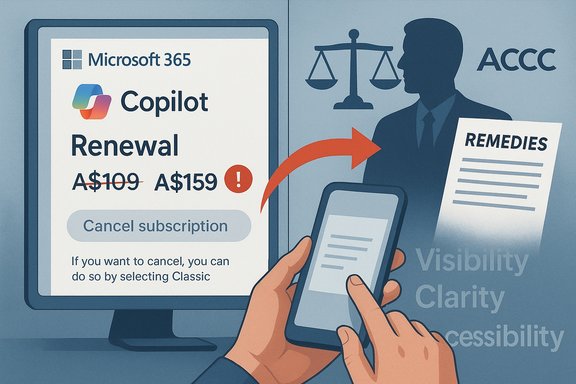
Key figures in the dispute are straightforward on paper but consequential in practice: the ACCC identifies roughly 2.7 million Australian subscribers as potentially affected, and cites headline price moves such as Microsoft 365 Personal rising from A$109 to A$159 and Family from A$139 to A$179 — changes that amplify the alleged harm if customers renewed without seeing the cheaper alternative.
Microsoft responded publicly with an apology, a process for customers to switch back to Microsoft 365 Personal/Family Classic plans, and an offer to refund the price difference for eligible subscribers who move to Classic within a stated window. Microsoft framed the action as remediation while stopping short of conceding legal liability.
This remedial step prioritises speed and operational simplicity: automated refunds to the payment method on file and a clear path to switch SKUs can reduce friction for eligible subscribers — provided the outreach reaches the right people and the account flows work as promised.
Caveat: while Microsoft’s outreach is verifiable (the company publicly acknowledged shortcomings and published switching/refund mechanics), several important operational details remain uncertain in the public record — for example, the exact number of refunds actually paid, what proportion of the 2.7 million ACCC figure corresponds to customers who paid the higher price, and how the refund mechanics will function in localized billing scenarios. These are live, verifiable facts only once Microsoft reports them or regulators disclose outcomes.
From a product ethics perspective, placing a lower‑cost alternative inside a cancellation flow rather than in renewal communications is a textbook design pattern that can be used to influence behaviour. Critics have labelled such tactics as dark patterns when they materially disadvantage consumers by reducing the discoverability of reasonable choices. The ACCC’s action signals that regulators now see these UX decisions as potential legal issues rather than merely bad design.
Regulators are concerned about three core elements in subscription markets:
Beyond monetary penalties, courts can issue injunctive relief forcing behavioural changes in digital communications and UX, and orders that reshape how subscription rollouts are handled. Microsoft’s voluntary refunds and apology may mitigate practical harm, but they do not terminate the ACCC’s legal action or eliminate the possibility of additional remedies ordered by the court.
The counterintuitive effect has several dimensions:
This episode is a practical test of several enduring lessons for subscription businesses in the era of paid AI:
Microsoft’s refund offer solved one problem but sharpened another: it repaired immediate consumer pain while spotlighting the UX and communication choices that regulators now treat as potentially unlawful. The coming weeks of litigation and operational disclosure will determine whether the company’s repair work suffices — or whether this becomes a landmark enforcement action reshaping how paid AI features are rolled into the services millions of consumers rely on.
Source: The Age ‘Epic fail’: Microsoft refund offer backfires
Source: The Sydney Morning Herald ‘Epic fail’: Microsoft refund offer backfires
 Background / Overview
Microsoft folded Copilot, its generative AI assistant, into consumer Microsoft 365 Personal and Family plans as part of a broader product and pricing change that began in late 2024 and rolled through 2025. The Australian Competition and Consumer Commission (ACCC) says that when Microsoft communicated those changes to auto‑renewing customers, its renewal notices and account flows created a binary impression — accept Copilot at the higher price or cancel — while a lower‑cost, non‑AI Classic option was available but effectively hidden until a customer began the cancellation flow. The ACCC opened Federal Court proceedings on this point, alleging that the omission of the Classic option in renewal communications likely misled a reasonable consumer.Key figures in the dispute are straightforward on paper but consequential in practice: the ACCC identifies roughly 2.7 million Australian subscribers as potentially affected, and cites headline price moves such as Microsoft 365 Personal rising from A$109 to A$159 and Family from A$139 to A$179 — changes that amplify the alleged harm if customers renewed without seeing the cheaper alternative.
Microsoft responded publicly with an apology, a process for customers to switch back to Microsoft 365 Personal/Family Classic plans, and an offer to refund the price difference for eligible subscribers who move to Classic within a stated window. Microsoft framed the action as remediation while stopping short of conceding legal liability.
What actually happened: timeline and mechanics
The product change and communications
- Late 2024: Copilot begins to be folded into consumer Microsoft 365 plans, with Microsoft announcing the change and associated price adjustments in public communications during early 2025.
- Through 2025: Microsoft targeted messages to auto‑renewing subscribers notifying them of price changes, and account UI changes were implemented that, according to the ACCC, revealed the Classic option only during the cancellation flow rather than in renewal notices.
- 27 October 2025: The ACCC commenced Federal Court proceedings alleging misleading and deceptive conduct under Australian Consumer Law.
- Early November 2025: Microsoft issued apology emails, described switching mechanics for Classic plans and offered refunds covering the price premium from renewals after 30 November 2024 for subscribers who switch to Classic by the company’s deadline. Microsoft said refunds would be processed to the payment method on file within 30 days.
The account‑flow issue at the centre
The ACCC’s legal theory rests on the timing and discoverability of alternatives: renewal emails and a public blog gave the impression of two options — accept the Copilot-enabled plan at the new price or cancel — whilst the Classic plan that retained the earlier price and omitted Copilot was discoverable only after a user initiated the cancellation process. That placement, the regulator argues, effectively hid a materially different option from many auto‑renewing customers. Screenshots and account flow captures attached to the regulator’s filings form the evidentiary backbone of its claim.Microsoft’s remedy: apology and refunds — a practical summary
Microsoft’s customer-facing message laid out three choices for affected customers: remain on the Copilot-integrated plan; switch to a Microsoft 365 Classic SKU (no Copilot) and receive a refund covering the price difference from the first renewal after 30 November 2024; or cancel the subscription. The company set specific eligibility windows (customers were told to switch before a stated deadline to qualify for refunds) and said it would process refunds to the payment method used for subscription payments, typically within 30 days.This remedial step prioritises speed and operational simplicity: automated refunds to the payment method on file and a clear path to switch SKUs can reduce friction for eligible subscribers — provided the outreach reaches the right people and the account flows work as promised.
Caveat: while Microsoft’s outreach is verifiable (the company publicly acknowledged shortcomings and published switching/refund mechanics), several important operational details remain uncertain in the public record — for example, the exact number of refunds actually paid, what proportion of the 2.7 million ACCC figure corresponds to customers who paid the higher price, and how the refund mechanics will function in localized billing scenarios. These are live, verifiable facts only once Microsoft reports them or regulators disclose outcomes.
Why regulators care: law, choice architecture and dark patterns
The ACCC’s complaint sits at the intersection of consumer protection law and product design. Under Australian Consumer Law, omissions of material information can be actionable if they are likely to mislead a reasonable consumer. The regulator’s argument is not a challenge to Microsoft’s right to raise prices or add features, but to the adequacy of contemporaneous disclosure and the presentation of alternatives at the moment a customer faces a billing decision.From a product ethics perspective, placing a lower‑cost alternative inside a cancellation flow rather than in renewal communications is a textbook design pattern that can be used to influence behaviour. Critics have labelled such tactics as dark patterns when they materially disadvantage consumers by reducing the discoverability of reasonable choices. The ACCC’s action signals that regulators now see these UX decisions as potential legal issues rather than merely bad design.
Regulators are concerned about three core elements in subscription markets:
- Visibility: alternatives must be visible at the point of renewal or in renewal notices.
- Clarity: communications must clearly describe differences in features and pricing between plans.
- Accessibility: switching to alternatives should be straightforward without requiring circuitous or counterintuitive steps.
Legal stakes and potential exposure
The ACCC seeks a mix of remedies usual for consumer enforcement: declarations that the conduct breached consumer law, injunctions, orders for consumer redress and civil penalties. Corporate penalties under Australian Consumer Law can be substantial — the greater of A$50 million, three times the benefit obtained, or 30% of adjusted turnover in serious cases — creating meaningful financial exposure even for global tech firms.Beyond monetary penalties, courts can issue injunctive relief forcing behavioural changes in digital communications and UX, and orders that reshape how subscription rollouts are handled. Microsoft’s voluntary refunds and apology may mitigate practical harm, but they do not terminate the ACCC’s legal action or eliminate the possibility of additional remedies ordered by the court.
The refund offer backfiring — how a fix amplified the problem
Microsoft’s remediation had three practical aims: acknowledge error, limit consumer harm, and reduce reputational damage. Yet the company’s apology and refund notice also performed a rhetorical function: they concretised the ACCC’s allegations in customers’ inboxes and public debate, drew attention to previously buried account flows, and made the problem tangible for a wider audience.The counterintuitive effect has several dimensions:
- Visibility effect: The apology email and refund instructions explicitly identified the Classic option and the pricing differential, which may have alerted customers who previously believed there were only two choices. That attention can increase complaints and help regulators document harm.
- Evidence crystallisation: Broad-based remediation produces data (who switched, who claimed refunds, the amounts refunded) that regulators can later use in litigation or settlement negotiations. Microsoft’s own records of outreach and refunds could become evidentiary records.
- Optics: An apology framed as “we could have been clearer” concedes a communications failure without admitting liability, but public perception often reads a corporate apology as an admission of at least partial fault — creating reputational cost even if legal culpability is contested.
Practical consequences for subscribers and businesses
For affected Microsoft 365 subscribers in Australia
- Check inboxes and account notices for Microsoft’s message titled along the lines of “Your Microsoft 365 Options” and follow the link to the account page to confirm eligibility.
- If you were charged the higher Copilot price and prefer the older non‑AI experience, consider switching to Microsoft 365 Personal/Family Classic before Microsoft’s stated deadline to preserve refund eligibility.
- Keep records: save screenshots of renewal notices, account flows, and receipts; if you pursue redress beyond Microsoft’s offer, documentation will be important.
For product teams and subscription businesses
- Treat renewal notices as legal touchpoints, not marketing opportunities. Renewal communications need the same compliance scrutiny as formal notices.
- Avoid burying lower‑cost or legacy alternatives inside exit or cancellation flows; make all materially different options discoverable at the point of renewal.
- Coordinate product, legal, and UX teams early in rollout planning for price or feature changes tied to monetised AI capabilities.
- Maintain audit trails of customer communications and UX variants; those records will matter if regulators question design intent or discoverability.
Critical analysis: strengths and weaknesses in Microsoft’s approach
Strengths
- Rapid remediation: Microsoft moved quickly to contact subscribers and offer refunds, which helps reduce immediate consumer harm and demonstrates responsiveness.
- Operational simplicity: Offering refunds to the payment method used and automating the SKU switch is the least friction path for consumers who want relief.
- Clear options in follow‑up: Microsoft’s later messages explained the Classic option and refund mechanics more plainly than the renewal letters that triggered the problem.
Weaknesses and lingering risks
- Perception of concealment: Even if the omission was an oversight, hiding the Classic option in a cancellation flow looks like deliberate obfuscation to many observers and makes the optics worse.
- Reach of remediation: The refund window and requirement that customers take action (switch to Classic before a deadline) could leave some eligible customers unaware, effectively limiting redress.
- Legal exposure remains: Microsoft’s voluntary refunds do not remove the ACCC’s interest; court remedies could be broader and include substantial penalties.
- Internal governance questions: The episode raises questions about whether product and legal teams sufficiently framed communications, and whether A/B experiments or staged rollouts created inconsistent experiences across locales. These programmatic questions can complicate defence strategies.
Broader implications: AI monetisation, subscriptions and regulatory spillover
This dispute has the hallmarks of a precedential moment. Regulators, not only in Australia, are watching how major vendors monetise AI features inside existing subscription products. The ruling and any remedial orders that follow could:- Force more explicit opt‑in architectures for paid AI features, rather than default inclusion with price increases.
- Require clearer, contemporaneous disclosure of alternatives at renewal points across jurisdictions.
- Increase enforcement actions where UX choices are used to nudge customers toward higher‑priced plans.
Unverifiable elements and cautionary notes
- The headline 2.7 million figure is an ACCC estimate that anchors the regulator’s claim; Microsoft has not independently verified that precise number in public statements. Treat the number as the regulator’s public estimate pending judicial findings.
- The aggregate dollar value of possible redress or penalties reported in some outlets (figures cited in the press as industry estimates) remain speculative until the Court issues orders or Microsoft discloses totals. Those headline estimates should be treated cautiously.
- The precise operational performance of Microsoft’s refund program (fraud checks, cross-border refunds, multi‑currency settlements, and the eventual number of successful refunds) is not yet publicly audited and therefore cannot be confirmed at the time of writing.
What to watch next
- Federal Court timetable: directions hearings and discovery will reveal whether the ACCC secures granular UX telemetry, screenshots, and internal timelines that support its omission theory.
- Microsoft’s execution: reported problems, delays, or a high friction rate in processing refunds will work against the company in Court and in public perception.
- Regulatory echo: other jurisdictions may open scrutiny into how AI features are monetised in subscription products, especially where auto‑renewal and default settings are common.
- Industry reaction: product teams at large vendors will likely re-evaluate renewal UX, default opt-ins, and legal sign‑offs for future AI rollouts.
Final assessment — a practical, reputational and legal test
Microsoft’s apology and refund offer were necessary damage control in the short term: they give affected customers a route to redress and demonstrate responsiveness. However, the very public remediation has also crystallised the ACCC’s case, elevated public scrutiny and produced data that could bolster enforcement.This episode is a practical test of several enduring lessons for subscription businesses in the era of paid AI:
- Disclosure is not optional. When product changes materially affect price and functionality, companies must disclose alternatives prominently and contemporaneously.
- UX is regulatory terrain. Choice architecture — what is shown, when and how — is now a compliance issue as much as a design one.
- Remediation is not immunity. Apologies and refunds can mitigate harm but do not neutralise legal exposure when regulators have launched formal proceedings.
Microsoft’s refund offer solved one problem but sharpened another: it repaired immediate consumer pain while spotlighting the UX and communication choices that regulators now treat as potentially unlawful. The coming weeks of litigation and operational disclosure will determine whether the company’s repair work suffices — or whether this becomes a landmark enforcement action reshaping how paid AI features are rolled into the services millions of consumers rely on.
Source: The Age ‘Epic fail’: Microsoft refund offer backfires
Source: The Sydney Morning Herald ‘Epic fail’: Microsoft refund offer backfires
