

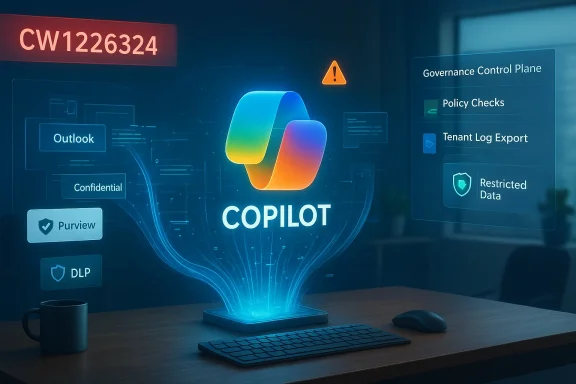
For weeks, Microsoft 365 Copilot quietly read, summarized, and surfaced emails that organizations had explicitly marked Confidential — a failure Microsoft tracked internally as service advisory CW1226324 and one that has forced a hard reassessment of how enterprise AI and governance controls interact. om]
Microsoft 365 Copilot is designed as an embedded productivity assistant across Outlook, Word, Excel, Teams and other Microsoft 365 surfaces. It uses a retrieval‑then‑generate architecture: first it selects contextual content (emails, documents, chats) via Microsoft Graph and internal indexing, then feeds that context into a large language model to produce summaries, drafts and answers. That architecture works well for productivity — until a retrieval error pulls the wrong content into the model’s context window.
In late January 2026 Microsoft’s telemetry and customer reports flagged anomalous behavior: Copilot Chat’s “Work” tab was picking up items from users’ Sent Items and Drafts folders even when those items carried Purview sensitivity labels and were protected by Data Loss Prevention (DLP) policies. Microsoft recorded the issue internally as CW1226324, attributed the root cause to a code/logic defect in the Copilot retrieval pipeline, and began a staged server‑side remediation in early February. The company emphasized that the behavior “did not provide anyone access to information they weren’t already authorized to see,” but it also acknowledged the assistant had processed labeled content it should have excluded.
Multiple independent reporters and security teams confirmed the core facts: the exposure window began around January 21, 2026; affected messages were confined to Drafts and Sent Items; and Microsoft rolled a configuration fix in February while monitoring deployment and contacting subsets of impacted tenants. The vendor has not published a comprehensive tenant‑level impact count or a public, detailed post‑incident forensic report.
Think of it like a bank where the vault door, the alarm and the security cameras all share one circuit breaker. One failed wire, and the vault is open, the alarm silent, and the cameras dark. That is what happened when a retrieval logic bug inside Copilot allowed labeled content to flow into the model’s context window. No external detector—no independent “backup” policy engine—saw it happen.
Why that architectural coupling matters now:
That creates at least three governance vulnerabilities:
That operational blind spot is systemic. Until enterprises insist on telemetry that they themselves can ingest and analyze (or require an independent governance control plane), they remain reliant on vendor disclosures and goodwill.
Enterprises must adopt a defense‑in‑depth approach to AI: independent governance, tenant‑owned logging, purpose‑bound connectors, routine tests that validate policy enforcement, and contractual rights to forensic exports and third‑party audits. Regulators should accelerate rules that make those requirements enforceable — because evidence left only in the vendor’s own logs is not enough when compliance and trust are on the line.
The labels were in place. The DLP policies were configured. And for a window of weeks, the AI read your confidential emails anyway. If that doesn’t change how you architect AI governance in your organization, what will?
Source: TechRepublic Microsoft Copilot Ignored Sensitivity Labels, Processed Confidential Emails
 Background / Overview
Microsoft 365 Copilot is designed as an embedded productivity assistant across Outlook, Word, Excel, Teams and other Microsoft 365 surfaces. It uses a retrieval‑then‑generate architecture: first it selects contextual content (emails, documents, chats) via Microsoft Graph and internal indexing, then feeds that context into a large language model to produce summaries, drafts and answers. That architecture works well for productivity — until a retrieval error pulls the wrong content into the model’s context window.In late January 2026 Microsoft’s telemetry and customer reports flagged anomalous behavior: Copilot Chat’s “Work” tab was picking up items from users’ Sent Items and Drafts folders even when those items carried Purview sensitivity labels and were protected by Data Loss Prevention (DLP) policies. Microsoft recorded the issue internally as CW1226324, attributed the root cause to a code/logic defect in the Copilot retrieval pipeline, and began a staged server‑side remediation in early February. The company emphasized that the behavior “did not provide anyone access to information they weren’t already authorized to see,” but it also acknowledged the assistant had processed labeled content it should have excluded.
Multiple independent reporters and security teams confirmed the core facts: the exposure window began around January 21, 2026; affected messages were confined to Drafts and Sent Items; and Microsoft rolled a configuration fix in February while monitoring deployment and contacting subsets of impacted tenants. The vendor has not published a comprehensive tenant‑level impact count or a public, detailed post‑incident forensic report.
What actually broke: the technical failure in plain language
- The enforcement model: In normal operation, Purview sensitivity labels and Purview‑configured DLP policies act as an exclusion gate — telling Copilot what it must not ingest or process. Those tools are the enterprise’s method of purpose‑binding content to policy.
- The fault: A server‑side code/logic error in Copilot Chat’s retrieval pipeline allowed messages in specific mailbox folders (Sent Items and Drafts) to be picked up and included in the retrieval context even when those messages were labeled Confidential or otherwise protected. Once restricted content entered the retrieval set, it could be summarized and surfaced in Copilot responses.
- The scope: Reports indicate the incident was limited to the Copilot Chat “Work” experience and those two folders. That narrow scope may make the failure easier to patch — but it also makes it more insidious, because Sent Items and Drafts commonly contain threads, external quotes and attachments that expose broad context.
- The practical harm: Even if no new user gained permission to view a message, processing a confidential email inside an AI pipeline is materially different from a human merely reading it. An AI ingestion event can create summaries, embeddings and derivative outputs that are harder to audit and control — and may persist in vendor logs or indexes unless explicitly purged. Microsoft has not publicly disclosed whether such derivative artifacts were retained or how many tenants were affected.
The deeper architectural problem nobody is talking about
This is not just an isolated bug. It’s an acute symptom of an architectural design choice: security controls and the AI processing stack live inside the same vendor platform. When enforcement logic is implemented within the same production pipeline that performs retrieval and generation, a single code path failure can render those defenses inert.Think of it like a bank where the vault door, the alarm and the security cameras all share one circuit breaker. One failed wire, and the vault is open, the alarm silent, and the cameras dark. That is what happened when a retrieval logic bug inside Copilot allowed labeled content to flow into the model’s context window. No external detector—no independent “backup” policy engine—saw it happen.
Why that architectural coupling matters now:
- Retrieval‑first systems create a single enforcement choke point. If an exclusion check fails at retrieval time, everything downstream is compromised.
- Traditional security tools (EDR, WAF, SIEM) are optimized for endpoints, network flows and transactional telemetry — not for inspecting or validating what a vendor‑hosted model ingests inside the cloud.
- The vendor controls — label enforcement, DLP rules, access tokens — are necessary but they are not sufficient if you cannot independently verify or audit their runtime behavior. Multiple incidents in 2025–2026 show different root causes (adversarial inputs and internal bugs) leading to the same outcome: AI processing of off‑limits data.
The governance gap: “Trust but verify” fails when the verifier is the same vendor
Microsoft’s public framing — that users only accessed content they were already authorized to see — is technically correct but incomplete. The salient question for security and compliance teams is whether the AI system was authorized to ingest and process that data for model-driven summarization and indexing. Purview labels are designed to say “do not process,” but the enforcement point that should have honored that instruction was part of the same cloud pipeline that failed.That creates at least three governance vulnerabilities:
- No independent audit trail. If your only logs come from the vendor whose system misbehaved, you have a single point of truth controlled by the same entity that had the defect. Regulators and internal compliance teams loathe that.
- No external anomaly detection. Common enterprise detectors never saw what Copilot did because the retrieval and processing happened inside Microsoft’s opaque pipeline.
- Delayed or incomplete disclosure. Tenants learned about the issue via advisories and press reports weeks after initial detection; Microsoft is contacting subsets of customers to validate remediation rather than issuing a mass, detailed tenant export.
Compliance consequences: why this can be expensive and legally risky
This was never just a technical embarrassment. The regulatory stakes are genuine.- HIPAA (United States): If Copilot processed emails containing protected health information (PHI), covered entities and business associates may face HIPAA breach notification obligations. Under the HHS Breach Notification Rule, an impermissible use or disclosure of unsecured PHI is presumed to be a breach unless a risk assessment shows a low probability of compromise. Notifications must be timely and, in some cases, include media and HHS reporting. Vendors’ failures are not a safe harbor for covered entities that relied on those controls.
- GDPR (EU): Article 32 requires controllers and processors to implement “appropriate technical and organisational measures” to ensure processing security. If a processor’s internal failure allowed personal data to be processed in ways not intended by the controller, that raises questions about adequacy of technical measures, breach notification duties and potential fines — especially if organizations cannot demonstrate effective, independent safeguards.
- EU AI Act (record‑keeping): The Act’s Article 12 requires high‑risk AI systems to allow automatic recording of events (logs) to enable traceability and post‑market monitoring. If an AI provider’s logs are the only source of truth, deployers and regulators may still demand independent, machine‑readable records and access to those logs. The Copilot incident exposes the operational friction when the vendor is the sole keeper of the logbook.
The operational checklist every security team should run this week
If your organization uses Microsoft 365 Copilot, treat this incident as a security triage exercise. Below is a prioritized action plan that’s practical, vendor‑agnostic and time‑sensitive.- Immediate triage (hours to 48 hours)
- Check your Microsoft 365 admin center for advisory CW1226324 and any tenant‑specific notifications from Microsoft; preserve all communications and advisory IDs.
- Identify high‑risk mailboxes (legal, HR, execs, finance, clinical). Place those mailboxes on immediate hold; consider temporarily disabling Copilot for them until you validate remediation.
- Export Purview and audit logs covering January 21 through mid‑February 2026; preserve them under legal hold. If logs are incomplete, document precisely what is missing.
- Evidence and validation (48 hours to 2 weeks)
- Ask Microsoft for a tenant‑level confirmation about whether your tenant was included in the subset contacted for remediation validation; request any forensic exports the vendor can provide (search queries, retrieval hits, timestamps).
- Run controlled tests: create labeled drafts and sent messages, then query Copilot to confirm the assistant does not surface or summarize them. Repeat tests across environments (desktop, web, mobile) and record evidence.
- Review downstream systems: check whether any Copilot‑generated summaries were copied into shared docs or downstream channels during the exposure window.
- Risk assessment & regulatory planning (1–4 weeks)
- Conduct a cross‑functional risk assessment (legal, privacy, security) to determine whether breach notifications are required (HIPAA, GDPR, local laws).
- If PHI or regulated personal data was likely processed, prepare breach notification drafts and escalation playbooks now — do not wait until the vendor releases a final report.
- Longer‑term fixes (30–90 days)
- Re‑evaluate which data sources Copilot may access. Where possible, purpose‑restrict the assistant so it cannot access mailboxes or repositories that hold the most sensitive material.
- Implement periodic, scripted checks that verify Copilot respects labels and DLP across all mailbox folders (including Sent Items and Drafts).
- Negotiate contractual audit and log‑access rights with the vendor: require prompt, tenant‑level forensic exports and SLA‑backed transparency obligations for any future incidents.
Technical mitigations enterprises should demand now
The Copilot incident makes clear that vendor‑hosted enforcement alone is an insufficient trust model. Here are technical and contractual mitigations to close that gap.- Independent governance plane: Deploy an external AI governance/control plane that mediate requests before data ever reaches the model. That control plane should support purpose binding, least‑privilege scopes, and block/allow lists enforced outside the vendor’s processing pipeline. This creates a backstop if the vendor’s internal enforcement fails.
- Purpose‑bound connectors: Where possible, configure connectors that only allow specific content types or folders into the retrieval index (for example: exclude any mailbox content mapped as PHI or Legal). Hard‑exclude categories are preferable to soft policy checks.
- Tenant‑controlled logging: Require the vendor to push detailed retrieval and invocation logs to a tenant‑owned logging endpoint (S3, Blob, SIEM). If the vendor refuses, require contractual audit rights and escrowed logs for the exposure period. Article 12 of the EU AI Act underscores the regulatory appetite for robust logging.
- Regular RAG penetration testing: Treat retrieval‑augmented generation pipelines as code that must be tested. Simulate label bypass conditions, adversarial prompt injection, and malformed inputs to ensure the enforcement layer is resilient.
- Staged enablement: For high‑value environments (healthcare, legal), adopt a phased model for Copilot adoption: start with read‑only insights, then add write capabilities only after a documented assurance and logging regimen is in place.
Why existing security tooling didn’t see this (and what that implies)
EDR watches processes and file system activity. WAF inspects HTTP payloads leaving your perimeter. DLP inspects flows you control. None of these tools are designed to detect when a vendor’s internal retrieval engine misclassifies or pulls a labeled document into a model’s context. The event happened entirely inside Microsoft’s cloud infrastructure — between a Graph connector and a model invocation — which means traditional tooling had no observability into that critical boundary.That operational blind spot is systemic. Until enterprises insist on telemetry that they themselves can ingest and analyze (or require an independent governance control plane), they remain reliant on vendor disclosures and goodwill.
What regulators and vendors should do next
This incident presents a clear policy roadmap for both regulators and AI vendors:- Mandatory, machine‑readable logging for AI retrieval/generation events (Article 12‑style requirements). Regulators should require providers of widely deployed AI assistants to produce standardized logs that capture inputs, outputs, timestamps and the reference data sources consulted.
- Faster, clearer tenant notifications. Vendors must commit to near‑real‑time tenant alerting for failures that could affect labeled data, including tenant‑level forensic exports and a clear remediation timeline.
- Independent third‑party audits. Large AI platforms should submit to periodic, independent verification of enforcement logic (labels/DLP enforcement) across a variety of scenarios, with summaries made available to deployers.
- Contractual and SLA upgrades. Deployers should demand contract language that guarantees access to logs, indemnities for compliance failures, and rights to third‑party forensic review when incidents occur.
Final analysis: strengths, weaknesses and risks
What this episode confirms — and what security leaders must internalize — is brutally simple.- Strengths observed:
- Copilot delivers real and measurable productivity gains by synthesizing context across mail, files and chat.
- Microsoft detected the anomaly internally, tracked it as an advisory and deployed a server‑side configuration fix rather than leaving tenants to fend for themselves.
- Weaknesses exposed:
- A single vendor‑side code path failure circumvented controls that tenants had carefully configured.
- Lack of tenant‑owned, independent logs and limited disclosure left many organizations with insufficient forensic evidence to assess exposure.
- Traditional security stacks remain blind to AI retrieval‑layer failures happening inside vendor clouds.
- Primary risks going forward:
- Regulatory exposure (HIPAA, GDPR, national privacy laws) if sensitive data was processed and adequate notifications were not made.
- Reputational and contractual fallout if confidential negotiations, legal strategies, or patient data were summarized by an AI system and then shared inadvertently.
- A repeating pattern: different root causes (a bug, a prompt‑injection attack) can produce the same result — labeled content processed by an AI — and traditional tooling will often miss it.
Conclusion — the hard tradeoff, and a practical call to action
The fix is not to stop using AI. That ship sailed years ago. The fix is to stop assuming that a single, vendor‑controlled set of policies is sufficient to defend sensitive data when that vendor also runs the inference pipeline.Enterprises must adopt a defense‑in‑depth approach to AI: independent governance, tenant‑owned logging, purpose‑bound connectors, routine tests that validate policy enforcement, and contractual rights to forensic exports and third‑party audits. Regulators should accelerate rules that make those requirements enforceable — because evidence left only in the vendor’s own logs is not enough when compliance and trust are on the line.
The labels were in place. The DLP policies were configured. And for a window of weeks, the AI read your confidential emails anyway. If that doesn’t change how you architect AI governance in your organization, what will?
Source: TechRepublic Microsoft Copilot Ignored Sensitivity Labels, Processed Confidential Emails
