

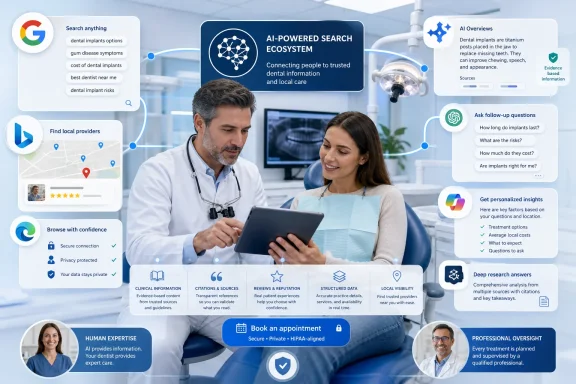
Artificial intelligence is changing how patients discover dental clinics, but the emerging battle for visibility is more complicated than simply “ranking in ChatGPT.” A new campaign from Ireland-based dental marketing agency Dental Booster argues that practices must prepare for ChatGPT search, Google AI Overviews, Perplexity, Microsoft Copilot, and other answer engines alongside conventional search. The central warning is directionally sound: patients increasingly ask conversational, multi-part questions before contacting a provider, and AI systems can influence which clinics, treatment options, and sources enter that consideration set. Yet “AI SEO” is not a magic new discipline, and clinics that pursue shortcuts risk wasting money, publishing unsafe health content, or measuring visibility that never produces a real appointment.
That journey has already been compressed by local packs, featured snippets, review summaries, booking integrations, and paid placements. Generative AI takes the compression further by attempting to synthesize an answer before the user visits a clinic’s website.
Instead of searching separately for “dental implants cost,” “implant recovery time,” and “dentist near me,” a patient can ask a single question such as: Which implant treatments might suit someone with previous gum disease, what are the risks, and which clinics nearby offer consultations? An AI service can break that request into subtopics, gather supporting information, and present a consolidated response.
Pages generally still need to be crawlable, indexable, technically sound, and eligible to appear in ordinary search. Helpful content, accurate business information, internal links, page experience, and structured data that matches visible content remain foundational.
The practical shift is therefore not from SEO to AI SEO. It is from optimizing isolated keywords to building a coherent, verifiable digital identity that can survive several discovery systems.
Patients can now describe their age, concerns, treatment history, budget, anxiety, schedule, and desired outcome in one prompt. They may ask an AI assistant to compare alternatives, identify questions for a consultation, explain terminology, or create a shortlist of nearby providers.
This behavior changes what a useful dental page must accomplish. A thin page containing a treatment name, several promotional paragraphs, and a booking button may rank for a conventional keyword while providing too little evidence for a detailed AI-generated response.
The exact impact varies by query, market, device, and study methodology. Nevertheless, the direction is difficult to ignore: when a search interface answers the immediate question, fewer users need to open every source.
This does not make website traffic irrelevant. It changes the role of the website from being the only place where discovery happens to being the authoritative destination for verification, deeper research, and conversion.
Clinics should not interpret this as permission to ignore Google. Google Search and Maps remain central to local business discovery, while AI referrals are still only one part of the market.
The more useful conclusion is that a first-page ranking does not guarantee AI inclusion, and an AI citation does not guarantee clicks, enquiries, or appointments.
Search providers therefore have strong reasons to apply higher trust thresholds to dental information than to low-risk lifestyle content. Google describes health-related material as a category where experience, expertise, authority, and trust receive additional weight.
A clinic cannot establish credibility merely by repeating a treatment keyword or generating hundreds of frequently asked questions. Its content needs identifiable authorship, clinically responsible wording, review processes, appropriate qualifications, and clear boundaries between general education and individual diagnosis.
This makes dentistry particularly compatible with conversational search. AI systems are designed to combine several related information needs, even if their answers are not always dependable.
Clinics that explain complex treatments well may gain visibility early in the decision process. However, the page must still guide the patient toward a professional examination rather than implying that a chatbot or online checklist can determine suitability.
AI-generated summaries can flatten these distinctions into overly confident statements. A clinic’s content should counter that tendency by explaining dependencies, uncertainty, and the role of diagnostic records.
Responsible language is not a conversion weakness. In healthcare, careful qualification can be a stronger trust signal than an absolute promise.
Edge can place AI assistance close to browsing, comparison, and research activity. That distribution matters because users do not have to make a deliberate decision to visit a specialist “answer engine”; generative assistance can appear inside tools already used for everyday work and web access.
Dental clinics should consequently treat Microsoft visibility as more than a secondary copy of Google SEO. Bing’s index, local data, entity understanding, and source-selection behavior can influence what Copilot presents.
A sensible audit should confirm that Bing can crawl and index important treatment, location, clinician, and contact pages. It should also identify accidental blocks, canonical errors, JavaScript rendering problems, duplicate pages, and stale business details.
This work is not glamorous, but it is more defensible than buying a package that promises guaranteed Copilot mentions. No agency can legitimately guarantee a stable recommendation from a probabilistic system whose answers vary by prompt, user context, location, and time.
Patient data must not be casually pasted into public AI tools to create case studies, social posts, review replies, or treatment content. Even apparently harmless details can become identifying when combined.
AI visibility projects therefore need an information-governance policy as well as an SEO plan. Marketing convenience must not override confidentiality, contractual controls, healthcare regulation, or the clinic’s security obligations.
However, schema is descriptive rather than magical. Adding a
Google specifically advises that structured data should match visible page content. Marking up invisible claims, fabricated reviews, unsupported ratings, or services that the clinic does not provide can create policy and trust problems.
A dental clinic should use a consistent official name, address, telephone number, domain, clinician naming convention, and location description. Professional registrations, staff biographies, map listings, social profiles, local directories, press mentions, and authoritative associations should not contradict one another.
Entity optimization is less about repeating a brand name and more about removing ambiguity. If one page lists a clinician under a shortened name, another uses an outdated qualification, and a third associates the dentist with a former practice, a machine may struggle for the same reason a patient would.
The goal is not to create a separate page for every imaginable keyword variation. That approach produces duplication, weakens internal linking, and encourages repetitive AI-generated copy.
Each page should answer a meaningful clinical or logistical question. It should also identify the clinic, relevant practitioners, location, treatment scope, limitations, and next appropriate step.
A high-quality answer should explain context, not merely define a term. For example, an implant suitability section might discuss the need for an examination, imaging, gum health assessment, medical history, and evaluation of available bone.
Clinics can organize content around six patient-focused categories:
Clinics should also update content when techniques, products, regulations, staff, or services change. An old page naming a departed dentist or discontinued treatment can undermine entity confidence and create a poor patient experience.
AI tools may help draft outlines or simplify language, but the clinic remains responsible for the published result. Human clinical review is essential, especially where the copy discusses risks, eligibility, outcomes, or comparisons.
Google says local results principally consider relevance, distance, and prominence. Complete business information, correct categories, verified locations, current hours, links, and reviews contribute to how confidently a platform can match a clinic to a local request.
Each physical practice should have a useful location page rather than a doorway page that swaps only the town name. Patients need directions, accessibility information, parking or public transport details, hours, contact methods, available services, and an accurate description of the team at that site.
Clinics must not turn review generation into manipulation. Incentivized reviews, review gating, fabricated testimonials, or pressure to remove criticism can violate platform rules and damage public trust.
Responses require particular care. A clinic should avoid confirming that a reviewer is a patient or discussing treatment details in public, even when the reviewer has volunteered those details.
Together, however, they help establish that a clinic is a real organization with a stable location, identifiable clinicians, and a record beyond its own promotional pages.
This is why entity-building cannot be reduced to purchasing backlinks. Relevant, credible references are more valuable than a large volume of low-quality directory entries created only for search manipulation.
AI answers are less stable. Two users can ask similar questions and receive different wording, citations, or recommendations. Results may also change according to location, conversation history, model version, account state, and live web access.
A clinic should therefore avoid presenting one screenshot as proof of durable AI visibility. A mention captured on Monday may disappear on Tuesday or appear only for a narrowly engineered prompt.
Clinics should combine Search Console with analytics, call tracking, booking data, and qualitative intake questions. They should also mark major website and campaign changes so that traffic movements can be interpreted against a timeline.
The business objective is not to win an AI visibility chart. It is to attract suitable patients, communicate responsibly, and convert demand into appropriate care.
This may be especially helpful for anxious patients or people who struggle to navigate complex clinic websites. AI can act as an orientation layer before professional care, provided users understand its limitations.
Clinics benefit when informed patients arrive with clearer questions and more realistic expectations. Useful educational content can also reduce repetitive administrative enquiries.
Patients should verify provider details, professional credentials, fees, availability, and treatment claims through authoritative channels. Generated advice should not replace an examination or individualized diagnosis.
Dental practices should monitor prominent AI systems for serious inaccuracies, but they should not assume every output can be directly corrected. Improving source consistency is usually more practical than attempting to control the model.
Enterprise AI visibility therefore begins with governance. The group needs a designated owner for clinic data, documented naming standards, a process for staff changes, and a reliable method for updating holiday hours or temporary closures.
Central control should not erase local detail. Each branch needs accurate information about its own clinicians, equipment, accessibility, referral pathways, and treatment availability.
Large groups should use templates for consistency while requiring genuine local and clinical information. Automated drafts need legal, regulatory, brand, and clinical review before publication.
A controlled content system can improve efficiency, but unattended generation can create unsupported claims across an entire domain. The scale that makes AI attractive also magnifies its mistakes.
More reliable platform-level reporting would help clinics distinguish genuine discovery from synthetic visibility tests. Until then, budgets should remain proportional to measurable business value.
Practices should watch for improved referral labeling, citation reporting, local answer analytics, and clearer separation of AI features in webmaster tools.
If that happens, accurate operational data will become as important as editorial content. A beautifully written implant guide will not help if the assistant encounters an obsolete telephone number or a broken booking page.
Clinics should test their patient journey from question to action, not stop at whether the brand appears in an answer.
Healthcare makes those gaps consequential. A low-quality comparison page can influence where a patient seeks treatment even if no clinician reviewed its recommendations.
Expect greater scrutiny of source transparency, sponsored content, fabricated authority, synthetic reviews, and mass-produced “best dentist” lists. Clinics should avoid tactics that may work briefly but become liabilities when trust systems improve.
 Background
From ten blue links to generated answers
Dental marketing has long depended on a familiar digital funnel. A prospective patient searches for a dentist, a treatment, or a symptom; Google returns advertisements, map listings, and organic links; the patient opens several pages before calling or submitting a form.That journey has already been compressed by local packs, featured snippets, review summaries, booking integrations, and paid placements. Generative AI takes the compression further by attempting to synthesize an answer before the user visits a clinic’s website.
Instead of searching separately for “dental implants cost,” “implant recovery time,” and “dentist near me,” a patient can ask a single question such as: Which implant treatments might suit someone with previous gum disease, what are the risks, and which clinics nearby offer consultations? An AI service can break that request into subtopics, gather supporting information, and present a consolidated response.
Traditional dental SEO is not disappearing
Dental Booster’s announcement frames AI visibility as an extension of dental SEO rather than its replacement. That distinction matters because Google’s own guidance says websites do not need special AI markup or a separate machine-readable file to qualify for AI Overviews or AI Mode.Pages generally still need to be crawlable, indexable, technically sound, and eligible to appear in ordinary search. Helpful content, accurate business information, internal links, page experience, and structured data that matches visible content remain foundational.
The practical shift is therefore not from SEO to AI SEO. It is from optimizing isolated keywords to building a coherent, verifiable digital identity that can survive several discovery systems.
How AI Search Changes Patient Discovery
Questions are becoming longer and more contextual
Traditional keyword research often reduces patient intent to short phrases such as “Invisalign Cork,” “emergency dentist,” or “dental implants near me.” Those phrases remain commercially important, but conversational tools encourage people to provide far more context.Patients can now describe their age, concerns, treatment history, budget, anxiety, schedule, and desired outcome in one prompt. They may ask an AI assistant to compare alternatives, identify questions for a consultation, explain terminology, or create a shortlist of nearby providers.
This behavior changes what a useful dental page must accomplish. A thin page containing a treatment name, several promotional paragraphs, and a booking button may rank for a conventional keyword while providing too little evidence for a detailed AI-generated response.
Discovery may happen without a website visit
AI-generated summaries also intensify the zero-click problem. Ahrefs previously reported that the presence of a Google AI Overview correlated with a substantial reduction in clicks to the top-ranking organic result, based on its analysis of hundreds of thousands of keywords.The exact impact varies by query, market, device, and study methodology. Nevertheless, the direction is difficult to ignore: when a search interface answers the immediate question, fewer users need to open every source.
This does not make website traffic irrelevant. It changes the role of the website from being the only place where discovery happens to being the authoritative destination for verification, deeper research, and conversion.
Citations and rankings are related but not identical
Dental Booster points to another Ahrefs finding: some pages frequently cited by ChatGPT reportedly have little or no conventional Google organic visibility. That suggests an AI assistant’s source selection can differ from Google’s ranked results, especially when the assistant relies on different search indexes, retrieval partners, models, freshness systems, or query-expansion techniques.Clinics should not interpret this as permission to ignore Google. Google Search and Maps remain central to local business discovery, while AI referrals are still only one part of the market.
The more useful conclusion is that a first-page ranking does not guarantee AI inclusion, and an AI citation does not guarantee clicks, enquiries, or appointments.
Why Dentistry Is a High-Stakes Search Category
Dental advice affects health and finances
Dental content sits at the intersection of healthcare and substantial consumer spending. A misleading article about whitening may cause inappropriate use of products, while inaccurate claims about implants, gum disease, sedation, or orthodontics can affect treatment decisions and patient safety.Search providers therefore have strong reasons to apply higher trust thresholds to dental information than to low-risk lifestyle content. Google describes health-related material as a category where experience, expertise, authority, and trust receive additional weight.
A clinic cannot establish credibility merely by repeating a treatment keyword or generating hundreds of frequently asked questions. Its content needs identifiable authorship, clinically responsible wording, review processes, appropriate qualifications, and clear boundaries between general education and individual diagnosis.
High-value treatments create lengthy research journeys
Patients considering implants, full-arch restoration, veneers, orthodontics, clear aligners, oral surgery, or sedation rarely make decisions after one generic search. They compare treatment stages, eligibility, cost factors, alternatives, expected longevity, maintenance requirements, discomfort, recovery, and possible complications.This makes dentistry particularly compatible with conversational search. AI systems are designed to combine several related information needs, even if their answers are not always dependable.
Clinics that explain complex treatments well may gain visibility early in the decision process. However, the page must still guide the patient toward a professional examination rather than implying that a chatbot or online checklist can determine suitability.
Clinical nuance resists automated simplification
The same dental treatment can have very different implications for different patients. Bone volume, periodontal health, medications, smoking, bite, age, previous procedures, oral hygiene, and general health may all influence clinical recommendations.AI-generated summaries can flatten these distinctions into overly confident statements. A clinic’s content should counter that tendency by explaining dependencies, uncertainty, and the role of diagnostic records.
Responsible language is not a conversion weakness. In healthcare, careful qualification can be a stronger trust signal than an absolute promise.
The Windows, Edge, and Copilot Dimension
Microsoft controls an important discovery surface
For Windows users, AI-assisted search is not confined to a separate chatbot tab. Microsoft has integrated Copilot experiences across its broader ecosystem, while Bing continues to combine conventional search results with generated answers and source links.Edge can place AI assistance close to browsing, comparison, and research activity. That distribution matters because users do not have to make a deliberate decision to visit a specialist “answer engine”; generative assistance can appear inside tools already used for everyday work and web access.
Dental clinics should consequently treat Microsoft visibility as more than a secondary copy of Google SEO. Bing’s index, local data, entity understanding, and source-selection behavior can influence what Copilot presents.
Bing fundamentals deserve renewed attention
Many small businesses focus almost exclusively on Google Search Console and Google Business Profile. In an AI-mediated environment, neglecting Bing Webmaster Tools, Microsoft-compatible indexing signals, and the clinic’s broader web presence becomes harder to justify.A sensible audit should confirm that Bing can crawl and index important treatment, location, clinician, and contact pages. It should also identify accidental blocks, canonical errors, JavaScript rendering problems, duplicate pages, and stale business details.
This work is not glamorous, but it is more defensible than buying a package that promises guaranteed Copilot mentions. No agency can legitimately guarantee a stable recommendation from a probabilistic system whose answers vary by prompt, user context, location, and time.
Windows-based clinic operations create a second issue
There is also an internal Windows angle. Dental groups may use Microsoft 365, Teams, Windows PCs, cloud storage, analytics dashboards, and practice-management software while testing generative AI for marketing.Patient data must not be casually pasted into public AI tools to create case studies, social posts, review replies, or treatment content. Even apparently harmless details can become identifying when combined.
AI visibility projects therefore need an information-governance policy as well as an SEO plan. Marketing convenience must not override confidentiality, contractual controls, healthcare regulation, or the clinic’s security obligations.
The Technical Foundation of AI Visibility
Crawlability still comes first
An AI system cannot reliably reference a page it cannot discover, retrieve, or interpret. Clinics should begin with the same technical fundamentals that support conventional search:- Important pages should return successful status codes and remain accessible without a login.
- Robots directives should not accidentally block treatment, clinician, or location content.
- Canonical tags should identify the intended version of duplicate or near-duplicate pages.
- XML sitemaps should include current, indexable URLs rather than redirects and obsolete pages.
- Mobile layouts should preserve essential text, contact information, and booking functions.
- JavaScript should not hide critical clinical content from crawlers or users with limited browser capabilities.
- HTTPS, security updates, backups, and reliable hosting should be treated as basic operational requirements.
Structured data clarifies, but does not confer authority
Structured data can help search systems identify an organization, local business, address, phone number, opening hours, breadcrumbs, articles, and other page elements. For multi-location practices, consistent location markup can reduce ambiguity between branches.However, schema is descriptive rather than magical. Adding a
Dentist or LocalBusiness type does not prove that a clinic is reputable, nor does FAQ markup force Google or an AI assistant to display the answers.Google specifically advises that structured data should match visible page content. Marking up invisible claims, fabricated reviews, unsupported ratings, or services that the clinic does not provide can create policy and trust problems.
Entity consistency reduces uncertainty
An entity is the identifiable real-world clinic, practitioner, brand, treatment service, or location behind a collection of web pages. AI and search systems attempt to determine whether references across websites describe the same entity.A dental clinic should use a consistent official name, address, telephone number, domain, clinician naming convention, and location description. Professional registrations, staff biographies, map listings, social profiles, local directories, press mentions, and authoritative associations should not contradict one another.
Entity optimization is less about repeating a brand name and more about removing ambiguity. If one page lists a clinician under a shortened name, another uses an outdated qualification, and a third associates the dentist with a former practice, a machine may struggle for the same reason a patient would.
Building Treatment Content That AI Can Use
One page should have one clear clinical purpose
Strong treatment architecture starts by separating genuinely distinct patient needs. A general implant page, for example, can introduce the service, while supporting pages may explain assessment, bone grafting, aftercare, alternatives, or full-arch treatment when the clinic actually provides those services.The goal is not to create a separate page for every imaginable keyword variation. That approach produces duplication, weakens internal linking, and encourages repetitive AI-generated copy.
Each page should answer a meaningful clinical or logistical question. It should also identify the clinic, relevant practitioners, location, treatment scope, limitations, and next appropriate step.
Question-based content must go beyond FAQ padding
Frequently asked questions are useful when they reflect issues patients genuinely raise. They become counterproductive when an agency generates dozens of near-identical answers solely to capture long-tail prompts.A high-quality answer should explain context, not merely define a term. For example, an implant suitability section might discuss the need for an examination, imaging, gum health assessment, medical history, and evaluation of available bone.
Clinics can organize content around six patient-focused categories:
- Suitability: The page explains who may or may not be an appropriate candidate without diagnosing the reader.
- Process: It describes the major stages from assessment through treatment and review.
- Alternatives: It compares reasonable options without presenting one service as universally superior.
- Risks: It addresses complications, limitations, and factors that may affect outcomes.
- Recovery and maintenance: It sets realistic expectations for aftercare and long-term responsibility.
- Cost factors: It explains what can change the fee without using misleading headline prices.
Clinician review should be visible
The name and credentials of the person reviewing clinical content should appear where appropriate. A dated review statement is more meaningful than a generic claim that “our experts” approved the page.Clinics should also update content when techniques, products, regulations, staff, or services change. An old page naming a departed dentist or discontinued treatment can undermine entity confidence and create a poor patient experience.
AI tools may help draft outlines or simplify language, but the clinic remains responsible for the published result. Human clinical review is essential, especially where the copy discusses risks, eligibility, outcomes, or comparisons.
Local Search, Maps, and Reputation Signals
Location remains decisive
Most dental care requires physical attendance, so local relevance continues to separate dental search from purely digital markets. An AI assistant may explain root canal treatment using global sources, but a request for an emergency appointment depends on location, opening hours, availability, and scope of service.Google says local results principally consider relevance, distance, and prominence. Complete business information, correct categories, verified locations, current hours, links, and reviews contribute to how confidently a platform can match a clinic to a local request.
Each physical practice should have a useful location page rather than a doorway page that swaps only the town name. Patients need directions, accessibility information, parking or public transport details, hours, contact methods, available services, and an accurate description of the team at that site.
Reviews influence trust but require restraint
Reviews can help patients compare clinics and can contribute to local prominence. They may also provide search systems with recurring language about services, location, staff behavior, accessibility, and patient experience.Clinics must not turn review generation into manipulation. Incentivized reviews, review gating, fabricated testimonials, or pressure to remove criticism can violate platform rules and damage public trust.
Responses require particular care. A clinic should avoid confirming that a reviewer is a patient or discussing treatment details in public, even when the reviewer has volunteered those details.
Reputation is broader than star ratings
A strong reputation footprint can include professional profiles, local citations, authoritative media coverage, community involvement, specialist affiliations, and consistent staff information. None of these individually guarantees an AI mention.Together, however, they help establish that a clinic is a real organization with a stable location, identifiable clinicians, and a record beyond its own promotional pages.
This is why entity-building cannot be reduced to purchasing backlinks. Relevant, credible references are more valuable than a large volume of low-quality directory entries created only for search manipulation.
Measuring AI Visibility Without Inventing Certainty
Conventional rankings are easier to track
Traditional search provides relatively mature measurement through Search Console, analytics platforms, call tracking, form submissions, booking systems, and advertising reports. Even these tools have attribution gaps, but they offer a clearer chain from impression to click and conversion.AI answers are less stable. Two users can ask similar questions and receive different wording, citations, or recommendations. Results may also change according to location, conversation history, model version, account state, and live web access.
A clinic should therefore avoid presenting one screenshot as proof of durable AI visibility. A mention captured on Monday may disappear on Tuesday or appear only for a narrowly engineered prompt.
Measure presence, sentiment, and conversion separately
An effective dashboard should distinguish between several outcomes:- Citation presence records whether a clinic or its pages appear as sources for monitored prompts.
- Brand mention presence records whether the clinic is named even when no clickable citation appears.
- Answer accuracy checks whether the generated description correctly represents location, services, clinicians, and limitations.
- Competitive share compares the clinic’s visibility with relevant local competitors.
- Referral activity measures identifiable visits from AI platforms where referral data is available.
- Conversion quality evaluates whether those visits produce calls, forms, consultations, or accepted treatment.
- Assisted discovery uses surveys and call scripts to identify patients who learned about the clinic through an AI tool but arrived later through branded search or direct navigation.
Search Console cannot tell the whole story
Google groups traffic from its AI search features into broader web search reporting rather than providing every clinic with a clean, feature-specific conversion report. That limits the ability to determine whether a click came from a traditional result, an AI Overview citation, or another search presentation.Clinics should combine Search Console with analytics, call tracking, booking data, and qualitative intake questions. They should also mark major website and campaign changes so that traffic movements can be interpreted against a timeline.
The business objective is not to win an AI visibility chart. It is to attract suitable patients, communicate responsibly, and convert demand into appropriate care.
Consumer Impact
Research can become faster and more accessible
For patients, conversational search can lower the effort required to understand unfamiliar treatments. People can ask follow-up questions, request simpler explanations, compare terminology, and prepare a list for a consultation.This may be especially helpful for anxious patients or people who struggle to navigate complex clinic websites. AI can act as an orientation layer before professional care, provided users understand its limitations.
Clinics benefit when informed patients arrive with clearer questions and more realistic expectations. Useful educational content can also reduce repetitive administrative enquiries.
Recommendations may be incomplete or wrong
AI assistants can produce outdated opening hours, confuse clinicians with similar names, blend services from different locations, or present an unsuitable clinic as a specialist provider. They can also summarize medical information without preserving important caveats.Patients should verify provider details, professional credentials, fees, availability, and treatment claims through authoritative channels. Generated advice should not replace an examination or individualized diagnosis.
Dental practices should monitor prominent AI systems for serious inaccuracies, but they should not assume every output can be directly corrected. Improving source consistency is usually more practical than attempting to control the model.
Enterprise and Multi-Location Implications
Larger groups face an information-management problem
A dental group with many sites may have hundreds of practitioner profiles, treatment pages, opening-hour records, telephone numbers, and booking links. Small inconsistencies multiply quickly when data is distributed across websites, map platforms, directories, advertising accounts, and internal systems.Enterprise AI visibility therefore begins with governance. The group needs a designated owner for clinic data, documented naming standards, a process for staff changes, and a reliable method for updating holiday hours or temporary closures.
Central control should not erase local detail. Each branch needs accurate information about its own clinicians, equipment, accessibility, referral pathways, and treatment availability.
Content scaling can create dangerous duplication
Generative AI makes it easy to produce hundreds of location-and-treatment combinations. It also makes it easy to publish hundreds of pages that say almost nothing original.Large groups should use templates for consistency while requiring genuine local and clinical information. Automated drafts need legal, regulatory, brand, and clinical review before publication.
A controlled content system can improve efficiency, but unattended generation can create unsupported claims across an entire domain. The scale that makes AI attractive also magnifies its mistakes.
Strengths and Opportunities
The rise of AI-assisted discovery gives well-run clinics several legitimate opportunities:- Detailed clinical education can earn visibility across multiple channels. One carefully reviewed resource can support organic search, AI citations, patient emails, consultation preparation, and staff communication.
- Smaller clinics may compete on clarity rather than advertising budget alone. A well-structured local practice with strong expertise can become a useful source even when a larger group dominates paid search.
- Conversational queries expose unmet patient needs. Prompt and search data can reveal confusion about treatment stages, costs, anxiety, recovery, and suitability.
- Better entity data improves the whole digital footprint. Correcting names, locations, hours, clinicians, and services benefits Maps, search results, AI systems, directories, and patients.
- High-intent AI referrals may be valuable despite low volume. A user who clicks after an extended comparison may be closer to arranging a consultation than someone making a broad informational search.
- Microsoft and Bing optimization can diversify discovery. Clinics that have ignored non-Google channels now have a reason to correct that imbalance.
- Responsible content can differentiate a clinic. Transparent discussion of risks, alternatives, and limitations may build more durable trust than aggressive promotional claims.
Risks and Concerns
AI SEO for dentists also brings substantial operational, ethical, and commercial risks:- Marketing agencies may rebrand ordinary SEO as an expensive proprietary service. Clinics should ask which deliverables are genuinely new and how success will be measured.
- Generated health content can contain clinical errors. Every consequential claim requires qualified human review.
- Visibility does not equal endorsement. An AI citation merely indicates that a system retrieved or referenced a source.
- Recommendations can change without warning. Model updates, index changes, prompt wording, and location can alter results overnight.
- Patient confidentiality may be compromised. Staff must not upload identifiable cases, messages, records, photographs, or review histories to unauthorized AI services.
- Review campaigns can violate platform policies. Incentives, gating, and manufactured feedback may result in removal or profile restrictions.
- Schema abuse can create false confidence. Structured data cannot manufacture expertise, ratings, or services that the visible page does not support.
- Overproduction can weaken a domain. Thousands of repetitive pages may confuse users, dilute internal linking, and create maintenance debt.
- AI answers may divert traffic while using clinic information. A practice may contribute useful content yet receive few visits from the generated summary.
- Aggressive treatment claims can create regulatory exposure. Promises about guaranteed results, pain, suitability, or permanence require particular scrutiny.
What to Watch Next
Better reporting may reshape investment
The AI search market still lacks standardized reporting comparable with mature web analytics. Agencies and software vendors are building prompt-monitoring tools, but their datasets, model access, geographic controls, and definitions differ.More reliable platform-level reporting would help clinics distinguish genuine discovery from synthetic visibility tests. Until then, budgets should remain proportional to measurable business value.
Practices should watch for improved referral labeling, citation reporting, local answer analytics, and clearer separation of AI features in webmaster tools.
Local actions may move inside AI interfaces
The next competitive step is likely to involve more than informational answers. AI interfaces could increasingly connect discovery with maps, appointment availability, calls, directions, insurance information, financing, or online booking.If that happens, accurate operational data will become as important as editorial content. A beautifully written implant guide will not help if the assistant encounters an obsolete telephone number or a broken booking page.
Clinics should test their patient journey from question to action, not stop at whether the brand appears in an answer.
Trust systems will face pressure
AI platforms will need better methods for evaluating healthcare sources, professional credentials, conflicts of interest, local relevance, and manipulated recommendation pages. Research has already suggested that some frequently cited pages lack strong conventional organic visibility, highlighting the possibility of gaps between retrieval and trust.Healthcare makes those gaps consequential. A low-quality comparison page can influence where a patient seeks treatment even if no clinician reviewed its recommendations.
Expect greater scrutiny of source transparency, sponsored content, fabricated authority, synthetic reviews, and mass-produced “best dentist” lists. Clinics should avoid tactics that may work briefly but become liabilities when trust systems improve.
The durable plan is straightforward
A dental clinic preparing for AI search should follow a disciplined sequence:- Correct the digital identity across the website, Maps, Bing, directories, professional profiles, and social accounts.
- Repair technical problems that prevent crawling, indexing, fast loading, accessibility, or secure booking.
- Prioritize important treatments and patient questions rather than generating pages indiscriminately.
- Publish clinically reviewed resources with clear authorship, limitations, alternatives, risks, and update dates.
- Strengthen location pages and reputation practices without manipulating reviews.
- Add accurate structured data that reflects what users can see on the page.
- Monitor conventional search, AI answers, referrals, and appointments as separate but connected signals.
- Protect patient information through approved tools, staff training, and documented governance.
- Review results quarterly and remove weak, duplicated, obsolete, or unsupported content.
- Judge success by suitable patient enquiries and care outcomes, not by screenshots of chatbot mentions.
References
- Primary source: Knoxville News Sentinel
Published: 2026-07-21T08:26:02+00:00
AI Search Is Changing How Patients Find Dental Clinics and Dental providers
Dental Booster highlights the growing importance of AI SEO for dentists as ChatGPT, Google AI Overviews and AI-poweredwww.knoxnews.com