• Thread Author
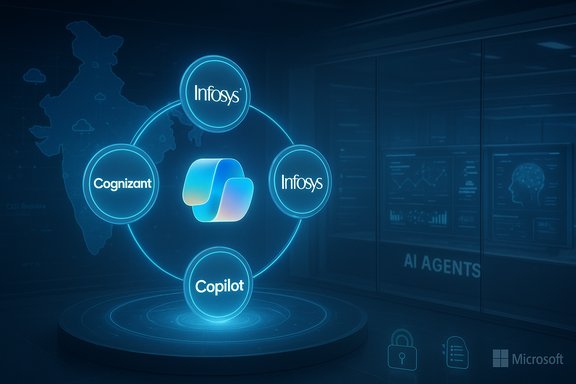
Microsoft’s latest push to make AI a default layer of enterprise work just got a shot of oxygen from four of India’s largest systems integrators, a move that signals both rapid industrial-scale adoption of Copilot and a major expansion of Microsoft’s partner-led strategy for agentic AI across industries.

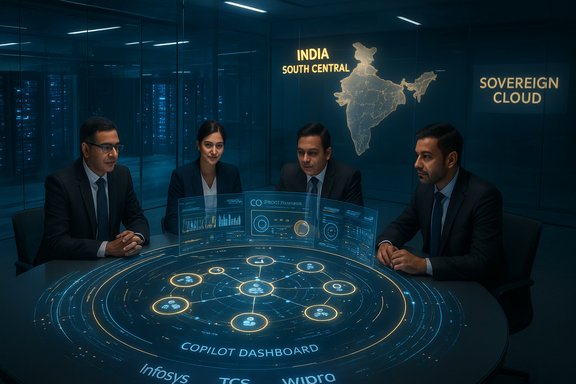
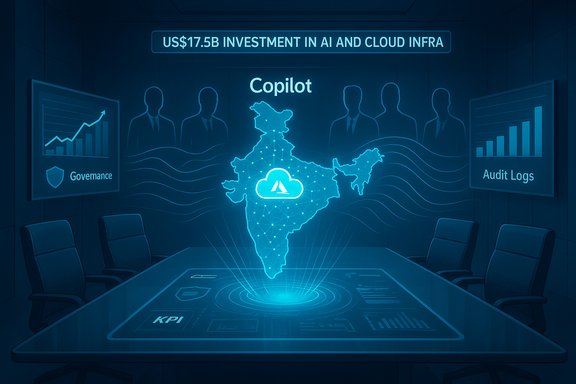
A futuristic boardroom with a holographic India map labeled Copilot and cloud, amid KPI dashboards.Background / Overview​

Microsoft CEO Satya Nadella used a high-profile India visit to outline an expanded investment and partnership plan: a US$17.5 billion commitment to accelerate cloud and AI infrastructure in India, paired with strategic collaborations with major IT services firms including Cognizant, Tata Consultancy Services (TCS), Infosys and Wipro. Those partners, Microsoft says, will deploy Copilot at scale across their organisations and client bases — media reports quote combined licence counts that would establish a new enterprise benchmark for Copilot adoption. This announcement is not just a promotional headline. It ties three interlocking trends that are defining enterprise AI in 2025 and beyond:
  • The acceleration from pilot projects to production‑grade deployments of agentic AI and copilots.
  • A partner‑centric go‑to‑market model where system integrators provide the operational muscle for scaling licences, connectors, governance and adoption programs.
  • A geopolitical and regulatory reality where in‑country processing and sovereign-ready infrastructure are becoming prerequisites for regulated industries.
The basic commercial claim that has circulated widely in the press is straightforward: these IT majors will each deploy tens of thousands of Microsoft Copilot licences, with some outlets reporting over 50,000 licences per partner and a combined total that crosses 200,000 licences. That figure, as carried by several Indian business outlets, is striking in scale and — if validated in full — would represent one of the largest coordinated Copilot rollouts to date.

Why this matters: the technical and commercial mechanics​

Copilot as a platform, partners as the delivery engine​

Microsoft’s strategy bundles three technical layers that together lower friction for enterprises:
  • Azure cloud and Azure OpenAI for hosting models and inference.
  • Microsoft 365 Copilot and Copilot Studio for workplace augmentation and agent orchestration.
  • Microsoft Foundry / governance tooling for model routing, policy and enterprise controls.
Partners bring the missing operational pieces: domain connectors, role-specific agents, migration and change‑management services, and the large-scale training programs required to move from trials to sustained monthly active user metrics. This is a deliberate market design: Microsoft supplies the platform and the controls; integrators supply the industry context, engineering capacity and adoption playbooks.

Sovereignty, latency and regulated workloads​

A practical barrier for Copilot-type services in regulated sectors (finance, healthcare, government) is where prompt traffic is processed and how tenant data is handled. Microsoft has committed to in-country processing for Copilot in select markets — a capability now being accelerated for India — which allows prompts and responses to be routed and handled within national borders under defined controls. That contract-level capability addresses a core procurement and compliance requirement for large institutions. Nevertheless, in-country processing is a necessary but not sufficient condition for regulatory compliance: enterprises still require strong governance over connectors, DLP, and audit trails.

Pricing and economics (verified)​

Microsoft’s public pricing for Microsoft 365 Copilot has been widely published: the enterprise list price is at roughly $30 per user per month (annual commitment), with agent usage and capacity packs priced on a metered basis. That published figure frames the commercial math for a 50,000+ seat deployment: licence fees, partner professional services, Azure compute for model inference, and ongoing governance will combine into a five‑ or six‑figure recurring monthly obligation per partner program. Microsoft’s pricing page and recent product communications confirm the baseline rate and agent metering approach.

The partners’ role: what TCS, Cognizant, Infosys and Wipro add​

Scale, skilling and domain accelerators​

Each partner already markets broad AI stacks and packaged capabilities that map directly to Microsoft’s offerings:
  • TCS has invested in AI.Cloud and large internal skilling drives.
  • Infosys promotes its Topaz/agentic offerings and Infosys Cobalt cloud services.
  • Wipro emphasizes Copilot‑integrated assistants and adoption analytics.
  • Cognizant has publicly disclosed very large Copilot seat purchases in prior announcements.
Partners contribute:
  • Pre-built connectors to industry systems (ERP, CRM, claims systems).
  • Vertical templates and scenarios (banking workflows, claims automation, manufacturing SOPs).
  • Large-scale training and enablement programs to create internal champions and reduce human risk in agent use.
  • Managed services to operate inference, monitoring, and incident response at production scale.
These capabilities are the operational glue that makes a Copilot licence more than software — they convert it into a workflow‑specific productivity proposition.

Adoption playbooks they will run​

Common patterns for success — and what partners sell to customers — include:
  • Start with outcomes, not features: define measurable KPIs (reduced time to close a sale, faster case resolution).
  • Pilot with high-impact roles (sales, legal, finance) before broad rollouts.
  • Implement governance first: Purview sensitivity labels, DLP, Entra conditional access, prompt logging and audit trails.
  • Operate a center of excellence to iterate on prompts, agents, and metrics.
Partners offer packaged adoption services (measurement dashboards, training vouchers, “Copilot heroes”) that are designed to convert licence commitments into measurable ROI. These are standard elements of the partner‑led Copilot playbook.

The scale claim: reading the numbers (and where to be cautious)​

Journalists reporting on the India announcements have quoted the claim that the four partners would deploy over 50,000 Microsoft Copilot licences each, collectively exceeding 200,000 seats. Multiple outlets repeated the same figure, and Microsoft’s executive framing around partner-led acceleration gives those numbers commercial plausibility. However, there are important verification caveats:
  • Public reporting on aggregated seat counts often comes from company statements or on‑stage comments and is not always broken down by partner, region, or timeline in audit-ready detail. In this case the exact per‑partner breakdown and the contract timing (how many seats are immediately active vs. a committed multi‑year purchase or an aspiration) are not uniformly documented in audited filings or detailed partner statements. Treat the precise number as a material indicator of intent and momentum — not as a fully audited transaction record.
Practical implications of this caution:
  • CIOs and procurement teams should ask partners for contractual evidence: purchase orders, seat activation schedules, and SLAs for agent hosting and in‑country processing.
  • Analysts and investors should expect a staggered rollout: initial seat activations for internal staff and marquee clients, followed by phased expansion to client engagements and co‑sells.

Strengths: real reasons to take the announcement seriously​

  • Platform convergence: Microsoft now exposes an integrated stack (Azure, Azure OpenAI, Microsoft 365 Copilot, Copilot Studio, Foundry) that reduces integration overhead for large customers. This reduces time to production for complex retrieval‑augmented generation (RAG) and agent orchestration scenarios.
  • Partner delivery velocity: The Indian IT majors have execution capacity — thousands of consultants, CoEs and global delivery centers — that can staff large migrations and build connectors at scale. That operational depth is what separates marketing announcements from real deployments.
  • Sovereign‑ready infrastructure: Microsoft’s hyperscale region plans, plus announced in‑country Copilot processing for India, materially reduce a common regulatory blocker for enterprise procurement in sensitive sectors.
  • Economics of scale: Large licence blocks, partner services and managed inference create consumption that supports Microsoft’s incentive programs and justifies partner investments in IP and CoEs. That economic alignment accelerates the commercial flywheel.

Risks and hazards: governance, hallucinations, lock‑in and workforce impacts​

1) Governance and safety at scale​

Deploying Copilot across hundreds of thousands of seats amplifies governance challenges. Agents that can autonomously act — read, write, trigger processes, or access systems — require runtime policies, credential management, prompt auditing, and human‑in‑the‑loop approval gates. Without strong controls, an enterprise deployment can produce data leakage, incorrect actions or regulatory exposure. Microsoft provides tooling and partners provide processes, but the integration of governance across thousands of agents is non‑trivial.

2) Hallucinations and over‑trust​

Generative outputs can be plausible but factually wrong. When Copilot answers are used for decision support or automated actions (contracts, compliance guidance, financial calculations), an unchecked hallucination can have real operational consequences. Enterprises must design for verification layers and human oversight. This remains a material operational risk.

3) Vendor lock‑in vs. interoperability​

Microsoft’s integrated stack is convenient, but comprehensive adoption ties data schemas, connectors, agent definitions and governance to a single vendor ecosystem. There are countervailing industry efforts to create agent‑to‑agent protocols and multi-model orchestration layers, but these are nascent. Organisations should negotiate exit options, data portability and interoperability clauses into contracts.

4) Workforce change and socioeconomic effects​

Large‑scale automation of knowledge work tasks inevitably affects roles and work patterns. Partners and Microsoft highlight skilling programs, but the broader impact on job structures within delivery firms and client organisations requires planning: reskilling, redesign of career paths, and redefining delivery economics.

Practical guidance for IT and procurement leaders​

  • Require clear, contract‑level evidence for licence counts and activation timelines. Do not accept on‑stage or summary press numbers as procurement proof.
  • Insist on a governance baseline before broad rollouts: DLP, sensitivity labels, Entra conditional access, Copilot audit logs and a defined incident response plan.
  • Pilot with outcome KPIs (time saved, error reduction, SLA lift) and measure at 30/60/90 days before scaling. Use partners to instrument those measurements.
  • Negotiate pricing and bundling details: agent metering, prepaid capacity packs, and committed seat discounts. Align procurement with Microsoft’s published pricing (Copilot $30/user/month baseline) while modeling Azure inference costs separately.
  • Build a multi‑model and data portability strategy to avoid single‑provider dependency. Require exportable agent definitions and data indexes.

The market and strategic context​

Microsoft’s India investment and the partner announcements must be read in the broader competitive context. Hyperscalers are racing to secure data center footprints, sovereign capabilities and ecosystem partnerships. The news follows similar strategic plays by other cloud providers and reflects a larger battle for enterprise AI adoption. For Microsoft, expanding Copilot uptake among the IT services firms serves multiple strategic goals: it locks in consumption across Microsoft 365, drives Azure usage for inference and data, and creates high‑visibility enterprise references that accelerate future sales. For the Indian IT players, the relationship deepens their cloud and AI practice monetisation, offers new managed service lines, and strengthens their position as essential delivery partners to global customers who want to adopt Copilot at scale.

What to watch next (near‑term signals)​

  • Which partners publish audited seat activation numbers and timelines (internal vs. client seats). Public disclosure of purchase orders or activated seats will convert intent into verifiable fact.
  • How Microsoft’s in‑country Copilot processing is implemented technically: SLAs, auditability, and whether guarantees include model routing and logs remaining within borders.
  • Early customer case studies that quantify realized productivity gains, error rates, and governance incidents. Real-world telemetry will separate promotional claims from sustained impact.
  • The development of industry standards for agent interoperability and safety. If neutral standards or agent‑to‑agent protocols gain traction, the lock‑in risk will be mitigated.

Conclusion​

Microsoft’s announcement — backed by a headline US$17.5 billion infrastructure and skills commitment in India and reinforced by tie‑ups with Cognizant, TCS, Infosys and Wipro — is a decisive escalation in the race to industrialize agentic AI. The declaration that partners will deploy tens of thousands of Copilot licences reflects genuine commercial intent and a partner‑led route to scale that is both logical and powerful. At the same time, the precise licence math and the operational details behind these headline figures remain partially opaque in public reporting; procurement teams should therefore demand contractual transparency, robust governance guarantees and measurable outcome commitments before signing large‑scale deals. If executed well — with governance, human oversight and clear measurement — these partner deployments could mark a watershed moment in enterprise productivity. If executed without discipline, they risk being expensive, brittle and operationally risky.
For CIOs and IT leaders, the path forward is disciplined adoption: pilot, measure, govern, scale — and insist on contractual evidence and interoperability. This is how enterprise AI moves from a vendor promise to sustained, auditable business value.
Source: Deccan Herald Microsoft, TCS, Infosys, Wipro Partner for Massive AI Adoption
 

Microsoft’s visit to India this month has turned into a high‑stakes moment for enterprise AI: the company announced a landmark US$17.5 billion investment in cloud and AI infrastructure for India and signalled a rapid acceleration of its partner‑led Copilot strategy with tie‑ups involving Cognizant, Infosys, TCS and Wipro — a move that several outlets report will bring tens of thousands of Microsoft Copilot licences into active use across the Indian IT services ecosystem. While one Indian business title carried an eye‑catching headline claiming two lakh (200,000) Copilot licences, the most verifiable public figures and company disclosures point to a more conservative, but still significant, set of deployments that underscore both opportunity and risk for enterprises and partners alike.

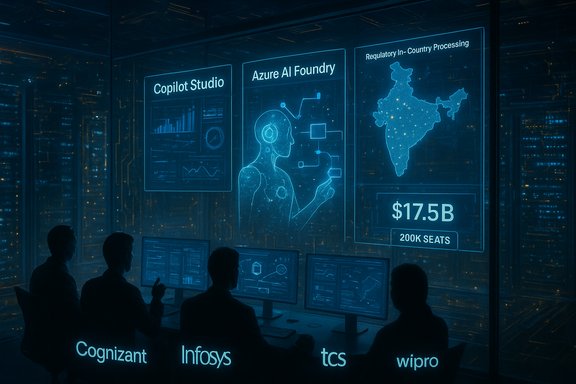
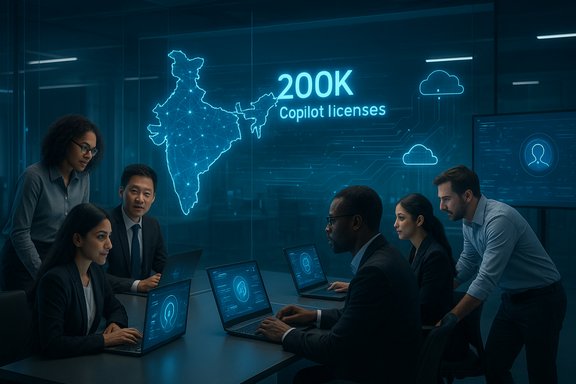
Two engineers in hard hats study a holographic dashboard showing India's map in a futuristic data center.Background / Overview​

Agentic AI — often shortened to “agents” or “agentic systems” — describes generative AI constructs that do more than answer one‑off prompts: they plan multi‑step tasks, orchestrate API calls, manipulate documents and tools, and can operate as semi‑autonomous “digital teammates.” Microsoft’s Copilot family (Microsoft 365 Copilot for knowledge work, GitHub Copilot for developer workflows, Copilot Studio for custom agents and orchestration) is the platform through which the company expects to scale agentic AI into enterprise operations. That product and partner strategy is tightly coupled to Microsoft’s Azure infrastructure and the new “sovereign‑ready” cloud options the company is promoting for highly regulated markets. Microsoft’s public statements from the India visit emphasize three pillars — scale, skills, and sovereignty:
  • Scale: rapid hyperscale datacenter expansion (India South Central region in Hyderabad, plus expansions in Chennai and Pune).
  • Skills: stepped‑up skilling commitments to train tens of millions of Indians in AI skills over the coming years.
  • Sovereignty: in‑country processing options for Copilot to help meet regulatory and compliance needs.
Those platform and policy moves are the technical underpinning for the partner‑led commercial play: Microsoft provides the platform (Copilot products, Azure compute, identity and governance tooling), while large IT services firms provide integration, industry templates, copilot‑powered IP, skilling and managed operations — the practical mechanics needed to move pilots into production.

What Microsoft announced (the facts)​

The investment and the infrastructure​

Microsoft confirmed a US$17.5 billion commitment for India focused on cloud capacity, AI infrastructure and skilling investments over the next four years. The company said the investment will enlarge hyperscale datacenter capacity, accelerate the India South Central cloud region (Hyderabad) and expand in‑country capabilities intended to reduce latency and support regulated workloads. Independent outlets including Reuters and AP covered the announcement and Microsoft’s statement.

Sovereign / in‑country Copilot processing​

Microsoft has stated that Microsoft 365 Copilot will offer an option for in‑country data processing in markets including India — meaning prompts and Copilot responses can be processed within national borders under normal operations. Microsoft describes this as a key enabler for compliance‑sensitive sectors (financial services, healthcare, government). That capability is being rolled out as part of the company’s regional infrastructure and product changes.

Partner tie‑ups and licence counts​

Microsoft publicly highlighted strategic engagements with major Indian IT services players — specifically Cognizant, Infosys, Tata Consultancy Services (TCS) and Wipro — positioning these firms as important channels to scale agentic AI inside large enterprises across industries.
  • Several prominent news outlets reported that these partnerships will result in the deployment of “over 50,000” Microsoft Copilot licences across those partner organisations or their customer footprints. That figure has been repeated in press coverage of Nadella’s India visit.
  • Independently verifiable is Cognizant’s previously disclosed purchase: Cognizant publicly reported the acquisition of 25,000 Microsoft 365 Copilot seats (plus Sales and Services Copilot seats) as part of its global generative AI partnership with Microsoft. That specific procurement number is confirmed in Microsoft’s own partnership materials and Cognizant’s public statements.
Important verification note: one business outlet circulated a two lakh (200,000) Copilot licences headline; that larger number is not corroborated by Microsoft’s primary release or other major press reporting, and it should be treated as an unverified media claim until partners or Microsoft publish auditable seat counts. The most consistent public evidence points to the “tens of thousands” scale (for example, Cognizant’s 25,000 seats) rather than a four‑fold larger 200k figure.

Why this matters: strategic context and immediate implications​

Platform + partner economics​

Microsoft’s strategy is explicit: deliver a high‑functioning Copilot platform (integrated with Microsoft Graph, Purview, Entra, and Azure AI services) and lean on system integrators to convert generic LLM capabilities into industry‑specific agents, connectors and governance processes. Partners sell licences, but more importantly they sell adoption — training, change management, vertical connectors, and managed operations that make Copilot usable in regulated, enterprise contexts. That commercial model accelerates consumption (and Azure compute usage) while shifting delivery risk to partners.

Sovereignty and compliance​

In‑country processing is a material step to reduce cross‑border data concerns, but it’s not a silver bullet. In‑country inference helps with latency and jurisdictional visibility, yet enterprises still must design end‑to‑end controls: data classification, least‑privilege identity, Purview‑driven governance, logging and model provenance, human‑in‑the‑loop gating for high‑risk actions, and contractual guarantees on SLAs and auditability. Sovereign processing reduces one dimension of regulatory friction but does not relieve organizations of full compliance design.

Productivity vs. hallucination risk​

Copilot and agentic workflows can yield material productivity gains — summarization, drafting, code suggestions, automated ticket triage — but generative models still produce plausible‑sounding errors. Enterprises must treat Copilot outputs as drafts unless validated, implement confidence indicators and guardrails for mission‑critical outputs, and instrument telemetry so false positives and risky recommendations are visible and correctable.

Vendor lock‑in and interoperability​

Large, partner‑driven Copilot rollouts increase dependency on Microsoft’s stack. That can be efficient for organizations already invested in Microsoft 365 and Azure, but it raises long‑term strategic questions about resilience and portability. Industry initiatives for multi‑agent orchestration and vendor‑agnostic agent standards aim to reduce lock‑in, but such interoperability remains a work in progress and adds integration complexity.

Technical verification: what’s proven and what needs scrutiny​

The following items are cross‑checked against multiple sources and flagged where verification is partial or absent.
  • Microsoft’s US$17.5 billion India commitment: verified via Microsoft press materials and major international news outlets.
  • In‑country Copilot processing availability: Microsoft’s communication explicitly mentions in‑country processing for Microsoft 365 Copilot in select markets including India; the company gave an end‑of‑2025 timeframe for availability in some regions. Enterprises should confirm regional SLAs and auditability details directly with Microsoft.
  • Cognizant’s 25,000 Microsoft 365 Copilot seats: specifically confirmed in Microsoft/Cognizant partnership materials. This is a verifiable, company‑level procurement disclosure.
  • The “over 50,000” aggregate number attributed to the group of partners: reported widely in press summaries of the India visit. It appears plausible when aggregating confirmed purchases (Cognizant’s 25k plus other partners’ internal and customer deployments), but the exact consolidated breakdown across the four firms has not been itemised in a single audited statement from Microsoft. Treat the “50,000+” number as a directional aggregate put forward in media accounts rather than an independently audited total.
  • The “two lakh (200,000)” Copilot licences headline: not corroborated by Microsoft’s official announcements, Cognizant’s published figures, Reuters, AP or most major outlets. This figure remains unverified and should be treated with caution unless Microsoft or the named IT firms publish explicit seat counts per organisation that support it.

Operational playbook — how large adopters are actually moving Copilot from pilot to scale​

Analysis of partner playbooks and multiple enterprise case studies shows a recurring sequence organisations use when implementing Copilot at scale.
  • Readiness & scoping
  • Inventory tenant permissions, data classifications and connectors.
  • Map 3–5 high‑value scenarios and define measurable KPIs (time saved, FCR improvements, development cycle reduction).
  • Pilot & safety gating
  • Run a controlled pilot with human‑in‑the‑loop approvals for decisions that matter.
  • Index knowledge bases (SharePoint, Knowledge Graphs, Fabric) to ground responses and reduce hallucination risk.
  • Instrumentation & governance
  • Deploy Purview for data governance; use Entra/Azure AD for conditional access and least‑privilege.
  • Capture telemetry: prompt lineage, response confidence, override events and model versions.
  • Skilling & change management
  • Role‑based training (scenario labs, office hours, Copilot champions) to ensure adoption and appropriate use.
  • Measure adoption metrics and reassign licences where utilisation lags.
  • Scale & automation
  • Convert validated pilots into role‑based copilots and publish agents via Copilot Studio.
  • Formalize SLAs and managed operations with partners; automate lifecycle updates and continuous validation.
This staged approach reduces the chance of expensive licence spend for unused seats and improves measurable ROI by linking seats to specific productivity outcomes.

Security, governance and legal checklist (what enterprises must demand)​

  • Auditability: logs tying every agent decision to model versions, input sources and operator actions.
  • Data minimization: strict rules for what corpora agents can access; avoid sending PII to third‑party models unless contractually protected and encrypted.
  • Human‑in‑the‑loop: explicit gating for high‑risk actions (financial transactions, legal language generation, safety‑critical suggestions).
  • Supply‑chain visibility: SBOMs for partner‑supplied templates and connectors; patching/mitigation SLAs.
  • Exit & portability: contractual rights to export knowledge stores and connectors if migration or de‑commissioning is required.
  • Continuous red‑teaming and model validation: regular adversarial testing for hallucination, bias, and data leakage.
These are not optional extras; they’re mandatory elements for any enterprise where compliance, reputational or operational risk matters. Microsoft provides tooling (Purview, Defender, Entra) that helps build these controls, but the customer and partner must assemble and operate them.

Commercial math: pricing signals and procurement realities​

Published pricing and partner promotions create practical procurement tradeoffs that drive adoption speed.
  • Published list pricing for Microsoft 365 Copilot in many commercial accounts has been reported around the mid‑tens to low‑thirty USD per user per month range depending on SKU and term; Microsoft has also introduced a distinct Copilot Business SKU at different price points for SMBs and promotional bundles that shift effective per‑seat economics during launch windows. Enterprises negotiating multi‑ten‑thousand seat deals will secure partner incentives, bundled Purview or promotional discounts, and managed service credits that materially alter the headline price per user. Treat list price as a starting negotiation point, not as the final committed TCO.
  • Licence cost is only one part of the TCO: plan for Azure inference compute (especially for multimodal agents and large contexts), data engineering to prepare knowledge stores, governance tooling and the partner’s delivery fees for customization, skilling and ongoing managed services.
Procurement teams should insist on three‑year TCO models and measurable deliverables (first‑wave KPIs, rollback/exit terms, data residency and audit rights) before signing large seat agreements.

Workforce and market impact: reskilling, job design, and competitive dynamics​

Large Copilot deployments are explicitly framed by major IT firms as skilling‑driven transformations: reskilling associates to become “human‑plus‑AI” teams is central to preserving revenue per employee while shifting task composition. For partners, copilot deals are a new delivery model: they sell seats and recurring managed services rather than purely time‑and‑materials engagements.
The labour dynamic is delicate: automation can compress growth in lower‑value delivery roles even as it creates demand for higher‑value tasks (agent engineering, model oversight, data engineering). Companies that invest in targeted upskilling and clear career pathways will retain talent; those that treat Copilot as a cost‑cutting add‑on risk demoralisation and higher attrition.

What to watch next (near‑term signals to validate claims)​

  • Which partners publish audited seat counts and customer case studies with before/after KPIs.
  • How Microsoft implements in‑country processing: the SLAs, auditability and whether prompt/response processing is guaranteed locally under enterprise contracts.
  • The emergence of agent governance standards or independent certifications that vendors and partners can adopt to ease procurement friction.
  • Pricing and partner incentive structures once promotional windows close (this will shape real adoption velocity).
  • Early adopter evidence of measured productivity gains (not just projections) and data about hallucination or leakage incidents.

Bottom line: prudent optimism — a strategy for CIOs and procurement leaders​

The Microsoft investment and partner announcements mark a clear acceleration of Copilot and agentic AI into mainstream enterprise adoption. Verified facts — such as Cognizant’s 25,000 Copilot seats and Microsoft’s $17.5 billion India commitment — confirm the scale and seriousness of the push. At the same time, media claims that multiply the likely seat counts (for example the two lakh headline) are not corroborated by primary Microsoft disclosures and should be treated cautiously until audited numbers are published. For CIOs and procurement leaders the sensible playbook is straightforward:
  • Start with outcome‑led pilots and clear KPIs.
  • Demand partner verification: certified staff rosters, dated Partner Center evidence, telemetry dashboards and at least three customer references for agentic deployments.
  • Embed governance by design: Purview, Entra, conditional access and human‑in‑the‑loop gates.
  • Negotiate TCOs that include Azure inference costs and managed services, and require export/exit clauses for knowledge stores and connectors.
Microsoft’s platform and partner model remove many adoption barriers, but they also amplify the consequences of weak governance or unclear contractual protections. Organizations that pair rapid pilots with disciplined controls and a clear skilling roadmap will extract real value; those that treat Copilot as a simple seat purchase risk wasted spend and governance exposure.

Conclusion
Microsoft’s expanded investment and the announced collaborations with Cognizant, Infosys, TCS and Wipro represent a decisive push to make agentic AI part of routine enterprise tooling. The immediate commercial announcements and verified partner purchases show momentum is real and measurable. At the same time, the public record does not uniformly support the largest seat totals reported in some headlines; independent verification remains essential. The adoption that follows over the next 6–18 months will reveal whether partners can deliver safe, auditable agentic workflows at enterprise scale — and whether organizations can convert platform promise into sustained, measurable productivity gains while keeping governance and compliance front and centre.
Source: BW Businessworld https://www.businessworld.in/articl...akh-copilot-licences-in-major-ai-push-583258/
 

Microsoft CEO Satya Nadella used the opening days of his India AI tour to place agentic AI — autonomous, multi‑agent systems that can act across code repos, data, and cloud workflows — at the centre of Microsoft’s product and go‑to‑market narrative, pairing a sweeping $17.5 billion India investment pledge with a set of product and partner claims that signal a major transition in how enterprises build, test and deploy software.

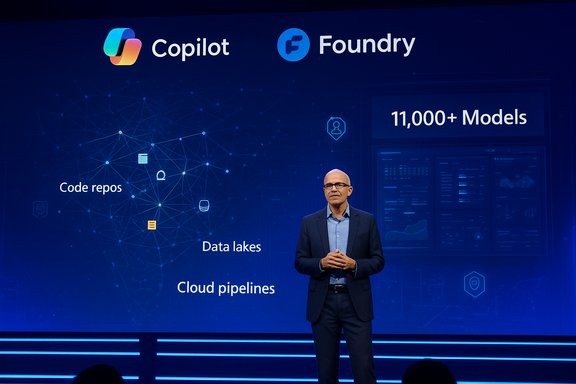
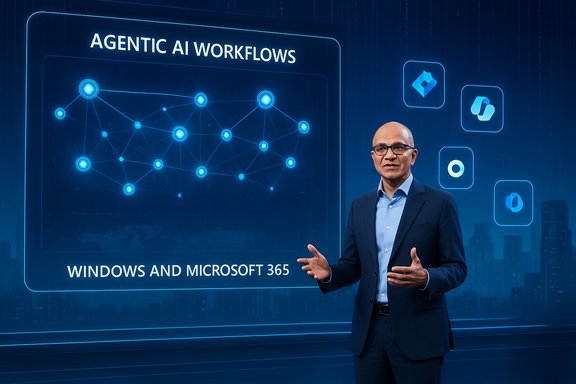
Speaker on stage presenting Copilot and Foundry branding with 11,000+ models and data pipelines.Background​

Since the arrival of mainstream generative AI in late 2022, developer tooling and software delivery have been reshaped by code assistants, automated reviews and low‑friction model integrations. Microsoft’s leadership now argues that the next phase is agentic AI — systems that do more than suggest code or answers; they can plan, execute, debug, and redeploy across an application lifecycle with minimal human orchestration. Nadella framed this as a change to the classic software development lifecycle (SDLC), and Microsoft has emphasized product integrations (GitHub, Visual Studio Code, Copilot, Foundry) and large commercial agreements to accelerate that shift. In parallel, Microsoft announced a headline investment commitment — US$17.5 billion over four years (2026–2029) — to expand hyperscale cloud infrastructure, in‑country data processing capabilities, and skilling programs in India. The company presented the investment as both a commercial bet and a sovereignty play: more local datacentres, sovereign cloud offerings, and in‑country processing for Microsoft 365 Copilot in regulated sectors.

What Microsoft announced on the India tour​

Agentic AI as the “next form” of SDLC​

  • Nadella described agentic AI as capable of managing end‑to‑end SDLC tasks: planning, writing, reviewing, security fixes, testing, and even deployment.
  • He tied the shift to a “mindset change” — developers must now define desired end states and curate context and data for agents to operate reliably.
These remarks were given alongside live demos showing multi‑agent tasking, mission‑control views in developer tools, and integrations bringing custom, fine‑tuned models into Copilot experiences. The company characterized agentic workflows as central to the coming wave of enterprise productivity.

Infrastructure and sovereign readiness​

  • Microsoft plans to scale hyperscale regions in India — notably an India South Central region (Hyderabad) slated to go live mid‑2026 — and expand existing regions. The investment is explicitly positioned to enable “AI diffusion at population scale.”

Partner deals and enterprise scale​

  • Microsoft announced strategic tie‑ups with major Indian IT services firms — Cognizant, Infosys, Tata Consultancy Services (TCS) and Wipro — and said these partners will each deploy more than 50,000 Microsoft Copilot licences, collectively pushing rollouts to over 200,000 licences in aggregate. The partners were highlighted as early adopters and delivery engines for agentic AI at scale. These partner commitments were widely reported across the Indian and global press.

Foundry, Copilot and the model catalogue​

  • Microsoft promoted Azure AI Foundry (sometimes shortened to Microsoft Foundry in press) as the enterprise model and agent factory, with marketing surfaces and partner documentation referencing a model catalogue in the “thousands” — widely stated as 11,000+ models available for discovery, benchmarking and routing in production. Foundry is presented as a single surface for models from multiple vendors plus customer‑owned fine‑tuned assets, enabling routing, governance and “intelligent model selection.”

Why this matters: the technical and commercial thesis​

From autocomplete to autonomous agents​

For years, AI tools in development environments have operated as assistants — inline suggestions, refactor hints, automated code comments. Agentic AI proposes a qualitatively different mode: agents with memory, tools and persistence that can carry multi‑step workflows across time. This changes:
  • Who triggers work (developers become agent bosses rather than primary code writers).
  • What is automated (not only snippets, but test orchestration, deployment, rollback).
  • How systems are validated (agents introduce new failure modes and observability needs).
Microsoft’s messaging — and its product moves — attempt to convert the hopeful promise of agentic systems into enterprise controls (Foundry governance, Copilot Studio, agent observability and model routing) that CIOs can buy into.

Commercial scale and market positioning​

The $17.5B investment and the partner license commitments matter because they are not just marketing — they reflect Microsoft’s push to anchor large enterprise workflows to Azure and Microsoft Copilot ecosystems in India, which is increasingly a strategic region for cloud providers. The blend of sovereign cloud options, dedicated local processing for Copilot, and enterprise skilling creates a package that appeals to regulated industries and governments while locking in large outsourcing partners as go‑to‑market conduits.

Productivity claims and reality checks​

  • Microsoft and other vendors have pointed to rapid gains: internal and external studies show AI is already being used to write or assist a sizeable portion of new code in many teams (industry figures frequently land in the 25–35% range for some tasks or teams). Independent surveys and vendor reports show significant adoption of Copilot and similar tools among developers. However, these figures are heterogeneous across geographies, languages and codebases and should not be read as uniform productivity improvements.

The strengths of Microsoft’s approach​

1. End‑to‑end stack integration​

Microsoft controls tooling across the SDLC — IDEs (VS Code), code hosts (GitHub), low‑code platforms (Power Platform, Fabric), compute (Azure) and productivity (Microsoft 365 Copilot). This vertical integration simplifies a vendor narrative where model, data, identity and governance flows are already connected. Customers get a single trust boundary for identity, data residency, and audit trails.

2. Enterprise governance and compliance primitives​

Foundry and Azure’s enterprise features add model routing, policy guardrails, agent identity, and auditability — things large regulators and financial institutions require. Sovereign cloud options and in‑country processing for Copilot are clear responses to regulatory and procurement realities in countries that demand local control.

3. Partner leverage and skilling​

By aligning with Cognizant, TCS, Infosys and Wipro, Microsoft accelerates real‑world deployments. These partners provide the thousands of engineers necessary to operationalize agentic workflows in large enterprise estates — from migration to production hardening. Microsoft’s parallel skilling commitments aim to supply the talent base that enterprises will need to supervise agentic systems.

Material risks and open questions​

1. Automation hallucinations, drifting agents and brittle tooling​

Agentic systems compound classic LLM failure modes: confident-but-wrong outputs (hallucinations), context mismatches, and cascading errors across interconnected systems. When an agent writes and merges a change, then triggers tests and deploys, the blast radius for a bad decision is much larger than a single bad autocomplete suggestion. Observability, canaries, rollback policies and human‑in‑loop checkpoints are essential but not yet standardized across organizations. Independent security researchers and enterprise reports continue to flag that AI‑generated code can introduce vulnerabilities at scale.

2. Governance and accountability​

Agentic workflows raise thorny governance issues: Which agent made a call? What data trained that agent? Who is legally and operationally accountable for actions initiated autonomously? Microsoft’s tooling offers identity and logging, but enterprise processes must still bridge model‑level auditing with business‑level compliance and legal frameworks — an area where many organizations are underprepared.

3. Economic and skills disruption​

While AI can speed routine work, organisations report mixed outcomes: more code produced does not always equal more shipped features. Teams may incur higher review overhead, require new roles (agent trainers, model ops engineers), and need to invest in robust CI/CD and security validation. The promised productivity gains will depend heavily on disciplined engineering processes, not just licensing or model upgrades.

4. Concentration of power and vendor lock‑in​

A single vendor controlling the stack and a large model catalog risks lock‑in. By embedding models and agents tightly into Microsoft ecosystems, customers may face higher switching costs for alternative model providers or on‑premises solutions. Enterprises should negotiate contractual portability, model provenance, and exit strategies.

5. Environmental and capital costs​

Agentic systems — particularly those running persistent agents or high‑throughput reasoning models — can drive up compute and energy consumption. The capital intensity of hyperscale datacentres and specialised GPUs is being balanced by leasing, efficiency gains in model inference, and mixed routing strategies, but the environmental footprint and cost curve remain important governance metrics for CIOs.

Practical guidance for IT leaders adopting agentic AI​

1. Treat agents like production services​

1. Define SLOs/SLA equivalents for agents (throughput, error rate, rollback time).
2. Run agents in isolated environments before production and require explicit human approval for outbound side‑effects (deploy, database writes).
3. Instrument agents with tracing, persistent logs, and end‑to‑end telemetry.

2. Enforce identity, least privilege and data‑grounding​

  • Use enterprise identity (e.g., Entra) for agent identity.
  • Apply least privilege for tool access and ensure agents are grounded to canonical data sources via signed connectors or policy‑enforced indices.
  • Record model versions, fine‑tuning datasets and prompt templates as part of release artifacts.

3. Strengthen CI/CD with AI‑specific gates​

  • Add AI‑aware linting, static analysis and security scanning for model outputs and generated code.
  • Require integration tests that cover agentic changes, plus dedicated security fuzzing on AI‑produced code paths.
  • Use canary rollouts, feature flags and manual override switches.

4. Invest in model ops and agent engineering skills​

  • Create roles for model ops (monitoring model drift, validating fine‑tunes) and agent engineers (designing safe workflows, maintaining tool catalogs).
  • Build internal standards for context engineering — how prompts, memory and tool access are structured for predictable agent behavior.

5. Negotiate enterprise protections​

  • Ensure contractual rights to model artifacts, ability to extract fine‑tuned weights or datasets (where permitted), and clear SLAs on availability and data handling.
  • Ask for portability and audit access to model provenance to meet regulatory obligations.

The marketing vs. technical reality of “11,000 models” and “new model releases”​

Microsoft’s public materials, product slides and partner documentation repeatedly reference a large Foundry catalog — numbers on the public surfaces have been presented in the “thousands,” and marketing often cites 11,000+ models as an indicator of breadth. These counts reflect a catalog that mixes curated frontier models, vendor offerings and community contributions; they are useful as a measure of breadth but require verification for any given enterprise use case (region, compliance, model family and SLA). Enterprises should validate the live Foundry catalog in their Azure tenant to confirm availability and legal terms for specific models and regions. Separately, press reports quoted Nadella as confirming a “new AI model” would be released on December 12. This specific assertion — a named model launch scheduled for that date — is referenced by some outlets but could not be independently verified in official product release schedules at the time of reporting. Until Microsoft publishes a dedicated model release page or a formal product blog with versioning, that particular claim should be treated as provisional. Microsoft’s public India visit pages and press assets confirm the broader programme but do not provide a single authoritative release notice for an individual model on Dec 12. Flagging these calendarized model release claims is prudent.

Competitive and regulatory landscape​

  • Other major cloud and AI vendors (Google, Amazon, Anthropic, OpenAI partners) are racing on two fronts: capabilities and in‑country infrastructure. Microsoft’s $17.5B in India and partner engagements are a direct play to secure a large addressable market and regulatory goodwill. Several competitors have announced significant India commitments in recent months, making the market aggressively contested.
  • Regulators globally are watching agentic systems more closely than earlier chat assistants. Autonomous decision agents that make changes to production systems intersect with existing compliance regimes (financial reporting, healthcare device regulation, data protection laws). The absence of standardized certification regimes for agentic workflows means enterprise risk teams must develop internal compliance patterns now rather than later.

Bottom line: opportunity and urgency in equal measure​

Microsoft’s India announcements crystallize a major industry bet: agentic AI will move from research demos to embedded enterprise workflows, and cloud providers with the deepest integration across tooling, identity, and compute will capture the first wave of large contracts. For enterprises, the promise is real — increased automation, faster iteration cycles, and new automation categories — but the path to realizing those outcomes is neither automatic nor risk‑free.
  • Organizations that treat agentic systems like production software — governed, tested, and observably instrumented — will extract value.
  • Those that adopt agentic agents purely as productivity enhancers without changing release practices risk higher defect rates, compliance failures, and surprising operational costs.
Microsoft’s investment, partner plays and product narrative are likely to accelerate the adoption curve, especially in markets prioritizing sovereign infrastructure and localized processing. Yet many tactical questions remain: how to operationalize agent identity, how to measure the real productivity delta, and how to avoid the “review trap” where generated volume outpaces human review capacity.

Conclusion​

The Nadella‑led pronouncement from Microsoft’s India AI tour frames agentic AI as the defining platform shift for enterprise software delivery in the coming years. The company’s combined strategy — massive local investment, partner scale‑outs, enriched developer tooling and a broad model catalogue — creates a practical path for organizations that want to adopt autonomous agents while retaining enterprise controls.
The opportunity is substantial, but so are the engineering and governance demands. The sensible path for IT leaders is to pilot conservatively, codify agent testing and rollback rituals, and scale once operational controls and auditability are proven. Treat the next phase of SDLC not just as a set of new tools, but as a transformation in how teams design intent, verify outputs and maintain accountability when autonomous systems act on behalf of humans.
Source: Moneycontrol https://www.moneycontrol.com/artifi...icrosoft-s-latest-model-article-13721012.html
 

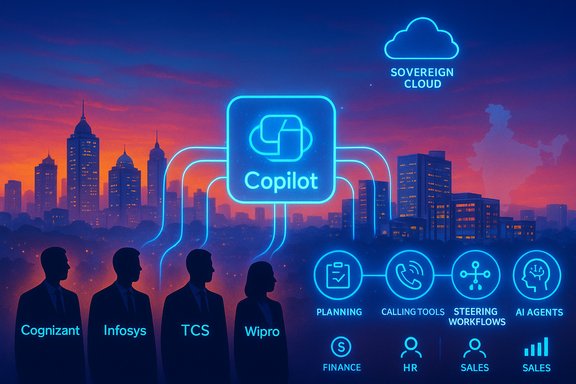
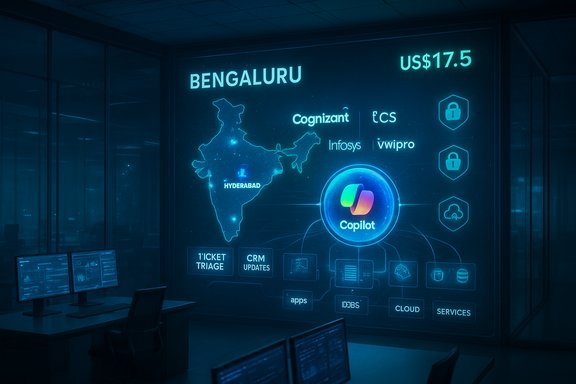
Analysts in a neon-blue data center monitor holographic dashboards on AI, analytics, and maps.
Microsoft’s Bengaluru appearance this week crystallized a high-stakes moment in enterprise AI: Satya Nadella announced a US$17.5 billion commitment to India’s cloud and AI infrastructure and unveiled deepened partnerships with Cognizant, Infosys, TCS and Wipro to deploy Microsoft Copilot and agentic AI at unprecedented scale, with each partner committing to more than 50,000 Copilot licences and a combined deployment figure that Microsoft says will exceed 200,000 seats.

Background​

The announcement ties three strategic threads: massive cloud and datacenter investment for regional sovereignty, partner-led scaleouts to reach enterprise customers, and an explicit pivot toward agentic AI—systems that plan, act and persist across multi-step workflows rather than only answer single prompts. Microsoft framed this as a shift from assistants to autonomous collaborators embedded into the enterprise fabric.
Microsoft’s headline commitment—US$17.5 billion over four years covering hyperscale datacenters, in-country processing capabilities for Copilot, and skilling programs—was positioned as a commercial and sovereign readiness play, intended to reduce latency and enable regulated workloads to run with local data residency controls.

What Microsoft and the Frontier Firms Announced​

  • Microsoft publicly announced strategic collaborations with four major IT services firms—Cognizant, Infosys, TCS and Wipro—to embed Microsoft 365 Copilot, Copilot Studio and agentic AI across their operations and customer offerings.
  • Each of the four partners was presented as deploying over 50,000 Microsoft Copilot licences, collectively surpassing 200,000 licences—a scale Microsoft positioned as a new enterprise benchmark. This figure has been repeated in company statements and press coverage.
  • Microsoft also emphasized product and platform pieces that enable this move: Microsoft 365 Copilot, Copilot Studio, Azure AI Foundry (model catalogue and routing), and in-country Copilot processing options to meet regulatory needs.

Partner highlights (as announced on stage)​

  • Cognizant: Positioned as an early “client zero” and a builder of Copilot-driven agentic solutions, Cognizant described its goal of scaling Copilot to millions of users through refined enterprise implementations. Cognizant earlier disclosed a 25,000-seat Copilot purchase, which underpins part of the company’s large-scale deployment narrative.
  • Infosys: Touted the integration of Microsoft’s Intelligence Layer with Infosys Topaz Fabric™ and Infosys Cobalt®, using those building blocks to operationalize multi-agent workflows and a human+agent operating model.
  • TCS: Reported broad internal enablement—every employee with a personalized AI coach and democratized developer tooling (GitHub Copilot, M365 Copilot) after a large internal skilling push; Microsoft was a partner in TCS’s global hackathon with over 281,000 participants.
  • Wipro: Announced a three-year strategic partnership that includes launching a Microsoft Innovation Hub at Partner Labs in Bengaluru, upskilling more than 25,000 employees, and rolling Copilot across industry-specific workflows.

Why the Scale Claim Matters — And What Is Verified​

The magnitude of the licence numbers matters for three reasons: monetary scale (subscriptions + Azure inference), organizational change (large skilling and adoption programs), and geopolitical resonance (local processing and sovereign data handling). Microsoft’s posture—platform plus partner—aims to convert billions of infrastructure dollars into mainstream enterprise usage of agentic AI.
What we can verify with high confidence from the public record:
  • Microsoft publicly committed US$17.5 billion to India for cloud and AI infrastructure, skilling and operations.
  • Microsoft stated that partner tie-ups will accelerate Copilot rollouts and in-country Copilot processing is being prioritized to meet regulatory needs.
  • Cognizant has previously disclosed a 25,000-seat purchase of Microsoft 365 Copilot seats, which is a verifiable anchor in the broader narrative of large seat deployments.
Caveat: the precise accounting behind the “over 50,000 licences per partner” claim is not uniformly published in audited partner filings as of the announcement; reporting aggregates on-stage remarks and company statements rather than consolidated audited seat-level schedules. That makes the aggregated 200,000 figure plausible and newsworthy, but still partially dependent on disclosures that remain to be granularly itemized by partner. Treat the per-partner totals as company-level commitments announced on stage rather than as fully audited contract schedules.

Technical and Product Implications​

Agentic AI: what’s changing in the enterprise stack​

Agentic AI moves Copilot from single-turn assistance to persistent, multi-step workflows with memory, tool use and the ability to act across systems. The announced stack that supports this shift includes:
  • Microsoft 365 Copilot for knowledge work and business productivity.
  • Copilot Studio for building and orchestrating custom agents.
  • Azure AI Foundry as a model catalogue and governance surface—Microsoft’s marketed surface for model routing, benchmarking and enterprise governance.
These pieces aim to solve three enterprise problems: model governance, operational orchestration of agents, and regulated in-country processing for sensitive data. However, these are complex technical and operational requirements that require sustained engineering and process work to get right.

In-country Copilot processing and sovereignty​

Microsoft emphasized in-country processing for Microsoft 365 Copilot—meaning prompts and responses can be processed within a nation’s borders under normal operations—to address regulatory and compliance pain points for financial services, healthcare and government customers. This capability is being fast-tracked in India and is central to the sovereign readiness argument. While in-country inference materially reduces one compliance barrier (cross-border data transfers), it is not a substitute for full governance: enterprises still need DLP, prompt logging, identity and least-privilege access, model provenance and auditability.

Cost profile that CIOs must model​

Published Microsoft list pricing for Microsoft 365 Copilot in prior communications has been roughly in the ballpark of $30 per user per month (annual commitment), with additional metered charges for agent capacity and inference in heavier scenarios. For seat counts in the tens of thousands, licence fees plus Azure inference, data engineering and partner services produce a recurring monthly financial commitment that is materially higher than licence cost alone. Procurement should model three- to five‑year TCOs and include Azure compute, data engineering, and managed services in the calculation.

Strategic Strengths of Microsoft’s Partner-First Play​

  • Rapid distribution: Longstanding relationships with TCS, Infosys, Wipro and Cognizant provide Microsoft a ready-to-deploy channel to hundreds of enterprise customers across verticals. These partners bring domain connectors, vertical templates, and adoption playbooks that reduce time-to-value for clients.
  • Integrated control plane: Combining Microsoft Graph, Purview, Entra and Azure AI creates a defensible set of enterprise controls—identity, data governance and telemetry—critically important for auditing and compliance when agents act across systems.
  • Skilling and workforce transformation: Partners are committing to mass upskilling programs to create human+agent teams; Wipro and others highlighted extensive training and enablement initiatives that are necessary to preserve value-per-employee rather than only cutting cost.

Significant Risks and Gaps​

1) Governance and auditability are not solved problems​

Agentic systems introduce novel failure modes—persistent memory that can be stale, instrumented actions that can mis-execute, and compounding hallucinations if an agent uses incorrect data as inputs. Enterprises must demand end‑to‑end observability: prompt and response logging, model lineage, test suites for agent behavior, and human-in-the-loop gates for high-risk decisions. Microsoft’s tools are maturing to address these needs, but the deployment complexity remains high.

2) Vendor lock-in vs. interoperable ecosystems​

The Microsoft stack is attractive for its integration, but wide Copilot adoption risks deep platform lock-in unless firms prioritize agent interoperability and exit strategies. Several market efforts aim to create federated agent orchestration, but those are nascent and not yet standardized. Enterprises should insist on connector portability and data extraction guarantees when negotiating large Copilot programmes.

3) Data residency is necessary but not sufficient​

In-country inference mitigates cross-border routing concerns, yet it does not eliminate the need for strict data-handling practices: connectors to ERP/CRM systems, fine-tuned model training data, and knowledge stores all expand surface area for leaks. Contracts must include strong DLP SLAs, audit access, and defined breach response terms.

4) Economic and workforce impacts​

Large deployments change the labor economics of IT services: they shift value from repeatable delivery tasks to higher-value agent engineering and oversight. This can compress headcount growth in commoditized roles while increasing demand for scarce skills (prompt engineering, model ops, governance). Firms that fail to invest in structured upskilling risk attrition and productivity shortfalls.

5) Seat-count transparency and procurement risk​

On-stage seat commitments and headline licence numbers are powerful marketing devices; procurement teams must validate purchase, activation, and usage metrics before bridging to multi-year commitments. The 200,000-seat headline is significant but requires granular, auditable confirmation at the partner and customer level.

Practical Playbook: How Enterprise CIOs Should Respond​

  1. Align outcomes to metrics: Define 3–5 measurable KPIs for initial Copilot/agent pilots (time-to-resolution, reduced cycle time, quality uplift). Tie payments or milestone-based fees to outcome delivery.
  2. Insist on verifiable seat activation: Require Partner Center evidence of seat procurement, activation logs, and early-use dashboards before scaling licences.
  3. Build governance by design:
    • Enforce Purview sensitivity labels and DLP across connectors.
    • Require prompt and action logging with immutable audit trails.
    • Implement human-in-the-loop approvals for high-risk agent actions.
  4. Model TCO and contractually cap compute: Include Azure inference estimates and negotiate pricing bands or caps for metered inference to avoid surprise bills.
  5. Require portability and exit rights: Contractual clauses for data export, connector removal, and transition assistance to mitigate lock-in.
  6. Invest in targeted skilling: Prioritize reskilling programs for delivery teams into agent engineering, model ops and governance roles.
  7. Pilot conservatively, scale iteratively: Start with high-value, contained workflows (finance close, sales proposal generation, customer triage) before broad horizontal rollouts.

Sector-Specific Considerations​

Financial services​

High compliance sensitivity and regulatory scrutiny mean in-country processing is table stakes, but banks must also ensure models, prompts, and connectors meet regulatory exam standards. Strong encryption, audit-ready logs and third-party attestation will be prerequisites.

Healthcare​

Patient data strictures and clinical safety requirements make conservative, evidence-driven pilots essential. Human oversight and traceability of clinical decision-support outputs are mandatory.

Manufacturing and Retail​

High-volume, rules-driven processes (inventory management, order triage) are natural targets for agentic automation and can yield rapid ROI, but require robust integration with ERP and PLM systems to avoid operational drift.

A Reality Check on Productivity Claims​

Microsoft and partners cite meaningful productivity gains in early case studies, and large-scale seat buys—like Cognizant’s 25,000 seats—show that the interest is real and investment is material. However, the most persuasive evidence will be longitudinal ROI data from customers showing sustained gains after 6–18 months of live production use—data many procurement teams should demand before greenlighting massive rollouts. In other words, headline seat counts are an important signal, but observable, auditable business impact is the real metric that separates marketing from value.

Where to Watch Next (Signals that will validate the initiative)​

  • Partners publish audited seat and usage metrics, with before-and-after KPIs for at least three large customers.
  • Microsoft’s in-country Copilot processing is rolled out with explicit SLAs, locality guarantees and independent attestation for data handling.
  • Third-party certifications or standards for agent governance and interoperability begin to appear and gain industry traction.
  • Evidence of cost predictability for inference (metering transparency, predictable pricing tiers) that reduces procurement risk.
  • Independent reporting on governance incidents (misuse, data leakage, hallucination-driven errors) and how partners handled rollback and remediation.

Conclusion​

Microsoft’s announcement—US$17.5 billion in India and headline partnerships with Cognizant, Infosys, TCS and Wipro aimed at deploying Copilot and agentic AI at scale—represents a deliberate bet to make AI the default fabric of enterprise work. The combination of platform investments, sovereign-ready processing, and partner distribution creates a credible path to mainstream agentic AI adoption.
At the same time, this is a moment of transition more than a finished solution. The biggest risks are not technical capabilities alone, but governance, procurement discipline, economic transparency and workforce design. Enterprises that pair rapid pilots with disciplined governance, auditable KPIs and a clear skilling roadmap will be the ones that extract sustainable value from Copilot and agentic AI. The rest risk large headline-led bills and operational exposure if they treat seat purchases as a substitute for engineering maturity and governance.
This announcement marks a pivotal phase in enterprise AI adoption: scale is being promised and provisioned, but proof of safe, measurable, long-term outcomes will be the ultimate test.

Source: Microsoft Source Cognizant, Infosys, TCS and Wipro emerge as Frontier Firms with Microsoft—deploying Copilot and agentic AI across the enterprise - Source Asia
 

Microsoft’s India visit has turned into a watershed moment for enterprise AI adoption: Satya Nadella announced a sweeping US$17.5 billion investment in cloud and AI infrastructure and unveiled close strategic tie‑ups with Cognizant, Infosys, Tata Consultancy Services (TCS) and Wipro to accelerate agentic AI — with each partner expected to deploy tens of thousands of Microsoft Copilot licences, a move Microsoft says will collectively exceed 200,000 seats.

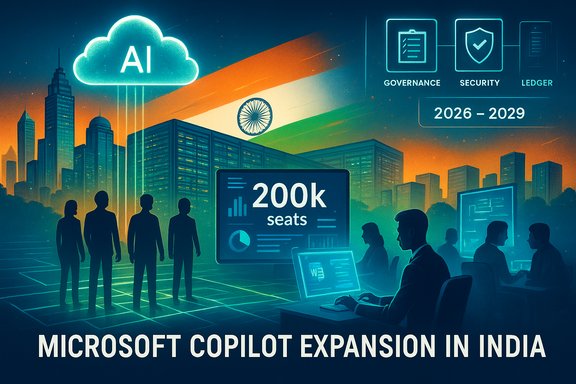
Team of professionals in a futuristic briefing around a table, with a holographic Copilot and India map backdrop.Background / Overview​

Microsoft framed its India announcements around three interlocking pillars: scale, sovereignty, and skilling. The company committed US$17.5 billion across calendar years 2026–2029 to expand hyperscale datacenter capacity (including a major India South Central region in Hyderabad), deliver sovereign‑ready cloud options, and intensify skilling programs aimed at preparing millions of workers for an AI‑first economy. At the same time, Nadella and Microsoft positioned the Copilot family — Microsoft 365 Copilot, GitHub Copilot and Copilot Studio — as the enterprise delivery vehicle for agentic AI: autonomous, multi‑step systems that can orchestrate tools, act across data and take initiative in business workflows. Microsoft announced that Cognizant, Infosys, TCS and Wipro will each deploy over 50,000 Microsoft Copilot licences, which Microsoft described as setting a “new benchmark” for enterprise‑scale AI adoption. These twin moves — massive local infrastructure investment plus rapid partner‑led seat deployments — make India an explicit strategic anchor in Microsoft’s global AI playbook. They also crystallize practical questions for CIOs, compliance teams, procurement officers and boardrooms: what does agentic AI mean in production? How will governance, costs and sovereignty be enforced? And how credible are the headline licence counts being reported? Several contemporaneous analyses urge caution and independent verification of some of the larger seat‑count claims.

What Microsoft announced (the facts)​

The investment: US$17.5 billion for India​

  • Commitment: US$17.5 billion for cloud, AI infrastructure, and skilling across 2026–2029. Microsoft calls this the company’s largest investment in Asia.
  • Infrastructure: major expansion of datacenter regions (Hyderabad India South Central region slated mid‑2026 rollout, plus expansions in Chennai and Pune), and new sovereign cloud options (Sovereign Public Cloud and Sovereign Private Cloud) for regulated workloads.
  • Public‑sector integration: commitments to embed AI into national platforms such as e‑Shram and the National Career Service to extend capabilities to hundreds of millions of informal workers.

The partner tie‑ups and the Copilot scale claim​

  • Microsoft announced strategic collaborations with Cognizant, Infosys, TCS and Wipro to accelerate agentic AI deployment, each partner said to be deploying over 50,000 Microsoft Copilot licences, collectively surpassing 200,000 licences. Microsoft presented these partners as a delivery channel to embed Copilot and agentic capabilities across client estates and internal operations.
  • Independent, verifiable figures exist for some prior purchases: Cognizant previously disclosed a purchase of 25,000 Microsoft 365 Copilot seats (plus additional Sales and Services Copilot seats) as part of a broader global generative AI partnership. That disclosure is publicly documented in Cognizant’s communications and helps explain why aggregated figures reported by Microsoft and media are plausible — though the exact breakdown of the “50k+ each” headline is not uniformly itemised across partner public filings.

Pricing and economics (publicly available)​

  • Microsoft 365 Copilot list pricing: roughly $30 per user per month for enterprise (with business‑tier variants and SMB bundles priced differently). Partner and Microsoft documentation make clear Copilot is sold as an add‑on to eligible Microsoft 365 subscriptions; capacity/agent metering and Azure inference costs are additional commercial considerations.

Why this matters: strategic and technical implications​

1) From pilots to industrial adoption​

Microsoft’s announcements mark a deliberate shift from experimental proofs‑of‑concept to industrialized agentic AI. By pairing a massive infrastructure investment with strategic systems integrators, Microsoft reduces three common enterprise blockers:
  • Compute and latency concerns (local hyperscale regions);
  • Regulatory friction (sovereign processing options for Copilot and Sovereign Cloud architectures);
  • Adoption and change management (partner professional services and skilling programs).

2) Platform + partner economics​

  • Microsoft supplies the integrated stack: Azure compute and Azure OpenAI, Microsoft 365 Copilot, Copilot Studio, and governance primitives (Purview, Entra, model routing tooling).
  • Partners supply scaling capability: domain accelerators, connectors to client ERP/CRM systems, managed services, and the thousands of engineers needed to operationalize agents across verticals. The combined model drives both licence consumption and Azure inference revenue.

3) Sovereignty isn't just marketing​

Microsoft’s commitment to in‑country processing for Microsoft 365 Copilot (announced for India by end‑2025) addresses procurement barriers for regulated industries and governments. This capability routes Copilot prompts/responses to be processed within a country’s borders under normal operations — important for banks, hospitals and public agencies. But in‑country inference is necessary, not sufficient: end‑to‑end governance still depends on connectors, DLP, identity controls and auditable telemetry.

Critical analysis — strengths and opportunities​

Strengths​

  • Integrated, end‑to‑end stack: Microsoft’s control across identity, productivity apps and cloud removes many integration hurdles enterprises face when composing a multi‑vendor agent stack. This lowers friction for CIOs who prefer single‑vendor trust boundaries.
  • Partner velocity and scale: Cognizant, Infosys, TCS and Wipro each have global delivery networks and domain IP that can turn Copilot licences into usable, audited agentic workflows rapidly. That partner muscle is a practical accelerant for adoption.
  • Sovereign cloud and in‑country processing: Providing local processing and sovereign primitives materially expands the addressable market in compliance‑heavy industries. This will unlock larger public‑sector and regulated enterprise deals.
  • Skilling and talent pipeline: Microsoft’s parallel commitment to train millions of people — and partners’ internal skilling programs — helps create the supervisory talent that agentic systems require (agent designers, prompt engineers, verification engineers).

Opportunities for measurable value​

  • Automating recurring knowledge‑work tasks (report generation, contract summarization, code review orchestration) can deliver rapid ROI if instrumented with metrics like time‑saved, error reduction and SLA improvements.
  • Industry‑specific agent templates (finance reconciliation agents, claims triage agents, developer CI/CD agents) reduce time‑to‑value and are well aligned to the SI delivery model.

Risks, weak points and what to watch​

1) Seat counts and headline inflation — verify before you buy​

Several media headlines recycled Microsoft’s claim that each partner will deploy “over 50,000” Copilot licences, and some outlets reported an aggregate exceeding 200,000 licences. The public record confirms large prior purchases (for example Cognizant’s disclosure of 25,000 Microsoft 365 Copilot seats), but the precise, audited breakdown behind the 50k‑each claim is not uniformly itemised in primary filings. Procurement teams should insist on contract‑level activation evidence and timelines rather than on‑stage counts. Treat the 200k headline as a marketing‑facing aggregate until partners provide auditable seat activation data.

2) Governance, auditability and hallucinations​

Agentic systems increase the attack surface for:
  • Hallucinations: when an agent generates plausible but incorrect outputs that may be used to trigger downstream actions.
  • Data leakage: connectors or misconfigured indexing can expose sensitive documents to model access.
  • Operational drift: autonomous agents that act across systems risk cascading failures if not tightly constrained.
Governance must include logging, model provenance, sensitivity labels, human‑in‑the‑loop gates for high‑risk actions, and automated rollback patterns. Microsoft provides tooling (Purview, Entra, Foundry governance) but implementing them across heterogeneous estates remains nontrivial.

3) Cost transparency — inference is the hidden variable​

Licence fees (~US$30/user/month for Microsoft 365 Copilot at enterprise list price) are only part of the TCO. Azure inference, model routing, data storage, capacity packs, and managed services (partner delivery) drive the bulk of operational costs for agentic systems. Estimate compute budgets carefully, model metering, and require clear capacity/package pricing in contracts.

4) Vendor lock‑in vs. interoperability​

Microsoft’s integrated approach reduces integration friction but concentrates risk. Enterprises must negotiate:
  • Exportable agent definitions and searchable indices,
  • Exit terms for knowledge stores and connectors,
  • Multi‑model strategies (the ability to route to best‑of‑breed models rather than a single provider).
    Industry efforts toward agent‑to‑agent protocols are nascent; without them, large estates risk longer‑term lock‑in.

5) Workforce displacement and socioeconomic effects​

Large‑scale automation of knowledge tasks will require organizational redesign. Partners and Microsoft pledge skilling, but enterprises must plan for role re‑definition, career pathing and measurable reskilling outcomes. Failure to pair automation with responsible workforce transition increases social and reputational risk.

Practical guidance for CIOs, procurement and security teams​

  • Demand contract‑level verification:
  • Require partner evidence of license activation, timelines and scope (internal seats vs. customer seats).
  • Insist on published KPIs and at least three reference customers for comparable horizontal/vertical agent deployments.
  • Baseline governance before scaling:
  • Implement Purview‑driven data classification, Entra conditional access and conditional policies for agent identities.
  • Require audit logs for every agent action and create automated monitoring dashboards to detect anomalous agent behavior.
  • Start with outcome‑led pilots:
  • Choose discrete, measurable use cases (e.g., automated contract summarization, customer triage, invoice reconciliation).
  • Measure 30/60/90‑day productivity deltas, error rates and review burdens before wider rollouts.
  • Model your total cost of ownership:
  • Price licences at list (approx. $30/user/month for enterprise Copilot) then add metered inference, storage, capacity packs and partner delivery fees.
  • Negotiate prepaid capacity or committed usage discounts where possible.
  • Negotiate portability and exit terms:
  • Require exportable agent definitions, exportable indexes and contractual clauses for data deletion or migration in the event of partner or platform changes.
  • Insist on adversarial testing and independent validation:
  • Include hallucination and safety testing in acceptance criteria.
  • Require partners to provide test suites, false‑positive/false‑negative metrics and sample telemetry as part of delivery sign‑off.

Sectoral implications — who benefits first​

  • Financial services: high compliance needs make sovereign processing and audit trails essential; agents can speed reconciliation, KYC and customer support triage if governance is solid.
  • Healthcare: clinical decision support is promising but high‑risk; pilot with strict human oversight, model logging and provenance tracking.
  • Public sector: large population‑scale services (employment, benefits) can gain from personalized, multilingual agents — but procurement must focus on audits and data sovereignty.
  • Software development: agentic systems that orchestrate CI/CD, code review and automated regression testing can shift developer workflows rapidly; quality gates and traceability become mission critical.
These sectors have the strongest immediate upside — and the highest compliance bar. Microsoft’s sovereign‑ready options and partner scale directly target these industry dynamics.

Verification notes and unresolved questions​

  • The US$17.5 billion investment pledge is confirmed by Microsoft and widely reported by independent press outlets; it is a contractual corporate commitment framed as spending across 2026–2029.
  • The claim that Cognizant, Infosys, TCS and Wipro will each deploy “over 50,000” Copilot licences was announced by Microsoft; that aggregate figure (200k+) has been widely reported in the press. However, precise partner‑level activation data is not uniformly present in all public filings and press releases. Procurement teams should treat the headline counts as indicative until audited seat activation details are produced by partners or Microsoft. This caution is explicitly supported by independent analyses that call for contract evidence.
  • Cognizant’s previously disclosed purchase of 25,000 Microsoft 365 Copilot seats is publicly documented and helps validate that large single‑partner purchases are credible. But aggregating prior purchases with new commitments does not equal real‑time activated seats across customers; verify activation and monthly active user metrics.

What to watch next (near‑term signals)​

  • Which partners publish audited seat activation numbers, with granularity on internal vs client seats and activation timelines.
  • The technical details of Microsoft’s in‑country Copilot processing: locality guarantees, SLAs, and how audit logs are retained and routed.
  • Early customer case studies that quantify realized productivity gains, hallucination incidents, and governance failures or successes.
  • Development of neutral, cross‑vendor standards for agent interoperability and safety — progress here would materially reduce lock‑in risk.

Conclusion​

Microsoft’s twin announcements — a US$17.5 billion infrastructure and skilling commitment to India and strategic tie‑ups with Cognizant, Infosys, TCS and Wipro to scale Copilot and agentic AI — represent a decisive escalation in the race to industrialize enterprise agents. The combined approach addresses the largest practical barriers enterprises face: compute, data residency, and adoption velocity. If delivered as promised, it could accelerate a material shift in how knowledge work is organized and how software is built and maintained.
At the same time, headline licence counts and the promise of rapid agentic automation should be handled with disciplined skepticism: procurement teams need contract evidence of activation, security teams must demand robust governance and auditability, and business leaders must budget for inference and delivery costs beyond per‑user licence fees. The true test will be measured in activated seats with audited outcomes — reductions in cycle time, demonstrable error reduction, and safe governance — not in marketing aggregates.
For IT leaders, the pragmatic posture is clear: pilot conservatively, codify governance, require auditable evidence of scale, and design for portability. Microsoft’s platform and partner play make large‑scale agentic AI achievable — but the long‑term winners will be organizations that pair rapid pilots with rigorous controls and a plan to reskill the workforce that will supervise these new digital collaborators.

Source: Moneycontrol https://www.moneycontrol.com/artifi...e-agentic-ai-s-adoption-article-13720849.html
 

Microsoft’s India AI tour reached a watershed moment in Bengaluru when Satya Nadella announced that Cognizant, Infosys, TCS and Wipro will partner with Microsoft to operationalize agentic AI and ramp Microsoft 365 Copilot deployments — a coordinated push Microsoft says will put more than 50,000 Copilot licences into each partner’s environment and push the combined total past 200,000 licences.

Neon Copilot cloud hub connects Cognizant, Infosys, TCS and Wipro to planning and AI tools.Background​

Microsoft’s visit to India this week combined a sweeping infrastructure pledge with a partner-led commercial playbook. The company committed US$17.5 billion to expand cloud and AI infrastructure, skilling and operations across India between calendar years 2026 and 2029 — a strategic investment Microsoft says will build hyperscale regions, sovereign-ready options, and a broader rollout of Copilot capabilities. At the centre of the Bengaluru announcements is a framing of Microsoft’s large-system integrator partners as “Frontier Firms” — organisations that will go beyond experimentation to redesign workflows around human–agent collaboration, embed Copilot across delivery, sales, finance, HR and customer engagement, and act as scaled channels to push agentic AI into global enterprise accounts. Microsoft’s statement positions these partners as engines for operationalizing Copilot at enterprise scale.

What Microsoft and the partners announced​

The headline claims​

  • Microsoft publicly stated that Cognizant, Infosys, TCS and Wipro will each deploy over 50,000 Microsoft Copilot licences, and that the four together will “collectively surpass 200,000 licences.”
  • The company also linked these partner commitments to its US$17.5 billion India investment — a package intended to expand datacenter capacity, introduce sovereign-ready clouds, and scale skilling programs.
These are large, headline-grabbing numbers and they matter because they shift conversation from pilots and proofs-of-concept to enterprise-scale license and operational commitments — the kind that create durable revenue streams for cloud providers and long-term technical lock-in for customers. Multiple independent news outlets reported the announcement and repeated the same per-partner licence counts.

Company-specific colour​

  • Cognizant: long-standing Microsoft collaborator and previously disclosed buyer of 25,000 Microsoft 365 Copilot seats as part of an earlier global partnership; Cognizant has publicly framed itself as a “client zero” and a major internal adopter.
  • Infosys: positions its Topaz Fabric™ and Cobalt® cloud offerings as the operational backbone for agent orchestration and multi-agent workflows, and Microsoft materials call out Infosys as having one of the world’s largest Copilot deployments.
  • TCS: described in Microsoft materials as democratizing Copilot and GitHub Copilot across tens of thousands of employees and offering personalized AI coaches internally; TCS has been showcased for large-scale internal skilling and hackathon activity.
  • Wipro: launched a three-year strategic partnership with Microsoft that includes a Microsoft Innovation Hub at Wipro Partner Labs in Bengaluru and statements that more than 50,000 Copilot licences have been deployed alongside major upskilling programs.

Verifying the headline numbers — what’s solid and what needs caution​

Microsoft’s own press materials are the primary source for the “50,000 per partner / 200,000+ aggregate” claim; independent reporting from respected outlets in India and trade press replicates the figure, indicating that it originated from Microsoft’s on-stage announcement. At the same time, company-level public records and earlier press filings show a patchwork of confirmed seat purchases. For example, Cognizant has verifiably purchased 25,000 Microsoft 365 Copilot seats (along with Sales and Services Copilot seats) as part of a prior partnership announcement, a concrete procurement number that is documented in Cognizant and Microsoft materials. That specific figure is independently confirmable. However, the exact per-partner breakdown and activation timeline for the new “50,000+” claims are not uniformly traceable in audited filings or individual partner statements published immediately after the announcement. Multiple analyst and industry write-ups therefore recommend treating the 200,000 figure as a directional indicator of scale rather than a detailed, auditable contract ledger item. Enterprises and analysts should expect phased activations, multi-year seat commitments, managed services bundles, or channel-led aggregates that combine internal seats and client-facing seat enablement.
Key verification points:
  • Confirmed, verifiable procurement: Cognizant’s 25,000 Microsoft 365 Copilot seats from earlier partnership disclosures.
  • Primary claim origin: Microsoft on-stage/press messaging announcing partner deployments and the 200,000+ aggregate.
  • Independent echo: Indian and trade press coverage repeats Microsoft’s on-stage claims but does not replace contract-level audits or company filings with primary verification.

Why Microsoft is pursuing a partner-led Copilot scale-out​

Microsoft’s strategy weaves three threads together: platform, partners, and sovereign-ready infrastructure.
  • Platform: Microsoft offers a growing stack — Azure AI, Azure OpenAI Service, Microsoft 365 Copilot, Copilot Studio, and Azure governance tools (Purview, Entra) — intended to reduce integration friction and provide enterprise controls.
  • Partners: System integrators provide the operational muscle — domain connectors, vertical templates, skilling and change management, and managed inference operations — that turn seat licences into measurable, repeatable business outcomes. The four Indian IT majors bring global delivery scale that Microsoft can leverage as a distribution channel.
  • Sovereignty and infrastructure: Microsoft’s $17.5 billion India investment explicitly funds hyperscale datacentres, sovereign-ready cloud options and in-country Copilot processing — all designed to unblock regulated workloads that require local data processing. That sovereign capability is a practical procurement and compliance enabler for banks, healthcare organisations and governments.
This three-pronged approach reduces the classic enterprise barriers to AI deployment: compliance concerns, lack of in-house scale, and integration complexity. The partner model accelerates seat adoption while Microsoft captures subscription and consumption revenue across Microsoft 365 and Azure inference workloads.

Technical picture: Copilot, agentic AI and Foundry​

Microsoft’s announcements emphasise a move from single-turn generative features to agentic AI — systems composed of multi-step agents that can plan, call tools, access data stores and act across business systems.
Key technical elements called out:
  • Copilot Studio: a surface for building, testing and publishing role- and task-specific copilots and agents.
  • Foundry / Intelligence Layer: a model catalogue and routing fabric that can combine vendor models, Microsoft models, and fine-tuned customer assets while supporting governance and model selection at runtime.
  • In-country processing for Microsoft 365 Copilot: the capability to process prompts and responses within India’s borders under normal operations — a functional pivot to support regulated industries. Microsoft said this regionalised processing would be available in select markets and has pointed to end-of-2025 timelines for certain rollouts.
These components are meant to work together: Foundry chooses models, Copilot Studio composes agents and connectors, and Azure hosts telemetry and runtime policies — while partners build vertical accelerators and run adoption programs.

Commercial math and procurement realities​

Large seat buys are not just licence counts; they are bundles of software, managed services, compute and governance.
  • Published baseline pricing for Microsoft 365 Copilot places the product in the paid enterprise add‑on category with list pricing in a range that places multi‑ten‑thousand seat contracts into the six-figure or seven-figure recurring spend bracket (depending on term and bundled services). Enterprises should expect Azure inference costs, data engineering, governance tooling and partner professional services to add materially to headline licence spend.
  • Partners commonly combine licence packages with managed inference capacity, adoption playbooks, and skilling — converting a Copilot licence into a delivery engagement that includes internal enablement, scenario engineering, and ongoing monitoring. This converts licence velocity into sustained consumption of Azure resources.
Procurement best practice checklist:
  • Require partner-provided activation schedules and measurable KPIs for early waves.
  • Insist on SLAs for in-country processing and auditability if regulatory compliance depends on it.
  • Include exit and portability clauses for knowledge stores and connectors.
  • Demand telemetry access (prompt lineage, override events, and model versions) for governance and forensics.

Governance, safety and enterprise risk​

Deploying Copilot and agentic agents at scale amplifies governance requirements.
  • Data exposure risk: Agents that access multiple enterprise systems increase the attack surface and raise the stakes for DLP, identity and credential management. In-country processing helps but does not eliminate leakage risk across connectors or during model fine-tuning.
  • Hallucinations and automation risk: Generative outputs still require validation. Agents that can act (execute transactions, modify records) require human-in-the-loop gating for high-risk tasks and robust rollback/observability designs.
  • Regulatory and audit demands: Banking, healthcare and government customers will demand local processing SLAs, audit trails and the ability to demonstrate model provenance and testing histories. Microsoft’s sovereign cloud options are designed to respond to this demand, but contractual clarity will be essential.
  • Vendor lock-in: Large Copilot deployments deepen dependency on Microsoft’s stack, raising long-term strategic questions about portability and cost. Organisations should weigh productivity gains against potential long-run constraints.
Operational controls that matter:
  • Least-privilege identity (Entra/Azure AD), Purview-based data classification, prompt logging and agent-level governance.
  • Continuous red-teaming and adversarial testing for agents to surface hallucination and bias modes.
  • Center-of-Excellence for agent lifecycle management and role-based training to reduce misuse.

Workforce, jobs and skilling​

Microsoft’s announcements are explicitly tied to skilling: doubling skilling commitments, partner-led training programs, and large internal enablement campaigns are core to the plan.
  • Microsoft said it would scale skilling programs and cited millions of people for future training as part of its India investment narrative, while partners are already publicly describing large upskilling cohorts and developer training on GitHub Copilot.
The practical workforce implications:
  • Short term: reskilling to new “human-plus-AI” roles (agent engineers, prompt engineers, model stewards) and redeployment of talent to higher-value tasks.
  • Medium term: compression of demand for lower-margin delivery roles if automation reduces the headcount needed for routine tasks; this will put a premium on partner and company reskilling programs and clear career paths.
  • Long term: firms that invest in structured reskilling and measurable productivity-linked job transitions will retain margin while reducing attrition; those that treat Copilot purely as a cost-cutting lever risk morale and talent flight.

Geopolitical and sovereign implications​

Microsoft’s $17.5 billion India pledge and the in-country processing commitments are explicitly framed as sovereignty plays — addressing latency, regulatory, and national data governance priorities.
  • Hyperscale region expansion (including an India South Central region slated for mid-2026) and sovereign public/private cloud options are intended to reduce regulatory friction and make the Microsoft Copilot story more palatable for highly regulated Indian enterprises and public-sector platforms.
This moves Microsoft’s strategy beyond pure commercial logic into geopolitical positioning: local infrastructure + partner adoption = higher barriers for competitors, but also new expectations from governments about contract terms, audit rights, and local operational control.

What enterprises and CIOs should do next​

  • Treat the Microsoft–partner announcements as a credible strategic shift toward production-grade agentic AI and plan accordingly.
  • Pilot conservatively: run outcome-led pilots with clear KPIs linked to revenue or cost metrics before broad licence activation.
  • Demand verification: require partners to produce activation schedules, Partner Center evidence, telemetry dashboards, and at least three customer references for agentic deployments.
  • Insist on contractual protections: portability of knowledge stores, defined in-country processing SLAs, audit access, and human-in-the-loop gating for critical actions.

Critical appraisal — strengths, risks and what’s unresolved​

Strengths​

  • Scale and product breadth: Microsoft’s integrated stack significantly lowers engineering friction for enterprises trying to deploy agentic solutions.
  • Partner velocity: The Indian IT majors have proven, large‑scale delivery capacities and global client reach — ideal vehicles for rapid enterprise adoption.
  • Sovereign-ready features: In-country processing and sovereign cloud options materially reduce procurement friction for regulated sectors.

Risks and open questions​

  • Opaque seat accounting: While Microsoft’s announcement is credible, the granular, auditable breakdown of who activates which seats and when remains incomplete in public filings. Treat the 200,000 figure as a directional indicator pending partner-level documentation.
  • Governance complexity: Agentic systems introduce novel failure modes; robust ecosystem-level governance practices must mature quickly.
  • Lock-in and interoperability: Heavy adoption may increase vendor dependence; multi-agent interoperability standards and escape clauses will be critical.

Bottom line​

Microsoft’s Bengaluru announcements accelerate an evident industry shift: moving Copilot and agentic AI from isolated pilots to partner-led, enterprise-scale operational programs supported by significant infrastructure investment. The combination of Microsoft’s platform, the delivery muscle of Cognizant/Infosys/TCS/Wipro, and dedicated in-country infrastructure makes large-scale Copilot adoption far more tractable for regulated enterprises.
At the same time, the biggest, load-bearing claims — specifically the per‑partner “50,000+” licence number and the 200,000+ aggregate — originate in Microsoft’s own on-stage messaging and press materials; they are plausible given prior disclosed seat purchases (for example Cognizant’s 25,000 Copilot seats) and partner-scale, but they should be treated as strategic commitments and staged rollouts that require contract-level verification and activation timelines to be fully auditable. Enterprises, procurement teams and regulators will now watch how quickly partner-led activations turn into sustained, measurable productivity gains — and whether the governance practices, auditability and contractual protections necessary to operate agentic systems at scale mature in parallel with licence and infrastructure expansion. The next 6–18 months will be decisive: the announcements provide the capability and intent; execution, governance and transparency will determine whether this becomes a durable transformation or a high-cost experiment.

Conclusion
The Microsoft–partner initiative signals a major acceleration in enterprise AI adoption, combining product integration, partner-scale and sovereign infrastructure. If executed with transparent accounting, enforceable governance and robust skilling, the move can deliver measurable productivity and new operating models across industries. If executed without those guardrails, the same scale that promises gains will amplify governance, safety and dependency risks. The only prudent response for enterprise leaders is disciplined, outcome-led piloting coupled with contractual demands for auditability, portability and operational control.
Source: The Hindu Cognizant, Infosys, TCS, Wipro deploy over 200,000 Microsoft Copilot licences
 

Satya Nadella used Microsoft’s India AI Tour in Bengaluru to unveil a coordinated, high‑stakes push to industrialize agentic AI, pairing a US$17.5 billion investment in Indian cloud and AI infrastructure with strategic alliances that will see Cognizant, Infosys, TCS and Wipro deploy large-scale Microsoft Copilot programs—the company says each partner will roll out more than 50,000 Copilot licenses, a combined effort Microsoft presents as exceeding 200,000 seats.

Business team in Bengaluru demonstrates AI scale on a holographic map of India.Overview​

Microsoft’s announcements in India stitch together three strategic threads: scale (massive hyperscale infrastructure and datacenter expansion), sovereignty (in‑country processing and sovereign cloud options), and velocity (partner-led seat deployments and skilling). The goal is explicit—move enterprises from proofs‑of‑concept to production-grade, agentic workflows that plan, act and persist across multi‑step business processes rather than only responding to single prompts. The headlines are easy to summarise: Microsoft committed US$17.5 billion to India for cloud, AI infrastructure, sovereign solutions and skilling across 2026–2029; and it announced deepened strategic alliances with four global IT services firms—Cognizant, Infosys, TCS and Wipro—each presented as a “Frontier Firm” that will embed Microsoft 365 Copilot, Copilot Studio and agentic capabilities across internal operations and client delivery.

Background: why this matters now​

The era of single‑turn generative assistants has already reshaped developer tooling and knowledge work. The next phase—agentic AI—promises persistent, tool‑enabled agents that can orchestrate multi‑system workflows, execute tasks on behalf of users, and maintain state across time. Microsoft frames Copilot and Copilot Studio as the enterprise delivery vehicles for that transition, while Azure, Azure OpenAI Service and governance tooling (model routing, observability and policy controls) are the operational backbone.
India is not incidental to this strategy. Microsoft is positioning India as a strategic hub for talent, cloud capacity and large customer deployments—partly because regulatory, latency and procurement barriers in regulated industries make in‑country processing and sovereign cloud options essential. The $17.5B commitment is explicitly pitched as Microsoft’s largest investment in Asia and a way to accelerate “AI diffusion at population scale” through datacenter expansion, sovereign offers and skilling initiatives.

What Microsoft announced — the facts and what’s verified​

  • US$17.5 billion investment in India across 2026–2029 to expand hyperscale datacenter capacity, build sovereign‑ready cloud options, and scale skilling programs.
  • Strategic partner collaborations with Cognizant, Infosys, TCS and Wipro to accelerate large‑scale Copilot and agentic AI adoption; Microsoft presented a figure of over 50,000 Copilot licenses per partner, which it says will collectively exceed 200,000 licenses.
  • Product positioning: Microsoft 365 Copilot, Copilot Studio and Azure AI Foundry (model catalogue and routing) are central product pieces for agent production, governance and multi‑agent orchestration.
  • Sovereign / in‑country Copilot processing options and expansion of Indian cloud regions (notably India South Central in Hyderabad slated for mid‑2026).
These items are published in Microsoft’s announcements and widely reported by international and Indian outlets, confirming the broad contours of the initiative.

Verifiable, independently confirmed details​

  • Microsoft’s $17.5B commitment is recorded in Microsoft communications and covered by independent outlets.
  • Cognizant’s earlier purchase of 25,000 Microsoft 365 Copilot seats is publicly documented and provides a verifiable anchor for large seat buys in the market.

Claims that require caution​

The “>50,000 per partner / >200,000 aggregate” seat figure appeared on stage and in company materials, but the consolidated, itemized accounting behind per‑partner totals was not uniformly published in partner filings at announcement time; treat the headline aggregate as a company statement until audited seat schedules and activation metrics are made public.

What each partner said and how they will operationalize Copilot​

Cognizant — “client zero” and scale‑out engineering​

Cognizant has framed itself as an early adopter and a builder of Copilot‑driven agentic solutions, describing the company as a “client zero” that will refine multi‑agent implementations for customers and convert infrastructure into measurable business impact. Cognizant’s previous public purchase of 25,000 Microsoft 365 Copilot seats is documented and helps explain why Microsoft’s larger headline is plausible.

Infosys — intelligence layer and multi‑agent workflows​

Infosys is integrating Microsoft’s intelligence layer with its Topaz Fabric™ and Infosys Cobalt® cloud offerings to operationalize multi‑agent workflows and a human+agent operating model. The partnership is presented by both companies as strategic—Infosys positions the integration as core to its AI‑first enterprise transformation.

TCS — personalized AI coaches and broad internal enablement​

TCS showcased democratization of Copilot across sales, HR and finance, plus internal developer enablement using GitHub Copilot. TCS statements say every employee will have access to a personalised AI coach—an internal‑first program intended to accelerate production readiness and use case creation.

Wipro — innovation hub and industry accelerators​

Wipro announced a three‑year strategic partnership creating a Microsoft Innovation Hub and upskilling programs across tens of thousands of employees. The company is embedding Copilot into industry‑specific workflows to accelerate client value in Financial Services, Retail, Manufacturing and Healthcare.

Technical anatomy: what makes agentic Copilot deployments different​

Agentic AI is not simply “better chat.” The shift requires a layered enterprise architecture:
  • Interface and productivity layer: Microsoft 365 Copilot and GitHub Copilot for end‑user and developer interactions.
  • Agent orchestration: Copilot Studio for defining agents, multi‑step workflows, tool access and process persistence.
  • Model governance and routing: Azure AI Foundry / model catalogue to discover, benchmark and route model calls, with policy enforcement and telemetry.
  • Infrastructure: Hyperscale Azure regions, GPU capacity, and in‑country processing options for regulatory geography.
  • Security and compliance: Purview, Entra, DLP and immutable audit logging for agent actions and connector activity.
This stack creates new operational responsibilities: agent observability, prompt provenance, human‑in‑the‑loop gating, and rollback/playbook procedures for agent failures. The engineering lift is non‑trivial—model selection, prompt engineering, connector hardening and runtime cost control are all new system integration challenges.

Economics and pricing: the true cost is more than a licence​

Public pricing for Microsoft 365 Copilot places list price in a ballpark that makes large seat buys commercially meaningful but also highlights hidden costs. Enterprises should model:
  • Licence fees (Copilot add‑on to Microsoft 365; public list figures exist).
  • Azure inference and capacity costs for agent workloads (metered, can dominate TCO for high‑volume agents).
  • Professional services and integration (partner implementation, connector work, governance and testing).
  • Ongoing ops: monitoring, model retraining/fine‑tuning, security and incident response.
A headline seat count can mask multi‑year inference spend and managed services fees that materially change the financial case; procurement must insist on end‑to‑end TCO models that include metered inference and predictable pricing bands.

Governance, safety and procurement playbook​

The scale promise elevates governance from nice‑to‑have to mission‑critical. The following is a pragmatic checklist for CIOs and procurement teams negotiating large Copilot/agentic programs:
  • Require verifiable seat activation evidence: Partner Center purchase records, dated activation logs and early‑use telemetry dashboards.
  • Tie payments to outcomes and milestones: initial KPIs (first‑wave deployments, MAU uptake, time‑saved metrics), with remediation clauses for safety incidents.
  • Enforce governance by design: Purview sensitivity labels, DLP across connectors and prompt/action logging with immutable audit trails.
  • Cap and model inference costs: Contractual pricing bands, predictable metering or monthly caps to avoid surprise bills.
  • Require portability and exit rights: data export, back‑end connector removal, and partner transition assistance to reduce lock‑in.
These steps protect procurement spend and ensure partners deliver activated value, not just headline seat counts.

Risks and potential downsides​

  • Headline inflation vs. activation: On‑stage licence commitments are not the same as provisioned, active users. Several analyses urge buyers to seek audited seat counts and activation KPIs.
  • Governance gaps: Agentic systems introduce new failure modes—automation drift, hallucinations tied to transactional actions, or data leakage across connectors—that demand continuous oversight.
  • Cost surprises: Metered inference and high‑frequency agent workflows can create unpredictable cloud spend unless carefully modeled and contractually constrained.
  • Workforce disruption: Large‑scale automation risks compressing some delivery roles while creating demand for agent engineering, model ops and governance specialists. The outcome depends on reskilling investments and job redesign.
  • Sovereignty is necessary but not sufficient: In‑country Copilot processing addresses a procurement blocker, but full compliance requires connector control, encryption, and auditable telemetry across the entire data path.

Where this could go right (opportunities)​

  • Rapid productivity gains on repeatable knowledge tasks: Finance reconciliation, contract summarization, developer CI/CD orchestration and customer triage are high‑value, low‑risk first waves where agents can deliver measurable ROI.
  • Industry accelerators: Partners can package vertical‑specific agent templates (claims triage in insurance, regulatory reporting in banking) to shorten time‑to‑value.
  • Population‑scale public services: Microsoft’s announced integrations with platforms like e‑Shram and National Career Service point to possibilities of AI augmenting public sector delivery at scale—if governance and privacy are enforced.

Near‑term signals to watch (6–18 months)​

  • Partners publishing audited seat activation and usage dashboards with before/after KPIs for at least three large customers.
  • Microsoft’s in‑country Copilot processing rolling out with explicit SLAs, locality guarantees and independent attestation.
  • The appearance of third‑party certifications or standards for agent governance and interoperability.
  • Evidence of cost predictability for inference (meter transparency, pricing tiers) and contractual caps being adopted more broadly.
These signals will determine whether Microsoft’s bold packaging of platform, partners and sovereign infrastructure converts into durable enterprise outcomes.

Practical recommendations for enterprise leaders​

  • Start with outcome‑led pilot projects that have narrow scope, clear KPIs and rollback playbooks. Focus on measurable time‑savings and error reductions before scaling horizontally.
  • Insist on partner verification and documented activation: demand Partner Center evidence, telemetry and early customer references.
  • Contract for governance and cost transparency: embed audit rights, predictable inference pricing, and exit clauses into multi‑year agreements.
  • Invest in supervisory skills: agent engineers, model ops, validation teams and human‑in‑the‑loop roles are essential to keep agents safe and effective.
  • Treat sovereignty guarantees as a baseline: verify the end‑to‑end data handling and SLAs, not just the promise of in‑country processing.

Critical assessment — strengths and strategic risks​

Microsoft’s approach unites a full stack—productivity apps, developer tooling, cloud infrastructure and governance primitives—backed by deep SI relationships that can accelerate enterprise adoption. That combination lowers integration friction for CIOs and creates a credible path to scale agentic AI. The $17.5B investment signals long‑term commitment to the region and to sovereign capabilities that many regulated buyers require. However, the initiative’s success hinges on execution beyond headline numbers. The most important measures will be: verified seat activation and usage, demonstrable and audited business outcomes after 6–18 months, predictable inference economics, and mature governance artifacts (audit trails, model lineage, and human‑in‑the‑loop safeguards). Absent those, the same scale that promises productivity could amplify governance failures and lock‑in risk.

Conclusion​

Microsoft’s India announcements stitch together capital, product and partner plays designed to turn agentic AI from experiment to operating reality. The combination of a US$17.5 billion infrastructure commitment, sovereign‑ready cloud options, and partner‑led Copilot rollouts creates a credible route to scale—if the partners and customers can prove activation, governance and predictable economics.
CIOs and procurement teams should adopt prudent optimism: welcome the tools and the capacity they enable, but require auditable evidence of activation, disciplined governance by design, and contractual protections that make the economics and data controls explicit. The next 6–18 months will tell whether this is the moment agentic AI delivers material, measurable transformation—or a costly wave of headline buys without commensurate outcomes.
Source: Republic World Nadella Unveils Mega AI Push: Microsoft Partners With TCS, Infosys, Wipro & Cognizant To Accelerate 'Agentic AI' Adoption
 

Microsoft’s global Copilot push escalated dramatically this week as Satya Nadella announced coordinated partnerships with Cognizant, Infosys, TCS and Wipro that Microsoft says will put more than 50,000 Microsoft 365 Copilot licences into each partner’s environment — collectively topping 200,000 seats — and followed that with a separate commitment of US$17.5 billion to expand Microsoft’s cloud, AI infrastructure and skilling programmes in India across calendar years 2026–2029.

India's AI cloud city with 200k seats as Microsoft Copilot expands.Background / Overview​

Microsoft’s announcements in India stitch together three strategic threads: scale, sovereignty, and skilling. The company framed the move as an industrial‑scale shift from pilot projects to productionized, agentic AI across enterprise workflows, delivered through a platform‑plus‑partner model where Microsoft supplies the cloud, models, governance tooling and Copilot products, and system integrators provide connectors, vertical templates, managed services and large adoption programmes.
  • Microsoft positions the investment and partner tie‑ups as a step to accelerate “agentic AI” — persistent, multi‑step agents that orchestrate tools and workflows rather than only answering single prompts.
  • The four partners were described on stage as “Frontier Firms” that will embed Copilot across functions such as delivery, sales, finance, HR and customer engagement, and help scale Copilot into client organisations.
  • Microsoft also emphasized in‑country processing options for Copilot to address data residency and regulatory concerns, and plans to expand hyperscale regions in India with a major new region slated to come online in mid‑2026.
This is a purposefully ambitious package: large licence counts to create near‑term revenue and adoption momentum, hyperscale infrastructure to reduce latency and support regulated workloads, and substantial skilling to create the human supervisory capacity agentic systems require.

What Microsoft actually announced​

The headline claims​

  • Microsoft stated that Cognizant, Infosys, TCS and Wipro will each deploy over 50,000 Microsoft 365 Copilot licences, and that the four together collectively surpass 200,000 licences as a new enterprise adoption benchmark.
  • A separate corporate commitment of US$17.5 billion will be invested in India for cloud and AI infrastructure, skilling, and operations across calendar years 2026–2029.
  • Microsoft framed product pieces critical to this effort as Microsoft 365 Copilot, Copilot Studio, GitHub Copilot, and governance surfaces such as model routing and observability tools (presented under Microsoft Foundry / Azure AI Foundry branding).
  • The company also committed to expanded in‑country processing for Copilot in India to address procurement and compliance requirements for regulated sectors.

What the partners promised on stage​

Each partner offered company‑specific declarations of large internal and client-facing Copilot deployments, skilling drives and innovation hubs. The partners were presented as delivery engines that will:
  • Deploy Copilot broadly inside their own workforce (internal seats) and to client organisations.
  • Build vertical accelerators and connectors to ERP/CRM and industry systems.
  • Stand up upskilling programs and Centres of Excellence to train hundreds of thousands of engineers, prompt engineers and agent supervisors.

Verification: what is solid and where to be cautious​

Key claims were checked across Microsoft’s corporate announcements and independent news coverage. The broad contours are verifiable:
  • Microsoft’s US$17.5 billion India investment commitment and plans for expanded hyperscale capacity and in‑country processing were published in Microsoft announcements and widely reported by independent media.
  • Microsoft’s pricing baseline for Microsoft 365 Copilot (enterprise list price around US$30 per user per month) and the existence of bundle/promotion options for business customers are public product facts from Microsoft’s pricing materials.
  • Cognizant’s earlier 25,000‑seat purchase of Microsoft 365 Copilot is a documented, verifiable procurement that predates this announcement and provides a concrete anchor for large seat buys.
Caveats and areas requiring evidence:
  • The precise, audited breakdown that would confirm each partner currently has and has activated >50,000 seats today is not uniformly available in public, audited filings at announcement time. The per‑partner “>50k” figure was presented on stage and repeated by press; it is reasonable to treat it as a corporate commitment or multi‑year deployment target rather than an immediately activated, independently audited seat ledger.
  • Pricing headlines (list price vs. channel promotions) can vary by geography, contract term and promotional programmes; buyers should confirm contractual pricing, metering for agent usage, and inference cost allocation.
In short: the investment pledge and strategic intent are solid; the aggregated 200k licence headline is credible and newsworthy, but the per‑partner activation timetable, internal vs. client seat split, and contract-level details should be validated in procurement documents.

The technology stack explained​

Agentic AI and Copilot: not just chat​

Agentic AI means systems that can plan, act and persist across multi‑step workflows. Microsoft’s approach bundles several layers:
  • Microsoft 365 Copilot — enterprise knowledge worker copilots embedded in Office apps and Teams that reason over tenant data and context.
  • Copilot Studio — a platform for building and orchestrating custom agents (multi‑agent workflows, connectors, tools).
  • GitHub Copilot — developer‑focused assistant that complements agentic functions for engineering workflows.
  • Azure AI Foundry / model catalogue — a governance and routing layer that catalogs models, enables model selection and routing, and provides observability and compliance features.
  • In‑country processing / sovereign options — routing and hosting capabilities to keep inference within national borders where required.

Operational plumbing enterprises must solve​

Deploying agentic Copilots at scale is not only a licensing exercise; it requires operational controls executed across:
  • Identity and access: Entra conditional access, least privilege for agents, agent identity separation.
  • Data governance: Purview classification, DLP, and careful connector governance to control what context agents may access.
  • Observability and audit: robust logging, prompt trails, human review workflows and model performance telemetry.
  • Model lifecycle: testing, fine‑tuning, model routing (when to use a hosted model vs. a fine‑tuned customer model), and rollback plans.

Economics and pricing — the real TCO​

Headline seat counts catch attention; true costs include several moving parts:
  • Licence fees: Microsoft 365 Copilot list pricing has been communicated around US$30 per user per month for eligible Microsoft 365 plans (enterprise annual commitments are common). Promotional bundles and SMB variants exist, which change the effective per‑seat cost.
  • Inference & capacity costs: agentic workloads often require more model inference and capacity than single‑turn chat. Azure inference, model hosting and specialized agent capacity are metered and can materially add to monthly spend.
  • Partner professional services: integration, connector development, vertical acceleration, and change‑management services are typically sold as one‑time or managed services fees.
  • Skilling and operating costs: training, supervision, audit staffing and running a Centre of Excellence are recurring expense pools.
  • Governance & security tooling: additional costs for Purview, SIEM integration, and SSO/identity hardening.
A rough commercial equation for a large programme therefore becomes:
  • Recurring licence fees (seats × per‑seat price)
  • Variable inference/compute costs (agent metering, model throughput)
  • Professional services and managed operations
  • Governance, audit and security tooling costs
  • Skilling and change management investments
Large seat purchases make the vendor economics attractive for platform providers and encourage partners to build IP — but buyers must budget for the full stack.

Why India matters in Microsoft’s strategy​

  • Scale and Talent: India is a global hub of engineering talent and enterprise delivery capacity; announcing India‑focused investments positions Microsoft to both capture client workloads performed by Indian firms and to partner with India’s outsourcers for global delivery.
  • Sovereignty and Procurement: Many regulated industries and governments require local processing of sensitive data. Microsoft’s emphasis on in‑country Copilot processing and a new hyperscale region is a direct answer to procurement and compliance objections.
  • Geopolitics & Market Position: Aggressive investment commitments signal long‑term regional anchoring and aim to shape cloud market dynamics in India as hyperscale providers compete for large public and private contracts.

What Cognizant, Infosys, TCS and Wipro bring to the table​

These four firms are not just channel partners — they are global delivery networks with IP, vertical accelerators and scale:
  • Pre‑built connectors for ERPs, CRMs and industry workflows that convert Copilot into domain‑specific agents.
  • Large CoEs and skilling pipelines to train engineers, prompt engineers and agent supervisors.
  • Managed service arms to operate inference, monitoring and incident response at production scale.
  • Sales and client reach to embed Copilot in customer estates, accelerating license monetization.
Their operational muscle is the practical glue that attempts to convert licence seats into real, measurable business outcomes.

Risks and blind spots enterprises must manage​

Technical and safety risks​

  • Hallucinations and misinformation: agentic systems can fabricate plausible but incorrect outputs. At scale, error rates can compound unless verification processes are built in.
  • Data leakage and over‑exposure: misconfigured connectors or permissive agent permissions can expose sensitive PII or regulated data outside allowed boundaries.
  • Agent identity and accountability: who or what is authorized to act on behalf of the organisation? Agents require clear, auditable identity and policy enforcement.
  • Operational failure modes: agents acting across systems can create cascading failures (automated emails, erroneous invoice edits, deployment rollbacks).

Business and strategic risks​

  • Vendor lock‑in: heavy investment in a single platform’s agent tooling and model catalog can raise migration costs and reduce bargaining power.
  • Unrealistic productivity expectations: early pilots often show strong efficiency gains, but scaling those gains broadly across roles can be uneven.
  • Hidden costs: inference charges, premium support, and additional governance tooling can inflate budgets beyond licence line items.
  • Regulatory and contractual exposure: if agentic systems act on regulated data and misbehave, organisations may face litigation or regulatory penalties.

Implementation playbook for CIOs and procurement leaders​

  • Start with outcomes, not seats.
  • Define measurable KPIs (e.g., time to resolution, customer handle time reduction, developer throughput).
  • Require auditable contractual evidence.
  • Ask partners for PO/contract line items, activation schedules, and SLAs for in‑country processing and data residency.
  • Pilot with high‑impact roles.
  • Choose a small set of functions (sales, legal, claims processing) where ROI is measurable and risk is manageable.
  • Implement governance first.
  • Deploy classification, Purview DLP rules, and Entra conditional access before broad rollout.
  • Design human‑in‑the‑loop review gates.
  • Establish explicit verification steps for any agent action that changes production systems or customer data.
  • Meter and tag agent activity.
  • Ensure every agent interaction is logged, traceable to an agent identity and tied to cost centers.
  • Build an agent safety lifecycle.
  • Test agents in staging, run red‑team scenarios, create rollback plans, and prescribe kill switches.
  • Plan for portability.
  • Use well‑documented connectors and explicit data export formats to reduce lock‑in risk.
  • Budget comprehensively.
  • Include licence, inference, professional services, governance tooling and skilling in TCO models.
  • Measure and iterate.
  • Track monthly active users, error rates, financial impact and compliance incidents; scale only when outcomes are repeatable.

Practical checklist for security and compliance teams​

  • Confirm in‑country processing guarantees and documented SLAs for telemetry and log retention.
  • Audit connector permissions: ensure agents only access data strictly necessary for tasks.
  • Insist on exportable, dated evidence bundles for audits (prompt logs, decision trails).
  • Define supervisory roles and an escalation path for anomalous agent behaviour.
  • Require contractual commitments on model provenance, fine‑tuning artefacts and retraining policies.

Macro implications: market, labour and geopolitics​

  • For cloud providers, large, partner‑led seat deployments create recurring consumption — an economic flywheel for inference revenue and managed services.
  • For Indian IT firms, being early “frontier” adopters can both protect revenue streams and reposition them as builders of agentic solutions sold globally.
  • For governments, increased local cloud investments and in‑country processing options will be politically salient and may open public sector contracts that previously required strict data residency.
  • For the workforce, there will be a simultaneous need to reskill roles (agent supervisors, verification engineers) and to redesign jobs to accommodate human‑agent collaboration.

What to watch next​

  • Which partners publish audited, activation‑level numbers (internal vs client‑facing seats and timelines).
  • Early customer case studies that quantify realized productivity gains and report incidents (hallucinations, data leaks).
  • Technical details of Microsoft’s in‑country Copilot processing guarantees: locality SLAs, auditing, and how telemetry is retained.
  • The evolution of neutral standards for agent interoperability and safety; progress in this area would materially reduce lock‑in concerns.

Critical analysis: strengths, weaknesses and the unsettled questions​

Strengths​

  • Integrated platform: Microsoft’s vertical integration across identity, productivity apps and cloud reduces the friction CIOs face when composing multi‑vendor stacks.
  • Partner delivery muscle: The four IT majors provide global delivery scale, vertical IP and real world connectors — the operational lift that turns seats into working solutions.
  • Sovereignty and scale: Hyperscale regions and in‑country processing materially expand the addressable market in regulated industries.

Weaknesses and unanswered questions​

  • Headline numbers vs. activation: The “>50k per partner” headline is persuasive marketing; the audited activation schedule and client seat split remain to be confirmed in contract documents.
  • Governance gap risk: In‑country processing is necessary but insufficient; end‑to‑end governance requires connectors, DLP and identity controls that are non‑trivial to implement.
  • Economic and operational prudence: Large licence commitments without clear plans for human supervision and verification risk producing nominal seat activation without measurable value.

Net assessment​

If delivered as promised — with robust governance, audited activation schedules and measurable outcomes — the combination of infrastructure investment and partner scale could materially accelerate enterprise adoption of agentic AI. The initiative is credible, strategically coherent and likely to generate significant adoption activity. But it must be judged by activated seats with audited outcomes, not by marketing aggregates.

Conclusion​

Microsoft’s coordinated Copilot scale‑out with Cognizant, Infosys, TCS and Wipro, paired with a US$17.5 billion investment pledge in India, represents a deliberate move to industrialize agentic AI at enterprise scale. The strategy is ambitious and technically plausible: integrated cloud and Copilot products, partner delivery networks to convert licences into production workflows, and in‑country processing to address procurement hurdles.
Yet the most important metric will be the details that follow the headlines: the activation schedules, the split between internal and client seats, SLA commitments for in‑country processing, and independent evidence that agentic deployments are delivering measured safety and productivity gains. For enterprise leaders, the pragmatic path is clear: treat large partner commitments as opportunity and procurement risk — demand contractual evidence, design governance first, and pilot with a conservative, measurable approach before scaling.
The announcement sets a new pace for enterprise AI adoption. Its promise is real — but the work to make it safe, auditable and truly productive happens after the headline seats are counted.

Source: The Hindu Cognizant, Infosys, TCS, Wipro deploy over 200,000 Microsoft Copilot licences
 

Microsoft’s latest move in India marks a clear acceleration in enterprise-scale AI adoption: during a high-profile visit, Satya Nadella announced strategic partnerships between Microsoft and four major IT services firms — Cognizant, Infosys, TCS and Wipro — where each partner will deploy more than 50,000 Microsoft Copilot licenses, a coordinated rollout that surpasses 200,000 licenses in aggregate and follows Microsoft’s separate commitment to invest US$17.5 billion in India’s cloud and AI infrastructure over the next four years.

Four suited professionals study a glowing holographic dashboard in a high-tech control room.Background​

Why this announcement matters now​

The combined package of large-scale Copilot deployments and the multibillion-dollar infrastructure commitment signals a shift from pilot projects to enterprise-wide, mission-critical AI deployments. Microsoft’s investment — intended to scale hyperscale cloud regions, introduce sovereign-ready cloud options, and expand skilling — creates an environment where agentic AI systems can be operated at national and enterprise scale. This coordination between platform owner (Microsoft) and top systems integrators (Cognizant, Infosys, TCS, Wipro) compresses years of incremental adoption into a condensed window of implementation and market influence.

What Microsoft and partners are saying​

Microsoft framed the announcement as the elevation of these partners to “Frontier Firms” that will embed agentic AI — systems that can take initiative, coordinate tasks, and drive decisions autonomously within business processes — into their operating models. Partner CEOs framed Copilot deployments as part of broader AI transformations: upskilling workforces, re-architecting operating models (human+agent workflows), and offering new IP and services built around Microsoft’s AI stack. Those public statements and the official Microsoft briefings provide the bedrock facts for this story.

Overview: What is being deployed and why it’s significant​

Microsoft 365 Copilot at scale​

  • Each of the four IT firms will deploy over 50,000 Microsoft Copilot seats internally and for client delivery, totaling in excess of 200,000 Copilot licenses. This is being presented as a landmark enterprise-scale deployment of workplace AI assistants.
  • The deployments are not limited to productivity assistants; partners are embedding Copilot and related multi-agent systems into delivery pipelines, sales operations, HR, finance, and client-facing products — turning Copilot from a desktop assistant into a composable enterprise capability.

Microsoft’s US$17.5 billion infrastructure commitment​

  • Microsoft’s pledge covers calendar years 2026–2029 and is explicitly targeted at cloud and AI infrastructure, skilling programs, and sovereign-ready cloud capabilities in India. The company said this builds on an earlier US$3 billion investment announced in January 2025. The investment includes expanding existing data center regions and completing a new India South Central hyperscale region slated to go live in mid-2026.
  • Microsoft also emphasized in-country processing for Microsoft 365 Copilot (processing prompts and responses within India) as part of its sovereign-ready strategy, positioning this deployment for regulated industries and government customers.

Technical context: Agentic AI, Copilot variants, and infrastructure​

What “agentic AI” means in practice​

Agentic AI refers to systems designed to operate with autonomy across discrete tasks — initiating actions, orchestrating other agents or services, and iterating without direct human micro-management. In enterprise settings that typically means:
  • Automation of multi-step business processes,
  • Autonomous data retrieval and synthesis across enterprise systems,
  • Contextual decision suggestions (or actions) based on policies and compliance constraints.
Microsoft’s Copilot family (Microsoft 365 Copilot, Sales Copilot, GitHub Copilot, and Security Copilot) is being positioned not merely as a text or code assistant but as an intelligence layer that can power agentic workflows across enterprise tooling. This is an evolution from single-query generative AI to coordinated multi-agent orchestration.

Infrastructure demands and sovereign controls​

Delivering agentic AI at scale requires:
  • Hyperscale compute and GPU capacity (for large models and inference),
  • Low-latency, high-bandwidth connectivity to enterprise data sources,
  • In-country processing and sovereign cloud constructs for compliance, and
  • Operational controls (governance, logging, auditability) to meet regulatory and corporate risk requirements.
Microsoft’s announced India South Central hyperscale region — plus expansion of existing regions — and the introduction of Sovereign Public Cloud and Sovereign Private Cloud are intended to satisfy these requirements while offering customers options for in-country processing and compliance. Microsoft stated that M365 Copilot in-country processing would be available for India, strengthening the claim that Copilot deployments can meet local data residency and regulatory needs.

Business implications for Cognizant, Infosys, TCS, and Wipro​

Strategic positioning and revenue levers​

For the four IT majors, embedding Copilot and agentic AI into their operating models creates multiple revenue and strategic advantages:
  • Faster time-to-market for AI-powered services and industry solutions,
  • A platform for monetizing managed AI services, including Copilot provisioning, customization, and governance,
  • Upskilling and internal productivity gains that can either raise margins or be repurposed to scale delivery capacity,
  • Differentiation in selling end-to-end AI modernization engagements anchored on Microsoft’s stack.
These firms have long-standing Microsoft alliances and large client bases across regulated sectors where in-country processing and sovereign-ready architectures are valuable; the Copilot deployments therefore function as both internal modernization and a demonstrator for client engagements.

Workforce and operating model changes​

All four partners are explicitly calling out upskilling and embedding AI into daily workflows. That shift translates to:
  • Large-scale training programs for knowledge workers and developers,
  • Rewriting process playbooks to include AI agents as first-class participants,
  • New governance roles (AI auditors, AI ops, model risk managers),
  • Re-skilling from manual process work to model supervision and exception handling.
Deploying 50,000+ Copilot seats at a firm is as much a human transformation challenge as it is a technical one; success will depend on change management, measurable KPIs, and continuous model governance.

Risks, limits, and critical caveats​

Overhyped metrics and unverifiable comparisons​

Some language around the announcement — for example phrases like “largest infrastructure investment in tech history” or sweeping GDP impact estimates attached to AI — should be treated cautiously. Such superlatives are often colored by marketing or aspirational policy framing and are difficult to verify objectively without strict definitions and independent audit. Where companies quote internal investment multipliers or macro projections, treat those as directional rather than precise predictions.

Data privacy, compliance, and supply-chain risk​

Even with promised in-country processing and sovereign cloud variants, practical privacy and compliance risks persist:
  • Integrations with third-party SaaS and client legacy systems can create data flows leaving jurisdictions if not properly controlled.
  • Model-inference logs, telemetry, and backups can become governance blind spots unless explicitly architected for residency and audit.
  • Vendor lock-in: deep integration with Microsoft Copilot and Azure services can reduce flexibility to switch providers, increasing long-term cost and contractual risk.
CIOs and security teams will need to design data flow maps, explicit policy enforcement, and verifiable audit trails before wide deployment.

Model behavior, hallucination, and legal exposure​

Agentic systems can act on incomplete information; hallucination risk (confident but incorrect outputs) remains a core operational hazard. When agents are authorized to generate documents, code, or decisions used downstream, organizations assume legal and reputational exposure. Appropriate guardrails include:
  • Human-in-the-loop verification for high-risk outputs.
  • Model output provenance tracking and verifiable evidence links.
  • Clear assignment of decision ownership and escalation pathways.
Absent these mitigations, scaling Copilot across hundreds of thousands of seats risks amplifying erroneous outputs at scale.

Operational resilience and cost​

Running large-scale agentic AI is expensive in compute and support overhead. Beyond license fees, companies must budget for:
  • GPU-backed inference capacity,
  • Model monitoring, fine-tuning, and update pipelines,
  • Continuous skilling and organizational redesign costs.
The economics of productivity gains versus ongoing cost should be explicitly modeled — not treated as an automatic return.

Competitive and geopolitical context​

India as a strategic foothold for hyperscale AI​

Microsoft’s multi-billion-dollar commitment positions India as a strategic hub for AI deployment and a showcase for sovereign-ready cloud architectures. That investment arrives alongside other large tech commitments into India, signaling intense competition among cloud providers to capture region-scale workloads and government/public-sector partnerships. For Microsoft, deepening local infrastructure capability both aids compliance and strengthens its commercial moat.

What competitors and clients will watch​

Clients and competitors will closely monitor:
  • Whether in-country Copilot processing delivers the promised latency and compliance benefits,
  • How quickly partners convert internal deployments into monetizable client offerings,
  • Whether alternative stacks (open models, other hyperscalers) can offer comparable sovereign controls without comparable vendor lock-in.
Enterprises with multicloud strategies will evaluate trade-offs between integration depth (with Microsoft) and strategic flexibility.

Practical guidance for enterprise IT teams​

Short-term checklist for CIOs and IT leaders​

  • Map data flows: Identify what data Copilot agents will access and where those datasets reside.
  • Validate residency: Confirm Copilot processing locales (in-country vs global) for your tenant and workloads.
  • Define governance: Establish model-use policies, escalation paths, and human review rules for high-risk outputs.
  • Pilot with observability: Run a controlled pilot with strict logging and monitoring before broad rollout.
  • Cost modeling: Build TCO models that include license fees, GPU compute, integration, and support staffing.
These steps reduce operational surprises and create measurable success criteria for Copilot rollouts.

Best practices for security and compliance​

  • Use data minimization and synthetic data for agent testing.
  • Enable role-based access control and least-privilege principles for agent permissions.
  • Maintain provenance metadata (who/what triggered the agent, dataset versions, prompt history) to support audits.
  • Contractually define responsibilities with vendors for model updates, security incidents, and data breaches.
Investing in telemetry and automated compliance tooling early will pay dividends as deployment scales.

What this means for WindowsForum readers and enterprise technologists​

For sysadmins and IT implementers​

Large-scale Copilot adoption will ripple into day-to-day work: new automation hooks, changing SSO and identity flows, adjustments to endpoint policies, and increased telemetry data volumes. Administrators should expect to:
  • Re-evaluate conditional access policies and MFA posture,
  • Update endpoint management (Intune) policies to handle Copilot agents’ data flows,
  • Expand monitoring and logging to capture agent activity.

For developers and engineers​

Developers will increasingly work with model-assisted coding (GitHub Copilot) paired with business-context agents (M365 Copilot). Focus areas include:
  • Secure prompt engineering and prompt templates,
  • CI/CD pipelines that include model artifact management,
  • Unit tests and guardrails for model-generated code.

For procurement and vendor managers​

Expect complex contract negotiations around data residency, incident response SLAs, and vendor lock-in clauses. Procurement should build exit-path scenarios (how to export data and switch providers) into contracts.

Critical analysis: strengths and weaknesses of the strategy​

Strengths​

  • Scale and credibility: Combining Microsoft’s platform with four global service providers accelerates adoption and gives organisations a tested route to enterprise deployment at scale.
  • Sovereignty and infrastructure: The $17.5B investment and sovereign cloud options address the single largest barrier to enterprise AI in regulated sectors: data locality and control.
  • Workforce impact: If executed well, the scale of upskilling can shift labor-market dynamics by moving large swathes of workers from task execution to supervision and orchestration roles.

Weaknesses and open questions​

  • Vendor concentration risk: Deep reliance on Microsoft’s stack across cloud, identity, and AI agents increases systemic exposure to a single provider’s policy and pricing changes.
  • Measurement of ROI: Historical enterprise tech rollouts often underperform expectations; the proof will be in measurable productivity, quality, and revenue metrics — not launch press releases.
  • Governance maturity: Rapid rollouts may outpace enterprise governance structures, creating operational and compliance gaps.

Conclusion​

The coordinated Copilot deployments by Cognizant, Infosys, TCS, and Wipro, paired with Microsoft’s US$17.5 billion Indian infrastructure commitment, marks a decisive phase in enterprise AI: from pilots to platform-scale operationalization. This is a turning point where agentic AI is being architected not as an add-on but as a core operational layer — with all the opportunities and responsibilities that entails. The strategic advantages are real: improved automation, new service lines, and sovereign-ready architectures. However, the path to sustained business value requires disciplined governance, robust privacy controls, transparent measurement of outcomes, and careful vendor strategy to avoid lock-in and manage long-term costs. For enterprise technologists and IT leaders, the immediate imperative is to translate promotional commitments into rigorous pilots, clear governance, and measurable KPIs so that agentic AI delivers usable, auditable, and defensible outcomes at scale.
Source: Ommcom News 4 Leading Tech Firms Join Microsoft To Accelerate Adoption Of Agentic AI | Nation
 

Microsoft’s Bengaluru announcements this week mark a clear inflection point for enterprise AI adoption: four of India’s largest IT services firms — Cognizant, Infosys, TCS and Wipro — will each deploy more than 50,000 Microsoft 365 Copilot licenses, collectively exceeding 200,000 seats, as part of a broader push to operationalize agentic AI across global delivery operations.

Diverse team works in a tech room with a holographic India map and 200K Copilot licenses.Background​

Microsoft’s announcement in India arrives on the heels of a much larger corporate commitment: a planned US$17.5 billion investment into India’s cloud and AI infrastructure, skilling and operations over four years (calendar years 2026–2029). That investment includes a massive hyperscale data center region, enhancements to in-country processing for Copilot, and explicit sovereign-ready offerings intended to address regulatory and data residency concerns. Those twin developments — large-scale Copilot rollouts by the major services firms and Microsoft’s infrastructure pledge — are not isolated PR moments. They together signal a coordinated strategy: scale software (Copilot), scale cloud infrastructure (Azure hyperscale regions and sovereign cloud options), and scale human capital (skilling programs and partner upskilling). The net effect is to move generative AI from pilot projects into the enterprise fabric of business operations.

What Microsoft 365 Copilot and “agentic AI” mean in enterprise terms​

What is Copilot today?​

Microsoft 365 Copilot is a suite of AI-augmented capabilities built into Microsoft 365 apps and services, leveraging large language models, search, and organizational data to assist knowledge workers with drafting content, summarizing information, and automating routine workflows. The product family also includes Sales Copilot and Services Copilot variants focused on specific business functions. Microsoft has been positioning Copilot not as a single chatbot but as a set of embedded, context-aware assistants across productivity, developer tooling, and business processes.

Defining “agentic AI” in this announcement​

The term agentic AI used in the announcements refers to systems designed to take initiative within pre-established guardrails — for example, autonomously triaging tickets, generating project summaries, drafting proposals, or completing multi-step business tasks with minimal human prompts. It’s a marketing-forward name for a class of capabilities built from LLMs, automation layers, and integration with enterprise systems. It does not imply unconstrained autonomy; real deployments rely heavily on orchestration, role-based access, verification layers, and human-in-the-loop controls.

The scale: why 50,000 licenses matters​

Each firm’s commitment to deploy over 50,000 Copilot seats is substantial for several reasons:
  • It converts Copilot from a productivity add-on into a platform-level standard across large employee populations, creating network effects for tool adoption and developer ecosystems.
  • At per-seat commercial pricing levels discussed in public reporting, large deployments become material revenue streams for Microsoft and potentially significant operational line items for the adopters.
  • The uniformity of such rollouts simplifies interoperability and governance for large outsourced teams delivering services to global clients.
Microsoft’s own announcement frames these companies as “Frontier Firms” that are embedding Copilot and agentic AI across finance, HR, sales, delivery, and customer engagement — areas where scale can multiply the productivity impact. The aggregated scale — more than 200,000 seats — is notable because it signals movement from isolated experiments to enterprise-standard AI across multiple tier-one IT services players.

Company-by-company snapshot​

Cognizant​

Cognizant’s leadership described the collaboration with Microsoft as part of a broader infrastructure and skilling wave, positioning generative AI as a pervasive force across industries. Cognizant previously purchased tens of thousands of seats in earlier phases and has run large internal skilling programs; the new commitment continues that trajectory and expands Copilot use across client-facing delivery.

Infosys​

Infosys explicitly ties its Copilot rollout to a strategic program called Infosys Topaz, describing the company’s shift to a human + agent operating model — that is, redesigning processes so AI agents collaborate with employees as co-pilots rather than isolated tools. Management frames this as part of the company’s evolution into a Frontier Firm capable of leading client transformations.

TCS​

Tata Consultancy Services reports equipping tens of thousands of professionals with Microsoft AI solutions already, and is positioning Copilot as part of a broader digital transformation across internal functions like sales and HR. TCS’s public messaging emphasizes skilling and enterprise adoption at scale.

Wipro​

Wipro’s partnership includes a three-year strategic collaboration with Microsoft and the launch of a Microsoft Innovation Hub inside its partner labs. Wipro reports deploying more than 50,000 Copilot licenses and upskilling tens of thousands of employees on Microsoft Cloud and GitHub technologies. The firm positions Copilot as core to its Wipro Intelligence platform and industry-specific AI solutions.

Microsoft’s $17.5 billion India commitment — context and specifics​

Microsoft announced a US$17.5 billion investment aimed at expanding cloud capacity, creating sovereign-ready solutions, and accelerating skilling — adding to an earlier announced $3 billion program. The investment period spans calendar 2026–2029 and includes a new hyperscale region in Hyderabad set to come online in mid-2026. Microsoft also signaled that Microsoft 365 Copilot will offer in-country data processing in India by the end of 2025 — a critical point for regulated industries concerned about data residency. Independent reporting and international outlets corroborated the scale and timing of the commitment, characterizing it as Microsoft’s largest investment in Asia and part of a competitive wave of investments by cloud vendors and platform companies in India. The strategic alignment between infrastructure spend and partner deployments reduces friction for regulated customers and enables lower-latency, sovereign-capable Copilot use cases.

Why this matters to enterprise customers and their clients​

  • Operational transformation at scale: When IT service firms standardize on the same AI platform across hundreds of thousands of seats, they can produce reusable frameworks, templates, and agent designs that accelerate client rollouts.
  • Faster time-to-value: Large-scale internal deployments create a tested ecosystem of governance, monitoring, and integration patterns that reduce implementation risk for clients.
  • Sovereignty and compliance: Microsoft’s investment includes sovereign-ready cloud options and promises of in-country processing for Copilot — addressing regulatory demands that have been a major blocker for some public sector and financial services customers.
However, scale also amplifies risk. A mistake in governance or a gap in model guarding can affect tens of thousands of employees and, by extension, millions of customer interactions. That systemic risk requires enterprise-grade controls, audits, and continuous model monitoring.

Technical and operational considerations: what enterprises need to plan for​

Data residency, sovereignty, and in-country processing​

Microsoft’s pledge of in-country Copilot processing for India by end of 2025 is a concrete step toward satisfying regulatory requirements for certain sectors. Enterprises must still validate the exact guarantees: what data is processed locally, whether metadata or embeddings transit outside borders under specific service features, and how Microsoft defines “normal operations” for in-country processing. These technical caveats matter for compliance and procurement.

Integration with enterprise systems​

Agentic workflows require deep integration with ERPs, CRMs, HRIS, ticketing systems, and bespoke IP. That integration increases attack surface and raises questions about least-privilege access, audit trails, and just-in-time elevation. Firms should require role-based access controls, detailed logging, and immutable audit records for agent actions.

Model behavior and hallucinations​

Large language models can hallucinate — produce plausible but incorrect content. At scale, hallucinations can cause material business risk: erroneous legal language, flawed financial summaries, or incorrect code. Deployments must include prompt engineering best practices, verification layers, and human approval gates for high-impact outputs.

Cost and commercial models​

Public reporting indicates Microsoft has experimented with per-seat pricing (widely reported at $30 per user per month in some contexts) but large-volume enterprise deals often involve bespoke pricing, consumption components, and bundled offerings. Large services firms and their clients must model both recurring per-user costs and incremental compute or consumption charges for heavy agentic workflows. Pricing dynamics remain fluid and can materially change ROI calculations.

Skilling, change management, and productivity measurement​

Upskilling programs are essential. Copilot is only productive when employees understand its strengths and limitations, and when processes are reengineered around human+AI collaboration. Measuring productivity uplift requires careful baseline metrics, control groups, and longitudinal measurement to avoid over-claiming short-term gains.

Risks, governance and ethical concerns​

Vendor lock-in and platform dependency​

Adopting a single vendor for both models and cloud infrastructure increases dependency risk. Firms should design portability strategies for models and data export, and insist on contractual terms that permit transitions without prohibitive lock-in costs.

Security and supply-chain risk​

Agentic AI increases the number of automated actions that can be performed across systems. Securing API keys, managing third-party connectors, and enforcing secure development lifecycles are non-negotiable. Regular penetration testing, red-team exercises, and third-party audits should be contractual requirements.

Regulatory and legal uncertainty​

AI-specific regulations are evolving quickly. Deploying agentic systems across client accounts raises potential liability for erroneous outputs, privacy breaches, and discrimination. Providers and clients must map regulatory exposure across jurisdictions and embed legal review into deployment pipelines.

Workforce impacts and cultural friction​

While Copilot promises productivity gains, there will be significant change management challenges around role definitions, reskilling, and morale. Transparent communication and reskilling pathways reduce disruption, but the net workforce impact across years will vary by industry and role.

Practical recommendations for enterprises (a step-by-step checklist)​

  • Establish an AI governance board that includes legal, security, privacy, HR, and business stakeholders.
  • Start with low-risk, high-value pilot workflows (automated summarization, templated content generation, code scaffolding).
  • Require explicit human-in-the-loop approval gates for any agentic automation that has customer-facing or regulatory impact.
  • Define data residency requirements and verify in-country processing claims against contractual SLAs and technical evidence.
  • Negotiate contractual rights for model behavior, auditability, and data export to mitigate vendor lock-in.
  • Invest in a measurement program that captures baseline productivity, quality metrics, and change in cycle times.
  • Train contributors on prompt design, model limitations, and security hygiene; require certification for agent designers and operators.
  • Implement robust telemetry, anomaly detection, and mitigation playbooks for model drift, hallucinations, and security incidents.
These steps are not exhaustive but form a practical roadmap for de-risking large-scale Copilot and agentic AI rollouts while preserving upside.

What the large services firms gain — and what their clients should expect​

For Cognizant, Infosys, TCS and Wipro, standardized Copilot deployments deliver several advantages:
  • Faster productization of AI-enabled IP and managed services.
  • A stronger bargaining position with cloud providers through committed seat volumes and services.
  • An internal feedback loop to create packaged offerings for clients, reducing custom engineering costs.
Clients of these firms should expect accelerated proof-of-concepts that now have a pathway to full-scale rollouts. However, clients must also insist on transparency: what data will be used to fine-tune models, how outputs are validated, and who is accountable for agentic actions that affect business results.

Balanced assessment: strengths and red flags​

Strengths​

  • Scale and alignment: The combined license volumes, together with Microsoft’s infrastructure investments, create a viable path for enterprise-grade agentic AI.
  • Sovereignty and infrastructure investment: Microsoft’s commitment to sovereign-ready clouds and in-country processing addresses a top enterprise concern and unlocks sensitive use cases.
  • Partner ecosystem readiness: The four firms have both the delivery scale and client reach to operationalize Copilot across incumbent enterprise accounts quickly.

Red flags​

  • Operational risk at scale: Large, rapid rollouts magnify the impact of governance gaps, model errors, and integration faults.
  • Commercial opacity: Pricing models for large deployments are opaque and may include hidden consumption costs that affect TCO.
  • Overhype vs. reality: Marketing terms like “agentic AI” can obscure the fact that most useful production systems will still require significant human oversight and structured integrations.
Where announcements are specific — license counts, investment amounts, and in-country processing timelines — multiple independent sources corroborate the claims. Where announcements are broader or aspirational — the degree of autonomy agents will have, or the precise ROI impact across industries — those remain contingent on implementation details and require careful validation in customer-specific pilots.

How to audit claims and validate vendor promises​

  • Request technical runbooks that detail where data is processed, what telemetry is logged, and how model outputs are traced to inputs.
  • Insist on third-party audits for security and compliance, especially for regulated industries.
  • Require SLAs for in-country processing with measurable uptime, latency, and data handling guarantees.
  • Run A/B tests with control groups to validate productivity claims before wholesale rollouts.
These audit steps transform vendor marketing into verifiable commitments that can be tracked over time.

The broader market impact​

Microsoft’s public alignment with India’s largest IT services players shifts the competitive landscape in several ways:
  • It deepens the dependency bond between enterprise software (Microsoft) and IT services firms, potentially reshaping client procurement dynamics.
  • It accelerates the normalization of per-seat AI augmentation as a central component of digital services offerings.
  • It raises the barrier to entry for smaller cloud-native competitors that cannot match the combined cloud-and-license scale offered by Microsoft plus its large partners.
At the same time, the policy and regulatory community will watch closely, particularly in jurisdictions where data sovereignty and algorithmic accountability are active policy issues. The combination of hyperscale infrastructure plus partner-led distribution creates both opportunity and systemic oversight obligations.

Conclusion​

The coordinated announcements — over 200,000 Copilot licenses across Cognizant, Infosys, TCS and Wipro and Microsoft’s US$17.5 billion India investment — represent a sizable acceleration of enterprise AI adoption. The technical and commercial scaffolding is being put in place: hyperscale regions, sovereign-ready clouds, in-country processing, partner skilling programs, and standardized seat deployments. These are necessary preconditions for moving generative and agentic AI from novelty to enterprise infrastructure. Yet scale magnifies both opportunity and risk. The next 12–24 months will determine whether these deployments produce sustained productivity gains or introduce systemic governance challenges. Enterprises and their auditors should treat vendor claims as starting points for rigorous technical validation, contractual protections, and staged adoption roadmaps that prioritize safety, auditability and measurable outcomes. When properly governed, the human+agent model Microsoft and its partners describe can indeed reshape how knowledge work is done — but realizing that upside requires discipline, vigilance, and transparent metrics at every step.

Source: dtnext 4 leading tech firms join Microsoft to accelerate adoption of agentic AI
 

Satya Nadella’s India tour crystallized a radical pitch: Microsoft is moving past single‑turn assistants into agentic AI—identity‑bound, multi‑step agents that plan, act and persist across applications—backed by a new model release, deep product integrations across Windows and Microsoft 365, and a sweeping commercial push that includes a US$17.5 billion India investment and large partner-led Copilot deployments.

A businessman presents Agentic AI Workflows for Windows and Microsoft 365, beside a glowing blue network diagram.Background​

Agentic AI is shorthand for systems that do more than answer prompts: they break goals into subtasks, orchestrate tools, take actions across apps and services, maintain state, and iterate until human‑approved outcomes are reached. That shift reframes AI from a suggestion engine to a class of autonomous, auditable digital workers that must be governed like production software and integrated into enterprise identity, telemetry and policy stacks.
Microsoft’s bet is built on the Copilot ecosystem—Copilot Studio, Microsoft 365 Copilot, Azure AI Foundry, and a set of governance and identity primitives (Agent 365, Entra agent identities, Model Context Protocol, and runtime sandboxes). The company says this is a full stack approach: models + orchestration + identity + governance + app integrations.

What Microsoft announced (the facts, verified)​

New model and agentic positioning​

  • Microsoft signaled a model release tied to its India tour and described agentic AI as the next evolution of the software development lifecycle (SDLC), where agents can plan, write, test and even deploy code across repositories and cloud. The Moneycontrol report covering Nadella’s remarks summarized the new model announcement and the agentic framing.

$17.5 billion India commitment​

  • Microsoft announced a US$17.5 billion investment in India for cloud, AI infrastructure, skilling and sovereign options to be deployed across calendar years 2026–2029. This commitment was confirmed across Microsoft’s own press channels and global press coverage.

Partner rollouts and seat counts​

  • Nadella said Microsoft is deepening partnerships with Cognizant, Infosys, TCS and Wipro, with each firm committing to deploy more than 50,000 Microsoft Copilot licences—presented as a collective deployment above 200,000 licences. Microsoft has published partner messaging describing these Frontier Firm commitments; independent outlets have widely reported the same figures. That number should be read as a large‑scale deployment commitment announced publicly by the companies.

Product and platform pieces​

Microsoft’s product announcements and documentation confirm several concrete technical capabilities that underpin the agent narrative:
  • Agent 365: a tenant control plane / registry to organize, govern, and visualize agents, including access control, observability and lifecycle management.
  • Copilot Studio: builder tooling to author agents, orchestrate multi‑agent flows and publish agents across tenant catalogs. Copilot Studio now integrates with identity and data connectors and supports federated knowledge sources.
  • Entra Agent ID: agents created in Copilot Studio can be automatically assigned directory identities (agent identities) that appear in the Microsoft Entra admin center, enabling lifecycle governance, access logging and conditional access for agents. This is documented in Microsoft Learn as a preview capability.
  • Model choice and Foundry: Azure AI Foundry hosts a large model catalog and a model router that can select models by cost, latency and capability. Microsoft says Foundry now lists over 11,000 models and lets developers bring custom fine‑tuned models into Copilot and VS Code workflows.
  • Multi‑model integrations: Microsoft has added Anthropic’s Claude (Sonnet 4 and Opus 4.1) as selectable model options inside Researcher and Copilot Studio, giving tenants a choice between OpenAI families and Anthropic models for deep‑reasoning tasks. These models run on their respective providers and require admin opt‑in.
  • Office Agent / Agent Mode: in‑canvas agents inside Word and Excel (and soon PowerPoint) that break briefs into visible plans, perform edits, surface intermediate artifacts and allow human review—designed to make agent actions auditable and reversible.
  • Model Context Protocol (MCP) and integrations: MCP enables agents to interact with third‑party apps and services (Jira, Asana, ServiceNow) so agents can query task systems or update records as part of workflows.
Each of these product claims is documented on Microsoft’s official blogs or Learn pages and was repeated in press coverage during Nadella’s India events.

Why this matters for enterprises (short version)​

  • Operationalization: Agents turn point‑solutions into sustained operational services. That promises bigger productivity gains—but only if organizations adopt engineering practices for testing, telemetry, rollout, incident response and governance.
  • Governance by design: Treating agents as first‑class identities enables lifecycle control (creation, permissioning, revoke), audit logs and conditional access—key to meeting compliance requirements.
  • Model choice and specialization: A multi‑model runtime reduces single‑model risk and lets teams match model characteristics to task profiles.
  • Sovereignty and latency: In‑country Copilot processing promises better compliance for regulated sectors and can reduce latency for large enterprise deployments.

Critical analysis: strengths, weaknesses and unknowns​

Strengths (what Microsoft has right)​

  • Platform integration and identity plumbing. Microsoft’s ability to reuse Entra, Purview, Defender and Microsoft 365 telemetry means agents can be governed with enterprise‑grade primitives most customers already use. Entra Agent ID giving agents directory identities is a major practical step for lifecycle control.
  • End‑to‑end developer tooling. Copilot Studio + Azure AI Foundry + GitHub and VS Code integration create a realistic path for developers to build, test and deploy agents with model routing and observability.
  • Model choice and routing. The Foundry model router and multi‑model support let organizations route tasks to the most appropriate model by cost, latency, and capability—addressing a real operational pain in multi‑vendor model stacks.
  • Commercial scale and partner network. Announced partner commitments (50,000+ seats each from major Indian IT firms) accelerate adoption velocity and create a support and services ecosystem for complex enterprise integrations.

Risks and open questions (what keeps CIOs up at night)​

  • Activated seats vs contractual commitments. Public announcements of license counts are a commercial signal; they are not the same as activated, instrumented seats producing measurable outcomes. Premature scaling without validated metrics invites wasted spend. Independent verification of activated seats and measured KPIs is still necessary.
  • Hallucination and operational correctness. Agents executing actions—editing documents, running scripts, or deploying code—raise the stakes for factual accuracy and safe defaults. Visible plan views and human‑in‑the‑loop gates help, but they don’t eliminate the need for rigorous test harnesses and approval workflows.
  • Attack surface and identity risk. Assigning directory identities to agents simplifies management but also creates targets for impersonation, privilege escalation and credential misuse if agent lifecycle controls and conditional access are not tightly enforced.
  • Cost inflation from inference. Orchestrating many models across thousands of agent sessions can quickly create substantial inference bills. The model router helps, but procurement and FinOps teams must model real call volumes and per‑request costs.
  • Data residency and third‑party hosting. Some selectable models (for example Anthropic’s Claude family as offered today) run on third‑party infrastructure rather than on‑Azure compute, which affects contractual terms, data handling and auditability. Admins must opt in and evaluate provider terms.
  • Vendor lock‑in. Deep integration across identity, data, and agent registries increases switching costs. Organizations should demand portability and clear exit paths for knowledge stores and connectors.

Practical guidance for IT, security and procurement teams​

The shift to agentic AI requires structured adoption. Below are prioritized actions for organizations that want to adopt safely and extract value.

1. Pilot with a strict charter and ROI metrics​

  • Identify a single high‑value, low‑regret workflow (e.g., standard report generation, internal code review, or customer triage).
  • Define concrete KPIs: cycle time reduction, error rate delta, human review time, cost per run.
  • Limit scope to a single team and measure before/after outcomes.

2. Treat agents as production software​

  • Adopt release practices: staging, canary, feature flags, rollback.
  • Implement automated tests (unit + integration + behavioral) for agent actions that modify artifacts (code, documents, tickets).
  • Instrument agent telemetry: decision traces, model version, prompt context, and outcome labels.

3. Enforce identity and least privilege​

  • Use Entra Agent ID or equivalent to make agents visible in the directory and subject to access reviews. Automate lifecycle: disable, rotate and revoke agent credentials on a schedule.
  • Apply conditional access and step‑up authentication on high‑impact actions.

4. Define human approval gates and audit trails​

  • For any agent action that modifies legal text, financial models, production deployments or customer‑facing content, require human signoff and store visible change plans and diffs.
  • Log every agent decision and the model used (including third‑party model IDs) for regulatory auditability.

5. Financial controls and metering​

  • Model forecast inference costs by workload type and establish budget alerts.
  • Use model routing deliberately: cheaper models for low‑risk tasks, frontier models for high‑stakes reasoning.

6. Contract and data protection clauses​

  • When enabling third‑party models (Anthropic, others), require clear contractual terms on data handling, retention, and auditability. Anthropic models accessible via Copilot today may run outside Microsoft‑hosted compute; treat that as a contractual and compliance variable.

7. Procurement and vendor validation​

  • Demand activation evidence from partners claiming large seat rollouts: audited seat activation, monthly active users, representative customer case studies with pre/post KPIs, and telemetry access where appropriate. Public seat commitments are important signals but not a substitute for proof of adoption.

The India play: geopolitics, sovereignty, and scale​

Microsoft’s US$17.5 billion investment in India is as strategic as it is commercial: it aims to expand hyperscale datacenter capacity, deliver in‑country Copilot processing, and support skilling at population scale. For regulated sectors—finance, government, healthcare—local processing and sovereign controls are often procurement requirements. Microsoft’s announcement of in‑country Copilot processing for India by end‑2025 signals a technical and contractual commitment to satisfy those constraints. At the same time, the announced partner deployments (Cognizant, Infosys, TCS, Wipro) are meant to accelerate adoption and demonstrate real enterprise deployments. These partnerships amplify Microsoft’s reach but also move the industry into a phase where governance, auditing and vendor transparency will determine whether agentic AI delivers real productivity improvements or simply shifts costs and risks.

Where the promises still need verification​

  • Model release timing and capabilities: public briefings and press coverage describe a model release tied to Nadella’s December events; independent technical details and benchmarks remain sparse outside vendor demos. Treat claims about model capabilities and token windows with measured skepticism until independent benchmarks are available.
  • Seat activation and realized productivity gains: large licence counts are commercially meaningful but require activation evidence, telemetry and before/after KPIs to validate claims. Public reporting so far indicates commitments and in some cases prior purchases (for example Cognizant’s disclosed 25,000 seats), but aggregation into a single live‑active figure needs contractual or telemetry confirmation.
  • Third‑party model hosting guarantees: when organizations select Anthropic or other external models in Copilot, those requests may run on the model provider’s infrastructure, with implications for residency, logging and SLAs. Admins must evaluate these differences when enabling model choice.

A technician’s checklist: immediate steps for Windows and Microsoft 365 environments​

  • Review Copilot and Copilot Studio release notes and preview docs; opt into Frontier programs only inside test tenants.
  • If using Copilot Studio agents, enable preview Entra Agent ID mapping in a non‑production environment to validate lifecycle behavior and logging.
  • Build a minimal agent test harness that records: prompt, model ID, tool calls, intermediate artifacts, and human approvals. Ensure logs ship to your SIEM for long‑term retention.
  • Map owners and finance centers to every agent. Treat agents as billable resources with SLOs, runbooks and incident contacts.

Long‑term implications​

Microsoft’s agentic strategy is a credible attempt to industrialize AI inside the enterprise by combining identity, governance and multi‑model orchestration with broad application reach across Windows and Microsoft 365. If executed with rigorous governance, transparent measurement of outcomes, and sensible procurement terms, agentic AI can shift enterprise productivity in measurable ways.
However, the transition raises legitimate concerns about concentration of control (who owns model behavior and training data), cost dynamics (inference and managed services), and a new category of operational risk where autonomous systems—not humans—initiate actions that can have business, legal or safety consequences.
The next 6–18 months will be decisive: proof will come not from press releases or license counts but from verifiable activation metrics, independent audits, reproducible case studies and the emergence of practical standards for agent safety and interoperability.

Conclusion​

What Microsoft announced in India and during recent product briefings is more than marketing: it is a coherent platform strategy to make agentic AI a mainstream enterprise service. The architecture—agents as identities with registries, model routing, Copilot Studio authoring, and OS + app integrations—addresses many of the operational gaps that have historically stopped pilots from reaching production.
At the same time, the change raises new demands on IT, security, procurement and legal teams: treat agents like production software, insist on activation evidence and measurable KPIs from partners, and require contractual clarity when models or execution run on third‑party infrastructure. The platform is powerful and practical, but success will depend on disciplined pilots, rigorous governance, and realistic assessments of cost, safety and auditability.
For organizations planning to adopt agentic workflows, the sensible path is staged: pilot with clear KPIs, instrument and test agents as you would any service, apply least privilege to agent identities, and only scale once audit trails and human‑in‑the‑loop guardrails have proven effective. The agent era promises a new kind of productivity—if enterprises treat it like the systems upgrade it truly is.
Source: Moneycontrol https://www.moneycontrol.com/artifi...oft-s-latest-model-article-13721012.html/amp/
 

Holographic AI leader guides a team around laptops in a cloud-connected, neon cityscape.
Microsoft’s Bengaluru appearance this week crystallized a high‑stakes moment for enterprise AI: Satya Nadella announced strategic partnerships with Cognizant, Infosys, Tata Consultancy Services (TCS) and Wipro to push Microsoft 365 Copilot and agentic AI into everyday business operations — and paired that with a headline US$17.5 billion commitment to expand cloud, AI infrastructure and skilling in India.

Background​

The announcements are part product launch, part commercial playbook and part geopolitical positioning. Microsoft framed the moves around three pillars: scale (broad, partner‑driven Copilot seat deployments), sovereignty (in‑country processing and sovereign cloud options), and skilling (large-scale workforce training). The immediate headline: each of the four IT majors will deploy more than 50,000 Microsoft Copilot licences, which Microsoft said will collectively exceed 200,000 seats — a figure repeated across company briefings and media coverage. At the same time, Microsoft announced an expanded investment in India — a US$17.5 billion commitment across calendar years 2026–2029 to scale hyperscale datacentres, introduce sovereign-ready cloud offerings and widen skilling programs aimed at readying millions for AI‑enabled roles. This pledge builds on Microsoft’s earlier investments and is being promoted as a strategic bet on India as both a talent base and a regulatory‑sensitive market for enterprise AI.

Why this matters: from pilots to production​

The combination of a large infrastructure commitment and partner‑led licence scaleouts is intended to push Copilot beyond proofs‑of‑concept into routine, auditable production workflows. For enterprises and channel partners this has three immediate implications:
  • Operational velocity — partners with delivery muscle can package, deploy and manage agentic workflows at pace.
  • Commercial gravity — large internal seat counts and bundled services create recurring revenue for cloud and model inference.
  • Regulatory accessibility — in‑country Copilot processing aims to reduce procurement friction for regulated sectors like banking, healthcare and government.
Those are not abstract benefits. Microsoft has tied Copilot’s evolution into a broader platform architecture — Copilot Studio for building and managing agents, Azure AI Foundry (Foundry) for model catalogue and routing, and in‑country / sovereign cloud constructs — that together reduce integration friction for large organisations.

What Microsoft actually announced​

The headline claims​

  • Each partner — Cognizant, Infosys, TCS, Wipro — will deploy over 50,000 Microsoft Copilot licences internally and in client engagements, with a cumulative total surpassing 200,000 licences. This figure was presented by Microsoft on stage and echoed by partner statements.
  • Microsoft committed US$17.5 billion to expand cloud and AI infrastructure, sovereign‑ready options and skilling in India across 2026–2029. The plan includes a major India South Central hyperscale region (Hyderabad), expansions in Chennai and Pune, and in‑country processing for Microsoft 365 Copilot.
  • Microsoft emphasized product building blocks for agentic AI: Microsoft 365 Copilot, Copilot Studio, GitHub Copilot, and Azure AI Foundry — a stack meant to cover developer tooling, agent authoring, model selection/routing and governance.

Partner commitments — what was said on stage​

  • Cognizant framed itself as a “client zero” and emphasized large internal and client deployments; previous public disclosures show Cognizant had earlier purchased substantial Copilot seats, making its role both practical and symbolic.
  • Infosys described integration of Microsoft’s intelligence layer with its Topaz Fabric™ and Cobalt® services and framed Copilot as central to its evolution into a “Frontier Firm.”
  • TCS emphasized democratizing Copilot and GitHub Copilot across internal teams and providing personalised AI coaches for employees. The company also highlighted developer enablement and large‑scale upskilling activities.
  • Wipro announced a three‑year partnership with a Microsoft Innovation Hub at Partner Labs in Bengaluru and detailed upskilling and Copilot rollouts across industry workflows.

Verifying the claims — what’s confirmed and what needs caution​

The big picture items are verifiable:
  • Microsoft’s US$17.5 billion India investment was published by Microsoft and covered broadly in international press.
  • Microsoft’s product claims — Copilot Studio, in‑country Copilot processing, and Azure AI Foundry capabilities — are documented in Microsoft product pages and technical blogs. These products provide the functional capabilities Microsoft says are necessary for agentic deployments.
However, the licence‑count headline requires nuance:
  • The “>50,000 per partner / >200,000 aggregate” figure was articulated on stage by Microsoft and repeated in press materials. It is plausible given partner scale and earlier disclosed purchases (for example, Cognizant’s pre‑existing large seat buy), but public records at the time of the announcement did not uniformly publish detailed, auditable seat‑activation schedules or partner purchase contracts. Treat the figure as a directional, strategic commitment rather than a fully audited activation count until partners publish activation dashboards or contract schedules.
  • Practical verification requires partner‑level telemetry: activation timelines, monthly active user (MAU) metrics, workload routing and inference costs. Until such evidence is published, licence totals are best viewed as committed capacity rather than completed, measured utilisation.

What “agentic AI” means in this context​

Microsoft and its partners are using “agentic AI” to describe systems that go beyond single‑turn prompt/response assistants. These systems are designed to:
  • Plan and persist across multiple steps, chaining tasks and calling external tools;
  • Act autonomously within governed boundaries (e.g., triage tickets, generate and route invoices, synthesize cross‑system reports);
  • Maintain state and context across conversations and time, enabling more complex business processes to be automated.
Technically, Microsoft’s approach stitches together:
  • Copilot Studio — a low‑code/no‑code authoring and lifecycle tool for building, testing and publishing agents, with governance controls and connectors to enterprise systems. It supports triggers, actions, and Model Context Protocol connectors to integrate knowledge servers and APIs.
  • Azure AI Foundry — a model catalogue and routing plane to select the optimal model for a task, manage fine‑tuning and balance quality vs cost using real‑time model routing. Foundry also provides observability and pre‑built connectors to enterprise data sources.
  • Microsoft 365 Copilot and GitHub Copilot — the end‑user and developer facing copilots that expose agent capabilities inside the apps employees use daily.
This architecture allows organisations to build multi‑agent systems that can, for example, surface project summaries from SAP data, draft proposals in Word, and then trigger follow‑up actions through a ticketing system — all while preserving audit trails and governance controls.

The economics — licence price, inference costs and real dollar maths​

Microsoft publishes a list price for Microsoft 365 Copilot at roughly $30 per user per month (annual commitment) for enterprise licences, with Copilot Studio access included for Copilot users. That pricing frames the baseline licence economics for large seat deployments. But Copilot deployments at scale incur additional cost vectors:
  • Azure inference and model compute — running agent workloads, especially multimodal or persistent agents, requires GPU-backed inference; Foundry’s model routing aims to optimize cost vs quality, but these expenses are incremental to licence fees.
  • Partner professional services — integration, connector build, governance engineering and change management usually represent the bulk of the implementation cost for initial rollouts.
  • Operational overhead — monitoring, human‑in‑the‑loop supervision, model updates and remediation staffing create ongoing costs that are often undercounted in headline licence announcements.
For a 50,000‑seat deployment at $30/user/month, licence fees alone amount to roughly $1.5 million per month on list pricing, before factoring in inference, engineering and support — a substantial recurring commitment that requires measurable ROI. Enterprises should therefore insist on pilot KPIs, clear MAU forecasts and capped inference pricing in contracts.

Governance and security — the unresolved hard work​

Agentic systems introduce novel risk vectors that must be addressed up front:
  • Agent identity and credential management — agents acting across systems need tightly controlled credentials, least‑privilege access and robust rotation policies.
  • Auditability and observability — enterprises need immutable logs of agent actions, rollbacks, and explainability artifacts to investigate incidents and meet compliance requirements.
  • Prompt & output governance — content filtering, DLP integration, and contextual grounding are essential to prevent data leakage when agents synthesize or transmit sensitive information.
  • Supply chain and model provenance — enterprises will demand guarantees about model lineage, training data handling and third‑party model usage.
Microsoft’s technical stack includes governance primitives — tenant‑scoped Copilot Studio controls, Purview and Sentinel integrations, and Foundry observability — but operationalising these capabilities across thousands of agents and multiple client projects is a major engineering and process challenge. Until partners publish independent attestations or audit reports, governance remains an execution risk. Security researchers are already surfacing threats tied to agent platforms. For example, token‑theft techniques targeting Copilot Studio were disclosed by security teams, underlining the need for admin consent controls, conditional access and monitoring for suspicious app registrations. Agents that can interact with web UIs and desktop apps — a capability Microsoft has been developing — amplify both automation value and attack surface.

Strategic strengths of the Microsoft + SI package​

  1. Integrated stack reduces friction. Microsoft controls identity, productivity apps, cloud and increasingly the model hosting layer, which makes end‑to‑end integration far simpler than composing a multi‑vendor agent system.
  2. Delivery scale via partners. The four Indian IT majors operate global delivery networks with vertical IP, making them natural channels to deploy, customise and manage agents for large enterprises. This structural advantage accelerates adoption velocity.
  3. Sovereign‑ready options lower procurement barriers. In‑country processing for Copilot and Sovereign Public/Private Cloud offerings reduce latency and regulatory friction for sensitive workloads. This is especially material in finance, healthcare and government procurement.
  4. Skilling investment aims to create supervisory labour. Microsoft’s commitment to large scale skilling in India is framed as a way to produce the human supervisors, agent engineers and model ops talent that enterprises will need to operate agentic systems responsibly.

Risks and open questions​

  • Opaque seat accounting. The per‑partner seat numbers originate from on‑stage messaging; detailed activation schedules, MAU figures and client references will be necessary to validate claimed scale. Treat the >200k figure as an intentioned capacity commitment rather than completed utilisation unless partners publish activation evidence.
  • Governance maturity. Building auditable, testable agent behaviours at enterprise scale is non‑trivial. Many organisations lack the processes and personnel to supervise large fleets of agents safely.
  • Vendor lock‑in vs interoperability. Heavy adoption of a single vendor stack increases switching costs. The industry is beginning standards work (agent interoperability, model context protocols) but multi‑vendor portability remains an open engineering challenge.
  • Economic unpredictability. Model inference costs are variable and can spike unpredictably with heavy agent activity. Clear commercial constructs for metering, caps and predictable pricing are essential to avoid surprise bills.
  • Socioeconomic disruption. Large‑scale agent automation will reshape delivery models and job roles at scale. While Microsoft and partners emphasise “human+agent” models, workforce redesign is inevitable and requires responsible transition planning.

Practical playbook for CIOs and procurement teams​

  1. Start with outcome‑led pilots: choose a narrow, high‑value process (e.g., contract review, sales proposal drafting, HR onboarding) and measure before/after KPIs.
  2. Demand partner verification: require Partner Center activation dashboards, MAU and telemetry evidence, and at least three customer references for comparable enterprise rollouts.
  3. Contract for governance and cost transparency: embed audit rights, data portability, inference‑cost caps and SLAs for in‑country processing into agreements.
  4. Build human supervisory capacity: invest in model ops, agent engineers, SREs and human‑in‑the‑loop reviewers before scaling.
  5. Validate sovereign claims end‑to‑end: confirm that in‑country processing promises include connector handling, DLP, and audit trails — not just a regional data centre location.

Wider market and geopolitical context​

Microsoft’s India commitment and partner push sit inside a larger industry trend: hyperscalers are building sovereign‑ready clouds and partner ecosystems to win regulated workloads and national public sector engagements. That market dynamic creates both opportunity and competition for system integrators: they can be the gatekeepers who operationalise agents for global clients, but they also risk consolidating lock‑in to a particular platform. Countries that prioritise digital sovereignty will view in‑country processing as a baseline requirement, and vendors that can demonstrate audited residency and controls gain procurement advantage.

Conclusion​

Microsoft’s coordinated bet — a US$17.5 billion infrastructure and skilling commitment plus partner-led Copilot deployments that Microsoft says will exceed 200,000 licences — is a decisive move to industrialise agentic AI at enterprise scale. The technical building blocks (Copilot Studio, Azure AI Foundry, in‑country processing) and delivery partners (Cognizant, Infosys, TCS, Wipro) materially lower adoption friction. If realised, the initiative can accelerate productivity, automation and new service models for clients worldwide. Yet the scale of the promise makes rigorous scrutiny essential. Licence figures should be treated as strategic commitments pending audited activation data; governance, cost predictability and human supervisory capacity must be proven in production. The next 6–18 months will be decisive: this initiative supplies capability and intent, but execution, transparency and governance will determine whether agentic AI becomes a durable, value‑creating enterprise platform or a costly, high‑risk experiment.

Quick reference: What to watch next​

  • Partners publish audited activation dashboards and customer case studies.
  • Microsoft converts in‑country Copilot processing from promise to SLA with locality guarantees.
  • Evidence of predictable inference pricing (metering, caps) and contractual protections against runaway model costs.
  • Independent standards or certifications for agent governance and interoperability.
The announcements in Bengaluru signal a new chapter in enterprise AI adoption. They present a compelling architecture for scaling agentic systems — but scale without governance is not progress. Enterprises and IT leaders should proceed with pragmatic ambition: pilot fast, insist on auditable evidence, and build the human systems that will keep agents accountable and valuable.

Source: IndUS Business Journal Four Major Tech Firms Partner With Microsoft to Accelerate Adoption of Agentic AI - IndUS Business Journal
 

Microsoft’s surprise move in Bengaluru this week rewrites the playbook for enterprise AI adoption: the company announced coordinated strategic partnerships with Tata Consultancy Services (TCS), Infosys, Wipro and Cognizant that Microsoft says will place more than 50,000 Microsoft Copilot licenses inside each partner’s operations — a combined footprint that tops 200,000 Copilot seats — and tied that commercial push to a separate US$17.5 billion commitment to expand cloud and AI infrastructure, skilling and sovereign-ready services in India.

Neon blue holographic map of India highlighting Bengaluru and Hyderabad with the Copilot logo.Background / Overview​

Microsoft framed the announcements as a single, integrated strategy: deliver hyperscale infrastructure and in-country processing for regulated workloads, enable partner-led large-scale seat deployments of Microsoft Copilot and Copilot Studio, and fund broad workforce skilling so that agent-enabled workflows can be adopted at production scale. The company calls the four partners “Frontier Firms” in this campaign to industrialize what it terms Agentic AI — autonomous, multi-step agents capable of initiating tasks and orchestrating tools across enterprise systems. The timing and scale matter. Satya Nadella’s public schedule in India included meetings at the political level and a string of product and commercial disclosures; Microsoft’s press materials and mainstream outlets repeated the same headline figures and framing, turning a regional investment plan into a global test case for driving enterprise AI adoption through system integrators.

What Microsoft announced — the facts​

The license and partner commitments​

  • Each of the four IT services firms — Cognizant, Infosys, TCS and Wipro — will deploy over 50,000 Microsoft 365 Copilot licenses internally and through client engagements, according to Microsoft’s on-stage announcement. That creates an immediate headline metric: a coordinated Copilot footprint that collectively surpasses 200,000 seats.
  • Media coverage across independent outlets corroborated the headline license counts and the identity of the partners, repeating Microsoft’s figure and describing the initiative as a benchmark for enterprise-scale AI adoption.

The India infrastructure commitment​

Microsoft separately pledged US$17.5 billion of investment in India across calendar years 2026–2029. The plan is explicitly targeted at three priorities: AI-driven digitization (hyperscale infrastructure for large models and low-latency inference), export acceleration (helping Indian SaaS and IT firms serve global markets), and job creation through skilling programs. The company also highlighted an India South Central hyperscale region (Hyderabad) expected to come online in mid‑2026 as a cornerstone of the infrastructure plan.

Product and sovereign capabilities​

Key product pieces called out were Microsoft 365 Copilot, Copilot Studio (for building and managing agents), GitHub Copilot (developer tooling), and Azure AI Foundry (model catalog, routing and governance). Microsoft emphasized in-country processing for Microsoft 365 Copilot — a capability the company says will be available for India under normal operations to address data residency and regulated workloads.

What “Agentic AI” means in practice​

From assistants to agents​

Agentic AI is shorthand for multi-step systems that can take initiative within preconfigured guardrails: break down goals into subtasks, call tools or APIs, persist state, and iterate until an outcome is reached. This is different from single-turn chat assistants; agentic systems are designed to operate across time and systems, which introduces new operational, security and governance demands. Microsoft positioned Copilot Studio and Azure AI Foundry as the orchestration and governance backbone that makes agents auditable and manageable in enterprise contexts.

Practical examples​

  • Automated ticket triage that can research, classify, summarize and assign work, then follow up with status updates.
  • Multi-stage sales workflows where an agent drafts proposals, populates CRM records and schedules follow-ups with the appropriate stakeholders.
  • Developer agents that plan, produce, test and even prepare code for deployment while generating audit trails for each decision.

The partners’ roles and what each brings​

Cognizant​

Cognizant has already disclosed a multi-thousand seat Copilot purchase in previous partnerships and was presented as an early “client zero” in Microsoft’s narrative. The company will scale Copilot internally and use the capability in client delivery across industries, informed by large skilling drives and domain accelerators. Prior verified purchases (for example, a 25,000-seat buy disclosed last year) make its scaling claim plausible, and Cognizant’s global delivery footprint gives it the operational reach to package Copilot into managed services.

Infosys​

Infosys is positioning Copilot and Microsoft’s intelligence layer as a core part of its Topaz Fabric™ and Infosys Cobalt® offerings, focusing on verticalized multi-agent workflows and human+agent operating models that can be offered to global clients.

TCS​

TCS highlighted democratizing Copilot and GitHub Copilot across its workforce, describing personalized AI coaches and massive internal skilling initiatives that aim to seed use cases and accelerate production readiness. TCS’s scale means an internal rollout becomes a demonstrator for client engagements.

Wipro​

Wipro announced a multi-year partnership with Microsoft that includes a Microsoft Innovation Hub and industry accelerators. The company is emphasizing upskilling and embedding Copilot into industry-specific workflows for financial services, retail, manufacturing and healthcare.

Economics: pricing, compute and the real cost drivers​

Microsoft’s published pricing historically set Microsoft 365 Copilot at roughly $30 per user per month for qualifying commercial Microsoft 365 plans, with specialized Copilot variants and agent capacity billed separately. That baseline price frames the commercial math for very large license commitments and helps explain why the partners’ seat numbers translate into meaningful recurring revenue for Microsoft and material operational costs for adopters. Additionally, compute for inference (GPU capacity, SCUs or capacity units) and metered agent usage are significant line items beyond per‑seat subscription fees. Key cost components enterprises and partners must plan for:
  • Per-seat Copilot licensing fees (list baseline ~ $30/user/month).
  • Azure inference and model capacity (metered consumption or provisioned SCUs).
  • Integration and engineering professional services (connectors, vertical accelerators, migration).
  • Governance, observability and ongoing model management costs.

Data sovereignty and in‑country processing​

One of the explicit levers Microsoft used in India was a promise of in‑country processing for Copilot prompts and responses under normal operations, intended to meet procurement and regulatory requirements for banks, hospitals and public agencies. Microsoft also described sovereign-ready cloud constructs (Sovereign Public Cloud and Sovereign Private Cloud) and a large Hyderabad hyperscale region to reduce latency and retain data residency controls. These are practical prerequisites for many regulated customers to accept agentic AI in production. That said, in-country processing is necessary but not sufficient for full regulatory compliance: end-to-end governance still depends on connectors, DLP, identity controls, auditable telemetry and contractual assurances about model use and data retention. Enterprises should treat regional processing as one control among several.

Strengths and strategic upside​

  • Integrated stack and single‑vendor simplicity. Microsoft controls identity (Entra), productivity apps (Microsoft 365), developer tools (GitHub) and cloud (Azure) — a combination that dramatically reduces integration friction when composing agentic workflows. This is attractive to CIOs who prefer predictable trust boundaries and unified governance primitives.
  • Partner delivery muscle. Cognizant, Infosys, TCS and Wipro bring global delivery networks, vertical IP, and thousands of engineers — the operational capability that turns license purchases into live, supported production systems. Those partners can bundle Copilot seats with managed services, accelerators and skilling programs to create immediate client offers.
  • Sovereign-ready infrastructure. Expanding hyperscale regions and offering in-country processing opens regulated markets and reduces latency for big enterprise workloads — a commercial advantage in industries with strict data residency rules.

Risks, unknowns and governance challenges​

Activation versus purchase​

Public announcements often conflate license purchases, seat commitments and active users. Headlines that cite tens of thousands of licenses per partner can mask the reality that activation rates, usage patterns and agent deployments over time determine business impact. The on-stage 50k+ per partner figure is a Microsoft-presented commitment and should be treated as a staged rollout that requires contract-level verification and activation metrics before being counted as productionized seats.

Security and auditability​

Agentic systems introduce new failure modes: an agent that can act across systems may execute incorrect or non-compliant actions if prompts are malformed or if the access model is misconfigured. Enterprises must demand:
  • Strong identity and credentialing for agents,
  • Audit trails and immutable logs of agent actions,
  • Human-in-the-loop approval gates for high-risk operations,
  • Regular model evaluation and retraining controls.

Data leakage and IP exposure​

Copilot-style systems aggregate organizational knowledge and can expose sensitive content unless data loss prevention (DLP) and policy routing are tightly enforced. In regulated industries (BFSI, healthcare, government) legal and contractual protections must be explicit about where and how data is processed, stored and used for model training.

Lock-in and vendor concentration​

Bundling infrastructure, identity, productivity apps and models into a single ecosystem accelerates value capture, but increases strategic vendor dependence. Large license volumes and vertical accelerators create switching costs that boards and procurement teams must weigh carefully. Multi-cloud or model-portability strategies remain important countermeasures.

Operational debt: review capacity and false confidence​

A growth in generated content or agent-produced actions may outpace an organization’s review capacity. The “review trap” — where volume of agent output overwhelms human verification workflows — risks letting incorrect or non-compliant changes slip into production. Governance, sampling, and phased rollouts are necessary to avoid this operational debt.

Execution realities — what will determine success​

  • Clear measurement frameworks — adoption must be coupled to measurable KPIs (time saved, error reductions, throughput improvements) rather than raw seat counts.
  • Governance-first rollouts — enforceable model routing, policy controls, role-based access and telemetry before wide release.
  • Reskilling and role redesign — invest in agent supervisors, prompt engineers, AI ops, and model risk managers with clear career paths.
  • Contractual transparency — require activation schedules, SLAs for in-country processing, audit rights and data-use commitments from vendors and integrators.

Guidance for CIOs and procurement teams​

  • Treat the Microsoft–partner program as an opportunity, not an automatic mandate. Use the partners’ accelerators and skilling programs, but require proof points: activation reports, sample governance artifacts, audit trails and measured productivity outcomes.
  • Insist on contractual protections around data residency, model use, access controls and portability. Confirm that in-country processing commitments are operationalized with observability and auditability in the agreement.
  • Start with conservative, mission-aligned pilots: high-value, low-risk processes where automation yields clear ROI and where verification is straightforward.
  • Design human+agent workflows with explicit exception handling: what agents will do autonomously, and when humans must intervene.
  • Plan for the economics beyond per-seat fees: budget for cloud inference, capacity units, and ongoing model management costs.

The strategic picture: why India, why partners, why now​

India is central to Microsoft’s hypothesis about the next phase of enterprise AI: a large talent pool, a rapidly digitizing economy, and pressing demand for sovereign-ready infrastructure make it a prime battleground for cloud and AI. Microsoft’s US$17.5 billion commitment, the Hyderabad hyperscale region and the explicit in‑country processing promise are designed to remove three common enterprise blockers — latency/compute constraints, regulatory friction, and adoption velocity — by delivering platform capacity and partner-led operational muscle in one package. The coordinated partner licensing push aims to convert infrastructure investment into recurring software and inference revenue while giving system integrators the IP to sell managed AI services worldwide.

Bottom line — opportunity meets accountability​

Microsoft’s coordinated announcement with Cognizant, Infosys, TCS and Wipro marks a deliberate attempt to industrialize enterprise AI adoption: the combination of platform investments, sovereign-ready processing, and partner delivery scale can compress years of incremental adoption into months. That promises faster transformation, but not without material execution risk.
The most important facts to track in the next 6–18 months are activation and governance: how many of the announced seats become active, what measurable productivity gains appear, how in-country processing is demonstrated in contracts and operations, and whether partners can convert license commitments into auditable, secure, and portable production deployments. Until those activation and governance metrics are visible, the public headline of “200,000+ Copilot seats” is best read as a firm commercial commitment rather than a fully realized production footprint.

Final assessment​

This is a consequential moment for enterprise AI. The combination of a major regional infrastructure investment and partner-led commercial scale is a credible way to move Copilot and agentic systems from demos to production. For enterprises, the upside is clear: faster workflows, new automation categories and scaled developer productivity. For boards and CIOs, the imperative is equally clear: demand measurable outcomes, require rigorous governance, and treat agentic systems as production software — engineered, monitored and contractually constrained.
If the partners execute with transparent activation reporting, auditable controls and clear economic models, the initiative could become a template for enterprise AI adoption worldwide. If not, it risks becoming a wave of large headline buys without commensurate operationalization — costly in money and in lost trust. The next phase of reporting should move beyond commitments to measurable, verifiable outcomes.
Source: domain-b.com Microsoft Strikes Major AI Partnerships with TCS, Infosys, Wipro, and Cognizant to Drive Global Adoption
 

Microsoft’s Bengaluru announcement this week crystallized a strategic inflection point: Satya Nadella unveiled deepened partnerships between Microsoft and four major IT services firms — Cognizant, Infosys, TCS and Wipro — with each partner committing to deploy more than 50,000 Microsoft 365 Copilot licences, a coordinated program Microsoft says will collectively exceed 200,000 seats, and paired this commercial push with a US$17.5 billion investment in India for cloud, AI infrastructure, skilling and sovereign-ready capabilities across 2026–2029.

Futuristic holographic display showing Infosys and Cognizant AI agents connected to Copilot.Background​

Microsoft’s announcement ties three deliberate strategic threads — scale, sovereignty, and skilling — into a single market play. The company is packaging product capabilities (Microsoft 365 Copilot, Copilot Studio, GitHub Copilot, Azure AI Foundry), hyperscale cloud infrastructure, and partner delivery muscle to move enterprises from isolated pilots to industrialized, agent-enabled workflows.
The scale claim is headline-grabbing: Microsoft presented four of the largest global IT services firms as “Frontier Firms” that will embed Copilot and agentic AI across internal operations and client deliveries, each deploying 50,000+ seats — a public commitment that, if fully activated, would mark one of the largest coordinated Copilot rollouts to date. At the same time, Microsoft’s US$17.5 billion investment is explicitly positioned to expand hyperscale datacenter capacity, in-country processing for Copilot, sovereign cloud offerings and large-scale skilling programs across calendar years 2026–2029.
It’s important to note that the 50k-per-partner figure originates in Microsoft’s on-stage messaging and partner statements; while prior disclosed purchases (for example, Cognizant’s previously announced 25,000-seat purchase) make the headline plausible, the precise itemized seat schedules and activation timelines were not uniformly published by each partner at announcement time. Treat the per-partner totals as substantial commercial commitments tied to staged rollouts rather than immediate, fully provisioned active seat counts.

What Microsoft Actually Announced​

The commercial and infrastructure package​

  • A deepened strategic collaboration between Microsoft and Cognizant, Infosys, TCS and Wipro to operationalize Microsoft 365 Copilot and related Copilot variants at enterprise scale.
  • The partners are presented as committing 50,000+ Copilot licences each, a combined deployment Microsoft says will surpass 200,000 licences.
  • A separate corporate commitment of US$17.5 billion to expand cloud and AI infrastructure, skilling programs and sovereign-ready cloud capabilities in India across 2026–2029.

Product and platform pieces highlighted​

  • Microsoft 365 Copilot as the productivity/knowledge-worker layer.
  • Copilot Studio as the authoring and orchestration surface for multi-step agents and workflows.
  • Azure AI Foundry (model catalogue and routing) and governance tooling for enterprise controls.
  • In-country processing for Copilot to meet data residency and regulatory requirements.
These pieces together are presented as an integrated stack for agentic AI: models + orchestration + identity + governance + app integrations.

Defining “Agentic AI” in Enterprise Context​

The term agentic AI in Microsoft’s framing means systems that go beyond single-turn chat and take initiative across multiple steps. Practically for enterprises, agentic systems are expected to:
  • Break a goal into subtasks and orchestrate actions across applications and services.
  • Maintain state between interactions and iterate toward outcomes.
  • Execute changes or trigger downstream operations (subject to guardrails and approvals).
  • Interact with business systems (ERP, CRM, ticketing, HR) via connectors and APIs.
Agentic capabilities shift the mental model from “assistant” to “autonomous collaborator” or “digital teammate,” creating new engineering, governance, and operational requirements — most notably around identity, telemetry, audit trails, and human oversight.

Company-by-Company Snapshot: What the Partners Said​

Cognizant​

Cognizant positioned itself as a “client zero” and a major internal adopter, pointing to prior large seat purchases (a documented 25,000-seat Copilot buy) and significant skilling efforts. The company frames Copilot adoption as a builder role for client solutions and internal productivity transformation.

Infosys​

Infosys emphasizes integration of Microsoft’s intelligence layer with its Topaz Fabric™ and Infosys Cobalt® platform, describing an evolution to a “human+agent” operating model and deeper AI embedding across its Topaz/Topaz Fabric stacks. Infosys frames Copilot at scale as core to its Frontier Firm strategy.

TCS​

Tata Consultancy Services highlights democratization of Copilot and GitHub Copilot across tens of thousands of employees, aiming to provide personalized AI coaches and developer enablement at scale. TCS has emphasized skilling and internal hackathons as part of its readiness program.

Wipro​

Wipro announced a multi-year strategic partnership and plans for a Microsoft Innovation Hub, upskilling programs and industry-specific Copilot accelerators spanning financial services, retail, manufacturing and healthcare.
Collectively, the partners present themselves not just as distribution channels but as the delivery engines that will package Copilot into vertical accelerators, managed services and outcome-based offerings for clients.

Technical Anatomy: What Infrastructure and Controls Are Required​

Delivering agentic AI at enterprise scale requires more than “better LLMs.” The practical technical stack includes:
  • Hyperscale GPU compute and low-latency regions for inference.
  • Secure connectors to enterprise systems (ERP, CRM, finance, HR).
  • In-country processing and sovereign cloud constructs for regulated workloads.
  • Identity and agent identity frameworks to bind actions to policy and audit trails.
  • Observability, logging, and lineage tooling to make agent decisions auditable.
Microsoft’s pledge includes expansion of datacenter regions (including a major India South Central region slated for mid-2026), plus offerings described as Sovereign Public Cloud and Sovereign Private Cloud — all intended to reduce latency and address procurement barriers for regulated sectors. The company also signalled in-country processing for Microsoft 365 Copilot to support data residency requirements.

Economics: Pricing, Commercial Models, and Partner Incentives​

Microsoft’s published list price for Microsoft 365 Copilot has been widely reported at roughly $30 per user per month for enterprise tiers, though bundle variants and capacity/agent metering add complexity to total cost. A 50,000-seat deployment at list price translates to significant recurring licence expense before partner services and Azure inference costs are added.
Key commercial levers and cost considerations:
  • Licence fees for Copilot seats (recurring).
  • Azure inference and capacity costs (GPU-backed compute for agent workloads).
  • Professional services and accelerators from partners (one-time and recurring).
  • Ongoing governance, observability, and MLOps investments.
  • Reskilling and organizational change costs for human supervisors and agent engineers.
From Microsoft’s perspective, partner-driven seat deployments create both licence revenue and downstream Azure consumption (inference and storage), while SIs gain an annuity via managed services, accelerators, and verticalized IP. For customers, large deployments raise questions about predictable inference pricing and contractual protections for migration or exit.

Governance, Safety, and Regulatory Risks​

Agentic AI elevates governance from optional to essential. Key risk vectors include:
  • Data residency and sovereignty: In-country processing for Copilot is a necessary capability for regulated buyers, but enterprises must verify end-to-end data flows (connectors, logs, backups) and SLAs beyond promotional statements.
  • Auditability and agent identity: Agents that take actions (or propose actions) must be traceable to an identity, with clear lineage for decisions and the ability to roll back actions.
  • Hallucination and incorrect actions: Autonomous agents acting on business data can generate erroneous outputs; human-in-the-loop controls and stringent test/validation processes are required.
  • Supply concentration and lock-in: Four global SIs standardizing on a single vendor’s copilot technology raises concentration risk and potential dependency on proprietary agent connectors and managed services.
Practical governance demands include audit trails, model lineage, observability dashboards, policy-enforced permissions, automated testing suites for agents, and contractual rights to telemetry and portability. Enterprises and regulators will expect independent attestations and measurable SLAs for in-country processing and operational guarantees.

Implementation Challenges: The Hard Work After the Headline​

The announcements accelerate intent — but practical adoption will run into several real challenges:
  • Reskilling at scale: training agent supervisors, prompt engineers, model ops staff, and validation teams is resource-intensive and time-consuming.
  • Integration complexity: building secure, reliable connectors between Copilot agents and enterprise systems (with DLP and compliance) requires non-trivial engineering effort.
  • Measuring outcomes: defining concrete, auditable KPIs (time saved, error reduction, revenue uplift) and proving them across pilot and production environments is essential to justify recurring costs.
  • Cost predictability: inference costs and agent usage patterns can be highly variable; enterprises will need contractual transparency or metering caps to avoid bill shock.
These operational realities mean that the headlines for licence counts and investment are only the starting point; execution, monitoring, and controlled scaling will determine whether these programs deliver durable ROI.

Strategic Analysis: Strengths and Opportunities​

  • Integrated stack lowers friction. Microsoft controls identity (Entra), productivity apps (Microsoft 365), and the cloud (Azure), reducing integration overhead for enterprises that prefer single-vendor trust boundaries. This can materially shorten time-to-value for agentic scenarios.
  • Partner delivery muscle accelerates adoption. Cognizant, Infosys, TCS and Wipro provide global delivery networks, vertical IP and client relationships — critical for scaling pilots into enterprise rollouts. Their managed services can package Copilot into industry accelerators that clients buy as outcomes rather than technology experiments.
  • Sovereign and in-country processing opens regulated markets. In-country Copilot processing and sovereign cloud constructs lower procurement barriers for banks, healthcare providers and governments that require local processing and strict data residency.
  • Skilling investment builds long-term capability. Microsoft’s US$17.5 billion pledge includes skilling that may expand the labor pool for agent engineers and supervisors, addressing one of the most persistent bottlenecks to production adoption.

Strategic Risks and Where the Plan Could Falter​

  • Activation vs. Commitment: Public commitments to deploy seats are not equivalent to active usage. The industry must watch for audited activation metrics and usage dashboards to separate PR pledges from operational reality.
  • Governance gaps amplify harm at scale: If agentic systems are rolled out without robust validation, exposure to data leakage, regulatory fines, and erroneous automated decisions grows with scale.
  • Vendor lock-in and concentration risk: Heavy reliance on a single cloud and Copilot ecosystem could make migration costly and reduce competitive options for enterprises over time.
  • Cost unpredictability: Without clear metering and contractual caps on inference spend and agent usage, enterprises risk unanticipated operating costs.
  • Talent and process mismatch: Organizations that scale seats without investing in human oversight roles and operational processes may see productivity claims erode under volume and review backlogs.

Practical Recommendations for IT Leaders​

  • Start with focused, outcome-led pilots: pick a narrow, measurable use case (e.g., contract summarization, incident triage, procurement automation). Define KPIs and rollback criteria up front.
  • Require auditable activation evidence: insist on Partner Center telemetry, usage dashboards, and before/after KPI reporting as contract deliverables.
  • Contract for cost transparency: negotiate predictable inference pricing, caps or metering visibility and right-to-audit clauses for cloud consumption.
  • Build governance by design: enforce agent identity, policy controls, DLP integrations, and immutable audit trails for every agent that can act on production systems.
  • Invest in supervisory roles: hire or train agent supervisors, validation teams and model ops staff before rolling out hundreds or thousands of seats.
  • Verify sovereignty claims end-to-end: don’t accept promotional in-country processing statements alone — validate SLAs, jurisdictional guarantees and independent attestations for data handling.
  • Plan exit and portability: make portability and data exportability contractual requirements to reduce lock-in risk if architectures or economics evolve.

Near-term Signals to Watch (6–18 months)​

  • Partners publish audited seat activation and usage dashboards with customer KPIs showing measurable productivity gains.
  • Microsoft rolls out in-country Copilot processing with clear SLAs, locality guarantees and third-party attestation.
  • Emergence of third-party standards and certifications for agent governance and interoperability.
  • Visibility into inference cost patterns and predictable, standardized metering for agent workloads.
These signals will distinguish headline announcements from operationally mature, repeatable enterprise practice.

Conclusion​

Microsoft’s coordinated push — marrying a US$17.5 billion India infrastructure and skilling commitment with partner-led Copilot deployments across Cognizant, Infosys, TCS and Wipro — is a clear attempt to compress years of incremental adoption into a condensed window of operationalization. The integrated stack and partner delivery model reduce friction and make agentic AI credible at scale, and in-country processing addresses critical regulatory barriers for large, regulated enterprises.
At the same time, the initiative is only as good as its execution. The most consequential questions are not the headline seat counts, but whether partners can activate licences into measurable outcomes, whether governance and auditability mature in lockstep with scale, and whether cost and portability protections are baked into commercial agreements. Enterprises and procurement teams should welcome the capacity — but insist on auditable evidence, defined SLAs, and contractual safeguards before turning strategic pilots into enterprise-wide bets. The next 6–18 months will determine whether this move becomes a durable transformation in how organizations work, or a high-cost wave of headline buys without sustained outcomes.

Source: Social News XYZ 4 leading tech firms join Microsoft to accelerate adoption of agentic AI - Social News XYZ
 

Back
Top