

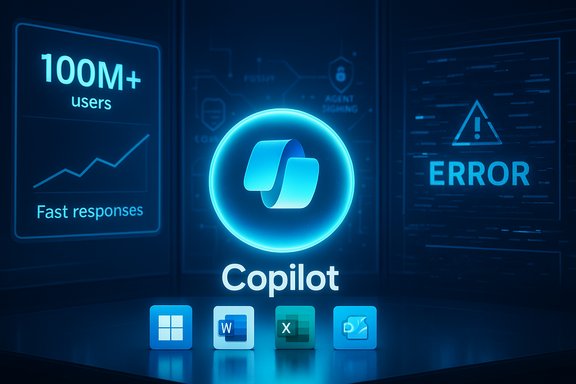
Microsoft’s Copilot has migrated from bold experiment to boardroom headache: what began as an audacious bet to make AI the connective tissue across Windows and Microsoft 365 now faces broad user pushback, internal alarms, and mounting skepticism from customers and competitors alike. Over the last year Microsoft has doubled down — rolling GPT‑5 into Copilot Studio, certifying Copilot+ PCs, and publishing a 37.5‑million‑conversation usage report to demonstrate traction — yet independent hands‑on reviews, a high‑profile BBC accuracy study, outage incidents, and critical commentary from industry figures have combined to expose gaps between promise and delivery.
Microsoft positioned Copilot as the linchpin of an “agentic OS” vision: AI assistants that understand context, act across apps, and reduce routine work. The company bundled Copilot into Windows, Microsoft 365, Edge, and Copilot‑branded experiences — and committed significant cloud and hardware investments to make it feel native and responsive on everyday PCs. Executives framed the launch as part of a multi‑year shift that redefines productivity and locks AI into Microsoft’s platform moat. But the rollout has been uneven. Two parallel realities have emerged: Microsoft’s telemetry and marketing point to scale and strategic progress (management has publicly claimed Copilot lines of usage that exceed 100 million monthly users), while independent testing, social media, and enterprise pilots report misidentifications, hallucinations, sluggish performance, and privacy anxieties that undermine real‑world value. These contradictory signals are now shaping product decisions at the highest levels inside Microsoft and altering customer upgrade plans across enterprises.
If Microsoft can prioritize surgical fixes to reliability, make governance simple and auditable for enterprises, and continue to supply better models with sensible human‑in‑the‑loop safeguards, Copilot can still fulfill its promise. If not, the product risks becoming an expensive, high‑visibility lesson in how platform ubiquity alone does not guarantee human trust — and how the race to ship the next “agent” must be matched by the discipline to make it reliably useful where people actually work.
Source: WebProNews Microsoft Copilot AI Faces Backlash Over Performance Woes and Inaccuracies
 Background / Overview
Microsoft positioned Copilot as the linchpin of an “agentic OS” vision: AI assistants that understand context, act across apps, and reduce routine work. The company bundled Copilot into Windows, Microsoft 365, Edge, and Copilot‑branded experiences — and committed significant cloud and hardware investments to make it feel native and responsive on everyday PCs. Executives framed the launch as part of a multi‑year shift that redefines productivity and locks AI into Microsoft’s platform moat. But the rollout has been uneven. Two parallel realities have emerged: Microsoft’s telemetry and marketing point to scale and strategic progress (management has publicly claimed Copilot lines of usage that exceed 100 million monthly users), while independent testing, social media, and enterprise pilots report misidentifications, hallucinations, sluggish performance, and privacy anxieties that undermine real‑world value. These contradictory signals are now shaping product decisions at the highest levels inside Microsoft and altering customer upgrade plans across enterprises. The promise vs the lived experience
What Microsoft promised
Microsoft’s public roadmap has emphasized three pillars:- Contextual help across Windows and Office apps (summaries, edits, and automated actions).
- On‑device/Hybrid inference — Copilot+ hardware to run heavy models locally for low latency and better privacy.
- Agent workflows that execute multi‑step tasks safely (Copilot Studio and Agent Builder to govern and deploy agents).
What users are reporting
Real users and reviewers describe a different picture: Copilot often behaves like a help article rather than a trustworthy assistant. Problems documented across journalism and community reproductions include:- Hallucinations — factual errors and fabricated details in otherwise confident outputs.
- Context blindness — failing to read current UI state, misnavigating settings (an accessibility demo became a high‑visibility embarrassment).
- Performance and responsiveness issues — slow or timing‑out completions, frame‑rate hits in games, and higher battery draw on older devices.
- Fragmented experience — different Copilot instances (Windows Copilot, M365 Copilot, GitHub Copilot) produce inconsistent results and UX.
Performance, hallucinations and the accuracy debate
Measured failures: what independent evaluations show
One of the most load‑bearing findings for enterprise buyers came from the BBC’s investigation into AI news summarization: across 100 news questions, leading assistants (including Copilot) produced answers with significant problems in roughly half of cases, and smaller but meaningful rates of factual errors and misquotes. That study underlined a simple reality — generative assistants can sound authoritative while being wrong, and the problem is cross‑vendor, not unique to Microsoft. Journalistic hands‑on tests of Copilot Vision and agentic flows corroborate these concerns: image misidentifications, incorrect UI guidance in demos, and outputs that require manual cleanup. Community tests reproduced many of these failure modes and amplified them across social networks and forums, building a chorus of complaint that contrasts starkly with the marketing narrative.Where accuracy varies
Accuracy is not a single number. Copilot is a family of assistants: summarization, code generation, spreadsheet reasoning, vision, and agentic automation are distinct tasks with different success rates. Narrow benchmarks (e.g., spreadsheet evaluation on a limited dataset) can show high accuracy; open‑ended, real‑world tasks (current‑events summarization, visual UI parsing) show far higher error rates. Treating Copilot as a uniform product with a single “accuracy” metric is unsafe — but the perception of low reliability in many everyday tasks remains the consumer reality.Reliability and real‑world availability: outages and scaling
Copilot’s heavy integration into Office and Windows surface area makes it an operational dependency. On December 9, 2025 Microsoft logged incident CP1193544 (a regional service degradation that affected Copilot in the UK and parts of Europe), citing an unexpected surge in traffic and a load‑balancing policy change that stressed autoscaling and caused degraded functionality. Public status notes, regional advisories (including NHSmail and Microsoft’s own admin notices), and outage trackers showed users receiving fallback messages or timeouts in Word, Excel, Outlook and Teams during the incident. The outage underlines that synchronous, human‑facing AI features are sensitive to cloud autoscaling and routing faults. When an AI control plane that orchestrates edits and summaries stalls, the effect is not theoretical: automated workflows fail, meeting summaries disappear, and helpdesk tickets spike. That operational fragility — inherent to GPU‑backed inference chains requiring warm pools and pre‑warmed capacity — is an engineering reality for any large‑scale AI service. Microsoft teams are explicitly wrestling with these trade‑offs in production environments.Privacy, governance and enterprise trust
Copilot’s system‑level presence raises a different kind of alarm for IT teams: the assistant can access documents, messages and app context to be useful, but that access must be governed. Two areas generate particular concern:- Recall and screen indexing — features that snapshot screens and build local timelines required reworking after initial privacy pushback. Even where Microsoft implements hardware‑anchored encryption and Windows Hello gating, enterprise admins want clear, auditable guarantees and simplified opt‑in controls.
- Oversharing and connector risks — if sensitivity labels and permissions are misconfigured, Copilot can synthesize and surface confidential material. Analysts and IT leaders have reported delayed rollouts and cautious pilots as organisations tighten governance. Public calls from industry figures — including Salesforce CEO Marc Benioff — have emphatically flagged data‑spill risks and promoted the view that enterprise cognitive security remains unsettled.
Competitive pressure and the internal scramble
User counts and market context
Microsoft has repeatedly pointed to scale: senior briefings and earnings commentary stated that Copilot products had surpassed 100 million monthly users across consumer and commercial surfaces — a milestone investors and analysts interpreted as evidence of traction. Reuters and other outlets reported this figure in mid‑2025, and Microsoft’s own Copilot Usage Report (a 37.5‑million‑conversation sample) was published to show real usage patterns across devices and times of day. At the same time, competitors are making cultural gains. Google’s Gemini app has reported explosive growth and viral features that have driven very high engagement figures (reports in late 2025 cited monthly active user counts in the hundreds of millions for Gemini’s mobile experiences), creating a hard benchmark in both product polish and public perception. Those numbers — and Gemini’s growing cultural mindshare — have sharpened executive focus inside Microsoft.Nadella’s involvement and internal pressure
Public and private reporting indicates Satya Nadella has taken an unusually hands‑on role in Copilot product work: internal messages, weekly engineering meetings and direct emails urging faster fixes and better parity with competitors have been reported. The Information and corroborating journalistic coverage describe Nadella pushing engineering leads and sometimes personally intervening in product issues considered strategic. That level of CEO involvement signals the high stakes for Microsoft: Copilot is not a peripheral product but central to the company’s AI narrative and future revenues.Microsoft’s response: iteration, governance and new models
Microsoft’s engineering response has been multi‑pronged:- Model upgrades and choice: Copilot Studio’s November 2025 updates introduced GPT‑5 Chat and experimental GPT‑5.2 models for Copilot Studio agents and Agent Builder — an explicit effort to raise baseline model competence across agentic workflows. These model choices aim to improve instruction‑following, reasoning and code generation in production agents.
- Human‑in‑the‑loop (HITL): Copilot Studio previewed HITL patterns that pause critical agent steps for human verification, lowering end‑to‑end risk for sensitive business actions.
- Governance tooling: agent signing, revocation, containment workspaces, and admin policy controls are being emphasized to give enterprises auditability and containment for agents.
- Usage transparency: the Copilot Usage Report is an explicit PR and product datapoint intended to show that Copilot has real, varied uses (health queries on mobile, work queries on desktop) — part of a narrative to reposition Copilot as a companion rather than a gimmick.
Strengths Microsoft still controls
Despite the headwinds, Microsoft retains structural advantages that make the Copilot bet defensible:- Platform integration: owning Windows, Office and Azure provides unparalleled reach and data‑plane control for embedding assistants where work actually happens.
- Hardware+software co‑design: the Copilot+ PC concept and NPU requirements are pragmatic engineering levers to move latency and privacy trade‑offs closer to users.
- Cloud capacity and investment: Microsoft’s record capital spend on data centres and its Azure footprint let the company shoulder expensive GPU infrastructure at scale — a long‑term moat if it stabilises.
Where Microsoft is most at risk
- Trust erosion: repeated missteps in demos and real‑world failures create a credibility gap that advertising and analytics cannot easily erase. Viral fail videos and memes amplify perception faster than bug fixes can repair it.
- Enterprise caution: security and TCO concerns slow rollout budgets; Gartner and pilots have shown many organisations postpone full deployments pending clearer controls and ROI. When enterprises delay, revenue growth tied to Copilot seat‑upsell and premium tiers becomes uncertain.
- Operational fragility: autoscaling issues and regional outages are sticky problems for synchronous features; they cost trust and create measurable support loads. A single high‑visibility outage can cost more than a few hours of engineering time if it triggers cancellations or holdouts.
- Competitive mindshare: consumers often discover generative AI in the browser; ChatGPT and Gemini dominate that mental space. Copilot’s contextual advantage is real, but it must translate into irresistible everyday wins to overcome cultural inertia.
Practical recommendations for Microsoft and customers
For Microsoft (product & engineering)
- Prioritise repair work — fix repeatable failures that damage credibility (UI automation reliability, common vision errors, latency hot spots).
- Expand transparent, auditable governance controls that non‑technical admins can test and sign off on.
- Publish concrete SLAs and regional scaling commitments for synchronous Copilot features; make autoscaling behaviour observable to large customers.
- Add lighter, offline‑first Copilot modes for low‑power devices to reduce perceived bloat and battery impact.
- Keep investing in HITL paths for high‑risk agent actions while offering tighter developer controls for emergent agent behaviour.
For enterprise buyers and admins
- Treat Copilot as a staged rollout: start with read‑only or advisory modes, evaluate outputs rigorously, and onboard agentic automation only after governance and labeling are ironed out.
- Apply strict sensitivity labels and implement tenant‑wide policies before broader rollout.
- Demand operational transparency and incident postmortems for outages that affected your tenant and negotiate uptime support in procurement.
A candid assessment
Copilot is simultaneously one of Microsoft’s most important strategic bets and a case study in how hard it is to ship agentic AI at consumer scale. The company has the assets to win: platform breadth, cloud scale, and direct model partnerships. Yet the pathway to durable value is narrow. Hallucinations, UX regressions, privacy anxieties, and regional outages have created a trust deficit that will not vanish with a single model upgrade or PR brief. Microsoft’s November 2025 Copilot Studio upgrades (GPT‑5 availability, HITL, governance improvements) are necessary steps — but they are also incremental: they reduce risk and raise baseline quality rather than flipping a switch to “solved.” Cross‑vendor evidence shows this is not only Microsoft’s problem: the BBC’s analysis found major issues across Copilot, Gemini and ChatGPT for news summarisation, underscoring that accuracy at scale is an industry challenge, not a single‑vendor failure. That reality both relieves and complicates Microsoft’s position: competitors suffer similar limits, but those competitors also shape public expectations and capture mindshare when their consumer experiences feel smoother.Conclusion
The Copilot saga is a modern product‑management parable: vision and scale without commensurate polish and governance produce backlash that chips away at adoption. Microsoft has responded with model upgrades, governance tooling, and public usage reports — and the company’s internal escalation shows the effort is serious. Yet user trust, enterprise adoption and smooth operational reliability are the true measures of success for an assistant that’s supposed to make everyday computing easier, not more complicated.If Microsoft can prioritize surgical fixes to reliability, make governance simple and auditable for enterprises, and continue to supply better models with sensible human‑in‑the‑loop safeguards, Copilot can still fulfill its promise. If not, the product risks becoming an expensive, high‑visibility lesson in how platform ubiquity alone does not guarantee human trust — and how the race to ship the next “agent” must be matched by the discipline to make it reliably useful where people actually work.
Source: WebProNews Microsoft Copilot AI Faces Backlash Over Performance Woes and Inaccuracies
