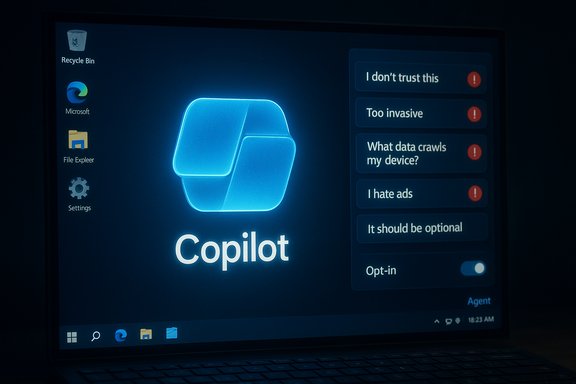
Microsoft’s Copilot push has become a lightning rod — not because the technology is uninteresting, but because the messaging, demos and rollout cadence have repeatedly collided with an audience that’s tired of broken promises, privacy worries and an operating system that still feels unfinished to many power users.
Microsoft has rapidly embedded Copilot — its family of generative-AI assistants — across Windows, Edge and Microsoft 365, and has introduced a hardware tier called Copilot+ PCs to accelerate on-device AI. The company’s public posture around this shift has emphasized an “agentic OS” vision: a Windows that does more than respond, a Windows that can act on behalf of users. That framing is strategic — and consequential — because it redefines expectations about autonomy, telemetry, identity and control on billions of endpoints. Multiple reporting threads and community discussions have shown the strategy landing poorly with a substantial slice of Windows’ installed base. The reaction to individual promotional posts and short ads has been unusually hostile. Promotional copy that reads like lighthearted marketing has repeatedly attracted hundreds — sometimes thousands — of derisive replies, and a small number of demonstrable ad misfires (an influencer clip that guided users to the wrong setting, for example) were amplified as proof the product isn’t ready. These incidents are less about a single tweet or clip and more about a pattern: promising agentic reliability while delivering inconsistent, state‑unaware assistance.
The path forward is not abandoning agentic ideas. It is slowing down on PR‑first narratives, accelerating the release of governance artifacts, and demonstrating humility in public messaging. If Microsoft does that, the company can convert the current skeptical chorus into cautious partners rather than perpetual critics. If it does not, Copilot risks becoming shorthand for a corporate push that ignored user consent and hard engineering tradeoffs — a reputational cost that will be expensive to repair.
Microsoft still has the assets to make this work: hardware partners shipping 40+ TOPS systems, a massive cloud footprint, and millions of enterprise contracts. Turning those assets into trust requires more than feature rollouts; it requires open, auditable policies, better demos, and an admission that early agentic features should be conservative by default. The conversation around Copilot is no longer just about what AI can do — it’s about who controls it, how mistakes are fixed, and whether businesses and individuals can opt in with confidence.
Source: Neowin Microsoft keeps getting roasted whenever it tries to promote Copilot
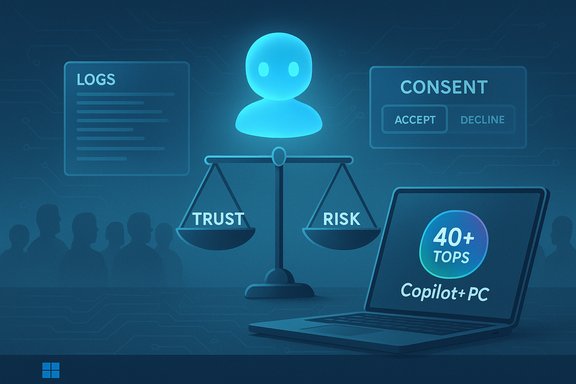 Background / Overview
Microsoft has rapidly embedded Copilot — its family of generative-AI assistants — across Windows, Edge and Microsoft 365, and has introduced a hardware tier called Copilot+ PCs to accelerate on-device AI. The company’s public posture around this shift has emphasized an “agentic OS” vision: a Windows that does more than respond, a Windows that can act on behalf of users. That framing is strategic — and consequential — because it redefines expectations about autonomy, telemetry, identity and control on billions of endpoints. Multiple reporting threads and community discussions have shown the strategy landing poorly with a substantial slice of Windows’ installed base. The reaction to individual promotional posts and short ads has been unusually hostile. Promotional copy that reads like lighthearted marketing has repeatedly attracted hundreds — sometimes thousands — of derisive replies, and a small number of demonstrable ad misfires (an influencer clip that guided users to the wrong setting, for example) were amplified as proof the product isn’t ready. These incidents are less about a single tweet or clip and more about a pattern: promising agentic reliability while delivering inconsistent, state‑unaware assistance. Why the backlash keeps happening
1. Message versus reality: “agentic” is a loaded word
Calling Windows an “agentic OS” signals autonomy. For enterprise admins and power users that phrase triggers instinctive governance questions: how are agents permissioned? What is logged? How do you revoke memory and actions? Microsoft’s public messaging around agentic capabilities — meant to highlight productivity gains — has instead provoked anxiety because it arrives without clear, auditable governance artifacts. That gap between marketing and operational detail creates a credibility deficit.2. Demonstrations that don’t survive hands‑on testing
Several promoted demos and influencer videos intended to normalize Copilot’s role in the OS instead highlighted basic failings: recommending the wrong setting, ignoring the system’s current state, or steering users to less appropriate controls. A short clip that attempted to show Copilot fixing “text size” instead pointed to display scaling and recommended a value that was already active — a visible failure that was widely reshared and criticized. When an assistant behaves in front of millions as if it lacks basic context awareness, adoption becomes political, not technical.3. Timing and product quality
The Copilot push coincided with ongoing complaints about Windows 11: UI regressions, missing customization (the vertical taskbar debate is symbolic), and occasional stability issues reported by power users. When basic platform polish is perceived as lagging, adding a layer that requires deep integration and additional telemetry looks like prioritizing optics over fundamentals. Critics interpret that sequencing as product mis‑prioritization.4. Marketing tone and community trust
Short, snackable marketing lines — for example, a social post that cheered “Copilot finishing your code before you finish your coffee” — were intended to humanize AI benefits. Instead, they were read as dismissive of developer realities: generated code needs review, testing, and security vetting. The gulf between marketing shorthand and developer workflow produced ridicule rather than conversion. Independent reporting documented large reply threads and sustained ridicule; the social metrics involved changed rapidly and should be treated as transient signals, but the volume and tenor of responses were clear.What Microsoft has actually shipped — and where it’s aspirational
Copilot features and hardware
- Copilot is present across Microsoft 365 apps, GitHub Copilot for code, and system-level experiences in Windows (voice, vision, and actions).
- Microsoft has introduced Copilot+ PCs, a category that requires an NPU capable of 40+ TOPS (trillion operations per second) to deliver certain local AI experiences like Recall, Cocreator and Live Translate. The 40+ TOPS requirement and the Copilot+ feature set are documented in Microsoft’s materials and corroborated by major outlets.
Agentic primitives in preview
Microsoft has been releasing platform primitives — a local model runtime, APIs intended to let agents interact with system services, and the Model Context Protocol for interoperability. Those are technical building blocks, but turning them into safe, auditable, enterprise‑grade agentic behavior requires governance work: consent models, accessible logs, robust sandboxes and operational controls for remediation. Those guardrails are still evolving in Insider channels.Who’s loudest — and why their reaction matters
Developers and power users
The developer community’s reaction is not merely contrarian. Developers and system administrators are the people who will debug, vet and protect systems if Copilot‑generated code is integrated into production pipelines. High‑profile technologists, community moderators and enterprise IT professionals framing the conversation matters because developer trust is a durable asset: once it erodes, it’s costly to rebuild. Repeated messaging missteps — and visible demo failures — have turned skepticism into policy discussions inside some organizations.Influencers and media
When a demo fail gets amplified by an influencer or a mainstream tech outlet, it becomes shorthand for product maturity. That kind of coverage makes the issue visible to non‑technical audiences and enterprise procurement leads, amplifying reputational risk even if the failure was narrow or fixable. The PR cost is real: the same clip that reveals a lack of state awareness also undermines confidence in agentic workflows at scale.Microsoft leadership and tone
Senior Microsoft voices have publicly defended the AI-first agenda. CEO Satya Nadella has said that around 20–30% of some internal code is now AI‑generated — a claim repeated across multiple outlets after a fireside chat at Meta’s LlamaCon. That figure is notable because it reframes Microsoft internally as a heavy user of AI; externally, it makes customers wonder how much human oversight remains in core product engineering. The figure is corroborated by multiple mainstream tech publications, but the exact measurement methodology is internal to Microsoft and thus should be interpreted as an executive estimate rather than a precise, independently audited statistic. Mustafa Suleyman, head of Microsoft AI, publicly pushed back at critics, expressing surprise that people aren’t more impressed with conversational AI — a tone that some interpreted as dismissive of legitimate user concerns about privacy, correctness and governance. Outright dismissal of criticism rarely calms a noisy community; it tends to harden opposition. Several outlets documented Suleyman’s remarks and the subsequent reaction. Readers should treat paraphrases of rapidly posted social comments with caution; those lines are often edited or reformulated in follow-ups.The practical risks that matter to enterprise IT
- Security of AI‑generated code: Independent research shows AI-assisted code can introduce vulnerabilities if not reviewed rigorously. A nontrivial share of model outputs include known classes of security problems unless subjected to automated and human review. Enterprises must treat AI‑produced code as an input requiring the same testing and static analysis as human-written code.
- Data governance and telemetry: Agentic features imply memory; enterprises need explicit controls over what is stored on device, what is sent to the cloud, retention periods and who can access agent logs. Absent transparent defaults and admin tooling, agentic features will be a risk factor for regulated customers.
- User consent and UX friction: Aggressive push‑to‑adopt flows, persistent prompts to sign in with a Microsoft Account, and default-on behaviors can increase help desk load and fuel resentment. Enterprises prefer opt‑in, auditable features with central policy controls.
- Regulatory and compliance exposure: New generative capabilities intersect with privacy, IP and sectoral rules. Without clear data residency and usage contracts, organizations subject to stringent compliance regimes will be cautious to enable agentic features.
What Microsoft needs to fix — a pragmatic playbook
Short-term wins are possible and attainable. The following is a prioritized list Microsoft could follow to climb back to a position of trust.- Publish measurable pilot KPIs and governance artifacts
- Release a public, machine‑readable spec for agent actions, retention, and revocation APIs.
- Share pilot KPIs (error rates, mean time to remediation, false‑positive/negative rates) for enterprise previews so that IT can validate claims.
- Stop lightweight marketing for hard problems
- Replace punchy social copy with transparent, contextual messaging that acknowledges limitations and invites feedback.
- Ensure all demos are reproducible under sane test conditions; never ship a demo that depends on idealized, edited footage.
- Harden developer workflows
- Integrate static analysis, SCA (software composition analysis), and security scanning into Copilot workflows as first‑class features.
- Make it trivial to flag, annotate and audit AI‑produced code within PR review pipelines.
- Ship enterprise defaults that respect choice
- Provide MDM/Intune controls to disable agentic memory, restrict cloud sync, or route data through customer-managed keys.
- Offer a “conservative” agent mode for regulated environments that limits persistence and background actions.
- Improve observability and rollback
- Agent actions must be auditable by default and reversible by users or admins within clear SLAs. Log formats should be exportable to SIEM and SOAR tools.
Notable strengths in Microsoft’s position
- Breadth of integration: Copilot across Office, GitHub and Windows creates an opportunity for a consistent developer and end‑user experience that competitors find hard to replicate.
- Hardware+software stack: Copilot+ PCs and an emphasis on local NPU acceleration make low‑latency, private AI practical in many scenarios — a technical differentiator for regulated customers who want on‑device inference. Microsoft’s 40+ TOPS specification is a clear engineering bar that OEMs are meeting.
- Cloud and platform reach: Azure’s scale and Microsoft’s enterprise relationships mean that if governance and controls are strengthened, adoption could accelerate quickly among customers who trust Microsoft’s operational playbook.
What the data and coverage actually show (verification)
- The agentic OS messaging and its backlash were widely reported across mainstream outlets and reproduced in community threads; the phrase itself was used publicly by Windows leadership and triggered a high volume of negative replies in social channels. Multiple outlets covered the story and the ensuing reply storm.
- Satya Nadella’s estimate that “20–30%” of some Microsoft projects’ code is AI‑generated was stated during a public fireside chat and reported by several major tech outlets; these reports corroborate the number but the underlying measurement methodology has not been independently audited and should be treated as an executive estimate.
- The Copilot+ PC 40+ TOPS hardware requirement and feature set are documented by Microsoft and covered by major tech press; that technical spec is verifiable and tied to device eligibility.
- Reports about a promotional clip that misguided users and that was later removed are documented in coverage and community writeups; the removed clip became one of the vivid examples critics point to when arguing Copilot isn’t ready for general availability. Specific counts of replies and views vary by report and are transient; treat any single social metric as ephemeral.
Bottom line: adoption will hinge on governance, honesty and a slower hand
Copilot is technically compelling in many scenarios, and Microsoft’s platform approach — cloud, local NPUs, and developer tooling — is strategically coherent. The current public backlash isn’t a death knell; it is a diagnostic. It tells Microsoft that the company must reconcile its marketing cadence with product readiness, provide far clearer governance and admin controls, and demonstrate measurable improvements in reliability and privacy before agentic features can be widely trusted.The path forward is not abandoning agentic ideas. It is slowing down on PR‑first narratives, accelerating the release of governance artifacts, and demonstrating humility in public messaging. If Microsoft does that, the company can convert the current skeptical chorus into cautious partners rather than perpetual critics. If it does not, Copilot risks becoming shorthand for a corporate push that ignored user consent and hard engineering tradeoffs — a reputational cost that will be expensive to repair.
Microsoft still has the assets to make this work: hardware partners shipping 40+ TOPS systems, a massive cloud footprint, and millions of enterprise contracts. Turning those assets into trust requires more than feature rollouts; it requires open, auditable policies, better demos, and an admission that early agentic features should be conservative by default. The conversation around Copilot is no longer just about what AI can do — it’s about who controls it, how mistakes are fixed, and whether businesses and individuals can opt in with confidence.
Source: Neowin Microsoft keeps getting roasted whenever it tries to promote Copilot