

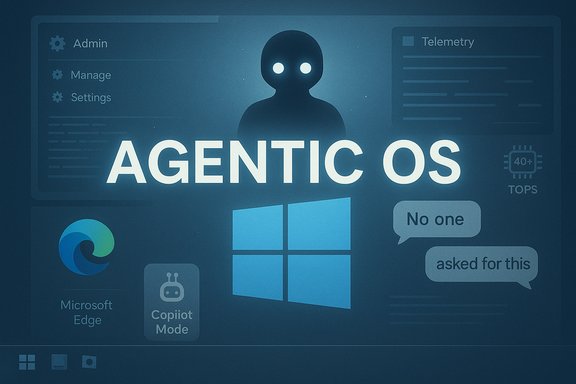
Microsoft’s latest Copilot push has detonated into one of the most visible user-reaction storms in recent Windows history, with a string of corporate posts, a promotional Edge teaser and an incredulous public reply from Microsoft AI CEO Mustafa Suleyman all provoking a wave of “No one asked for this” responses across social media and enthusiast forums. The backlash crystallizes a widening trust gap: while Microsoft markets an “agentic OS” powered by Copilot and on-device NPUs, a vocal portion of long‑time Windows users and IT professionals say they simply want stability, control and clear opt‑outs — not an AI assistant baked into every system surface.
Microsoft’s messaging in the weeks around Ignite leaned heavily on a single, ambitious framing: Windows is “evolving into an agentic OS,” a platform that hosts persistent, permissioned agents which can act on behalf of users across apps, devices and the cloud. That phrase — and the product signals around it (Copilot embedded widely across Windows, Copilot Vision and Actions, Copilot+ PCs with on‑device NPUs) — moved the company’s AI story from app-level convenience to a system-level promise. Multiple Microsoft briefings and blog posts described developer primitives, on‑device runtimes and hardware guidance (including NPU performance targets expressed as “40+ TOPS”) that underpin this vision. At face value, the strategy is coherent: tightly integrate models and agents into the OS to enable faster, context-rich productivity scenarios while giving IT controls for enterprise governance. In practice, however, marketing messages, demo stumbles and an aggressive cadence of Copilot placements have provoked a visible, cross‑platform reaction. The ensuing conversation has left Microsoft in the unusual position of defending its vision to the users whose desktops it controls.
That said, the criticism sometimes flattens legitimate enterprise use cases. Some organizations will accept Copilot only if it reduces time‑to‑value in measurable ways and fits into existing compliance workflows. For them, the agentic OS is not inherently dystopian — it could be a productivity multiplier. The issue is execution and consent, not the raw technology.
The Suleyman reply — framed as incredulity that people weren’t “mindblown” by modern AI — was perhaps the most consequential single moment because it inverted the dynamic: a CEO’s emotion became the focal point of critique rather than the product itself. In social media dynamics, tone can matter as much as content. A defensive tone amplified the sense of a leadership out of sync with some users’ experience.
The coming months will be revealing. If Microsoft moves quickly to publish opt‑outs, third‑party audits, transparent telemetry flows and rigorous admin tooling, it can repair trust and steer adoption thoughtfully. If it treats vocal user communities as an irritant and presses forward without addressing the core operational issues — accuracy, performance, control and cost transparency — the “No one asked for this” refrain risks becoming a lasting brand scar.
Source: PCWorld 'No one asked for this': Microsoft's Copilot AI push sparks social media backlash
 Background
Microsoft’s messaging in the weeks around Ignite leaned heavily on a single, ambitious framing: Windows is “evolving into an agentic OS,” a platform that hosts persistent, permissioned agents which can act on behalf of users across apps, devices and the cloud. That phrase — and the product signals around it (Copilot embedded widely across Windows, Copilot Vision and Actions, Copilot+ PCs with on‑device NPUs) — moved the company’s AI story from app-level convenience to a system-level promise. Multiple Microsoft briefings and blog posts described developer primitives, on‑device runtimes and hardware guidance (including NPU performance targets expressed as “40+ TOPS”) that underpin this vision. At face value, the strategy is coherent: tightly integrate models and agents into the OS to enable faster, context-rich productivity scenarios while giving IT controls for enterprise governance. In practice, however, marketing messages, demo stumbles and an aggressive cadence of Copilot placements have provoked a visible, cross‑platform reaction. The ensuing conversation has left Microsoft in the unusual position of defending its vision to the users whose desktops it controls. What actually sparked the outrage
The posts, the promo and the reply
Three public moments acted as accelerants.- Pavan Davuluri, President of Windows & Devices, posted a short message stating that “Windows is evolving into an agentic OS,” a line intended for Ignite audiences that rapidly bled into mass social channels. The reply thread filled with blunt opposition — “Stop this nonsense. No one wants this,” and similar sentiments — and the volume of negative replies forced follow‑ups acknowledging that Microsoft “has work to do” on reliability and usability.
- Microsoft Edge Dev published a teaser promoting a new “Copilot Mode” for Edge for Windows 11 with copy like “We heard you wanted Copilot Mode at work.” The post drew a deluge of sarcastic and hostile replies, many pointing out they hadn’t asked for Copilot to be everywhere and demanding easier ways to remove or disable it.
- Mustafa Suleyman, CEO of Microsoft AI, publicly replied to critics with an incredulous post — essentially saying he’s “mind‑blown” that people remain unimpressed by today’s conversational and generative AI, referencing growing up with Snake on a Nokia as a contrast. That tone — defensive and a little dismissive of user grievances — became a focal point for criticism and amplification across outlets.
Why the phrasing “agentic OS” mattered
The single phrase “agentic OS” did more work than Microsoft likely intended. “Agentic” implies initiative — agents that remember, plan and take action beyond single-shot queries. For many long‑time Windows users, that sounded like a loss of control: opaque decision‑making, more telemetry, and software that might act without clear, auditable user consent. That semantic shift ignited a debate about agency, governance and the social contract between platform makers and users.The core complaints: accuracy, control, performance and cost
User feedback clustered into a small set of repeatable concerns. Each is important, measurable and in some cases verifiable.- Accuracy and hallucination risk. Several hands‑on reports documented Copilot making procedural or factual errors, misidentifying screen elements in vision tasks, or recommending redundant or incorrect steps for simple settings changes. Those are not hypothetical concerns: independent testers reproduced instances where Copilot’s guidance was wrong, undermining confidence in an assistant meant to be relied upon.
- Perceived loss of control and forced placement. Users repeatedly complained that Copilot was being “shoved into” Windows, making it difficult to avoid or fully disable. That sentiment is amplified where Microsoft ties advanced Copilot features to specific subscription tiers or hardware (Copilot+ PCs), which some interpret as a form of opt‑out‑resistant monetization.
- Performance and battery impact. Embedding AI at the OS level changes how often models are invoked and where inference runs. On older or lower‑powered devices, on‑demand AI can lead to measurable slowdowns and battery drain. Microsoft has pushed hardware guidance (NPUs targeted at 40+ TOPS for Copilot+ experiences) that implies on‑device acceleration is necessary for a smooth experience — but independent testing and user reports show a mixed picture depending on device capabilities.
- Privacy and telemetry fears. Features that capture screen context or chain actions across local files raise immediate questions: what data leaves the device, how is it stored, who can access the logs, and how long is context retained? Microsoft has described enterprise controls and DLP integrations for agentic features, but users and admins want more detailed, auditable guarantees before they trust persistent agents with sensitive data.
- Pricing and the perception of forced upgrades. In some markets Copilot’s arrival has been associated with higher Microsoft 365 pricing tiers or limited opt‑outs, creating resentment among customers who feel they’re paying for features they don’t want. That economic angle reframes the debate from mere UX to consumer fairness and market dynamics.
What Microsoft says it’s building — and what’s verifiable
Microsoft’s public roadmap and Ignite materials do supply concrete technical claims that can be checked.- Copilot is being extended into voice, vision, and agentic actions across Windows and Edge. Microsoft has released previews and developer APIs (Model Context Protocol, Windows AI Foundry) that indicate a genuine engineering push rather than pure marketing.
- Microsoft markets a Copilot+ PC hardware class and documents NPU performance guidance (the oft‑cited “40+ TOPS”) as an expected baseline for richer on‑device experiences. Those hardware targets appear in Microsoft’s published guidance and were repeatedly referenced in Ignite materials. Independent outlets also reported the same figures in coverage.
- For enterprises, Microsoft describes administrative controls, DLP integration and site‑level permissions for agentic features — in other words, a governance model intended to limit agent scope. The devil is in operational detail: how those permissions are enforced and audited is not yet fully visible outside preview documentation.
Analysis: strategic strengths and where Microsoft is exposed
Strengths — why Microsoft is doubling down
- Platform leverage. Microsoft controls Windows, Edge, Office and Azure. Bundling Copilot across those surfaces creates unique cross‑product synergies; when executed well, the system‑level context (files, tenant data, active app state) can enable genuinely faster workflows than isolated AI assistants. This is a defensible strategic move.
- Enterprise proposition. For organizations that prioritize productivity gains and already trust Microsoft for identity and device management, agentic automations backed by tenant context and DLP could deliver real value — automating repetitive tasks, surfacing consolidated knowledge, and reducing friction in cross‑document work. Microsoft’s enterprise channels and partner ecosystem are well positioned to pilot those scenarios.
- Hardware and edge investment. Pushing on‑device acceleration (NPUs, Copilot+ PCs) is a long‑term play that addresses latency, offline capability and some privacy concerns — if the promised local inference actually matches the marketing. Microsoft’s hardware guidance is a concrete signal to OEM partners and enterprise buyers.
Risks and operational vulnerabilities
- Trust erosion is real and measurable. Users’ expressed distrust — about telemetry, forced features, and accuracy — cannot be papered over by repeated demos. Trust loss translates to slower adoption, vocal churn, and reputational costs. Microsoft’s defensive social media posture (selectively replying to positive comments) has not helped perceptions.
- Hallucinations and reliability gaps are dangerous for a system agent. An assistant that “acts” and occasionally invents steps risks more than a bad answer; it can change system state in ways users don’t expect. Until agentic features are demonstrably robust with clear rollback and verification mechanisms, the practical case for initiative‑taking agents remains weak for conservative users.
- Fragmentation of user base. Power users and IT admins prioritize control; consumer users often prize simplicity; enterprises demand auditability. A single aggressive push without clear, differentiated enablement and opt‑in paths risks alienating multiple segments simultaneously.
- Regulatory and security surface. As agents gain the ability to access tenant data and act across systems, compliance and adversarial misuse scenarios rise. Attackers could seek to trick agents into revealing secrets or taking privileged actions; regulators may demand auditable logs and consent frameworks. Microsoft will need stronger technical and legal assurances to manage that risk.
Practical checklist: What Microsoft should do next (and what IT teams should ask for)
- Publish precise, machine‑readable opt‑out controls and ensure they persist through major updates.
- Release independent third‑party audits of Copilot’s telemetry, data flows and inference locations (cloud vs. on‑device).
- Provide granular admin tooling with tamper‑evident action logs for any agentic activity performed at tenant scope.
- Commit to conservative rollout patterns (feature flags, staged rollouts, measurable KPIs) and share the KPIs publicly.
- Deliver a documented rollback and compensation policy for customers who experience data loss or compliance breaches tied to agent actions.
Why some of the criticism is warranted — and where it oversimplifies
Many users’ immediate reaction — “No one asked for this” — is a blunt but not entirely unfair political expression of fatigue. Microsoft has layered new prompts, assistant surfaces and subscription messaging on top of a user base that has, in recent years, faced forced sign‑ins, UI changes and contentious telemetry debates. Critics are right to demand choice, performance improvements and clear governance before being asked to accept agents with initiative.That said, the criticism sometimes flattens legitimate enterprise use cases. Some organizations will accept Copilot only if it reduces time‑to‑value in measurable ways and fits into existing compliance workflows. For them, the agentic OS is not inherently dystopian — it could be a productivity multiplier. The issue is execution and consent, not the raw technology.
The social media angle: marketing misfires and community consequences
Microsoft’s public communications strategy here matters more than usual because the product is a system-level change. Promos that show Copilot failing to point to the correct accessibility setting became memes. Short, punchy social posts intended to excite developers (“Copilot finishing your code before you finish your coffee”) instead drew snark and ridicule because they appeared to minimize developer pain where AI‑assisted code still needs review. Selective engagement — answering supportive comments while ignoring negative replies — made the company look tone‑deaf to legitimate operational concerns.The Suleyman reply — framed as incredulity that people weren’t “mindblown” by modern AI — was perhaps the most consequential single moment because it inverted the dynamic: a CEO’s emotion became the focal point of critique rather than the product itself. In social media dynamics, tone can matter as much as content. A defensive tone amplified the sense of a leadership out of sync with some users’ experience.
Looking forward: scenarios and probabilities
- Best‑case: Microsoft accepts the backlash as a signal and invests in transparency, robust opt‑outs, and enterprise‑grade governance. Agents become a managed, auditable augmentation for organizations while desktop users keep control. In this scenario, Copilot becomes a clear paid tier for those who want it; the broader Windows base enjoys a stable, optional experience.
- Middle ground: Microsoft continues a two‑track approach — rolling out agentic features for enterprise customers with stronger controls while slowly enabling consumer experiences that are easier to disable. The company achieves gradual adoption but remains a recurrent target for enthusiast criticism.
- Worst‑case: Microsoft doubles down on aggressive placements without delivering the guardrails, leading to tighter regulatory scrutiny, higher churn among privacy‑sensitive customers and a long‑term erosion of goodwill among the most vocal Windows communities.
Conclusion
Microsoft’s Copilot push is not simply a product rollout; it’s a test of how a dominant platform company introduces initiative‑taking software agents into a system millions rely on daily. The technology’s promise is real: context‑aware agents that speed workflows and reduce repetitive tasks could change productivity in meaningful ways. But the backlash makes a clear point — promise without control breeds resentment. Microsoft now faces a classic product governance problem: deliver demonstrable value while preserving clear, auditable user agency and enterprise controls.The coming months will be revealing. If Microsoft moves quickly to publish opt‑outs, third‑party audits, transparent telemetry flows and rigorous admin tooling, it can repair trust and steer adoption thoughtfully. If it treats vocal user communities as an irritant and presses forward without addressing the core operational issues — accuracy, performance, control and cost transparency — the “No one asked for this” refrain risks becoming a lasting brand scar.
Source: PCWorld 'No one asked for this': Microsoft's Copilot AI push sparks social media backlash
