

Microsoft’s Copilot rollout has moved from a bold strategic bet to a bruising operational and product-management headache, and the two recent reports provided paint a consistent — if cautionary — picture: heavy marketing, real technical and privacy failures in the field, and a user base that is far more skeptical than Microsoft’s headlines would suggest.
Microsoft positioned Copilot as the linchpin of an “AI-first” era across Windows, Microsoft 365, Teams, GitHub and partner devices. The pitch was straightforward: embed generative AI deeply into the daily tools billions already use and monetize both software seats and Azure inference consumption. That strategy promised much — contextual summaries, automated workflows, visual understanding inside apps, and on-device inference through a higher-tier “Copilot+” hardware program — but real-world delivery has been uneven.
Copilot’s public rollout combined ambitious engineering (cloud and on-device inference), aggressive product placement inside everyday UI surfaces (taskbar integration, app-specific Copilot panes), and commercial changes (seat pricing tiers that folded certain AI features into higher-priced packages). The result was rapid visibility but also rapid scrutiny: functional brittleness in many scenarios, privacy concerns around features like Windows Recall, and an economic story that made IT buyers and consumers question value relative to cost.
Operational implications are not abstract:
Key governance concerns:
Daijiworld’s coverage focuses on the commercial bet Microsoft is making: pushing Copilot as a flagship tied to premium pricing and device programs while facing cool reception from users and market skepticism. It emphasizes that users remain unconvinced, particularly where the feature arrives as default or with an added cost, and notes how Microsoft’s investment in OpenAI and AI-first messaging shapes the broader narrative.
Taken together the pieces argue:
Two broader lessons:
However, unlocking it requires four linked outcomes:
The next year will show whether Microsoft can convert scale into sustained trust, or whether Copilot will instead become a cautionary example of distribution without commensurate discipline.
Source: WebProNews Inside Microsoft’s Copilot Crisis: How the Tech Giant’s AI Flagship Lost Its Way
Source: Daijiworld Microsoft bets big on Copilot as OpenAI ties cool; users remain unconvinced
 Background / Overview
Microsoft positioned Copilot as the linchpin of an “AI-first” era across Windows, Microsoft 365, Teams, GitHub and partner devices. The pitch was straightforward: embed generative AI deeply into the daily tools billions already use and monetize both software seats and Azure inference consumption. That strategy promised much — contextual summaries, automated workflows, visual understanding inside apps, and on-device inference through a higher-tier “Copilot+” hardware program — but real-world delivery has been uneven.Copilot’s public rollout combined ambitious engineering (cloud and on-device inference), aggressive product placement inside everyday UI surfaces (taskbar integration, app-specific Copilot panes), and commercial changes (seat pricing tiers that folded certain AI features into higher-priced packages). The result was rapid visibility but also rapid scrutiny: functional brittleness in many scenarios, privacy concerns around features like Windows Recall, and an economic story that made IT buyers and consumers question value relative to cost.
Why the controversy matters: UX, reliability, privacy and economics
UX and product identity: one brand, many assistants
“Copilot” became an umbrella brand for a wide range of assistants — Windows Copilot, M365 Copilot, Copilot in Edge, Copilot in Teams, GitHub Copilot and more — but these assistants behave differently in practice. That brand fragmentation produced confusion: a user who trusts Copilot in Word may receive a different quality of result from Copilot in the Windows shell. The inconsistency weakens trust quickly; an assistant that is supposed to reduce cognitive load instead forces users into verification work.- Brand dilution: multiple copilots under one name with inconsistent capabilities.
- Surprise surfaces: Copilot buttons and nudges appeared in traditionally minimal apps (Notepad, Paint), creating friction for users who expect predictability.
- Perceived upsell: in some markets Copilot’s presence accompanied higher subscription pricing or paid tiers, increasing resentment when value did not match cost.
Reliability and outages: the operational reality
Embedding a synchronous assistant that can act across documents, meetings and messages converts model or routing failures into business interruptions. High‑visibility regional outages and autoscaling incidents have shown how an overloaded orchestration layer or a regional capacity shortage can turn Copilot into a point of operational fragility rather than a productivity enhancer. One documented incident (an autoscaling/load-balancer stress event) produced multi‑hour degradations impacting Word, Teams and other surfaces — and that incident shifted enterprise conversations from theoretical risk to lived disruption.Operational implications are not abstract:
- Timeouts or partial replies can corrupt workflows and escalate support costs.
- Synchronous agent failures create real business risk when automation is relied upon.
- Procurement and FinOps teams resist metered, unpredictable inference costs unless ROI is demonstrable and stable.
Privacy and governance: Recall and on-device indexation
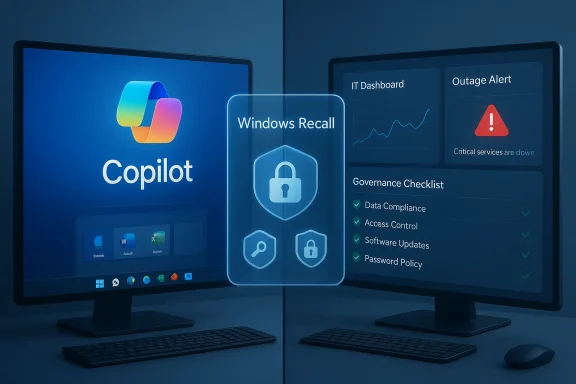
Windows Recall — a feature designed to periodically snapshot on‑screen content and index it for later natural‑language search — became a lightning rod. Its original design and early rollouts raised plausible attack scenarios and privacy alarm bells; researchers demonstrated how an inadequately protected index could leak sensitive content, and enterprise admins balked at a feature that could capture and index unconstrained on-screen material. Microsoft responded with opt‑in defaults, encryption and gating via Windows Hello, but the damage to trust lingered.Key governance concerns:
- Default settings that favor visibility over consent undermine trust.
- Complex admin policy surfaces are needed to make agentic features safe in enterprises.
- Auditability and human‑in‑the‑loop (HITL) controls must be simple enough for non‑specialist administrators to apply.
Economics and positioning: Copilot+, hardware bars, and pricing friction
Microsoft’s Copilot+ concept tied a set of premium on-device experiences to a hardware class with NPU performance requirements (roughly 40+ TOPS) and other baseline specs. That specification narrowed the set of PCs that could deliver the full Copilot+ promise and created buyer confusion about which devices provided which features. Concurrently, Microsoft’s seat-based pricing for Copilot features moved certain capabilities behind higher-cost tiers, generating backlash in consumer and regional markets when costs rose without a clearly demonstrable productivity delta.- Hardware fragmentation: early Copilot+ availability skewed toward Qualcomm-based devices, leaving Intel and AMD systems with partial parity.
- Pricing backlash: regional examples of noticeable subscription increases and the perception of forced upsell reduced goodwill.
What the two reports say (summary and synthesis)
The WebProNews piece characterizes Copilot as a strategic flagship that is “losing its way” because Microsoft’s execution has not matched its marketing. It highlights the UX clutter, privacy alarms (Recall), and operational mishaps that have eroded user and admin confidence, while noting Microsoft’s continuing investments in underlying AI infrastructure. The report frames current actions — pauses, redesigns and rethinking of visible integrations — as repair work rather than abandonment.Daijiworld’s coverage focuses on the commercial bet Microsoft is making: pushing Copilot as a flagship tied to premium pricing and device programs while facing cool reception from users and market skepticism. It emphasizes that users remain unconvinced, particularly where the feature arrives as default or with an added cost, and notes how Microsoft’s investment in OpenAI and AI-first messaging shapes the broader narrative.
Taken together the pieces argue:
- Microsoft has the technical assets (models, cloud, device partnerships) to make Copilot powerful if it is executed cleanly.
- Current problems are largely executional: reliability, privacy defaults, UX noise, and economic friction.
- Microsoft is now in a remediation phase: pausing or rethinking some visible integrations, reworking Recall’s architecture, and investing in governance and HITL safeguards — but the trust deficit remains.
Strengths: why Copilot still matters
Platform breadth and integration
Microsoft enjoys an enormous unfair advantage: a huge installed base across Office, Windows, Teams and Azure combined with deep enterprise relationships. This reach means Copilot can, in theory, deliver systemic productivity gains by operating across the places knowledge workers spend their time. When it works, that contextual edge is real and defensible.Vertical and enterprise opportunity
Enterprises that can validate Copilot’s outputs and control governance may achieve real ROI through automation of recurring tasks (summaries, data preparation, first‑draft content, ticket triage). Microsoft’s ability to offer compliance tooling, tenant controls and custom model governance is a competitive asset if those controls are genuinely usable.Investment in hybrid inference
The Copilot+ story — on-device inference combined with cloud — is strategically sensible: lower latency, data locality and offline modes matter for privacy-sensitive customers. If Microsoft and OEM partners can deliver consistent, cross-vendor drivers and developer tooling, that hardware-first tier could be a significant differentiator. The winner here will be the company that reduces fragmentation and simplifies the developer experience.Risks and unresolved problems
Trust erosion is sticky
Trust lost through defaults that feel forced, privacy stumbles, and repeated reliability incidents is not easily restored. Opt‑in settings and better cryptography help, but enterprises will remain cautious until postmortems, SLAs and observable operational improvements are documented.The “helpfulness tax” and hallucination problem
If Copilot’s suggestions routinely require human verification, the assistant imposes a cognitive tax: users spend more time checking and correcting than benefiting. Industry benchmarks and independent reports show hallucinations and brittle agent behavior remain unsolved in many real-world scenarios. This is an industry-level challenge, but Microsoft’s scale means its failures are more visible and consequential.Commercial model friction
Seat‑based pricing plus metered compute can create unpredictable total cost of ownership. Finance and procurement teams dislike variability; if Copilot does not show clear, repeatable ROI, organizations will delay or opt for lighter advisory deployments. Microsoft’s desire to monetize both seats and inference can conflict with buyer preferences for predictable, outcome-focused pricing.Device and developer fragmentation
Copilot+ initially required high-performance NPUs (40+ TOPS), which narrowed hardware eligibility and complicated developers’ lives with multiple runtimes and drivers. Without interoperability and clearer developer tools, the promise of seamless local inference remains aspirational.Tactical roadmap: what Microsoft should prioritize (practical steps)
- Prioritise reliability "plumbing" over new surface experiments.
- Fix autoscaling and routing fragilities and publish regional SLAs for synchronous Copilot services.
- Convert visible default behaviors into explicit opt‑in choices.
- Make any feature that records, indexes, or captures user content opt-in by default and provide transparent, easily audited admin controls.
- Simplify Copilot’s identity.
- Move from one‑name‑many‑assistants to a clearer taxonomy (e.g., Copilot for Office, Copilot for System) with consistent expectations and capability matrices.
- Stabilize Copilot+ hardware messaging.
- Define and publish clear, interoperable hardware and runtime standards so developers can target predictable capabilities without vendor lock-in.
- Rework pricing toward outcome-focused contracts.
- Offer predictable “automation outcome” pricing or pilot-friendly tiers with bounded inference spend to reduce procurement resistance.
- Expand HITL and audit tooling.
- Deliver admin-facing HITL workflows and automated audit trails for agentic actions so compliance teams can sign off on rollouts.
For enterprise buyers and IT leaders: a conservative playbook
- Treat Copilot as a staged rollout: start in advisory/read-only modes and validate outputs with domain experts before enabling actioning or agentic automation.
- Require postmortems and incident transparency as procurement conditions for Copilot seat purchases. Ask for historical incident data and mitigations.
- Negotiate predictable cost structures where possible; avoid unbounded metered inference without a proof of ROI.
- Apply strict sensitivity labeling and restrict agentic features to explicitly approved scenarios.
Broader implications: what Copilot’s trajectory means for AI in platforms
Copilot’s struggles underscore an industry truth: powerful models are not the whole answer. Product design, governance, operational reliability and economical packaging matter as much as model capability. The more deeply an AI assistant is embedded into critical workflows, the more it must meet enterprise-grade expectations around SLAs, auditability and explainability.Two broader lessons:
- Distribution can amplify failure: when you push an assistant into every surface, each point of failure becomes a magnified liability.
- The default matters: opt-in defaults for data-sensitive features are not just privacy hygiene — they are product strategy.
Cautionary notes and unverifiable claims
Several high-level metrics cited in public discussions — usage numbers, seat counts, and revenue projections — are reported by Microsoft and various outlets and can vary by reporting period and accounting assumptions. Where the sources are company-provided figures or rapidly changing press reports, readers should treat absolute numbers with caution and look for audited or independently verified figures. Similarly, specific social-media quotes and paraphrases of executive posts have sometimes been edited or deleted; verbatim reconstructions should be treated with care unless preserved in a verifiable archive.Final assessment: can Microsoft fix Copilot’s trajectory?
Yes — but only if the company treats the next phase as a disciplined engineering and product problem rather than a marketing problem. Microsoft has the unique combination of cloud scale, models, enterprise trust relationships and device partnerships to deliver meaningful, contextual AI assistance at scale. That potential is real and strategically valuable.However, unlocking it requires four linked outcomes:
- Evidence of improved operational reliability and transparent SLAs.
- Clear, opt‑in privacy boundaries and admin controls that remove ambiguity for enterprises.
- Simpler commercial packaging that reduces procurement friction and demonstrates ROI.
- Reduced platform fragmentation so developers and OEMs can deliver consistent experiences across devices.
The next year will show whether Microsoft can convert scale into sustained trust, or whether Copilot will instead become a cautionary example of distribution without commensurate discipline.
Source: WebProNews Inside Microsoft’s Copilot Crisis: How the Tech Giant’s AI Flagship Lost Its Way
Source: Daijiworld Microsoft bets big on Copilot as OpenAI ties cool; users remain unconvinced
